Joplin Young People's Society Activities and Mission Work
By Thos. W. Lewis
From Joplin, Missouri
We are glad to send in a report of our Young People's Society here since last winter. We hold our meetings on Sabbath afternoon, and use the weekly study outlines suggested in the INSTRUCTOR for our Young People's Societies. These lessons are just what is needed to awaken a greater and grander aspiration in the hearts of our young people, and we are thankful to the dear Lord for them all.
Our membership at present is about thirty, though only a few, comparatively, are active, working members. Yet there has been quite a good deal of work done in this vicinity by our active ones. The sewing circle meets each Monday evening, and through this gathering twenty-eight garments have been finished, and sent to the Nyassaland Mission in Central Africa; carpet-rag sewing and quilt-piecing is carried on, even by the smaller children; and other work is being done. The Society also aided in sending a box of clothing to the Kansas City flood sufferers last spring.
Quite a good work has been done in the distribution of our denominational literature, both books and papers. The tract campaign was entered into, and we sell a large number of the Life Boat each month. Some of the children have helped pay their schooling in this way, while other local expenses are contributed to by the sale of our papers and books. About twelve dollars' worth of mottoes was sold, and now some of us are selling the “Life of Joseph,” both of which are in the interest of the work for the colored people in the South. We also send a yearly term of The Signs of the Times, The Sentinel of Christian Liberty, The Life Boat, and The Bible Training School to the local Y. M. C. A.
A goodly number of missionary visits have been made, among them some precious Christian help talks and ministering to the sick. The Society has also just ordered a number of sets of the “Family Bible Teacher,” and we design sending for a large number of the special Capital and Labor number of the Signs.
We are of good courage in the Lord, and are glad that we have a part in the great work in which all heaven is interested,—the giving of the third angel's message to the world in this generation.
THOS. W. LEWIS,
Assistant Leader.
Three Great Parades
By Aunt Betty
“I DIDN'T think so much of the parade as I expected to,” said little Annette, soberly, to mama, as she laid aside her hat. “I thought there would be more kinds of animals in it. There were three elephants and two camels, and some llamas; then there was a sea-lion in a cage, besides some dogs and ponies. The ponies were pretty, but I wanted to see some strange animals.”
“Well, dear, next Sabbath I will tell you of a great parade. Now run and call papa to dinner, please.”
Out in the field papa was full of interest in the parade.
“Was the parade all that you expected it to be, Annette?” he asked.
“It was very gay, papa; but I thought the elephants would be much larger.”
“Next Sabbath,” said papa, “I will tell you of a great parade, one of the greatest ever seen.”
Annette was about to say that mama had already promised to tell her this story; but she was a kind little girl, and, being afraid she might hurt papa’s feelings, she said nothing.
In the evening she ran over to grandma’s, as she did every day; and, of course, grandma had to hear of the parade, too.
“And I felt so sorry for the poor animals, grandma,” said Annette. “I don’t think they liked to be there at all; they must have been afraid of all the people.”
“I suppose they were,” said grandma; “but next Sabbath I will tell you of a grand parade where the animals were not at all afraid.”
“I wonder,” thought Annette, as she went home, “I wonder why they all want to tell me the story on Sabbath. If they would just tell me at different times and in different places, they need not know that I heard the story three times; but it will be very embarrassing for them.”
Sabbath afternoon and story-telling time came, and grandma had come home from meeting with Annette.
“It happened a very long time ago,” said mama, “and in a country very far from here, that a good man went up to the top of the house where he was lodging, to pray, early in the morning. As noon drew near, he became very hungry; but while the people of the house were preparing dinner, he fell asleep; and as he slept, he saw a vessel like a great sheet, let down from heaven, and in it were ‘all manner of four-footed beasts of the earth, and wild beasts, and creeping things, and fowls of the air.’ And he saw this great sight three times. It would not be called a parade, but it must certainly have been a wonderful sight.”
“I know,” said Annette, “the man’s name was Peter.”
“My story is of a real parade,” said papa, and Annette looked relieved to find it was not the same story. “It happened hundreds and hundreds of years before the one mama told, and I do not know just where it was. A great ship had been built on dry land, far from water, so that the neighbors of the man who had built it all laughed at him, although they had helped him make it. But one day as they stood looking and scoffing at it, they were surprised to see a long procession coming, in which were one pair of every kind of unclean animal, and seven pairs of every clean animal,—birds, beasts, and reptiles. That was a wonderful parade, for all those creatures came quietly along, without any visible leader or driver, and went into the great ship before the astonished eyes of the people.”
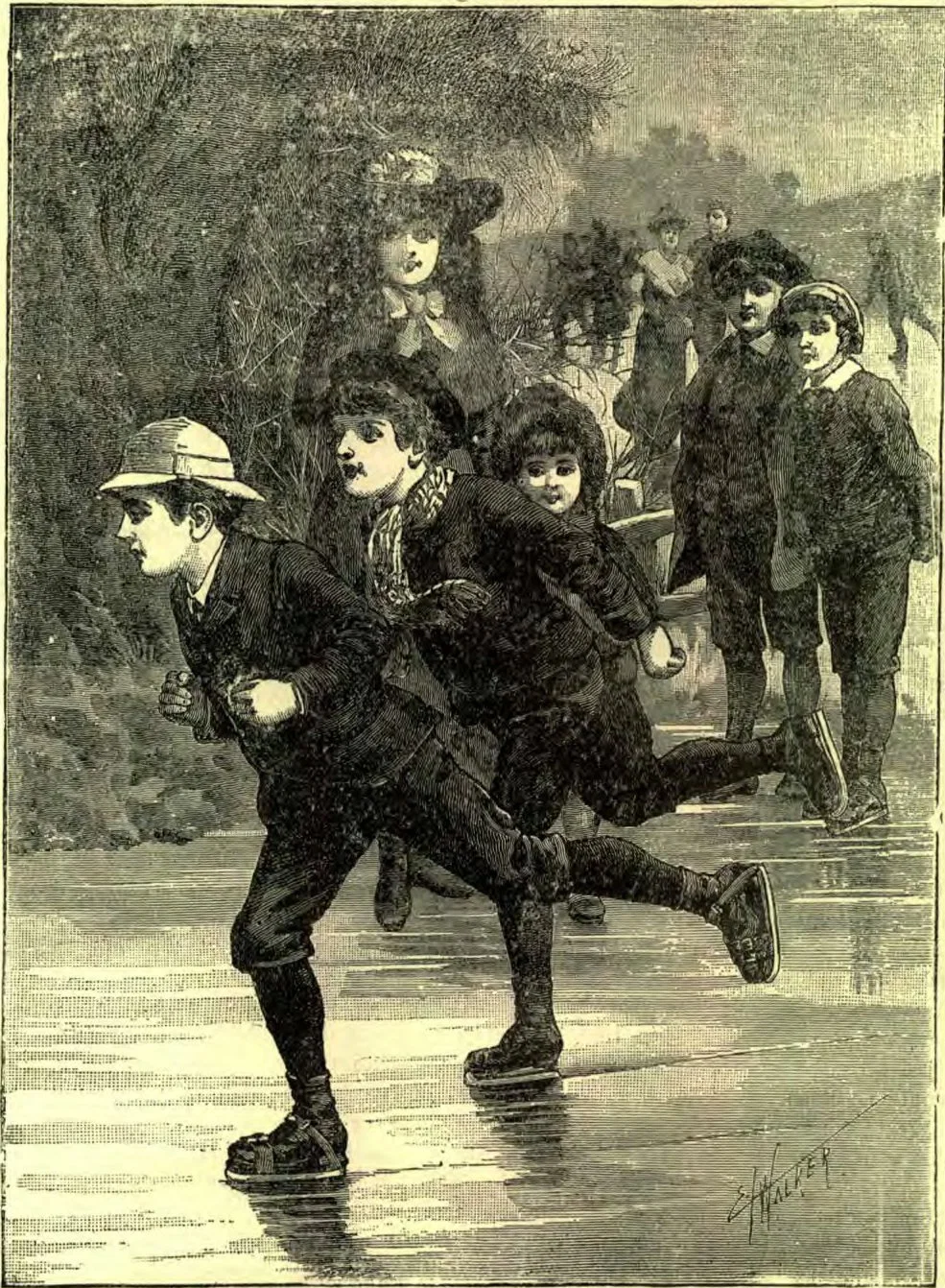
WINTER JOYS
“O, I know,” said Annette; “they were the animals going into the ark,” and she looked expectantly at grandma; for she began to hope that she, too, might have a different story from either of the others.
“The story I will tell you,” said grandma, “is older than either of the others; for it is one of the very oldest stories we know. There was but one man to see the parade, and as all the beautiful creatures, large and small, passed by, he gave them names, and the names he called them by were so good that we are told that ‘whatsoever he called every living creature, that was the name thereof.’”
“I know that, too,” said Annette; “that was when Adam named the animals. O, I wish I could have seen one of those parades.”
“Well,” said grandma, “I don’t know whether we shall ever see such a parade, but there is a time coming when ‘the wolf also shall dwell with the lamb, and the leopard shall lie down with the kid; and the calf and the young lion and the fatling together; and a little child shall lead them;’ and I trust my little Annette may see that sight.”
AUNT BETTY.
Some Mysteries of History
Perkin Warbeck
THE little Princes in the Tower — what a pathetic tragedy was theirs, as we look at it across the centuries! No wonder that, when the two royal children disappeared from their rooms in the Tower, there were many followers of the House of York who still hoped against hope that these Babes in the Wood had somehow escaped their wicked uncle, the terrible hunchback Richard, and might be in hiding somewhere, ready to come back when it was safe to appear. The only thing known about their fate was the brief announcement, by Richard, in 1483, that they were dead. But there had been no funeral, no date of death given, even; and for ten years no one could say, authoritatively, what had really become of the sons of King Edward the Fourth after the Tower gates had closed upon the royal lads.
Meanwhile, England was at peace again, after the long agonies of the Wars of the Roses. King Richard the hunchback was dead long ago — slain on Bosworth Field. His conqueror, Henry Tudor, had married King Edward’s only known surviving child, the Princess Elizabeth, and was reigning as Henry the Seventh. It was well understood that he was not searching for his young brothers-in-law, nor did he propose to yield the crown to them if they appeared and claimed it. It was, therefore, not altogether safe, even now, for any claimant to come forward. Yet, in the same year that the caravels of Columbus crossed the Atlantic, a handsome, golden-haired youth, resembling the royal House of York most astonishingly, came to Ireland from the Low Countries,6and proclaimed himself to be Richard, Duke of York, the younger of the two Princes in the Tower.
He wrote letters to the Earls of Desmond and Kildare, great Irish nobles of that day; and, later in 1492, Desmond himself wrote a letter to King James of Scotland, setting forth the claims of the young prince, and forwarding a statement from him, to this effect:—
Young Perkin Warbeck (for so he had been known thus far) was the younger son of King Edward. His brother and he, boys of thirteen and eleven, had indeed been doomed to death in the Tower by Richard the Third. The murderers had killed Edward the Fifth (poor, helpless little king, whose title was but a fatal mockery!), but the one who was told off to kill the younger boy was moved with pity at his childish pleading, and not only spared his life, but smuggled him out of the Tower, and sent him abroad secretly, to friends in the Low Countries. Little Richard, in return, made a solemn promise that he would not reveal who he was for eight years. During these eight years, he had wandered in various countries, under the name of Perkin Warbeck. He had been in the service of an English noblewoman, a Portuguese knight, and a Breton merchant, and it was on business for the latter that he had come into Ireland, where so many had recognized him as the true heir of the House of York that he felt the time had come to avow his identity and assert his rightful claim to the throne of England.
“The news,” says an old historian, “hereof came blazing and thundering over into England that the Duke of York was sure alive.” It also went abroad in France and Flanders. The Duchess Margaret of Burgundy, sister of Edward the Fourth, had lately made a very bad blunder by believing the claim of a lad named Lambert Simnel, a flagrant impostor, to be the little Duke of York. However, she was still hoping to find her lost nephews, and so, by her influence, succeeded in inducing King Charles the Eighth of France to invite the new pretender to court. When the young Perkin arrived in France, his claims were received without doubt; Charles assigned him a magnificent suite of apartments, settled a princely pension upon him, and gave him a special guard, and other marks of royal honor. Some prominent nobles of the Yorkist party came over from England to see the young Plantagenet. Sir George Nevil, Sir John Taylor, and above a hundred of the lesser gentry attached themselves warmly to his cause, and he began to have a court of his own about him. He bore himself, all agreed, with great dignity, and had a personal fascination which strongly recalled that of Edward the Fourth, whom he also, by common report, resembled most strikingly.
France and England were at this time at war. Henry the Seventh was the craftiest and wisest king of his time, and he thought the situation was too dangerous to continue. So he made peace at once with France, but asked, as one of the conditions, that Perkin Warbeck should be given into his hands. To the honor of Charles the Eighth, he refused to do this, but warned the youth to leave his court, as he could no longer protect him. Perkin accordingly sent word to the Duchess of Burgundy, asking her to receive him in Flanders.
Just here comes in a contradiction—the first one of the many which we find in the story. Some historians say that Margaret, having been deceived by Lambert Simnel, would not receive this new pretender until she had thoroughly sifted his claims, and that he convinced her, against her will, of his identity. Others say that she was so anxious to support his claim—any claim against Henry the Seventh, in fact, whom she hated—that she sent for him, and instructed him in his part, teaching him many details which he did not know. When we learn, however (even from those who do not believe that Perkin was the Duke of York), that Margaret had not been in England for forty-five years, and had really seen nothing of her brother’s family, it is hard to see what she could have taught any one about the details of the youth of the little duke. Besides, Perkin, before meeting her, had already convinced Scotland, Ireland, France, and many of the most close and familiar adherents of the House of York, that he was the true prince. He and his little court, at any rate, now removed to the Low Countries, where the Duchess of Burgundy, the Archduke Philip, and the Emperor Maximilian all backed his claim, and acknowledged him as royal. The Duchess gave him the title of “The White Rose of England,” and his “gracious and princely behavior” won all hearts.
Henry the Seventh became a good deal disturbed over the matter. He demanded the surrender of the pretender into his hands, but the Archduke Philip refused. Then Henry banished all Flemings from England, and laid a strict embargo upon Flanders goods. He executed several English nobles for plots in favor of Perkin, and thus “did extremely quail the design of Perkin and his complices.” But the Duchess of Burgundy, at the same time, was writing to Ferdinand and Isabella of Spain, and to the pope himself, and getting encouragement all round. An invasion was planned, backed by Philip and Maximilian, and on July the third, 1495, the Plantagenet pretender and his little army landed on the coast of Kent.
There is no doubt that he expected all England to rise in his behalf. But the Wars of the Roses had done their work. No such bloody, useless, and exhausting wars had ever been known in England. When they ended, the great barons were all destroyed, and, indeed, the whole nobility reduced to a mere handful. There were left only the monarchy and the people; and the people were so exhausted by war that they wanted only peace, and would not have risen for anybody, no matter what his claim or his charm. Besides this, Henry had caused to be published everywhere a statement concerning the two Princes in the Tower, purporting to be the confession of Tyrrel and Dighton, the two murderers hired by Richard the Third to kill his little nephews. The real examinations of Tyrrel and Dighton, however, were not given out, even to the king’s council, “the matter being left somewhat perplexed,” and Tyrrel was disposed of by being beheaded for treason. Dighton, “who, it seemeth, spake best for the king, was forthwith set at liberty,” and told to spread his statements everywhere.
This revised version was, that Brackenbury, keeper of the Tower, had refused to murder the princes; that one night he had been removed, and Tyrrel put in power in his stead; that the children, by Tyrrel’s command, had been smothered in bed, and that their dead bodies had been seen by Tyrrel and Dighton afterward, and had been buried under the stairs. When King Richard, however, was told where his nephews had been buried, he said, “It was too base a place for them that had been king’s children.” So the little bodies, by the king’s warrant, were taken up by the “priest of the Tower,” and buried again by this priest in some unknown place. The priest and King Richard both being dead, this place could not be found; but there was no doubt that the little princes were both dead. This was Dighton’s story; and as the young Queen Elizabeth and the queen-mother, Elizabeth Woodville, showed no belief in Perkin Warbeck’s claim, the people of England refused to believe it, either, and the men of Kent, so far from rising and joining him when he landed, drove his followers back to the ships, after capturing eighty of them. The pretender weighed anchor at once, and sailed for Ireland, where he besieged Waterford and failed again. Then he took his little fleet and army to Scotland, and there he found welcome, friends, and a wife.
James of Scotland evidently believed thoroughly in the last heir of the Plantagenets. He made tournaments for him, helped him invade England, and gave him the beautiful Catherine Gordon, his own kinswoman, to wife. Henry of England employed spies in Scotland, and tried to seize Perkin, but did not succeed. The young pretender seems to have been of a merciful, as well as a gracious, disposition. When James raided English villages and plundered the peasants, Perkin “entreated him not to thus afflict his people.” If he were not the Duke of York, he certainly showed every characteristic of a kingly nature, and James of Scotland admired him greatly. He remained in Scotland until 1497, but now his romantic career was drawing to a close.
From Scotland, after an ineffectual invasion of the northern counties, Perkin went back to Ireland, and thence to Cornwall, where he gave battle to Henry at Taunton, with some seven thousand men at his back. The battle went against him, and he fled for sanctuary to Beaulieu, where he was besieged, and at last, on a solemn promise of pardon from the king, surrendered. He was at this time but twenty-five years old, but his days of liberty and life were well-nigh over. His “confession” was proclaimed everywhere, by order of the king, but this printed paper (setting forth that he was not the Duke of York, but the son of John Osbeck, of Tournay) was so confused and unsatisfactory that “men were in more doubt than before.” Before long, Perkin, though kept under guard, found means to escape, and it was believed that Henry was only too glad to have this excuse for more severity when he was recaptured. This time he went to the Tower, where Richard of Warwick, son of Clarence Plantagenet, was also confined. The two became great friends; and both of them won the favor and kindness of the keepers to such a degree that a plot was formed for their escape. It is charged by many historians that Henry the Seventh actually allowed and encouraged this plot, so that he might, by its discovery, get rid of the two last scions of the family of York, and clear the way for his own son Arthur’s marriage with Catherine of Spain, whose father would not permit her to marry the heir of Henry until the Tudor succession was thus absolutely established. We can believe anything of Henry the Seventh in the line of policy and treachery; and certain it is that he seized his chance, when the plot was revealed, to send both Warwick and the pretender to the block. In 1499 both were beheaded by order of the king, after Perkin’s confession had been repeated, and thus ended the short career of Perkin Warbeck.
But his mystery survived. King James of Scotland, to the end of his life, upheld that he was no pretender, but the true Duke of York. Catherine, his wife, had the same absolute belief in him, and the Duchess of Burgundy and the king of France never changed their opinion that he was the real heir of the English crown. Historians have taken sides for and against ever since. Bailey, in his interesting history of the Tower, upholds Perkin Warbeck’s claim, and believes his confession to have been a fraud, or wrung from him by threats of torture. Walpole, in his “Historic Doubts,” sides with the young pretender. Yet the finding of the bones of two children under some stairs in the Tower, in Charles the Second’s reign, is a strong fact on the other side—although Tyrrel and Dighton’s testimony that the bodies had been removed from beneath the stairs seems to conflict, again, with this discovery. If Perkin Warbeck were not the Duke of York, who was he? Nobody (as in the case of Lambert Simnel) ever came forward to identify him, either before or after his death, which, if he were an impostor, would have been very likely to happen. This golden-haired, gracious, kingly mannered unknown moves across the page of English history a living mystery.
Would not the “White Rose of England” have made a better king than Henry the Eighth? It is an idle question, and yet it inevitably suggests itself as we read the story of the Princes in the Tower, and wonder whether little Richard really did escape the assassin only to die under the executioner’s ax at Tyburn.—The Well Spring.
A Word
By Benjamin B. Keech
If you have a word to speak,
That will pale a gentle cheek,
Wound a tender spirit meek,
Oh, do not say it!
'Tis a trifle small, and yet
It is hard to quite forget;
And you'll surely know regret
If you say it.
If you have a word to say
That will drive a tear away,
Go and say it now, to-day,
Lest you forget it;
For a word quite often may
Keep unhappiness at bay,—
Pride and scorn and anger slay;
Oh, don't forget it.
MEMORY VERSE: “Rejoice not when thine enemy falleth.” Prov. 24: 17.
While David was in the wilderness, fleeing from Saul, Samuel died. The children of Israel mourned for him greatly. They had plenty of opportunity to see how much better was their condition when guided by the prophet of the Lord than when ruled by the king they had chosen.
Even Saul, who during Samuel’s life had not heeded his words, felt less safe after his death. When the Philistines gathered together in battle to fight against Israel, Saul was afraid, and his heart trembled. In his distress he did a thing that God had expressly forbidden. He tried to consult the spirit of the dead prophet, to find out if God would give him the victory.
“The dead know not anything, . . . neither have they any more a portion forever in anything that is done under the sun.” They sleep in the dust until the coming of the Lord. Evil spirits sometimes take the form of the dead, and come with messages to the living. All dealing with the supposed spirits of the dead is really dealing with devils. So God said that the people who did this were to be cut off out of the land. Lev. 20: 6; 19: 31.
Saul had himself put away the witches and wizards from his kingdom. 1 Sam. 28: 3. But now that the Lord had departed from him, he turned for help to evil spirits. He went to a witch at Endor, and she gave him a message which was supposed to come from Samuel, telling him that he and his sons would be slain, and Israel given into the hands of the Philistines. The effect of this upon Saul was just what Satan wished it to be. Hope was driven from his heart. All his strength and courage left him, and he became weak and helpless. One who is discouraged is already defeated, and so on the next day the Philistines gained an easy victory over the Israelites.
Jonathan had stood faithfully by the side of his father all through the troubled years of his reign. Much as he loved David, and believed in him as the future king of Israel, hoping to be next unto him, he would not desert Saul. He was with his father in this last battle with the Philistines, and was slain, with his two brothers, Abinadab and Malchishua.
Saul took his own life, in order to escape being slain by the Philistines. The next day, when the Philistines were robbing the bodies of the slain, they found Saul and his three sons. They cut off their heads, and fastened their bodies to the wall of Beth-shan. The tidings of their death was sent into all the land of the Philistines, unto the house of their idols, and to the people. At the beginning of his reign, Saul had befriended the men of Jabesh-Gilead and delivered them from the Ammonites. And now, in return for his kindness, they took the bodies of Saul and his sons from the wall of Beth-shan, and buried them.
A young man took Saul’s crown and bracelet, and carried them to David with the news of Saul’s death. Thinking that David would rejoice at the death of his enemy, and give him a rich reward, he lied to David, boasting of having slain Saul with his own hand.
But “David took hold on his clothes, and rent them; and likewise all the men that were with him: and they mourned, and wept, and fasted until even, for Saul, and for Jonathan his son, and for the people of the Lord, and for the house of Israel; because they were fallen by the sword.”
The young man who, according to his own story, had dared to put forth his hand and slay the anointed of the Lord, had his own life taken.
In a beautiful song called “The Song of the Bow,” which David commanded to be taught to the children of Judah, he lamented over Saul and Jonathan.
“Saul and Jonathan were lovely and pleasant in
their lives,
And in their death they were not divided;
They were swifter than eagles,
They were stronger than lions.
Ye daughters of Israel, weep over Saul,
Who clothed you in scarlet delicately,
Who put ornaments of gold upon your apparel.
How are the mighty fallen in the midst of the
battle!
Jonathan is slain upon thy high places.
I am distressed for thee, my brother Jonathan:
Very pleasant hast thou been unto me:
Thy love to me was wonderful,
Passing the love of women,
How are the mighty fallen,
And the weapons of war perished!”
Questions
1. When the Philistines came against him, whom did Saul consult? What had God forbidden his people to do? Deut. 18: 9-12. What had Saul done with the witches and wizards?
2. Can the dead tell us anything? Eccl. 9: 5. Who communicates with those who seek knowledge from the dead?
3. Whom did Saul wish to have brought up? What message came to him? What was Satan trying to do to Saul? How did he feel after this?
4. Who gained the victory in the battle? Who were among those slain by the Philistines? When Saul saw that he could not escape, what did he do?
5. Did the Philistines know that Saul and his sons were slain? How did they find out? How did they show their joy?
6. What was done with the bodies of Saul and his sons? Who rescued and buried them? What had Saul done for the men of Jabesh-Gilead?
7. Who carried news of the battle to David? What did he take him? What story did he tell of Saul’s death?
8. How did David show his forgiving nature? Did he reward the man whom he thought slew Saul? What was his punishment?
9. How did David commemorate the death of Saul and Jonathan? What was his song called? What did he command concerning it?
XII — The Third Angel's Message— The Closing Conflict
(December 19)
MEMORY TEXT: “And I saw as it were a sea of glass mingled with fire: and them that had gotten the victory over the beast, and over his image, and over his mark, and over the number of his name, stand on the sea of glass, having the harps of God.” Rev. 15: 2.
Questions
1. What message followed that of the first and second angels? Rev. 14: 9-11.
2. Against what worship is this message a warning? Verse 9.
4. What have we already learned that the papacy holds up as the mark of its authority? See note .
5. What authority was given to this beast? Rev. 13: 7.
6. What class only refrained from worshiping the beast? Verse 8.
7. What new earthly power arises at this time? Verse 11; see note .
8. What power does it exercise? Verse 12.
9. What does it require those that dwell on the earth to do? Verse 14.
10. After the image has been made, what power is given to it? Verses 15, 16.
11. What warning does the third angel raise against this worship? Rev. 14: 9-11.
12. How are the saints described at this time? Verse 12.
13. What do they keep in contrast with those who receive the mark of the beast? Rev. 14: 12.
14. Upon what commandment is there a reform in the last days? Note .
15. Then against what is the third angel's message a warning?
Meeting Life's Vexations With Inner Strength
“If you let yourself be upset by the little vexations and perplexities from which no life is free, you are acknowledging that they are bigger than you are. There should be enough of inner strength to meet with serenity all that comes—the great crisis of life, and its little worries as well. You should be greater than all of them together.”
Two Kinds of Ambition
THERE was once a young man who desired to be king. He was a king’s son, and dearly beloved by his father. Everything that the king could do for his son, to make him wise and happy, had been done. In all the land there was none so much praised for his beauty as this young man; “from the sole of his foot to the crown of his head, there was no blemish in him.”
But an unworthy ambition filled the heart of the prince. Beneath its fierce heat his love for his father withered and died. He wanted to be king! But the king was honored and greatly beloved — how could the prince take the kingdom? He knew that if he should try to gain a following, no one would listen to him. So he went out very early every morning, and sat by the gate of the city. When a stranger came in, the prince ran to meet him, and shook hands with him, and kissed him, and asked from what city he had come. And when, as was often the case, the stranger had come to the capital to have some dispute or quarrel settled before the king, the young man said that his cause was just, but there was no one deputed by the king to hear. And then he would add, “O, that I were made judge in the land, that every man which hath any suit or cause might come to me, and I would do him justice!”
All this had just the effect that the prince had hoped. For a long time he made himself friendly, and instilled into the hearts of his father’s subjects the idea that the king was not doing all he ought to do for them, and that he, the prince, would do a great deal more and a great deal better. Thus he “stole the hearts” of the men of that kingdom.
At last the time came when he dared seize the crown. With a lie on his lips, he gained his father’s permission to go to a town a few miles away, and here he had himself proclaimed king. But his reign came to an abrupt end; and the young prince, who, in the days of his ambition, had had a graceful pillar reared up to keep his memory alive, suffered a shameful death, and was buried in a pit covered with stones.
The danger of ambition has had many illustrations in these days — days a long way removed, in point of time, from those of the beautiful prince with the wicked heart. Especially is there often seen a desire on the part of the young and the inexperienced to fill some higher place than that which they occupy before they are qualified to fill it worthily. Not long ago a young pilot, only a boy in years, and not any older in experience, received his first commission. He was to take one of the largest ocean steamers out of the New York harbor — and it was a foggy day. Agitated and anxious, he succeeded in passing the most difficult points in the channel, and yet ran the steamer fast aground within sight of Sandy Hook.
Thus this young man’s career, which promised well, is perhaps ruined — for no one will care to trust him with another steamer in that harbor. He thought he was fit for the responsibility, but he was not, as the event proved.
“Getting on slowly” need not trouble any one, if he knows in his inner consciousness that he is surely making progress. Of course between the person who settles down in one place, content to rise no higher, and the one who rushes ahead into responsibilities that he is not fit to assume, there is little choice — except that the former is likely to injure only himself, while the other may become responsible for the lives of others.
The ambition that is “an eager desire to gain power or distinction or fame or wealth,” is as different as possible from the ambition that is a “steadfast purpose to achieve something commendable.” The former ends oftenest in failure — the “failures that promised well;” the latter brings success of the highest character.
Our Annual Offering
By E. H.
Will easily reach the fifty-thousand-dollar mark, if every one deliberately and prayerfully plans to do more this year than he did last year. And is this not reasonable? The message has made most rapid strides during 1903. God has dealt with his people in a marvelous manner. By his judgments and by his reproofs and his counsel, he has led them in a plain path. No one who has kept pace with the movements of this year can fail to discern his hand. True, right among us there are occurrences that would make it appear that the Lord’s coming is to be long delayed. But these very experiences are evidences that the end is at hand, and are only additional signs to strengthen our faith in the early advent. All these things indicate the need of our greater consecration to God’s closing work.
We are not able to discern with the finite eye the rapidity with which God’s work in the earth is moving. But the eye of faith sees in the events that are taking place the end of all things; the testing time for God’s people; the time of shaking, when many who have lost their hold on the Lord and his work will be shaken out; the time described by the prophet when those true to God will be found humbly seeking him, and laying all at his feet for service. Then is it not reasonable to expect 1903 to close with the largest gift to missions that we have ever recorded, and that this will be but an earnest of what we shall do during 1904? What say our young people? We should come to the front in these closing hours. May we begin by making a thank-offering for 1903, according to our ability, proportionate to the blessings that have been ours this year. If we do, the young people alone may be the factor that will bring the annual offering of 1903 up to fifty thousand dollars. E. H.
“I Will Help Thee”
By H. H. Hall
THE blessed promise, “Fear not, I will help thee,” was certainly valuable to a sister with whom I talked last Sabbath.
She said: “When Brother Gilbert was here, he asked how many of us would go out and help sell the Signs of the Times. Not many seemed willing to go, so I thought I would at least show my willingness to try, although I knew I could not sell them; for no one hates to ask favors of people more than I. No one was more surprised over my success than I have been.”
This young woman is now selling fifty copies of the Signs each Saturday night on the streets and in the stores of Kansas City, Missouri. How is it with you? Does the Lord ask you through this experience to-day to do a similar work for him? The promise, “Fear not, I will be with thee,” is just as true for you as it was to this young lady.
H. H. HALL.
A Rare Opportunity for Service
By Editor
WE have reached the time of year when the evenings are long, and multitudes will devote time to reading. It is our privilege to supply many of them with our books. Thousands of our smaller books, such as contain present truth for this time, can be sold.
Within a few weeks many books will be presented to friends as holiday gifts. An excellent book for this purpose, and one that forcibly presents the message, is that recently issued by the Review and Herald, “Our Paradise Home.” It presents in a brief, expressive, earnest manner the plan of salvation, from paradise lost to paradise regained. Though it is not yet four months old, nearly thirty thousand copies have been sold, and many hearts have been cheered and warmed with the reading of its thrilling truths.
Many of our brethren, sisters, youth, and children should sell this messenger of truth by thousands. It can be used by our canvassers as a help when selling larger volumes. Who will engage in the work immediately? Can not you sell and deliver a large number before Christmas? If you desire to make a holiday present, this little book will make a valuable one.
It is a subscription book, and gives a good discount to agents. It is finely illustrated with original engravings. Two bindings. Cloth, 50 cents. Board, 25 cents. Address your State tract society.
At the Door
A NEW, profusely illustrated booklet, containing forty-five impressive engravings illustrating in consecutive order the fulfilment of every prophecy in Matthew 24, Mark 13, and Luke 21. Each picture is accompanied by the verse of Scripture which it illustrates. In this way the whole story of Christ’s second coming is made very attractive in appearance and impressive in fact.
The entire booklet is devoted to the proclaiming of the coming of the King of kings, in the words of the Saviour himself, and each prophecy uttered is illustrated as fulfilled.
It is an excellent little seller, and ought to have a large circulation. Any person can handle it.
It is printed in beautiful photo-brown ink, in attractive covers, the best style being heavy paper covers, with beautiful enameled designs, and bound with silk cord. Prices, 15 and 25 cents.