The Youth’s Instructor, Vol. 47, No. 49.

THE EMPIRE OF BABYLON

The Youth’s Instructor

Dec 14, 1899

Review and Herald Publishing Company · Battle Creek, Mich. · Dec 14, 1899

THE EMPIRE OF BABYLON

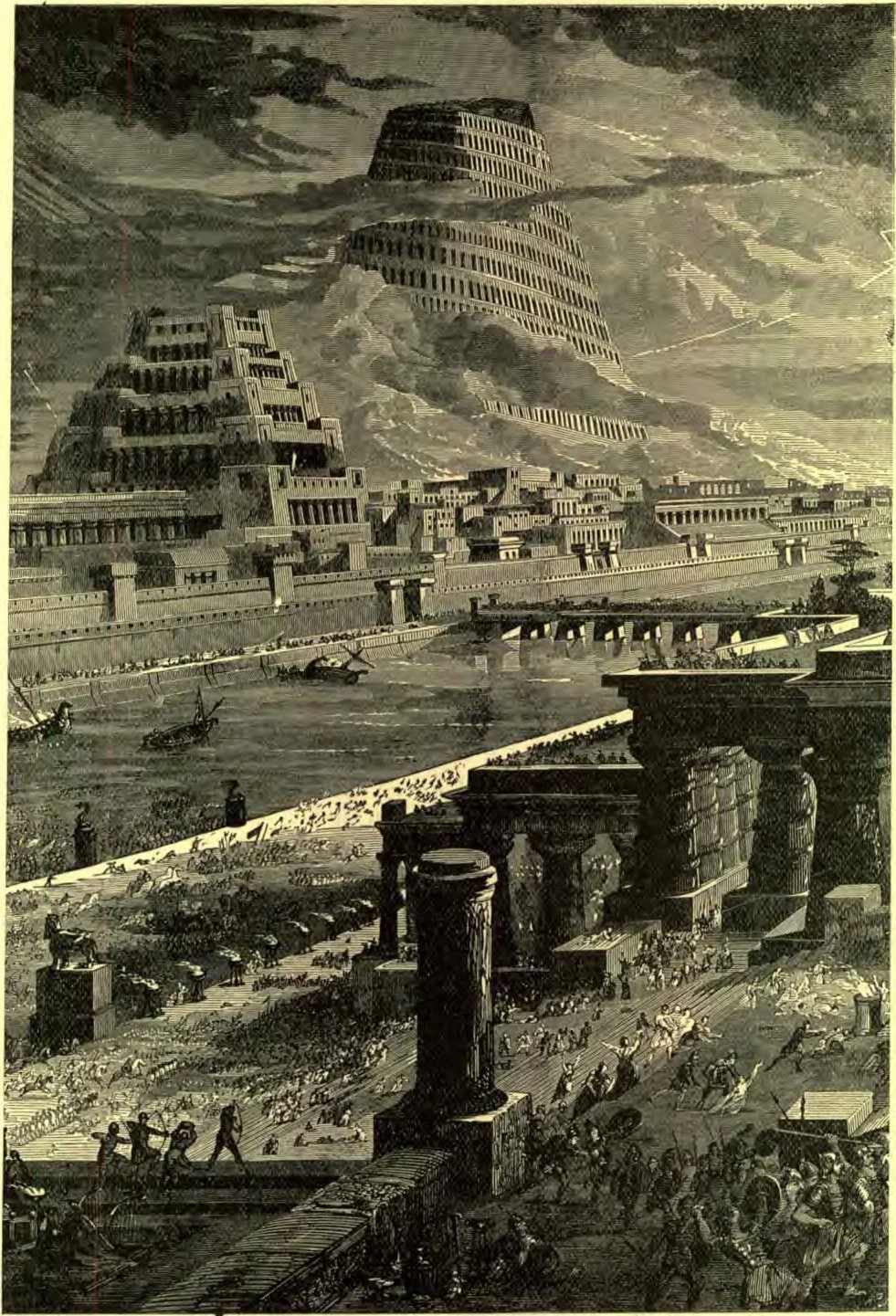
THE region of country known as “Babylonia” is identical with that of ancient Chaldea, being the alluvial tract between the rivers Tigris and Euphrates. Across the Tigris the country is no longer Babylon, but Susiana, known to the Jews as Elam; and therefore ancient Babylon was composed of the two great alluvial plains, one containing eighteen thousand, and the other nine thousand, square miles, or, in the time of Nebuchadnezzar, a region of twenty-seven thousand square miles. The Babylon of the Scriptures, however, includes, in addition, Susiana, or Elam, and on up the Euphrates to at least the city of Carchemish, westward to the Mediterranean, and southward perhaps to Egypt. The early history of Babylon, the capital of the empire, is so shrouded in uncertainty, and even mystery, that most that relates to it seems doubtful and problematical. The period when it became the capital of the nation was during what Rawlinson calls the “fourth monarchy.” Tradition insists that it was the largest and most magnificent city of the ancient world. Nineveh, which preceded it, was of even surpassing splendor, yet its circuit did not exceed three miles by about one and one-half miles,—an extent of territory not larger than that of thousands of small towns today.
The Babylonians were emphatically traders and merchants, navigating the Persian Gulf, and trading with Arabia, India, and Western Asia, traders coming down the tributary rivers. The main body of the people were, however, agriculturists, as the plains of Babylon were then the granaries of the world. The soil was rich, producing wheat, barley, and millet in abundance. Herodotus claims a yield of two, and even three, hundredfold, with wheat and barley plants often four fingers in breadth. The date, however, was the staff of life; and the dried fruit was regarded as the bread of the people, many of the poorer classes subsisting entirely upon dates and goats’ milk. The cultivation of the date was universal, and date groves dotted the landscape in all directions. Fish abounded in the marshy districts of the south, and many found remunerative employment in catching and drying them. The dried fish were pressed through a sieve, and made into cakes, or bread.
The government of the Babylonian Empire was similar to the Assyrian,—a loose organization of provinces, under native kings,—and, like Assyria, it failed to win the affection of the subject-nations because of its policy of exhausting and oppressing the conquered races. In time of peril the subject-nations often became a menace instead of a help, sometimes even taking sides with the enemy.
The religion of the Babylonians was identical with that of their predecessors, the Chaldeans,—polytheism, or plurality of gods, mainly astral, the sun, moon, stars, and planets being worshiped. The chief objects of worship were the gods Bel, Merodach, and Nebo, the first two being peculiarly the gods of the city of Babylon. In the temple of Bel at Babylon, as well as in temples in other cities, a great festival was held once a year. Numerous victims were sacrificed, and it was customary to burn a thousand pounds of frankincense on the great altar.
In civilization the Babylonians were originators, not imitators of other nations. They invented an alphabet; figured out the simple rules of arithmetic; invented instruments to record time; discovered the art of polishing, boring, and engraving gems; became passable sculptors, astronomers, and grammarians; elaborated a systematized code of laws; attempted an exact chronology; and made rapid progress in all sciences.
The luxurious living of the Babylonians is a matter of comment by all writers. They were brave and skillful in war, though cruel and savage in disposition. They were proud, passionate, and unprincipled, yet, strange to say, they taught and cultivated the practice of two virtues—honesty and calmness. “While rage boiled in their hearts, and commands to torture and destroy fell from their lips, etiquette may have required that the countenance should be unmoved, the eye serene, the voice low and gentle.” Their practice of honesty in deal won for them the trade of the world; but true honesty, aside from policy, and real gentleness, “were certainly not the attributes of a people who were so fierce in their wars and so cruel in their punishments.” W. S. CHAPMAN.
BABYLON TAKEN BY CYRUS.

THE FIELD

DECEMBER STUDY: PART III

(December 17-23)
1. The Basis of Study.—Read “Jamaican Houses of Worship,” “Our Work in Skagway, Alaska,” and “Openings in Cuba,” pages 477, 484, and 486 of the Missionary Magazine for November. Questions on these articles will be found in the December Magazine, and in the Review and Herald of December 12.
2. First Efforts in Jamaica.—The first Sabbath-keepers in Jamaica received the message through literature furnished by the International Tract Society. This work was followed by the canvasser. About six years ago ministerial labor was begun. A report at the beginning of this year showed six organized churches, with a membership of three hundred and thirty-three; sixteen companies, aggregating one hundred and sixty-nine members, all of whom had been baptized; and about one hundred more keeping the Sabbath. The Sabbath-school membership was six hundred and forty-six. Since that time a number have accepted the truth. And yet our work here is only begun. A recent letter from one of the ministers says that they now have all the work the present force of laborers should carry. Reinforcements will soon be called for.
3. More Houses of Worship (Missionary Magazine, page 477).—The demand for houses of worship in Jamaica still continues. A recent report announces seven chapels on this island in different stages of erection.
4. Alaska a Mission Field (Missionary Magazine, page 486).—The field for spiritual work in Alaska is boundless; for in addition to the natives, upward of one hundred thousand white men have recently gone into this country. The work of William Duncan, who began labor there more than forty years ago, is an illustration of what may be accomplished for the natives of Alaska. In its beginning his work was among cannibals, from whom his life was in constant danger. In a few years, however, he had won the respect and love of many, and through the power of God had seen the ferocious savages transformed into quiet, earnest Christians. A neat village had been established, with well-built houses, sidewalks, regularly laid out streets, a school, store, saw-mill, salmon cannery, and a fine church, seating over a thousand persons,—all built by the Indians themselves. Six years after his work began, over fifty Indians had been baptized. All this from the efforts of one man, who went to Alaska not as a missionary, but in the capacity of a clerk.
5. Women of Alaska.—The life of the Alaskan women is very hard. They do all the work and drudgery. The men hunt when hunger compels. When a man has been out on the ice and killed a seal, he does not carry it home, but marks the place; and when he gets back to the village, the woman must find it, drag it home over the rough ice, and skin it. When a man and his wife are traveling, she does most of the running ahead of the team; and when they reach the camp at night, she has to make the fire; cook the meal, if they have one; take her husband’s boots off, and dry them, as well as her own; and then get ready for the start in the morning. Yet she does all this without complaint. What the gospel will do for these women is illustrated by the remarkable results achieved where missions have been opened. This field, white to the harvest, is open to us, though as yet it is unentered by any organized effort to teach the third angel’s message.
6. Cuba, the “Pearl of the Antilles,” is beautiful for situation. The coast-line of this thin crescent, if all indentations were included, would equal seven thousand miles. If the island were laid down with Cape Maisi, the eastern extremity, at Sandy Hook, Cape San Antonio, at the west, would be in the vicinity of Chicago. Its area is about equal to that of Pennsylvania. Its population, at the beginning of the war, was estimated at 1,631,687, of whom only about one million now survive. How many have gone down into Christless graves?
7. Missionary Efforts in Cuba.—In a few months a year will have passed since the American flag was raised over the public buildings throughout Cuba. During all this time there has existed in the island the American guaranty of absolute religious freedom and sure protection for every minister, with other measures calculated to make for peace, prosperity, and pure conditions among the people. There has been an open door for Christian missions, and yet the sum total of endeavors in American missionary work thus far is beggarly in amount and disappointing in character. That these people are susceptible to gospel truth has been shown by the results of the labors of Mr. Diaz, who in eleven years baptized three thousand persons, and this largely while they were under the rule of Spain.
8. Cuba’s Orphans (Missionary Magazine, page 488).—One result of the terrible war in Cuba is the fifty thousand destitute orphan children of reconcentrados, who have in the last few years died from starvation and want. These children are scattered in every town and village which was of sufficient size and importance to receive the driven-out country people. They are not children of low or doubtful origin; many are of the best families, as the reconcentrados were largely the country people of property—farmers and small planters. Being driven into the towns, the fathers were killed or joined the army, and the mothers died from suffering and starvation. Scarcely an orphan child but represents the sacrifice of a heroic mother. Where there was but little food, the mother went without and died; but the little ones ate and lived. These little tots have had to get their food as they could, and shelter themselves in war-wrecked buildings and in caves. Many of the towns contain from thirty to seventy-five, and even as many as one hundred, of these children. The American National Red Cross Society has recently begun an organized effort for them, which will tell on the future of Cuba. It being impossible to form large asylums in the cities, the children are gathered up where they are, in small asylums of the simplest and plainest kind. The Cubans are much interested in this movement, and are rendering most valuable assistance. At another time we may describe one of these little orphanages. This work certainly presents an open field for the young who would engage in missionary work.

BEREAN LIBRARY STUDY

“Thoughts on Daniel,” pages 41-56. Dan. 2:31-39
The regular Outline of this study is published in the Review and Herald and also in the Missionary Magazine. What is here given is only supplementary, and should be studied in connection with the Outline.

NOTES ON LESSON 3

(December 17-23)
1. A Fascinating Study.—There is a charm in the study of prophecy and its fulfillment in history, which is irresistible to the earnest seeker after truth. Faith in the absolute sureness of every word of God grows perceptibly stronger as each prophetic lesson is learned and appreciated.
2. Details Foretold.—Over a hundred years before the prophecy concerning Babylon was revealed to Daniel, the prophet Isaiah had foretold some of the details of its overthrow. If read in connection with the description of the taking of the city, as given in “Thoughts on Daniel,” the three points given below are of special interest:—
(a) The name of the country that should overthrow Babylon. Isa. 13:1, 17.
(b) The name of the general commanding the armies, and the mention of the gates of the city. Isa. 45:1, 2.
(c) The complete destruction and final desolation of the city. Isa. 13:19-22; 14:22, 23.
3. The Two-Leaved Gates.—The walls of Babylon extended around the city in the form of a square, fifteen miles on a side. On each side of the square were twenty-five gates of solid brass, a hundred in all. These gates were so heavy that it is said to have taken twenty men to open and close one of them. A branch of the Euphrates River flowed through the city from north to south, and on each side of the river were walls, the same as around the city. Where the streets crossed the river, there were also gates of brass, and from them were steps leading to the river, for the convenience of the inhabitants, who passed from one side to the other in boats. These gates were always locked at night. One historian says that in the center of the city was a “two-leaved” gate, which was built in such a way as to serve as a bridge during the day, and at night was let down and locked, thus effectually barring all entrance to the city by means of the river.
4. Why Called “the Great”?—Doubtless many will recall the childish inquiry which formed a lesson in one of the old school readers, beginning thus:—
“How big was Alexander, pa, That people call him great? Was he like old Goliath, tall, His spear a hundredweight? Was he so large that he could stand Like some tall steeple high; And while his feet were on the ground, His hands could touch the sky?”
After reading the brief description of the closing scenes in the life of Alexander the Great, in this week’s lesson, it seems fitting to ask, Why was he called great?
5. Punishing the River.—The foolishness of great men is aptly illustrated by an act of Cyrus, also called “the Great,” while on his way to subdue Babylon. The main army was preceded by the sun-car of Ormazd, a heathen god, drawn by white horses, and having in it fire supposed to have been kindled from heaven. In crossing the River Gyndes, one of the horses that drew the chariot of the sun was drowned. The Persian king thereupon ordered a halt, and spent most of the summer and fall in punishing the river, which he did by scattering its waters through three hundred and sixty channels into the desert.
6. “Never before Saw the Earth a City like That; Never Since Has It Seen Its Equal.”—But God had said that Babylon should fall, and when the time came, his word was fulfilled. A single line of prophecy is more powerful than stone walls, gates of brass, or the combined armies of the earth. The following description of the fall of Babylon, by Ridpath, answers completely to the specifications of the prophecy: “The Babylonians, in contempt of an enemy whom they supposed to be foiled in his purpose, made unusual preparations for the great feast. The young prince, Belshazzar, gave himself up recklessly to the occasion. A thousand nobles were invited to a royal banquet at the palace. There was splendor within and darkness without. It was the night of doom. While the revel was going on in the wild abandonment of victorious debauchery, the hardy Persian was opening the sluices into his canals above the city. The river began to sink, but made no moan. The invaders hurried along the banks to the wall of the city. There was no alarm. The river had left on each side a broad space of bare ground, and the Persians passed in without opposition. The noise of the festival resounded afar. The river-gates were seized by the invaders, who now sounded the tocsin and began the assault. It was a gigantic massacre. The drunken Babylonians fled in all directions. The prince Belshazzar and his nobles were slain at their banquet, and the dawn found the victorious Persian in complete possession of the city.
“It was the last act in the drama of the great empire. ‘The kingdom was given to the Medes and Persians.’ A new power had arisen, whose energies were still freshened with the breezes of the hills, and whose natural ambitions had not yet been quenched in the cups of luxury and lust. ‘The beauty of the Chaldees’ excellency’ faded like the shadow of a pageant from the great canvas of history, and the glory of Babylon began to hide itself under the dust and ruin of the ages.”

A MESSAGE TO THE YOUNG

1. Why is Satan trying to gain a controlling power over young people?
“I saw that Satan is a vigilant foe, intent upon his purpose of leading the youth to a course of action entirely contrary to that which God would approve. He well knows that there is no other class that can do as much good as young men and young women who are consecrated to God.”—“Testimonies for the Church,” Vol. I, page 511.
2. How valuable is the work that the youth might do?
“The youth, if right, could sway a mighty influence. Preachers, or laymen advanced in years, can not have one half the influence upon the young that the youth, devoted to God, can have upon their associates.”—Id.
3. Are all ready to begin this great work?
“I saw that many souls might be saved if the young were where they ought to be, devoted to God and to the truth; but they generally occupy a position where constant labor must be bestowed upon them, or they will become of the world themselves. They are a source of constant anxiety and heartache. Tears flow on their account, and agonizing prayers are wrung from the hearts of parents in their behalf. Yet they move on, reckless of the pain which their course of action causes.”—Id., page 512.
4. What kind of workers are needed?
“The Master calls for gospel workers. Who will respond? All who enter the army are not to be generals, captains, sergeants, or even corporals. All have not the care and responsibility of leaders. There is hard work of other kinds to be done. Some must dig trenches and build fortifications; some are to stand as sentinels, some to carry messages.”—“Gospel Workers,” page 206.
5. Upon whom does the success of the army depend?
“While there are but few officers, it requires many soldiers to form the rank and file of the army; and yet its success depends upon the fidelity of every soldier. One man's cowardice or treachery may bring disaster upon the entire army.”—Id.
6. In what sphere of life have many honored workers received their training?
“How many useful and honored workers in God's cause have received a training amid the humble duties of the most lowly positions in life. Moses was the prospective ruler of Egypt, but God could not take him from the king's court to do the work appointed him. Only when he had been for forty years a faithful shepherd was he sent to be the deliverer of his people. Gideon was taken from the threshing of wheat to be the instrument in the hands of God for delivering the armies of Israel. Elisha was called to leave the plow and do the bidding of God. Amos was a husbandman, a tiller of the soil, when God gave him a message to proclaim.”—Id., page 316.
7. What earnest appeal is made to our young people?
“Young men and young women, I saw that God has a work for you to do; take up your cross and follow Christ, or you are unworthy of him. While you remain in listless indifference, how can you tell what is the will of God concerning you? and how do you expect to be saved, unless, as faithful servants, you do your Lord's will? . . . Young men and young women, God calls upon you to work,—work for him. Make an entire change in your course of action. You can do a work that those who minister in word and doctrine can not do. You can reach a class whom the minister can not affect.”—“Testimonies for the Church,” Vol. I, page 513.

I WILL COME AGAIN

WHEN the Master gave this promise unto hearts oppressed with fear,— Fear of fierce and unknown sorrow, coming swift and very near,— Every word, a star of comfort, shining brightly through the gloom, Showed them, in the light before them, flowers of hope in fairest bloom.
Since the supper and the garden, and the crucifixion day, What a host of years and ages to the past has rolled away! Still, with rapture-waking cadence, dearer now than e’er before, Sounds the sweet farewell of Jesus, unto all whose sins he bore,—
Sounds the Saviour’s dearest promise, to the Christian loud and clear,— Sounds in accents very tender, and the voice seems strangely near, Not as if from long past ages, but as if from just ahead! Onward, onward, let us hasten, by this golden promise led.
Brothers, let us follow Jesus, closer now than e’er before, In each work of word or action, till our final work is o’er: Every cloud of every sorrow, every thrill of every pain, Leaves us in celestial rapture when our Jesus comes again!
— Addison F. Browne.

OLD SPECKLED SIDES

I wonder how many of my young friends ever thought of having a pet fish; yet a speckled trout formed one of our group of family pets.
In a hollow back of the house rose a beautiful spring, whose crystal waters boiled upward in large volume, maintaining an even temperature throughout the year. Over the large spring pool stood the dairy house; and milk and butter set in its depths were secure alike from winter’s cold or summer’s heat.
In this pool lived a number of large brook trout, that could readily screen themselves from observation by swimming under the plank floor. These speckled beauties knew they were perfectly free to come and go at their pleasure; for the spring brook led to the river, only a hundred yards away. They certainly did not stay in the pool from fear of other fishes; for in streams of that size, trout are the kings of all fish. Though trout are the shyest of all our friends who inhabit the water, these particular trout seemed to become really attached to the locality and to the family, by the kind treatment that had been extended to them for more than a generation.
We learned, in time, that they were very intelligent; but perhaps it would be too much to assume that they kept track of the days of the week, and knew when to expect churning days and butter-working days; yet they were quick to recognize the preparations for those operations. This was shown by their swimming around with more activity and excitement then, as if they expected some extra treat. In fact, they were always sure of this; for at such times the dairymaid would frequently drop little dabs of butter into the water. We always took great delight in watching the trout at these times; and as the water was but a few inches deep, and was perfectly clear, we could see them as plainly as if they had been above the surface instead of just below it.
They were so watchful that they quickly noticed the first motion of the arm as the hand was extended over the water to drop a bit of butter, and their fins would begin to tremble and move in expectation. The instant the titbit was released from the fingers, there would be a grand rush; and as it touched the surface, the water would be beaten into foam, so eager were the fish to get this little luxury. They always seemed to consider it a luxury rather than a food; for they never swallowed it greedily, as they did worms and bits of meat. Instead, the successful one retreated at once to a corner, and there deliberated as seriously over the sample as if he were one of the judges at a dairy exhibit, turning it over and over in his mouth.
Sometimes he would drop it, and, backing away a little, would partially close one eye, and look at it reflectively, as if saying to himself, “What’s the matter with the butter this week? That girl’s been using too much salt.” Then he would move forward, and take it in again, as if he wished to give his judgment the benefit of a sober second thought. But the second trial was final; if favorable, the bit was seen no more, and the fish would take his place to watch for a chance at the next piece. But if it was unfavorable, the piece would be rejected, and would float away, undisturbed by the others; for, curiously enough, after one had sampled a bit, and rejected it, the others would never touch it. I suspect that their love of butter was rather an acquired taste, and never very strong, and their grand rush for bits was more for a frolic than anything else. We sometimes used to catch crickets and dig worms for them, and these always disappeared at a single gulp.
It was great fun to feed the trout, and they really seemed to enjoy our company. But let a strange face show itself at the door, and—bliff!—away they all went under the plank floor, nor would we see one of them again until the strangers were gone.
There was one particular old fellow who was a special favorite with us children, perhaps because he was so large and friendly. We called him “Old Speckled Sides.” Speckled Sides was a kingly fish, and ruled his little realm in a way that none of the others cared to dispute. One of his rules was that small fish must stay outside the dairy house, in shallow water. What would happen to them if they disobeyed we were enabled to guess by what did happen once.
Thinking to add to the size of our colony, I brought a fish that I had caught in the river, and put him in the spring. Old Speckled Sides was resting quietly in his corner; but when he saw the stranger swimming slowly around, his fins suddenly grew rigid, his tail quivered with excitement, and his eyes seem to grow large and fierce with anger. Suddenly there was a rush and a tumult in the water, and then I saw Speckled Sides sailing under the plank, with the other fish’s tail protruding from his mouth.
But if he was arbitrary to his subjects, he was gentle to us; and many a time I have lain down on the floor, and, putting my hand in the water, softly stroked his sides. He could not purr like a kitten, for he breathed water instead of air, but he seemed just as much pleased. He would turn slowly over on his side, showing the line of bright spots that gave him his name, and the sheen of silver underneath. Sometimes he would close his eyes in sheer delight with the caresses, and even follow my hand a little, as I drew it gently away.
But Speckled Sides had one adventure that I do not think either he or his victim ever cared to repeat. One of the children was a practical joker, and practical jokers seldom know just how their jokes are coming out.
There was a new dairymaid, fresh from the Emerald Isle, and scarcely less a child in some respects than the rest of us. The fish had taken refuge from the new face by hiding under the floor, but the joker proposed to her that she dip her finger in cream, and put it in the water, “to see what will happen.” What did happen was that ten sharp teeth suddenly closed on the finger. There was a wild scream. Speckled Sides was jerked out of the water, and fell back with a splash, while Ellen rushed to the house in a panic of fright.
Speckled Sides did not suspect us of having any part in the mischief, but was ready as ever next day to be fed and petted again. Ellen soon got over the fright, and grew fond of telling the story herself.—Young People’s Weekly.

German Patent for Oxynaphthidophenolithiosulfuric Acid

A GERMAN has obtained a patent for the process of manufacturing “Oxynaphthidophenolithiosulfuric acid.” Infringers, take warning!—Electrical Review.

THE MELANCHOLY DAYS

IN our northern countries it is generally supposed that the fall of the leaf is brought about by the action of frost. This idea is founded on the observation that when, in October or November, the temperature falls below zero, many leaves drop from the exposed branches in the early hours following the cold, clear nights.
It can hardly be denied that the fall of the leaf is in some measure connected with frost; but that this is not always the immediate cause is evident from numerous facts. For instance, when leafy branches of trees are exposed at the end of August or the beginning of September to a temperature below zero, the leaves do not fall immediately. Again: the foliage of elms, maples, cherry-trees, and some others, is at length stripped off in autumn, even though there be no frost. “It can only be said, therefore, as already stated, that frost is favorable to the fall of the leaf, and that it hastens the beginning of the process; but not that the detachment of the foliage is brought about by its sole agency.”—Natural History of Plants, page 359.
Leaves are, in fact, detached by the formation of a peculiar layer of cells, which we have already mentioned. As a rule, leaves can not detach themselves unless this layer forms, not even though they are exposed for a long time to frost and cold, and the sap in their cells and vessels is frozen solid.
It might be thought that this fall of the leaves would entail a great deal of waste for the tree; and in some degree this is true. Much organic material for which the plant has toiled for months is lost; but against this loss must be reckoned up a great and overbalancing advantage. The loss is not so extensive as might be supposed. The leaf that falls is but a frame of empty shells. Before the envelope was dropped to earth, the living contents were removed.
All the protoplasm of the cells withdrew into the stems and trunk, before the leaf was removed. The plastids,—the masons and carpenters, so to speak,—which labored in the cells of the foliage, have packed up, and taken up winter quarters in the stem, root, and tubers, taking with them all that will be of use next year, such as the starch and sugar.
During the summer, by the formation of albuminous compounds in the leaves, an abundance of calcium oxalate was formed, which is of no use to the tree; in fact, by the end of the summer it becomes stored up in such quantities as at last to be burdensome to the plant. The throwing off of the leaf is therefore a decided benefit in removing this large amount of waste material. The leaves fall to the ground, where they decay, and assist in forming new material for the further feeding of plants. Thus they are not lost, but merely changed.
There are some other weighty considerations, but it is not best that we discuss them here. We are impressed with the fact that this work has been well planned; and that throughout the economy of the plant, there is a helpful co-operation of all the functions.
The fall of the leaf is not a sign of decay, but the evidence of vigorous life. It is sad to see the trees lose their wealth of beautiful foliage; and we may well say—
“The melancholy days are come, The saddest of the year;”
but back of the seeming death are the mightiest activities of the plant’s life. Before the leaf falls, all the valuable products within its structure are removed; then a layer of cells grows by a mysterious giant force across the leaf-stem, and severs it from the plant. We can not call such activity death; it is life.
And remember, He who cares for the plant, cares for you. Your life, too, may be as harmonious as the life of the plant, all its parts helpfully co-operative; and even its saddest, darkest portions be in reality but the mighty enginery of the mysterious but beneficent providence of God,—not blasting, but healing; not destroying, but building up. I. A. REED.
Continue reading: A ROPE-WALKER