The Youth’s Instructor, Vol. 47, No. 49.

THE EMPIRE OF BABYLON
Earlier text: THE EMPIRE OF BABYLON

A ROPE-WALKER

“Tell me a story, please,” said my four-year-old brother, George, as he settled himself cozily in my arms for a little talk in the twilight.
“And what kind of story shall it be?” I inquired. “Would you like to know about a rope-walker I saw this afternoon?”
“What is a rope-walker? Where did you see him?”
“Well,” I answered, “sometimes men stretch a rope high across a street, and then walk on that, instead of on the ground. These men are called ‘rope-walkers.’”
“What makes ’em do that? I should think they’d fall. Aren’t they afraid?” he broke in.
“They like to have people see what they can do, and they get money for it, too, I suppose. I don’t know whether they are afraid, but should think they wouldn’t keep at it if they were. Perhaps some are rather timid at first. I have seen a picture of a man walking a rope with a long pole in his hands, to help him keep his balance.
“But that isn’t the kind of rope-walker I am going to tell you about. I saw mine this afternoon, when I was in the corn-field. You remember how bright the sun shone, and how warm it was. I had my shock all husked, and was resting on the stalks. While lying there so still, I heard a little noise, and looked to see what made it. There was a spider just a little way from me, jumping along on the stalks. And a pretty fellow he was, too, dressed in a shining black suit, with a few bright spots on his back. He was well supplied with legs, having twice as many as a horse has. We would hardly think that so small a body would need so many; but God made him, and he knew just how many the spider needed. He had several eyes, and I think he looked at me with all of them; for he turned first this way and then that, and acted as if he wondered what that great creature might be. I kept very quiet, watching all the time to see what he would do. Finally he decided that I was harmless, and came up close to my hand. Then I moved just a little; I didn’t really care to have him get on me, but I did desire to watch him more. Soon he began to take longer leaps, going the whole length of my shock, and I had it well scattered out. Then I noticed that he had stretched a tiny rope all the way, fastening it securely wherever he had stopped. I supposed he was resting, but he must have been hard at work.”
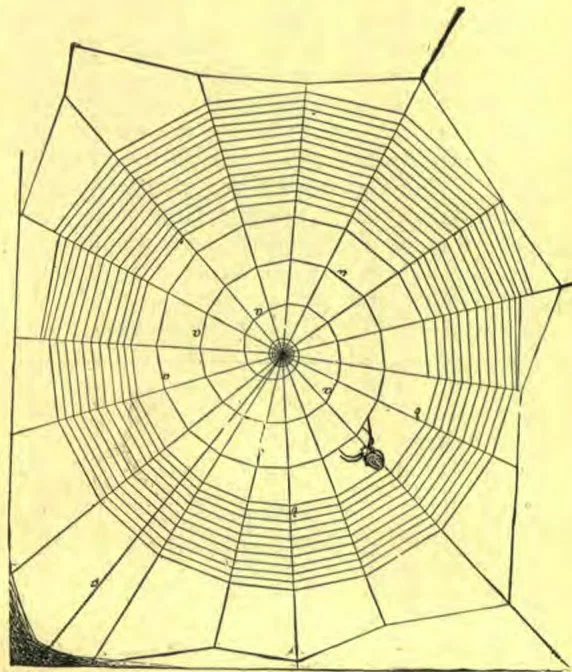
WEB OF THE GEOMETRIC SPIDER.
“Where did he get the rope? Was it one of papa’s?” asked George, anxiously.
“Oh, no! it was his own rope,” I replied. “He carries in his body a little manufacturing establishment, where he can make rope, and have it ready to use whenever he takes the fancy. You have seen the spider’s webs, made of delicate thread, finer than a raveling of silk, which he uses to catch flies for his food. His rope is very useful to him. Isn’t our Heavenly Father kind to provide so carefully for even a spider? And doesn’t it seem strange that some children, and grown people, too, should wish to hurt the tiny creatures that God cares for so tenderly?”
“After a while, I saw this spider, or another one like him, walking along through the air with his back downward. Looking closely, I noticed that he was walking on one of these silken threads. How frail it seemed! Yet it was strong enough to hold him. His weight made the delicate thread sag considerably, but it did not break. In the bright sunlight it shone like silver, and in some places I could see the colors of the rainbow. Don’t you think he must have been a dainty fellow, to walk on so beautiful a thing?”
“I wish I had been with you, so I could have seen it all,” said George, thoughtfully.
“Keep your eyes open, and you will see many interesting things every day,” I answered.
And wouldn’t we all be far wiser if only we took time to notice the common, everyday things along our paths?
FERN HAYSMER.

WHAT BERNICE LEARNED ABOUT THE APOSTLES

I

“O Aunt Emma!” said Bernice Hill, one evening, “I have found just the grandest chapter in the Bible, I do believe! It’s the twenty-first of Revelation. I always supposed that book was too hard for children to understand, and so I never read much in it; but I declare, Aunt Emma, it is more interesting than any story-book I ever read.”
Aunt Emma smiled, and turning to grandma, whispered, softly: “Do see how enthusiastic the dear child is growing since she has begun to study the Bible in earnest!”
Grandma glanced up from her knitting, toward the quiet little figure seated at the farther side of the table. “Shall I tell you, my dear, one verse in that beautiful chapter, which takes me back, every time I read it or hear it read, to the time I was a child like you,—a little girl,—sitting by my dear mother’s knee?”
“Yes, grandma; tell me all about it,” pleaded Bernice, always delighted to hear grandma tell of the time when she was a little girl.
“Well, it is the fourteenth verse. You may find it, if you will, and watch to see if I recite it correctly;” and grandma slowly repeated: “And the wall of the city had twelve foundations, and in them the names of the twelve apostles of the Lamb.”
I remember hearing my mother read that verse when I was very young, and I asked her who the twelve opossums were.”
“O grandma!” said Bernice, laughing, “what did your mother say? Did she think you a very ignorant little girl?”
“I suppose so; but she did not laugh at me; for she knew I would feel bad if she did. Instead, she did a much more sensible thing; she told me who the apostles were, and taught me their names, and I have never forgotten them.”
“I have never learned the names of the apostles, grandma. Tell me where can I find them, please, and I will turn and read.”
“In the tenth chapter of Matthew, dear; but if you will learn this little stanza, maybe it will fix them in your memory.” Then grandma slowly repeated to Bernice these lines, which I am sure you will all be glad to commit to memory:—
“Peter, who his guilt confessed; John, who leaned on Jesus’ breast; Lebbeus and Andrew too, Philip, James, Bartholomew, Matthew, Thomas, James, we see, Who was the son of Zebedee; Simon, he the Canaanite; And if we would name them right, We must add the traitor bold, Judas, who his Master sold.”
Bernice soon learned the little rhyme; and often the next day grandma and auntie overheard her repeating, with a very serious face, and a wise nod of her golden head, “Peter, who his guilt confessed.”
“I must say, grandma,” she declared at the dinner-table, “that little stanza has made me anxious to know more about the apostles. I have been wondering all day whatever happened to them after the Lord left them. I should think they would have been very, very lonesome. I remember how I felt when Cousin Julian went home after his long visit this summer; and of course they must have thought more of the Lord—a great deal more—than a little girl like me could possibly think of her cousin. I suppose they all died in a little while, didn’t they, grandma?”
“Well, no, dear; they lived a long, long time, and did a great deal of good before they died. The ages of all of them are not known to a certainty; but it is sure that the beloved disciple, John, lived to be almost a hundred years old.”
“Why do people call John the ‘beloved disciple,’ grandma? Were not the others beloved as well as he, I wonder?”
“Certainly, my child, they were all dear to the heart of the Master; but because of John’s loving, gentle disposition, he was termed The Beloved.”
“It hardly seems as if Judas could have been loved very much. I’m afraid I could not even treat a person kindly who was so wicked as Judas. I—”
“And yet,” interrupted grandma, “the Master spoke kindly to him, and called him ‘friend,’ on the very night of his betrayal, when the traitorous kiss was given in the garden. Can you tell me, Bernice, what became of Judas? Did he die a natural death?”
“Oh, no, grandma! he hanged himself; but I can’t tell you anything about the life or death of any of the other apostles.”
Then grandma and grandpa and auntie and mama and Bernice had a long talk about the twelve apostles; and they decided to learn all they could about them, and in a week from that evening to talk over all they had learned.
MRS. L. D. AVERY-STUTTLE.

ELIZABETH ROSSER

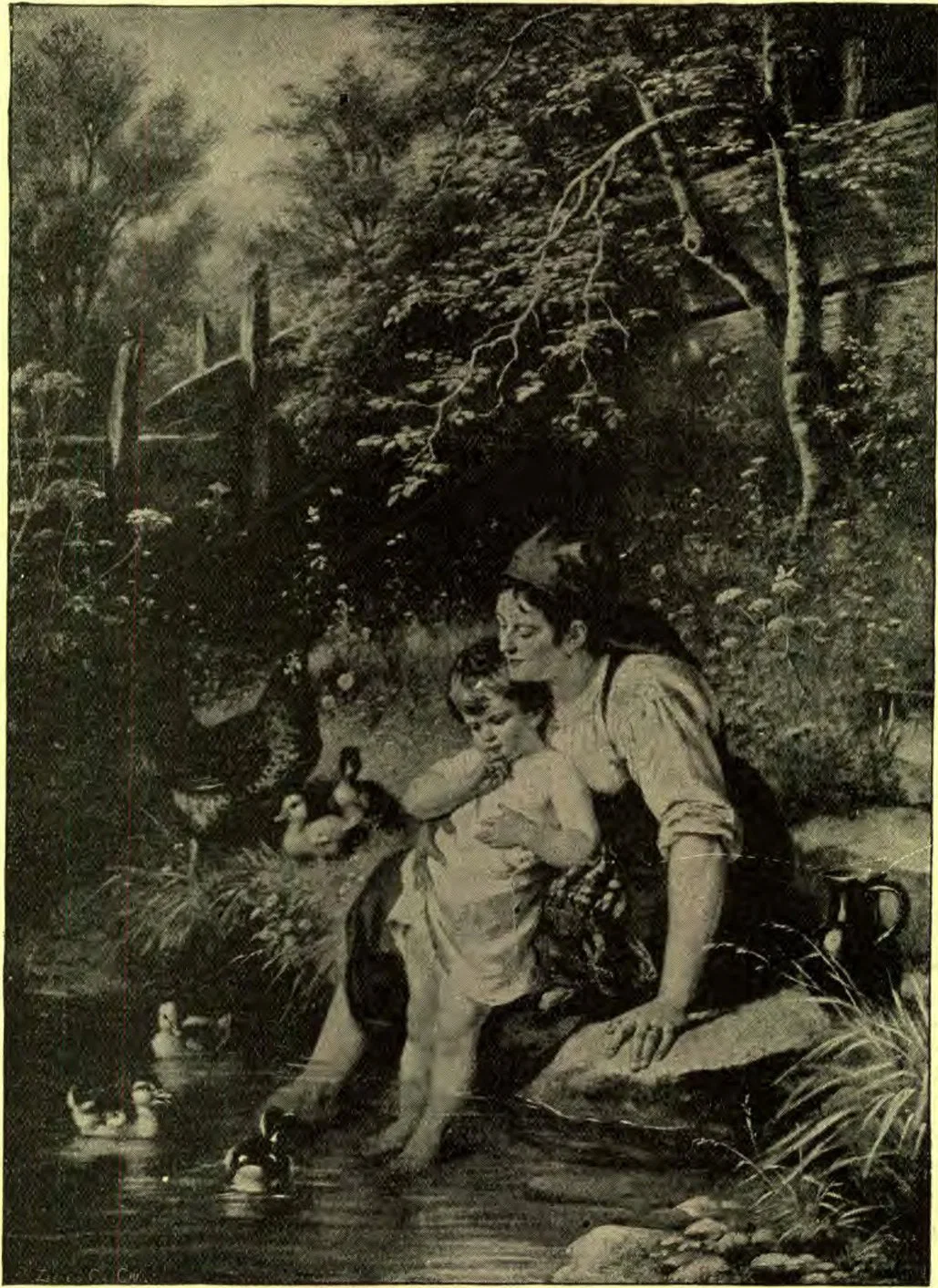
BY THE BROOK

On such a June day, long ago, When the warm sun was dropping low, Low in the sky. The baby left his picture-book, And I my sewing work forsook; Along the lane our way we took, And sat us down beside the brook,— Wee Tom and I.
BY THE BROOK.
BY THE BROOK.
We sat us down beside the brook, Within a shady, grassy nook, With trees o’erhead; And there I taught my darling boy Of that eternal world of joy, Where praises shall all tongues employ; Where naught shall hurt, and naught destroy, And naught shall dread.
There none shall hurt, and none shall cry; The leopard and the kid shall lie Together down, The lamb and bear along the glen Shall feed in new-found peace again; No fear shall guard the adder’s den; Fierce beasts a child may fondle then, All gentle grown.

ELIZABETH ROSSER

ONE WAY TO MANAGE

Ted and Patty perched on the woodpile, and watched the frantic attempts of Hiram, the hired man, to drive six little pigs up a broad plank into the farm-wagon. Neighbor Billman had bought the pigs that morning, and Hiram had promised to deliver them by noon; but he soon found that that was easier said than done. They dodged, and squealed, and ran between his cowhide boots, and stepped on his toes, and nearly tripped him up, until at last the poor fellow dropped down on the sawhorse, and, wiping his crimson face vigorously with a crimson handkerchief, exclaimed, in despair, “Well, I’m beat!”
The provoking little scamps trotted off to a pile of refuse potatoes, and began to munch them contentedly, giving vent to many little saucy squeaks, and casting numerous defiant side-glances at the defeated Hiram.
“Must you give it up, Hiram?” queried sympathetic Patty.
“I’d make ’em go in!” exploded Ted, kicking at a maple log with his copper toes.
“Make ’em! That’s all you know about it!” responded Hiram, in an injured tone.
“I’ll go in and get mama to make you a glass of lemonade, Hiram,” said Patty, “and p’raps she can think of some way to help you.”
“I’ll be thankful for the lemonade,” replied Hiram, much mollified, “but I guess your ma hain’t made a study of the best way to get pigs into a wagon.”
Presently Patty returned with a pitcher, a glass, and a plate of cookies. She also had a look of mysterious satisfaction on her kind little face, which was explained when, just as Hiram finished the lemonade and cookies, mama appeared with a pail of something steamy and savory-smelling. She carried it over near the suspicious little pigs. They stopped munching apples, and sniffed appreciatively. Then she walked along to the wagon, set the pail on the plank, and pushed it slowly up into the wagon. And, honor bright, every one of those little pigs trotted briskly after it! Up they went, straight into the wagon that they had been dodging all the forenoon!
“Well,” said Hiram, “your ma knows more about pigs than I give her credit for.”
“I don’t know much about pigs,” said mama, “but I do know that gentle ways are best, and that coaxing is much wiser than driving.”
Remember that, little folks—and larger folks.—Epworth Herald.

HEATHEN DEVOTION

As I was on my way home to Delhi, I saw a strange and moving spectacle. In the distance there came in sight what seemed a prostrate body in the middle of the road. On coming nearer, I found it was the form of a woman, slowly crawling along, and measuring her length on the road as she went. I drew up as I came up to her, and began to question her. She told me she was a Brahman woman, the wife of a man who was about one hundred yards behind her on the road. She had journeyed in this way from a far-distant village in the Northwest Province, and was on her way to Jarvala-Mukhi (fire-mouth), a celebrated place of pilgrimage in the Kangra district, at the foot of the Himalayas. Altogether, her pilgrimage could not be less than five hundred miles, and that at a rate, she told me, of about two miles a day.
I had often heard of this method of performing a pilgrimage, but it was the first time I had ever witnessed the sight (such mode being very rare in these parts); one could not fail to be much affected by it. Poor thing! her arms and legs, which were quite bare, were worn hard and leathery by the constant rubbing along the roads.
I asked her why she was undergoing all this pain and toil. She replied, again and again, “Uska, darshan” (“To see Him”). To gain salvation by doing so?—“No, only to see Him.” O the pity and pathos of it! What a wealth of devotion displayed, and so largely (though who would dare to say entirely?) thrown away! All she would be able to see with her outward eyes when she reached her destination, would be the flame of the ignited gas, which superstition makes people believe to be the divine exhalation of the god Agni.
If only, one felt, all that faith and devotion could but be directed into its right and natural channel! One could breathe a prayer that some day it might find the object of its aspiration, and the poor, misguided creature be enabled to see Him whom her soul did indeed long for. I don’t think anything I ever witnessed in the country moved me so much. The loneliness of the spot, the bare, dull, monotonous road along which the couple were toiling, and that simple, earnest, reiterated cry, “To see Him!”—Rev. S. S. Allnutt.

Poison from Mosquitoes

Poison from Mosquitoes.—It is now believed that some species of mosquito infect their victims with malarial poison. Major Ronald Ross, in an article in the Popular Science Monthly, advises a thorough study of the habits of such species, in order that they may be exterminated in populous districts.
A New Profession.—Forestry is a new profession opening up before the oncoming generation of men. Mr. Pinchot, the forester of the Department of Agriculture, announces that the government will take a few well-qualified men as student-assistants, at a salary of three hundred dollars a year and expenses.
Artificial Rubber.—An artificial India-rubber, showing all the characteristics of the natural substance, has been made by Dr. Tilden from turpentine. The discovery is not of commercial value; for it takes two years to make the rubber, and no way of hastening the process has been found. Sometime, no doubt, it will be made quickly and cheaply enough to replenish the world's waning supply of rubber.
The Chipping Sparrow.—A Vermont naturalist has made a study of the habits of the chipping sparrow, beginning his watch at daylight, and continuing till after dark. He found that when feeding their young, the parents made more than two hundred trips to and from the nest in the course of the day, bringing insects almost every time. They were never away so long as half an hour. Farmers should think twice about this.
Wireless Telegraphy.—The necessities of wireless telegraphy, the latest wonder of applied science, have become the mother of several interesting inventions. One of these is a method of measuring the frequency of electric pulsations. This feat is accomplished by photographing the electric spark, as reflected from a rapidly revolving mirror. When the rate of the discharge is one million pulsations a second, the photograph shows a line of dots about one tenth of an inch apart.
The Sun's Heat.—The source of the sun's heat—which is certainly kept up somehow; it does not grow less—has long been a mystery to scientists. Many suppositions have been brought forward to account for it. No one supposes now that it is due to combustion. Nor does the theory that bodies are constantly striking the sun, and so heating it, find much support. There is a simple and more reasonable explanation,—that it is due to the compression of its particles by its own enormous weight. All gases become hotter under pressure, as one will find out by touching the barrel of a bicycle-pump in action. This would seem a reasonable explanation of the sun's continued supply of heat.
The Color of the Eye.—The color of the eye is due to color- or pigment-cells in the iris, or circular curtain, surrounding the pupil. This curtain is a somewhat complex structure; but it may be roughly divided into the muscular layer and the stroma, or soft outer portion. At the back of the stroma is a thick layer of pigment-cells. If the stroma itself is nearly free from pigment, the black background shows through, and the iris appears blue; this may be verified by putting a little soapy or milky water in an iron pan or skillet. If the stroma is not quite so clear, the eye will appear gray. Still more pigment in the stroma will give green, hazel, or brown; and a large amount makes the stroma quite opaque, and the iris black. The pigment-cells in the stroma are not evenly distributed, but form more or less fanciful patterns. When pigment is absent at the back of the stroma, as is the case with albinos, the muscles and blood-vessels show through, and the eye is pink.
A Novel School.—There is a school in Chicago where children are taught to play. It is situated in the river district, in the very heart of the tenement-house district, where the children's entire world is a few squalid rooms, a dark and dirty passageway, a cheerless street, and the school. They have, most of them, no idea of play when they come to school; they are pale, pinched little old men and women. But every half-hour or so during the school-day, books are closed, and for five minutes the children play—leap-frog, hop-scotch, pussy-wants-a-corner, almost any game that calls for quick, active exercise of brain and muscle. Very many of the children are allowed to come to school only the half-day required by law; the rest of the time they must sell papers, black boots, or otherwise help support their families. In spite of this, they make as rapid progress as the children more favored by fortune, and give the truant officers little trouble. Indeed, they love to go to school; the school-day is the one bright spot in their dreary lives.
C. B. MORRILL.

(December 23, 1899)

SABBATH-SCHOOL LESSON.—NO. 12

(December 23, 1899)

THE DECISIONS OF THE JUDGMENT DAY

Lesson Scripture.—Matt. 25:31-46.
Memory Verse.—Matt. 25:40.
Time: A. D. 31. Place: Mount of Olives.
Persons: Jesus, disciples.

QUESTIONS

1. Having related the parable of the talents, to what time did Jesus call the attention of the disciples? Matt. 25:31. Who will then be summoned before him? What will be done to the multitude thus gathered? Vs. 32, 33; note 1.
2. What words of blessing will be spoken to those represented by the sheep? V. 34. Why does he in this manner address this class? Vs. 35, 36. What answer will they return? Vs. 37-39; note 2. In what sense have the righteous ministered unto Christ? V. 40.
3. To those represented by the goats, what will the King say? V. 41. What reason will he have for pronouncing a curse upon them? Vs. 42, 43.
4. In contrast with the statement of those who are blessed, what will these say? V. 44. By what sin are they cut off from life? V. 45; note 1. What will be the portion of the wicked? of the righteous? V. 46.

NOTES

1. The scene here described is undoubtedly identical with that brought to view in Revelation 20. The right and left hands are symbols, respectively, of favor and disfavor. To be in favor with God at that time is, as it were, to stand at his right hand, while to be under wrath and condemnation is as to stand at his left. At that time Christ will be seated upon the throne of his own glory and kingdom. In the presence of both men and angels he will pronounce the final sentence for or against men. The great sin of all sins to be noted by the Judge at the final day is the sin of neglect,—“Ye did it not.” Life is nothing, yea, worse than nothing, if it be not filled every day with deeds of love. The great lesson is how to live wholly for our fellow men.
2. The righteous can not remember the good of which the King speaks. Why?—Because any act performed in a spirit of unselfishness is done, of course, for others, not for self. And when the habit of unselfish living is once established, the good deed done is but the simple, natural outflowing of the Christ life, and is not so much as thought of again. O for that blessed, Spirit-filled life, in which it is so natural to spend and be spent in behalf of mankind that the good work is unconsciously performed! This is the life of Him who knew no pride nor self-glory.

Self-Pronouncing S. S. Teachers’ Reference Bible.
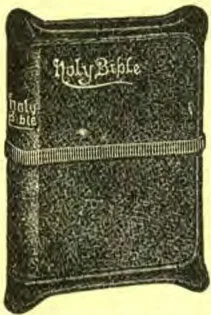
CONTAINS the celebrated Teachers’ Helps, comprising nearly 400 pages. Also a complete series of fifteen new maps.
Description. — Imperial Seal Binding, Tuck Edges, known as “Divinity Circuit,” Rounded Corners, Full Red under Gilt Edges.
We offer this Bible, post-paid, for only SIX NEW YEARLY SUBSCRIPTIONS at 75 cents; or TWELVE NEW SIX MONTHS’ SUBSCRIPTIONS at 40 cents.
We will also send it, post-paid, with the INSTRUCTOR one year for $2.25. For 20 cents extra we will stamp your name in gold upon the cover.

"Dickey Downy."

By Virginia Sharpe Patterson.
This little volume is charmingly written, its object being to teach the children to love and protect the birds. That it is interesting, the following selected chapter-headings will abundantly show:—
The Orchard.
Dickey Downy's Meditations.
Dickey's Cousins.
A Winter in the South.
The Prison.
The Hunters.
Polly's Farewell.
The book is bound in cloth, and contains 192 pages, with four beautiful colored plates. Price, post-paid, 60 cents.
We offer this book, post-paid, for three new yearly subscriptions to the YOUTH'S INSTRUCTOR, at 75 cents each, or with the INSTRUCTOR one year for only $1.15.

“Beautiful Joe.”

An Autobiography By Marshall Saunders.
Beautiful Joe is a real dog, and “Beautiful Joe” is his real name. He belonged during the first part of his life to a cruel master, who mutilated him in the manner described in the story. He was rescued from him, and is now living in a happy home, with pleasant surroundings, and enjoys a wide local celebrity.—Author’s Preface.
This story awakens the interest of the reader in the first chapter, and sustains it to the end. It must make an impression for good, and in the interests of kindness and gentleness, upon all who read it.
The book is well bound in cloth, with gilt side-stamp; 304 pages; illustrated. Price, 75 cents. Bound in paper, 50 cents.
It will be sent, post-paid, for four new yearly subscriptions to the YOUTH’S INSTRUCTOR, at 75 cents each; or with the INSTRUCTOR one year for only $1.25. In paper covers, with the INSTRUCTOR one year, for $1.00.

Making Home Happy.

By Mrs. L. D. Avery-Stuttle.
This subject is presented in an interesting story form, and every reader will feel inspired to strive to make his home cheerful. Happy homes are needed everywhere, and “Making Home Happy” is a good little book to help bring about this result.
The book contains 206 pages, with four full-page illustrations, besides smaller ones. Price, bound in cloth, 50 cents.
We will send it, post-paid, for three new yearly subscriptions to the INSTRUCTOR at 75 cents each; or with the INSTRUCTOR one year for $1.00.

TAKE THE Canadian Pacific Railway

for . . . CHATHAM, OTTAWA, MONTREAL, LONDON, GALT, QUEBEC, WOODSTOCK, TORONTO, BOSTON, PORTLAND, and
All points in New England, the Maritime Provinces, Great Britain, and the Continent.
Illustrated literature, time-tables, and full particulars, upon application to—
J. FRANCIS LEE, GEN. AGENT,
Passenger Dept. 228 SOUTH CLARK ST., CHICAGO
Branch Offices: 76 Ottawa St., Grand Rapids, Mich. Room D, Chamber of Commerce, Cincinnati, Ohio. 315 Chestnut St., St. Louis, Mo.

Cincinnati Northern Railroad Co.

TIME TABLE NO. 3.
IN EFFECT SEPT. 24, 1899.
Trains Pass Battle Creek, as follows:

WEST-BOUND.

No. 21, Mail and Express ................. 6.58 P. M.
No. 23, Accommodation .................... 2.07 P. M.
No. 27, Local Freight .................... 8.25 A. M.

EAST-BOUND.

No. 22, Mail and Express ................. 8.25 A. M.
No. 24, Accommodation .................... 1.45 P. M.
No. 28, Local Freight .................... 5.30 P. M.
Direct connections are made at Toledo with all roads diverging. Close connections for Detroit and Cincinnati. J. L. READE, Ticket Agt., Battle Creek.
E. R. SMITH, City Pass. Agt., 6 West Main St.
Continue reading: GRAND TRUNK RAILWAY SYSTEM