The Youth’s Instructor, Vol. 47, No. 46.

THE “HERALD” AND ITS WORK

The Youth’s Instructor

Nov 23, 1899

Review and Herald Publishing Company · Battle Creek, Mich. · Nov 23, 1899

THE “HERALD” AND ITS WORK

BELIEVING that it will be of interest to INSTRUCTOR readers to know more about our mission schooner, the “Herald,” we here give a view of the vessel as it looked at anchor in the harbor of Boca-del-Tora, United States of Colombia, South America. This is a Spanish name, and means “Mouth of the Bull.” We anchored at this place last December, and stayed a few days on one of our voyages. We had come about six hundred miles, nearly the entire length of Central America. We started from Bonacca on the first day of December. Everything was pleasant, and the vessel, with all sails spread, started off as majestically as we could wish; all were happy and well. There were twenty-one persons on board; fourteen of the number were passengers, and five of us were to man the vessel. I might say six, as Mrs. Hutchins was my assistant navigator. Elder Haysmer was also with us, on his way home to Jamaica.
THE “HERALD.”
THE “HERALD.”
For the first few days, with the exception of some calm spells, the sailing was fairly pleasant. We anxiously watched our barometer to see if any changes in the weather were indicated. At this season there are liable to be heavy storms from the north; and we were off a bad coast to have one of these “northers” come down on us, as there are no harbors for vessels as large as the “Herald.”
We rounded Cape Gracias a Dios, so named because Christopher Columbus landed there with his crew, and gave thanks to God for preserving them on one of their voyages. It is a Spanish name, meaning, “Thanks to God.”
Just here the storm came, and we all had our hands full for two days and nights. It is a real comfort, when severe storms are raging, to know that many are praying for the safety of the Lord’s property, and for the missionaries on board. When this is said, the only comfort we do have has been described. The vessel pitches and rolls, now dashing up on a watery pinnacle, now down in a chasm of the sea; breakers frequently sweep over it, flooding the deck, and sometimes splashing up ten feet on the sails, so that we are obliged to hold on, to keep ourselves from being washed overboard.
These are only a few of the experiences of sea life, but these we willingly endure, in order that the precious truth may be carried to the isles that “wait for his law.” We were on our way to places where there are a large number of children and their parents in whose hands we have placed many precious bundles of truth, such as “Gospel Primer,” “Gospel Reader,” “Bible Child Life,” “Christ Our Saviour,” etc. As we used the cabin of the “Herald” for a dental office, we often had an opportunity to tell old and young about the Saviour’s love. They expressed real gratitude for the visit of the “Herald,” as it brought relief to their suffering, supplied their missing teeth and saved the decaying ones, and in this way improved their digestion and health. The hearts of many have thus been warmed; and no doubt they will be led to read the books more thoughtfully, and so receive much more good from them, than they otherwise would.
The “Herald” is fifty-seven feet long on deck, and eighteen feet wide in the widest place. It was built on the Island of Bonacca, Bay Islands, by Mr. Charles Kirkconnell. It has a comfortable cabin, finished in a way to do credit to the builders. There are three bunks, each large enough for two persons. The sailors have four bunks forward in the bow. This part of the vessel is called the forecastle. Seeing the vessel lying as quiet as it appears in the picture, one not accustomed to the sea can scarcely imagine how it can plunge so hard as to throw the drawers from under the bunks into the middle of the floor, and move everything that is movable.
Our sailors go on shore and sell books; thus they are useful missionaries, and fill a noble place in the vineyard. Many have received a knowledge of the truth by means of the missionary schooner, and much good seed has been sown. May the Lord of the harvest water and bless it!
F. J. HUTCHINS.

EXPERIENCES IN KANSU

II

WHILE I was out in the streets and highways giving the word of God to the people, my wife was busy visiting the women and children with the bread of life. She used to play her stringed instruments, and sing hymns, and also tell them the story of God’s infinite, enduring love. In the summer, and even in the winter, when the weather is favorable, Chinese women and children do their housework in the court-yard. They spread a mat made of reeds on the ground, and on this they sit and work. All kinds of work, such as spinning, weaving, shoemaking, dressmaking, footbinding, etc., are done in this way. Several in one neighborhood who are on good terms with one another, usually gather in one court-yard. Naturally they speak of everything a company of women and children who do not know Jesus can think of. I suppose it is not unknown to you that those who do not have Jesus in their hearts, always think of many bad things. When I had a little spare time, I used to go with my wife when she visited these family companies, because I wished to gain a true knowledge of the life and practises going on in Chinese homes; for then I could more fully realize what it meant for them to be without Christ. In this way, too, I learned something of the suffering and misery the poor people of China have to pass through. What I write and tell you is not something that has been heard or thought; but it is the naked facts, which repeat themselves in the daily life of the common people in the Flowery Land.
We were usually courteously received, and invited to sit down on the mats. Some would bring us a cup of tea; another, perhaps, had an oil-cake, which she put beside the cup, with the words, “Tsing’chi, please eat.” When we were sitting among those ignorant, needy women and children, we used to think and speak about Jesus when he was surrounded by all classes of people, and how kindly he spoke to them, and led their thoughts away from their daily troubles to the fountain of love and blessing.
While we were talking to the people, they used to ask all kinds of questions, such as, “How old are you?” “What is your honorable name?” “Are your parents still alive?” “How many ko-ko [elder brothers] have you?” They wished to know what Americans eat, drink, and wear; if we have the same sun in our country that they have; etc. In order to satisfy to some extent their hunger for knowledge, we would answer some of their questions, and then ask them to keep quiet that we might tell them of God’s love for them. Some would listen attentively, while others would discuss in whispers our physiognomy. The color of my eyes was a great mystery to them. No one seemed to understand why they are blue. One old grandmother in the eye-discussing committee appeared to have more wisdom than the others. She said that I was born in an extremely cold country; “and that is the reason,” she added, “that his eyes are blue.” My wife’s unbound feet were also a curiosity to these women.
My wife started special meetings in our home for those who cared to come; and a few of those whom we had visited came regularly twice a week, and were instructed, and taught to love their Redeemer. In that way we worked day by day in the strength of God. Although we passed through many temptations and hardships, we were not broken down. The ever-loving arms were always around us, and upheld us. To-day I look back on those days with a thankful heart.
While we were working, the Spirit of God was also working, even more than we were able to understand at that time. The church-members, who were so badly sifted abroad when we first came, were greatly influenced by the power of the Holy Spirit, and, one by one, confessed their sins, and took a new stand to serve the Lord. Others who had heard about the way of salvation, in the street chapel and in their homes, came to gain a deeper knowledge of our loving Heavenly Father, in whom is all power. UNCLE PILQUIST.

THE CARPENTER

That evening when the Carpenter swept out The fragrant shavings from the workshop floor, And placed the tools in order, and shut to And barred for the last time the humble door, And, going on his way to save the world, Turned from the laborer's lot forevermore, I wonder — was he glad?
That morning when the Carpenter walked forth From Joseph's doorway in the glimmering light, And bade his loving mother long farewell, And through the rose-shot skies, with dawning bright, Saw glooming the dark shadow of the cross, Yet, seeing, set his face toward Calvary's height, I wonder — was he sad?
Ah! when the Carpenter went on his way, He thought not of himself, for good or ill; One was his path, through shop or thronging men Craving his help, e'en to the cross-crowned hill. In toiling, healing, teaching, suffering,— all His joy was just to do his Father's will: And earth and heaven are glad!
— Selected.

The Parable of the Talents

I
It is not alone to the minister that God entrusts his talents. His goods are lent to every man as verily as they are lent to the most exalted angel in the courts of heaven. To every man God has appointed his work, and the talents are given in proportion to the capabilities of the receiver. Every soul, in taking his position as a member of Christ’s body, pledges himself to act faithfully his part as a steward of God; to work with the same prudence and wisdom in behalf of his Master that he would use if he were himself to be enriched by all that is gained.
By the parable of the talents, Christ teaches us the relation that man sustains to God. “The kingdom of heaven,” he says, “is as a man traveling into a far country, who called his own servants, and delivered unto them his goods. And unto one he gave five talents, to another two, and to another one; to every man according to his several ability; and straightway took his journey. Then he that had received the five talents went and traded with the same, and made them other five talents. And likewise he that had received two, he also gained other two. But he that had received one went and digged in the earth, and hid his lord’s money.
“After a long time the lord of those servants cometh, and reckoneth with them.” He sees the servant to whom he has entrusted five talents, and he asks him to give an account of his stewardship. The servant has been faithful; he has added five talents to the talents entrusted to him. He answers: “Lord, thou deliveredst unto me five talents: behold, I have gained beside them five talents more. His lord said unto him, Well done, thou good and faithful servant: thou hast been faithful over a few things, I will make thee ruler over many things: enter thou into the joy of thy lord.”
The servant entrusted with two talents has also added to the capital lent him. “He also that had received two talents came and said, Lord, thou deliveredst unto me two talents: behold, I have gained two other talents beside them. His lord said unto him, Well done, good and faithful servant; thou hast been faithful over a few things, I will make thee ruler over many things: enter thou into the joy of thy lord.”
Now the man to whom has been given the one talent is called to give an account. But he can only look with confusion upon the face of his lord; for he has followed the suggestions of the enemy. If he had been convinced that he could not use that one talent, he should have asked wisdom of God; but instead of this, he buried it in the earth. Now he comes to his lord with a falsehood on his lips. “I knew thee that thou art a hard man,” he says, “reaping where thou hast not sown, and gathering where thou hast not strewed: and I was afraid, and went and hid thy talent in the earth: lo, there thou hast that is thine.”
No man whose heart is converted can say such a thing as this; for it is impossible for the Lord to gather where he has not strewed. Heaven and earth are his property, and we can not bring to him anything that is not already his own.
“His lord answered and said unto him, Thou wicked and slothful servant, thou knewest that I reap where I sowed not, and gather where I have not strewed: thou oughtest therefore to have put my money to the exchangers, and then at my coming I should have received mine own with usury. Take therefore the talent from him, and give it unto him which hath ten talents. For unto every one that hath [improved his talents] shall be given, and he shall have abundance: but from him that hath not shall be taken away even that which he hath. And cast ye the unprofitable servant into outer darkness: there shall be weeping and gnashing of teeth.”
The parable presents a truth which all should understand. God has not distributed his talents capriciously. To every man are given abilities which will fit him for the work he is called to do. To one are committed five talents; to another, two; to another, one: and each is accountable to God for his gifts. A time is coming when Christ will require his own with usury. He will say to each of his stewards, “Give an account of thy stewardship.” Those who have hid their Lord’s money in the earth, in worldly investments, instead of putting it out to the exchangers, to increase by use; and those who have squandered his money by expending it for needless things, instead of investing it in his cause, will receive the condemnation of the Master. Not only will they lose the talent lent them by God, but they will lose eternal life. The command will be given: “Take therefore the talent from him, . . . and cast ye the unprofitable servant into outer darkness: there shall be weeping and gnashing of teeth.” The faithful servant, who invests his talent in the cause of God, who uses his money to the glory of God, will receive the commendation, “Well done, thou good and faithful servant; . . . enter thou into the joy of thy Lord.” What will be this joy of the Lord?—It will be the joy of seeing souls saved in the kingdom of God. Those who are faithful stewards are partners with Christ, who, “for the joy that was set before him endured the cross, despising the shame, and is set down at the right hand of the throne of God.”
MRS. E. G. WHITE.

LIQUID AIR

Charles E. Tripler, of New York City, is the first experimenter who has succeeded in producing liquid air in large quantities at small expense.
In the mind of the public the idea is gaining ground that liquid air is a dangerous substance to handle. This is not true. So far as explosive power is concerned, the liquid is dangerous only when confined; and the dangers in handling it are now so well known as to render its use safe if reasonable care is exercised.
Liquid air contains, approximately, seventy-five parts of oxygen to twenty-five parts of nitrogen, while ordinary air contains only twenty-two parts of oxygen to seventy-eight parts of nitrogen. Because of the great expansibility of air, in changing from the liquid to the gaseous state, it has the power of absorbing heat to an almost incredible degree. “It is difficult to conceive of the cold of liquid air. Mr. Tripler performs a number of experiments to illustrate its low temperature. He partially fills a tin teakettle with it, and sets it on a cake of ice, when the air at once begins to boil violently, throwing off a fierce white vapor. The temperature of ice is about thirty-two degrees Fahrenheit, while the temperature of liquid air is three hundred and twelve degrees below zero. In other words, ice is three hundred and forty-four degrees warmer than liquid air; consequently it makes the air boil.”
In the medical profession, great results are hoped for by the application of liquid air to some forms of practise. It is claimed, for instance, that a carbuncle or other sore can be completely removed by simply directing a small jet of liquid air upon it. There is no pain in the application, the only sensation being one of slight burning or tingling. Flesh thus frozen for a limited time will gradually return to a normal condition without injury.
Much misconception exists in regard to the use of liquid air for cooling residences, and in refrigerators. It has been supposed that it could be sold in cans for this purpose, but it has no practical value in this direction. If meat, potatoes, eggs, etc., are placed in liquid air, they soon become frozen so solid that, when struck, they fly into hundreds of small pieces, just as would a lump of coal. How far such treatment will affect their value as food, has yet to be determined. When touched by frost, vegetation withers and blackens; but if flowers—roses, for instance—are dipped into liquid air, though instantly frozen solid, they come out of their bath more beautiful in color than before. As the flowers thaw out, however, the petals crumble away, life having been destroyed.
Professor Tripler is now in the lecture field, and in his lectures he introduces many wonderful and startling experiments. Among others he presents a large rubber ball, throwing it upon the floor to have it bound back into his hand. He then immerses the ball in liquid air, and in a few minutes again throws it upon the floor, when, with a loud crash, it breaks into scores of small pieces. A quantity of mercury, which freezes at 40° below zero, is placed in a metal form the shape of a hammer head. As the form is immersed in the liquid air, the mercury begins to solidify. As it hardens, a handle is pressed into the center of the freezing mass, and in a few minutes the whole is withdrawn, appearing as a tolerably well-shaped hammer, as hard as stone, with which the professor proceeds to drive several large nails into a block of wood. Asbestos is supposed to be absolutely fireproof; but if, after being placed in liquid air for a few minutes, it is brought in contact with a lighted match, it will burst into a lurid flame, and quickly consume away. Cotton so treated will disappear like a flash from gunpowder, so quickly that the eye can scarcely follow the consumption.
A glass containing liquid air is suspended in water, and almost instantly covered with a thick coating of ice. A stick of carbon is then placed in the liquid air within the glass, and at once bursts into flame, burning fiercely inside its icy tank. The tin dipper used to ladle out the liquid air is finally crushed in the hands of the professor into scores of small pieces, as easily and quickly as he could crush an empty eggshell. Iron and steel immersed in the liquid become as brittle as glass. On copper, gold, and other precious metals, however, the result is different. If a thick piece of copper, for instance, is dipped into liquid air, it becomes soft and pliable, and can be easily bent between the fingers.
The most remarkable and apparently incomprehensible experiment is that of placing liquid air within a teakettle, and then putting the kettle over the flame of a gas-stove. The cold of the liquid is so intense that a thick coating of frost is deposited on the bottom, directly exposed to the flame, as well as over the sides. Repeatedly will the professor brush off the white frost from the bottom of the kettle, finally turning out the liquid air as lumps of ice.
Liquid air, when handled, does not moisten the hands, nor wet anything with which it comes in contact. When thrown upon the floor, it rattles as if a handful of peas were dropping; and when picked up by the fingers, it feels like coarse shot; yet it is a liquid, can be ladled out, and flows like water.
W. S. Chapman.

BIBLES BY THE MILLION

IN the sixteenth century it was possible to produce with pen and ink one copy of the Cloverdale Bible in ten months; to-day, “a single Wharfdale machine will produce a Bible in ruby type at the rate of nine copies every eight minutes.” According to the Sunday Magazine, the Oxford Press sent out 500,000 complete Bibles in the year 1875, 650,000 in 1880, 700,000 in 1885, 900,000 in 1890, and five years later the yearly output reached 1,000,000. Bibles issued by other houses in Great Britain would greatly swell these figures, to say nothing of those published in America and other parts of the world.

If I in Harvest Fields

If I in harvest fields, Where strong ones reap, May find one golden sheaf For love to keep; May speak one quiet word When all is still; May help some fainting heart To bear Thy will; Or sing one high, clear song, On which may soar Some glad soul heavenward, I ask no more.
—Selected.

YOUR PLACE.

Just where you stand in the conflict, There is your place; Just where you think you are useless, Hide not your face. God placed you there for a purpose, Whate’er it be, Think! he has chosen you for it; Work loyally.
Gird on your armor! be faithful At toil or rest, Whiche’er it be, never doubting God’s way is best. Out in the fight, or on picket, Stand firm and true; This is the work that your Master Gives you to do.
— Churchman.

THE HORIZON LINE

If, standing between the rails, we look up a long, straight stretch of railroad track, we shall observe that the rails apparently come together at the place where earth and sky seem to meet. This apparent junction of earth and sky, or, at sea, of sea and sky, is called the horizon; and the horizon line is the most important line in the study of perspective, as it determines the drawing of all receding lines.
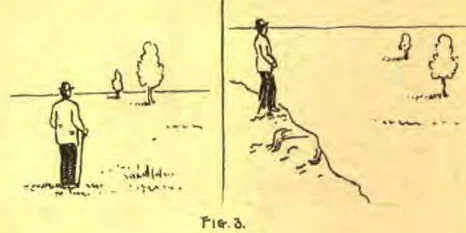
Fig. 3.
Fig. 3.
I would like to ask you who intend to take up these studies in perspective to content yourselves for the present with the most active observation, in the scenes about you, of all points to which your attention is called, before trying to draw. In this way you will thoroughly test the statements made. Statements and drawings are of little use unless we know, by personal observation, that they are true. And with such observation will come an understanding of many other facts, which can be gained in no other way.
In nature the horizon line is imaginary; it is not a real line at all, but simply a term used to define the limit upon the earth’s surface, which our eyes can see. The horizon line is always on a level with our eyes.
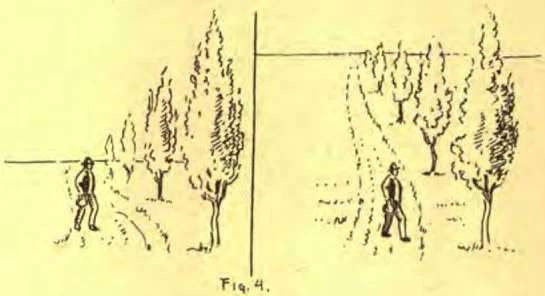
Fig. 4.
Fig. 4.
We shall observe, upon trial, that if we are low down, as in a valley, we can see less of the earth’s surface than if we stand on a level plain; and that if we are high up, we can see more: thus we learn that the horizon line is opposite the observer’s eyes, wherever he stands, and, consequently, is not the same to any two persons, unless their eyes are on exactly the same level.
One reason the horizon line appears to rise as we ascend, is that we are by that means literally taller, and can therefore see more of the earth’s surface. For example, suppose the person shown in Fig. 3 is the observer. Then the horizon line will be on a level with his eyes, and he will see the horizon line across the trees, below their branches. As he ascends a hill, the horizon line ascends with him; in other words, he sees a higher horizon line with every upward step. When he reaches the summit, the horizon line passes above the trees.
In Fig. 4 suppose you are the observer. You see a man coming along the road, and his head is about level with yours, as is shown by the horizon line. Now suppose you ascend some eminence until your eyes are near the top of the trees, you will see a new horizon line, far above the man’s head, passing near the top of the trees, and you can see much more of the earth’s surface. All this will show you plainly that the higher the eye, the higher the horizon line.
Therefore, if not so situated as to be able to see the horizon line (and we seldom can see it unless we are by the seashore, or on an open plain), we need be at no loss to know where the horizon line would be,—that is, how high or how low it would appear to us,—for at whatever height we are standing, the horizon line is always at just the height of our eyes.
PEDRO LEMOS.

INTO THE LIGHT

That evening found all of the Conwells, with Aunt Jane, May, and her mother, at the tent. Grace had managed, with the aid of a cane and her father’s arm, to get to and from the carriage.
All were interested; and as Elder Barnes looked into their eager, expectant faces, he breathed a prayer for wisdom in presenting God’s last message of mercy.
He began by saying: “Last night we found that God judges his people according to their works, of which an accurate account is kept in the books in heaven.
“If we realized that every action, every word, yes, even every thought and motive of our lives, is to be presented before God when our names are called at that great roll-call, how careful we should be!
“Great solemnity attends this judgment work, this cleansing of the heavenly sanctuary; for this is a time when the eternal destiny of every son and daughter of Adam is settled.
“From those decisions there is no appeal; for when Christ, our High Priest and Mediator, leaves the most holy place, he pronounces the sentence found in Rev. 22:11: ‘He that is unjust, let him be unjust still: and he which is filthy, let him be filthy still: and he that is righteous, let him be righteous still: and he that is holy, let him be holy still.’
“Many people think that we can not tell when the Judgment begins; but this is a mistake. Amos 3:7 reads, ‘Surely the Lord God will do nothing, but he revealeth his secret unto his servants the prophets.’ Through the prophets, God makes known to us his ways.
“The Lord has not only told us a great deal about the manner in which this work is conducted, but also the very year in which it begins. In Daniel 8 we learn that Daniel had a vision, and the angel Gabriel was commissioned to make him understand it. This he at once proceeded to do, telling him that the ram represented Media and Persia; the rough goat, Grecia; and the little horn, the power that would succeed Grecia, destroy the mighty and the holy people, and stand up against the Prince of princes. As Daniel fainted, the last symbol, that brought to view in verse 14, was not explained then. That is the one that we shall study this evening. We will read the verse: ‘And he said unto me, Unto two thousand and three hundred days; then shall the sanctuary be cleansed.’
“In the ninth chapter we find Daniel praying and earnestly seeking light upon this part of his vision, which had not yet been explained. Let us read verses 21 and 22 of that chapter: ‘Yea, whiles I was speaking in prayer, even the man Gabriel, whom I had seen in the vision at the beginning, being caused to fly swiftly, touched me about the time of the evening oblation. And he informed me, and talked with me, and said, O Daniel, I am now come forth to give thee skill and understanding.’ Then in the latter part of the next verse, he says, ‘Understand the matter and consider the vision.’
“Daniel’s mind would naturally at once revert to the twenty-three hundred days, at the end of which the sanctuary was to be cleansed. These days, like the other parts of the vision, were prophetic. In prophecy a day stands for a year. See Num. 14:34; Eze. 4:6. The sanctuary to be cleansed must have been the heavenly, as the earthly was destroyed hundreds of years before the expiration of the twenty-three hundred years. Heb. 9:23 shows that the heavenly sanctuary must be cleansed.
“Now if we can find out when these twenty-three hundred years began, it will be easy to see when they ended. Verse 24 of Daniel 9 says that the first seventy weeks—literally, four hundred and ninety years—were to be determined upon, or ‘cut off,’ for Daniel’s people, the Jews; and in verse 25 we read, ‘Know therefore and understand, that from the going forth of the commandment to restore and to build Jerusalem unto the Messiah the Prince shall be seven weeks, and threescore and two weeks,’ or sixty-nine weeks—literally four hundred and eighty-three years.
69 weeks 7 — 483 prophetic days or literal years.
This commandment was given in 457 B. C., as shown by the margin of Ezra 7. Four hundred and eighty-three full years will carry us over to the fall of A. D. 27. Now let us turn to John 1:41: ‘He first findeth his own brother Simon, and saith unto him, We have found the Messias, which is, being interpreted, the Christ [“Anointed,” margin].’ So Jesus did not become the Messias until he was anointed. Acts 10:38 shows that he was anointed with the Holy Ghost, and Mark 1:9–11 shows that this took place at his baptism, in A. D. 27, or at the end of the four hundred and eighty-three years. This proves our starting-point to be right.
“Seven years (one week) of the four hundred and ninety still remained for the Jews. In the midst of this week, A. D. 31, Christ was ‘cut off.’ Dan. 9:26. For three and one-half years longer the apostles labored almost exclusively for the Jews; but at the end of that period, A. D. 34, Saul, the great apostle to the Gentiles, was converted. This ended the four hundred and ninety years that were to be ‘cut off’ from the twenty-three hundred years. 2300 years — 490 years = 1810 years. Since the four hundred and ninety years brought us down to A. D. 34, the 1810 years remaining would bring us down 1810 years further, or to 1844 A. D. (34 + 1810 = 1844), the great antitypical day of atonement.”
As Elder Barnes finished, he said, “Are there any questions? If there is any point that you do not understand, be perfectly free to ask for an explanation.”
Aunt Jane arose and said, “I can not tell you how thankful I am that I have heard this message to-night. It is wonderful! Does the Lord anywhere tell us when the Investigative Judgment closes?”
“No; we only learn from the Scriptures that we are, and have been for some time, living in the last generation. Soon our names will be called. Are you ready? If not, I earnestly entreat you to get ready, at once. Make your peace with God before it is too late. ‘For what shall it profit a man, if he shall gain the whole world, and lose his own soul?’”
LENA E. HOWE.

WHERE GOD IS SEEN

In the trees, and ferns, and flowers, Nursed by breezes, fed by showers; In the birds, which sing and fly Gaily through the airy sky; In the sunlight all day long, In the evening’s cheerful song, Calling thousand insect notes From their tiny wings and throats,— All these speak of God to me, Quiet though their worship be.
Then we see his mighty hand In the sea so broad and grand; Hear him speak in thunders’ roar, When the clouds their torrents pour; See him in the sun and sky, In the starry worlds on high, And in gold of waving grain, Spread in beauty o’er the plain; And behold his love and care In the luscious fruit so rare. May we ever learn to trace In his works his smiling face.
MRS. P. ALDERMAN.
Continue reading: WHAT HAPPENED AT THE BIRAHI GUNGA