The astronomer is ever reaching out in an attempt to measure space, but he never will achieve his goal, because of the human limitations to his powers. This article ends the present series.
IN THE previous article we found that space is filled with great island universes, and that the Milky Way is the island universe to which our sun and earth belong. We learned that it is 300,000 light years in diameter, the light year being the distance that light covers in one year, traveling, as it does, 186,000 miles a second, or nearly six trillion miles a year. And so the spiral nebula to which we belong, the Milky Way, is six trillion times three hundred thousand miles in extent.
The basic principle involved in ascertaining these great distances is quite fully explained in the book, “Astronomy and the Bible,” pages 106-121, so we need not take time for it here.
It is said that when a certain farmer saw a camel for the first time, he exclaimed, “There isn’t any such animal.” And so when Lord Rosse, in 1845, announced his discovery of the first spiral nebula, astronomers said there was no such thing, and that his imagination had run away with him. Now astronomers know that there are at least a million of these spirals, or island universes, each one having its own family of thousands and millions of suns, and traveling in a path of its own, separated from its fellow spirals by at least ten thousand light years.
BILLIONS OF SUNS
Our galactic system is composed of billions of suns. But in some of these other island universes there are stars, or suns, very much larger than any in our system.
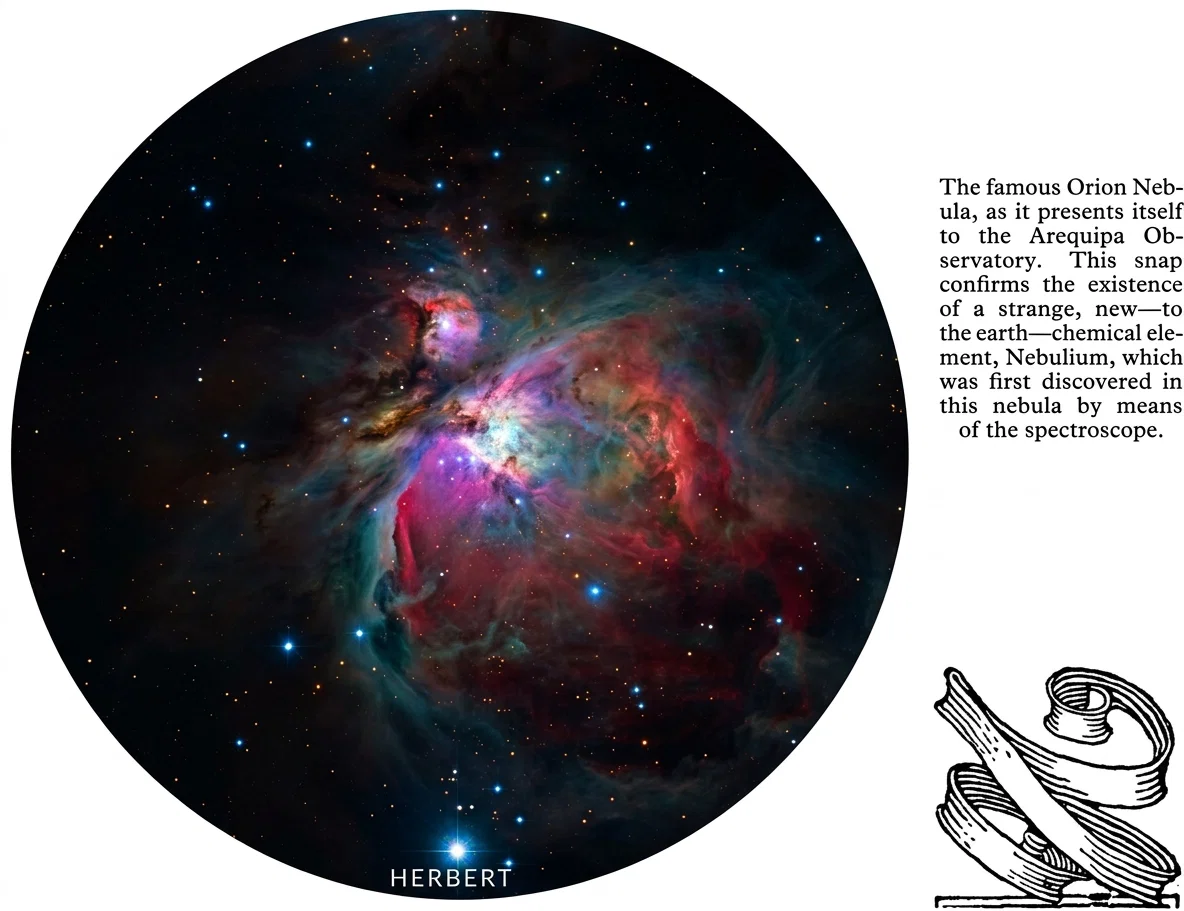
The famous Orion Nebula, as it presents itself to the Arequipa Observatory. This snap confirms the existence of a strange, new—to the earth—chemical element, Nebulium, which was first discovered in this nebula by means of the spectroscope.
S Doradus, in the large Magellanic cloud, is the most luminous object known, its emission of energy being 600,000 times that of the sun. It radiates away 2,500,000,000,000 tons of its mass every second.
N. G. C. 6822 was discovered by Professor Barnard forty years ago, with a six-inch telescope, at Nashville, Tennessee, and is now known to be a star cloud 750,000 light years from us.
Shapley and Hubble have estimated the distance of the clusters in Virgo and Coma Berenices at 10,000,000 light years, while other smaller clusters of fainter appearance may be much more distant.
The astronomer of the University of Paris says that at a low estimate it will take from eight million to ten million years for light to reach us from some of these nebulae that are visible with the telescope. And he observes that the cosmos seems to be composed of millions of Milky Ways separated by oceans of uninhabited space, soundless voids, which light, swiftly as it travels, takes thousands of centuries to traverse. And he further remarks: “To-day the spiral nebulae represent, after the stars themselves, the most profusely scattered bodies in the universe.”
Mr. Curtis of Lick Observatory estimates the number at present observable at one million. These are such as are capable of being photographed with the 36-inch Crossley reflector of the Lick Observatory.
A close telescopic view of Omega Centa
across, as it is viewed from the Harvar
numerable suns, which scientists believe
speculations
Hubble has estimated that island uni verses are on the average not much closer to one another than 10,000 light years. They are certainly not much crowded for room.
LOTS OF ROOM IN UNIVERSE
The astronomer estimates that the now-visible universe is probably one hundred billion light years in diameter. “This does not mean that there is nothing beyond, but only that we terrestrials, living and thinking in three dimensions, could never hope to observe it.” The astronomer cannot penetrate into space more than one hundredth of this greatest distance.—William J. Luyten, in “The Pageant of the Stars.”
“What is the outcome of all this new information?” he asks. “Our giant telescopes have temporarily brushed aside the eternal veil of empty space, and in less than ten years we have advanced our milestones from one hundred thousand light years to one hundred million, only to find that more are awaiting us. The ‘eternal silence of infinite space,’ which so frightened Pascal, has ceased to exist for us. Silence reigns no more in the realms of space, but has given way to . . . light messages from countless island universes. . . . In a perhaps not entirely futile attempt to comprehend this time scale of the cosmos, we have fatigued our imagination to the breaking point, only to realize that in our apparent advance against infinity and eternity we never really gain ground. Our mind stands perplexed, our intellect overwhelmed, before the joint concept of infinity existing throughout eternity.”
that measures many billions of miles
Arequipa, Peru. It is made up of in-
the dim ages of time far beyond the
dreamers.
Astronomers have a larger measuring unit than the light year, which they call the parsec, and is the distance that light travels in three years and three months. It is the distance measured by a heliocentric parallax10of one second. But many astronomers prefer the light year; for, as Shapley says, it expresses not only distance but also time. It is the distance that light traverses in one year of time. And it is to this that Luyten refers when he speaks of the “joint concept of infinity existing throughout eternity.”
The infinity is that infinitude of space that the astronomer is ever approaching in his measurements and that he will never actually reach because of the feebleness of his powers. But his labors are not in vain, for he comes to believe in the actual reality of an infinity of space. And as he thinks of the gigantic measure of time thus involved, there is born within his mind the concept of a real eternity of time, though he can never live long enough here to demonstrate it. How can the finite measure the infinite? How can the temporal comprehend the eternal?
HERE IS THE ANSWER
And so this is our answer to the question, How big is the universe? It lies out before us in an expanse of space that hints to us of the immeasurable. It reveals ages of time that whisper of the eternal.
As the poet has declared, so now in the light of the past ten years of astronomical research do we declare, “End is there none to the universe of God; lo, also there is no beginning.” “Whose goings forth have been from of old, from the days of eternity.” Micah 5:2 margin.
And all this should, in a measure, humble us, but not too much; for we are feeble and of only a few years’ existence. The ages of the stars long years of durance teach us.
“The elders of the night, the steadfast stars,
The old, old stars which God has let us see,
That they might be our soul’s auxiliars,
And help us to the truth how young we be.”
At night alone the sight to us is given,
To humble us, His glorious ageless heaven.
Rejecting the gloomy doctrine of Erasmus Darwin’s poem, we might paraphrase and recast it to tell this great truth declared by the prophet of old,—“For that He is strong in power; not one faileth.” Isaiah 40:26.
And so we sing:
Roll on, ye stars; exult in youthful prime;
Mark with bright curves the printless steps of time;
Near and more near your heavy cars
approach;
Yet never star on fellow star encroach.
Flowers of the sky, yet ne’er to age shall yield
Like your frail, silken sisters of the field.
Though star on star from heaven’s high arch
shall rush;
Yet star on star or system ne’er shall crush,
Headlong, extinct, to one dark center fall,
And death, and night, and chaos mingle all;
For He that made and kindled you with light
Shall still uphold and gird you with His might.
Your message, this, I ever firm shall hold:
His perfect work can nevermore grow old.
There waits for me, for you, times vast eternal,
And room unmeasured in a light supernal.
Says Prof. Charles Young of Princeton, “If I were to say what I really believe, it would be that the motion of the spheres of the material universe stand in some such relation to Him in whom all things exist, the ever-present and omnipotent God, as the motions of my body do to my will.” Yes, they are all under His control.
IMMENSITY FAILS TO MOVE GOD
In viewing the immeasurable universe, its gigantic bigness gives us an overwhelming conception of God’s almighty power and wisdom. The vision of these great things of eternity and immensity, if looked on alone, might weary and oppress us, and this by our comparing them with our mortality and frailty. To inspire us, to uplift us, God has [[FIGURE]] given us the spectacle of the cross to show us that there is a bigness of love for us that outweighs any mere bigness of purely material things.
It is not material bigness that has most moved the heart of God. He has not often called the great nation or the great person to do His work, but rather the smaller, the less significant, and even the despised. We are not to think that our importance as a world demands that the earth be at the center of the universe, with all other created orbs rotating about it. Mere position and size do not appeal to God. He who has chosen for His work the younger and the less-esteemed brother, the humble, neglected person, has in His wisdom and mercy chosen a small, fallen world where to manifest His greatest care and tenderest love. It is the one lost sheep that calls to the great heart of the true Shepherd.
Agnes Gibérne and Dr. Pritchard were together outside his observatory at Oxford. Agnes had made some remark about the earth’s insignificance because of its small size and humble place in the cosmos. He opposed with emphasis.
“You think,” said he, “a great deal too much of mere bigness! I find as much in one little flower in my garden to arouse my wonder and awe as in all the stars of the universe.” And this from an astronomer.
Size or distance are as nothing with God. Since a thousand years are in His sight as but one day, so a billion miles are as one mile to Him. A blazing sun a million miles in diameter is after all only a big fire; but a world filled with blood-bought souls is worth more than millions of suns, for it is the purchase of the Son of God, and the price He paid is His own valuation of its worth, the worth of His life, His own precious blood.
Since the “heavens declare the glory of11
The Infinity of Space
(Continued from page 9)
God; and the firmament showeth His handiwork,” so indeed does the earth manifest the unmeasured riches of His grace that have been here displayed, and the uncounted deeds of His love that have here been performed.
Our vast need of salvation from sin and restoration to righteousness have drawn upon Him with a measure that outweighs all the gravitational pull of all the material worlds of the universe.
And as our need drew upon Him, so now does His love draw us, and we realize anew how forever He upholds, and heals, and saves.
Therefore, as you meditate on the might and the majesty, the vast power or force, the swift movement of ponderous balls of fire whirling and whizzing through space; as you view this awful spectacle of gigantic systems in the far-off chasms of immensity moving in order and rhythm; as you get the concept of these overmastering examples of material infinitudes, do not fail to neutralize its humbling effect by gazing long and earnestly and believingly upon that rugged cross where hung in agony for you the very heart of God.
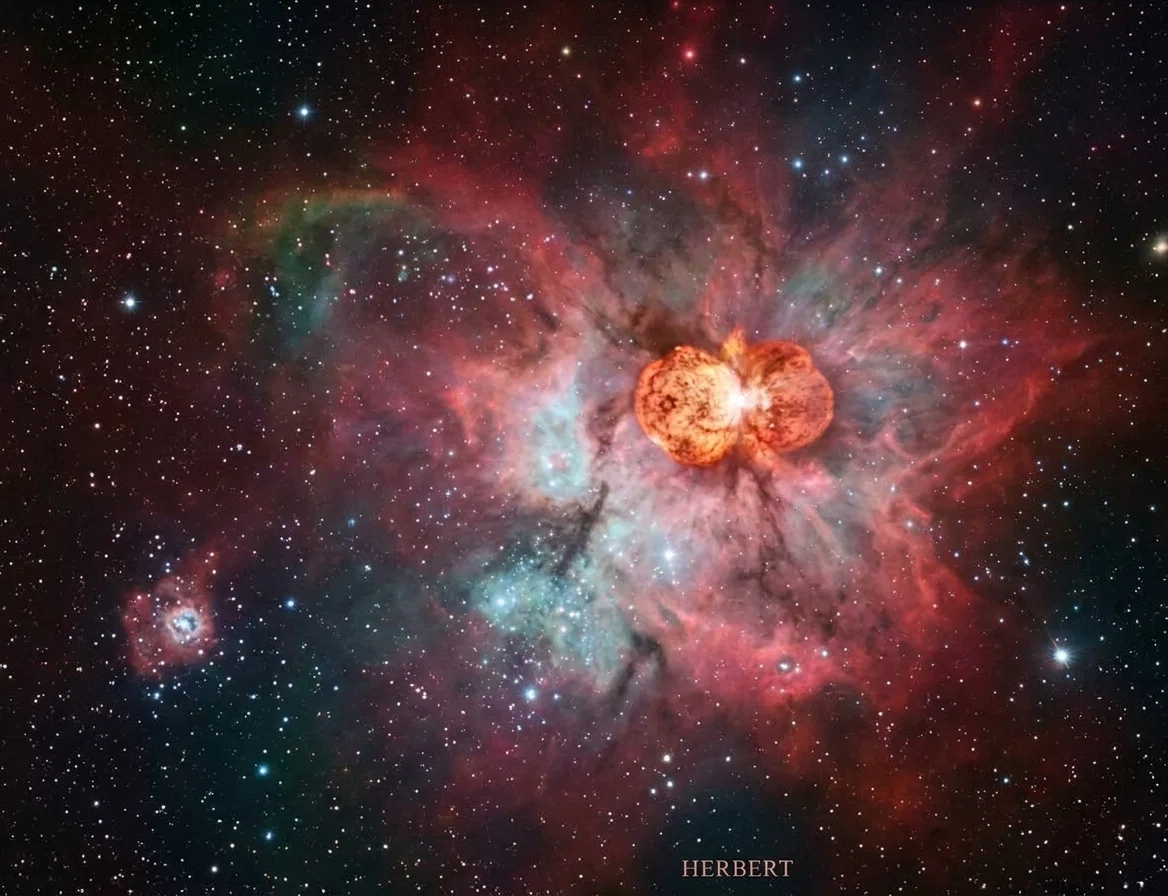
Eta Argus, the finest nebula in the southern heavens, and probably the most wonderful that is visible from any part of the earth. This nebula furnishes valuable proof of the existence and some of the characteristics of another of the chemical elements of nature.
Does God REWARD Faithfulness?
By Evelyn Fernstrom
“She was not such a peculiar girl after all, yet I had made up my mind that I would not let her ideas influence me.”
The story of two friends who worked in the same office, but had different ideas concerning stewardship and what God had intrusted to their hands.
Evelyn Fernstrom
Jean, have you seen those lovely fur coats at Mandel's? They are gorgeous; I went past there this noon, and I just can't forget them," I said to my friend as we were both trying to adjust ourselves to our afternoon's work.
"Yes, I noticed them. They are beautiful, just what we need for the long, cold, Montreal winters," Jean replied.
We had worked together in the same office for one year. Jean was a lovely girl, but somewhat peculiar. She had a heart of gold, was always pleasant to every one, but somehow she was not really one of us, and we had not become very intimately acquainted with her.
"Let us each get a fur coat," I suggested. "You are making as much as I am, and we could begin saving for them at once, and soon we would be beautifully clad," I urged.
"I'm willing," she remarked.
"Good; we'll go down to-morrow and look them over. I'm really thrilled."
The next noon we each decided that we would need one hundred fifty dollars before we could get our coats. This would not take us so very long, we promised each other.
JEAN IS A GOOD NURSE
During the next week it was necessary for me to look for another apartment. I told Jean of my plight and upon her suggestion I moved in with her. It was not long until I became sick with the "flu." Jean insisted on nursing me. I must confess that she knew almost as much about taking care of sick people as a trained nurse would. She was not such a peculiar girl, after all, yet I had made up my mind that I would not let her ideas influence me. I was satisfied with my manner of living, and if she was satisfied with hers, then I felt everything was all right. Another thing, she did not work on Saturdays; nevertheless, I could not help liking her, especially now that I was ill and she was so kind to me; but before I had fully convalesced, I had learned to love Jean. She was like all other girls, full of joy and kindness, but, besides, she had sterling qualities that very few girls possessed.
One evening some time later, as we were sitting in our cozy living room, our conversation led again to fur coats. "I think I have enough saved so that I can purchase mine next week!" I exclaimed. "You have, too, haven't you, dear?"
"No, I really haven't," Jean admitted.
"Oh, I am sure you have. We earn exactly the same, and spend just about the same amount." "I think I lack just exactly fifty dollars."
"Impossible! You must have made a mistake somewhere."
"Why, no, but you know that I give one tenth of my income to the Lord, and, therefore, I have not as much money as you, just now."
"Oh, I had forgotten about that. Well, really why do you do it?" I asked.
JEAN EXPLAINS THE BIBLE
Jean explained that the Bible told us to do this. At this time we were interrupted by some friends who came in, and I forgot about Jean's and my previous conversation. The following day Jean went with me when I purchased my coat. The weather was extremely cold, and I was more than glad that I had finally bought it. "I'm sorry you haven't yours," I said.
That evening, in the course of our conversation, Jean explained that God owned everything, and that all nature gave. She said that we had nothing of our own; God had only appointed us as stewards over His goods, and that God wants His stewards to be faithful in everything. She read the parable in Matthew 25, of the man who traveled into a far-off country. As I listened to her, I could not help seeing the remarkable faith she had in God.
"Why do you have to give one tenth of your income to the Lord?" I asked.
She said that tithing is an expression of our stewardship in giving. We tithe our income in recognition of God's ownership of the whole, just as a tenant pays rent in recognition of the landlord's ownership of, or rights in, the house. Although paying rent entitles the tenant to use the house, it does not make him the owner of it. The tithe is not paid simply because it is the Lord's but because all one has, or acquires, is His.
NOT A NEW DISCOVERY
"I suppose this is something new that has just been discovered," I said.
"No," Jean replied; "we find that Abraham honored God by being faithful in giving the tenth part of his increase to the Lord. This is the first recorded instance of tithing in the Old Testament. To Abraham it was a moral obligation. It was a duty universally recognized by the nations in Abraham's time and long before. Traces of it as something old and well understood appear in the earliest historic times among nations having little or no intercourse with the Jews or with one another. To suppose that so many people all hit upon the tenth is out of the question, and the only reasonable conclusion is that they all got it from the altar, and that it was a part of God's moral law originally revealed to man, and as such was obeyed by Abraham. Abraham's act was, undoubtedly, an expression of his gratitude to God for His goodness to him. It was in full recognition of God's ownership of all things."
"I surely did not know that before. Is there anything else in the Bible about the tithe?" I asked. I wanted to find out all about it, but still I knew that it could hardly be meant for us. It was just one of Jean's peculiarities, but it would do no harm to know how she felt about it.
"There are many references made to it," Jean explained. "I will tell you of a few. The Lord says in Leviticus 27:30, 'All the tithe [tenth] of the land, whether of the seed of the land, or of the fruit of the tree, is the Lord's: it is holy unto the Lord.' In Numbers 18:21 we read that God had given the children of Levi all the tenth in Israel for an inheritance for their service. Jacob vowed a vow at Bethel that of all that the Lord would give him, of that he would surely give the tenth unto the Lord. Christ Himself approved of tithe paying, for we read in Matthew 23:23, 'Ye pay tithe of mint and anise and cummin, and have omitted the weightier matters of the law, judgment, mercy, and faith: these ought ye to have done, and not to leave the other undone.'"
"Christ did not censure them for paying a tenth of even the mint and rue and every little herb. They could not be too strict or too careful in paying debts to God. These they ought to have done. What He reproached11them for was that they were content with this and omitted the equally important matters of justice and real love to God.
"In Deuteronomy 16:17 we are told, 'Every man shall give as he is able, according to the blessing of the Lord thy God which He hath given thee.' We can give according as God has prospered. There is equality among the rich and poor. We need to give only one tenth of our income."
"I did not have any idea of the system that God has requested. I am glad that you told me about it," I exclaimed. I thought that it was a good way, but did not think it was necessary for me to do it. It was right, I knew, but I was not going to become like Jean. Anyhow, was Jean any better off because she paid tithe? I could not see much difference between her and me except that she had less money than I.
THE REWARD
The following day we passed Mandel's during our noon hour, and we could hardly believe our eyes. There were the coats that we had been looking at, and they had been marked down to ninety-nine dollars. Jean and I walked in, and Jean purchased her coat, the identical one she had selected a few weeks before, and which yesterday had been marked one hundred fifty dollars. Jean was fortunate. "Jean," I said, "Do you suppose there is something to this tithe paying?"
"My dear, of course there is. God challenges man to test Him. God says, 'Prove Me now herewith.' When I was saving for my coat, I was tempted to use my tithe so that I could purchase it at the same time you bought yours. I wrestled with the thought that it was cold, and that I needed my coat. I also wondered if it made so very much difference if I used the money and then paid it back at once. However, I finally decided that God wanted me first to give Him the portion that He has asked for; and now I surely am glad that I did so."
I could not forget the experience that Jean had had, and Jean's peculiarities became to me beautiful traits in her character. Jean became a new girl to me. Finally I tried to become like her. God has richly blessed me. I have been paying one tenth of my income to Him, and have in every other way tried to follow Him. I shall always thank Him for bringing Jean into my life.
Dignified Credit
By Bert Rhoads
BERT RHOADS
Much of the business of the world is done on credit. Almost anything, even diamonds, can be bought on what the world calls “dignified credit.” It is a very human frailty for men to be constantly wanting to put the cheap and low on the pedestal of dignity. And everybody knows that what the world calls “dignified credit” rests on the ability of the debtor to pay his bills. If he fails in his payments and his mortgaged property is taken or if the payments need to be forced, the credit becomes anything but dignified.
One Exacts, the Other Forgives
But there is a real dignified credit, and it is outside the realm of worldly business. What the world calls “dignified credit” rests at its best on the debtor’s dollars. If the dollars fail, the dignity is gone. But in Christian business there is genuine dignified credit. And it is dignified because the payment of the debt rests on the creditor and not on the debtor. When the thief on the cross acknowledged his inability to pay his spiritual bills and asked Jesus to do it for him, he did the most dignified thing a thief could do. And when Jesus forgave the debts of the thief, He did the most dignified thing Heaven could do, He extended to the thief dignified credit.
Worldly business exacts the debt; Christian business forgives the debt. Worldly business rests on dollars,—something the debtor has. Christian business with its real dignity rests on something apart from, and outside of, the debtor, something God has,—His forgiveness.
Worldly business asks if a man is successful. Christian business asks if he is faithful. Measured by worldly standards, Moses was a stupendous failure. He rejected a throne with all its wealth and glory to become a herder of sheep and men for eighty years, casting his lot with a race of slaves. And just on the border of the goal of his hopes he saw another leader take his place, while he was called to a lonely grave on a mountain, outside the goal. Worldly business calls him a failure; Inspiration says the man Moses was “faithful in all his house.” Christian business has far more to say about faithfulness than about success. But, regardless of what worldly dictionaries say, in the lexicon of heaven, success is faithfulness.
Credit in Heaven Exalts
Worldly business seeks to do the spectacular thing; it gives and bestows and rescues when it can be done in spectacular ways. It does apparently big things in cheap ways. Christian business gives in obscurity its cup of cold water, mingling with it the tear of sympathy. It bestows the needed garment with the trembling touch of love. It rescues the sick or sin-prisoned one with the broken voice of kindness. Christian business dignifies everything it touches. Where worldly business gives its dollars, Christian business gives its tenderness, its tears, its heart.
It is humiliating to ask credit of a money-lending institution or to affix one’s name to a mortgage note. But the bank of heaven says, “Come unto Me, . . . and I will give,” and it is transcendent dignity to accept that credit. Your debts to an earthly bank may humiliate you and the bank. Your credit at the bank of heaven exalts and dignifies you, your bank, and your Banker.