THROUGH the kindness of the superintendent of the Mexican Mission Field, Pastor G. W. Reaser, we have received copies of “The Mexican Herald,” published in the City of Mexico, giving very full accounts of the awful floods in the city of Monterey in Northeast Mexico. It is almost impossible to conceive how breaking dams and heavy rains could cause such damage. Railroads have been broken up and the city has been more than flooded. Eighteen blocks have been washed away. Thousands are without food and thousands more homeless.
Over 1,200 bodies have been recovered so far, but the last estimates are that more than 2,000 perished in the city of Monterey. The Santa Catarina River became a great roaring torrent, which divided in the city into two fierce streams, sweeping away five blocks of the district south of the river, and leaving that part of the city as tho no buildings had ever stood there.
No Americans have been reported to be lost, and it is not thought that any of them are missing, as few foreign families resided in the flooded district.
Reports from the country up and down the valley of the Santa Catarina are hard to obtain; but the associated press despatch reports that the dead has been placed at 2,000 by the city authorities, and the number of homeless between 15,000 and 20,000. The Federal Government has sent in $50,000 in money, and contributions are pouring in from different cities in the United States.
The great Monterey steel plant was one of the heaviest losers, not only in wrecked buildings, but in 500,000 tons of coke. It is, however, upon the poor people that the suffering falls heaviest.
During seventy-two hours ending at noon of August 29, twenty-one and seven-eighths inches of rain fell in Monterey. Many houses have fallen from the effects of the continuous rains, and many others are tottering. It is supposed that many of the dead will never be recovered, as the river is filled with quicksand, and bodies have doubtless been covered by these shifting sands.
Local bakers were unable to supply bread, as their ovens were flooded and a scarcity of wood exists. There is plenty of corn around the town, but all the mills for grinding it have been destroyed. Water pipes were broken, so that no drinking-water was left in the city, and a food and water famine is threatened. Yet humanity is doing all that it can to relieve the sufferers.
Added to the flood have been destructive fires which have since occurred, increasing the loss many thousands of dollars. The accompanying photographs will give our readers an idea of the destructiveness of the flood.
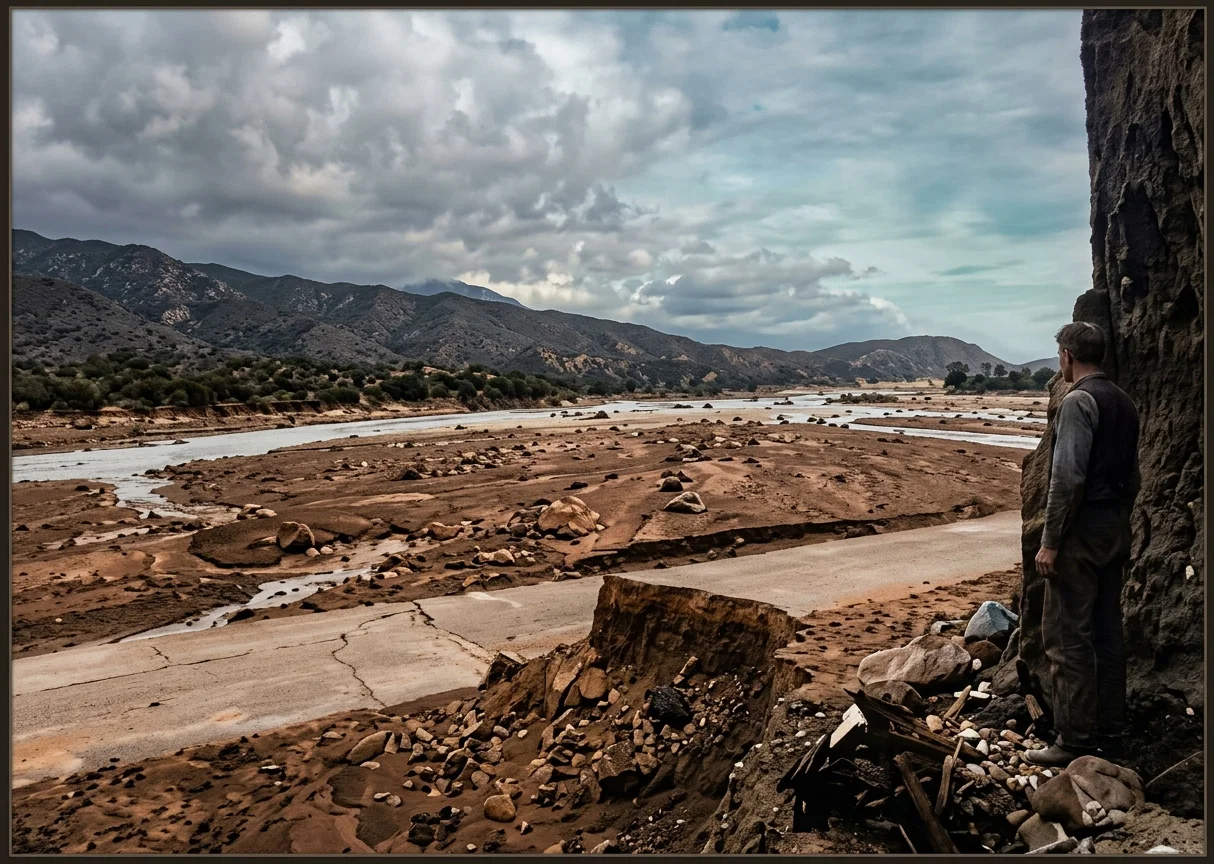
Where the flood cut down 25 feet. Washing away bodily four city blocks which extended out from the spot where the man stands. Once a street corner.
One well-known magazine writer, Mr. E. T. Hollingsworth, declares that the rise of the Santa Catarina was one of the most devastating floods on record. In the mountains the loss of life and property was greater than in the city. It is estimated that three thousand lives were lost in the mountains, and property valued at one million dollars. Where once was the national railroad to Saltillo is now the bed of a large river, so that the railroad is compelled to build an entirely new line.
Working in the flooded district is very dangerous on account of the stench from the dead bodies of both man and beast. Soon after the flood, he tells us, and before the city recovered itself, the meats sold in the markets were something horrible, but the people were forced to buy them or starve. One of the natives was to be seen on the street with an old hen in one hand and a basket of eggs in the other. The eggs had signs of the cross painted on them, and also some queer characters which read that the world is coming to an end. He was telling every one that the hen was a saint and had laid the eggs. Some of the people of course believed this, and they were to be seen praying to the hen to please stop the flood.
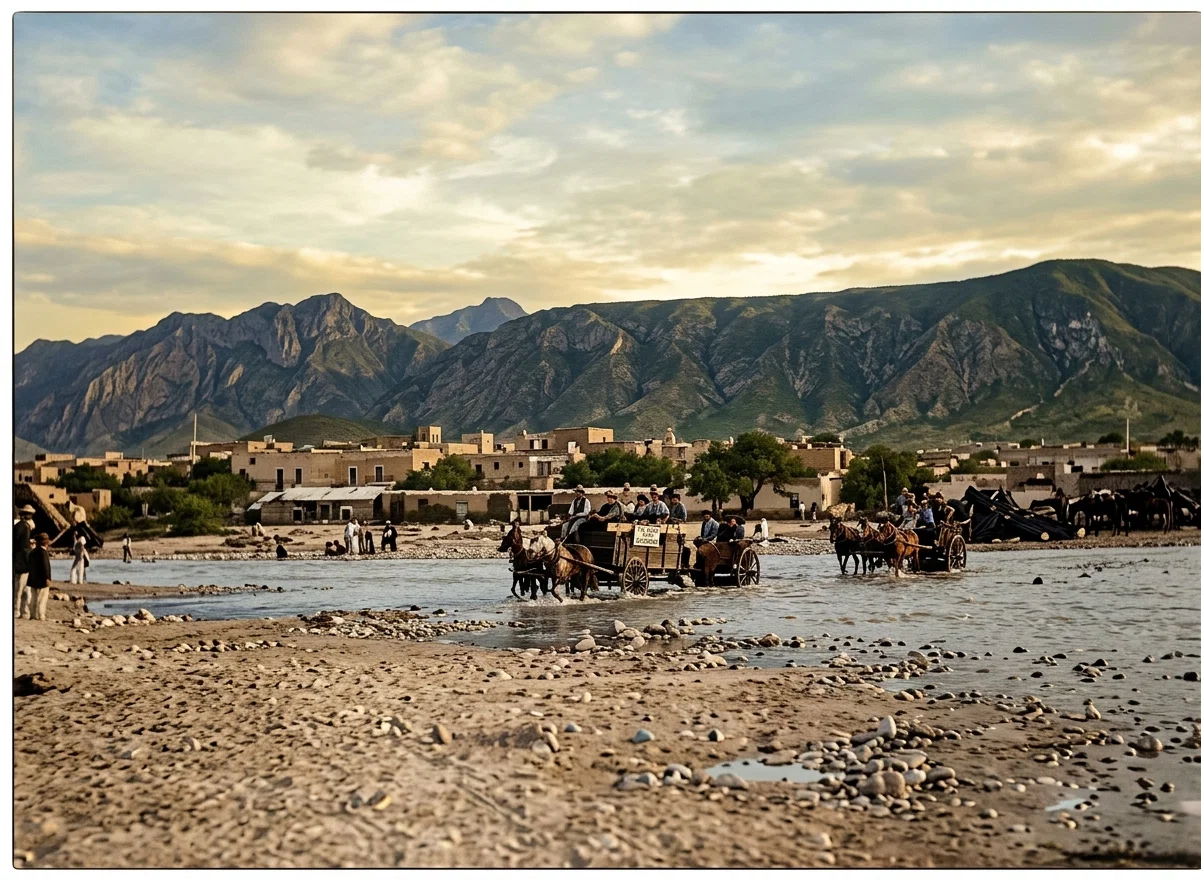
Improvised ferry. Ten cents for crossing after the flood.
The original bed of the river in the city was only about fifty feet wide, and now is over half a mile. Where streets were once only ten feet above the river, the river is now twenty-five feet below the streets.
And so we might fill a page with items of the awful news, but this must suffice.
The latest news comes from Washington, September 12, and is to the effect that more than 10,000 lives have been lost in the Santa Catarina Valley. Matamoras is under water. The receding of the flood water reveals no exaggeration, but confirms all the earlier reports sent out. It is said that none other than eye-witnesses of the scene in the stricken portion of the city can imagine its awful horror.
Higher Criticism and Christ’s Birth
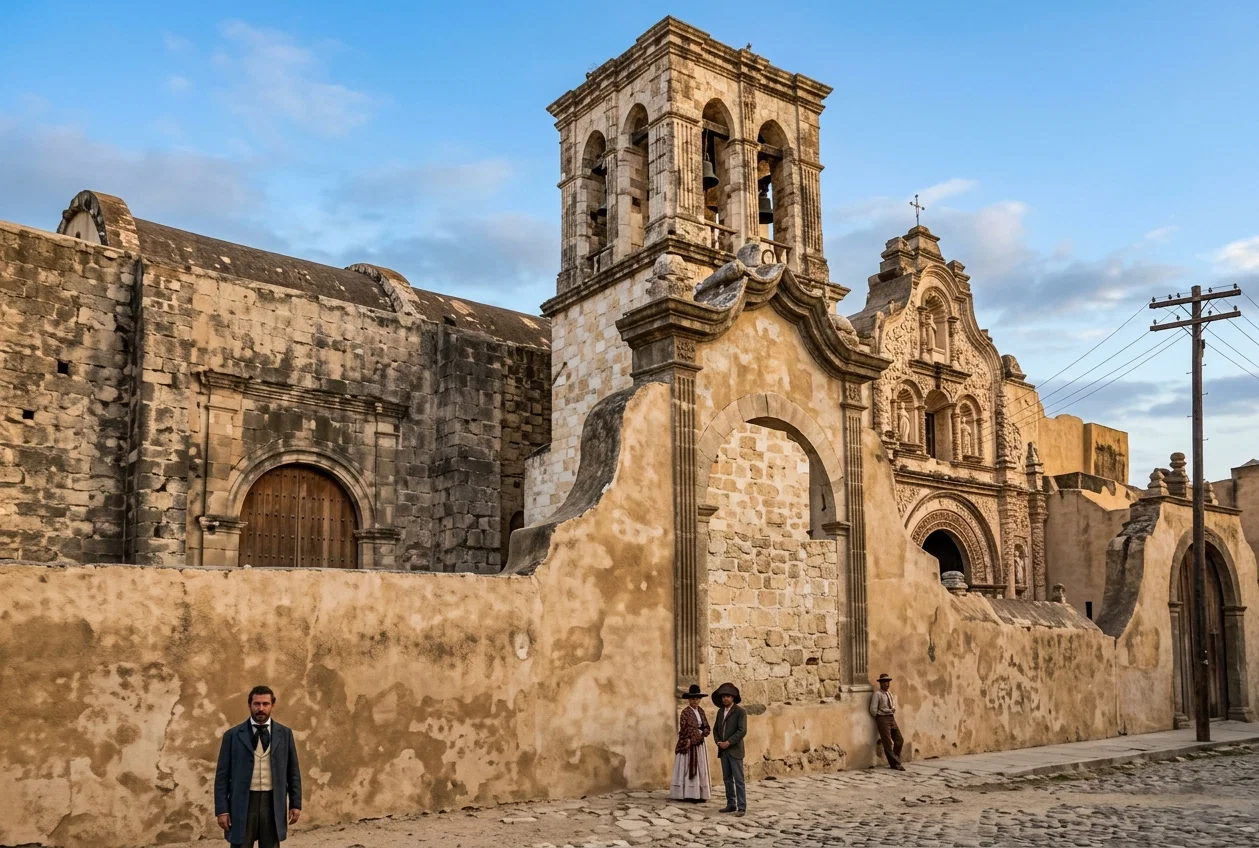
San Francisco Church, the oldest in Monterey, one block from Zaragoza Plaza, completely destroyed by the flood.
And now the Higher Critic, Dr. Paul Haupt, according to a Sunday daily, wishes us to believe that Jesus was not a Jew, but a member of the Aryan race, and that He was born in Galilee. Of course this could stand only on the supposition that the record of Christ’s birth in Matthew 2 and the many other scriptures which declare that He was of the seed of David according to the flesh, are interpolations. Dr. Haupt’s theory would set aside the record of both Matthew and Luke regarding the birth of Jesus. Many other passages would have to give way to the supposition of the learned doctor that Jesus was born in Galilee, and, as there were many Gentiles in Galilee, presumably of Gentile parents. With what wondrous ease the sacred Scriptures are set aside for the Higher Critics! Such astounding assumption is worthy of a better cause. There are many, we are glad to say, who will prefer the Scriptures to the unsupported opinion of Dr. Haupt and his associates.
Recovery of a Lost Art
By R.
Hardening Copper
We now have in “The Technical World” for June, the statement by Roland Ashford Phillips that a jeweler, David Lamon, of Denver, has suddenly found himself in possession of the much-sought-after method of hardening copper. While working at his trade as a jeweler, he mistook another compound for borax; and this, instead of softening the metal, as borax does, instantly changed the heated copper into such a degree of firmness that manipulation was impossible. Quick to take advantage of this accident, the jeweler at once made a chemical analysis of the compound, determined the ingredients, and protected his wonderful secret by a patent.
Thus the art that was old even when the pyramids were building, and which was lost, to remain a mystery and an unsolved secret for centuries, seems to have once more been given to the world by the fortunate blunder of an unsuspecting jeweler.
By the processes, the copper is not only hardened, but tempered. We are told that it is neither treated in the molten state nor glazed, but the finished product in any and all shapes is given a complete and lasting physical change.
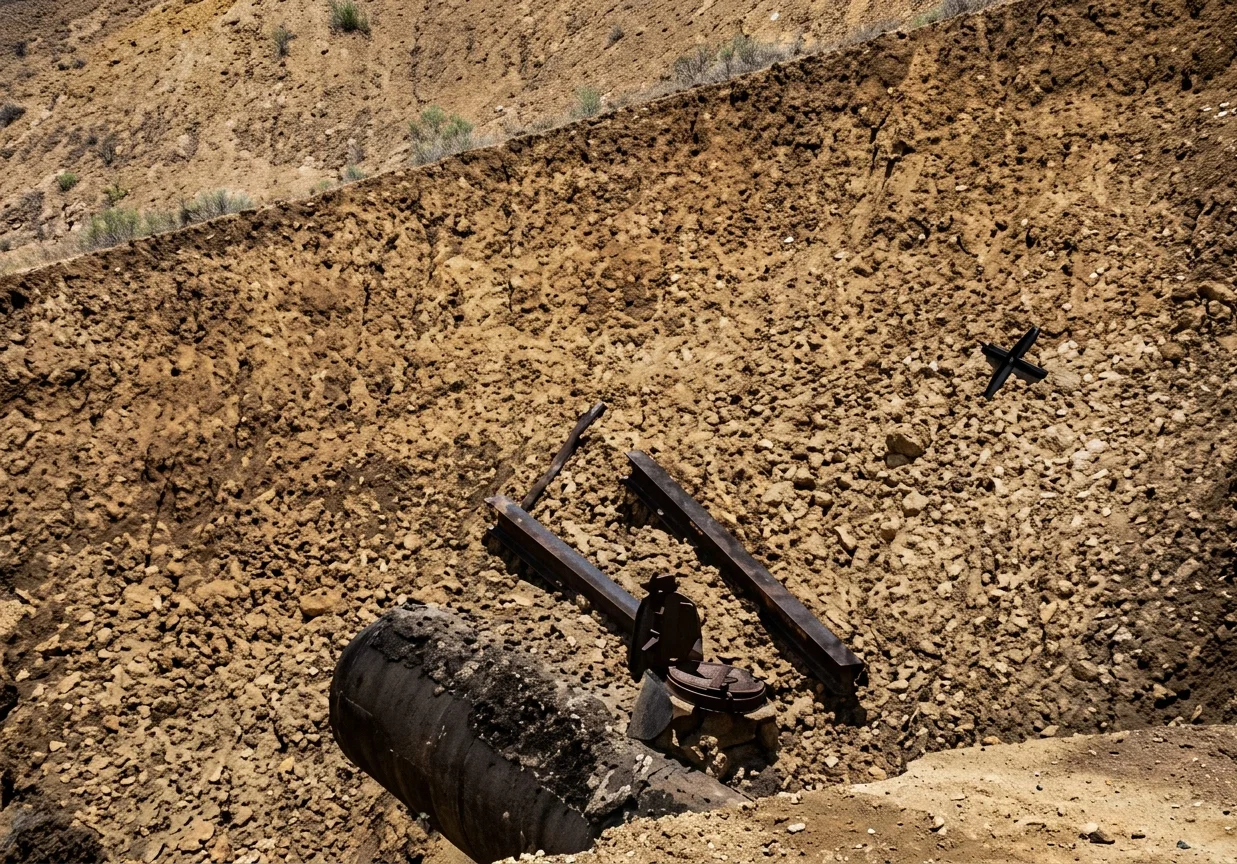
Looking out from the same spot as the picture opposite. The sewer pipe jutting out 20 feet over the ground where formerly it was buried 5 feet.
The method has met with considerable opposition, but has finally won enough confidence on the part of capital that a large plant has been erected and is now nearly ready for operation. This new product will be known as Lamon copper, and it will be used for all commercial purposes from wire to automobile engines. The cost of the treatment is so slight that the tempered metal can readily be sold at the present price of the raw material.11Recently, as an experiment only, the dies of a certain manufacturing company were tempered; and a letter from the president of the company states that the life of each die was trebled, altho the striking pressure of 1,200 lbs. was still sustained. According to the statements of a railroad company’s engineer, the average copper-wheel will run from 1,200 to 3,000 miles. When it begins to blister, the blister crumbles into dust and the wheel is ruined. Where these wheels were treated by the Lamon process, they ran from 8,000 up to almost 16,000 miles. A trolley wire where the wasting, wear, and tear are continual, as at curves, will under this treatment be lengthened, so that instead of lasting nine months as now, they will last three or more years.
To awaken interest and strengthen its proofs, the inventor is giving to his friends small copper screw-drivers treated by these methods. Altho barely as thick as a copper cent, with an edge almost razor-like, they will turn the most stubborn screw without the least trouble, as easily as if made of steel. Copper is in great demand for electric appliances, which constantly keeps the market value up. By doubling and trebling the life of the copper in use, the result will be the same as if twice or three times as much copper were produced by the old methods.
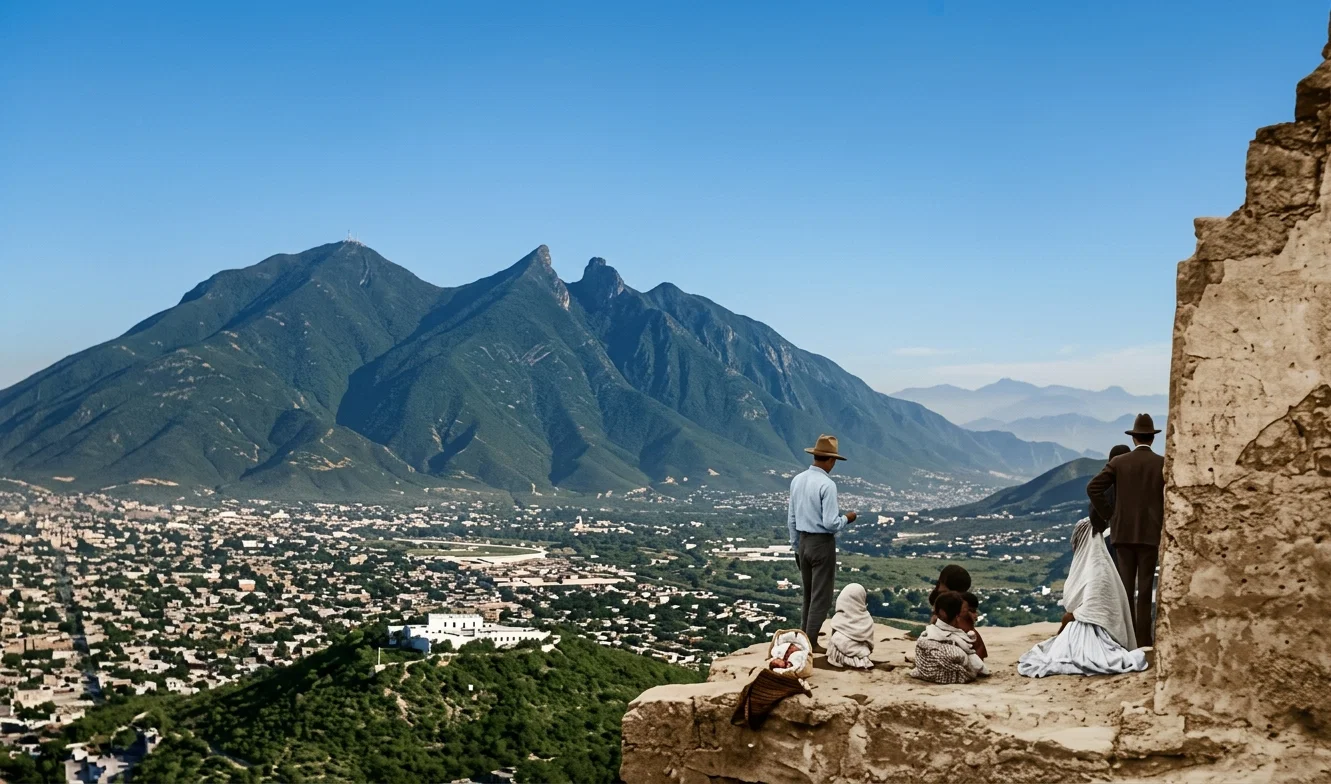
General view of Monterey looking eastward toward the Gulf of Mexico from the site of an old church which stands 500 feet above the city on a mountain ridge west of the city. Eighteen blocks of the city were washed away in a district just around the prominent white building in the center. Saddle Mountain in the distance.
Consequently, the promise of this process is very great.
It is only one out of the many evidences that we are in the time mentioned by the prophet Daniel, the time when knowledge should be increased. Knowledge to-day is being extensively increased, and the lesson of it all is that each one of us should know his duty before God as no people in any age of the past have ever known it. Knowledge is increasing; and if our knowledge of our relationship to God is not proportionately increased, a heavy responsibility rests upon us. As to our knowing our duty and doing it, Christ has said: “He that willeth to do His will shall know of the doctrine;” and the angel informed Daniel that the wise should understand these things, but the wicked should do wickedly, and none of the wicked would understand. Dan. 12: 10. R.
University Extension in Agriculture
The University of California is doing excellent work for the agriculturists of the state through their Extension in Agriculture of the College of Agriculture. For the year closing June 30, 1909, there were 93 farmers’ institutes held, covering 34 counties of the state. The total number of sessions in these institutes was 297, with a total attendance of 28,294. In addition to the regular institute work, a farmers’ demonstration train was run in cooperation with the Southern Pacific Company. These cars were filled with exhibits covering the matter of better cereal productions, soils and fertilizers, diseases of animals, creamery work, insect pests and plant diseases, spraying, re-forestation, and the eucalypts, and other subjects of an instructive nature. Attached to this train was a passenger coach used for lecturing purposes. During the year the University Extension in Agriculture came into personal contact with 67,564 individuals in the state. This certainly ought to be appreciated by the farmers and fruit-growers of the state.
Persecution in Mexico
There has come to us directly from Mexico, from a gentleman who is reliable, the following story of persecution, which recalls the Dark Ages. Names and places are given, but these we withhold as they do not affect the principles involved, but may affect parties.
Seven years ago, a young man began work for a Bible society. He was born of Protestant parents and was himself a Protestant. He felt that it was his duty to publish the word of God as far as possible. His work brought to him persecutions because of his efforts to distribute Bibles among the Catholics of the Republic. In one town the people stoned him until he became unconscious. His brother-in-law, and companion in labor, was tied to a tree and stoned to death. The circumstance occurred only one year ago. As the result of his injuries, he was laid up in the hospital for three months. However, this did not affect his courage in the work of the Lord. When he was able, he began his work again. At one time while working on the West Coast in company with an ordained minister, a Catholic mob came to their room, assassinated the minister, but spared his life.
He has recently accepted the great message for this time, planting his feet upon all the commandments of God and the faith of Jesus.
We are told again and again by Roman Catholics themselves that the church never changes. As she has been in the past, so shall she always be. Such incidents as this, in a land where she has power, where for many years her doctrines have had hold upon the people, very clearly point out what we could expect if she were given complete power in the world. We would find that the freest lands would become realms of tyranny. He who has the truth can afford to be fair, nay, more than fair, for he is willing to leave to the great Author of Truth the judgment and final destiny of every soul. He who believes in religious liberty, believes in religious liberty for the other man.
The Shepherd’s Rod and Staff
Artists all through the Middle Ages and to the present time have been wont to represent the Eastern shepherd as having a long staff with a hook on the end. This, according to seeming facts, is an utter misrepresentation of the case. Dr. Geo. M. Mackie, of Beirut, Syria, writes to the Sunday School Times that the staff commonly used by Orientals on a journey is somewhat longer than the ordinary walking-stick, always held by the thin or small end, and serves as a weapon of defense and something to lean upon in places of difficulty. Sometimes the thick end is formed in the shape of a battle-ax head or some other object as an ornament, but where it is meant for actual service, it has no curved or ornamental top. One of the peculiarities of the shepherd’s outfit is that it includes two sticks; one of these a short heavy-headed club just mentioned; the other a staff between six and seven feet in length. The club hangs from the belt or fitted into a pouch or strap at the side of the shepherd’s cloak. The latter is always held with the thick end to the ground and is carried by the shepherd. With it he beats down leaves from trees, and rests his weight upon it in climbing the mountains. The former is the “rod” of Psalm 23; the latter the “staff.” But the doctor says he has never seen any approach to the pastoral hook introduced by medieval Italian art into Scripture illustration.
What Shall I Do?
By Illinois Layman
TELL me what is the duty of an old-fashioned Congregationalist? What is he to do in this day of new lights, when your pastor does not consider baptism of any importance, and the Lord’s Supper has nothing in it for him, but he can give it to the church if they want it, and he never preaches salvation through repentance and faith in Christ, but holds up good works? Shall we, if the church fills the pulpit with that kind of service, continue with them, or shall we withdraw and pay our money to some church where the old-time religion is taught? I wish you would say something on this point that would benefit many in my fix. —Illinois Layman, in “The Advance” (Congregationalist paper).
A Sunday-Law, City.
At the recent Catholic Federation meeting in Pittsburg, Pa., the mayor of that city said:
“Detractors have tried to smirch Pittsburg, but I want to say to you that this is the most moral city of its size in the world. Instead of being the center of all that is bad, it is just the contrary. In no city is there a stricter observance of the Sabbath; no city is more religious. Pittsburg has a real, genuine Sunday; a real Christian, moral, religious Sunday.”
The keeping of a counterfeit Sabbath is mighty poor evidence of genuine morality. Unfortunately for her reputation, Pittsburg is noted for other things as well as Sunday-keeping.
A Masterpiece of Satan
“A Masterpiece of Satan” is what the Christian Statesman, the organ of the National Reform party, calls the Sunday paper. It is not so characterized because it is worse than the average paper; for “it is no worse;” “much of it is excellent,” the Statesman declares, but “the grave objection to it is that it preempts sacred time.” Now, if it be true that the Sunday paper is a “masterpiece of Satan” because “it preempts sacred time,” what shall we say of Sunday, which has preempted the place that belongs to God, the Creator? The Sabbath is the seventh day, not the first day, of the week. To apply the Sabbath law to Sunday is an utter perversion of the Scripture.
Increasing
Increasing.—Referring to the Catholic charge that Protestants are repudiating the Bible and Christianity, the Christian Advocate, the leading Methodist paper, says: “To deny that these tendencies are increasing we have not the courage to attempt.”
Idaho Counties Vote Dry
Two counties in Idaho voted “dry,” August 26; namely, Idaho and Canyon, the latter by a majority of 1,850.
The Indians of Ecuador
By Delwin Rees Buckner
WHEN we speak of the Indians of Ecuador, we may also be said to be speaking of the native inhabitants of other South American countries as well. There is much similarity between the Indians of Ecuador, Peru, Bolivia, and Chile. In fact, before the Spanish conquerors came, they were all linked together under the domination of the Inca monarchs, of whom Huayna-Capac was the principal one. At his death, he divided his empire between Atahualpa, who ruled in Quito, and Huascar, who had his capital in Cuzco, Peru. Later Atahualpa conquered his brother and ruled supreme until the arrival of Pizarro, who in turn took him prisoner, and after exacting millions as ransom money, finally strangled him in Cajamarca. The story of Spanish rule is one of cruelty and barbarity.
Indians of Ecuador
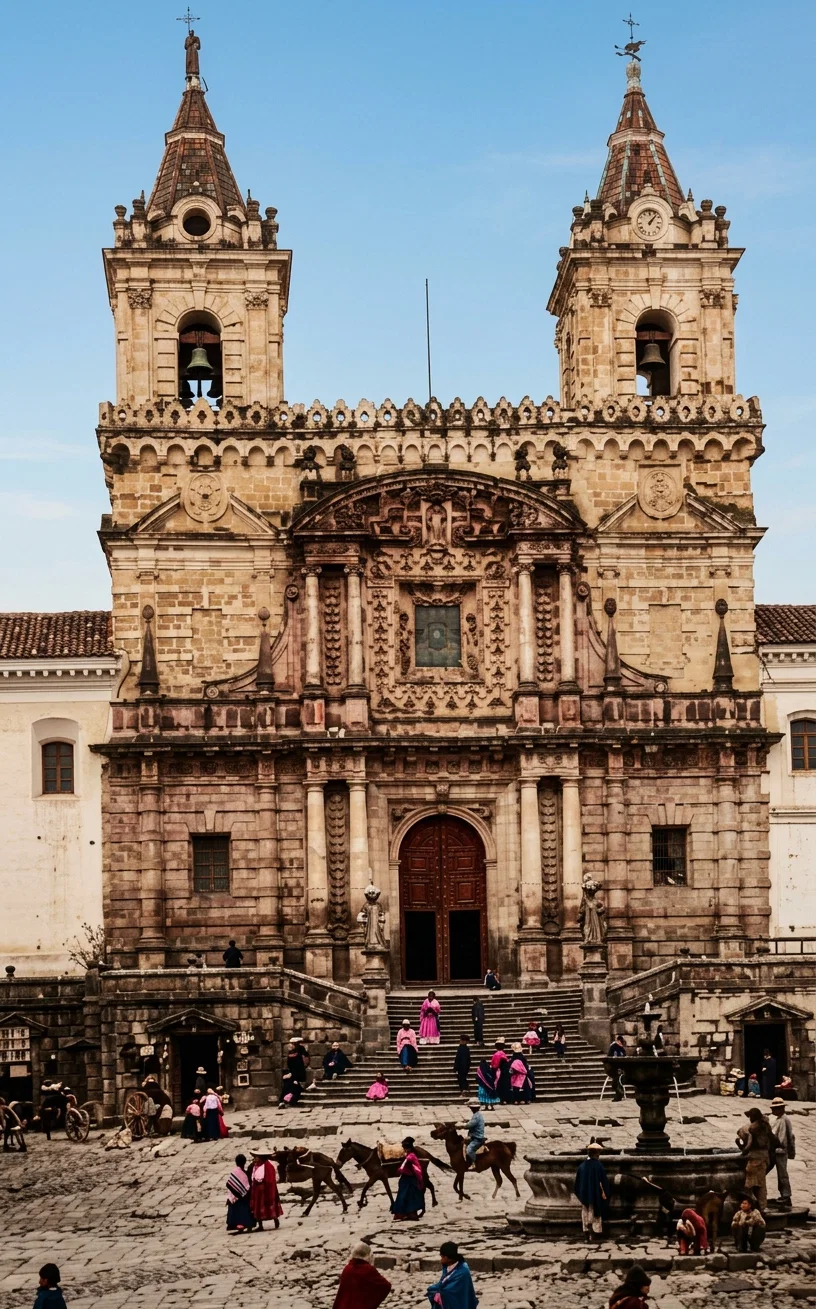
San Francisco Church, dating from the early Colonial period.
The pure Indian of Ecuador forms at least one half of the population. On the coast he is not so common as in the mountainous region. In Esmeraldas, the most northern province, there is one tribe left in all of its purity. They know little Spanish. The women are forbidden to learn the language of the white men. Before the advent of the Spaniard, the coast region was undoubtedly more extensively populated, but owing to internecine wars, and conflicts with the white man, the pure Indian of the coast has almost disappeared.
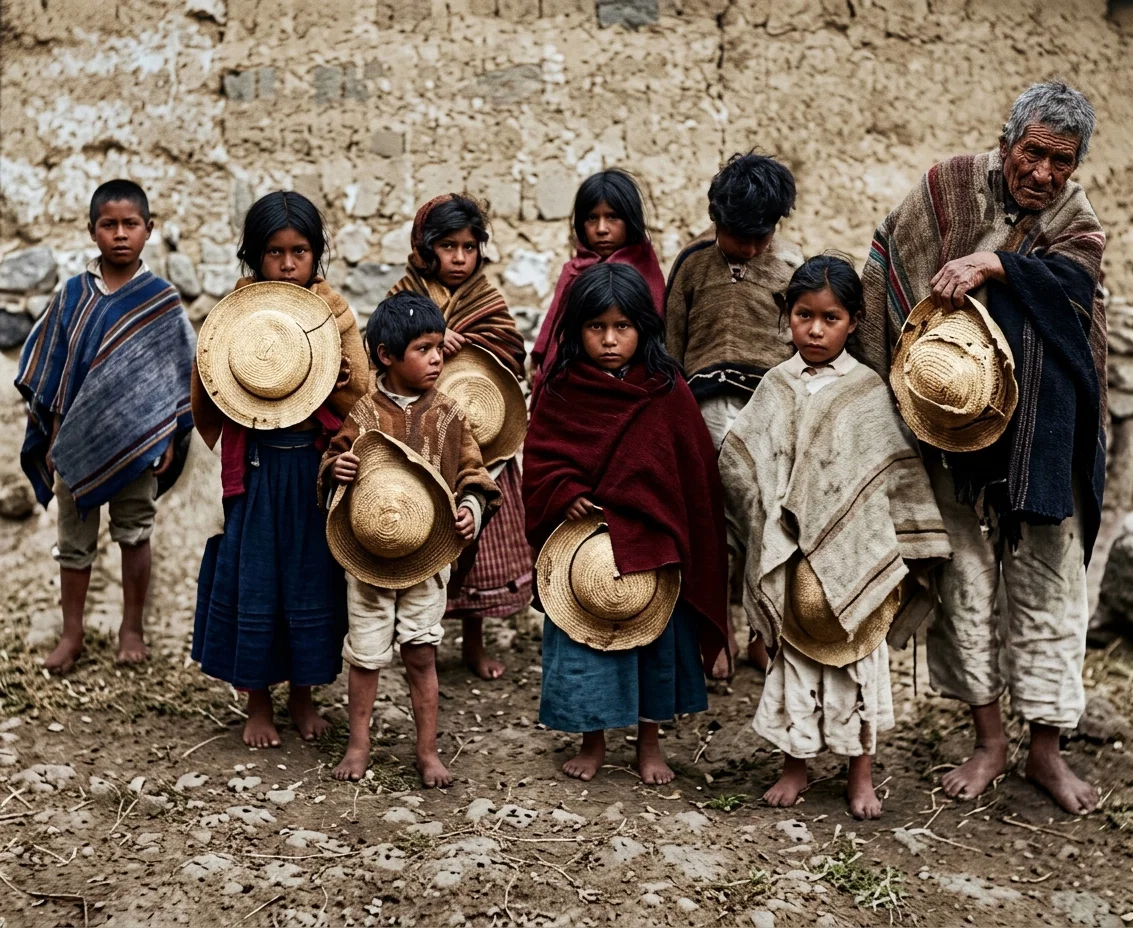
The Indians of the mountains form a compact population. They are descendants of the Shiris who ruled in Ecuador before the Incas. Altho there is some difference between these Indians in the different provinces, still they speak a common language. This unity of speech has been effected in large part by the owners of estates and Catholic missionaries, who, instead of learning many Indian dialects, urged or compelled the natives to learn the most widely spoken language, which has always been the Quichua. This arrangement will aid our missionaries also. If they know the Quichua they can work among any of the Indian tribes of the Sierra and also among some in East Ecuador. This tongue is common also to the Indians of Colombia, Peru, and Bolivia, as well as parts of Chile.
The Indian of the mountains is of a phlegmatic temperament. Unless under the influence of liquor he is melancholy, taciturn, cautious. His worst vice is drunkenness. The men are strong and vigorous when it comes to bearing heavy burdens, or walking long distances. They are weak in other classes of labor. They have been patient under the abuses of the Spaniard. Very few massacres have ever occurred in the Sierras.
The Indian lives in a rude hut, constructed of straw, or of earth and straw. This consists of no more than one or two rooms. It lacks every comfort. A sheepskin serves as a bed for the inmates, as well as for four or more dogs.
Nominally there is no slavery in this country. However, under the system of “Conciertos” the Indian is as much in servitude as he has ever been, perhaps. With justice, Wolf says, “The Indian, altho nominally free, groans under as true a yoke of serfdom as in colonial days.”
The Indians of the Amazon Valley, or the eastern part of Ecuador, differ somewhat from those of the Sierra. Having been free for centuries in their forests, they are restless when placed under restraint. In the seventeenth and eighteenth centuries the Jesuit missionaries founded missions in the region east of the Andes. In 1767 these Jesuits were expelled, and the Indians, who had been gathered together into mission centers, were left free to enter again into their savage life. Missions of the Catholic Church are only found to-day in the region of Napo and Canelos. At the present time the government is stirred over the fact that some unscrupulous men are selling Indian families to Peruvians further down the river for the sum of $100, $200, $400, or $500. The church, too, is doing its best to put a stop to the inhuman practise. These Indians are taken to populous centers. It may be that there they will have a better privilege of hearing of the only Gospel which can brighten their lives and bring them perfect freedom.
Of all the heathen tribes of the eastern region of Ecuador, the Jivaros are the most civilized and numerous. At the same time they are bloodthirsty and warlike, and cherish an undying hatred for the white man, and with some reason. The Spaniards were attracted by the gold which is found in all rivers which flow into the Amazon from the Andes of Ecuador. In the sixteenth century populous cities were founded in the Amazon Valley at the foot of the Cordilleras, some of which counted 20,000 or 30,000 inhabitants. The eastern part of Ecuador was far more advanced than the mountainous region. At present all is very much reversed. In 1599 the Jivaros, exasperated by the harshness of Spanish rule, mutinied. The governor was compelled to drink molten gold. All men were killed. The white women were taken captive. Many Jivaros of to-day are quite white, being due to the fact that they are descendants of Spanish women carried away at the time of the massacre.
These Indians live in polygamy. Their houses are roomy and well fortified against the attacks of an enemy. They cultivate cotton and a few other articles, and have dealings with the whites. Some missionaries from the “Gospel Union,” of Kansas City, are situated among the Jivaro Indians at Macas. They are learning the language preparatory to working among them and teaching them the Bible. There are women among these, but, altho they have to undergo hardships in the march to the station, live with none of the comforts of civilization, not even beasts of burden, still, as one of them has said in a letter, “We endure all things for the Gospel’s sake.” I long for the moment when we who have the true message will be able to bear our testimony among not only the Jivaros, but all other kindreds and nations of the great Amazon Valley, one of the darkest, most neglected parts of the world of to-day.
The Zaparos are more friendly to the whites than are the Jivaros. They are hospitable, easy-going, jovial in character, but are lazy and take small pains to work the soil and cultivate it. Their language is peculiar, insomuch as it contains a number of words which pass three syllables. The word for “seven” is “haimucamaraqui-caramau-taca-nacuaqui,” which means three pairs and one. Happily “seven” is the highest number13. All higher numerals are expressed by “cuma,” which means “much.”
At present the Indians are fewer in number than before the Spanish conquest. Some of the reasons are: The Portuguese in the seventeenth and eighteenth centuries made several excursions into their territory and took about 50,000 captive. Smallpox, which appeared among the Indians shortly after the entrance of the Spaniards among them in the seventeenth century, has according to one Ecuadorian author, carried off 400,000 victims. Ten rebellions waged against the conquering Spaniards, the principal ones in 1599, 1660, and 1695, have caused the death of a number. Spanish ambition, greed, thirst for gold, have been the cause of the death of millions of American Indians.
This, in brief, is an account of the Indians of Ecuador, especially of those of the eastern region. The Amazonic territory included in Ecuador, is equal to 12,000 square leagues. The principal products of the region are rubber, quinin, vanilla, gutta-percha, used for cables, cinnamon, of as good quality as that of Ceylon, sarsaparilla, wax, chocolate (cacao), and gold.
Where the soil is worked, tobacco, sugar-cane, coffee, grapes, tropical fruits, cotton, indigo, cochineal, may be produced.
At the present time missionary endeavor is being urged by the church here. Among the Catholics the Jesuits have always been the most active in bringing the Indians under the Catholic catechism and church regulations. Recent, indeed, has been the entrance of Protestants among the Indians of East Ecuador. Adventists have never given their message in this region yet, but as our papers go to the missionaries stationed in Macas we may be justly said to have gained a start. One of the attendants of our Sabbath-school class here has also been offered a position in Canelos. As he has always had an interest in our message, and keeps the Sabbath as a rest, we hope that, if he does go, he will continue to follow the convictions of his heart and bring some souls to the light. Thus goes God’s message to this part of the earth.
DELWIN REES BUCKNER.
Ambato, Ecuador.
Necessary
“THE heavier cross the heavier prayer,
The bruised herbs most fragrant are;
If wind and sky were always fair
The sailor would not watch the star;
And David’s psalms had ne’er been sung
If grief his heart had never wrung.”
Our Work and Workers
(Items from the Local Papers)
A COMPANY of workers at Fergus Falls, Minn., at the head of whom is O. E. Johansen, report eleven persons who have been baptized, eight joining the church at Navan, Minn.
SEVEN persons were baptized at Northeast, Pa., on July 4. July 31, in Philadelphia, fifteen decided to obey the truth. Four were added to the Leesburg Church July 31.
THREE were baptized at St. Helena (Cal.) Sanitarium, July 10, by Brother F. W. Field, superintendent of the Japanese Mission Field, one of whom was his little daughter Ethel.
G. G. RUPERT closed a series of ten days’ meetings at Butler, Okla., and as the result eleven were added to the church and three baptized. David Voth reports the baptism of two at Purcell, Okla.
FOUR accepted the truth at Norwood, Colo., at recent meetings held by J. W. Norwood and C. S. Prent. J. W. Norwood has left Colorado for the Arkansas Conference, of which he becomes president.
CHARLES M. COTTRELL, who has had charge of the Canadian Branch of this house, has been forced to return to California on account of the illness of his father. W. V. Sample, one of our old employees, takes charge for a few months.
AT the West Virginia Conference proceedings, August 5-15, W. D. MacLay was chosen president; John F. Steele, vice-president; secretary and treasurer, Pearl L. Rees; field missionary secretary, D. W. Perry; Sabbath-school and educational secretary, Mrs. M. L. Haddix. The executive committee consists of W. D. MacLay, John F. Steele, S. F. Ross, A. T. Halstead, and W. H. Snider.
UNION COLLEGE has for some years been developing a system of industrial education, which is now in a measure perfected. They now publish an industrial manual describing in detail the academic, industrial, agricultural, and domestic science courses. Those desiring it will send ten cents in stamps, or, by the dozen, five cents each, to the president’s office, Union College, College View, Neb. The president is desirous of obtaining the names and present addresses of all who have ever been connected with Union College. Address as above.
LARS NIELSON tells the story of a young Swedish family out in North Dakota moving onto a homestead, their horses running away and tipping the wagon over in a German’s yard; but the wife and two little girls who were on the land were uninjured. About a year after this the German called at the home of the Swedish family and found that the lady had been weeping. Inquiring the reason, she said that she was burdened about the salvation of herself and family. They sent her the Swedish paper Sions Väktare, which was received and read with interest. The next year the Swedish family, with the wife of the German brother, went to camp-meeting, where the entire Swedish family were baptized with much joy of heart. Meetings were held in their community, and six persons were baptized and a church of sixteen members was organized. Ten of these were baptized at the camp-meeting. The seed of truth will not return void.
One of the Tokens.— At a Kansas camp-meeting at Council Grove, August 25, a collection was taken for foreign missions aggregating $6,341.98. Let the good work go on. It is a good time to deposit in the treasury of God, and to invest in souls.
CHRIST OUR ADVOCATE
A clear, tho brief, setting forth of the Bible types and symbols, the services in connection with the earthly sanctuary, the effectual sacrifice and priesthood of our Lord, to which all these types pointed, and the great prophetic period of Dan. 8:14. Contains 112 pages and is illustrated. Price ten cents.
Life and Health
A PRACTICAL health journal, published with a view of meeting hygienic needs in every home; teaching how to care for the health and how to preserve life; prescribing simple home treatments to assist nature in throwing off diseases rather than adding more poison by using drugs or unnatural stimulants as remedies: teaching how to avoid disease as far as possible, how to manage in the home when sickness does come, and how to combat the disease by simple remedies which nature provides.
Send for sample copy and special rates to agents. Price 10 cents per copy or $1.00 per year.
Address, LIFE & HEALTH, Takoma Park, D. C.
For Sale
For Sale.—Several tracts good farm property near Sebastopol and Santa Rosa; liberal terms; excellent improvements; fruit, etc. Address “L,” care of Pacific Press, Mountain View, Cal.