We wish at this time to address you a few words in reference to a question which we feel is of some importance to our people in this Conference.
After much delay and anxious waiting, the two Dakotas, with sister Territories, expect soon to become full-fledged States. Of course this fact has caused much rejoicing in both North and South Dakota, and all are longing for admission to the Union. The convention to frame a Constitution to be submitted to the people of South Dakota at the fall election in October, has convened at Sioux Falls, done its work, and adjourned. This constitution, which President Harrison recently stated was the best one ever offered to the people of any State, will be either adopted or rejected. No doubt you have read it, and admire the spirit which generally pervades that document. Probably there will be no question on its adoption, but we wish to call your attention to one of the three amendments, which are to be voted on separately at that time; viz., the one relating to constitutional prohibition. This amendment, if sanctioned by the people, becomes a part of the constitution, and prohibits the manufacture and sale of intoxicating liquors within the bounds of this new State.
Perhaps there are those who may read these lines who have traveled more or less extensively over the Territory, and who know by observation to what an extent the rum traffic is carried on in Western towns and cities. In many places rich and poor, young and old, men and women, are frequenters of the open saloon, imbibing freely of the deadly drink which degrades a person's soul and body, and dethrones reason and judgment. One of the great questions to be decided by the people of our new State this fall is, Shall the manufacture and sale of intoxicating liquors be legalized or placed under the ban of the law? We firmly believe that the manufacture and sale of spirituous liquors as beverages, is a sin before God and man. If this is true, then the people of South Dakota would be committing sin to legalize its traffic, for we have no right to license a thing that is morally wrong. But, says one, if the amendment should be carried, would it prohibit the manufacture and sale? Perhaps not entirely at first. But how many laws have we on the statute-books which are entirely and wholly observed and not broken in some instances? And shall we say that as long as they are not, they are not necessary?—Certainly not.
Let us notice some of the States where the prohibitory law is in force, and listen to some statements from their governors relative to the question, “Does prohibition prohibit?” Hon. Frederick Robie, Governor of Maine, in his last annual message to the legislature of that State says:—
In no city or town in our State does one see the open advertisements of the bar-room inviting the young, as well as the old, to indulge in a habit so degrading as the habitual use of intoxicating liquors. The constant agitation of the subject of temperance has created a firm adherence of the people to the principle of prohibition.
Governor John A. Martin, of Kansas, in his annual message in 1886, speaking of the practical effect of the law in his State, uses the following language:—
The general working of the amended prohibitory law of last winter has been favorable. Organized opposition to the law is fast disappearing, and the general and popular feeling is positively and decidedly in favor of obedience to573the constitution as amended. Kansas has made a greater moral progress than in any other twelve months in her eventful and noble history. On the first of January, 1885, saloons were open in twenty or thirty towns and cities of the State. A year later the open saloon had been banished from every town and city of Kansas, with possibly two exceptions, and in these active and determined legal efforts for its suppression have been instituted.
Governor Sherman, of Iowa, in his retiring message, January, 1886, said:—
After quite a thorough and patient investigation, I am satisfied that the law is very generally observed throughout the State, and has more of the intelligent public endorsement than when enacted two years ago. It must be continued therefore, and as far as possible made more vigorous.
Now, what has been seen in Iowa under the present system? Are things there generally going to ruin, values decreasing, and good people leaving the State, because of constitutional prohibition? Let us hear Governor Wm. Larrabee, its present Governor. It should silence those who say that prohibition is a failure. In a letter addressed, Feb. 16, 1889, to prominent men of the territory in reference to the condition of things there under the present law, he uses the following language. We wish that space would permit us to copy the letter entire, but here is what he says on some points:—
In reply, I desire to say that the prohibitory law in Iowa has much more than answered the best expectations of its former most hopeful advocates. As regards the assertion that prohibition has driven people out of the State, I think not a person has left the State on account of prohibition whom it is desirable to have return. Many of those engaged in the saloon and liquor business, and such persons as are usually attracted by these interests, have left, and the State is largely the gainer thereby. . . . There has been a steady growth in our population, and the census of 1889 will probably show in Iowa at least 2,000,000 inhabitants. . . . As to depreciation of value of real estate occasioned by prohibition, it is the sheerest nonsense. Values have, I believe, been sustained in Iowa as well as in adjoining States where prohibition is not the rule. The same causes that have affected values elsewhere, have undoubtedly had their effect here. Crops grow, herds multiply, and the markets of the world continue open to us the same as before, and why should business suffer? Money is now spent for the necessaries of life, and for legitimate uses, instead of being spent at the saloon. . . . The number of banks in the State has increased from 186 in 1883, to 244 in 1888; deposits have increased from $27,231,719.74 to $39,935,362.68 in 1888. I think more than half of the jails in the State are entirely empty at the present time. There are ninety-eight less convicts in our penitentiaries than there were three years ago, notwithstanding the increase in our population. Tramps are very scarce in Iowa. There are evidently very few attractions for them here. Probably more than 3,000 of their recruiting stations have been closed in Iowa during the last five years. . . . There is no question in my mind but that the law is doing good for the people. My views hitherto advanced in favor of the law, are strengthened and confirmed by added experience. Our people are more determined than ever to make no compromise with the saloon. The law has more friends in the State than it ever had before, and I am satisfied that no State can show results more gratifying.
So it would not seem that Iowa is going to ruin under its prohibitory law; and, further, we understand that recently that State has paid the last dollar of its outstanding debt, and is probably in as good a financial condition as any State in the Union. And now if prohibition works well for Kansas, Maine, and Iowa, why will it not work well for the new State of South Dakota? But the enemies of temperance are active, and their literature is falling thick and fast over the country. No doubt all will be done that can be, to retain the miserable traffic, and it seems as though the influence of every lover of temperance and virtue should be thrown on the right side in the struggle this fall. Again we have been made to realize very sensibly of late, that many are watching us as a people, to see what stand we take on this question. Only recently, while listening to a prominent lecturer, at the place where we were holding meetings, he referred to the temperance principles of Seventh-day Adventists, the stand they had taken in Michigan on the question of prohibition, how at different places our people had opened church and tent for lectures on this subject, and he believed they would be on the right side this fall, when the great issue comes before us here.
We are glad to realize that the issue, as far as we are able to discern, is not connected with any third party movement, or religious legislation. As the amendment is coming before us, we believe it should have the hearty support of all our people; and while it may not be best for us to have our minds absorbed with politics, yet on these great questions affecting so materially the morals of the people, we should not be slow to take our stand.
W. B. WHITE.
VIRGINIA TRACT SOCIETY.
By Amy A. Neff
Report for Quarter Ending June 30, 1889.
No. of members
42
“ reports returned
7
“ letters written
50
“ received
33
“ missionary visits
1,125
“ Bible readings held
2
“ persons attending readings
12
“ subscriptions obtained for periodicals
5
“ periodicals distributed
279
“ pp. publications distributed
75,157
Cash received on books, tracts, and periodicals, $10.82; on sales of subscription books, $148.40; on fourth Sabbath donations, $1.43; on first-day offerings, $3.72; other donations, 19 cts. Tithes paid to church treasurer, $47.88. AMY A. NEFF, Sec.
ARKANSAS TRACT SOCIETY.
By W. G. Smith
Report for Quarter Ending June 30, 1889.
No. of members — 118
“ reports returned — 66
“ members added — 4
“ dismissed — 2
“ letters written — 193
“ “ received — 125
“ missionary visits — 1,290
“ Bible readings held — 178
“ persons attending readings — 158
“ subscriptions obtained — 17
“ periodicals distributed — 873
“ pp. books and tracts distributed — 302,748
Cash received on books, tracts, etc., $295.37; on sale of subscription books, $665.02; on fourth Sabbath and other donations, $3.94; on membership, $3.11; on first-day offerings, $5.10. W. G. SMITH, Sec.
ARKANSAS TRACT SOCIETY.
By W. G. Smith
Report for Year Ending June 30, 1889.
No. of members ................................ 118
“ quarterly reports returned ............ 290
“ members added ............................... 26
“ dismissed ........................................ 31
“ letters written .................................. 727
“ received ............................................ 473
“ missionary visits ............................. 4,550
“ Bible readings held .......................... 601
“ persons attending readings ............ 1,316
“ subscriptions for periodicals ............ 228
“ periodicals distributed ..................... 6,712
“ pp. reading-matter distributed ......... 922,840
Cash received on pledges, $359.50; on agents’ fund, $259.56; on subscription books, $1,407.52; on general mdse., $679.74; on Conference tithing, $29.25; on Christmas offerings, $78.28; on first-day offerings, $27.80; on sundry accounts, $49.34.
W. G. SMITH, Sec.
TITHES AND OFFERINGS.
LESSON 12.—TITHING—CONCLUDED.
(Sabbath, Sept. 21.)
Questions, with Scripture Texts, and Notes.
1.What portion of a man’s time does the Lord claim as his?
“Six days may work be done; but in the seventh is the Sabbath of rest, holy to the Lord: whosoever doeth any work in the Sabbath day, he shall surely be put to death. Wherefore the children of Israel shall keep the Sabbath, to observe the Sabbath throughout their generations, for a perpetual covenant. It is a sign between me and the children of Israel forever: for in six days the Lord made heaven and earth, and on the seventh day he rested, and was refreshed.” Ex. 31:15–17.
2.What portion of a man’s substance has God reserved as his? (See note.)
“And all the tithe of the land, whether of the seed of the land, or of the fruit of the tree, is the Lord’s: it is holy unto the Lord.” Lev. 27:30.
3.Can a man dispose of that which is the Lord’s as he chooses?
“Only the firstling of the beasts, which should be the Lord’s firstling, no man shall sanctify it; whether it be ox, or sheep: it is the Lord’s.” Verse 26.
4.What class of offerings connected with the tithe went to the priest?
“And that we should bring the first-fruits of our dough, and our offerings, and the fruit of all manner of trees, of wine and of oil, unto the priests, to the chambers of the house of our God; and the tithes of our ground unto the Levites, that the same Levites might have the tithes in all the cities of our tillage.” Neh. 10:37.
5.What does God say of those who withhold tithes and offerings from his treasury?
“Will a man rob God? Yet ye have robbed me. But ye say, Wherein have we robbed thee? In tithes and offerings. Ye are cursed with a curse: for ye have robbed me, even this whole nation.” Mal. 3:8, 9.
6.What promise does he make to his people if they bring their tithes and offerings into the store-house?
“Bring ye all the tithes into the store-house, that there may be meat in mine house, and prove me now herewith, saith the Lord of hosts, if I will not open you the windows of heaven, and pour you out a blessing, that there shall not be room enough to receive it. And I will rebuke the devourer for your sakes, and he shall not destroy the fruits of your ground; neither shall your vine cast her fruit before the time in the field, saith the Lord of hosts.” Verses 10, 11.
7.If, while passing the flock under the rod to be tithed, the owner, for any cause, sought to exchange the tenth for some other, what direction did God give?
“And if it be of an unclean beast, then he shall redeem it according to thine estimation, and shall add a fifth part of it thereto: or if it be not redeemed, then it shall be sold according to thy estimation.” “And concerning the tithe of the herd, or of the flock, even of whatsoever passeth under the rod, the tenth shall be holy unto the Lord. He shall not search whether it be good or bad, neither shall he change it: and if he change574it at all, then both it and the change thereof shall be holy; it shall not be redeemed.” Lev. 27:27, 32, 33.
8.Could the tithe be given to the poor? Why not? (See note.)
“He that hath pity upon the poor lendeth unto the Lord; and that which he hath given will he pay him again.” Prov. 19:17.
9.Could a covetous man sacredly regard God’s claim in the tithe and offerings?
10.Would it not then be reasonable to conclude that God’s reservation of the tenth was to guard the heart from covetousness?
11.To whom, and for what purpose, was all the tithe appropriated?
“And, behold, I have given the children of Levi all the tenth in Israel for an inheritance, for their service which they serve, even the service of the tabernacle of the congregation.” “But the tithes of the children of Israel, which they offer as an heave-offering unto the Lord, I have given to the Levites to inherit; therefore I have said unto them, Among the children of Israel they shall have no inheritance.” Num. 18:21, 24.
12.What portion of the tithe were the Levites to give?
“Thus speak unto the Levites, and say unto them, When ye take of the children of Israel the tithes which I have given you from them for your inheritance, then ye shall offer up an heave-offering of it for the Lord, even a tenth part of the tithe. And this your heave-offering shall be reckoned unto you, as though it were the corn of the threshingfloor, and as the fullness of the wine-press. Thus ye also shall offer an heave-offering unto the Lord of all your tithes, which ye receive of the children of Israel; and ye shall give thereof the Lord’s heave-offering to Aaron the priest.” Verses 26–28.
13.What other offering went to the priest who served at the altar?
“Therefore thou and thy sons with thee shall keep your priest’s office for everything of the altar, and within the vail; and ye shall serve: I have given your priest’s office unto you as a service of gift: and the stranger that cometh nigh shall be put to death.” “And this is thine; the heave-offering of their gift, with all the wave-offerings of the children of Israel: I have given them unto thee, and to thy sons and to thy daughters with thee, by a statute forever: every one that is clean in thy house shall eat of it. All the best of the oil, and all the best of the wine, and of the wheat, the first-fruits of them which they shall offer unto the Lord, them have I given thee. And whatsoever is first ripe in the land, which they shall bring unto the Lord, shall be thine; every one that is clean in thine house shall eat of it.” Verses 7, 11–13.
14.Is it a duty of those who receive the blessing of the gospel to contribute for its support?
“Let him that is taught in the word communicate unto him that teacheth in all good things.” Gal. 6:6.
15.How does the apostle enjoin this duty?
“Or I only and Barnabas, have not we power to forbear working? Who goeth a warfare any time at his own charges? who planteth a vineyard, and eateth not of the fruit thereof? or who feedeth a flock, and eateth not of the milk of the flock? Say I these things as a man? or saith not the law the same also? For it is written in the law of Moses, Thou shalt not muzzle the mouth of the ox that treadeth out the corn. Doth God take care for oxen? Or saith he it altogether for our sakes? For our sakes, no doubt, this is written: that he that ploweth should plow in hope; and that he that thresheth in hope should be partaker of his hope. If we have sown unto you spiritual things, is it a great thing if we shall reap your carnal things?” 1 Cor. 9:6–11.
16.How does the apostle show that the ministry should be supported?
“Do ye not know that they which minister about holy things live of the things of the temple? and they which wait at the altar, are partakers with the altar? Even so hath the Lord ordained that they which preach the gospel should live of the gospel.” Verses 13, 14.
17.Does not the apostle show from this that it is just as important to support the worthy laborer in the gospel as it was formerly to support the priesthood?
NOTES.
In a certain sense, everything we have and are belongs to God; but there are some things that belong to him in a special sense. Those things which he has never given to man for his own use are God’s and his alone. The Sabbath, the tithe, and the first-fruits in the former dispensation, illustrate this fact. God has also permitted men to make gifts to him, and to consecrate a portion of their substance, their talents, or their time, especially to his service. This the Lord also accepts, and it becomes consecrated and holy. In the former dispensation after men had consecrated a portion of their substance, if in any way they wished to change it the Lord would have them add one-fifth to it, that they might realize the sacredness of his claims. When men realize and acknowledge the importance of God’s claims, he has promised to let a special blessing rest upon them. The paying of the tithe also secured the heart from covetousness; for continual giving serves to cultivate the spirit of benevolence, which is a part of the grace of Christ.
The Levitical priesthood received the tithe from the people, and they gave a tithe of what they received to the ones who had special charge of the work of God. Another tithe was taken for the poor. Thus there were two tithes, one going to the priests and the other going to the poor. The apostle, in 1 Corinthians 9, teaches the duty of those who have received the gospel to support the same. He appeals to the law, and then applies it to the gospel. Men cannot give the tithe as a donation, because it never was theirs; but God has permitted them to handle the tithe, and then return it to God, that it may cultivate in them that spirit of liberality which was manifest in Christ’s coming to this earth to die. The tithing system, therefore, is one of the greatest blessings to man.
NEBRASKA, ATTENTION!
Let all who bring baggage to the camp-meeting, hold their checks until they reach the camp-ground, then turn their checks over to the grocer. He will collect for all checks left there. If these directions are followed, reduced rates can be had; otherwise it is at the owner's risk. There will be a committee at the trains to meet all passengers.
NEB. CONF. COM.
TENNESSEE AND KENTUCKY, NOTICE!
By Wm. Covert
WILL those who come to the Nashville camp-meeting please bring extra bedding where it is convenient, as there may be a demand for it? All should bring warm clothing, for we may have cool weather before the meeting closes. Let all bring tents who can do so. Tents will be furnished at reasonable rates to those who desire to rent. Let none remain away for fear of a lack of tent room, as we expect to have all provided for who will come.
WM. COVERT.
TENNESSEE, NOTICE!
By Wm. Covert
Last week I wrote that we had secured reduced rates from all points on the L. & N. Railroad, on the certificate plan. We have now secured the same favor from all points on the Nashville, Chattanooga, and St. Louis Railroad. These railroad lines are the only ones that reach the city. The N. C. & St. L. will honor certificates sold by L. & N. agents, to those starting from points on that route. Be sure to procure a certificate from an L. & N. or N. C. & St. L. agent. These certificates will be honored if dated any time from Sept. 17 to Oct. 1, good for returning up to Oct. 8.
Wm. Covert.
The Ottawa, Kan., Church School.
By M. J. Pierce
You have doubtless all seen the article in the REVIEW of Aug. 6, concerning our school, which it was expected would commence Oct. 1; but as we have postponed it until Oct. 14 in order to secure Bro. L. D. Santee and his daughter as teachers, we write this now that all may know of a certainty the time our school will begin, and who the teachers will be, that all who can, may be encouraged to come. We are sure that Bro. and sister Santee will work for the good of our children spiritually as well as mentally. Those of other States who wish to attend our school, will be cordially welcomed. Students desiring any information in regard to board, or text-books to be used, or any other matters connected with the school, will correspond with me.
M. J. Pierce, Sec. School Board.
A GERMAN AND ENGLISH CAMP-MEETING FOR KANSAS.
By Kan. Conf. Com.
A CAMP-MEETING will be held at Mound Ridge, Mc Pherson Co., for the accommodation of our German brethren, and of the English in that portion of the State, beginning Oct. 1, and closing on the 7th.
Eld. H. Shultz, with other valuable helpers from abroad, will attend to the interests of the German work, and we trust our brethren and sisters of that nationality will be largely in attendance. Our English-speaking people within reasonable distance, cannot afford to miss this opportunity of receiving the valuable instruction that will be given here, especially on justification only through faith in Christ. The Lord is giving us much increased light on this subject from his precious word, and none can afford to lose it. The children, also, will receive special attention in the tent which their own contributions have bought. Parents, do not neglect this opportunity, which may be the very time when the Lord will lead your little ones to give their hearts to him. Let no one within 150 miles of this meeting, fail to attend, who does not attend one of the other meetings which precede this. Begin now to seek the Lord, and to lay your plans to come, and bring your whole family with you, and the Lord will surely bless. KAN. CONF. COM.
THE SOUTHWESTERN KANSAS CAMP-MEETING.
THIS meeting will be held at St. John, Stafford Co., Sept. 18-25. Our brethren in this portion of the State have been asking for a meeting nearer them than they have ever had, but it has seemed out of the question heretofore to grant their petition; but now plans have been laid that will bring a meeting very near their own doors, and we trust it may receive their approbation, and a very general attendance. The meeting will be held at considerable expense, and we hope it may be a means of much good to all in that section. But it cannot benefit those who do not attend; hence we shall expect a good attendance.
The Lord is very graciously letting the blessed truth of justification only through Christ shine out from his word with increased brightness; and we should walk forward in the light as it is given, if we hope to keep up with the advancing message. This subject will be one of the most prominent themes at this meeting. Come out, brethren, and receive the rich blessing of God, while the privilege is at your doors. The new tent for children's meetings will be there, and special instruction will be given there, so do not fail to bring the children to the meeting, as this may be the time when they will be induced to give their hearts to God. Let us all bring his gracious Spirit with us, and work together for the good of souls, and receive a rich blessing in our own lives. As many of the brethren as can do so, should be on the ground one day in advance of the above date, to aid in pitching tents, etc.
KAN. CONF. COM.
News of the Week.
FOR WEEK ENDING SEPTEMBER 7.
DOMESTIC.
—Natural gas has been discovered at Toledo, O., and 20,000,000 cubic feet per day is the yield.
—The general cotton crop of this country for the present year promises to be the largest ever produced in the United States.
—Early Friday morning the roof of a portion of the Stewart Iron Company's works at Sharon, Pa., fell, fatally injuring four men.
—Barker, the business center of the Barker District in Montana, was destroyed by fire on Sunday. It is feared that nine persons lost their lives.
—In the Elliston and Ten Mile region, in Montana, snow fell Monday night to a depth of six inches, materially aiding in quenching the forest fires.
—Heavy rains, aided by the melting snow in the mountains, have extinguished the forest fires that have been raging for the past month in Montana.
—Forty car-loads of seal-skins, the entire catch of the Alaska Fur Company for the last year, passed over the Union Pacific Tuesday, bound for England.
—The new Roman Catholic university at Washington will be dedicated Nov. 13. Bishop Gilmour, of Cleveland, has been selected to deliver the sermon.
—During the first six months of the present year 57,000 Germans emigrated to America; the same number emigrated during the first six months of 1888.
—Holzhay, the bandit who has been terrorizing Northern Michigan and Wisconsin, was safely lodged in jail at Bessemer, Mich., at an early hour Monday morning.
—The Kansas September crop report, issued by the State Agricultural Department Friday, shows that the yield of corn promises to be the largest ever produced in the State.
—The steamship “City of Paris” recently made the trip from Queenstown to New York, a distance of 2,788 miles, in the astonishing short time of 5 days, 19 hours, and 18 minutes.
—The whole business portion of Linkville, Oregon, was destroyed by fire Thursday night. Loss, about $160,000. The town was swept from the bridge to the telegraph office.
—Mrs. George Coons, of Little Sandusky, Ohio, died Tuesday of what physicians pronounced to be genuine Asiatic cholera. Much excitement prevails, and many of the inhabitants have left town.
—The cigarette habit is sadly on the increase. The Commissioner of Inland Revenue collected taxes last year upon 2,151,515,360, which is an increase of 288,789,260, over the preceding fiscal year.
—Reports from North Dakota and portions of Minnesota, state that a terrific electrical and wind storm prevailed in that section Tuesday night. Between Grand Forks and Fargo much damage was done.
—The largest bar of gold ever cast in the world, was turned out at the Helena (M. T.) Assay Office, Wednesday. It weighs 500 pounds, and is worth $100,000, and will be exhibited at the Minneapolis Exposition.
—Negotiations among window-glass workers and the manufacturers have been declared off, and a long strike is expected. All the shoe-shops, save one, at North Adams, Mass., are closed, and 1,500 persons are idle, owing to differences as to wages.
—Many negroes are reported to have been killed in Le Flore County, Miss., as the result of a race war. The remoteness of the vicinity from lines of travel and communication, renders the account somewhat unreliable; but it is known that the district is being patrolled by the militia, who will prevent further trouble.
—The great project of cutting a ship canal across the Peninsula of Florida is revived by the incorporation of a company for that purpose, with a capital of $60,000,000. It is claimed that this passage, if opened, would save from 800 to 900 miles in the voyage between New Orleans and New York, and nearly as much to European ports.
—Near East Point, Ga., Thursday night, a number of negroes were scourged with whips by “regulators,” who spared neither age nor sex in the execution of their cowardly work. The affair grew out of the lynching of a negro boy for assaulting a white girl. The legislature refused to pass a resolution denouncing the night raiders, but the governor has offered a reward of $100 for any person convicted of having taken part in the affair.
FOREIGN.
—At last accounts 700 men were hard at work on the Nicaragua Canal.
—A colliery explosion at Penicnick, near Edinburgh, Sept. 5, resulted in the death of fifty persons.
—Dr. Fricke, who was with General Gordon at Khartoum, has returned to Berlin, after fifteen years spent in Africa.
—To-day thirty-four missionary societies are at work in Africa, and all its 200,000,000 souls are practically within the reach of Christian missions.
—A dispatch from London, dated Sept. 1, states that the Porte has excluded four English papers from Turkey, for commenting upon the outrages in Armenia.
—The Steam Navigation Company have accepted the terms of the striking London wharfmen, and the contest seems to be nearing its termination in favor of the latter.
—A company with $100,000,000 capital has been formed in London for the purpose of building there a tower that shall be double the height of the Eiffel Tower in Paris.
—A monster mass-meeting of strikers and their sympathizers was held in Hyde Park, London, Aug. 31, at which a large sum of money was collected for the benefit of the strikers.
—Since 1800 the population of Europe has just doubled itself. Then the population was 175,000,000; in 1830, 210,000,000; in 1860, 289,000,000; in 1880, 331,000,000; in 1888, 350,000,000.
—Dispatches from Egypt say that a famine prevails at Khartoum, Kassala, Tokar, and other river towns. The survivors are said to be feeding on the bodies of the dead. About twenty deaths from starvation are reported from Tokar.
—Earthquakes and floods are reported from Japan. It is said that, by the former, almost the entire town of Kumamoto, with its population of 38,000, was destroyed. Other statements declare that the loss was much less serious. The floods destroyed 930 houses and forty-one lives.
—Antwerp, the commercial center of Belgium, was the scene of a great disaster Friday, by which 300 lives were lost, and 1,000 persons were injured. The cause was an explosion of dynamite in a cartridge factory, destroying that and adjacent buildings, and causing a conflagration which spread over several acres of the city.
—Transpacific steamers bring details of the bursting of the Yellow River embankments in China. The destruction is wide-spread. The breach in the river is over 2,000 feet in length, and a swift current swept through, flooding to a depth of twelve feet a large extent of the country lying adjacent. Many houses were washed away, and a dispatch from Che-Foo states that the number of persons drowned is too great to be counted.
Appointments for Quarterly Meetings and Church Visits
Appointments.
“And he said unto them, Go ye into all the world, and preach the gospel to every creature.”—Mark 16:15.
THE quarterly meeting of the Williamsport, Pa., church will be held Sept. 21, 22, in order to have the assistance of Eld. J. W. Raymond. There are some who desire baptism. A full attendance is desired.
L. C. CHADWICK, Church Elder.
WE have planned to attend the quarterly meetings of the following churches in Pennsylvania: Allentown, Sept. 21, 22; Fleetwood, Sept. 28, 29; Reading, Oct. 5, 6. We hope the officers of these three churches will make special efforts to secure a full attendance of the membership at these meetings, as we desire to present some matters that are of interest and importance to all.
L. A. WING.
L. C. CHADWICK.
PROVIDENCE permitting, I will hold quarterly meeting with the St. Lawrence church, Dak., at the Silas school-house Sept. 24.
Madison, Sept. 28. The ordinances will be celebrated. Will be at Lake Hermon, near Madison, at the Sabbath-school gathering. Sept. 29.
At Taopi, Oct. 3-6. There will be services every evening. Eld. White is expected at Taopi. We hope to see a full representation at each place.
GEO. H. SMITH.
ADDRESS
By W. Harper
My address will be 812 19th Ave., Denver, Colo., till Sept. 15. W. Harper.
Travelers' Guide.
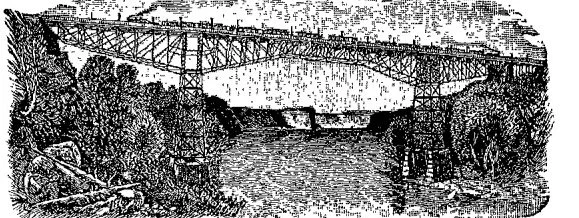
MICHIGAN CENTRAL NEW CANTILEVER BRIDGE, NIAGARA FALLS.
MICHIGAN CENTRAL
“The Niagara Falls Route.”
EAST
†Mail
†Day Express
*N. Y. Express
*Atlantic Express
†Night Express
†Kal. Accom’n
†Local Pass’gr.
STATIONS.
Chicago
am 7.55
am 10.35
pm 3.10
pm 10.10
pm 9.10
pm 4.50
Michigan City
pm 10.08
12.24
4.54
am 12.23
11.27
6.58
Niles
11.40
1.30
5.49
1.50
am 12.55
8.17
Kalamazoo
1.12
2.45
6.58
3.35
2.27
10.00
pm 5.30
Battle Creek
1.55
3.20
7.33
4.25
3.15
7.55
6.25
Jackson
3.05
4.39
8.49
6.15
4.45
9.35
8.20
Ann Arbor
5.04
5.48
9.41
7.50
6.00
10.43
Detroit
6.30
6.50
10.45
9.20
7.30
11.50
Buffalo
3.30 am
4.25 am
7.15 pm
6.55 pm
9.05
pm 8.05
Rochester
6.50
6.50
9.15
8.00
11.45
Syracuse
9.30
11.30
10.15
am 2.15
New York
pm 7.00
pm 8.50
am 7.20
11.15
Boston
10.00
10.50
9.35
pm 2.50
WEST
†Mail
†Day Express
*Chicago Express
*Pacific Express
Evening Express
†Kal. Accom’n
†Local Pass’gr.
STATIONS.
Boston
am 8.30
pm 3.00
pm 9.15
New York
10.03
6.00
11.30
Syracuse
pm 7.40
am 2.10
9.05
Rochester
9.55
4.20
11.30
Buffalo
9.30
am 12.15
6.15
pm 1.30
Detroit
am 9.00
8.01
pm 1.24
7.15
pm 9.00
pm 4.00
Ann Arbor
10.27
9.02
3.24
11.35
9.15
5.22
Jackson
pm 12.05
10.03
3.27
12.54
10.55
7.10
am 6.25
Battle Creek
1.55
11.36
4.38
2.15
am 12.27
8.52
7.55
Kalamazoo
2.45
pm 12.13
5.15
3.07
1.20
pm 3.45
8.40
Niles
4.20
1.30
6.27
4.32
3.06
6.37
Michigan City
5.42
2.35
7.32
5.43
4.32
9.00
Chicago
7.55
4.35
9.30
7.45
7.00
11.20
O. W. RUGGLES, General Pass. & Ticket Agent, Chicago. O. E. JONES, Ticket Agent, Battle Creek.
CHICAGO & GRAND TRUNK R. R.
Time Table, in effect June 23, 1889.
GOING WEST
STATIONS.
GOING EAST
Lmtd Exp.
Mail
†Day Exp.
*Pacific Exp.
Pacific Exp.
B. Crk Pass.
Mail
Lmtd Exp.
Atho Exp.
Lmtd Exp.
PtH’n Pass.
pm 12.45
am 7.5
am 4.10
pm 7.45
pm 8.55
pm 4.10
Dep. Port Huron Arr.
pm 9.20
am 1.15
am 6.35
am 12.00
am 10.50
8.45
8.05
9.08
10.20
5.40
Lapeer
8.40
11.5?
6.17
10.00
9.17
2.25
9.25
8.36
9.45
10.55
6.20
Flint
7.55
11.27
5.40
10.00
8.36
2.53
11.0?
9.03
10.35
11.35
7.15
Durand
7.15
10.58
5.03
9.40
8.00
3.45
11.05
9.55
11.4?
12.37
8.32
Lansing
5.20
10.07
4.00
8.55
6.55
11.4
10.21
11.31
1.09
9.08
Charlotte
4.42
9.37
3.25
7.40
6.02
a4.55
12.35
11.00
12.55
11.50
10.05
Battle Creek
3.45
8.55
3.25
7.45
5.15
d5.00
12.45
11.18
1.00
pm 1.00
A BATTLE CREEK B
3.45
8.55
3.25
7.45
am
1.28
11.51
1.48
2.50
Vicksburg
2.58
8.11
1.48
1.38
12.00
Schoolcraft
2.48
8.11
1.33
6.19
2.23
12.33
2.50
3.45
Cassopolis
2.05
7.26
12.45
6.19
6.50
3.05
1.05
3.35
4.23
South Bend
1.25
6.50
12.00
5.45
6.50
4.15
4.52
am
Haskell’s
12.05
8.10
4.0?
2.30
5.10
5.55
6.55
Valparaiso
11.50
5.30
10.30
4.30
10.10
7.00
4.45
7.30
8.10
9.45
Chicago
9.05
3.25
8.15
2.35
pm
pm
pm
am
am
am
Arr. / Dep.
am
am
pm
pm
pm
†Stops only on signal. Where no time is given, train does not stop.
Trains run by Central Standard Time.
Valparaiso Accommodation, Battle Creek Passenger, Port Huron Passenger, and Mail trains, daily except Sunday.
Pacific, Limited, Day, and Atlantic Expresses, daily.
Sunday Passenger, Sunday only.
GEO. B. REEVE, Traffic Manager. W. J. SPIER, General Manager.