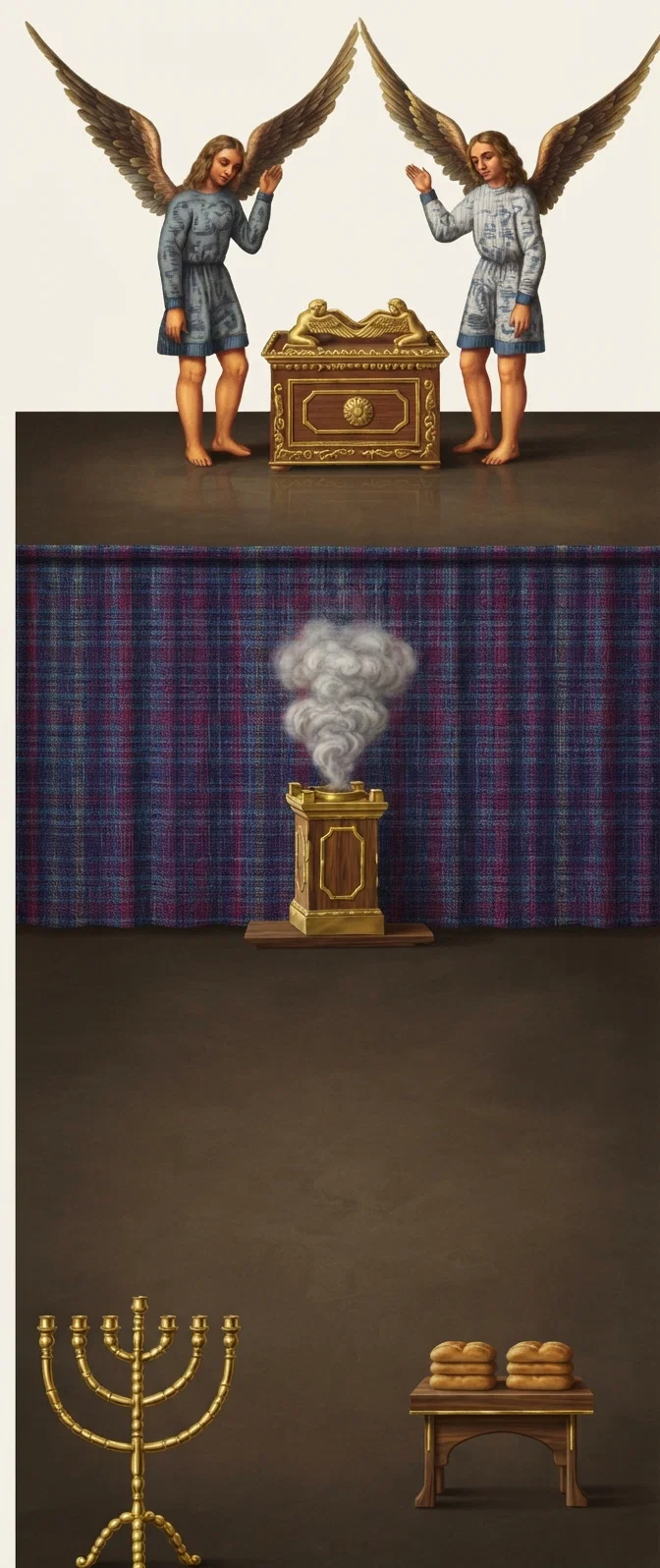
We have now reached a point in the course of our investigation, where we are led to inquire, What is the Sanctuary, and what is the nature of its cleansing? We have briefly noticed the mass of testimony that clusters about, and centers in, 1844, as the termination of the prophetic periods; and whatever were our expectations of the events to transpire at that time, it is certain that all the ground we had upon which to base them was the declaration of the
NOTE.—The above illustration is projected on a scale of four cubits to an inch, from the size of the tabernacle as erected by Moses in the wilderness. It is true that the large cherubim were not erected in the Most Holy Place, till it was permanently located in Solomon's temple, when the proportions of the Sanctuary, in length, breadth and height, were enlarged to double the size in which they had formerly existed. We have chosen however to take the dimensions of the tabernacle for a standard, and reduce the cherubim to one half their size to correspond, in order to give more prominence to the furniture. We have not represented the high priest in his yearly ministration before the ark, since as he entered in from the Holy Place he would only present his back to the beholder, and necessarily hide the ark from view.
angel to Daniel, "Then shall the Sanctuary be cleansed," or the announcement of that messenger of the Apocalypse, "The hour of his judgment is come."
We have seen that the evidence which determines the commencement and the reckoning of the 2300 days, so as to bring their termination in the year 1844, can neither be annulled nor evaded; consequently the efforts that have been made by two classes, the one to remove the original date for the commencement of the days, and the other to render them null and void, by disconnecting them from the 70 weeks, have no light nor truth in them. We say, therefore, that the subject of the Sanctuary as it was then held, demands a reconsideration.
The course of reasoning, by which we were led to look for the personal appearing of the Lord at the end of the days, by considering the earth, or some part of it, the Sanctuary, and its cleansing a regeneration by fire, to be preceded by the coming of the Son of man, has been already noticed. Was this incorrect? In determining this, the first thing to be ascertained is,
What is the Sanctuary? To learn what the Sanctuary now is, it will be necessary to go back to the fountain head of revelation and see what has been recognized by the Bible as the Sanctuary, in times past. The apostle Paul in his epistle to the Hebrews, introduces the subject fairly before us. In chap. viii, he contrasts two covenants, the first and the second, the old and the new, under the latter of which we now live. He then opens in chap. ix, as follows:
"Then verily the first covenant, had also ordinances of divine service, and a worldly sanctuary. For there was a tabernacle made; the first, wherein was the candlestick, and the table and the shew-bread; which is called the sanctuary; and after the second vail, the tabernacle which is called the Holiest of all; which had the golden censer, and the ark of the covenant, overlaid round about with gold, wherein was the golden pot that had manna, and Aaron's rod that budded, and the tables of the covenant; and over it the cherubims of glory shadowing the mercy-seat," &c. Verses 1-5.
The Apostle here tells us that the tabernacle, thus ordained, was the sanctuary of the first covenant. Turning back to the records of the times during which the first covenant was in force, do we find any mention of such a building as is here described by Paul? Yes, the most explicit. Let us briefly notice it:
The word of promise which God had left, for the children of Israel, while buried in Egyptian bondage, that he would surely visit them, and bring them out of the land of Egypt, [Gen. 1, 24.] had been fulfilled, and they were delivered. In the song of triumph which Moses sung upon that occasion, he said, The Lord is my strength and song, and he is become my salvation: he is my God, and I will prepare him an habitation. Ex. xv, 2. In this we receive the first intimation of that building which God would afterwards cause to be erected, that he might dwell among his people. In verse 17 of the same chapter, is the first occurrence of the word Sanctuary which we find in the Bible.
Pursuing the sacred record we find in the twenty-fifth chapter of Exodus and onward, more definite information respecting the sanctuary; namely, the commission which God gave to Moses for its erection. In the third month after their departure from Egypt, the children of Israel came to the wilderness of Sinai. There Moses was summoned up into the mount to an audience with his Maker. He remained there forty days and forty nights. During this time he was shown the pattern of the Sanctuary and all its sacred vessels, and received full instructions concerning them.
A particular description of the tabernacle, as erected by Moses, we need not enter into. It is minutely set forth in Exodus, chaps. xxv-xxxi. Suffice it here to say that it was a structure of extraordinary magnificence formed of upright boards overlaid with gold, thirty cubits long, about ten in width, and ten in height. At the east end, which was the entrance, there were five pillars of shittim wood, whose chapters and fillets were overlaid with gold, having hooks
of gold, standing on five sockets of brass. Over the tabernacle thus erected were thrown four different coverings. The first and inner curtain was composed of fine linen embroidered with figures of cherubim, in blue, purple and scarlet. This formed the magnificent ceiling. The second covering was made of goat's hair; the third of ram's skins dyed red; and the fourth and last, of badgers' skins. The east end was enclosed with a richly embroidered curtain, suspended from the pillars before mentioned.
The sacred tent was divided into two apartments by means of a vail suspended from four pillars of shittim wood overlaid with gold, set in sockets of silver. In what proportion the Sanctuary was thus divided, we are not informed, but it is supposed to be the same as was afterwards observed in the temple. 1 Kings vi.
In the first apartment, or holy place, were three things worthy of notice; the golden candlestick, the table of shew-bread, and the altar of incense. In the second apartment or most holy place, were also three things to claim attention: the ark, the mercy-seat, and the cherubim. It was above the ark over the mercy-seat, between the cherubim, that God manifested his presence, and from whence he communicated with his people. Ex. xxv, 22. And so David prays, "Thou that dwellest between the cherubims, shine forth." Ps. lxxx, 1.
It is to be observed that neither the holy nor most holy place had any window; hence in the first apartment there was need of the candlestick with its seven lamps; and in regard to the second where God dwelt, Solomon said, "The Lord said that he would dwell in the thick darkness." 1 Kings viii, 12.
Before the door of the tabernacle was placed the brazen laver, and the altar of burnt offering, and around the whole was erected the court with its curtains of fine twined linen.
In the second year after Israel had departed from Egypt, in the first month, on the first day of the month, the tabernacle was reared up. And Moses spread abroad the tent over the tabernacle, and he put the testimony (the tables of ten commandments) into the ark, and the mercy-seat upon it, and brought it into the tabernacle, and set up the vail; he placed the table of shew-bread, and golden candlestick, in the first apartment, and lighted the lamps before the Lord; he put the golden altar of incense before the vail and burnt sweet incense thereon; and on the altar before the door of the tabernacle he offered the burnt-offering and the meat offering, as the Lord commanded. Then a cloud covered the tent of the congregation, and the glory of the Lord filled the tabernacle. Ex. xl.
We have now before us the sanctuary as Moses erected it in the wilderness of Sinai 1490 years before Christ. With its ark of the covenant, its mercy-seat, and glorious Shekinah, it constituted the heart and center of Israel's religious worship, under that typical system.
The children of Israel were at this time in the period of their wandering; and therefore the sanctuary as first given to them was adapted to their condition: being so constructed that it could be easily taken down and borne with them in their journeys, and immediately erected wherever the Divine Presence, which accompanied them in a cloud by day, and a pillar of fire by night, should direct them to pitch their camp. Num. ix, 15-23.
From its entrance into Canaan, it is easy to trace the history of this building till it was embodied in the larger and more glorious structure of the temple of Solomon. We trace it down to the period when it was overthrown by Nebuchadnezzar, and suffered to remain in ruins during the 70 years of the Babylonish captivity. From the time that it was rebuilt by Zerubbabel, we follow it, until the days of our Saviour, by whom it was declared forever desolate. We trace it, after this event, through its brief, but nominal existence, to the year A. D. 70, when we forever lose sight of it in that destruction, by which it was overwhelmed through the violence of the Roman soldiers.
This was the sanctuary of the first covenant. There can be no doubt on this point with any who yet have confidence in divine revelation. It is directly declared to be such by the apostle Paul; and of the one hundred and forty-two times of the occurrence of the word in the Old Testament, it refers in almost every instance to this building. The main question at issue then, is, What is the Sanctuary of the second or new covenant? This next claims consideration.
(To be Continued.)
Meetings in Indiana.
By Joseph Bates
BRO. SMITH: The way was open for four lectures only on Stillwill Prairie, (refered to in Review No. 11.) One brother, a professed Advent believer, regretted that the way was not open for more meetings at that time. He said that himself and wife were persuaded that the seventh day was the Sabbath of the Bible. Another family has sent for the Review.
On returning to La Porte another hall was opened for our meetings on Main street, which we have occupied on Sabbath and First-day, and every evening through the week. The Congregationalists, Baptists, and Methodists have been, and are, tightening their cords by holding revival meetings, and thus keeping their members from hearing on the subject of the coming of the Lord, and the Sabbath of the Lord our God. Poor souls! they have some kind of an idea that their position is right, notwithstanding they differ so widely one from the other, utterly regardless of the sudden change, and the dreadful state they are so soon to occupy, according to the declaration of Jeremiah the prophet. Chap. xxv, 34-37.
Some come to hear and are believing the whole truth, while those who have believed are being strengthened in the Lord. We believe the Lord is lending a helping hand. Thanks to his holy name, Last First-day we baptized five more believers in Christ, and still the work is moving on.
J. BATES.
La Porte, Ind., Jan. 29th, 1858.
P. S. The reformation moves on slowly, but surely. Yesterday (First-day) five more were buried in baptism, and still there are half a score more who say they believe, but are held back from following their Lord and Master by unholy influences. Part of them are keeping the Sabbath with the church. Last evening we closed our public meetings, and retired to a private house to partake of the Lord’s supper, and had a heavenly place in Christ Jesus. Americans, Germans and Swedes, all united and rejoicing in the Lord! Thus the remnant are closing in together from the mingled nations, to meet their coming Lord, and receive the pure language to praise and serve him with one consent. In a few hours I expect to leave here for Bigelow’s Mills, to attend to the call of Bro. Scarborough, of Aug. 20th, 1857. See Review. My appointments are out to commence meetings there tomorrow evening, the 2d inst.
J. B.
Feb. 1st.
Lean on God, not on your Minister.
By J. Clarke
"For every man shall bear his own burden," Gal. vi, 7. Some years ago, Horace Greely, Ed. N. Y. Tribune, was in Paris, and while there, was suddenly and unexpectedly seized, and insultingly treated by the authorities, and was thrust into the debtor's prison, (Clichy,) for an unpaid claim against him as an officer of the Crystal Palace world's fair at New York. The claim was deemed an unjust one by Mr. Greely and his friends, and was finally set aside by a French court, and Mr. Greely was acquitted after a residence of some days in Clichy.
Here is the moral. Just as Mr. Greely was arrested, Judge Platt, and other influential Americans, came forward and offered to bail Mr. Greely, and thus save him the mortification and hardships of imprisonment. This Mr. Greely magnanimously refused, lest his friends might suffer loss, as he well knew that the objects of his foes would thus be in a manner gained: so this noble man of the present world endured a disagreeable confinement in a French debtor's prison, rather than trouble his friends, and risk their interests by a surety for him; and had this course been taken, it is very probable that Mr. Greely would have lost his case, which he gained only by means of his unflinching intrepidity and perseverance. His foes were awed by his resolute, manly courage.
Mr. Greely at the time wrote home a description of his imprisonment, in quite a playful style; but I never shall forget his instructive remarks, and his allusion to the passage above quoted, "Every man shall bear his own burden." It seems that prominent men of the world are often applied to for favors by those who could if they had the disposition, help themselves better than any one else could do for them, and Mr. Greely moralized beautifully to this class of individuals, and his Clichy experience was just in point, and it was a home thrust to those shiftless, irresolute ones who are always holding on to some one else, and cannot venture to go right forward and do for themselves trusting to God to bless the well-directed, vigorous effort.
Let us who are children of the light not be outdone by the world. Let us learn wisdom by every means. Let us go right to God with our troubles and trials, and he will help us. Are we cold and lukewarm? let us cry mightily to God, then shall our light break forth speedily. What is the use of crying out, O, if Bro. Cornell, or Bro. White, or Bro. Waggoner, or Bro. Loughborough, or Bro. Holt, or some other preacher would come and preach to us, then how we would rise, surely.
No, no, let these messengers go with the message to the millions who have not heard a lisp of it, to the benighted millions over whom the seven last plagues impend. Yes, go, go, and we the churches who have a flood of light, will walk in the light. We have more light now than we use. Go ye messengers of mercy to the cities and villages of our land, while the church in the light bears its own burdens. To the churches belongs the duty of sustaining a spirit of devotion. Yes, let the church encourage and inspirit its messengers, and bear them on. Let the church nourish its own young, strengthen the feeble, comfort its mourners, in short, bear its own burdens.
J. CLARKE.
Respectable.
By J. C.
We frequently hear of ministers preaching to respectable congregations, and there are respectable and highly respectable people and families spoken of, as though there was a difference and a dividing line somewhere among the citizens of the world. Dress, wealth, manners, station, education, polish, these and other aids raise men in the world's esteem, and often, very often, in the face of crime.
I have looked in vain for any such distinction in the Scriptures of truth: all are described as transgressors who are not the children of God.
Christ had followers, but we hear of no respectable people among them. The young man who came to Christ inquiring what he should do to be saved, was no doubt quite respectable; but Christ did not take any especial pains to hold him, although he was rich. The fisherman Peter would hardly have been called respectable, nor the young man who fled from the scene of Christ's passion with only a piece of linen around his body. Paul was very respectable while he persecuted the church, but when he sided with the Nazarene, he lost his popularity, and his influence. O what a deluded man, thus to sacrifice his respectability for so odd and unpopular a thing as the truth. But Paul like many fanatics now-a-days, loved and feared God more than man.
James speaks of a church that wished respectable people to join them, those who dressed richly, while the poor were directed to sit in a low place. It is evident that the church had even then begun to make a difference, and had instituted caste.
J. C.
Teach your Children
By J. C.
In the house, and by the way, when thou liest down, and when thou risest up. Show them that you are anxious for their salvation. Let them see that their eternal interests are very near your heart. Get them interested by first being interested yourself. Pray for them until your heart runs over with love and anxiety for them. Read the Bible until you find something applicable to their case. Notice the little affairs which interest them until you can sympathize in their little ideas, and stoop to their childish capacities. Then cheerfully, prayerfully, feelingly show them the way, illustrate truth by familiar images to their young minds. Do this often, patiently. Don't fret when they gape or run wild after their childish vanities, but persevere as God has borne with us. Hope, love and labor on, trusting that the seed watered with the dews of the spirit of grace will ere long spring up. Then nurse and nourish the first signs of good fruit: "first the blade," &c. Persevere: let the first word in the morning and the last at night, be of the things of God, always spoken with love. Thus you will avoid much evil. Thus your home will be made in some degree like Paradise, and thus you will win the little ones to be stars in your crown; but neglect this, and God will neglect you.
J. C.
The Prospect.
By R. F. C.
THE way seems opening for the last message of mercy to go forth with a loud voice. From different quarters the news comes, that men are opening their ears to hear. In the small circle of my labors the present winter, there is an increasing interest to listen to the truths of the Word.
I have been preaching in Bennington, Wyoming Co., N. Y., a number of days during a few weeks past, and the truth has been listened to by attentive hearers, some of whom manifest a deep interest. They are brought to a deciding point which is to tell upon their eternal destiny. May God help them to make the right decision! I think I may reasonably hope that Sr. Rice will soon have some united with her in the truth. She has stood alone there in the truth for three years, though trembling, yet steadfast, and I trust she will see the fruit of her perseverance, in the kingdom of God.
O for a preparation for the great work before us. I want to be willing to suffer with Jesus that I may reign with him. The saints will be "tried" before they are delivered. O Lord, prepare thy people for the trial, is my prayer. Here is the patience of the saints. Be patient therefore, brethren, to the coming of the Lord.
R. F. C.
Stephenson’s Arguments Against the Law
By James White
The articles of J. M. Stephenson against the Law of God have lately fallen into our hands, and we think that there is very little in them that needs a notice, especially if the reader is well acquainted with the arguments on the Law and the Sabbath in our publications. The arguments he formerly used on these subjects are yet untouched. His present position is evidently assumed, not from any new light on these points, but from a necessity growing out of his Age-to-come views of the covenants. We intend to notice some of his fallacies by and by. J. H. W.
The Instructor Delayed
By Editor
The INSTRUCTOR is unavoidably delayed. A double number for this month and next will be issued as soon as possible. J. W.
LETTERS.
By James White
“Then they that feared the Lord spake often one to another.”
GOOD NEWS FROM WISCONSIN.
BELOW is given good testimony from Wisconsin. It appears that the few friends of the present truth in that State are arousing. We sincerely hope they will get back to the spirit of the Third Angel's Message as it went forth in that State before the blighting influence of Elds. Stephenson and Hall was exerted there. Well for the cause in that State that S. renounced the Sabbath. The poor sheep can better tell wolves from those of their own flock when each appear in their native dress.
We are glad to hear that Bro. Phelps is preaching the Third Message. A brother writing Jan. 20th, says that “he preached twice, a week ago at Westport.” This brother thinks we erred in stating that Bro. P. stopped preaching through discouragement; that it was in consequence of bleeding of the lungs. We are willing to be corrected; but wish to say that we have never before heard of Bro. P.’s bleeding at the lungs, and had been informed that he left the work through discouragement. We venture to say, however, that Bro. P. has seen many things for a few years past of a very discouraging nature. Well, may his heart be cheered by the prospect of better days in Wisconsin, and may he have strength to labor till the Message closes with more than his former success.
J. W.
E. W. PHELPS
By E. W. Phelps
From E. W. Phelps.
BRO. SMITH: Those who love the truth, and love to hear of the advancement of the glorious cause of God, will rejoice with us when I tell them that the church in this place is making some advancement in the cause of truth and holiness. We have with shame, and I trust with godly sorrow, beheld our lukewarm condition, and are endeavoring to raise the standard of Christian holiness high, and attain unto it.
Last Sabbath Bro. Steward was with us, and spoke with much freedom upon the ordinances of the Lord's house. After meeting we repaired to the water, and then put on Christ by baptism, and we humbly trust arose to walk in newness of life. In the evening we met to attend to the ordinances. Between thirty and forty Sabbath-keepers were present, and all seemed willing, yea, anxious to show their love and humility by washing the saints' feet. We felt that it was indeed blessed to do as Jesus had done. It was truly a solemn and heart-searching time, and my prayer is that the vows and determinations there made may never be broken.
And to you, dear brethren, who feel that the cause in Wisconsin is almost a wreck, I want to say, Do not be discouraged. I fully believe that there are many honest souls here who would sooner give up their life than the Sabbath. It is too true that the children of God in some places are in a cold and stupid state; but I firmly believe could we have a few faithful laborers in this part of the field we should again behold the churches in a flourishing condition. O that God would send forth more laborers; for truly the harvest is great, but the laborers are few. Bro. S. is doing all he can; he gives his whole time to the work, yet he cannot fill one half of the calls.
The Third Angel's Message is on the rise, and will soon go with a loud cry. The people seem anxious to hear, but how can they hear without a preacher? No one but Bro. S. in this wide harvest-field, and no fellow-laborer to take him by the hand and encourage him in his labors of love.
Dear brethren, remember him in your prayers. And if any one of the messengers could see it duty to come this way, they would receive a hearty welcome, at least from those in this place. Remember us all at the throne of grace.
Yours striving for the kingdom.
E. W. PHELPS
Lisbon, Wis., Jan. 28th, 1858.
Stephenson’s Renunciation of the Law
By L. H. Bond
From Bro. Bond.
Bro. Smith: What think you of the course of J. M. Stephenson? I have just been reading his apology for renouncing the holy law of the blessed God, and I assure you that I felt lonely and sick at heart to think it possible for a man, professing as he did to be governed solely by the Word and Spirit of God, to turn square around and deny the plain meaning and teaching of the Word. I would like to ask him when the cause for the institution of the Sabbath was annihilated? or, when will it cease to be a fact that in six days the Lord made heaven and earth, and rested and sanctified the seventh? When, I would ask, will he be able to show satisfactorily that it was intended alone for the Jews, and not for man generally, as our Saviour has said? When he shows clearly the above considerations, and where, in all God's universe, we shall go to find sin in the absence of law, I will think that he may set up a claim that he has in his wisdom and foresight discovered what the Eternal has neglected or forgotten to reveal.
It is a fact that men who indulge in speculation on the revealed word of God, are often left to themselves, and given up to pursue their own course, and believe a lie, that they may be damned. My brother, I do not say that this will be the final issue of the course pursued by J. M. S. but my Bible informs me that he that breaketh the least of these commandments and teacheth men so shall be called least in the kingdom of heaven; as much as to say, he shall never enter there. I should be glad indeed if the Lord would not cut him off forever, but show him his sin and give him a heart to repent, that he may be saved.
Yours in Christ.
Milton, Wis., Jan. 24th, 1853.
L. H. Bond.
JONATHAN CHASE
By Jonathan Chase
From Bro. Chase.
DEAR BRETHREN AND SISTERS: "Then they that feared the Lord spake often one to another, and the Lord hearkened and heard it, and a book of remembrance was written before him for them that feared the Lord and that thought upon his name." Mal. iii, 16. I bless God for the promise that follows: "And they shall be mine, saith the Lord of hosts," &c. What a promise from the Lord of hosts! Not, may be; the word is, "they shall be mine." When?
"In that day when I shall make up my jewels." Thank God. I think that will be about the right time.
Dear brethren, let us hold fast whereunto we have attained that no man take our crown. I am truly thankful for the privilege that I have of hearing from you through the Review, which comes laden with food for my hungry soul. I love the truths it contains. One thing more, brethren, that I feel grateful to God for, is health and strength to go some among my brethren.
I would just say that I have made my brethren in Mackford a visit, and found them firm in the truth giving glory to God. While out there, I, with some of the brethren, went to Bro. Cady's in Waushara Co., where we had a good time in prayer-meetings, and saw one young man hopefully converted to God. I believe he is willing to save souls in Wisconsin.
Come, brethren in the ministry, gird on the armor anew, and come in the name of Israel's God: you can overcome all your foes. I have found some of the blighting influence of the Age-to-come among some in the North; but I hope it will soon leave the State, for we don't need any Age-to-come doctrine among us.
Yours waiting for redemption at the revelation of Jesus Christ.
JONATHAN CHASE
Columbus, Wis., Jan. 22d, 1858.
Tour in Jefferson and Lewis Counties
By F. Wheeler; H. Edson
From Brn. Wheeler & Edson.
DEAR BRO. SMITH : While our hearts are cheered by the accounts we read of what the Lord is doing for his people in other parts of the great harvest-field, we would also acknowledge his mercy towards us in this part of the vineyard. We have just returned from a tour in Jefferson and Lewis Cos., where we have been holding meetings among the brethren and in new fields.
Sixth-day and Sabbath, Jan. 1st and 2d, we met with the church in Jefferson Co., at the house of Bro. Lowree, in Lorrain. Our meetings were seasons of profit to the church, and of refreshings from the presence of the Lord. They are endeavoring to heed the counsel of the faithful and true Witness, and to obtain the gold, white raiment and eye-salve. The result is a gradual rising in holiness, and a more deep and full consecration of themselves and all to God.
Sabbath, Jan. 9th, we spent in Watson, Lewis Co. At this place a few discourses had previously been given on present truth, and some interest awakened. Circumstances were unfavorable for holding meetings, on account of sickness which prevailed in the vicinity. We however gave seven discourses in W. among the Seventh-day Baptists, and three in an adjoining school district in New Bremen. Our congregations were not large, but good attention was paid to the word spoken. The few that were striving to obey the truth were much strengthened ; others were convinced of the truth, and we trust will obey the same. We left, feeling that a goodly number were in sympathy with the present truth.
Our next meetings were at Indian River settlement. Here we gave six lectures, and although there was some opposition made when the perpetuity of the ten commandments was presented, yet the truth found its way to some minds, and one at least expressed a determination to keep all of the commandments of God. Others were investigating the truth. From here we passed through the forest eight miles to Diana and Pitcairn, St. Law. Co. Gave one discourse in P. to a small company of attentive hearers.
We next sought an opening at Harrisville. The school-house was kindly opened for our use. It was well filled, and most listened to the truth with deep interest. We gave six discourses when the teacher of the school objected to the house's being longer occupied for evening meetings. The house was closed, evidently against the wishes of most of the district. A friend offered to open his dwelling-house for us the next evening, which we occupied, and thus closed our labors in that place for the present. Before leaving we learned that the truth had made a deep impression on many minds; even on some111who had been far from God, who expressed their determination to seek salvation. Several made up their minds to obey God in all of his requirements, the Sabbath not excepted.
There is a large field of labor in that vicinity, where the Advent doctrine has never been preached, and where there are honest souls famishing for the bread of life. From what we have seen of the work of the Lord on this tour, we feel new courage to still visit the "highways and hedges," and with this last compelling message labor to rescue the honest from that destruction that is soon coming on the earth. Has not the time come when the church should put up one united prayer that God would raise up and send out more laborers into the wide harvest-field? "The harvest is great, but the laborers are few."
F. WHEELER.
H. EDSON.
Parish, N. Y., Feb. 1st, 1858.
LIFE FROM DEATH.
A seed found in the hand of a mummy two thousand years old, bloomed into a beautiful flower.
Two thousand years ago, a flower
Bloomed brightly in a far-off land;
Two thousand years ago, its seed
Was placed within a dead man's hand.
Before the Saviour came to earth,
That man had lived, and toiled, and died!
And even in that far-off time
That flower had shed its perfume wide.
Suns rose and set, years came and went;
The dead hand kept its treasure well:
Nations were born and turned to dust;
While life was hidden in that shell.
The senseless hand is robbed at last;
The seed is buried in the earth;
When lo, the long life sleeping there
Into a lovely flower bursts forth.
Just such a flower as that which grew
From such a seed when buried low—
Just such a flower in Egypt bloomed
And died two thousand years ago.
And will not He who watched the seed
And kept the life within the shell,
When those he loves are laid to rest,
Watch o'er his buried saints as well?
And will he not from neath the sod
Cause something glorious to arise?
Aye, though it sleep two thousand years,
Yet all that sleeping dust shall rise.
Just such a face as greets you now.
Just such a form as here we wear,
But yet more glorious far will rise
To meet the Saviour in the air.
Then will I lay me down in peace,
If called to leave this vale of tears;
For "in my flesh should I see God,"
Though I had slept two thousand years —Sel.
Extracts from Letters.
BRO. Wm. Lawton writes from West Winfield N. Y., Jan. 7th, 1858: “We want you to remember us in your prayers, that our works may perfectly correspond with our faith; for we want to learn as soon as possible to act with an eye single to the glory of God. We not only want to receive the counsel of the true Witness, but we want to live it out in our daily walk and conversation with all those with whom we have anything to do. We want to understand and know how to be zealous and repent; and we want to fully understand the words of the Saviour, [Matt. xvi, 24.] “If any man will come after me, let him deny himself,” &c. Now if we are daily trying to gratify ourselves, what evidence have we that we are trying to deny ourselves? or what evidence have we that we shall be overcomers? We want to deny ourselves and take up our cross and follow Christ.”
Reflecting the Image of Jesus
By H. S. Boyd
From Bro. Boyd.
DEAR BRETHREN AND SISTERS: I wish to say to you that I have been brought through many strait places, but God's mercy has been great to unworthy me. I feel that I have not been as thankful as I ought for all the blessings he has bestowed upon me; and I regret that my whole being has not been more fully and faithfully devoted to his service. Wherein I have in any way failed of manifesting the meek and forbearing spirit of Jesus, or in discharging my whole duty to any, or in any way cast an unholy influence, I hope that God and my brethren may forgive, and unite their prayers with mine that God will give me wisdom to direct me at all times, and grace to sustain me under all circumstances; that I may be led into all truth, sanctified through it, and saved from all unrighteousness.
I firmly believe that the work of grace must be deep enough in the hearts of God's people for them to reflect the image of Jesus in their daily deportment, or they will be unable to stand in his holy presence. We must be kindly affectioned one to another, in honor preferring one another. The long suffering and forbearance of God to us should lead us to great patience and forbearance toward our fellow men, especially those whom Christ has commanded us to love as he has loved us. Brother, sister, does your heart respond to this command? Have you fully obeyed it? Can you truly say, I know I have passed from death unto life because I love the brethren? If you love the Saviour as you ought, you are truly a happy recipient of God's grace; for Christ has said, If a man love me he will keep my words, and my Father will love him, and we will come unto him and make our abode with him. O what glorious and sure evidence this would be that our names were written in the Lamb's book of life? If we lack this is it not just as sure they will be blotted out unless we speedily repent. O Lord, save thy people, is my prayer. What a company we should be if we were united and perfected in God's love! The scoffing world would behold us with awe, angels would rejoice over us, and God would be well pleased and work for us as in days of old, and as in former years.
It is now a time that tries men's souls. Satan with all his deceptive snares is trying to lure men on to perdition; not only with the allurements of all the vanities and lusts that please the carnal heart, but he is trying to prevent our serving God, by exciting our fears. True, our names which are cast out as evil, may be still more disgraced, our few earthly friends may turn against us, our property and life may be taken from us; but my brethren, let us show to all that it is a name on high that is above every earthly name that we prize, and honor from above that we seek. It is immortal friends we desire. It is in heaven we are striving to lay up our treasure. Our homes and hearts are there. We can joyfully take the spoiling of our goods. We are pilgrims and strangers on our way home, and hope not to love our lives unto death; for it is eternal life that we seek. For it we are willing to suffer; for it we mean to strive. And should persecution arise which would exceed the cruelty of by gone ages, still let our trust be in God. Man can take our lives, then there is no more that he can do. The righteous will stand firm in the trying hour; for God has said he will never suffer them to be moved.
Now dear brethren, in view of the solemn time and trials that await us, our own weakness and proneness to err, I entreat you to be workers together in Christ Jesus, trying to encourage and help one another on in the heavenly way. Let the long suffering and tender mercies of our God towards us, stimulate us to be like minded one toward another, that when Christ who is our life shall appear, we may also appear with him in glory.
Yours hoping to be of that happy number.
H. S. BOYD.
Lyme, N. H., Dec. 31st, 1857.