Review and Herald Publishing Assn. · Takoma Park Station, Washington, D. C. · Feb 6, 1917
Brief News Items on War, Business, and Education
Have you read the book, “Ann of Ava”? It is a thrilling story of adventure in mission fields.
The several battle fronts of the great war now aggregate over four thousand miles in length.
French and English aviators during the past year brought down seven hundred enemy aeroplanes.
A colporteur in New England recently took orders for over fifty dollars’ worth of books in one day.
The 1916 output of the chewing-gum business amounted to $17,159,000, and that of the confectionery business was $153,000,000.
A company has been formed in Honduras for manufacturing alcohol on a large scale from bananas that are not suitable for exportation.
There are 1,010 persons on the teaching staff of Columbia University, and last year more than 19,000 persons received instruction in that institution.
May 1-6 has been agreed upon by the Children’s Bureau, Washington, D. C., and the General Federation of Women’s Clubs, as the best time for the 1917 Baby Week.
A bill is to be introduced into the Wisconsin Legislature providing for the submission of the question of State-wide prohibition to the vote of the people in November, 1918.
Mr. Orville Wright addressed the National Park Conference which convened the first of the year in Washington, D. C., on the subject, “Air Routes to the National Parks.”
The dead-letter division of the Post-Office Department handled during the past year 10,839,890 pieces of mail, 7,019,436 of which had to be destroyed because of inability to locate the individuals concerned.
A nurse in the Red Cross service in Bulgaria expresses great disappointment in not receiving the 1916 Morning Watch Calendar. The calendar is helping thousands in their endeavor to live the victorious life.
Raisin-growing owners of 100,000 acres of land in the San Joaquin Valley signed a protest against being declared opposed to prohibition in California, which was read at a great meeting in Fresno, the center of raisin production.
The assistant attorney-general for the State of Colorado, Miss Clara Ruth Mozzer, is the first woman in the United States to hold that office. Miss Mozzer is only twenty-four years old, and of Russian-Jewish descent. She made her own way through college.
The Italian government has decided to put all vacant public grounds under cultivation to increase the food supply. In Geneva, Switzerland, wheat and potatoes have already been planted in the parks. Forestry employees are being utilized for the purpose.
A recent traveler describes in a London paper a river in Algeria which he says is as black as ink, and which he even claims is genuine ink. It is formed by the union of two streams, the water of one being impregnated with iron, and the other, which drains a great swamp, with gallic acid. This combination of iron and acid, it is claimed, makes a pure ink.
Value of a Kind Word
A MAN came one day to Lord Shaftesbury, bringing a note from the governor of Manchester jail, saying that the bearer was absolutely incorrigible, and had spent twenty years of his life in prison. Lord Shaftesbury talked kindly to the man, and found certain marks of humanity left in him, and he said: “John Spiers, shall I make a man of you?” “Yer can try, but yer can’t do it,” was the discouraging reply; “though I’ll try, too.” Lord Shaftesbury placed him in a reformatory for men, where the discipline was severe, but good, and in three days’ time went again to see his protégé, asking, “Shall we go through with it and save you?” “If yer can,” was the answer this time; and Lord Shaftesbury placed his hand lovingly on the poor fellow’s shoulder, saying, “By God’s help we will;” and by the conversation that followed, John Spiers was completely broken down.
Two years later he was met by a friend of Lord Shaftesbury’s, clad in good clothing, and filling a trusted, honored situation. “Ah!” he said, “it was all the earl’s kind words did it. That was new. Why, I’d never had a kind word or a loving look given to me in my life before, or I might have acted very differently.”—Selected.
Mother's Vacation
The mother is usually the last in the family to be considered in the matter of a vacation. The school plans the vacation for the children; the college or the office arranges the vacation for the daughters; and business provides a time of knock-off for the husband or son at work. But the mother—who plans or schemes a vacation for her? Usually she supplements the school, the college, or the shop, and plans and packs the others off until there is no one left to plan or pack mother off. She never thinks about a vacation for herself, or if she does she keeps quiet about it and dismisses it as out of the question. But is it? Certainly she needs a respite; all agree on that. Then why shouldn't she have it? It can be done if the members of the family give it a little more thought than they usually do. But some one should plan for her vacation as she plans for others; some one should save a little money; some one should assign and divide the household tasks, look up the best place for mother to go and the train which she will take, and help to pack and get her off. Turn about is fair play, and this idea of planning for a vacation for mother is commended to families where the thought, unfortunately, is all too new!— Ladies' Home Journal.
Faith as Assent of Intellect and Consent of Heart
“FAITH is the assent of the intellect and the consent of the heart.”
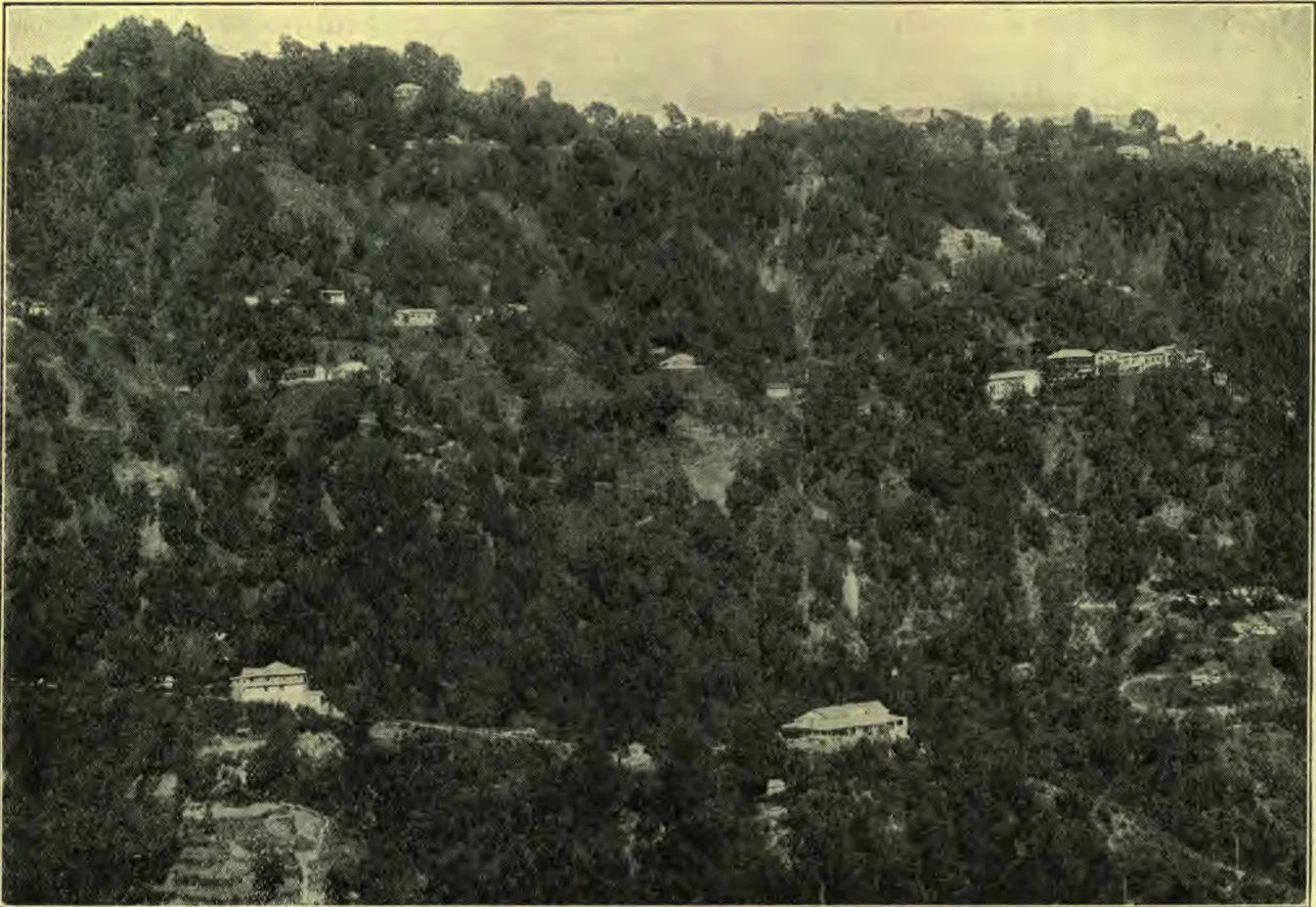
THE ANNFIELD SCHOOL, MUSSOORIE, INDIA
“The Lodge of Minnehaha” is shown near the bottom of the picture at the right.
What I Can See from My Window
By R. D. Brisbin
R. D. BRISBIN
It is a very unpretentious window, consisting of a rough frame about two and one-half feet by three and one-half feet, set with four windowpanes, and swinging on hinges against the outside wall; yet it opens unto some of the most wonderful and interesting sights I ever saw. I know you want to hear about it, and that is the reason I am going to write.
The little sheet iron cottage of which it is a part we call “The Lodge of Minnehaha.” It sits astride a spur of one of the vertebræ of the backbone of the world, the Himalayas, or abode of snows. Our altitude is 6,500 feet above the sea, and within a hundred miles are the eternal snows. Just above us towers Landour, lifting its head 500 feet higher, from which can be seen hundreds of miles of snow ranges, and Nanda Devi, 26,500 feet high in the snowy distance.
On both sides of the spur the earth seems to drop away—down, down—for nearly 400 feet, so steep you would not care to fall. These slopes, however, are covered with live oak trees, which partially cover the ragged aspect of the whole. These ravines, or khuds, as they are here called, are filled with raging torrents. The two streams on either side meet about half a mile below, and joining forces, they roll huge bowlders and tear loose the soil on their downward path, until they tumble at last into the plains and help to form the headwaters of the sacred Ganges.
I look down after the morning’s rain and see the city of Dehra Dun nearly 3,000 feet below on the plains, sweltering in the heat of an Indian summer, while we have just experienced a hailstorm. Dehra Dun is more than twelve miles away by road, but the air is so clear we can see the houses as they nestle among the trees, and with a glass, can see the people as they move about. Twenty-five miles to the west from there a low range of mountains divides the valley, and beyond twines the silver ribbon of the Ganges. Still farther the eye may rest until verdant plain and the blue sky meet fully 150 miles to the west. Aren’t you beginning to think it is a wonderful window?
Opposite, on another spur, about one-half mile distant, are schools, a hospital, a church, and many other buildings of the town of Mussoorie, all seemingly in reckless attitudes on the face of a cliff, as it were. I tremble to think what would happen if we had a severe earthquake shock; for here in India the houses are built mostly of brick, which is covered with plaster and then whitewashed, and the foundations that many of the masons lay are not to be relied on in strenuous circumstances. Built on side hills as they are, it would not take very much to send them down like a pack of cards, and earthquake shocks are by no means uncommon.
And what are those queer-looking little whitewashed affairs on the little hill below us? O, that is the Mohammedan4burying ground! The Mohammedans believe they must sit up after being buried, and answer several questions to the angel of death regarding their faith, and their conduct before death; so their tombs are made so they may assume the proper posture when being examined. Look, there comes a procession now. Four men are carrying a rough framework of poles, on which the dead man is laid. How strange! we hear no sound from any of them. No. The Moslem is taught to refrain from weeping for his dead, so all is quiet and still. The last prayer is said by the moolvee, or priest, and another of India’s sons has gone to his long home to await the resurrection. Fifteen people a minute, hour after hour, day after day, year after year, thus pass from India’s life of sin and misery.
But what is that coming now? That cannot be a funeral procession, for they have some men playing drums and a horn. That is a Hindu funeral, and the road down which they are winding from our right leads to the burning ghat. You exclaim, “What a hideous noise they are making!” Perhaps we may think so, but they think it is music; so as they lived here and were ruled by wise and powerful kings long before Englishmen were heard of, perhaps that is music after all, and what we call music is noise. Who can judge?
The complicated ceremonies for the dead were largely completed at the house. Now all that awaits is for his body to be burned, and his soul will commence another cycle of life, perhaps as a fish, an alligator, or a mammal of some kind; for is he not but a poor shopkeeper, and must suffer for the sins he has committed in this life? If he were a Brahman, that would be different. Then he might merge into Nirvana; but—“Bah! He is one of the common herd; so off we’ll hurry him and have it over.” We see the smoke ascending a little later, and know that another of the fifteen has gone. His ashes will be scattered in the stream and join the Ganges on its way to the sea. I wonder if I ever had a chance to tell him of Christ, and improved my opportunity?
The sun is now setting over the hills. How beautiful the colors! If they were painted, one could scarcely believe them to be true. During the rains the sunsets in the Himalayas are unequaled for beauty, and are indescribable. The afterglow in the eastern skies is also one of the beauties of these hills. Many times the reflection is so bright that the sun appears to have lost its way and to be setting in the east. We go outdoors and linger to catch the last rays as they nestle among the clouds, and then night settles over all, and we bow our heads and thank God for the beauty of the “everlasting hills.”
But I forgot to tell you about the birds. From the tiny little sapsucker and humming bird to the great lazy kite which soars in never-ending circles, all are here,—the omnipresent crow and English sparrow, the swallow, tailor bird, brown thrush, Indian robin, spectacle bird, wagtail, blue jay, kingfisher, parrakeet, cuckoo, wild pigeon, owl, and all the night birds, some of which have peculiar bell-like calls of one or two notes, which once heard can never be forgotten. But best of all is the whistling thrush. Of all the care-free, wild songs of the forest or field his is the most beautiful I ever heard or ever expect to hear in this earth. Early in the morning, before the world is astir, he is up and bursting his throat with melody which seems to be heaven-born in its fulness, and the last thing at night he perches on a tree or prominent rock and sings his matin. Dear little fellow, how many lessons we may learn from you!
In one of my jaunts in the jungle I heard the whip-poorwill, although he seemed to be just learning English, and stuttered badly when he tried to sing. But I knew his call, even though not so clear and sharp as that of his American cousin, and gave him credit for the attempt.
But did I tell you that the bobwhite often comes to entice me with his call and to flaunt his bravery right beneath my window? I often hear his voice down the khud and across on the wooded slopes of the other hills, and I answer back to him and try to deceive him into thinking I am one of his bitter rivals.
The best of all happened early one morning about five o’clock, when the mists hung heavy as a gray mantle about the cold, dripping trees and rocks. I was awakened by a strange clucking and beating of wings. It was another call of the wild, and in a moment I was standing in my magic window witnessing a royal battle between two wild cocks. Back and forth they rolled and tumbled and spurred and fought, much as their barnyard cousins. I was only twenty feet away, but they were so interested in their quarrel they paid no attention. Finally they rolled fighting down the path out of sight into the mist. They had evidently met on the narrow path which skirts the cliff below, and being old rivals, as I should judge from their hatred of each other, they had fought at sight. Many times they and their kin have visited my cottage for the crumbs outside. These birds are about the size of the Minorca fowl. The plumage of the female is brown and black, while that of the male is brown and black, with dashes of blue, red, and gold. A prettier family of fowl would be hard to find.
The insect life of the Himalayas includes some of the most beautiful butterflies and moths. The beetles are the fellows that make life interesting, though. If I happen to leave my window open during their season of flying tournaments I am likely to have two or three from two to four inches long, with ferocious-looking mandibles and horns, making circles about my electric light. I suppose that is part of the conditions in their contest for the championship. There is no peace until there is a skirmish and a capture. And what crabbed fellows they are! If two are placed together they will fight with terrible clashes of armor and grinding of incased legs until one gets enough. But it is a hard matter to separate them in their duels, for with horns and wings and twelve legs all mixed up together, it is almost too much to attempt.
I must not forget the flowers. Lilies, forget-me-nots, dahlias, roses, morning-glories, and many other flowers peculiar to the country, grow wild, and I look from my window down into their bright, sunny faces every day, and think how dreary this old world would be without flowers.
All this and more have I seen from my window.
Getting Rid of Shyness
By Marden
A CELEBRATED Japanese psychologist who had made a thorough study of shyness and its causes, was asked to take under his care the son of a nobleman, and cure him of that defect, which made him ridiculous and caused great suffering. The young man was so bashful that he could scarcely convey food to his mouth in the presence of a guest, and would often drop his chopsticks or whatever he was eating with, together with his food, if any one happened to look at him. It was positively painful to him to meet people or to associate with them in any way.5
The psychologist began his treatment by doing everything in his power to gain his pupil’s confidence and to put him at his ease. He introduced him to his friends and cultivated a friendly, even a chummy, relationship with the boy, so as to make him forget his defect and give him the greatest freedom for self-expression both in his studies and in his play.
Gradually, without being obtrusive, he began to refer to his pupil’s bashfulness, and assured him that his trembling, his confusion, his stammering, and his pain at meeting people had no real cause except in his imagination, and therefore could easily be overcome, if he would only think more and have a better opinion of himself. He endeavored to convince him of his real ability, and then showed him how his foolish shyness would cripple his whole career by robbing him of initiative, courage, independence, all the qualities that characterize men of large achievements.
At first it was very difficult for the youth to make himself do the things he had always shrunk from, but he persisted, and gradually gained more ease and lost much of the awkwardness caused by embarrassment. He found himself more and more willing to converse, and was conscious of greater freedom in his movements, his thought and expression. This encouraged him greatly, and before many months he had almost completely overcome the handicap which had threatened to ruin his whole career, to say nothing of his constant frightful suffering.
Shy people are constantly misunderstood and underestimated because their real selves are never allowed expression. They are so afraid that others are weighing and measuring them in the balance and finding them wanting, that whenever they can they “flock by themselves,” as the Irishman put it. Their shrinking, self-effacing, apologetic attitude is fatal to their efficiency as well as their comfort and happiness. If instead of avoiding others, they would mix freely in society and undertake responsibility at every opportunity, no matter how it might pain them or how every nerve might shrink from human contact; if they would stop staying alone in corners at receptions and in drawing-rooms; if they would cease worrying about their appearance and manner, and would force themselves into the great human current, they would soon entirely overcome their self-consciousness.
Why not sit down by yourself and take account of the things you are missing, the doors that are closed to you, the things you are barred from, because of your timidity, your hindering bashfulness? Try it, and then have a good heart-to-heart talk with yourself. Say, “I don’t propose to make a daub of what the Creator intended for a masterpiece just because of this sensitiveness which I have been encouraging all these years. I am going to overcome it. I am going to push to the front, I am going to force myself into the van, no matter how it pains me, no matter if I do seem forward and bold. I know that it is the only remedy for my defect. I am going to show people that I am not the failure, the deficient person they take me for.”
When timid, bashful, retiring men and women claim their kinship with the Supreme Being they feel re-enforced, buttressed with a mysterious inward feeling of peace, of harmony, a sense that they are not doing their work alone, but that they have tapped illimitable power. They no longer feel that they are separate units, puppets to be tossed about by cruel fate, with simply a gambling chance at life instead of certainty. All fear vanishes, and they become poised, natural, independent, masters of themselves, partakers of infinite power.—Marden, in Washington Herald.
Living Up to Our Privileges
By Lizzie M. Gregg
WONDERFUL are the privileges of the Christian. It is not easy for us to realize their value and importance, because the glories of the spiritual life are not earthly, and therefore do not appeal to our physical senses. But truly to be “partakers of the divine nature,” to be “heirs of God, and joint heirs with Christ,” is to have the highest honor possible to a human life.
The most saintly person with whom we may converse will tell us how far short he is of the ideal. There is always the longing to reach out for the higher and deeper things, but there comes the assurance that those who “hunger and thirst after righteousness” shall be filled. God has promised to satisfy the longing soul, but he blesses us that we may be a blessing.
We do not make the most of our life in the work of Christ. The possibilities of Christian service are incalculable. Opportunities of usefulness and helpfulness are ever before us, but so often are allowed to pass unnoticed. The “ideal” is ever before us, calling us on to better things.
It is encouraging, however, to know that each day of striving brings us a little nearer the goal. Jesus taught, both by precept and example, that we should live “not to be ministered unto, but to minister.” If we only understood that Christ himself is with us still in the person of the suffering and needy, what changes it would make in our lives! We often think if we had lived when Jesus did, and dwelt where he would have visited us, how different it would be. How we should have ministered to him, and faithfully followed his commands. A wonderful lesson is taught in the following poem by Mrs. M. E. Preston:—
“‘If I had dwelt’—so mused a tender woman,
All fine emotions stirred
Through pondering o’er that Life, divine yet human,
Told in the Sacred Word—
‘If I had dwelt of old, a Jewish maiden,
In some Judean street
Where Jesus walked, and heard his word so laden
With comfort strangely sweet;
And seen the face where utmost pity blended
With each rebuke of wrong,
I would have left my lattice and descended,
And followed with the throng.
“‘“Foxes have holes”—methinks my heart had broken
To hear the words so said,
While Christ had not (were sadder words e’er spoken?)
A place to lay his head!
I would have flung abroad my doors before him,
And in my joy have been
First on the threshold, eager to adore him,
And crave his entrance in!’
“Ah! would you so? Without a recognition
You passed him yesterday;
Jostled aside, unhelped, his mute petition,
And calmly went your way,
With warmth and comfort, garmented and girded.
Before your window sill
Sad crowds swept by, and if your blood is curdled,
You wear your jewels still.
You catch aside your robes lest want should clutch them
In its imploring wild;
Or lest some penitent might touch them,
And you be thus defiled.
O dreamer, dreaming that your faith is keeping
All service free from blot,
Christ daily walks your streets, sick, suffering, weeping,
And you perceive him not!”
Thus no seeming chance brings into our presence those in need of help. We need only to be in readiness for whatever heart or hand may find to do in serving him. Perhaps only the smallest service may be required, but that is a divine ministry, and we may never know what value it has been to the receiver.
One day, when it was cold and wintry, a little child, we are told, closed her prayer with the words, “I saw6a little girl on the street this afternoon, and she was cold and barefooted; but it isn’t any of our business, is it, dear God?” How many act in this way, though they would not state it so definitely as did this child.
We are sure our young people are finding many calls for helpfulness, and are being blessed in filling them as far as they can. We trust they will tell the INSTRUCTOR readers of these things, so that others may be provoked to good works also.
LIZZIE M. GREGG.
The Power of the Gospel
By C. C. Crisler
As a pioneer apostle to the Gentiles, Paul faced a heathen world the degradation of which was apparent even to the dispassionate philosophers of corrupt Rome. Dr. Fisher, in depicting the state of morals in ancient heathen society, has written of the period during which Paul lived and labored (“Beginnings of Christianity,” chap. 6) that “the decay of that virile energy, the loss of that virtue, which had carried Rome forward in its career of conquest, were visible on every hand. The civil wars, from the time of Sylla, had desolated the most flourishing regions of the empire. . . There were countries, like Sicily and Egypt, whose extraordinary fertility enabled them to recover rapidly from the devastating effects of war, and to furnish supplies of food to provinces whose agriculture was blighted. Greece, as a consequence of the Macedonian and Roman wars, was covered with ruins. The most of her renowned cities were reduced to villages. Corinth only, favored by its situation, rose from its ashes, and gained rapidly in population and wealth—the increase of luxury and profligacy keeping pace with its growth. The nobler qualities of the Hellenic race had vanished. Still proud of their blood, dexterous, supple, unprincipled, and accomplished in the art of catering to the appetite for amusement and sensual indulgence, they swarmed in Italy and Rome, and infected the whole atmosphere of domestic and social life with their pestiferous influence.”
Paul’s description of the hideous vices prevalent among the heathen, is paralleled by accounts written by eyewitnesses among the heathen themselves. Seneca, one of the most upright and trustworthy of Roman philosophers in Paul’s day, testifies with indignation against the evils of his age. “Daily,” he says, “the appetite for sin increases, the sense of shame diminishes. Casting away all respect for right and justice, lust hurries whithersoever it will. Crimes are no longer secret; they stalk before the eyes of men. Iniquity has so free a course in public, it so dominates in all hearts, that innocence is not only rare—it does not exist at all. It is not a case of violations of law in individual cases, few in number. From all sides, as at a given signal, men rush together, confounding good and evil.”—“De Ira,” ii. 8.
Professor Jowett (“Epistles of St. Paul,” p. 77) has said of society during the times when the apostle was preaching Christ and him crucified, that “if the inner life had been presented to us of that period which in political greatness and art is the most brilliant epoch of humanity, we should have turned away from the sight with loathing and detestation.”
Such were the conditions faced by the apostle Paul in his ministry; such were the conditions prevailing in Rome, the capital of the empire, when he addressed to the Christian believers in that city the epistle in which he confidently declared: “I am not ashamed of the gospel of Christ: for it is the power of God unto salvation to every one that believeth; to the Jew first, and also to the Greek.” Rom. 1: 16.
To Paul, at the time of his miraculous conversion at the gate of Damascus, had been granted a vision of his crucified Lord, now risen and ascended on high. The proud heart of the Pharisee had been melted; thenceforth Jesus appeared before him as One mighty to transform and to save. Through his personal experience he had received unmistakable evidence of the power of gospel truth; and he was inspired with a longing to exalt the cross before all classes. “I am debtor,” he declared, “both to the Greeks, and to the Barbarians; both to the wise, and to the unwise.” He knew that if only he could present before sinners the loveliness of the Christ-life, a marvelous change would take place, and the old life of sin would be abandoned for a life of holiness.
When, after many years of experience in preaching to the heathen and in observing the effects of the gospel message on the human heart, Paul entered Corinth, one of the most corrupt of all heathen strongholds in the apostolic age, he “determined not to know anything” among them, “save Jesus Christ, and him crucified.” The apostle had learned to put no trust in any wisdom or talent of his own. His labors among the careless inhabitants of the city were performed “in weakness, and in fear, and in much trembling.” Yet he had full confidence in the power of the gospel to save the most degraded of sinners, and his preaching was “in demonstration of the Spirit and of power.” The faith of his hearers stood not “in the wisdom of men, but in the power of God.” 1 Cor. 2: 2-5.
For a time after leaving Corinth, it seemed as if Paul’s confidence in the power of the gospel might have been presumptuous. Surrounded, as his converts were, by all that is alluring in heathenism, they began to waver, and some of them yielded to temptation. But the apostle appealed to them to turn from themselves and from all that was evil and corrupt, to the living God. “Ye are Christ’s,” he urged them to remember.7As he set before them the claims of the gospel, he waxed bold to declare that if they heeded its teachings, they would be saved from the prevailing iniquity.
Richly was the apostle’s faith rewarded. Many among the Corinthian believers, including some who had been rescued from the depths of heathenism, were enabled to become living monuments of the power of the gospel to transform life and character. “Thanks be unto God,” the apostle wrote to them when he learned of their faith and constancy, “which always causeth us to triumph in Christ, and maketh manifest the savor of his knowledge by us in every place. For we are unto God a sweet savor of Christ.”
The change wrought in the hearts of the Corinthian believers demonstrated beyond doubt the power of the gospel to save. And it was while Paul was visiting his beloved converts, after they had passed through fiery trials and had proved their devotion to the cross of Christ, that he wrote to the believers in Rome, assuring them of the power of the gospel to save to the uttermost.
Paul’s presentation of the gospel, declares the Rev. James Stalker (“Life of St. Paul,” chap. 4), “remains a possession of incalculable value to the human race. Its searching investigation of the failure and the wants of human nature, its wonderful unfolding of the wisdom of God in the education of the pre-Christian world, and its exhibition of the depth and universality of the divine love, are among the profoundest elements of revelation.”
“But it is in its conception of Christ that Paul’s gospel wears its imperishable crown. The evangelists sketched, in a hundred traits of simple and affecting beauty, the fashion of the earthly life of the man Christ Jesus, and in these the model of human conduct will always have to be sought; but to Paul was reserved the task of making known, in its heights and depths, the work which the Son of God accomplished as the Saviour of the race. He scarcely ever refers to the incidents of Christ’s earthly life, although here and there he betrays that he knew them well. To him Christ was ever the glorious Being, shining with the splendor of heaven, who appeared to him on the way to Damascus, and the Saviour who caught him up into the heavenly peace and joy of a new life.
“When the church of Christ thinks of her Head as the deliverer of the soul from sin and death, as a spiritualizing Presence ever with her and at work in every believer, and as the Lord over all things who will come again without sin unto salvation, it is in forms of thought given her by the Holy Ghost through the instrumentality of this apostle.”
C. C. CRISLER.
Walk Prayerfully
Let us walk softly, friend;
For strange paths lie before us, all untrod.
The new year, spotless from the hand of God
Is thine and mine, O friend!
Let us walk straightly, friend;
Forget the crooked paths behind us now,
Press on with steadier purpose on our brow,
To better deeds, O friend!
Let us walk gladly, friend;
Perchance some greater good than we have known
Is waiting for us, or some fair hope flown
Shall yet return, O Friend!
Let us walk kindly, friend;
We cannot tell how long this life shall last,
How soon these precious years be overpast;
Let love walk with us, friend.
Let us walk quickly, friend;
Work with our might while lasts our little stay,
And help some halting comrade on the way;
And may God guide us, friend!
— Selected.
Learning at School How to Use the Toothbrush
DECAYED teeth are due to the action of acids on the teeth, followed by the work of microörganisms flourishing in the remains of food. To combat decay, the surface of the teeth must be kept absolutely clean; plaques, stains, and accretions must be removed; calcareous, or lime, deposits around the gums must be dislodged, and the presence of food débris made impossible. How shall this be done? “Through the schools,” replies Dr. Alfred Fones, of Bridgeport, Conn.; and he points to the results already obtained in his home city as an evidence of the truth of his assertion. He describes Bridgeport’s plan as follows:—
“Every child submits to a thorough examination of the mouth and is given the prophylactic treatment. If, through ignorance, a parent objects and sends a note to the principal, asking that the child be excused from the prophylactic treatments, such wishes are recognized; but out of nearly twelve thousand children that we are handling in the public schools of Bridgeport this year, we have had fewer than sixty notes from the parents. This type of clinic costs about eighty cents per child per year. This city thus takes one half the responsibility in educating and helping the children to preserve their teeth. The other half is placed upon the child and its parents, in seeing to the dietary and the proper home care of the mouth.
“Almost any municipality can afford this type of clinic. It does not pauperize the child, and is in harmony with our American idea that we are glad to help those who help themselves. Not only will dental decay be greatly lessened under such a system, but a much greater interest will be aroused in the proper care and preservation of the teeth.
“The hardest work of all is that of educating the city officials sufficiently to secure an appropriation for such a clinic, and permission to enter the schools.
“The plan we have adopted for our school work is as follows:—
“When the child enters school in the first grade, his mouth is carefully examined, conditions recorded, and his teeth given8a thorough prophylactic treatment. Classroom talks are given by the supervisors, and toothbrush drills begun. The teacher records on the blackboard, morning and afternoon, those who have and who have not brushed their teeth. It is our effort to see that, during the course of the year, each child has four prophylactic treatments, also repeated toothbrush drills and classroom talks. When these children enter the second grade, the same form of treatment and teaching is followed, and so on up to and including their period in the fifth grade. Stereopticon lectures are given to the children of the third, fourth, and fifth grades, the still higher grades being accommodated if there is room for them. Pamphlets containing illustrations are given out to be carried home by the children—reaching, in this way, the parents. Many of the children entering school at six years of age have the first permanent molars in place, with cavities developing in the fissures on the masticating and buccal surfaces. In order to start these children with sound permanent teeth, we are having these small cavities filled, in the schools, by a woman dentist. This operative work we term preventive dentistry, for, in filling these small cavities at this early age, we are preventing the more serious ones later on. No attempt is made to do general reparative work, but we have the paid services of a dentist, centrally located in the city, who will relieve the school children from toothache, when they present cards which have been given to them by the principal of the school. By such a system the child is under instruction, education, and preventive treatment for the preservation of his teeth for the first five years of his school life, so that if, when leaving school, his teeth are decayed, he has no one to blame but himself.”
Help to Make Him Known
LESLIE was only thirteen years old, but he had spent three long years lying in bed. “Poor boy,” they said, “he will never walk again.” And by and by even his mother gave up hope. One day a stranger came to the house. “I know a doctor who can cure your boy,” he said. “But I have no money,” said the poor mother. “It will cost you nothing,” said the stranger. “Here is a letter. Go to him in my name. It is all written here.” It seemed too good to be true. The lame boy was cured. But he had lost three years before he heard of the great doctor. The world is full of sick souls waiting to hear about the Physician of souls. What are you doing to bring them to him?—Selected.
Bay Rum
ALL the genuine bay rum comes from the Danish West Indies. The source of the perfume (Myrica acris) is one of a large family of shrubs, and a distant relative of the American bayberry plant, from the berries of which the early settlers procured wax for candles. According to a bulletin of the National Geographical Society, the shrub produces leaves from three to five inches long and round berries about the size of a pea, which contain from seven to eight seeds. The bay rum made from a combination of the green leaves and the berries is of a better quality than that distilled from dried leaves or from the leaves without the berries, but gathering the berries is a task so tedious that it makes them cost from fifteen to twenty times as much as the leaves. The basis of bay rum is Jamaica or St. Croix rum, made from the skimmings of the sugar boilers, the scrapings of sugar barrels, and the washings from sugar pots. For the best grade of bay rum, the rum must be free from foreign odors and almost colorless. For a number of years much of the bay rum sold in this country has been made here; the ingredients are usually about one half alcohol, one sixteenth Jamaica rum, forty drops of oil of bay to the pint, twenty drops of oil of orange, a few drops of oil of mace, and the remainder distilled water, all of which is allowed to stand for several weeks and then is filtered through magnesia.—Youth’s Companion.