WITHIN a few years after the introduction of rabbits into Australia they were overrunning the country. They appropriated the forage for sheep and cattle, and threatened the extermination of the native fauna, because of the loss of its food supply. Like swarms of locusts, they swept parts of the country clean of vegetation, destroying the bushes and eating the grass down to its roots. Not only were the agricultural lands and sheep runs infested, but vacant land in the suburbs of the cities was honeycombed by these industrious little miners.
Liberal bounties and wholesale poisoning and hunting with packs of tamed dingos failed to check the spread of the remarkably prolific beast. Hundreds of thousands were killed, but millions were born each year. There was some hope that a severe drouth might exterminate them, or at least deplete their numbers to the point where a vigorous attack might be successful. It was found, however, that though during drouths their corpses were thickly strewn over “back blocks” and along dry watercourses, they quickly reappeared with the coming of the rains. The introduction of parasites was also without result, and it seemed for a time as if agriculture and grazing were doomed over large parts of the continent.
As a last resort, the scheme of fences, which gives to an Australian land map such an unusual appearance, was devised. As described in the South Australian Act of 1914, the “rabbit-proof fence” is made of wire netting three feet wide, set four inches into the ground, and topped by a strand of barbed wire placed above the netting. A “vermin fence,” designed to prevent the encroachment of “rabbits, wild dogs, and foxes, and any other animals which the governor, by proclamation, declares to be vermin,” is built like a rabbit-proof fence, but reaches a height of four and one-half feet and includes three strands of wire at the top. Especially designed gates are used on highways, and the penalty for leaving one open is justly severe.
The cost of these fences is enormous: for distances are great, construction is expensive, and they must be continually patrolled and repaired. The need, however, is imperative, and the work has been vigorously pushed. Vermin fences run through woods, cross vacant fields, and stretch far out into the desert. They border stream channels and follow the shores of the great salt lakes, dividing the country into a series of irregular blocks.
The state of South Australia has, since 1891, erected 29,148 miles of fence, enough to encircle the globe, and with the remnant build a double line of fence along the southern border of the United States. When contracts now running are completed, the mileage will be much increased. New South Wales has expended over $27,000,000 for rabbit extermination, and has within its borders 98,000 miles of fence. One of West Australia’s fences extends entirely across the continent.
It is said that rabbits were once so numerous that three million were poisoned at a single water hole in one of the drouth years. At some places the paths they wore in going down to Darling River are declared by C. E. W. Bean, author of “On the Wool Track,” to be two feet deep.
Of late years the rabbit has been paying in part for his keep—paying board, as it were. He goes to swell the total of food exports from the Commonwealth. Along the country roads, rabbits may be seen hung on the fences awaiting the passage of the rabbit carts which convey them to the packing houses to be prepared for shipment as frozen meat and hides. Practically all are exported (the Australian does not eat “vermin”), and during 1913 frozen rabbits and hare to the value of $1,400,000, and skins to the value of $3,000,000, were sent from Commonwealth ports.—Herbert E. Gregory, in the National Geographic Magazine.
The Phonopticon
To say that a man has invented an apparatus by means of which a blind man can hear printed letters, is a strange assertion; but it is not nearly so strange as the apparatus. That marvelous new chemical, selenium, is responsible.
One of the peculiarities of selenium is that the amount of electric current that can flow through it, is influenced by the intensity of the light in which it is placed. It registers these fluctuations in a phenomenal way, as Dr. F. C. Brown, of the University of Iowa, who is the inventor of the apparatus, has discovered.
The selenium “eye” of the apparatus is moved over a sheet of paper containing printed letters. The electric current is sent through the selenium, and, in turn, through a delicate ear receiver, which is clamped to the ears of the blind man. Various letters make various sounds in the receiver, according to their shape, and the tone produced by each letter is slightly different. It requires time, of course, for a blind man to learn the sounds produced by different printed letters; but the inventor believes that, with practice, a blind man will learn to read with greater facility than by the raised-letter method.
The blind throughout the country are expressing much interest in Dr. Brown’s “phonopticon,” as it is called, and it is expected that the device will find its way into all the blind institutions in the world.—Every Week.
Advice to Be Fretless and Get Busy
By George L. Walton
Be fretless; be fussless; be tired and good-natured instead of tired and cross; remember that any one can stand what he likes, but only a philosopher can stand what he doesn’t like; don’t suffer ten deaths a week through fear, when you have to die only once; and, above all, get busy!—George L. Walton.
An Essential Part of a Strong Organization
By Edith M. Graham
EDITH M. GRAHAM
A REGIMENT of soldiers on the march draws near a bridge. As they come to it, they see a notice that in crossing it they must break step. The force of so many feet coming down on the bridge in unison, is more than the structure can stand. Yet the same number of steps made irregularly do not produce any ill effects. In this we have an illustration of the strength of united efforts.
It is because organization increases the value and force of efforts that we organize our churches into societies for work, and have the young people organized into Missionary Volunteer Societies. It takes several things to make a strong organization, but one I would call attention to is the reporting system.
One of the things few of us like to do is to report. Yet a reporting system is essential to the success of God’s work. We can all readily see that if the warring nations on either side of the great world war were to try to carry on their warfare without knowing what their soldiers were doing to execute their plans, they would be hopelessly defeated in a very short space of time. No united effort, military, religious, or social, can be carried on successfully without some system whereby the leaders may know how the work is going. So with the missionary work of our churches, the leaders must know what the members are doing, or they cannot direct the work effectively.
PAGES FROM THE 1917 MORNING WATCH CALENDAR
We have something which we can all use to help us in reporting our work. It is the Morning Watch Calendar. As it lies open before us at January, 1917, we see on the left-hand side what God does. He guides, saves, protects, delivers, helps, and strengthens. How much he does! There are also suggestions for more things we may ask him to do for us, for we know he gives without measure.
On the other side is a blank page where we should put down what we do. All the doing is not to be on God’s part. He expects us to share in it. Why not form the habit of day by day putting down what you do for God, and placing the record before him with an earnest prayer that he will bless it to the salvation of souls? Such a practice would surely improve the quality of our work, and uniting prayer would add greatly to its effectiveness.
Some think the little they do is not worth reporting. If it is all you could do, it is worth just as much as the widow’s two mites. God judges, not by how much we give or do, but by the spirit of love and service that prompts us. The young man who, because he loves the Lord, gives the little time he has at his own disposal to God, when there are many things he might like to do for himself, gives service that is of much worth in God’s sight, and he may record the way he used it with a knowledge that it is accepted of God, though in itself it is small. So with the young woman who sacrifices her own pleasure and comfort to do something for some soul. Her service, while it may not seem great, is as great in God’s sight as the love which led to it.
After all, who can say which work is small? One tract has been the means of starting a work which has reached thousands. We cannot tell what will result in much or what in little. Therefore let us be careful not to despise the small things. If every member of the North American Division would distribute an average of one tract a day for a year, it would mean over 29,000,000 little messengers sent out among the people.
All God asks is that we do what we can. We can all do something for him during each week, and probably every day. Then let us put it down, and report it regularly, that all may have the encouragement that comes from seeing how the small work of many individuals mounts up when it is put together.
The Man Who Looked Up
By Charles Hanson Towne
I HEARD a beautifully sad story the other day. It was of a man who was suddenly stricken with an illness which necessitated his lying upon his back for the rest of his life.
“If I must lie on my back,” he said to a friend, “I will live, not in a dull room, looking at the ceiling, but upon my roof, looking at the stars and the moon, and at the wonderful storms that make the heavens glorious.”
So he caused a little roof garden to be built for him in the heart of the city where he dwelt—a garden in summer and a room with a glass top for stormy days and winter. To this he was taken. He had been a busy man in his younger days, and had never had time to study astronomy. Now he found his opportunity. He smiled up at the heavens, watching the miraculous processional of flame as it marched on its endless journey; he saw the inconstant moon, and timed his life by her moods; and he reveled in the lightning when it flashed its mysterious patterns on the deep velvet of the clouds. And many a night he forgot his pain in the great cosmic forces above him. He studied the stars, as always he had longed to do; and he dictated a volume filled with his observations. He made the most of a great misfortune.
He found Beauty—which is God.—Charles Hanson Towne.
Faithful Leo
By Nellie M. Leonard
The sun beat down with hot rays upon the hayfields. It was making the once green grass into fragrant hay, which Grandpa White would stow away in his barn loft for old Brindle and Daisy, and Dolly the horse, to eat next winter.
Marjorie and Ralph had chosen the tallest haycock for their playhouse. They worked busily, until they had hollowed out a cozy nook upon the shady side. Then they went back to the farmhouse for some playthings.
“I wish you to amuse the baby for a little while, Marjorie,” said her mother. “I must finish the ironing this afternoon and sew some lace upon your new dress.”
“All right, mamma,” agreed Marjorie, cheerily. “Ralph and I are playing house down in grandpa’s hayfield, and Beth shall be our baby.”
“Do not play out in the hot sunshine,” warned mother.
“Oh, our house is on the shady side of a big haystack,” explained Marjorie.
“And the wild grapevine that climbs on the rail fence is near by and makes it seem cooler,” added Ralph.
When they went back to their playhouse Marjorie carried Lilian, her prettiest doll, Ralph had a new book which his aunt had sent on his birthday, and Baby Beth hugged a plump Teddy bear. Grandpa’s dog, Leo, trotted on behind.
“Poor doggy, it is too bad you can’t take off your great fur coat,” said Marjorie, as Leo threw himself down in the shade with his tongue lolling out. “Just see how he is panting, Ralph.”
“I should think he would go swimming in the pond and get cooled,” replied Ralph. “That’s what I should do if I were a dog.”
They played happily for a long time. Marjorie dressed her doll in its best silk gown, while Ralph read aloud from his storybook. Beth tumbled about in the hay playing with Teddy. Leo stretched out lazily, until he looked like a yellow fur rug, and took a nap.
By and by, Marjorie said it was lunch time, and they ate the little frosted cakes which grandma had put into a paper bag for them.
It grew hotter as the breeze which had been cooling the hayfields stopped blowing. The sunshine did not seem so bright. Hazy clouds were gathering above the western hills.
Baby Beth cuddled her curly head upon one chubby arm, and went sound asleep. Marjorie made her a little pillow of hay and laid Teddy beside her.
“Doesn’t she look sweet!” Marjorie exclaimed.
Ralph looked up from his book. He had been away off in a New York zoo, gazing at all kinds of wild animals.
“Oh, say, Marjorie!” he cried, “Grandpa is going to get in a load of hay. See, Dennis has Dolly and the hay cart! Let’s have a ride to the barn.”
Marjorie hesitated. “Baby is sure to sleep for an hour, and nothing will hurt her,” she decided. “I’ll race you across the field.”
Away they flew, while Baby Beth and Leo slept on. It was great fun to tramp down the sweet-smelling hay as grandpa and the hired man tossed up great heaping forkfuls.
Then all at once it grew dark and the wind began to blow. Grandpa trotted old Dolly, that he might get the hay into the barn before the rain came. Just as they reached the end of the lane, great raindrops splashed down and the thunder pealed loudly.
Suddenly Marjorie cried out, “Oh, Baby Beth!” In the excitement and fun she had forgotten her little sister under the haystack.
“Quick, mamma!” she called, running into the kitchen and catching her mother’s hand. “Come with me and get Baby Beth. I’m afraid to go alone.”
Together they ran across the fields. Wild fears flashed through Marjorie’s mind. Perhaps the hay might have fallen in and smothered baby! Suppose, just suppose, that she had waked up and wandered down to the pond and been drowned!
Under the haystack, safely sheltered from the storm, they found Baby Beth. Her face was rosy with slumber, but her eyes were big and frightened and tears were rolling down her cheeks. In front of her, on guard, his great body protecting her from harm, was Leo, his shaggy coat dripping with rain. He wagged his tail and whined with relief when he saw baby’s mother coming.
“Naughty Leo, wouldn’t let baby get out!” sobbed Beth.
Mrs. White wrapped the baby in a shawl she had brought and hurried home. Poor frightened Marjorie followed closely, bringing Teddy and Lilian, whose lovely silk gown was spoiled. Leo ran on ahead, barking joyously.
Her mother did not need to scold penitent Marjorie.
“Old dog Leo was better than I,” she sobbed. “I never thought of the bad things that might happen to baby; I didn’t even remember she was under the haystack till it began to thunder. I was just thinking about having a good time myself, and I’m just as ’shamed as I can be. I’m glad Lilian’s blue dress is spoiled. I’m glad I’m sopping wet. I ought to get cold and be sick a whole month, only I s’pose you’d have to take care of me.”
Mother patted Leo’s shaggy head, saying, “Faithful old doggie!” Then she raised Marjorie’s tear-stained face and gave her a forgiving kiss.
“Mamma is sure that her little girl will remember next time,” she whispered gently.—Nellie M. Leonard.
Not Caught, and Yet Caught
By N. L. Beebe
ONE day when my cousin and I were playing out at the barn we found a nest of eggs. At that time I must have been about six years of age and he a year or so older. There was nothing strange about the finding of the eggs, for all farmer boys will do that, but that day we had been wishing to go to the little country store, which was but a quarter of a mile distant, and get some candy; but we hadn't any money, and moreover we knew that our mothers did not wish us to go. When we spied the eggs, the money proposition was settled, for we could trade the eggs for candy.
We took two eggs in each hand, and slipping out through the rear barn door, went to the grove where we could not be seen from the house. Here we tarried for a time; for in spite of the fact that we had the eggs, and thought they would never be missed, there still remained the feeling that we ought not to go.
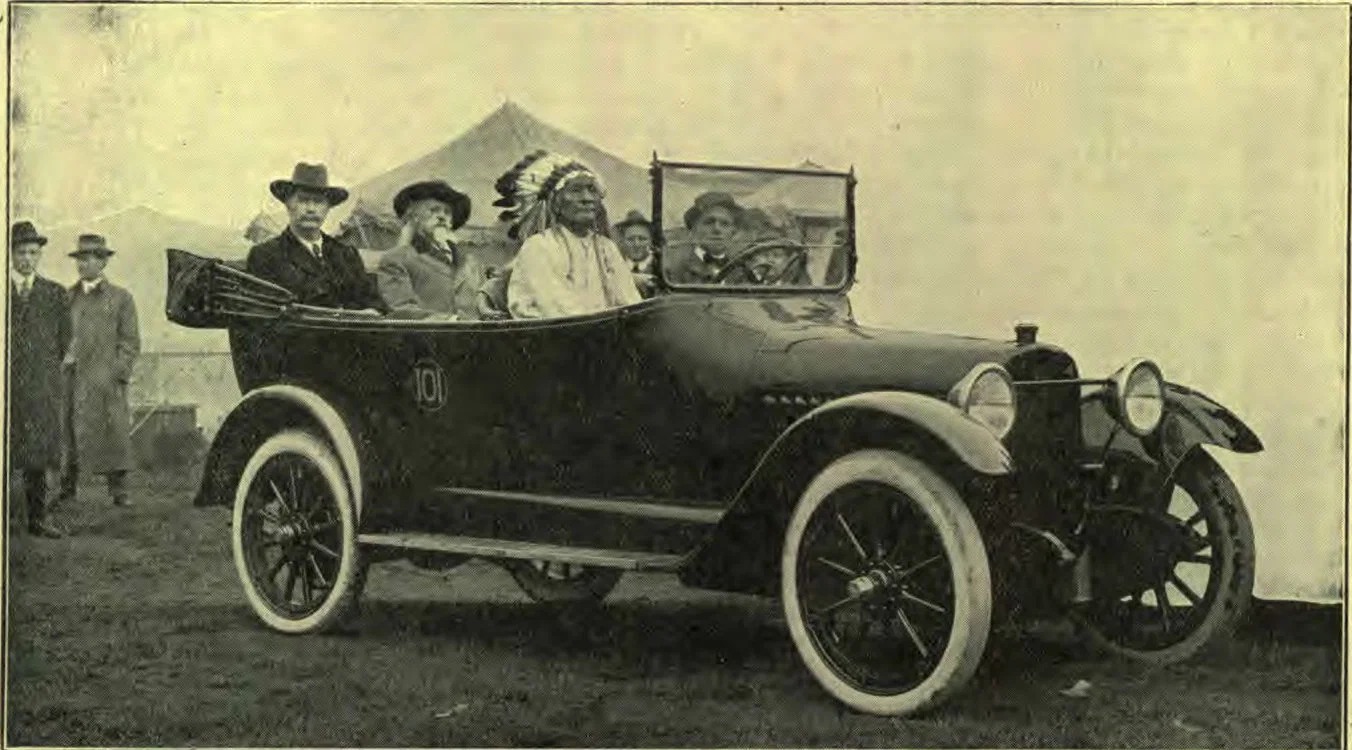
J. C. MILLER, OWNER OF CAR, COL. W. H. CODY (BUFFALO BILL), AND CHIEF WAN-NA-SA-GA. COLONEL CODY DIED JAN. 10.
We carefully weighed the reasons for and against, or thought we did: “We have the eggs, and they will never be missed; we are sure we shall not get caught; and then think of the candy we can buy. But we know it isn't just the thing to do, though we don't believe it is anything very bad.” My cousin first made up his mind that he was going; I wanted to go, but just couldn't get away from the thought that it would not be right, and also that there was a black dog at the store that would bite. The more I thought of it the more the dog, and not the thought of the wrong I was about to do, kept me from going.
My cousin was sure that we could get onto the porch before the dog would see us, and then the storekeeper wouldn't let her bite us. So after a little more debating I decided to risk it. All the way down the road I felt rather shaky, due mostly, I am sure, to a guilty conscience.
As we neared the store, I began to look for the dog. My cousin had just reached the porch and I had but a few more steps to take, when out came the dog. Without even trying to get onto the porch, I turned and ran down the road. The pup at a glance seemed to take in the situation, for without paying the least attention to my cousin, she raced up the road in pursuit of me, and though I am sure she didn't run any harder than I, she did cover more ground. In what seemed to me but a second she had caught hold of my overalls just above the knee. She stopped, but I went on, thus tearing a slit in my overalls from the knee down. I didn't stop running until I had reached the grove.
I climbed up and sat on the top rail of the fence, when, besides having my clothes torn and being out of breath, I found I had lost my eggs. While I waited for my cousin I had time to think. He soon came up the road with the candy, and made great fun of my misfortune.
The experience taught me two lessons: first, if we stop to reason with wrong, we are apt to yield; second, a guilty conscience is enough in itself to defeat the bravest undertaking. N. L. BEEBE.
Bob Montgomery
I am indebted to the courtesy and reliable memory of Maj. J. Coleman Alderson, of Charleston, West Virginia, who gathered from his correspondence, and from personal interviews with those who possessed the facts, most of the story related below.
Major Alderson, during the war between the States, was first lieutenant of Company A, 36th Battalion, Virginia Cavalry, in the Confederate army. One of his correspondents has been a frequent visitor to the Old Brierfield plantation, the estate of Pres. Jefferson Davis, and the Hurricane plantation, the home of Gen. Joe Davis, brother to the president.
For some years before the war, when Mr. Jefferson Davis was in public life and spending most of his time in Washington, he had a body servant by the name of Bob Montgomery, who, by reason of his constant contact and association with his scholarly and refined master, and the fact that he possessed an unusually bright mind for a Negro, had acquired a fair education.
When the war came on, and Mr. Davis moved to Richmond, Virginia, the capital of the Confederacy, he left Bob in charge of Brierfield, as the most reliable and trustworthy and competent agent he could commission for that responsible business.12
As a further proof of the character and ability of the man, the adjoining plantation of Hurricane was also left to his charge by Mr. Joe Davis, who went into the Confederate army and became a general in command.
When New Orleans fell, leaving the Mississippi River open and unobstructed to the entrance of the gunboats of the enemy, there was no protection to Vicksburg, which is about thirty miles up the river from the Brierfield and Hurricane estates. These plantations lay on the riverside, and Bob, with shrewd intelligence, realized the danger to his master's property.
Filled with apprehension and acting with the greatest prudence, he went at once by train to Richmond, Virginia, in order that he might place before his master a plan that he had devised for the protection of the joint estates. Reaching Richmond in the night, he did not wait for the morning, but hastened to find President Davis, arouse him from his slumbers, and submit his plan for the security of the estate. President Davis of course felt a doubtful hesitancy to act upon advice from so humble a source, as touching so important an enterprise, yet gave patient attention until Bob's proposition was fully explained.
The plan was as follows: That the president and his brother, Gen. Joe Davis, should sell the estates to him, Bob Montgomery, for which Bob should execute his notes, covering the full purchase money, and give a deed of trust on the property to secure the payment of the notes; that when the war should be over, there being default in the payment of the notes, the mortgage should be foreclosed, and the legal title should repass to the original owners.
The reply of Mr. Davis was: “Bob, I cannot sell my estate to you, because you are my slave, and you could not legally receive the title from me.” This staggered Bob for some time, and he had begun to think he had taken his trip to no purpose, but he recovered his equanimity, and promptly submitted another proposition; namely, that President Davis should first voluntarily grant freedom to his slave, have a public record made of the act, and then negotiate legally with Bob in respect to the real estate.
To this Mr. Davis replied that he would consult his brother, Gen. Joseph Davis, and give Bob an answer in the morning.
When Bob Montgomery came back again in the morning, he found Mr. Davis waiting for him with the papers drawn, signed, and acknowledged.
They were all delivered to Bob, who, now a free citizen of the Southern Confederacy, hastened to his home in Mississippi, to the control of his large Southern estate, and the enjoyment of his independent citizenship. The first thing he did after reaching Mississippi was to have his legal documents placed upon record.
One might have supposed that his care and forethought would have stopped here, but he had a mind to still further protection. He secured a transcript of all these papers, carefully certified by the recording officer, and made a journey to Washington. There he obtained an interview with President Lincoln. I can well imagine the President's surprise when Bob informed him that he had been the private secretary of President Davis, but was then a freedman, and the legal owner of the two estates of Brierfield and Hurricane, and produced the authenticated copies of the record to substantiate his claim.
Then he made known the object of his interview. He stated that it was well known that the plantation of Brierfield had belonged to President Davis, and the plantation of Hurricane had been the property of Gen. Joe Davis, and though both estates had passed into his possession, yet he feared that the simple assertion of his ownership would not be sufficient to protect his property from the molestation of soldiers and the devastation of war. He requested from President Lincoln an official order to the effect that no Federal officer or soldier should molest him, nor in any way interfere with or damage his property.
The order from this high source was obtained, and Bob Montgomery again started for home, this time with a reënforcement that the military of neither government could afford to disregard. He arrived just a few days before a Federal officer and a squad of men appeared on the premises with commands to make destruction complete. Bob met them with his official order, and the assurance that if anything was disturbed it would be reported to Washington as quickly as the wire could carry it, which information produced a retreat of the soldiers more rapid than was their advance.
Notice of this Executive shield of protection was widely published in the army, and no company, squad, or individual marauder ever appeared again on the premises of either plantation.
At the close of the war, and after the release of Jefferson Davis from prison, at Fortress Monroe, and the excitement of reconstruction had in a large measure passed away, by a friendly but formal legal proceeding the mortgage was foreclosed, and the two estates were conveyed to their original owners.
Bob Montgomery, however, on his part had not been idle during the four years of uninterrupted agricultural industry on those two productive Southern plantations. The cotton that had accumulated during this time amounted to an exceedingly large storage, and commanded a good price.
A large sum was realized from the sale of the cotton. Neither the Davises nor Bob Montgomery have ever seen fit to take the public into their confidence and inform it as to the exact figures of this sale. The neighbors were left simply to conjecture as to the amount of the returns. Some have put at a hundred thousand dollars, others at a hundred and fifty thousand dollars, and others at two hundred thousand dollars, the amount that went to Bob as his share of the sale.
Then Bob Montgomery went into the Mississippi delta and purchased a large tract of unimproved land. A part of it he sold out in small farms to Negro settlers. Upon another portion he built a Negro town, and called it Mound Bayou—exclusively an African municipality. Bob was its first mayor. It has four stores, sawmills, a good hotel, a strong and prosperous bank, numerous small manufactories, and other enterprises, and a steadily growing population. It remains a model Negro settlement to this day. All the civil offices are filled and conducted by Negroes.
In the days of carpetbag rule, Bob Montgomery was a member of the State legislature, and made himself conspicuous for the good sense and equity of his conduct, and particularly for the fact that he never let an occasion pass without warmly and defiantly resenting any indignity, or insult, or aspersion cast against the name of his old master and friend, Jefferson Davis.13
When, in 1876, white people recovered control of the State government, Bob Montgomery was still retained a member of the State legislature, and coöperated in harmony with his white fellow members. His memory is respected by all classes; but Bob himself has long since gone to rest.—American Magazine.
The Golden Rule Standard
By M. E.
(Texts for February 11-17)
Do you desire to be a guest of Jehovah? Of course you do. How tender, how sweet, how deep, is the thought that you may be his guest! And since you may be, you should know upon what terms he extends hospitality, for surely it is his privilege to prescribe them.
The fifteenth psalm helps one to understand what the qualifications of Jehovah’s guests must be. Notice the construction of this psalm: The first verse asks the question; the second verse describes in a general way the guests of Jehovah; and then the verses that follow, in three clauses each, expand upon the general description already given. It is probable that David wrote this psalm when the ark was returned to Jerusalem; but whether written for this occasion or not, it is of eternal value.
The psalmist’s idea of the righteous man flows from the Old Testament revelation of a righteous God. He who would be a true worshiper of God must strive to grow more and more like him in all the attributes that it is possible for humanity to share. “Not men’s own fancies, but insight gained by communion with God, and docile inquiry of him, will reliably tell what manner of men they are who can abide in his light.”
The picture given in this psalm of the ideal Christian hardly seems complete. It is almost entirely negative and concerned only with acts. It teaches justice and honesty, but not the deeper forms of “love to our neighbor.” “Herein,” says one writer, “it reproduces the limitations of earlier revelations.” Later, Jesus came to magnify the law and teach its deeper meaning, in order to show his followers how to live in the spirit as well as the letter of the law. But while the New Testament may add to the fifteenth psalm, it takes nothing away; and that psalm “still stands as an unantiquated statement of what a man must be who dwells in the secret place of the Most High.”
First of all, this psalm teaches that a man is not made up of two water-tight compartments in which he can keep his religious life and his daily conduct separate. Most of the Old World religions, as the heathen today, made no connection between a man’s religion and his conduct; but, as is seen in this psalm, Judaism taught that the two are inseparable. If a man cannot mix his religion and his business, it is pretty good proof that he is in either the wrong business or the wrong religion. It is a person’s daily life that proves the real worth of his religion.
Psalm 15 may well be called the Golden Rule Psalm. It attacks the sins of the tongue; and demands right speech, and faithfulness in vows and promises. It denounces flattery, and forbids usury and bribery. If it were made the universal standard for daily living, there would be great changes in many business transactions. If it were made general censor today, many of the bright and witty, but nevertheless unkind “speeches” that are current in social circles would never be heard. What a reformation this psalm would work in newspaper columns! How little it would leave of some of the political speeches that have echoed and reëchoed from shore to shore! How utterly it would annihilate words that have polluted royal lips! But the questions for you and me are, How do we measure up to this standard? Does it demand that any of our thoughts fall back unspoken? Does it call for any change in our dealings with others?
Those who live by this golden rule standard are accepted as guests of Jehovah; and come what may, his guests remain steadfast, for he will hide them in the secret recesses of his pavilion. “The world passeth away, and the lust thereof: but he that doeth the will of God abideth forever.”
MEDITATIONS.—Father, while thou art preparing a home in heaven for thy children, I pray that thou wilt help me to make the necessary preparation here on earth to enter it. May my dealings with others, my words, and my inmost thoughts reflect thy will more and more each day.
SPECIAL PRAYER.—This week let us all pray for our missionaries in preparation.
M. E.
The Bible Year
By M. E. K.
Senior Assignment
February 11: Numbers 1 to 3. A census; order; redemption money.
February 12: Numbers 4 to 6. Separated for service.
February 13: Numbers 7, 8. Princely offerings.
February 14: Numbers 9 to 11. Following the cloud; murmuring; punishment.
February 15: Numbers 12 to 14. Jealousy punished; the reward of unbelief.
February 16: Numbers 15, 16. Sin and punishment.
February 17: Numbers 17 to 19. Aaron honored; support of priests and Levites.
For notes on this assignment, see the Review for February 8.
I have a picture which is named “The Oldest Living Thing.” It is a fine picture of one of the great California trees, the “General Sherman,” the patriarch14of the Sequoia National Park. It is 280 feet high, and its greatest diameter is 36½ feet. It is as thick as many houses are long. It surely makes one wonder and admire to behold its gigantic form towering far above the forest. It makes one dizzy to look up to the top of it, and it almost makes the brain dizzy to try to think back when that great tree was a little one such as several of those right around its base. Scientists tell us that this tree was already 2,000 years old when Jesus was born.
“In the age when the known world was rocking in the throes of the Trojan wars, and the time that history tells us marked the exodus of the Hebrews from Egypt, this greatest of Sequoia gigantea was a flourishing sapling of some twenty or thirty feet in height, and truly under the special care of the Creator, who held it safe from the lightnings of his wrath as he did from the attack of earthly enemies.”
But is this “the oldest living thing”? The word of God is older. Even part of the written Word is somewhat older than this tree is supposed to be. In Heb. 4:12 we read, “The word of God is living, and active” (A. R. V.), and Peter tells us that the word of God “liveth and abideth forever.” 1 Peter 1:23. Yes, the word of God is alive, and it still grows in the hearts of God’s children. And it has the same power to save from sin as in olden days. The “General Sherman” is on the decline, as can be seen by the dead branches in the top. Very likely some day it will succumb to the blasts of the storm or the tremor of an earthquake and come down with a crash; and great will be the fall thereof. But the word of God “abideth forever.”
What a privilege to read God’s wonderful, living book—the Bible. It contains the living word of God, which is able to make us wise unto salvation. 2 Tim. 3:15. If we will take heed to it, God will purify our hearts from sin. Ps. 119:9. The scriptures which we study will be brought to our minds again and again by the Holy Spirit. When we are tempted, we shall receive help, for “his word runneth very swiftly.” Ps. 147:15. Possibly some day even “General Sherman” will be sawed into lumber and built into houses. But these houses and all things earthly will pass away, while those who feed upon the word of God are built as lively stones into the Lord’s spiritual temple, which will endure forever. 1 Peter 2:2-5.
The Grandest Scene in Human History
Just now the papers of Washington, D. C., are having a great deal to say about the preparations that are being made for the second inauguration of Woodrow Wilson. It is felt that such a great event as installing a President of the United States in office should be marked by some grand display. It is planned to have a great inaugural parade which will be a kind of pageant representing the country’s progress. It is also proposed to have an exhibit of the actual working of the various departments of the government. Then, of course, there will be the solemn inaugural ceremony itself, on the Capitol porch, in the presence of many thousands of people.
As stated last week, the giving of the ten commandments on Mt. Sinai was perhaps the most wonderful event in human history except one. And it was made a scene of awful grandeur, in keeping with the great importance of the event. There, with a precipitous granite peak for a pulpit, and the whole nation of Israel for an audience in the plain below, God, with his own glorious voice, spoke his sacred law, amid thunder and flame and a wonderful display of power.
“God accompanied the proclamation of his law with exhibitions of his power and glory, that his people might never forget the scene, and that they might be impressed with profound veneration for the Author of the law, the Creator of heaven and earth. He would also show to all men the sacredness, the importance, and the permanence of his law.”
Afterward this holy law was written on tables of stone by God himself and delivered to Moses. It was kept in the sacred ark of cedar overlaid with gold, above which was the mercy-seat. The ten commandment law is often spoken of as the testimony. It is a testimony against us when we sin, and by it we shall all be judged. May we, like David and Jesus, be able to say, “I delight to do thy will, O my God: yea, thy law is within my heart.” Ps. 40:8. (See also John 4:34.) M. E. K.
Missionary Volunteer Society Programs for Week Ending February 17
THE programs for this date, with notes, illustrations, and other helpful material, will be found in the Church Officers' Gazette for February.