Your ShelfYour Projects

Review and Herald, Vol. 83, No. 13.

The Meeting Place
Earlier text: A Statement of Facts Concerning Our Present Situation—No. 8

My Song

W. S. CRUZAN
I WILL sing His saving power,— That power which frees from sin, And which protects me every hour, And gives me joy within.
A song of praise is justly due His great and glorious name; O then with songs my heart imbue, To sing thy mighty fame!
Let my inmost powers combine In lays of heavenly strains, And then with heart and soul and mind, Rejoice in pure refrains.
Then sing, ye saints, and glorify His name in tuneful lays; Then shall my tongue with yours supply A feeble gift of praise,
Semmes, Ala.

Irreverent Praying

My brother, take heed to that for which thou prayest! There lies the difference between the pious and the impious mind. It is not thy praying that makes thee good—not even thy sincerity in prayer. It is not thy sense of want that makes thee good—not even though expressed in abjectness. It is not thy feeling of dependence that makes thee good—not even thy feeling of dependence on Christ. It is the thing for which thou prayest, the thing for which thou hungerest, the thing for which thou dependest. Every man cries for his grapes of Eshcol; the difference is not in the cry, but in the grapes.
It is possible for thee to ask from thy God three manner of things: Thou mayest ask thy neighbor's vineyard; that is bad. Thou mayest ask thine own riches; that is neither bad nor good; it is secular. Thou mayest ask to be made unselfish; that is holy. It is not thy prayer that thy Father prizes; it is the direction of thy prayer. Dost thou deem thy child a hero because he asks thee for a holiday?—Nay, though he sought it sorrowing and with tears. But if he asks thee to let him share his joy with a brother or sister, then thou art exceeding glad; then thou sayest, “Thou art my son; this day have I begotten thee!” So with thy Father. He waits till thou criest for a crown—till thou prayest for his presence, longest for his light, sighest for his song, hungerest for his home, faintest for his footfall, callest for his company, tarriest for his tread, seekest for the sign of his coming. That will be thy Father's highest joy.—Rev. George Matheson.

I Am Hustled Out of My Spirituality

I AM hustled out of my spirituality. — Chalmers.

Just Smile and Forget

O, do not be discouraged, little heart! This world is not a wilderness of woe; And if sometimes its brambles catch and tear, Don't let the scratches vex you so.
For all the little worries that befall, The small vexations that so grieve and fret, To-morrow they will vanish into air; Then smile, dear heart, just smile and then forget.
And if to-day the skies are overcast, Somewhere we know the sun is shining still; Its silver radiance brims the lowering clouds, And we may catch its glory if we will.
And it is good to strive though we should fail, And good it is to suffer and be strong; And if we lift our faces to the light, The darkest day will ring to evensong.
And when our feet are weary, and the road More toilsome seems with every passing day, To share our every burden, little heart, The Helper walks beside us all the way.
— Woman's Life.

The Tree of Knowledge

L. A. S.
Eve had a fatal curiosity about the tree of the knowledge of good and evil, which led her to eat of its forbidden fruit, and thus obtain a certain sort of knowledge, which would much better not have been acquired. It was only knowledge that she obtained, not wisdom. It is always proper to seek for wisdom, and the Creator has never prohibited this; but mere knowledge is a very different thing, and there is much mere knowledge of which it is the part of wisdom to remain in ignorance.
It seems a surprising thing that parents are often so ready to lead their children to the tree of knowledge and give them its fruit to eat, and even to advocate this course as being for their good. Do they imagine that what worked harm to Adam and Eve can work good to their descendants of this degenerate age? What good did it do Adam and Eve to have their eyes opened and to know that they were naked? Even if God had permitted them to remain in Eden, it would never after that have been the same place to them that it was before.
An essential feature of the paradise which surrounds a happy childhood is ignorance. The child does not know that all persons are not good, and honest, and truthful; it does not know that a large proportion of the human race are not to be trusted; it does not know that the world is full of crime and suffering. It does not know enough about the nature of this life to see any of those things which darken the future to those of adult years. Hence it has no cares, no worries. And how much better off it is for not knowing these things! Its little paradise rests largely upon ignorance, yet it is no less real.
But the child, like Eve, has a fatal curiosity about the tree of knowledge. This, strangely enough, is often the excuse given by parents for letting him eat of its fruit. Was any child ever cured of unwise curiosity by this course? Is it not stimulated rather than satisfied? Curiosity has a proper place, of course, even a necessary place, in the child's mental equipment; but this does not justify giving it every kind of knowledge indiscriminately, any more than a child's hunger justifies giving it any sort of food it may fancy it wants.
Of that knowledge not suited to childhood the child can understand but little; and while it confers no benefit on the child, it opens a new avenue for curiosity and imagination to work much mischief. Wisdom is power, but mere knowledge is not power. Mere knowledge builds no fortification against evil. 'A little knowledge is a dangerous thing.'
Parents, guardians of children, beware of the tree of knowledge. Beware lest you spoil the paradise about your little ones by giving them of its fruit. Keep about them the safeguard of their ignorance, their innocence. Instead of leading them to the tree of knowledge, lead them to wisdom. Lead them to the One 'in whom are hid all the treasures of wisdom and knowledge.' This will be a safe course, always. Let them receive their knowledge through Christ. He knows what to say to little children. This will not spoil their paradise, and it will be the most effectual safeguard against all evil.

Spring Cleaning

If you have not time to do it yourself, interest the children in the cleaning up of the back yard. Nothing works more for the ‘good of the home’ than creating an interest in flowers and flower gardening, and beautifying the waste places in and about the farm or village houses. Many front and back yards may be redeemed from barrenness and neglect and from being a dumping-ground for the refuse of the family and farm. If no better can be done with these unsightly places, they might be sown down to rye or oats, or planted with corn. Anything is better than briars, bushes, old lumber, broken vehicles, tin cans, and the thousand things it is found most convenient to throw down in such places. Don’t allow the calves, or the hens, or the colts, or the pigs to use the yards as a pasture, and then wonder why the girls and boys want to leave home as soon as they are big enough to feel ashamed of “the looks of things.”
The flower garden, or, rather, the work in one, is one of the best nerve restorers in the world; better than any pills or powders or “teaspoonfuls.” Did you ever see a woman scowling over her flower bed? Did you ever see a morbid flower gardener? One who has a nice-looking yard, with plenty of shrubbery and blooming plants dotting the green-sward, is rarely a gloomy person, and never a pessimist. It is seldom the owner of a really “cozy corner” who wants to leave home, and nowadays, if the girls and boys can be proud of their homes, they find them infinitely more attractive than the life in the dirty town. It is seldom the woman’s fault that the yards are full of litter or overgrown with bushes, briars, burdock, cockleburs, jimson-weed, nightshade, etc., but she gets discouraged when, year after year, her plant beds and shrub borders are used for a browsing place for stock, and a dumping place for worn-out and broken-down vehicles, and small wonder if she gets cross and nagging, slipshod in manner and dress. Why should she look any better than her surroundings? She loses all heart. Begin now, to-day, this week, and “clean up and beautify the yards.— Selected.

Why Dread the Fly?

THE fly is usually considered simply as an annoyance, and its exclusion from the home is not so rigidly insisted upon as it would be if all were acquainted with its dangerous character as a conveyor of microbes.
Dr. Hayward, bacteriologist of the Michigan School Board of Health, recently made an examination of the “specks” of flies that were seen gathering about a cuspidor used by a tubercular patient, and found them to be full of tubercle bacilli. As a consequence of the presence of the fly, the bacilli of this dread disease are carried everywhere.
Imprisoned flies fed on tubercular sputum died in two or three days, while those fed on milk lived from eight to ten days. When the “specks” or feces of these flies were rubbed up with sterile water and injected into guinea-pigs, the pigs developed genuine cases of consumption.
The suppression of the housefly is a most important means of restricting tuberculosis and other deadly diseases.—Selected.

A Little About Peru

E. W. THOMANN
THERE are in Peru two completely different regions. The land between the Andes Mountains and the ocean, with the exception of a few plains and valleys, is a dry desert. That portion behind, or east, of the mountains, which constitutes the greatest part of Peru, is very fertile and productive. It is favored by frequent rains and a tropical sun, and vegetation grows so fast that many kinds of seeds produce twice a year; and some one has told me that it is possible to get three harvests of some kinds of grain from the same land in a single year.
The first-mentioned region is inhabited by a larger per cent of civilized people than any other region. Yet only in some parts can there be obtained enough water to irrigate the ground and make it productive. The light morning showers called camanchaca are not sufficient for irrigation, because the sun is so hot that in a little while the camanchaca is evaporated, and rises to form light clouds.
But behind the mountains the rains are heavy and frequent. And as this region is many thousand feet above sea-level, the sun's heat is not insufferable. There are immense forests, testifying to the good quality of the soil.
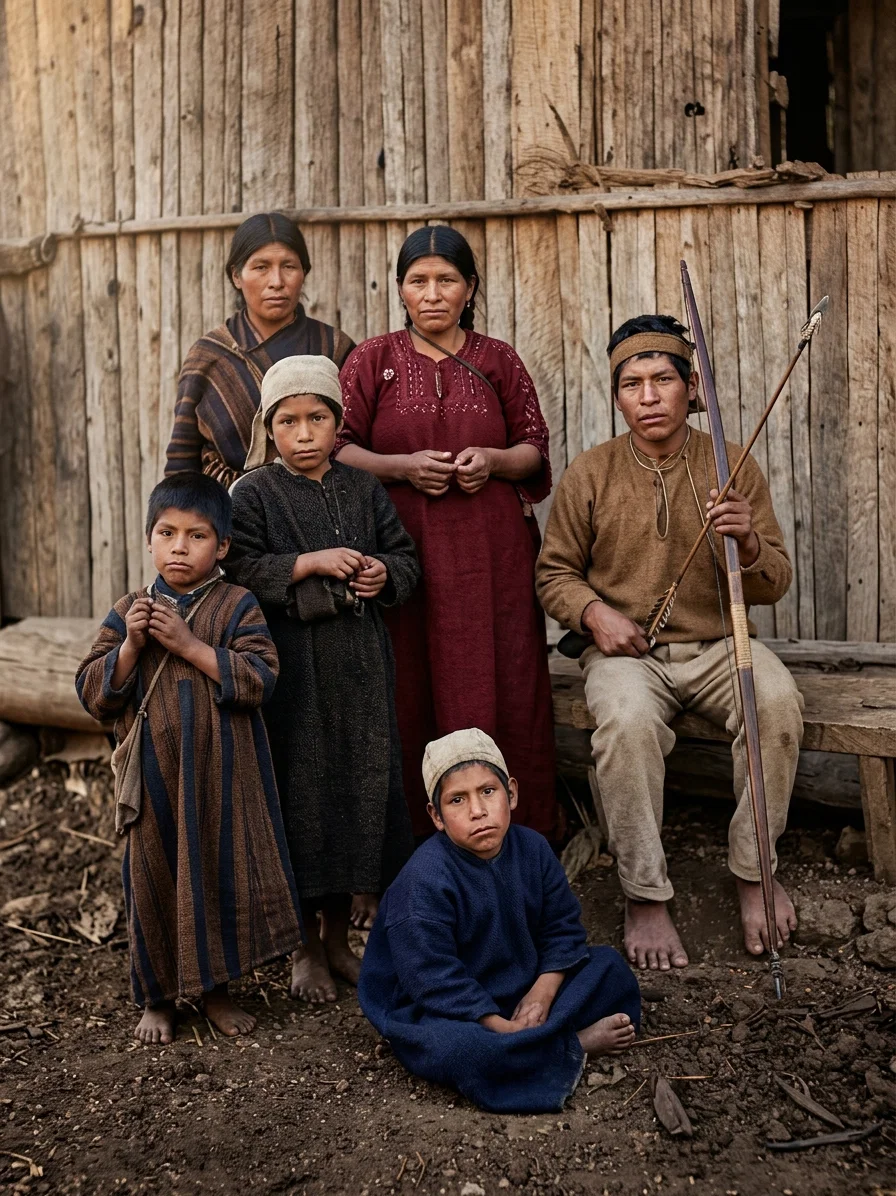
Any one who is willing to live among the Indians, far away from the corruptions and vices of the so-called civilized world, will find there a good field of labor, especially if he knows how to cultivate the ground or to prepare such things as are not easily carried from the coast to distances reached only by long trips on muleback.
Those who would come to Peru as self-supporting missionaries among the Indians should be persons who have an all-round education, who know how to do everything that needs to be done. Such people would be a great blessing to the Indians, and would be the means of raising many to a brighter plane in spiritual and physical life.
Others, who are not acquainted with agricultural work, but who have some trade, would do best to go to the cities, towns, or mines to find a field of labor in the Lord's vineyard while securing their daily bread.
Those who have no aptitude for languages should not come, because it is difficult to do much good if one is not able to learn the language sufficiently to talk with the people.
INDIANS OF PERU
INDIANS OF PERU
The Spanish is easy to acquire. The Quechua, or Indian tongue, is not much more difficult than the German. And as there are already parts of the Bible and grammars in the Quechua, it is not so very difficult to acquire it.
Young, earnest, consecrated Christians, who are not bound by family relations, would do better to work among the Indians than older persons who would with difficulty learn to use the language. He who comes should bid his relatives farewell, expecting not to meet them again until the gathering of the elect of the Lord in his great day.
Are there young, faithful brethren, who, impelled by the Spirit of the Lord, will venture to consecrate their lives entirely to him for the salvation of poor, desolate, uninstructed Indians? If there are such, let them come in the name of the Lord, and stand in the battle until they fall in physical death, or until the Lord comes to take them to his kingdom of glory, with all their fruits of labor.

Religious Influences in Japan—I

MARIA L. EDWARDS, M. D.
It was my privilege to spend thirty-one days in Japan recently; and while visiting my sister, Mrs. F. W. Field, I spared no pains to become as familiar as possible with the conditions as they exist to-day. In this country are many places which are renowned for their ancient temples and shrines, some of which are from three hundred to five hundred years old. But I feel far more interested in the living than the dead, and hence spent my entire time in the cities of Tokyo, Yokohama, and Kobe, and the surrounding country, where I could come in contact with the schools, hospitals, and, in fact, with the people of to-day as they live and act and think.
Tokyo, the capital of the empire, covers about one hundred square miles of territory, with a population of about 1,500,000. Being the educational center of not only Japan, but also of the entire East, many of the bright young people of the Orient are there, and many of the later missionary efforts have been put forth there.
Yokohama is the seaport of Tokyo, and is eighteen miles distant, being connected by steam railway. An electric line is now being built between the two cities. Its population is 252,699. All the large ocean steamers stop here, and here are located offices of all these lines of steamers, as also offices representing many other lines of business, such as life insurance agencies, importers, and exporters. French, German, and English hotels are here, which are well patronized by the passengers, who spend their time on shore while the boats are loading or unloading their cargoes. The stores in Yokohama are far more like our own than are the queer little Japanese shops which are found in other cities less frequented by foreigners. Nearly all the clerks speak English fairly well, and they seem to know exactly the kind of silk, embroidery, hand-painted screens, shell work, velvet pictures, etc., that the foreigner will purchase.
Kobe is another seaport town, three hundred and seventy-six miles from Tokyo. It can be reached by rail or by boat. The trip by rail occupies the hours between 6 P. M. and 9:30 A. M. The population numbers 215,780. It is probably more foreignized than any other city in Japan, and as there is comparatively a large foreign population, our sanitarium was established there in 1903, under the direction of Drs. S. A. and Myrtle Lockwood.
To say that it is, indeed, a strange country with a strange people, does not fully express the facts. Things are so very different from what we have been accustomed to, and their tastes, desires, habits, lines of thought, etc., are all so different that I found myself daily studying the problem as to why we can not better understand their lives, and enter into their feelings, and why it has seemed so hard to bring them to an understanding and an acceptance of Christianity. I am convinced that when we know the religious influence, or, rather, the lack of Christian influences, in their past history, we can in part understand why their lines of thought and their standards of right and wrong are so different from those who have had a Christian ancestry.
Let us note the influences that have been at work in Japan in the past, and the influences of the present. This is made plain by Rev. D. B. Schneder, in his little book, "Japanese Buddhism."
This work shows why the Japanese people are standing just where they are to-day, and, also, why the time is now ripe to do a special work for that interesting people.
Buddhism is, and has been, the prevailing religion for many, many years; A. D. 552 is the year agreed upon when it first entered Japan. At that time there were possibly one hundred thousand people—hunters, fishermen, and farmers. The people were intellectually well gifted. Their prevailing religion was Shintoism, or the “Way of the Gods.” Its central thought was reverence and obedience toward the mikado, combined with worship of ancestors and of nature. It identified patriotism with religious devotion. Hence, doubtless, the unparalleled patriotism even of to-day; for to die for the country is a great honor.
Buddhism came by way of Korea, and the story runs thus: In A. D. 552 a Korean king sent to the court of Japan some golden images of Buddha, with some sacred books. The council called by the mikado to determine what should be done with them, fearing that the worship of foreign gods would be a dangerous insult to the native ones, decided to have nothing to do with them. But one of the ministers of state set up the images in his country residence, which was thus converted into the first Buddhist temple in Japan.
Soon after, the land was afflicted with grievous pestilence, and this was attributed to the wrath of the native gods. War broke out, the temple was burned, and the idols thrown into the river. Still greater calamities followed, seeming to indicate that, after all, heaven was on the side of the sun-gods. The tide turned. Priests and missionaries were invited over from Korea, and later emissaries came from China, and monks went to China to the fountain of the new faith. Emperors became patrons of Buddhism, and helped to build great temples and monasteries. Still, questionings as to the temple of the native deities caused some uneasiness, until the ninth century, when the great Kobo arose. He successfully brought the two together, through the supernatural discovery that all the Shinto deities were incarnations of Buddha, and, therefore, belonged to the Buddhist pantheon. The native deities were christened with Buddhist names, and the scheme was a success. Temples assumed a mixed character, and on the family shelf sat, side by side, Buddhist and Shinto idols, dispensing supposed favors to devotees with equal alacrity.
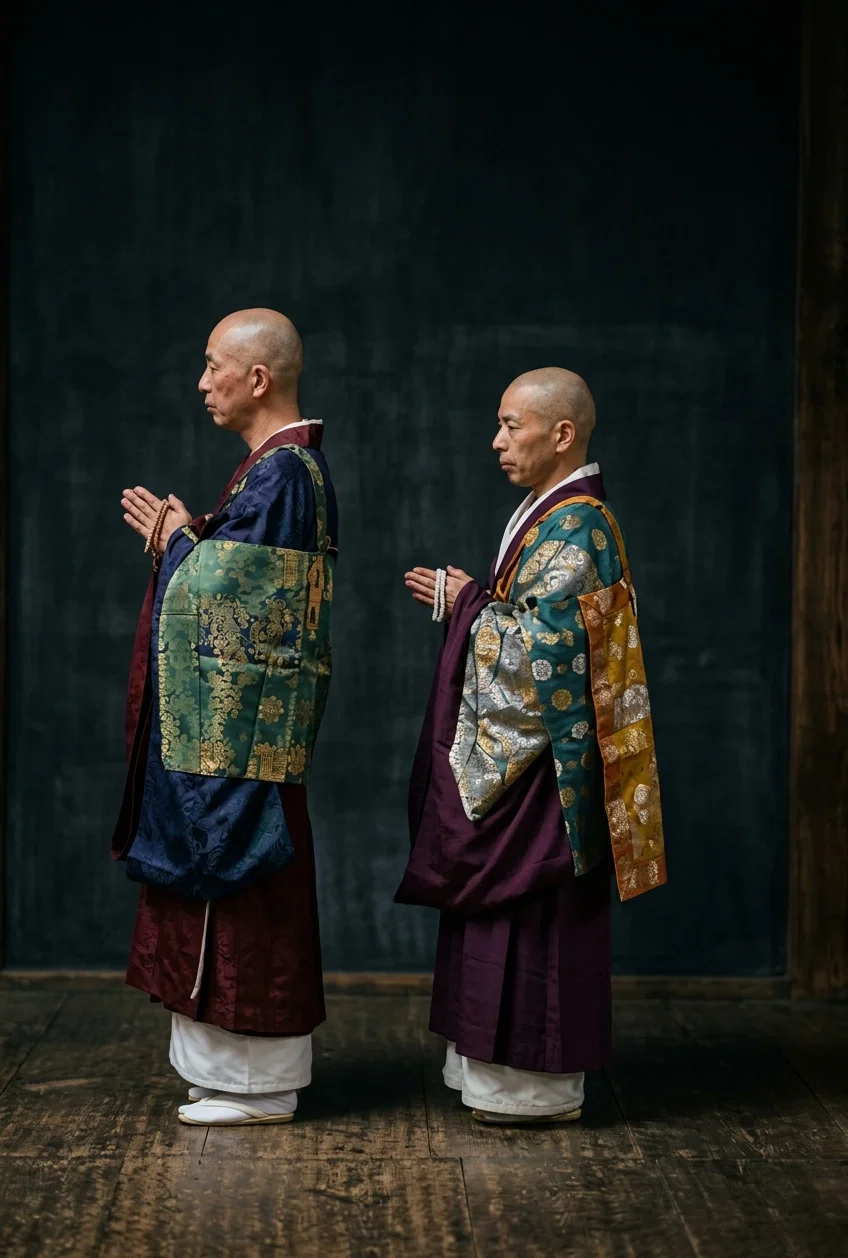
BUDDHIST PRIESTS
BUDDHIST PRIESTS
The history of Buddhism in Japan is a history of sects, which represent all sorts of one-sided emphasis on one or another element of Buddhist teachings, and all sorts of deviations therefrom. This inner history of Japanese Buddhism is interesting, not only for its own sake, but through the light which it throws on the religious tendencies of the Japanese mind; for in any country there is a process of interaction between the forces represented by the religion and the forces of the natural life.
Manifold ideas and practises have entered into the history of Japanese Buddhism, but certain elements, however, run through all the sects throughout the history of the faith: first, the transmigration doctrines, upon which Buddhism in all its forms unreservedly rests; second, pantheism, because of which gods represent forces, conditions, or principles, rather than distinct personal beings; a third, and less general feature, is the practise of religious contemplation, which requires that the subject sit for long periods quite motionless, legs crossed, hands in a certain position, the body erect,—as Buddha is nearly always represented,—mind fixed on vacancy, that Buddha might give an insight into deepest thought.
(To be concluded)
Moline, Ill.

A Crisis in Norway

O. A. JOHNSON
Norway, with an area of 15,289 square miles—more than twice the size of Massachusetts—and with a population of 2,000,917, passed through a crisis during the middle and latter part of 1905—a revolution which was without a parallel in the annals of history.
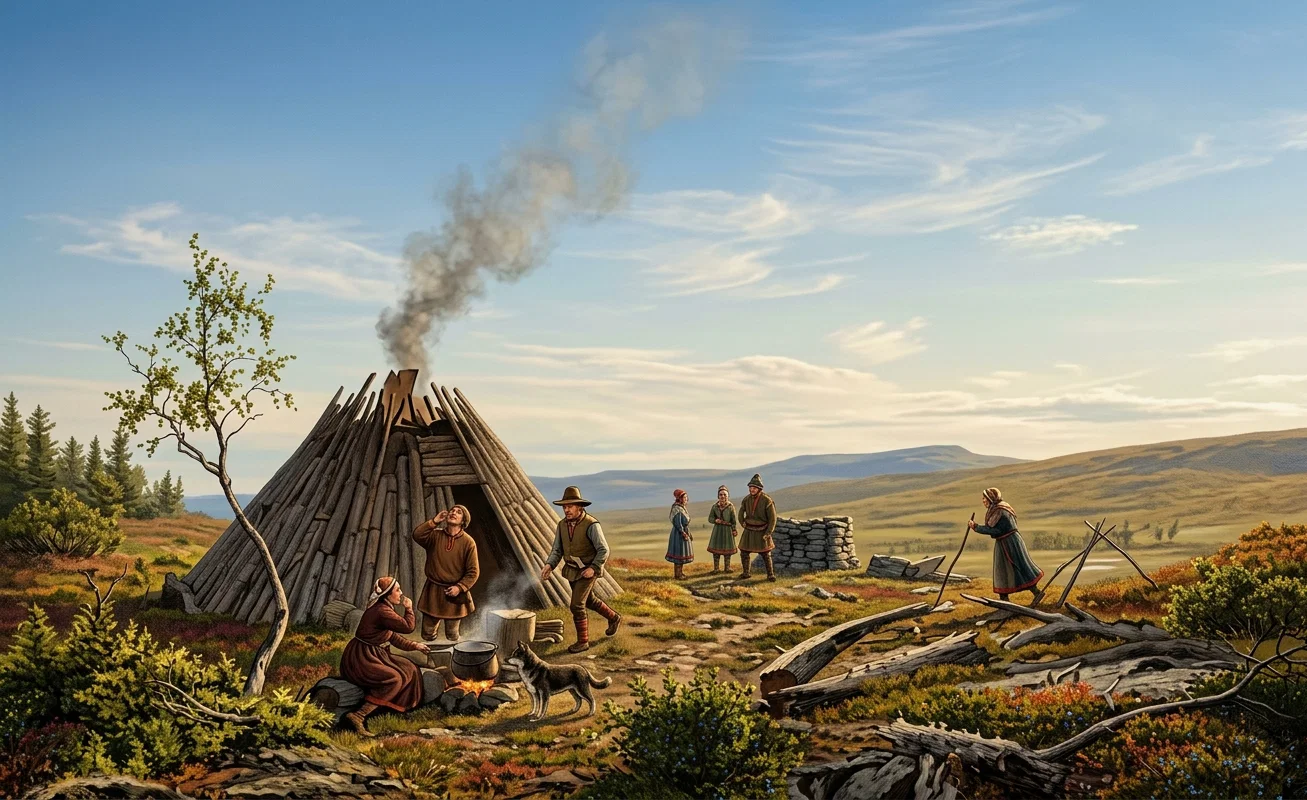
Of all northern countries, Norway was the last to be peopled. Its original inhabitants were in all probability a nomadic people, perhaps of the same stock as the Laps, who now live in northern Norway. Later came the Northmen, of Germanic stock, and took possession of the country. First in the Middle Ages we find Norway coming out of the legendary into the light of history.
The country was originally divided into fylker, of which there were thirty-one. Each fylke consisted of many families, and had its own chief, or king. The Viking period lasted from about 800 to 1000 A. D. After a ten-years' war with these small kings, Harald Haafager succeeded in becoming sole ruler of Norway, at the bloody sea fight at Hafsfjord, 872 A. D. Olav Trygvesen (995-1000 A. D.) introduced Christianity into Norway by force. Olav Haraldsson the Saint (1015-1030) confirmed the Christian religion, though not without compulsion. Magnus Lagaboter, a law reviser, reigned from 1263 to 1280. He published a general statute-book for Norway, which served as an authority in law for four hundred years. Some of its statutes are still in force.
Between the years 1319 and 1335 Norway was united with Sweden, under the reign of King Magnus Erikssen. But in the year 1355 he was compelled to abdicate the throne of Norway, in favor of his son, Haakon VI. This Haakon was married to the Danish princess Margreta, and by her he had a son, called Olav, who became king of Denmark, and upon the death of Haakon VI, in 1380, he inherited the kingdom of Norway. Thus Norway was united with Denmark, under one king, a union which lasted till 1814, or for four hundred and thirty-four years.
By the treaty of peace at Kiel in 1814, Denmark was compelled to give up Norway to Sweden, and thus ended the union between Norway and Denmark. But Norway, not being consulted in this arrangement, was not willing to comply with it. A meeting was called of the representatives, and a constitution was drafted and adopted at Eidsvold, on May 17, 1814, and Kristian Fredrick was unanimously elected king of Norway. But Sweden, not willing to yield Norway, given her by the treaty of Kiel, began hostilities, with favorable results. King Kristian Fredrick was compelled to abdicate the throne of Norway a few months after his election. The king of Sweden promised, if elected king of Norway, to govern in harmony with the constitution adopted at Eidsvold, only with such amendments as were made necessary by the union of Norway with Sweden under one monarch. The first article of the amended constitution reads thus: “The kingdom of Norway is a free, self-existent, undivided, and independent kingdom, united with Sweden under one king. Its government is a limited monarchy.”
These amendments were adopted on Nov. 14, 1814, and on the same day the Swedish king, Carl XIII, was elected king of Norway. Since then the kingdoms of Norway and Sweden have been under the rule of one monarch until very recently. This union was understood differently by these two people, and was, therefore, the cause of much misunderstanding and, consequently, many dissensions between them. This state of affairs continued till June 7, 1905, when the Storting of Norway felt itself justified in taking the necessary steps to dissolve this union.
The causes leading to this dissolution may be briefly stated as follows: During May, 1905, the Storting of Norway unanimously passed a law providing for the establishment of their own foreign consuls. The king refused to approve of this law. The Statsraad—state advisers—thereupon offered their resignation, as they did not feel justified to continue as his advisers when he refused to follow their counsels. The king refused to accept their resignation, and he refused to try to organize another Statsraad. Since the king failed to organize a new Statsraad in harmony with the constitution, Norway was thus left without a constitutional government, because the king failed to do his constitutional duty. Therefore, on June 7, the Storting adopted the following: “Since His Majesty does not regard it possible to give the country a new government—Statsraad—the constitutional kingly authority has thereby ceased to be effective,” and consequently the union between Norway and Sweden was thereby dissolved. At the same time, King Oscar was kindly asked to permit one of his sons to occupy the throne of Norway, as its sole ruler. In the meantime, the Storting authorized the Statsraad to govern in harmony with the constitution, as during an interregnum. This action of dissolution on the part of Norway came unexpectedly to Sweden.
After June 7 came days of suspense. Norway was prepared to make any offer necessary in its defense. Army and navy were ready to defend the country, because a break might be expected, rather than negotiations. It balanced long between peace and war.
Those were eventful days for Norway and Sweden. Religious meetings were held on the boundary line, in which Norwegians and Swedes united in worship, praying that God would so overrule all that all might end in a peaceful manner. None of the people were anxious for war. The press of Norway sustained the action of the Storting, though generally in very moderate and calm tones, in their articles touching this affair. The suspense was great all over the country. But it should be said, to the honor of the liberal party of Sweden, who have the future before them, that on account of the wise stand taken by them, it became possible to arrive at a peaceful solution of this rupture. To satisfy Sweden that the dissolution was the universal wish of Norway, an election was held on August 13, resulting in 368,200 votes in favor of the dissolution, and only 184 against it.
Then followed the negotiations between the representatives from the two countries, at Carlstadt, Sweden, from August 31 to September 23. During this time the suspense was great. Preparations for war were going on, and soldiers on both sides were called to the boundary line between Norway and Sweden. Believing Christians prayed much that the angel of peace might influence the delegates to arrive at a peaceful solution of this difficult problem, and that thus peace might be preserved between these two related people.
The negotiations ended in a careful solution of the whole matter. Both sides had to yield some points. Norway had to disarm and demolish three of the forts erected near the boundary line. A neutral zone, about ten miles on each side of the boundary line, was agreed upon. Various disputes that might arise were to be left to an arbitration, and Sweden was to acknowledge the dissolution of the union between the two countries.
But as King Oscar was not willing that any of his sons should occupy the throne of Norway, the Storting thereupon communicated with Prince Carl, of Denmark, to ascertain if he would take Norway's vacant throne. He replied that he would, providing such was the wish of the people, and not of a political party only. By another general election, November 12 and 13, about seventy-nine per cent voted in favor of Prince Carl; the rest voted in favor of a republic, without any ill will to this prince. On November 18 the Storting voted unanimously in favor of Prince Carl, of Denmark, for king of Norway. By the permission of his grandfather, King Christian IX, this prince accepted the offer of Norway's throne, under the name of King Haakon VII.
LAPLANDERS’ DWELLING IN NORTHERN NORWAY
On November 25 this newly elected king arrived with the queen and young prince in Christiania, the capital of Norway, which was finely decorated and illuminated. They were welcomed by many, many thousands from all parts of Norway. All political parties vied with one another in welcoming and honoring him and his wife, Queen Maud.
The year 1905 will be a memorable one for Norway and the other Scandinavian countries. To dismiss a king, dissolve a union between two nations, and place another king upon the throne, without war or shedding of blood, is certainly without parallel in the annals of history. But King Oscar II and the Liberals of Sweden deserve much credit for the peaceful solution of this revolution. The premier of Norway, with others, deserves credit and honor for the calm, careful, and wise manner in which the political affairs of Norway were conducted under these trying and difficult circumstances.
Now, according to all outward appearances, Norway has a time of peace and prosperity before her. But those who look upon these events in the light of prophecy, can truly see that the angels of peace have indeed held the winds of war in Scandinavia during the past summer. To the believers in the sealing message of Rev. 7:1-4, this time of peace means much. It means that God is at work to prevent war, that we may have a time of peace during which we can warn the world of its coming doom.
During these troublous times in Norway it has not been so favorable to work for the message. Some of our workers in the office, as well as other brethren, were mustered into service. The minds of the people were so occupied with war and the political disturbances that it was more difficult to call their attention to the Word of God. We are, therefore, very thankful for peace. We find people in many cities and localities who are willing to hear, and in many places in Norway people accept the truth through the reading of our publications and the Bible. Success is also attending our ministers. Canvassers have found it quite difficult to sell many books this summer. We are, however, of good courage, and shall labor hard while we have peace.

E. L. SANFORD

Kentucky

Grove.—I came to this place a little over two weeks ago, and began meetings in a church, but it was closed against me the second night, for fear, they said, that my doctrine would break up the church.
February 27 I held my first service in a private house which was offered me for this purpose, and as a result of the work done here, three families have accepted the truth, and others are interested, for which we praise the Lord.

E. L. SANFORD

Jamaica

PORT ANTONIO.—Port Antonio, the capital of the parish of Portland, is a town of growing importance. The starting of the banana trade and the building of the Titchfield Hotel have both increased its commerce and improved its financial condition. Hundreds of Americans visit this town between the months of February and May. Many of the natives of the other parishes of Jamaica are here, either employed or seeking employment. This city is more like an American than a Jamaican city. The people are less slothful than those of the other cities of the island which I have visited.
Pioneer work was started here about eight years ago by Elders Hall and Haysmer. These two brethren had scarcely made a beginning when they were called away by other matters of importance. The work was thrown upon Elder George Enoch, whose labors resulted in the raising up of a company of believers. Nine precious souls were the first-fruits of his labor. This was only a beginning. Before leaving, Elder Enoch had the pleasure of seeing others accept the truth, and at present Port Antonio has one of the best church buildings in the island. The number of baptized members is eighty-two, non-baptized twenty-six, and the outlook is still encouraging.
In accordance with the plans of our recent conference, I am now located in this town, where the opportunities for missionary work are seemingly many. My prayer is that wisdom and power may be given me to continue the good work started here. Brethren, pray for the work in Port Antonio. W. H. RANDLE.

L. G. KNIGHT

Panama

As a result of the tent effort at Colon, there has been a good interest awakened. We pitched the tent January 12, and began meetings that evening, continuing into the fourth week without missing a single night, an unusual occurrence for this climate, as we have rains nearly every week the year round. From the very start, the Lord's guiding hand was seen, even in finding a suitable place for the tent. I called on the superintendent of the Panama railroad to secure a certain plat of ground, he refused to let me have that, but after thinking a moment, said he would let me have a better place for the tent, a nice grassy spot between Colon and Cristobal. The latter place is the American quarters. The secretary gave me a written contract as a protection, to show to the police or any who might try to make trouble for us; in fact, the superintendent and secretary of the Panama railroad did all any one could ask for or reasonably expect, charging nothing for the ground, although in Colon every little space is considered valuable. The very day we took the tent down, they staked out on the spot a building foundation. Also, when the meetings were closed, they gave me a pass to the city of Panama and return, which gave me an opportunity of viewing again the big ditch work, which was in marked contrast to what I saw on my last trip a little over two years ago. There is now seen activity from one end to the other. At Culebra Cut I saw the steam shovels at work; they are a great invention for moving dirt. While steady at work, a dump car is loaded in one minute. While at this place, I visited four who had recently begun to observe the Sabbath. These had been brought out by Brother A. E. Connor's effort while located there.
The tent effort in Colon was considered by all the believers to be a success. Nothing, it is said, has ever stirred that place like the gospel tent. A notice of these meetings was printed in the Colon papers. The effect was to more firmly establish believers, encourage and build them up, and also to command a greater respect for our work. Although there was not directly so much done in gathering in souls as would be desired, six were baptized, and four others united with us, making ten accessions in all. The church-membership is now thirty-seven. We now leave them to labor in watering the seed sown, and they seem to realize as never before that it is obligatory upon them because of the widespread interest; and we trust that God will add the increase. Pray for this needy field with so few to work this large territory.

L. G. KNIGHT

Mission Notes

“Israel shall be saved in the Lord with an everlasting salvation.” Isa. 45:17.
Our of every one hundred thousand church-members, only twenty-one go to the foreign field.
Caste has become a religion to the Hindus, and is more difficult to deal with than their religions.
There are 2,201,404 children in India between the ages of five and nine who are married, and another 64,040 who are widows.
“God sent not his Son into the world to condemn the world; but that the world through him might be saved.” John 3:17.
There are yet sixteen hundred languages, representing three hundred million people, who have no Bible in their own tongue.
“How beautiful are the feet of them that preach the gospel of peace, and bring glad tidings of good things.” Rom. 10:15.
“Be it known therefore unto you, that the salvation of God is sent unto the Gentiles, and that they will hear it.” Acts 28:28.
The total number of Christian workers of all kinds in the United States is 1,218,025; one Christian worker to each forty-eight persons.
It has been stated at one of the Shanghai conferences that in Foochow from thirty to seventy per cent. of the female infants are put to death at birth.
In 1851 there were ninety-one thousand Protestant Christian adherents in India. At the close of 1889 the estimate was not less than eight hundred thousand.
Continue reading: Brusque (S. A.) General Meeting