Seventh-day Adventist Publishing Association · Battle Creek, Mich. · Nov 1872
SIN AND ITS RESULT.
By A. M. Driscall
DEAR READERS: You are all, doubtless, more or less familiar with the character of Nero the Roman Emperor, and with the persecution the Christians suffered under his reign. We will not, therefore, harrow up your feelings by giving a graphic description of this horrible persecution, but simply call your attention to Nero himself.
So much did this tyrant delight in suffering and the shedding of blood that it is said, “Death was his most trusty servant, whom he paid by daily victims.” These victims were not confined wholly to those who believed in Christ and obeyed his teachings, but those who stood in the way, or hindered in the least the accomplishment of his selfish designs, were alike subject to his displeasure, and consequently imprisonment or death was the result.
So destitute was this hated emperor of all the tender emotions of the human heart that he caused to be destroyed his own mother, wife, and step-brother, as also his wise and faithful teacher, Seneca, the philosopher, who alone had the courage and interest to point, and persuade him, as he had done in his youth, to the ways of virtue and of peace. These facts alone lead us to accept the statement made in reference to Nero, that “not a spark of love and mercy remained in his breast.”
And yet there was a time when his heart was tender and compassionate. It is said that “his youth gave fair promise; his heart was as pure and bright as the morning sun of the early spring. When he became emperor, and was called upon to sign the first death warrant, tears flowed from his eyes. He threw down his pen, and bitterly lamented that he had ever learned to write.”
But, behold how great the change! And what has wrought it? Dear children, pride and selfishness were the two leading principles of his character, and these conquered the man and proved his ruin.
It has been observed that love is man’s best friend, while-selfishness is his worst enemy. “Love endures all things to do good only; selfishness works sorrow everywhere in order to enjoy life, and yet the enjoyment which it obtains relates simply to earth, indeed, here yields its bitter fruits.”
This tender-hearted and promising prince, by indulging in sin, became the worst of tyrants; hated and feared by man, and forsaken by God, he died in the prime of life by falling upon his own dagger, which was held by another at his command because he had not the courage to hold it himself. He died, crying, “Too late! I am lost.”
Dear children, this is a sad picture, but it teaches us emphatically that the wages of sin is death, and unless we overcome sin, and not suffer it to overcome us, we shall be lost eternally. Can we afford to sin at so great a loss?
A. M. DRISCALL.
Battle Creek, Mich.
THE BEAR.
By J. E. White
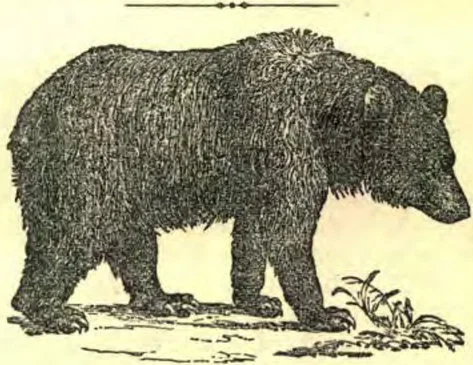
Children very often like to “play bear” with each other. But if a real, live bear should come into the room, I think they would not play long. There are several kinds of bears in America. The bear in the picture is called a black bear. He looks savage enough to eat anybody that comes in his way. But although he looks very savage, he will seldom attack a man if he can avoid it, unless he is very hungry.
A little boy and girl were once picking blackberries in the woods. Their baskets were nearly full, but they saw some very nice ones by the side of a large log. Just as they commenced picking them, they saw a big black paw reach up from the other side of the log and pull down some of the blackberry bushes, so that bruin could get the berries to eat; for bears, like children, are very fond of blackberries. As soon as the children saw the bear, they were terribly frightened and dropped their baskets and ran for home as fast as they could. But did the bear run after them? Oh! no. He seemed as much frightened as the children, and turned around and ran away as fast as he could, in the other direction.
The black bear is very fond of sleep, and if possible, will get away by himself and sleep all day. When winter comes, he hides himself away in some hollow tree, where he lives all winter in a half stupid state without food. When he goes into winter quarters, he is as “fat as a bear,” but when he comes out in the spring he is lean and as “hungry as a bear.” He is fond of green corn, berries, or roots. He is also a great thief, and if he can find a farmer’s sty, he is sure to carry away a pig.
The polar bear lives in the north where ice and snow are on the ground all the time. He eats seals and fish that are to be found in that region.
His fur is very long and white like the snow and ice amid which he lives. As the weather is very cold where he lives, he needs the thick, warm coat with which he is provided.
These bears are sometimes carried off to sea upon cakes of ice broken off by the waves, and they have been known to swim thirty or forty miles to get to their home again.
The grizzly bear is the most ferocious animal in our country. He knows his own strength, and is not afraid to attack even the great buffalo. He strikes him quick and fast with his great paw until he breaks his bones, and then he can kill him easily.
Some of these bears are nine feet long, and are as large as an ox. They often weigh ten or twelve hundred pounds. He is not afraid of a man, like the black bear, but will kill one if he can meet him, whether he is hungry or not. If he kills anything when he is not hungry, he digs a hole in the ground, puts in his prey, and then covers it up, and lets it stay till he is hungry.
A man once saw a great grizzly bear coming right toward him. He was not armed, and could not run away. So he lay down and pretended to be dead. Soon the bear came up, turned him over with his great paw, and at last dragged him off and buried him, and then went away to wait till he was hungry. After the bear was gone, the man got up and made his way out of the woods as fast as his feet could carry him. Don’t you think the man was glad that the bear was not hungry?
Bears are often spoken of in the Bible. Do you remember where David told Saul that he had killed both a lion and a bear that were carrying off his father’s lambs? He did not take all the praise to himself, but said that the Lord had delivered him from the paw of the lion, and the paw of the bear.
And do you remember the story of the forty-two children that were torn in pieces by two bears because they mocked Elisha? If you do not, ask your parents to read 2 Kings 2:23, 24, to you.
J. E. WHITE.
SOWING SEEDS OF TRUTH.
By Henry Hiatt
Passing seasons keep reminding,
Time is rolling on,
Life's fine thread is still unwinding,
Like a pleasant song;
Come, ye searchers after pleasure,
Come, then, gladsome youth,
Fill each fleeting hour of leisure,
Sowing seeds of truth.
Teach the young while hearts are tender,
Drop the precious grain,
Till the soul makes full surrender,
And its freedom gains;
With the Spirit's sword provided,
Put it to the proof,
Let your teaching be decided,
Sowing seeds of truth.
Soon, we hope, when toil is ended,
All our praise to bring
To the Lord who has defended;
Whom we serve as King;
Till his love through thought and feeling,
Woven, warp and woof,
Be throughout our life revealing,
Sowing seeds of truth.
—Henry Hiatt
Sanctified Afflictions Are Spiritual Promotions
SANCTIFIED afflictions are spiritual promotions.
CHARACTER
By Sunday-School Scholar
DEAR BOYS AND GIRLS: We have chosen a grand subject to talk with you about, a word full of mighty meaning to you all. It is the word character. It is a word of daily use, but how few understand its full importance. It hides in it great worlds of history and of hope, of pleasure and of pain, of good and evil, for all of you. Tell us your characters and we will tell your fortunes.
All of you have characters. They may not be very easy to understand, and are, probably, not very firmly fixed yet. And just because your characters are not yet in their final shape, and may be easily changed, we wish to talk seriously to you about character.
If you were to ask what is the best possession a man can have on earth, we would say, A good character. If asked what is the greatest misfortune that can happen to any one, we would say, A bad character. Better than riches, and honor, and many friends, is good character. It brings friends, and honor, and often wealth, and makes them all doubly valuable when they come.
You will all form your characters in some way, and you have no work on earth more important than this. Your grandest success or your grandest failure will be worked out here.
Remember you must always live with yourself. You can leave the society of other people if they are disagreeable. If your playmates are mean and selfish, you can go away from them and seek better company. But if your own character is mean, selfish, and disagreeable, there is no help for you. You cannot part company with yourself. And what is worse, you will know just how mean and selfish you are. You cannot conceal or forget it, though you may try to excuse it. But if your character is noble, and kind, and true, you will always have good company.
But, good or bad, the soul is forever its own most familiar associate. And it is a certain truth, boys and girls, out of this familiar companionship with your own characters will come the greatest part of the happiness or misery of your lives. Do not forget this. And even the good and evil that are in the world around you are changed to you by the power of your own character. When we look through green glasses, everything looks green. And through magnifying glasses, everything appears exaggerated. So, if seen through your own characters, everything looks changed from what it really is.
If you are pure and loving, even evil and misfortune will have a bright side; but if you are bad, even blessings will be changed to curses, and misfortunes will seem doubly dark. This is a grand and beautiful world to those of loving and happy hearts. It is a dark place to those whose evil thoughts make it so.
But this is not all. Your characters will be the chief causes of all your success or failures in life. The strongest or weakest thing about a man is his character. If your character is right, it carries you, and may bear you up to splendid hights of happiness. If it is bad, you must carry it, and it will sink you like a mill-stone tied to your neck. The consciousness of a good character will make you strong and brave, even when no one knows your worth. The secret knowledge that you are weak and bad will make you cowardly and feeble everywhere.
There is one other argument we wish to urge upon you, before closing this talk. It is this: The characters you form will be your greatest means to influence for good or evil your friends and associates, and the whole world. A noble character is like a beautiful beacon light, shining on a dark coast. It warns, guides, enlightens, cheers, and gives new hope to those who are ready to fall. A brave, kind, true-hearted boy will, by the simple power of his purity and truth, do good to the whole mass of his associates. His character acts as a silent, but constant, force to restrain the evil, encourage the weak, and make the good bolder and more active. We feel the power of a noble presence, man or woman, even if no word is spoken.
And so, on the other side, a bad and mean character is a power for evil. Even if a bad boy does not try to do wrong to his associates, he is still doing it every hour, by the silent, but baleful, influence of his character. The good do good when they seem to be doing nothing. The bad do evil, even when they do not desire to do it. The good bless and benefit even their enemies. The bad curse and injure even their friends.
Such, good lads and misses, are the forces and consequences that reside in that wonderful thing we call character. Think it over. Remember that characters of some sort you must form, and strive and pray that yours may be true and noble.—Sunday-School Scholar.
NEVER SAY FAIL.
KEEP pushing—'t is wiser
Than setting aside,
And dreaming and sighing
And waiting the tide.
In life's earnest battle
They only prevail,
Who daily march onward
And never say fail.
SECRET PRAYER.
By A. H. Clymer
MANY of the youth suffer loss by not spending more time in their closets. They are too brief in their devotions. They fail to wait before the Lord till their hearts are filled with his love. They fail to wait till they feel the heavenly attraction of the Spirit to realize the glories that await them on the other shore.
Dear youth, will you not take this matter into consideration? Think how much your soul needs the spiritual communion—the baptism of the Holy Ghost. You frequently find yourself weak, and unable to properly discharge duty, for want of this power from on high.
How often you have conversed with some friend till your hearts were blended together in love, and the time passed away so swiftly that you hardly realized its flight. Just so should your communion be with God. Continue your intercourse with him until your heart is renewed. Such seasons of prayer will do much to turn trials into joy.
A. H. CLYMER. Ohio.
EYES AND NO EYES.
You have all read the story in the school-reader of the two boys who went over the same route, one with his eyes open, and the other with them shut. It is old, but worth remembering every day. So many things worth knowing go on right under our eyes without being noticed.
I knew a man, a busy man, who had very little time for reading or study, but whose mind was a perfect storehouse of information on almost every subject.
“How does it happen that you know so much more than the rest of us?” I asked him, one day.
“Oh,” said he, “I never had time to lay in a regular stock of learning, so I save all the bits that come in my way, and they count up a good deal in the course of the year.”
This is just the thing—save all the bits.
“That boy,” said a gentleman, “always seems to be on the lookout for something to see.”
So he was; and while waiting in a newspaper office once for a package, he learned, by using his eyes, how a mailing machine was operated; while he waited at the florist’s, he saw the man setting a great box of cuttings, and learned, by the use of his eyes, what he never would have guessed, that slips rooted best in nearly pure sand.
“This is lapis lazuli,” said the jeweler to his customer; “and this is chrysoprase.”
And the wide-awake errand boy turned around from the door to take a sharp look, so that in future he knew just how those two precious stones looked. In one day he learned of the barber what became of the hair clippings; of the carpenter, how to drive a nail so as not to split the wood; of the shoemaker, how the different surfaces of fancy leather are made; of a locust, that his mouth was of no use to him in singing; from a scrap of newspaper, where sponges are obtained, and from an old Irish woman, how to keep stove-pipes from rusting. Only bits and fragments of knowledge, but all of them worth saving, and all helping to increase the stock in trade of the boy who meant to be a man.—Little Corporal.
THE COAL MINE.
By John P. Rathbun
DEAR YOUTH AND CHILDREN: While on my way home from our good camp-meeting this fall, I visited the coal mine at Williamston, Mich., that is now in successful operation. Thinking you would be interested, I give you a brief description of it. The coal is taken out in large quantities, to be used for fuel. The layer of coal is about three feet thick, and is forty feet below the surface. The miners have to work in a stooping posture. The coal is drawn up by steam power. They pump water out of the mine by the same power.
When the miner came out of the mine, he had a lamp still burning on the forepart of his hat, which he had for a light while in the pit at work. I thought this an important lesson for us, to have our light always burning, that others may see the light of truth.
JOHN P. RATHBUN.
Livingston Co., Mich.
Lay up treasure in Heaven.
Wonderful Sights and Ruins: Petra, the City of Rocks
By J. E. White
Wonderful Sights and Ruins. No. 3.
PETRA, or the city of the rocks, is situated about one hundred miles south-east of Jerusalem. It is without doubt the most wonderful city of which we have any record, for, as its name indicates, it is built in the rocks. Petra is about two miles long, and has but one street, which runs its whole length. Either side of this street, the mountain, composed of solid rock, rises perpendicularly from five hundred to one thousand feet. The most singular fact, however, is that the dwellings are chiseled in the solid rock which composes the sides of the mountain.
The road in this defile between the rows of dwellings is sometimes barely wide enough for two horsemen to pass, and is almost as dark as night. Then the road widens into a natural amphitheater, and a strong ray of light is thrown down which illumines the frightful chasm as light as day. Wild fig trees, oleanders, and ivy grow out of the rocky sides of the cliffs hundreds of feet above.
The sides of the cliffs are cut smooth, and filled with ranges of dwelling houses, temples, and tombs, excavated with great labor out of the solid rock. These dwellings were excavated one above another till the whole sides of the mountain were filled.
Some would think that because the dwellings were chiseled out of the rock that there is no beauty in them; but this is not the case. For although they were completed over three thousand years ago, they exceed in beauty anything in the form of architecture which is to be seen at the present day. In the language of Mr. Stephens: “While the summits present nature in her wildest and most savage forms, the base is adorned with all the beauty of architecture and art, with columns and porticoes, and pediments, and ranges of corridors, enduring as the mountains out of which they are hewn, and fresh as if the work of a generation scarcely gone by.”
There are only two means of access to this city: One by a very narrow passage up the ravine which leads to the city, and the other by climbing up the sides of the mountain and descending into the city from the other end. At either entrance a handful of men could defy armies. So you see that it was a natural fortress of itself, stronger than anything that can be built by the puny hand of man. The Bible recognizes its strength, as it calls it Bozra, which means the strong or fortified city.
We might spend a long time giving a description of palaces, houses, churches, &c., which compose the city, but time and space forbid. But the question comes up, “Who inhabited this city?” It was inhabited by the children of Esau, or the Edomites as they were called, as you see by Gen. 36: 1, Esau was named Edom. It is almost incredible the number that lived in this city. We have no account of how many people inhabited it, but about 100 years B. C., 50,000 soldiers issued from this city at one time. These were able-bodied men, able to go to war. Reckoning those that were too young, those that were too old, the women and children, and there could not have been less than 200,000 inhabitants. Should you not have thought that such a city would have become proud, and thought that they were absolutely invincible? But where are the Edomites that inhabited this and the surrounding cities of Edom?
On account of the sins of this people, judgments of the most terrible nature were pronounced upon them. “For I have sworn by myself, saith the Lord, that Bozra [Petra] shall be a desolation, a reproach, a waste, and a curse. Thy terribleness hath deceived thee, and the pride of thine heart, O thou that dwellest in the clefts of the rocks, that holdest the hight of the hill: though thou shouldest make thy nest as high as an eagle, I will bring thee down from thence, saith the Lord.” Jer. 49: 13, 16. What a description of Petra! “And Moab [a name given to Esau] shall be destroyed from being a people, because he hath magnified himself against the Lord.” Jer. 48: 42.
How was this fulfilled? About A. D. 200, this city lost its independence. From that time down to A. D. 800, its inhabitants, and even the location of the city, was lost sight of. And the very site of the city has been lost for 1000 years until 1812 it was discovered by Buckhardt.
Now not even a tribe is known who claim to be the descendants of Esau. How literally and awfully the prophecy has been fulfilled. J. E. WHITE.
Johnny the Newsboy.
Something more than a year ago, as the writer was seated in the cars going west, a pleasant voice sang out, “Papers, sir? morning papers, lady?”
There was nothing new in the words; nothing new to see a small boy with a package of papers under his arm; but the voice so low and musical, its clear, pure tones, mellow as a flute, and tender as only love and sorrow could make it, called up hallowed memories. One look at the large, brown eyes, the broad forehead, the mass of tangled nut-brown curls, the pinched and hollow cheeks, and his history was known.
“What is your name, my boy?” as, half blind with tears, I reached out my hand for a paper.
“Johnny —;” the last name I did not hear.
“You can read?”
“Oh, yes! I have been to school some,” glancing out of the window to see if there was necessity for haste.
I had a darling boy once, whose name was Johnny. He had the same brown hair, and large, tender, loving, brown eyes; and perhaps it was on this account I felt like throwing my arms around his neck, and kissing his thin cheek.
There was something pure in the child standing modestly there in his patched clothes and half-worn shoes; his collar coarse, but spotlessly white; his hands clean, and well molded.
A long, shrill whistle, and a short, peremptory call, and Johnny must be off. There was nothing to choose. My little Testament, with its neat binding and its bright steel clasps, was in Johnny’s hand.
“Will you read it, Johnny?”
“I will, lady; I will.”
There was a movement: we were off. I strained my eyes out of the window; but I could not see him; and shutting them, I asked His love for this destitute, tender-voiced boy.
A month since, I made the same journey, and passed over the same railroad; and what was my surprise to see the same boy, taller, healthier, with the same clear, calm eye, and pure, clear voice!
“I have thought of you, lady. I wanted to tell you it is all owing to the little book.”
“What’s all owing to the little book, Johnny?”
“The little book has done all. I carried it home, and father read it. He was out of work then; and mother cried over it so much that I thought it must be a wicked book to make them cry so. But it is different now; and it’s all owing to the little book. We live in a better house now, and father don’t drink; and mother says it will be all right again.”
Dear little Johnny! His brown face was all aglow, his eyes bright and sparkling, and his face looking so happy!
Never did I crave so for a moment of time. But no; the cars moved, and Johnny was gone.
“It is all the little book,” sounds in my ears—the little book that told of Jesus, and of his love to poor sinners. What a change! A comfortable home, no more a slave to strong drink, hope was in the mother’s heart; health mantled the cheeks of the children.
Would that all the Johnnies who sell papers, and have fathers who drink, and mothers who weep over the ruin of their once happy homes, would take to those homes the little book that tells of Jesus!—The United Presbyterian.
ONLY
Only a sunbeam! yet its bright ray
Clothes with their beauty the flowers as they grow,
Gladdens the heart in some wretched abode,
Lights up a smile on the aspect of woe.
Only a breeze! yet some feverish brow,
Cooled by its touch, throbs no longer with pain.
Only a smile! but o'er some weary heart,
Banishing sorrow, it breathes joy again.
Only a frown! but it crushes and grieves,
Sending a chill to the fond, loving heart;
Hot, gushing tears and the quivering lip
Telling how keen was the stroke of its dart.
Only a word—an encouraging word,
Yet it speaks strength when despondencies roll,
Rousing afresh to the conflict of life,
Onward to victory, bearing the soul.
Only a life—life that flies like a dream;
Yet if well spent to the ends for which given,
Training for duty, and shaping the soul
For glory and honor immortal in Heaven.
—American Messenger.
The Love of Knowledge
THE love of knowledge heightens the enjoyments of life. It elevates the soul of man. It gives a charm to society, and renders solitude pleasurable. It is a shield against temptation, and a solace in trouble. If you love knowledge, you need never be lonely. It feeds the imagination, refines the taste, and ennobles the character.
Kind Words and Pleasing Acts
Be not stingy of kind words and pleasing acts, for such are fragrant gifts, whose perfume will gladden the heart and sweeten the life of all who hear or receive them.