"THEN verily the first covenant had also ordinances of divine service, and a worldly sanctuary." Heb. 9:1.
Many consider this text as positive proof that the sacrifices and offerings connected with the sanctuary were the first, or old, covenant. This text does not say that the first covenant was ordinances of divine service, but that it had these ordinances. We have a similar expression in the third and fourth verses of this chapter, to which we call attention: "And after the second vail the tabernacle which is called the holiest of all [most holy place]; which had the golden censer, and the ark of the covenant overlaid round about with gold, wherein was the golden pot that had manna, and Aaron's rod that budded, and the tables of the covenant." The "first covenant had ordinances of divine service." The "most holy" place had "the golden censer," and the "ark of the covenant," which contained the tables of the covenant. The "golden censer," the ark, and the "tables" were not the "most holy" place, neither were the "ordinances of divine service" the "first covenant." The first covenant had the "tables of the covenant." That which the first covenant had can not be the covenant itself. Therefore the covenant written upon the tables is not the "first covenant."
Christ was the foundation and center of the sacrificial system in both the patriarchal and Jewish age, and it therefore pertains to the Gospel or new covenant.
"For those priests were made without an oath; but this [Christ] with an oath by him that said unto him, The Lord sware and will not repent, Thou art a priest forever after the order of Melchizedek; by so much was Jesus made a surety of a better testament." Heb. 7:21, 22.
"But now hath he obtained a more excellent ministry, by how much also he is the mediator of a better covenant, which was established upon better promises." Heb. 8:6.
The new covenant is as much better than the old as Christ, our high priest, and his ministration, is better than the priests and their ministration of the old dispensation. The first covenant was established upon the promise of the Jewish nation to obey God. It was only the promise of sinful man, and the ministration connected with that covenant (this ministration is not the covenant) was only the works of man. The new covenant was established upon the promise and oath of God, and the ministration connected with the new covenant is the work of the Son of God. The success of the old covenant depended upon man fulfilling his promise, but the success of the new covenant depends upon Christ, for he is the "surety."
The Covenant of the Lord.
The Ten Commandments are called a covenant, and the tables of stone upon which they were written are called "the tables of the covenant." Many, without any Bible authority, in order to destroy the Sabbath of the fourth commandment, call them the "first covenant." The Bible nowhere calls them the "first covenant." That they are called the "first covenant" in order to destroy the Sabbath is evident; for, declaring them all abolished at the cross, it is claimed that all but the Sabbath command was re-enacted. We most emphatically deny that the Ten Commandments constitute the first covenant, which has "vanished away," and shall show that there is a distinction made between the Ten-Commandment covenant and the one which has "vanished away." The first covenant dates from Sinai, but the Sabbath and the law existed before the first covenant was made. As soon as the Jews reached Sinai, God offered them great blessings on the condition that they would obey his voice and keep his covenant. Ex. 19:5. Here is a covenant referred to that existed before the first covenant was made, and the Lord calls it "my covenant":—
"And he declared unto you his covenant, which he commanded you to perform, even ten commandments; and he wrote them upon two tables of stone." Deut. 4:13.
How can this commanded covenant be the same as the one "entered into," by which Israel became the Lord's people? The covenant of the Lord was written upon the tables of stone by the finger of God (Ex. 31:18), and therefore they are called the "tables of the covenant." They are not the tables of the "first covenant," but they are the tables of the "covenant of the Lord." The "first covenant" had the "tables of the covenant." Heb. 9:1-6.
The first covenant and that which pertained to that covenant were written by the hand of Moses in a book. Ex. 24:3-8; Deut. 31:9, 24. It is then called the "book of the covenant." Paul tells us that when the first covenant was dedicated, this book was sprinkled with blood. Heb. 9:18, 19. Therefore the "book of the covenant" is the book of the "first covenant." If the Bible makes a clear distinction between the covenant of the book and the covenant of the tables, then we can safely decide that the Decalog is no part of the "first covenant."
"And Moses wrote this law ["in a book," verse 24], and delivered it unto the priests the sons of Levi, which bare the ark of the covenant of the Lord, and unto all the elders of Israel." Deut. 31:9. The ark is called "the ark of the covenant of the Lord," because it contained the tables of stone (1 Kings 8:9) upon which was written the covenant of the Lord. The priests had the ark in their possession, with the covenant of the Lord already in it. Moses delivered to them something entirely separate and distinct from that which they already had, and that was "the book of the law," called also "the book of the covenant." That which the priests had in their possession can not be the same as that delivered to them. Therefore the "book of the covenant" is different from the "tables of the covenant." The "tables" were kept in the ark, but the "book of the covenant" was kept on the outside.
"And it came to pass, when Moses had made an end of writing the words of this law in a book, until they were finished, that Moses commanded the Levites, which bare the ark of the covenant of the Lord, saying, Take this book of the law, and put it in the side [not inside, but in the side] of the ark of the covenant of the Lord your God, that it may be there for a witness against thee." Deut. 31:24, 26.6
In the above text we have the same fact revealed as in the ninth verse, viz., that Moses delivered to the priests the "book of the law," or "book of the covenant," when they already had the ark, and the tables of the covenant of the Lord in it. We also have the additional fact revealed that the "book of the covenant" was kept outside of the ark, while the "tables of the covenant" were kept in the ark. The book contained laws to regulate the government of Israel. The tables of stone contained commandments which are the standard of righteousness in all ages, and for all people.
The law of God is also called the "testimony" (Ex. 25:16), and the ark is also called the "ark of the testimony" (verse 22). The sanctuary of the new covenant (Heb. 8:1-4) has an ark, and in that ark is the covenant of the Lord,—the "testament" (Rev. 11:19), or the Ten Commandments. Therefore the Ten Commandments were the standard of righteousness required of the Jewish nation during the existence of the old covenant; and it is the standard of righteousness required of the Christian church, whose sins have been washed away by the precious blood of the new covenant. The Sabbath of the law is the Sabbath of the new covenant. "The seventh day is the Sabbath of the Lord thy God."
W. L. ILES.
Boulder, Colo.
INSPIRATION; WHAT IS IT.
By John Ap. Williams
It appears to the writer that the meaning of the word “inspiration” is not as well understood generally as it should be, more especially as it applies to God’s Holy Word.
The following question was asked by a deputed minister to the flock of Christ, “Do you think all the psalms of David are inspired?” He also answers his own question, thus, “I do not think so.”
Webster gives us this meaning to the word “inspiration,” “breath, influence,” and to the verb “inspire,” “to breathe into, animate, or infuse into.” The meaning of “inspiration” in 2 Tim. 3 : 16, 17 is “God-breathed.” It is there declared:—
“All Scripture is given by inspiration of God, and is profitable for doctrine, for reproof, for correction, for instruction in righteousness; that the man of God may be perfect, thoroughly furnished unto all good works.” 2 Tim. 3 : 16, 17.
The truly regenerate child of God, therefore, has no business to think about these vital matters, but to affirm, and trust to the great searchlight, “God’s eternal Word,” to bear him up. “Now we have received, not the spirit of the world, but the Spirit which is of God, that we might know the things that are freely given to us of God” (1 Cor. 2 : 12); and now, having no longer the spirit of the world, we cease to conform to the things of the world, but are transformed by the renewing of our minds (having the mind of Christ, 1 Cor. 2 : 16); “that we may prove what is that good, and acceptable, and perfect will of God” (Rom. 12 : 2). Having been brought by God’s love and mercy into this blissful condition, what is our most reasonable service?—To copy our divine Master by presenting our bodies a living sacrifice, holy, acceptable to God. Verse 1.
Mark, that this reproof, correction, and instruction are for the man of God, in order that he may be perfected. Is it not necessary, then, that he should be inspired, or, in other words, have the Spirit of God breathed into him, to enable him to comprehend the inspired Word?—It certainly is; because “the natural man receiveth not the things of the Spirit of God, for they are foolishness unto him, neither can he know them, for they are spiritually discerned. 1 Cor. 2 : 14. Are they discernible to the regenerate?—Most positively; God has revealed them to us by his Spirit, for the Spirit searcheth all things, yea, the deep things of God. Verse 10.
To what extent do we find Scripture inspired?—All. Could we then debar any portion of the Psalms of David?—Certainly not.
Our merciful and loving Father in heaven, in whom are all things, does not leave his trusting ones in a helpless condition, but reconciles us to himself by Jesus Christ. 2 Cor. 5 : 18. When man accepts this reconciliation, he enters, as it were, a new school, God’s Holy Spirit being the usher, the inspired Word, the corrector, reprover, and instructor, and Jesus, our loving Saviour, going before as our example, saying, “Follow me.” Let us delve, then, into this inexhaustible mine of treasure fearlessly, as all things revealed therein belong to us and to our children forever. Deut. 29 : 29.
JOHN AP. WILLIAMS.
GOD’S WAY OF REFORM.
By M. E. K.
EVERY great reform that has blessed and benefited mankind has had a humble origin. Rich and titled personages rarely lead out or take part in reforms. Such persons are too engrossed with the things of the world to take anything more than a passing interest in the great problems of society, or to lay plans for the betterment of mankind. When the greatest Teacher that the world ever saw inaugurated a reform, the introduction of which has marked the greatest epoch known in the history of the world, he chose twelve men from among the common people,—men of humble occupations,—to disseminate his doctrines. He was compelled to this because no others at that time believed in him or in his doctrines.
This feature of the reformation wrought by Christ has been repeated in his church every time it has been necessary that a great reform should be wrought in it, and for the same reason, that the great, possessing so much to enjoy, have no disposition to enter upon a path where sacrifice and suffering must be experienced for the defense and propagation of the truth.
Moreover, there is a divine purpose underlying every true religious reform, which necessitates that it be carried on in this way. God is the real originator of every true reform, and it is ever his purpose that its strength shall be in its inherent truthfulness and righteousness, that it may attract and draw to it those who love the right and the truth; that those who will not receive the truth for the love of it alone may be repelled from it, so that each era of reform may also be an era of separation, and thus by the cleavage which the truth makes God’s host may be separated and known from all others. An apostle has therefore truthfully said, and his words apply to every succeeding age and era as well as to his own: “For ye see your calling, brethren, how that not many wise men after the flesh, not many mighty, not many noble, are called; but God hath chosen the foolish things of the world to confound the wise; and God hath chosen the weak things of the world to confound the things which are mighty; and base things of the world, and things which are despised, hath God chosen, yea, and things which are not, to bring to naught things that are; that no flesh should glory in his presence.” 1 Cor. 1:26-29.
Those who engage in such works of reform, working in union with God and under his direction, tho perhaps looked upon by the world with contempt, and derided as imbeciles or fanatics, are really benefactors of mankind. The world persecuted and put to death the apostles, but what would the world have been to-day had they never lived, preached the Gospel of Christ, and attested in life and death their faith and the power of the Gospel? And whenever in any age there may be found men who are willing to die, if need be, for the defense and propagation of a righteous principle, we may be sure that that principle will not die, but that it will grow stronger and stronger.
“They never fail who die
In a great cause; the block may soak their gore;
Their heads may sodden in the sun; their limbs
Be strung to city gates and castle walls—
But still their spirit walks abroad. Tho years
Elapse, and others share as dark a doom,
They but augment the deep and sweeping thoughts
Which overpower all others, and conduct
The world at last to freedom.”
In illustration of the truths above stated we can do no better than to insert here the words of a well-known historian: “The multitude lays its homage at the feet of those for whom the world has done much; whose path it has made smooth with riches; whose head it has lifted up with honors; and for whom, while living, it provided a stately palace; and when dead, a marble tomb. Let us go aside from the crowd; let us seek out, not the men for whom the world has done much, but the men who have done much for the world; and let us pay our homage, not indeed to them, but to Him who made them what they were. And where shall we find these men? In king’s houses? in schools and camps?—Not oft. In gaols, or at the bar of a tyrannical tribunal, or before a bench of Pharisees, or on a scaffold, around which mobs hoot, while the executioner stands by to do his office. These are not pleasant places; and yet it is precisely there that those great examples have been exhibited which have instructed the world, and those mighty services rendered which have ennobled and blessed the race.”—Hist. Prot., vol. 1, p. 383.
Such scenes have often occurred in the history of the world, but the cause for which these witnesses for the truth gave their lives has always survived them. “The blood of the martyrs is the seed of the church.” Paul stood before Nero in Rome, and, witnessing to the truth, went to his death; but the truth he preached survived, and planted Christianity in Rome. Later, that Christianity becoming corrupted, Louis Pashole, a Vaudois pastor, a man upon whom the mantle of Paul had fallen, stood in Rome in the presence of Pope Pius IV, as Paul had stood before Nero, and died as Paul had died for the Gospel. But the Gospel light has been passed on and is still preached as the “power of God unto salvation,” a savor of life to those who love and embrace it.
At the present time we see in the fulfilment of the proclamation of the Gospel warnings and messages predicted in Rev. 14:6-12, the peculiar reformation necessary to prepare a people for the coming of the Lord. This reformation is being carried forward in a similar manner to those which have preceded it. Calvin, in the dedication of his “institutes” to Francis I. of France, declared that if the reformers whom the king was burning at the stake were in the king’s eyes but the “scum of the earth,” yet their cause was great, for, said he, “it is exalted far above all the power and glory of the world; for it is not ours, but that of the living God and his Christ, whom God has made king to rule from sea to sea, and from the rivers to the ends of the earth.”7And we may say the same of the proclamation of the soon coming of Christ in the fulness of the preaching of the everlasting Gospel, and the reform upon “the commandments of God and the faith of Jesus.” Rev. 14:12. The men who are engaged in this work may be small in the eyes of the world, as the world measures greatness by its own standard, but their cause, being God’s cause, is great, and those are honored of God who have a part in it. That in this age of science and worldly wisdom God’s special work in the earth can, and is, being done by humble and unpretentious men attests the holy character of the work and the power of God, which is its support.
This work being the last work of reform wrought in the earth before the coming of Christ, its victory will not be celebrated in the same way as have the preceding victories of the Gospel, but in a far better and grander way; for, translated to heaven, and standing upon the sea of glass before the throne of the infinite Creator, those who have engaged in it, with the true saints of God of all ages, who like them have fought the good fight and gained the victory, will celebrate the triumphs of redeeming love, which in many ages, and through great tribulations, has blessed, comforted, and sustained those who, in obedience to God’s Word, and under the influence of his Spirit, have separated themselves from the world in the acceptance and defense of the Gospel.
M. E. K.
"THE MOST HIGH RULETH."
By W. N. G.
NO. 9.
ALTHO Nebuchadnezzar had twice been compelled by overwhelming evidence to publicly acknowledge that "the Most High ruleth in the kingdom of men," his pride of heart would not permit a full surrender. It was not until he was brought under the chastening hand of the Lord that he really learned the lesson that his loving Superior in authority would teach him. "Whom the Lord loveth he chasteneth, and scourgeth every son whom he receiveth." Heb. 12:6.
In the fourth chapter of Daniel we read the king's statement of a dream, which he said made him afraid and troubled him. He called in the wise men of Babylon—the magicians, the astrologers, the Chaldeans, and the soothsayers—to learn of them the interpretation of the dream. Notwithstanding their former failures, he still kept this retinue of impostors. Notwithstanding his acknowledgments of the inferiority of the gods from which they claimed to receive their inspiration, he still clung to them. He still called Daniel by the name of Belteshazzar, as he said, "according to the name of my god." When the king had his former dream (chapter 2) these "wise men" had assured him that if he would tell them the dream they would show the interpretation. So this time he told them the dream, but they were just as powerless to give the interpretation as they had been before to tell the dream. Then Daniel was called and the dream was repeated to him, as follows:—
"Thus were the visions of mine head in my bed: I saw, and behold a tree in the midst of the earth, and the height thereof was great. The tree grew, and was strong, and the height thereof reached unto heaven, and the sight thereof to the end of all the earth; the leaves thereof were fair, and the fruit thereof much, and in it was meat for all; the beasts of the field had shadow under it, and the fowls of the heaven dwelt in the boughs thereof, and all flesh was fed of it. I saw in the visions of my head upon my bed, and, behold, a watcher and an holy one came down from heaven; he cried aloud, and said thus, Hew down the tree, and cut off his branches, shake off his leaves, and scatter his fruit: let the beasts get away from under it, and the fowls from his branches; Nevertheless leave the stump of his roots in the earth, even with a band of iron and brass, in the tender grass of the field; and let it be wet with the dew of heaven, and let his portion be with the beasts in the grass of the earth; let his heart be changed from man's, and let a beast's heart be given unto him; and let seven times pass over him. This matter is by the decree of the watchers, and the demand by the word of the holy ones; to the intent that the living may know that the Most High ruleth in the kingdom of men, and giveth it to whomsoever he will, and setteth up over it the basest of men."
Daniel understood the dream at once, but he was loath to acquaint the king with its terrible import. He "was astonied for one hour, and his thoughts troubled him." The king evidently suspected the cause of Daniel's hesitancy, so he said, "Let not the dream, or the interpretation thereof, trouble thee." Daniel then went on with the interpretation:—
"The tree that thou sawest, which grew, and was strong, whose height reached unto the heaven, and the sight thereof to all the earth; whose leaves were fair, and the fruit thereof much, and in it was meat for all; under which the beasts of the field dwelt, and upon whose branches the fowls of the heaven had their habitation; it is thou, O king, that art grown and become strong; for thy greatness is grown, and reached unto heaven, and thy dominion to the end of the earth. And whereas the king saw a watcher and an holy one coming down from heaven, and saying, Hew the tree down; and destroy it; yet leave the stump of the roots thereof in the earth, even with a band of iron and brass, in the tender grass of the field; and let it be wet with the dew of heaven, and let his portion be with the beasts of the field, till seven times pass over him; this is the interpretation, O king, and this is the decree of the Most High, which is come upon my lord the king: that they shall drive thee from men, and thy dwelling shall be with the beasts of the field, and they shall make thee to eat grass as oxen, and they shall wet thee with the dew of heaven, and seven times shall pass over thee, till thou know that the Most High ruleth in the kingdom of men, and giveth it to whomsoever he will. And whereas they commanded to leave the stump of the tree roots; thy kingdom shall be sure unto thee, after that thou shalt have known that the heavens do rule. Wherefore, O king, let my counsel be acceptable unto thee, and break off thy sins by righteousness, and thine iniquities by showing mercy to the poor; if it may be a lengthening of thy tranquillity."
Nebuchadnezzar was a servant of God (Jer. 27:6); that is, God had chosen him to carry out a certain purpose in the "kingdom of men." This being the case, he desired that the king might himself be benefited by the high privilege bestowed upon him. God would give him even more than the high temporal honors that fell to his lot; he would have him enjoy the spiritual blessings which are in store for all who will heartily yield themselves to his authority. But before attaining these, he must know that "the heavens do rule." His high position (he having received authority such as no man had enjoyed since Noah) could not give him any prestige over the poorest subject in the enjoyment of spiritual blessings. We are also reminded here that "showing mercy to the poor" stands high in the sight of God as a work of righteousness. This is also especially emphasized in Matt. 25:31-46; Luke 14:21-23.
But Nebuchadnezzar did not heed the warning sent to him in this remarkable dream. A year afterward we find him still filled with worldly ambition and puffed up with pride because of his great achievements. But for his own welfare, as well as for the honor of Heaven's authority, God could withhold his chastening hand no longer.
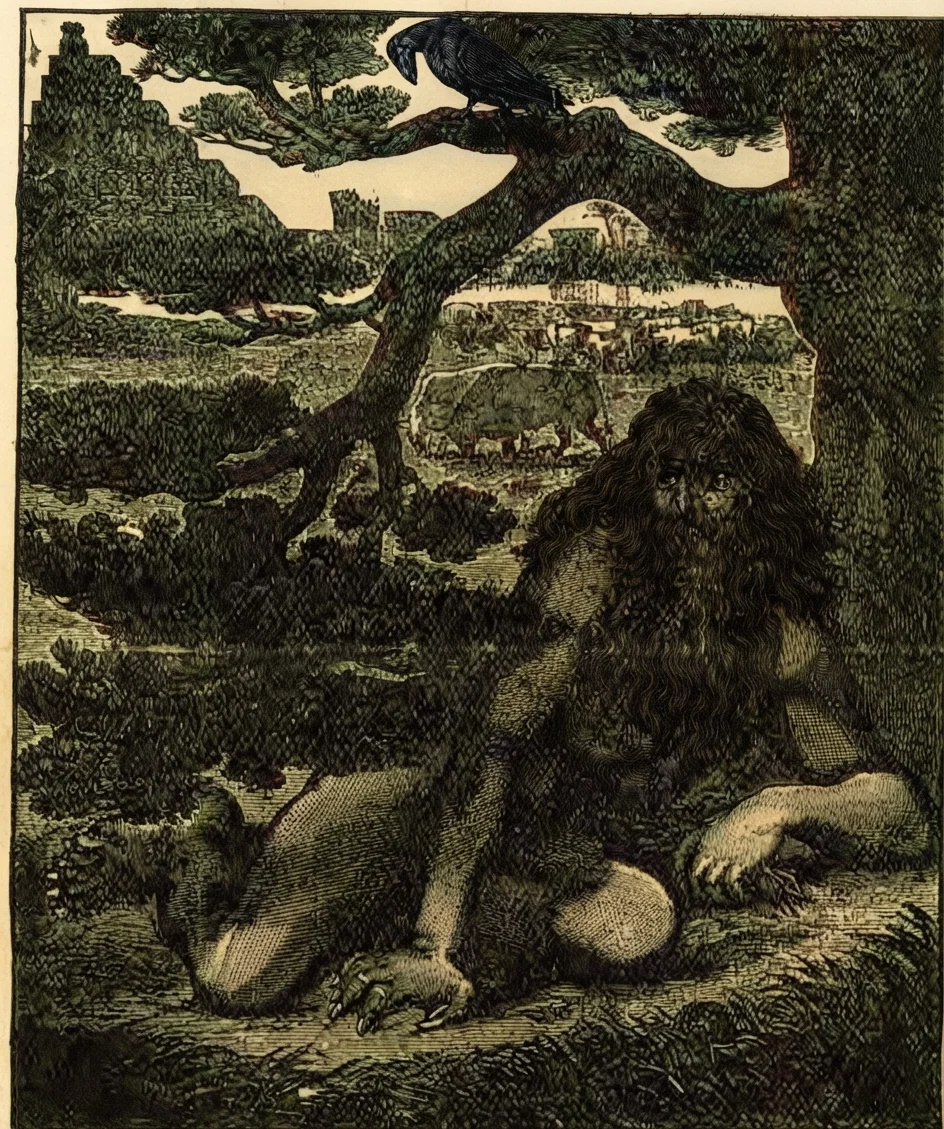
"At the end of twelve months he walked in the palace of the kingdom of Babylon. The king spake, and said, Is not this great Babylon, that I have built for the house of the kingdom by the might of my power, and for the honor of my majesty? While the word was in the king's mouth, there fell a voice from heaven, saying, O king Nebuchadnezzar, to thee it is spoken: The kingdom is departed from thee. And they shall drive thee from men, and thy dwelling shall be with the beasts of the field; they shall make thee to eat grass as oxen, and seven times shall pass over thee, until thou know that the Most High ruleth in the kingdom of men, and giveth it to whomsoever he will. The same hour was the thing fulfilled upon Nebuchadnezzar; and he was driven from men, and did eat grass as oxen, and his body was wet with the dew of heaven, till his hairs were grown like eagles' feathers, and his nails like birds' claws."
"Seven times," as is shown from other scriptures, and so reckoned in Josephus' "Antiquities," means seven years. The humiliation of Nebuchadnezzar consisted of his being deprived of his reason, and his mania was to act like a beast. This affliction came upon him the same hour in which the voice from heaven announced the decree. But the kingdom was preserved for him during all the years of his affliction, as indicated by the "stump" of the tree in the dream. He tells the story of his restoration, and of his entire submission to God, in the following graphic language:—
"And at the end of the days I Nebuchadnezzar lifted up mine eyes unto heaven, and mine understanding returned unto me, and I blessed the Most High, and I praised and honored him that liveth forever, whose dominion is an everlasting dominion, and his kingdom is from generation to generation; and all the inhabitants of the earth are reputed as nothing; and he doeth according to his will in the army of heaven, and among the inhabitants of the earth; and none can stay his hand, or say unto him, What doest thou? At the same time my reason returned unto me; and for the glory of my kingdom, mine honor and brightness returned unto me; and my counselors and my lords sought unto me; and I was established in my kingdom, and excellent majesty was added unto me. Now I Nebuchadnezzar praise and extol and honor the King of heaven, all whose works are truth, and his ways judgment; and those that walk in pride he is able to abase." Dan. 4:34-37.
It will be noted that the king did not make any more decrees of extermination against those who did not acknowledge the God of heaven.8He had at last seen the necessity of humbling himself before God, and the man who does this will not make or advocate laws to coerce the consciences of others. The man who has a heart to truly "praise and extol and honor the King of heaven," will love his neighbor as himself. And none but the most deluded fanatic will think of inflicting bodily punishment upon himself as a means of securing peace with God. There is a wide difference between the acknowledgment of God on the part of Nebuchadnezzar actuated by policy and Nebuchadnezzar converted.
WHO IS YOUR EXAMPLE?
By Clinton De W. Sharp
“HEAR this, all ye people; give ear, all ye inhabitants of the world; both low and high, rich and poor, together” (Ps. 49: 1, 2); “Know ye that the Lord he is God; it is he that hath made us, and not we ourselves; we are his people, and the sheep of his pasture” (Ps. 100: 3); “He is our God” (Ps. 95: 7); “Thou, even thou, art Lord alone; thou hast made heaven, the heaven of heavens, with all their host, the earth, and all things that are therein, the seas, and all that is therein, and thou preservest them all” (Neh. 9: 6).
God manifested his wonderful creative power in six days, and “spake in a certain place of the seventh day on this wise, And God did rest the seventh day from all his works” (Heb. 4: 4); “Wherefore the Lord blessed the Sabbath day, and hallowed it” (Ex. 20: 11).
God’s power was not to be forgotten. “He hath made his wonderful works to be remembered.” Ps. 111: 4. “The Sabbath was made for man” (Mark 2: 27), by which to remember the creative work of God.
“We are the people of his pasture, and the sheep of his hand.” Ps. 95: 7. If we are his sheep, he certainly must be our Shepherd.
“I am the Good Shepherd.” John 10: 11. Are the sheep expected to guide the Shepherd? “When he putteth forth his own sheep, he goeth before them, and the sheep follow him; for they know his voice.” John 10: 4.
“And the sheep follow him.” They are not leaders, but are being led. The Saviour adds, “A stranger will they not follow” (Id.).
Are you following a stranger, or the “Lord Jesus, that great Shepherd of the sheep”? Heb. 13: 20. If you are among those addressed as, “Fear not, little flock,” you are safe; for “a stranger will they not follow.”
Christ left you an example, “that ye should follow his steps.” 1 Peter 2: 21. “He that saith he abideth in him ought himself also so to walk, even as he walked.” 1 John 2: 6. Who is your example? Is Jesus? Are you walking as Jesus walked, following in his steps? If so, you will not keep Sunday, for “as his custom was, he went into the synagogue on the Sabbath day.” Luke 4: 16.
“Beware lest any man spoil you, through philosophy and vain deceit, after the tradition of men, after the rudiments of the world, and not after Christ.” Col. 2: 8. Scripture records no command of Christ or apostles to change the observance of the Sabbath; hence such a change must be “after the tradition of men,” “and not after Christ.” “A stranger will they [the sheep] not follow.” Listen not to obey the beguiling words of friends, teachers, pastors, or any one else save God. “To the law and to the testimony: if they speak not according to this word, it is because there is no light in them.” Isa. 8: 20
If you are a sheep, you will follow in the steps of the Shepherd, Jesus Christ; and he did not observe the first day of the week, nay, or even mention the day in any way. “If thou wilt enter into life, keep the commandments.” Matt. 19: 17.
The same plan of salvation has been held through all ages, faith in, and love to, God. “And this is life eternal, that they might know thee the only true God, and Jesus Christ, whom thou hast sent.” John 17: 3.
“Why halt ye between two opinions?” “Choose ye this day whom ye will serve.” “My sheep hear my voice.” “A stranger will they not follow.”
Whose example will you follow?
CLINTON DE W. SHARP.
Rochester, N. Y.
The Everlasting Covenant
No. 684. The Everlasting Covenant.
A CORRESPONDENT (E. B.) sends us the following clipping, and asks for a short answer:—
“I WILL make an everlasting covenant with them, that I will not turn away from them, to do them good; but I will put my fear in their hearts, that they shall not depart from me.” Now you can see that this third point has never taken place. At no time in the history of the Jews has such a covenant existed. For God has turned away from them for many, many years, and has not done them good. And at no time in their history has God put his fear in their hearts, that they have not departed from him. The Jews at this day still reject their Messiah, and as a nation have cast him out. Therefore this covenant is still a thing of the future, so far as the Jew is concerned.
The wrong ideas held by many concerning the return and restoration of the Hebrew nation come from wrong conception of what a true Jew or a true Israelite is, and of the nature of God’s covenant and promises. The right conception of these things may best be learned by looking at the earlier prophecies through the later declarations. Only so can we arrive at truth; but if we utterly ignore what is said by our Lord and his apostles, we shall ever interpret Israel and the promises to Israel, after the flesh.
In the first place, God’s “everlasting covenant” is the covenant of mercy, which has existed from the beginning, coextensive with “the everlasting Gospel.” It was promised to Adam, confirmed to Noah by the bow of promise, to Abraham by God’s promise and oath, and ratified at last by the death of Christ, the “surety” of that covenant. On God’s part it has ever existed, and it is sure to every soul who will grasp its mighty provisions by faith. The center of this covenant is Christ Jesus. Isa. 55: 3, 4; Ps. 89: 27, 28; 105: 8–10; Heb. 7: 22; 8: 10; 9: 15–17. The “making” of the covenant on God’s part refers to its ratification at the death of Christ, but the promise was sure before. And many hearts that feared God through all the years of the Hebrew nation have been established by it, and have not departed from God all their days.
2. The new covenant in promise and fact is open to all, both Jew and Gentile, seen more clearly since Christ; for thus the Scriptures declare: “How that by revelation was made known unto me the mystery; . . . which in other generations was not made known unto the sons of men, as it hath now been revealed unto his holy apostles and prophets in the Spirit; to wit, that the Gentiles are fellow-heirs, and fellow-members of the body, and fellow-partakers of the promise in Christ Jesus through the Gospel.” Eph. 3: 3–6, R. V. Before the Gentiles exercised faith they were aliens from the commonwealth of Israel, but now in Christ Jesus are fellow-citizens with the saints and of the one household of God. See Eph. 2: 11–22.
3. The Jews as a nation rejected Christ and chose Caesar, but the remnant, and those saved out of apostasy have always been a remnant, accepted Christ, a proof that all might have done so. God did not cast them off, as Paul shows in his own person. Rom. 11: 1–5. “Even so then at this present time” (in his day), he says, “there is a remnant according to the election of grace.”
4. The true Jew is the one who is a Jew inwardly, whose heart is cleansed by faith in the Shiloh of the tribe of Judah. Rom. 2: 28, 29; John 4: 24; Gen. 49: 10. The true Israelite is the one who, hearing and forgetting all else, pleads by faith with God, and obtains the victory. Gen. 32: 24–30; Rom. 9: 6–8. And all the prevailers by faith are the Israel, whom God is gathering out of all nations, Gentiles as well as Jews. Rom. 9: 24–26. “Is he the God of the Jews only? is he not also of the Gentiles? Yes, of the Gentiles also.” Rom. 3: 29. “For there is no difference between the Jew and the Greek [Gentile]; for the same Lord over all is rich unto all that call upon him.” Rom. 10: 12. “For by one Spirit are we all baptized into one body, whether we be Jews or Gentiles, whether we be bond or free.” 1 Cor. 12: 13. “What God hath joined together let not man put asunder.”
Question Corner
By Editor
“Enquire, and make search, and ask diligently.”
NOTE.—We wish those who ask questions to take particular notice: (1) Only such questions will be answered here as we believe to be of general interest and information. (2) We can not undertake to explain from four to a dozen scriptures, as in one sentence we are often requested to do. (3) Do not ask to “explain” a certain text or passage. State clearly the point in question. (4) Give full name and address, not for publication unless desired, but as evidence of good faith, and to give us the privilege of replying by letter if deemed best. (5) Unsigned communications of any kind find the quickest way to the waste-basket. (6) It is always well to inclose stamp. (7) “Foolish and unlearned questions avoid,” also those that minister to mere curiosity. (8) Study the Scriptures yourselves.
Tithes—on What?
By Editor
No. 685. Tithes—on What?
WOULD you kindly inform me through your Question Corner as to whether or not we should pay tithes on our profits or on full amount of money received? If I paint a house, am I to pay tithes on the cost of material plus profits, or just on the amount realized above the cost. F.
Tithe is paid on the income. From the gross income necessary expenses involved in producing the income should be deducted. This, of course, would not include a man’s own time. If you furnished the material for painting the house, you should deduct the cost. If your income is from a farm on which is a mortgage, the interest on the mortgage should be deducted, also expense of hired help.