Your ShelfYour Projects

Review and Herald, Vol. 82, No. 12.

Publishers' Page
Earlier text: “Ministers,” “Men of Means,” “Brethren and Sisters,” Attention!

_Open Air and Night Air_

The most interesting phase of present-day medicine is the open air treatment of respiratory diseases. From a state of mind which confined all patients suffering from diseases of the lungs to close rooms, thoroughly protected from all changes of temperature, there has come a development of medical opinion that insists on the greatest possible amount of fresh air consistent with the absence of drafts and of positive discomfort of high degree to the patient. The results obtained fully justify the practically universal medical agreement in the matter, and the death-rate from consumption has been more materially reduced thereby than by any other form of treatment ever suggested. . . .
It is not alone in tuberculosis, but also in other respiratory diseases, that the open air, under what would be usually considered discouraging circumstances, has been found eminently beneficial. In pneumonia, which has of late come to be the worst scourge of life in large cities, it is especially salutary. One distinguished American physician has declared on several occasions that if he were a sufferer from pneumonia, he would prefer to have his bed placed under a tree in the park, even in the depth of winter, than in the best-appointed hospital in the city. Once during the Civil War a snow-storm delayed the transportation of patients and tents, and a number of pneumonia cases were treated in the open field, covered only by army blankets. The mortality of that special epidemic—for nothing is clearer now than that pneumonia is sometimes mildly epidemic—was the lowest of any set of pneumonia cases that occurred during the war.
If in these serious illnesses fresh air is of so much benefit, when as a consequence of the lowered state of vitality the healthy reaction especially to cold fresh air might sometimes be missed, it is easy to understand that the same medium is of great importance for the preservation of health. This principle is becoming ever clearer in the minds of sanitarians. The old feeling of aversion to night air, especially because it is supposed to carry all sorts of miasmas with it, is now recognized as absolutely without any good foundation. As has been well said, the only fresh air at night is the night air. Instead of being more dangerous than day air, it is actually more salubrious. Night air in large cities particularly does not contain as a rule so many dust particles as day air, because there is not so much traffic, with movement of truck, carriage, and trolley, to disturb the dust. It is the dust particles to which microbes cling that make air dangerous.
The old prejudice with regard to night air was not without an apparently good foundation. Malarial diseases were acquired much more readily at night than during the day. It was almost inevitably fatal for a foreigner to be out on the Roman Campagna at night, though he might visit it with comparative impunity during the day. We now know by absolute demonstration that this was because the malaria-carrying mosquito did its stinging during the night, but especially just after sundown, and this was the time that was considered most dangerous. Properly protected against mosquitoes, however, one who has never had malaria may venture on the Roman Campagna without any danger, and Englishmen have lived there night and day, making the demonstration. As for malaria, so for yellow fever, and it must not be forgotten that so late as but little more than half a century ago yellow fever ravaged the Northern as well as the Southern cities. The disease is mosquito borne, and night is the dangerous time. No wonder our grandfathers, and especially our observant grandmothers, dreaded the night air, and transmitted the tradition of its balefulness.
Now this is a thing of the past. If fresh air is good for the ill, it is quite as good, or even better, for the well. The increased incidence of disease in large cities is exactly proportional to the lack of fresh air. Cities are healthiest where population is thinnest, and where the greatest attention is paid to ventilation. There are well-grounded opinions that the recent increase of pneumonia in all our large cities is due to a great extent to the almost hermetical sealing of our houses in the winter time, and to the dryness of artificially heated air, which keeps the lungs in a constant state of irritation, thus rendering them susceptible to infection. For children is this especially true. The lowered resistive vitality of children in asylums and other charitable institutions is largely a matter of restriction of that living in the open air which is so natural and necessary for children.
Undoubtedly all the world and its relatives would be benefited in health by a leaf from the book of the modern open air treatment of consumption. The healthy occupations are those which keep people outside most of the time. The ideal occupation for a young man with incipient consumption, in the condition sometimes called threatened with consumption, would be that of motor-man on an electric car, with an open platform, if it were not for the jar and exertion of so frequently applying the brake. Just inasmuch as people can be tempted to live more in the open will the average of health improve. Cold does not cause “colds.” Nansen and his men at the north pole did not suffer from respiratory affections, but several of them were down with grippy “colds” within a short time after their return. Dampness is not an active factor in the production of disease when there is adequate protection of the body by clothes, and when the food is abundant and nutritious, and there is no abuse of stimulants. Old traditions should not be allowed to have weight in the face of modern carefully collated observations. Windows should always be open in sleeping-rooms, no matter how cold or damp the weather; and if care is taken to have dry, abundant bed-clothing, and a warm room to dress in, there not only need be no fear of evil consequences, but the health will always be better, and any tendency, particularly to respiratory diseases, the most frequently fatal affections of this stage of civilization, will surely be obviated.—The Independent.

In “The Old Armchair”

SLEEP peacefully, my mother; cares have flown, And transient troubles gone; Heed no alarms, nor hear the night-winds moan; I’ll watch, sleep sweetly on.
Could I but lift that burdened life of thine, Much lighter mine would be; Could I escape with all thy care on mine, Much fleeter could I flee.
And yet those rugged hands with weary arms Await thy waking dreams, To soothe some fevered brow and bear the ills, And heal two sorrow’s streams.
Full many a recompense to thee has come For loss of lily hands And tripping feet and glittering glee and fun, As passing pleasure strands;
For love alone is worth the strain of years, As love alone survives. And thou hast gained, through tempest and through tears, Jehovah’s greatest prize.
Who loses love has lost his life, and found The mummy of a man, That wanders through the world a vagabond On Sheol’s border-land.
Sleep then in peace, the strength thy rest will give Will in its turn be given, To gain God’s greater love with which to live, And gild both earth and heaven.
— Frank Barrett, in The American Friend.

The Boys' School, Canton, China

E. H. WILBUR
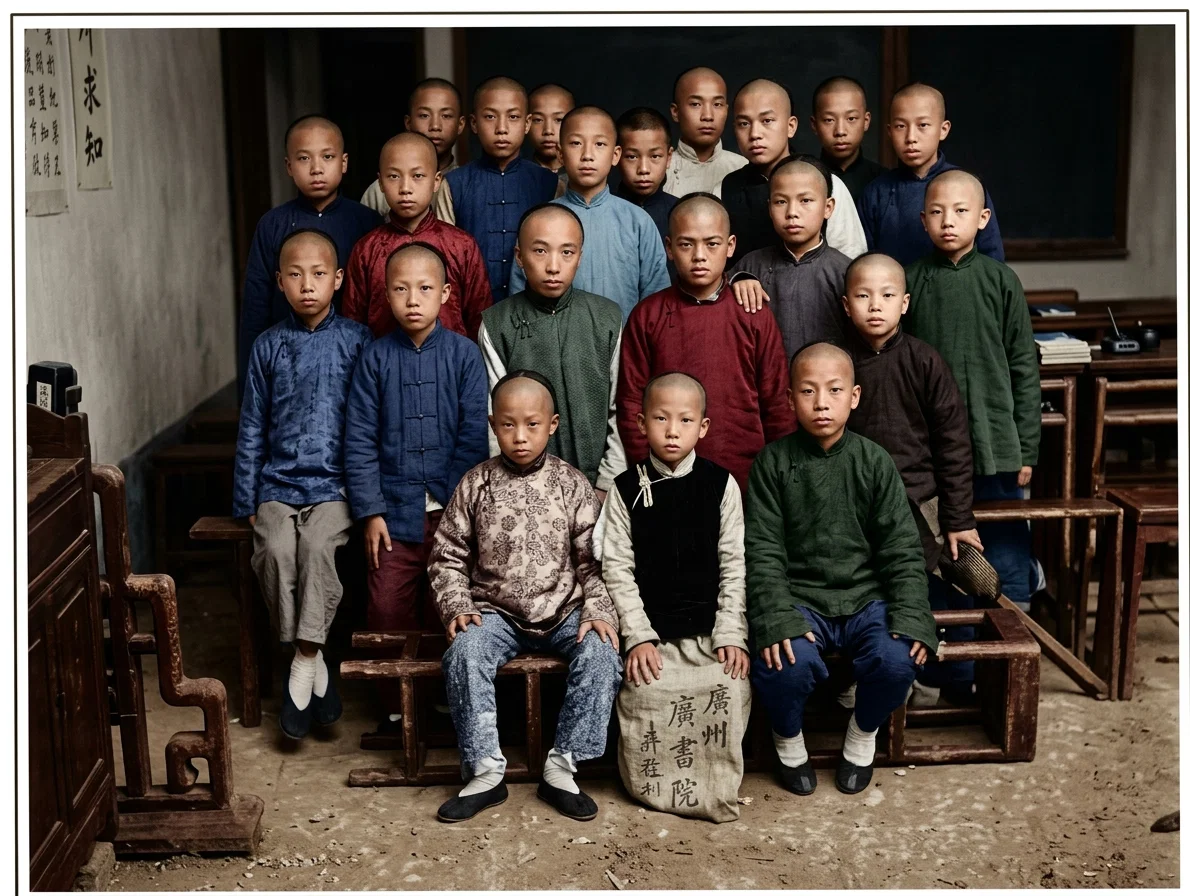
ON Aug. 11, 1904, we opened a boys' school near our mission hall, in Canton, China. The first term of five months closed January 13. Nearly all the schools here close at about this time, as many of the pupils return to their country home to spend Chinese New-year, which this year occurred on February 4.
During the first three months, a division of the school was conducted in the Chinese language, by a native teacher. The hours for study were from seven to nine and from ten to twelve in the forenoon. The first half-hour in the morning I spent with them in singing and Bible study. Later it was thought best to discontinue this division until after New-year, and instead the students of English were given daily lectures on physiology and hygiene, conducted in Chinese by a native preacher who is also a doctor. He was formerly an assistant in Dr. Kerr's Canton Medical Mission. He also preaches to the boys for one-half hour on Sabbath morning.
SOME OF THE BOYS
SOME OF THE BOYS
The hours for study in the English division were from one to five in the afternoon, five days in the week. The first half-hour each day and one hour on Sabbath were devoted to singing and Bible study, conducted by Elder J. N. Anderson. Afterward the school was divided into two parts, Brother A. C. Tidbury teaching the advance division, and I taking the beginners. A number of the pupils had never learned a word of English, and I found it convenient, if not necessary, to make explanations to them in their own language. I also required them to translate sentences from English into Chinese, and vice versa. The total enrolment in the English department was over forty, but the average attendance for the term of five months was only about twenty. These students were required to pay in advance at least one month's tuition fee of two dollars, Mexican.
Brother Tidbury has also conducted two private classes in English — one in the forenoon, and one in the evening. The members of these classes did not attend the afternoon school. Next term these private classes will be discontinued, and he will teach both sections of the English school — one in the forenoon, and one in the afternoon. Already a number of pupils have applied for admission, and probably we shall have a better attendance when school reopens.
Some of our pupils manifest an interest in Christianity, and we hope that by another year we may be able to report conversions. In these days, when China is opening wide her doors to Western education, shall we step into the opening providence and give these bright young men a knowledge of God, whom to know aright is life eternal (see John 17:3), or shall we sit idly by, and let this golden opportunity pass? Surely now is the time to work. But where are the teachers? Where is the money to carry forward this work? Our hearts have been made glad as we have seen so many good schools established by our people in America. In them we hope young people will be quickly fitted for the world's harvest-field, and that some of them will soon come to China to work as teachers and preachers. But as it has cost much money to establish schools there, so money will be required to establish and carry forward the educational work in this land. We are endeavoring to make our English school as nearly self-supporting as possible, yet have fallen somewhat short of this thus far.
British P. O., Canton, China.

The Journey to the West Coast of South America

F. H. WESTPHAL
AFTER our visit among the churches near Crespo, my brother and I made a trip to the eastern part of the province, where he and Elder Maas had been working. The Lord blessed their efforts, and a church of about twenty-five members has been raised up. Some of the members had been rescued from strong drink and the use of tobacco. There was a shout of joy from such. At the close of our meeting at this place, nine precious souls were baptized. They were mostly young people. We expect to see some of these at the school the coming year, to prepare themselves for missionary work.
At the close of this visit, there were still two weeks before our general meeting would be held, and I spent the time in visiting several of the churches in the province of Santa Fe. These had accepted the truth under my work a few years before, and it did us good to meet again. Our principal efforts were now made for the young people. Four of the youth gave their hearts to the Lord, and were baptized. We were pleased to see that the interest and courage of these churches had not abated. Some of the members had suffered severe trials of their faith; but their endurance and faithfulness have made them strong.
We next met for our general meeting at Lehmann. It was indeed a blessed meeting. There were representatives from Uruguay, Paraguay, Buenos Ayres, Entre Rios, Santa Fe, Cordoba, Chile, Corrientes, and the school in Entre Rios. Others will report this meeting more fully. From the very first, there was an earnest desire on the part of all to draw near to God. God was true to his promise that if we seek him with all the heart, he will be found. The preaching was highly practical, as well as doctrinal. The evidences of Christ's soon coming were deepened in each heart. All seemed to be glad that the Saviour will soon come. Every one in attendance expressed the desire to do all that is possible to bring the knowledge of the soon coming of the Lord to the attention of the people. We were glad to see this genuine missionary spirit taking hold of our people. It means that something will be done. If all those who know the Lord were genuine missionary workers, how soon could the gospel be preached in all the world!
Several of those who had attended the school were recommended to enter the field as licensed ministers and missionaries. All who were present were glad to see these devoted young men offer themselves for service. We were glad to give them an opportunity to enter the field to improve their gift and save souls. Some of these were sent to Paraguay and Uruguay, and others to Corrientes, Buenos Ayres, Santa Fe, Entre Rios, and Cordoba. We pray daily that their work may be successful, and that the Lord may go with them and give witness that he has called them to the gospel ministry.
At the close of this meeting I started on my journey to Chile. My family remained in Argentina until the close of the school year, as my son is attending school in Entre Rios.
We were favored with pleasant weather when we left Montevideo on board the “Orita.” The ship was crowded with passengers. There was a large number of nuns and monks. Some were going to Peru, Ecuador, and Bolivia, and others to Chile. These are from France. They are all teachers and professors, and have had to leave France or give up their profession. We ought to hasten to occupy the field before it is filled with agents who are bitterly opposed to the truth.
On our way to the Falkland Islands the weather grew colder from day to day. The islands looked bare, as the winter was just passing away. These islands belong to Great Britain. The English language is spoken. There are about three thousand five hundred inhabitants. They are engaged in sheep raising. One of our workers—Brother Nowlen—visited here a few years ago, and sold a number of books. Otherwise nothing has been done for these people.
Soon we entered the Straits of Magellan. The scenery was very beautiful. The hills were all covered with snow. It was the first time that I saw snow in South America. In the early morning we passed Punta Arenas. This place, with the surrounding country, has about fifteen thousand inhabitants. There are German, English, French, and Swiss people living here. Brother Nowlen traded many books for skins of animals and birds here at one time, but I think nothing more has been done for the people. There is room for work.
The beauty of the scenery increased as we went farther along. The hills were a little more elevated, and still covered with snow. The fleecy clouds hanging about them as the sun rose made a more beautiful picture than anything I had ever seen before.
There was a happy surprise among the sailors, as well as the passengers, when we steamed into the great Pacific Ocean, as it was as calm as a lake in fair weather. It is usually very stormy. Several boats have been destroyed in the storms. The snow-capped hills were in sight for at least one hundred and forty miles from Cape Pillar. There is little to be seen on the west coast until we reach Coronel. Here we stopped to take coal. We spent the day there. Some of the passengers went ashore, but came back somewhat disappointed with their visit to the place. After a ride of about four hours, we reached Talcahuano, a place of about ten thousand inhabitants. This city has a very fine harbor. Many of the Chilean navy boats are kept here. It is a good shipping port. One thousand tons of cargo were taken on board during the day.
Friday, November 4, we arrived at Valparaiso. Much of this city is built on the sides of the hills, but the business portions are largely in the valley. Brethren Steele and Thomann met me, and helped me to the shore with my baggage. I made my home at Brother Steele’s while there.
Friday evening we had a meeting. Quite a number were deeply interested in the truth. One Catholic family has lately begun to keep the Sabbath. They were driven out of the house that they had rented, because they left the Catholic Church. Brother Balada is holding meetings here now. On the Sabbath I spoke to the brethren. In the afternoon, with Brethren Thomann and Balada, we visited some of the church-members. Quite a number desire baptism, but they still have advance steps to take in order to be ready for that ordinance.
STRAITS OF MAGELLAN WEST OF PUNTA ARENAS
On Sunday we visited another family, whose only daughter had recently died. I could sympathize with them; for we had an experience like that ten years ago. This family is not keeping the Sabbath, but is somewhat interested. We had just entered the house when there was an earthquake. I thought of a time when, as the disciples prayed, the earth moved where they were assembled. God shook the earth at that time, and so he gave us an evidence of his power. This was my first experience in an earthquake. First the house trembled, and then it was lifted, and swayed back and forth, and then trembled again. Those who were with Brother Steele and me ran to the door and opened it. I asked them why they did this, and they replied that when an earthquake occurred once before, the people failed to open the doors in some places, and the houses sank down on the doors, and they could not be opened, and thus the people were shut in to perish. What a terrible shaking of the earth there will be when Jesus comes, and the islands shall not be found, and the hills and mountains shall vanish. How good it will be to see the dead come forth out of their long resting-places, and be changed in a moment, in the twinkling of an eye.
Before that great day shall come, we need to give to all the world the warning that it is near. There are but few laborers, and the field is large. The Lord says that we should pray that more laborers may be sent into the field. We need a school to educate workers here in Chile. Some of the brethren in the States donated a little for this purpose. I turned that, with some money that was given me in Argentina for that purpose, over to the secretary here. It amounted to one hundred and twenty-one dollars and three cents, North American gold. This is three hundred and sixty-three dollars and nine cents Chilean gold. The pledges of the two brethren in the States, of one hundred dollars each, with some pledges from Argentina, I turned over to the secretary also. This money should be paid to the treasurer of the Mission Board in Washington. If there are any who wish to help in this work, they may send their money to the Mission Board, telling for what purpose it is to be used. This should be stated definitely.
To-morrow I shall go on the frontier, where we shall meet the Chilean Indians. We shall need much grace to preach the truth to them, as well as to the many thousands of Germans and Chileans living in that part of the country. Remember the work here in your prayers, and with your donations.
Pua, Prov. Malleco, Chile.
CHILEAN INDIANS
CHILEAN INDIANS

Christian Prayer Meeting at Peking University

A CHRISTIAN from the London Missionary Society's college at Tientsin, China, who is now studying in the Imperial University at Peking, has started a Thursday evening prayer-meeting in the university. He thus brings together seven Christian students of the university, and we may expect to hear more of that prayer-meeting.

Live Missions

PRAY for missions. Preach missions. Eat and drink missions. Dream and talk of missions. Wear missions; they will never wear out. Live missions. Be a missionary, and you will often see Jesus at your side.—Selected.

Portugal

LISBON.—We are feeling quite at home in this needy field, as the language is becoming more familiar every day. We are short of literature on the subject of Christ’s soon coming and the signs of the times, but we have quite a number of tracts on the Sabbath question. We are praying for help in developing more literature. I have distributed 1,487 pages of tracts and about fifty of the Arauto de Verdade (Herald of Truth), our Portuguese paper published in Brazil. There are several persons for whom we are especially working and praying. Since it was in this country and city that there was such a manifestation of the approaching time of the end, the great earthquake of 1755, we have prayed to God to manifest the soon coming of our Saviour by an outpouring of his Spirit upon this people, and the giving to us of precious souls.
There is one reminder of the earthquake is an old clock tower, once a part of a royal palace, which was ruined at that time.
Some time ago, when the king, Don Carlos, was in London, the British and Foreign Bible Society presented him with a magnificently bound Portuguese Bible, which he received with very profuse thanks. The Protestants expect to make use of this fact in seeking to get the people to read the Bible.
We are progressing slowly in the language. I can now translate a Portuguese sermon fairly well. I attend four or five meetings a week, seeking to become acquainted with the people, and handing out literature as I can. There is a slight tendency on the part of the people here to lean toward liberalism, as they are getting tired of Jesuitical rule. Not long ago, on the occasion of raising a memorial of the five hundredth anniversary of the giving of the dogma of the immaculate conception, the priests were hooted by the populace, but the populace was put to flight by the soldiers.
We ask prayers in our behalf, as well as for this people who need light very much. We already need help—men, and means, and literature. Funds for the publication of more literature will be acceptable, if sent through the regular channels.
C. E. RENTFRO.

A Visit in Simultala, India

“BLESS the Lord, O my soul, and forget not all his benefits.” Thus wrote the psalmist under inspiration; thus does the Holy Spirit move upon the servants of the most high God to give utterance to his praises in this our day: and shall we say, Amen, brethren?
I am very truly thankful to our loving Father in heaven for the opportunity of spending a few days with Brother Barlow and his family in Simultala. After a year spent in a great city such as Calcutta, without so much as setting foot out of the city limits, the freedom and quietness of the country are much appreciated, where every object in nature seems to bask in the sunshine of the Creator's love, and to say, “God is love,” while we quickly respond “Amen.”
I had the opportunity of accompanying Brother Barlow to Babool Mohal, a village nine or ten miles distant by road from Simultala station, at which place a building has been erected by this brother, for a schoolhouse and church for the villagers near by. Half the boys in the school at Simultala went there to encourage other boys to join them in the study of the message. May the Spirit of the Lord raise up boys from these two schools to preach and teach the truth to their countrymen. When we left, eight or ten had already begun to attend school, chiefly shepherd boys of the Santal race.
Brother Barlow has learned the Santal language, and is thus able to work among the Santals; and, it seems to me, to work for India's millions, we must, first of all, acquaint ourselves with the language of the particular people we desire to work with. May God help us with heavenly wisdom.
It was inspiring, as we journeyed to and from Babool Mohal, to hear Brother Barlow give the message verbally, besides distributing the literature, to all whom we met on the wayside; and as afterward I followed his example, the Lord granted me a blessing.
A. G. WATSON.

Scotland

In reading Brother Spicer’s article “The Sabbath in Ancient Scotland,” REVIEW AND HERALD, No. 6, page 5, and noting the conditions that prevailed at that time, we could not help comparing those times with the present time, and drawing a parallel with things as we find them to-day.
The ardor of Queen Margaret in turning the Scottish people from the simplicity of their former religion, and in introducing Roman rites and ceremonies, together with the observance of the first day as the Sabbath, was successful to a very great extent, so much so that the whole country yielded, and, till the time of the Scottish reformation, Rome held full sway. But the light of the gospel was too bright for the darkness of papal superstition, and Scotland produced a noble array of martyrs, whose blood gave strength to the growth of the glorious seed of faith. Then from the labors of men like Knox the liberty of the gospel filled the heart of Scotland, and history shows how boldly she cut herself from the intrigues of Rome. But now, alas! again the scene is changed; no longer can we proudly call her “Protestant Scotland.” As we reach the time when the message of the third angel is to sound with its mighty shout, we find that again Rome, with bold front, is forcing her way with masterly cunning into the heart of Scotland.
True it is that there is a British law, unrepealed, which forbids a Jesuit to set foot on British soil, and yet here, in the capital of Scotland, each Sunday we find the Jesuits on the prominent corners of the streets, holding forth in open air services, the year round, and loudly proclaiming the infallibility of the Romish church and doctrine.
And more than this, it is no strange sight to see here, within one-half mile of Knox’s home and church, a procession, headed by the priests and acolytes, bearing aloft the “host,” while in the gutters kneel the blinded worshipers, humbly crossing themselves, and muttering their Ave Marias, etc.
Thus, as in the time of Margaret, when she set her influence against the Sabbath of the Lord, we now find, as the message is entering this country, Rome zealous for her claims and her counterfeit institutions.
And still we praise the Master that in spite of it all the work is going. The glorious message is finding a place in honest hearts. Fifty more were added to the small beginning during the past year.
The prospects for the coming season are brighter than ever before. By earnest endeavor on the part of all and the kindness of the brethren in America, we have now a fair equipment for summer work, and go forward with hearts full of courage, expecting nothing but victory. Scotch reserve is notorious, and this, together with their reliance on the experiences of their ancestors, makes it a difficult field to work, but still we know our Leader is with us, and our only sorrow is that there are not many workers where there is but one. The calls for help are legion, and how sad it is to have to say “Wait” to any hungry soul. But it is all in the hands of the Lord, and we know he is caring for his own work. We thank him for the evidences of his love in the past, and press forward with greater zeal as we see the advances of the enemy. Pray for the work in Scotland, brethren and sisters, that this land, which in the past has stood so nobly for God and his truth, may yet send forth a mighty witness for the closing message.
W. A. WESTWORTH.

South Africa

GWELO.— The work is onward here. We can see a great change since we first came to Africa. There is an increasing desire on the part of the natives to hear the word of God and to learn to read. We see plainly that God is compelling them, as it were, to come and hear the words of life—not that all who hear will be converted; still many have a rich experience in the things of God.
We are of good courage. We are glad in our hearts that our people are beginning to wake up and go to work in earnest, so as to finish the work soon. We pray God to help us so to work for him that we may hasten the coming of our blessed Lord. Then we can soon be at home with him in glory.
We pray that the blessing of God may rest on the work, and that many of those who sit in darkness may be brought to his marvelous light.
F. B. AND MARY ARMITAGE.

Central America

BELIZE, BRITISH HONDURAS.—When I see such openings as are reported from other fields, like Korea, China, and Fiji, it makes my wants seem small. Still I am sure that the results of the labors of the workers you have voted to send will prove the wisdom of sending. A letter from Brother M. Wood, West End, Ruatan, where it has seemed impossible to reach the people, says: “I believe there is a better chance to reach the people here now than ever before.” Brother Green, of Coxen Hole, writes of an interest on the North Side, where they are waiting to hear. Brother Jones writes from French Harbor that prejudice is very much less, and the way is open to preach the truth there.
Here in British Honduras, too, there are several places, where we have invitations to come and preach. In Belize the Bible work is prospering, and the interest is spreading. A lady asked me to come and give a reading at her home. Two neighbors came in to the second reading. I learned that next time several others expect to be present.
I look upon my Bible work as of the greatest importance. If I could give my whole time to this work, I would have all I could do. And I believe it will prove very profitable.
We met and organized a missionary society last Monday night. I wish you could have seen the interest taken in it by some of the new converts. It was very encouraging. Two strangers were with us, and when the matter of funds came up, one man said we might take his name for fifty cents a month. The other promised twenty-five cents monthly.
I am well, and of good courage, and praise the Lord for these opportunities.
H. C. GOODRICH.

_Cumberland Industrial School_

OUR school was opened February 1. The enrollment has reached thirty; and the students are mostly not of our faith; for, as I have stated before, there are not many of our people here. We do not wish to form a colony, and have earnestly asked the Lord not to permit any to come except those who will be a help to the work, and will themselves be benefited by coming.
A short time ago I received a letter from one who had sent to borrow money to help the work here, who said, “I do not know why my heart has been drawn that way.”
A little later another letter came saying, “Mrs. ——, the boys, and I will each send you $2.50 — ten dollars in all — to help buy seats; I wish we could pay for all of them.” And March 1 two envelopes came from one whom we have never seen, containing fifty dollars, with the message, “I send you this money for seats in the schoolhouse or church. It is God’s money. I want no thanks. Thank the dear Father. I wish I could do more.” The message and the offering were welcomed with tears of thankfulness, not only because of the good that would be accomplished, but because the dear Father has so large a care for so small a work. I am sure that what he has undertaken he is able to perform, and am deeply thankful to be used of him for the accomplishment of any part of his work.
All my advanced pupils are in a class in that wonderful book “Education;” and it is my sincere prayer that some of its holy truths will find a place in the hearts of these young people. Aid us by your prayers.
CLIFFORD G. HOWELL.
Earleysville, Warren Co., Tenn.
Continue reading: Uniting Church and State