Your ShelfYour Projects

Review and Herald, Vol. 93, No. 38.

Abide God's Time
Earlier text: Opening New Missions in the Lake Titicaca Region

The Priesthood of Christ

R. W. PARMELE

A Typical Service

BEFORE God pronounced sentence upon the first pair for their transgression, he announced to them the way of escape that had been provided. He told them that the seed of the woman should bruise the serpent's head. Gen. 3:15. By this announcement they were to understand that one was to come who would destroy the devil and his works. We may readily infer that from that time forward the service which typified the coming of that Seed, was performed by them and their children.
The first mention in the Bible of a definite typical service is found in Gen. 4:3-5: “In process of time it came to pass, that Cain brought of the fruit of the ground an offering unto the Lord. And Abel, he also brought of the firstlings of his flock and of the fat thereof. And the Lord had respect unto Abel and to his offering: but unto Cain and to his offering he had not respect.”
“By faith,” says the apostle, “Abel offered unto God a more excellent sacrifice than Cain, by which he obtained witness that he was righteous, God testifying of his gifts: and by it he being dead yet speaketh.” Heb. 11:4.
“Without shedding of blood is no remission.” Heb. 9:22. Abel's offering was made in faith, and was acceptable for that reason. In the death of that innocent victim, he saw a type of the blood that was to flow from the pierced side of the Lamb of God.
Traces of sacrificial service before the exodus may also be found in Gen. 8:20; 12:7; 22:9-13; and 35:1-3. These texts indicate that the father was the priest of the family; and it is generally conceded that upon the death of the father the priesthood fell to the eldest son, as a part of the birthright.

From the Exodus to the Cross

During the patriarchal age the priesthood was not confined to any particular tribe, nor the service to any particular place; but in the organization of the church in the wilderness, the Lord directed that the priests should be of the family of Aaron, who was of the tribe of Levi; hence the term so commonly used, “Levitical priesthood.” God directed also that his people should build him a sanctuary, where alone sacrifices were to be offered.
This sanctuary was a tent about eighteen by fifty-four feet, divided into two rooms. The first room of this tent was about eighteen by thirty-six feet, and the other about eighteen feet square. There were two curtains, made of the same material and of nearly the same pattern, one serving as an outer door of the tent, or sanctuary, and the other separating the two rooms; that is, between the holy place, or first apartment, and the most holy, or second apartment. The curtain forming the partition between the two rooms Paul calls “the second veil.” Heb. 9:3.
Inasmuch as there could not be a “second veil” without a first, the apostle evidently regarded the curtain which formed the outer door as the first veil; and as Paul himself was a Jew, and was addressing his epistle to the Hebrews, we may conclude that these curtains were so regarded by the entire Jewish people. So, in this article, we will, for convenience, use these terms to designate the two curtains.
This tent, or sanctuary, was surrounded by a court. In this court of the sanctuary was an altar, made of brass, upon which the sacrifices were offered. The first apartment of the sanctuary contained the candlestick, and the table of showbread, so called “because it was ever before the face of the Lord.” (See “Patriarchs and Prophets,” page 354.) This would seem to indicate the abiding presence, in some sense, of the divine Being in the first apartment. This room—the first apartment, or holy place—also contained the altar of incense.
In the second apartment, or most holy place, was the ark—a wooden chest overlaid with gold, the cover of which was called the mercy-seat, upon which stood two cherubim made of gold. The tables of stone on which were written the ten commandments were deposited in this sacred chest, or ark.

The Service

Daily throughout the year sacrifices were offered for the sins of the people, on the altar of burnt offering; but the climax of the service was reached on the tenth day of the seventh month. Continually came the children of Israel with their sin offerings. In figure the guilt of the worshiper was transferred to the innocent lamb, as with hands upon its head the transgressor confessed his sins. Then the blood of the lamb was shed. This blood, figuratively laden with the sins of the penitent, was poured out at the bottom of the altar. Thus throughout the year the sins of Israel accumulated in the sanctuary, until upon the tenth day of the seventh month the order of the service was changed, and the “cleansing of the sanctuary” took place. Leviticus 16.
The Lord frequently met with his people, but not always in the same place. His presence was seen on Mount Sinai (Exodus 20); he came and stood at the door of the tabernacle (Ex. 29:42, 43; 33:9, 10); he was also seen at the threshold of the house (Eze. 10:4) and over the cherubim (verse 18). From the first chapter of Ezekiel we learn that he sits upon a movable throne; and the psalmist tells us that he “did fly.” Ps. 18:10. But on the tenth day of the seventh month, he appeared specially in the most holy place of the sanctuary, between the cherubim, upon the mercy-seat. Lev. 16:2.
There were many rites connected with the sanctuary service, but of these, three parts of the service were especially full of meaning; namely, (1) the offering on the altar; (2) the ministration in the first apartment; and (3) the ministration in the second apartment. These were in consecutive order, and could not occur out of turn. The offering must first be made before there could be a ministration, then the service in the first apartment must follow, and the climax was reached in the ministration in the second apartment. Each yearly round of service was in itself a complete type of the ministration of Christ (see Heb. 8:1-5; 9:23, 24; 10:1); so we may expect to find in the ministration of Christ exactly the same order observed as in the type.

Type and Antitype

In the earthly sanctuary the service began with the sacrifice on the altar, and the ministration followed in the first apartment of the sanctuary, and later in the second apartment. So the service of Christ, our High Priest, began when he offered himself for us all; then his ministration followed in the first apartment, and later in the second. This will appear as we further study the type.
Three times during the year Israel was to gather at the sanctuary. Ex. 23:14-17; Deut. 16:16; Leviticus 23. These three occasions were the celebration of the Passover, the feast of Pentecost, and the day of atonement. Let us consider the significance of these general gatherings.

The Passover

Israel's bondage in Egypt was revealed to Abraham, as recorded in Gen. 15:9-16, and he was told the length of time that it would continue. In Ex. 12:17, 41, we learn that Abraham's descendants came out of Egypt four hundred and thirty years later, on “the selfsame day.” On that night the Passover service was instituted. This was observed yearly until the crucifixion, when “Christ our Passover” was sacrificed for us (1 Cor. 5:7), on the very day of the Passover. See John 13:1. The Passover was the first of the three special occasions in the year to which we have referred; and the sacrifice of Christ, “our Passover,” was the antitype of that service.

Pentecost

Beginning from the Passover, seven weeks were numbered, and the day following was set apart for the new meat offering, when the people returned again to Jerusalem and celebrated the feast of harvest, or the feast of weeks; that is, the Pentecost, or the fiftieth. The risen Christ, with the saints who were raised with him, remained in Jerusalem for forty days, “speaking of the things pertaining to the kingdom of God.” Matt. 27:51-53; Acts 1:3. Christ instructed the disciples to remain in Jerusalem and wait for the outpouring of the Spirit of God, the promise of the Father. The record of the fulfilment of this promise “when the day of Pentecost was fully come,” is given in Acts 2:1-4. This was the antitype of the feast of Pentecost that had been observed for so many years in Israel.
Explaining this event, Peter said, as recorded in verse 33, that Christ “being by the right hand of God exalted, and having received of the Father the promise of the Holy Ghost, he hath shed forth this which ye now see and hear.” A mistaken idea has led some to believe that before this outpouring of the Spirit, Christ had entered into the second apartment, into the most holy place of the heavenly sanctuary; but such a view would spoil the type. The high priest in the earthly sanctuary entered the most holy place only once a year, and that was at the year's end, a long time after the Pentecost, and never between the Passover and the Pentecost. This thought will be more clearly developed as we proceed.

The Atonement

The blowing of trumpets on the tenth day of the seventh month announced that the time for the cleansing of the sanctuary had come. As we shall see presently, the prophecy of Daniel made known the year when the real cleansing of the real sanctuary, “the true tabernacle,” would begin; and the type made known the very day.
Thus the three annual feasts, so strongly emphasized among the children of Israel, constituted a miniature representation of the three great parts in the ministry of Christ; namely, (1) his crucifixion, our Passover; (2) the beginning of his ministry in the first apartment, the sacrifice being accepted by the Father, as announced by the outpouring of the Spirit on the day of Pentecost; and (3) the closing service in the second apartment, the year for the beginning of this work having been given in the prophecy of Daniel, and the day in the type.
The priest was to enter the most holy place only once a year (Lev. 16:2), and alone (Heb. 9:7). The Passover and Pentecost must first be celebrated, and then, after a lapse of some time, came the atonement, on the first day of the seventh month, when the high priest passed within the second veil. So in the antitype, Christ is first slain as our Passover (1 Cor. 5:7); then comes the Pentecost, at the beginning of his ministration in the first apartment of the “true tabernacle;” and after a space of time—in the type about four months—he enters the most holy place. In the earthly sanctuary the service was progressive, beginning at the altar, from which the blood of the sacrifice was carried into the first apartment, where the ministration began, and culminating on the tenth day of the seventh month in the second apartment. To believe that Christ, or any other, was a priest in the first apartment of the heavenly sanctuary before the crucifixion, would disarrange this order, and start the priest upon his ministration before the blood was shed and the offering made. See Heb. 8:3. And to teach that Christ entered the most holy place at his ascension would place the atonement between the Passover and Pentecost, in flagrant violation of the type. The divine order must not be thus changed.

Our High Priest and His Ministry

Qualifications

When Jacob felt himself cut off from God, the Lord gave him hope through the vision of the mystic ladder, evidently referring to the connection between man and God to be found in Christ. John 1:51. Christ bridged the gulf that sin had made. It is evident that he who would mediate for man must identify himself with man. 1 Tim. 2:5; Heb. 2:14; 5:1, 2. Thus he “can have compassion on the ignorant, and on them that are out of the way.”
In order that Christ might become “a merciful and faithful high priest,” he was in all points “made like unto his brethren.” Heb. 2:17. “And being found in fashion as a man, he humbled himself, and became obedient unto death.” Phil. 2:8. He learned this obedience by the things which he suffered (Heb. 5:8, 9), and he thus obtained the perfection necessary (Heb. 2:10) to qualify him for his work. (See also verses 17 and 18, and chapter 4, verses 14 and 15.)
From this it is manifestly evident that Christ could not be our high priest before he obtained this fitting for the office. Furthermore, as in the type the ministration followed the sacrifice of the victim, so the offering must first be made. In the type the priest bore the basin of blood from the altar, where the victim was slain, into the sanctuary. So “by his own blood he entered in once into the holy place, having obtained eternal redemption for us.” Heb. 9:11, 12. So it is clearly evident that the sacrifice of Christ must precede his ministry in the true tabernacle.

Change of the Law

Still another act was necessary in order that Christ might become a priest. In the type the priests were without exception to be of the tribe of Levi; but “it is evident that our Lord sprang out of Judah; of which tribe Moses spake nothing concerning the priesthood.” Heb. 7:14. So, in order that Christ might become a priest, “there is made of necessity a change also of the law” of the priesthood. Verse 12. This change no one would claim took place prior to the crucifixion. And as Christ could not become a priest without this change of the law which directed that the priests should be of the tribe of Levi, it is evident that none other could. Therefore, before the law was changed, there could be, according to the type, no ministration in the heavenly sanctuary, or the minister must have been of the tribe of Levi. And if there was a ministration carried on in the true tabernacle by one of the members of the tribe of Levi, “what further need was there that another priest should rise?” Heb. 7:11.

“Being Come a High Priest”

The law governing the priesthood being changed to admit of a member of the tribe of Judah becoming priest, that One of the tribe of Judah having qualified, by identifying himself with mankind, the sacrifice having been slain, Christ our High Priest ascended to the sanctuary and entered upon his ministry. Does the Bible testify that he began his ministry, as did the priest in the type, in the first apartment?
In Heb. 1:3 we read that after his sacrifice for us, Christ “sat down on the right hand of the Majesty on high.” But where was the Majesty on high when Christ sat down by him? In the type, God sometimes met with his people “at the tabernacle door.” Ex. 29:42, 43; 33:9, 10. He was seen by Ezekiel, as recorded in the first chapter of that book, moving about on a throne borne by four living creatures. On the day of atonement he met with them between the cherubim above the mercy-seat. Where was he at Christ's ascension?
John tells us in the fourth chapter of Revelation that he saw a throne in heaven, around which were four and twenty elders and four beasts,—properly translated, four living creatures, the same as in Ezekiel 1,—and before the throne stood seven lamps of fire. In the midst of this throne John saw Christ. Rev. 5:5, 6. There can be no doubt that the twenty-four elders were from the company who were raised from the dead at the time of Christ's resurrection, and were taken to heaven with him. Matt. 27:52, 53; Eph. 4:8; Rev. 5:8-10. They had been made “priests.”
David divided the priests into twenty-four courses. 1 Chron. 24:2-5. The priests composing those courses were not all to go into the most holy place of the sanctuary. Only the high priest entered there, and he only once a year. Neither was the golden candlestick with its seven lamps of fire set in the most holy place, or second apartment, but in the holy place, or first apartment. To be true to the type then, where must Christ have been when John had this vision of him?—In the first apartment, assuredly.
In the type the priests ministered three hundred and fifty-nine days of each year in the first apartment, and on the last day of the year the high priest himself, ministering alone, completed the yearly round of the service in the second apartment. Just as in the type, Christ, having made the offering, passed with his own blood within the first veil of the heavenly sanctuary. There our faith follows him. Then at the time indicated by the prophet Daniel, our High Priest went into the second apartment, or within the second veil, and our faith beholds him there interceding for us. Our faith centers in him. Where he is, there our faith has entered, and thus it is that we have “an anchor of the soul, both sure and steadfast, and which entereth into that within the veil” (Heb. 6:19)—first, within the first veil, and later within the second veil. Paul could not designate which veil, for when the ministry changed, the veil also would change; so it is left for the worshipers, by the study of the prophecies and from the period of time in which they themselves live, to determine within which veil their faith enters. The apostle's faith entered within the first veil, for Christ was then there. Ours enters within the second veil, where he is now ministering, as is shown by the type and by—

Daniel's Vision

It is not possible in the limited space of this article to consider exhaustively the prophecy that locates the time of the entrance of our High Priest into the most holy of the “true tabernacle” to perform the closing service of his ministry. For such a treatise the reader is referred to other publications by this office. A very brief survey of the prophecy must suffice us.
The eighth chapter of Daniel presents a line of prophecy, the greater part of which is explained by the angel Gabriel in the same chapter. In the fourteenth verse of this chapter it is recorded that Daniel heard the words spoken, “Unto two thousand and three hundred days; then shall the sanctuary be cleansed.” Of those twenty-three hundred days the angel said in the twenty-sixth verse of the chapter, “The vision of the evening and the morning which was told is true; wherefore shut thou up the vision; for it shall be for many days.”
In the ninth chapter it is recorded that the angel was sent again in response to Daniel's supplication, and commanded him to “understand the matter, and consider the vision.” Dan. 9:23. The angel then begins an explanation of the time prophecy given in the preceding chapter, in which he shows that the days would begin “from the going forth of the commandment to restore and to build Jerusalem.”
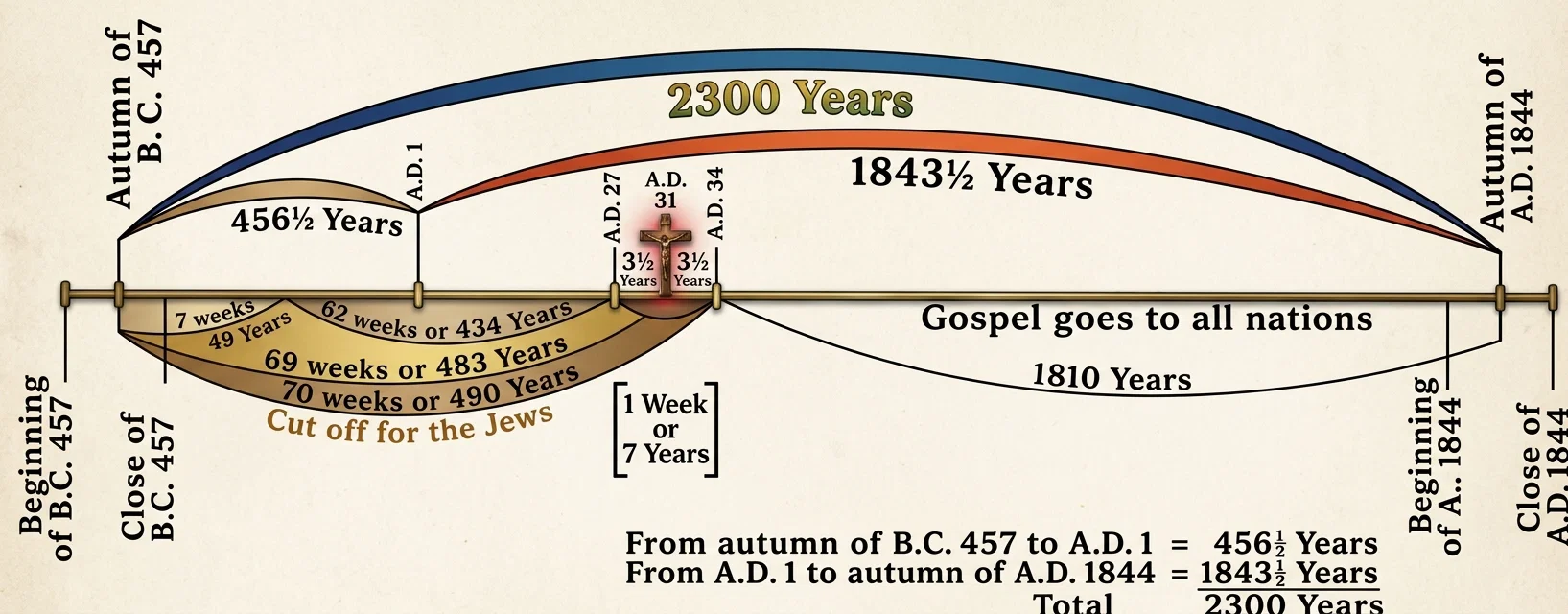
“The commandment to restore and to build Jerusalem” went forth in the year 457 B. C.,—approximately four hundred and fifty-six and one half years before the beginning of the Christian era, as is shown by Ezra 7:7-13. Each day of symbolical time should be reckoned as a year, as is shown by Ezr. 4:6. This prophecy of Daniel's being symbolical, we should understand that years are meant. Sixty-nine weeks, or 483 days, or as many literal years, would bring us to Messiah, or the anointing of Christ. John 1:41, margin; Acts 10:38. Jesus was anointed with the Holy Ghost at his baptism. Luke 3:21-23. By comparing marginal dates in Ezra 7:7 and Luke 3:21, it will be seen that the period between them is exactly 483 years, when it is remembered that a part of the year 457 B. C. had gone, which would run the time beyond the end of A. D. 26, nearly half a year into A. D. 27.
Further subdivisions are given in the angel's explanation of these prophetic days, by which the vision is “sealed,” or made sure; but this will suffice for our purpose to show that the year 457 is the proper date from which to begin the reckoning. Twenty-three hundred years from that date bring us to the year 1844 A. D., at which time, according to the prophecy, the sanctuary was to be cleansed. The accompanying diagram will make this reckoning more clear.
The cleansing of the sanctuary referred to in this prophecy could not mean the cleansing of the earthly sanctuary, for at the end of the twenty-three hundred years it had long since ceased to exist; and while it did exist, that service was to be performed annually. The prophecy could refer, therefore, to none other than “the true tabernacle, which the Lord pitched, and not man.” Of that cleansing the apostle Paul says, in Heb. 9:23, 24:—
“It was therefore necessary that the patterns of things in the heavens should be purified with these [the sacrifices they offered]; but the heavenly things themselves with better sacrifices than these. For Christ is not entered into the holy places made with hands, which are the figures of the true; but into heaven itself, now to appear in the presence of God for us.”
Thus Daniel gives the year, and the type gives the very day, when Jesus, our great High Priest, began his closing work,—that work fixed by the type on the tenth day of the seventh month.
Day after day, during all these years since Christ entered upon his priestly work, the sins of penitents have been brought to “the true tabernacle” by confession. They have been literally transferred to the head of our Offering, or Sacrifice, who is in the heavenly sanctuary. The time has now come when those sins must be transferred to the head of the antitypical scapegoat,—the devil,—who caused us to commit them, and whose guilt is not covered by the divine atonement. This is the closing work of the ministry of our High Priest, and it has been going on since 1844. How much longer will it continue?
Mercy was offered to Israel until the service of the day was ended; but he whose soul was not afflicted in that day was cut off. Our great High Priest is now engaged in the solemn work of that antitypical day. When that work is done, his mediation will close, and the fiat will go forth, “He that is unjust, let him be unjust still.” Rev. 22:11. Then from many lips will be heard the bitter wail, “The harvest is past, the summer is ended, and we are not saved.” Jer. 8:20.

The Sin of Criticism

E. HILLIARD
CRITICISM is a terrible sin. It exists in every carnal heart. The root cause is jealousy. It is a channel through which Satan works to force his subjects over the line, beyond hope of redemption. Jealousy was found in the hearts of the twelve apostles, even after they had been taught the principles of meekness and humility, by precept and example, for three and one-half years, by the greatest Teacher the world has ever known. It was the strong desire for supremacy that caused the strife among the twelve. “There was also a strife among them, which of them should be accounted the greatest.” Luke 22:24. They were not so much concerned as to the reality of their greatness as they were of being accounted the greatest. Each criticized the others in order to make manifest that their failings disqualified them for the highest position. Each seemed to think that his keenness to detect error was a recommendation for the supremacy. At the feet-washing ordinance they began to see the sinfulness of their unholy ambition.
Criticism is a sin hard to conquer, and is far more dangerous than many are aware of. A few lines from “The Desire of Ages,” page 323, will show to what the indulgence in this sin may lead, They read:—
“It is dangerous to utter a word of holy doubt, dangerous to question and criticize divine light. The habit of careless and irreverent criticism reacts upon the character, in fostering irreverence and unbelief. Many a man indulging this habit has gone on unconscious of danger, until he was ready to criticize and reject the work of the Holy Spirit.”
God, through the agency of the Holy Spirit, strives with the poor, sin-blinded criticizer for a long time. But if he continues to reject the wooings of the Spirit, he is rapidly nearing a hopeless condition. Again we read, “The most common manifestation of the sin against the Holy Spirit, is in persistently slighting Heaven’s invitation to repent. Every step in the rejection of Christ is a step toward the rejection of salvation, and toward the sin against the Holy Ghost.” — Id., p. 324.
St. Paul, Minn.

Boys Wanted!

THE world needs boys! Good boys are needed, manly boys, honorable boys,—boys who hate deceit and scorn lies, and who do not “follow the crowd” in the ways that lead to destruction.
Are you a boy? and would you like to qualify—to take an “efficiency test” to see if you are the kind really wanted today? Read the following list, and see how you measure up to its requirements. Can you “pass”? If you can, the world wants you, needs you, now!
“Wanted: a boy who stands straight, sits straight, acts straight, and talks straight.
“A boy who listens carefully when spoken to, who asks questions when he does not understand, and does not ask questions about things that are none of his business.
“A boy whose finger nails are not in mourning, whose ears are clean, whose shoes are polished, whose clothes are brushed, whose hair is combed, and whose teeth are well cared for.
“A boy who moves quickly and makes as little noise about it as possible.
“A boy who whistles in the street, but not where he ought to keep still.
“A boy who looks cheerful, has a ready smile for everybody, and never sulks.
“A boy who is polite to every man and respectful to every woman and girl.
“A boy who does not smoke cigarettes, and has no desire to learn how.
“A boy who never bullies other boys.
“A boy who, when he does not know a thing, says, ‘I do not know;’ and when he has made a mistake, says, ‘I’m sorry;’ and when requested to do a thing, immediately says, ‘I’ll try.’
“A boy who looks you right in the eye and tells the truth every time.
“A boy who would rather lose his job or be expelled from school than to tell a lie or be a cad.
“A boy who does not want to be ‘smart’ nor in any wise to attract attention.
“A boy who is more eager to know how to speak good English than to talk slang.
“A boy who is eager to read good, wholesome books.
“A boy whom other boys like.
“A boy who is perfectly at ease in the company of respectable girls.
“A boy who is not sorry for himself, and not forever thinking and talking about himself.
“A boy who is friendly with his mother and more intimate with her than with her than with any one else.
“A boy who makes you feel good when he is around.
“A boy who is not a goody-goody, a prig, nor a Pharisee, but just healthy, happy, and full of life.”
Or—are you a mother of boys? If so, are you training them to be the right kind?
Or a father? Are you giving your boy precept upon precept, line upon line, —and all backed up by the daily example that will make your words effective?
Yes, the world needs boys, the right kind of boys, as never before. And boys from Seventh-day Adventist homes ought to be able to measure up to the highest standards. Do they? Shall they? MRS. I. H. E.

The Boy and His Companions

It is a rude and sometimes a sad awakening which comes to many a mother when she first discovers that her boy is a gregarious animal. In her own heart the strongest of feelings has been her love for the boy, and then suddenly to learn that on his part there are elemental forces and impulses that outweigh his appreciation of her love and sacrifice is a shock that seems well-nigh cruel. He may be foremost in her life, but she is not first in his. Such a moment is almost critical for both. To him the call of his fellows is as natural as the call of the wild to the wolf or as the flocking together of birds of a feather.
“I am completely baffled,” said the young mother of a four-year-old, “by my boy’s running away. I have tried punishments and I have tried rewards, but nothing seems to cure him. The sight of the neighbors’ children will draw him every time, in spite of all I can say or do.”
“Cure him?” The young mother might as well have tried to “cure” her boy of hunger or of breathing. Stronger than his fear of punishment or his love of rewards was his instinctive desire to be with others of his own age. Her only reasonable course would have been to recognize the inborn impulse of her boy, and wisely direct it, without attempting to eradicate the ineradicable.
Strange as it may appear, it is right here, in this failure to recognize the nature of the boy’s longing for companionship, that more mothers than we think fail and more boys than we know are harmed. The mother’s knowledge of the possible corrupting of good manners and morals was less than her ignorance of an evil still greater—the lack of contact and attrition.
A young lawyer thirty years of age, a college man of parts and promise, of excellent physical appearance and bearing, said to me not long ago, “I am satisfied that my work is never going to tell very much.”
“Why not?” I asked in surprise.
“I’ll tell you. I know my law books fairly well, but I don’t know men. It’s too late for me to begin,” he added hastily, as I started to protest. “Here I am thirty years of age, and I ought to have begun before I was five. I was an only boy, and my mother never let me play very much with other children. She thought she was going to save me from contamination, but what she really saved me from was being normal. She was always good to me and generous beyond her ability, but no one will ever understand what I suffered when I went away to college. I wanted to be liked, and I think I had it in me, too; but from the very start I was ‘queered.’ If my mother had not kept me from playing with other boys, I shouldn’t be where I am now.”
There was a note of bitterness in his voice which the smile on his face could not conceal; and hardest of all was the knowledge that what he had said was true.

The Boy and His Crowd

And not only for the boy’s pleasure, but also for the very best part of his education, does he need his fellows. There is nothing like the brutal frankness of boys with boys, and it is in such associations only that he learns what he is really worth. Defects, which the father ignores or the mother condones, there are called by their true names. If the boy has been coddled at home, his mates generously provide the antidote. If he has been unduly praised, it is certain the weakening process will not be continued by “the fellows.” If he has had his own sweet will, by vigorous and sometimes compulsory methods he will be compelled to recognize the rights of others.
Whatever may be the later successes or failures, one thing is certain,—that no one ever passes for what he really is worth as does a boy with his own crowd. In all this world nowhere is such exact and ideal justice found as in the dealings of boys with boys. Even in the nicknames they so freely bestow upon one another, the same law of innate, almost instinctive justice, prevails, for boys are like the original savages, bestowing the name upon the individual which he has earned; and no other; and the name which at last is bestowed is far more likely to be the true name than the one which, after diligent search, was given by the father and mother.
Mercy is a quality which in most boys has to be cultivated. Justice, however, is immediate and instinctive. Not how fine a lad, how good a ball player, how excellent and lovable a boy his mother is certain her boy is, but the measure of regard “the other fellows” have for him is, in most cases, the true test. Without such testing and candid judgment few men are prepared for the later struggle of life.
“What are those boys quarreling about?” demanded a woman who was calling at a friend’s home one summer day. Through the open window had come the noise of a dozen boys who had assembled for play in that natural rendezvous of all normal boys,—the barn of a neighbor.
“Quarreling?” laughed the woman of the house. “They are not quarreling at all. They are playing hide and seek, and, incidentally, are candidly, and somewhat noisily, I confess, giving one another the benefit of their opinions. They would be greatly surprised if you should accuse them of quarreling. I don’t believe there’s a thought of unkindness in all their clamor. It’s as natural for boys to shout as it is for puppies to bark.”

“Prink” and “Pat”

Not long ago a widow brought her only boy—a well-grown, handsome lad of fourteen—to enter him in a well-known school for boys. “He needs a man’s hand now,” she explained to the head master.
“Where has he been in school?” inquired the master.
“He has never been in any. I have always had tutors for him.”
The head master smiled (in his experience the name of the new boy was legion) as he said, “He may need a man’s hand, as you say, but he needs a great deal more the hands of the boys. Leave him, and we’ll see what can be done.”
“But,” protested the mother quickly, “that’s just what I wanted to speak to you about. He hasn’t been used to boys, and I’m afraid their ways may annoy him.”
The boy was placed in the school, and within three days his “education” at the hands of his schoolmates began. They nicknamed him “Prink,” and then proceeded to upset his bed and room daily. They put him at first base, and “fired” balls at him till his hands were swelled and sore. They tripped him when he was not expecting it, they “bothered” him in countless ways. Even the younger boys looked upon him as legitimate prey.
At the end of a week “Prink” came to the head master with complaints. “I don’t like it here. My mother has written me that I can leave if I want to.”
“Yes,” assented the head master, “that’s true. You may leave. That may be best.”
“I can’t stand the boys,” declared “Prink,” almost in tears.
“Did you ever think that they couldn’t stand you?” inquired the head master kindly. And then, in response to the look of astonishment in “Prink’s” face, he continued: “You see, the boys here have an idea that you are not up to their mark. Your ways are more like a girl’s, and this is not a girl’s school, you understand.”
“What can I do?” said the lad.
“You can be a boy and like boys. If the boys mess up your room, put them out. Above all, don’t show that what they do annoys you. It will be hard, but you can do it. Be one of the boys, as well as one with them. Try it for three months. If at the end of that time you still want to leave, you can then run away from it all. That’s what every coward does.”
“Prink” remained through the year, but when the summer vacation came his name had been changed to “Pat.” The change in his nature had been even more marked. He had learned some lessons not outlined in the curriculum, and his teachers had not been members of the faculty only.
Excellent and necessary as the companionship of other boys may be, still there are evils which must be guarded against and perils to be avoided. A young boy ought not to be permitted to have older boys as his companions. And yet who does not know the persistence of the younger boy in this very direction? He may be teased and tormented, by some strange fatality he is “it” in every game, he is the fag of the crowd, and then, despite all his sufferings, he will be eager on the next day to go right back to the boys who have made life a torment for him on the preceding day. Strange infatuation, but one we all recognize and know.—Everett T. Tomlinson, in the Woman’s Home Companion.

The Way of a Boy

THIS is the way a boy comes home, And the way it shall ever be: A scamper of feet through the leaf and loam And the chase of a vagrant bee; A coat cast off and quite forgot, A whistle and ringing cheer, And a romp near every well-known spot On the way from There to Here.
This is the way a boy makes haste, And the way it has ever been: A squirrel seen is a squirrel chased, And a top is made to spin; A tree's to climb and a brook's to wade, And the shade is a place to lie After the zest of the game that's played When the sun is hot and high.
This is the path a boy calls straight: By every winding way, Where berries are or wild birds wait Or squirrels dart at play; By banks that bid you sit and cool Two dusty feet and brown In the pebbly shallows of the pool That's on the way from town.
This is the errand swiftly done, As doing shall ever be: An ounce of care to the pound of fun, And an hour that grows to three; A fence to climb and a rail to stride, With berries to hunt and share, And a breathless quarter hour beside A timid woodchuck's lair.
And this is the thing that a boy calls care, And the thing it shall ever be: An old straw hat that's lost somewhere In the shade of some far-off tree; A shirt that's damp or trousers rent, A bruise or a hornet's sting, And lagging footsteps choreward bent In the soft twilight of spring.
So these are the ways that boys all know, And so may they ever be: Fancies as fickle as winds that blow, And dreams as wide as the sea; Heaven above where the blue sky smiles, With no day overlong, And a whistle of merry tunes that whiles A whole world into song. — James W. Foley.

Home Life Department

Conducted by Mrs. I. H. Evans, Takoma Park, Washington D. C.
Assisted by Miss Lora E. Clement
Through the columns of this department, hints will be given on all matters pertaining to the home life. Short articles and letters are solicited from home makers, telling of their everyday experiences,—their joys and sorrows, their failures and successes.
Continue reading: A System of Memory Training