“Scientific Basis of Sabbath and Sunday. A new investigation after the Manner and Method of Modern Science, Revealing the True Origin and Exact Nature of the Jewish Sabbath and the Lord’s Day for the Purpose of Ascertaining Their Real Significance and Proper Observance.” By the Rev. Robert John Floody, M.S., S.T.B., etc. Cloth, 8vo, 360 pp., price, $1.25 net; postage 12 cents. Cupples & Schoenhof, Boston, Mass.
The author in his preface remarks that “the times call loudly for light on the Sunday question,” and that in the diverse claims and divergent theories, “our battle with Sunday desecration has been a gradual retreat.” This book is written to help out in the matter. It is not a Biblical book tho it deals with a Bible subject. The author has no faith in the divine origin of the day. He traces it among primitive peoples, and concludes upon his own argument, “It was the moon, then, that first determined the week and Holy Day,” and the Hebrews got the seventh-day Sabbath from Egypt, the sacred day of the Egyptian moon-goddess, Sin. To those who believe in the vagueness of evolution as opposed to the creative power of God, who prefer to accept the higher critics’ view of Genesis rather than the Biblical story and the words of the Master, who prefer the tradition of the heathen to the Word of God, Mr. Floody’s work will be satisfactory; but to those who still believe the Old Book it will prove Dead Sea apples. We may have more to say hereafter.
“Windows for Sermons.” By Louis Albert Banks, D.D., cloth, 12mo, 433 pp. Price, $1.50 net; postage, 15 cents. Funk & Wagnalls Company, New York and London.
This book is “a study of the art of sermonic illustration, together with four hundred fresh illustrations suited for sermons and reform addresses.” The sermon too deep for comprehension Dr. Banks characterizes more properly as “muddy,” or “dry,” or “dull,” or “uninteresting,” and this book is written with a desire to help in the art of sermonizing. It is not to be supposed that imitating Dr. Banks’ style will make a second Dr. Banks, or telling his anecdotes will give the same point and power to the sermon that is manifest in his. He offers some excellent suggestions, but we see no force in his advice that “the best books of fiction are valuable to the preacher.” Why? Because, he tells us, the “novelist has a genius for human nature. He sees deeper than most people into the motives that are back of human living.” But why not use the Word of God, in which “the thoughts and intents of the heart” are laid bare as in no other book? Study human nature in the light of God. The best books of fiction grade down to the sensational literature against which one of Dr. Banks’ illustrations so forcibly warns us. What he says on poetry and personal experience is of worth.
“Beware, or Irma’s Life.” By Ida Carmichael. With an introduction by Prof. C. C. Lewis, of Keene Academy, Texas. 45 chapters, 183 pp., price 75 cents. Address the author 1318 Market St., Oakland, Cal., or Pacific Press, Oakland, Cal.
“Beware” is a book written for Sabbath-keeping girls especially, and for fathers, mothers, and sons. It is written by a Christian mother upon whom the Lord has laid the burden. It would have been better if some of the reasons for the radical positions had been given, if some expressions had been omitted or modified; but its appeal is Biblical and at times soul-stirring. We wish that every Sabbath-keeping parent and girl might read it. Its experiences are enacted in practical life in hundreds of cases in the present.
“A Revolution in the Science of Cosmology; the Keystone to the Arch of Science.” By George Campbell. 210 pp., illustrated, price, $1.00. Crane and Company Publishers, Topeka, Kansas.
We reviewed this book when the first edition appeared a year ago. It now appears greatly improved in typography, in style, in appearance every way. It is a direct attack on the old scientific theory of world-building, holding that the earth is not a cooling globe condensed from nebulous matter; but rather the reverse is true; that the earth’s origin is aqueous rather than igneous, beginning in water rather than fire, with electricity as the mighty agent in world formation. Professor Campbell’s work is a mighty blow to the commonly accepted theories, but we are sure that a more faithful Biblical adherence would have improved his substitute. The book is, however, worth reading for its negative arguments.
“Under My Own Roof.” By Adelaide L. Rouse, author of “The Deane Girls,” “Westover House,” etc. Illustrations by Harrie A. Stoner. 12mo, cloth. Price, $1.20 net; postage, 13 cents. New York and London: Funk & Wagnalls Company.
This neatly bound volume is the story of a literary woman who determined to build a house for herself in a New Jersey suburb. The house idea seems to be used as an excuse for a romance, tho it gives in a bright way many nice suggestions in regard to house-building. Its aim is to entertain, however, more than to instruct.
“Jesus as a Penologist” is the title of a paper by the Hon. Samuel J. Barrows, Commissioner for the United States on the International Prison Commission, read before the National Prison Congress at Kansas City, Mo., November, 1901. Printed by the Bradley and Gilbert Company, Louisville, Ky. It is worth reading by every one, and especially do we commend it to our Christian brethren who are crying for vengeance, or lynching oftentimes imaginary wrong-doers. “What May the Prison Expect of the Church?” and “What May the Church Expect of the Prison?” By Rev. Henry Hopkins, D.D., is the title of another paper read at the same time. Address Joseph F. Scott, President National Prison Association, Concord Junction, Mass.
“A Sequel to Annie Moore Cable, or a Mind Destroyed Developing as a Medium.” This pamphlet is written by the father of the girl, and is an appeal for legislation to investigate asylums, etc., concerning the fruits of Spiritualism. While we know from God’s Word that so-called “Modern Spiritualism” is evil and only evil, it can not be checked by legislation. Only by the truth of God and the power of His Spirit can the devil be frustrated. His work will cease only at his destruction by Jesus.
Hand-Book of Musical Statistics, published by the Boston Musical Bureau, giving dates of noteworthy productions, size and location of great organs in the world, famous violinists, singers, etc. Price, 20 cents.
“The Utility of an Academic Education for Young Men who have to Earn their Own Living and who Expect to Pursue a Commercial Life. An investigation by R. T. Crane,” is the title page of a pamphlet by a practical and successful manufacturer of Chicago. It contains the opinions of educators, commercial men, and college graduates.
“A Message of Rest” is a sweet song. The words and the melody are by Frances Eugenia Bolton, and the arrangement and accompaniment by Harry J. Chalmers. Published for the author by the Review and Herald Pub. Co., Battle Creek, Mich. Price 25 cents.
WHY IS KILLING ESSENTIAL TO THEIR HAPPINESS?
Every day you read of men well-to-do who are going to the country—to kill something. The hunter goes out in his boat or walks through the woods, in the beautiful climate of the South.
There are a thousand things to please and attract him—the warm sun, the sky with its changing qualities, the smooth water, and all of the wonderful forms of animal life. The squirrel jumps twenty times its own length from one branch to another. The wild birds alight on the smooth water, swimming and diving and enjoying each other's company. Harmless, foolish little rabbits hop about looking for something to eat.
The prosperous man who has come out to enjoy nature can not be happy unless he can kill some one of these harmless creatures. He does not need them. He has all that he wants to eat. He has a dog, or he pays another man, to pick up the carcasses. It is his delight to bring down the bird on the wing or to shoot some poor animal as it dashes through the woods, seeking safety. He presses the trigger, ends the life of an animal that has never done him any harm, destroys the happiness of some poor animal family, feels very proud and happy as he reloads his gun, and looks for a chance to destroy another life. His kidneys are out of order or his liver is sluggish. He must be persuaded to walk and get fresh air—and the love of killing persuades him to do that which is good for his kidneys and liver.
There is really no need for the question which heads this column. The love of killing animals is inborn, and it is natural. The strongest thing about us is heredity. Emotions which have been bred in us for centuries can only be kept in check by the cultivation and force of will. For hundreds and thousands of years men have killed other things that they might live. They have stalked all kinds of animals, from the mammoth to the grasshopper, and each day of man's life meant inevitably the ending of the life of one or more humble creatures.
The habit of ages is not to be lived down in a moment, or even in a century. But certainly the killing instinct ought first to disappear among those whose brains have been developed on lines other than killing. It would seem only reasonable to ask that a man intellectual enough to attain the presidency of the United States should find sufficient pleasure in contemplation of nature's beauties and the wonderful works of God Almighty without craving additional sensation from destroying a harmless, helpless creature's life.—San Francisco Examiner.
HOW A BIBLE WAS SAVED.
ONCE a Bible was baked in a loaf of bread. That was in a far-away country called Austria. Some wicked men came into the house to find the Bible and burn it, but the woman who owned it was just going to bake bread; so she rolled up her Bible in a big loaf and put it in the oven. When the men went away, she took out the loaf and the Bible was not hurt a bit. That was a good place to hide a Bible, wasn't it? But I'll tell you a still better place. David knew of the place when he said, “Thy Word have I hid in mine heart.”—Selected.
KEEP YOUR TOP COOL.
It is said that a famous man who was known as Artemus Ward was once driving on the top of a stage through a part of country where mountains rose grand and tall. He took a flask of whisky from his pocket and offered it to the stage-driver, but the driver refused it. Said he,—
“I don't drink; I won't drink. I don't like to see anybody else drink. I am of the opinion of those mountains—keep your top cool! They've got snow, and I've got brains; that's the difference.”
Hospitality Is for Service, Not for Show
By Bishop Hamilton
HOSPITALITY is for service, not for show.—Bishop Hamilton.
CHICAGO IN LESS THAN 3 DAYS
From San Francisco at 10 a. m.
Chicago, Union Pacific & Northwestern Line
DOUBLE Drawing-Room Sleeping Cars, Buffet, Smoking and Library Cars, with Barber. Dining Cars—meals a la carte. Daily Tourist Car Service at 6 p. m., and Personally Conducted Excursions every Wednesday and Friday at 8 a. m. from San Francisco. The best of everything.
R. R. RITCHIE
617 MARKET ST.
GEN. AGENT PACIFIC COAST
PALACE HOTEL
SAN FRANCISCO
OR S. P. COMPANY'S AGENT
BED BUGS
Insexdie
kills roaches, ants, moths, bed bugs, fleas, and all insect life. Insects breathe through their bodies, having no lungs, and it does not require a Poison to kill them. It also kills the egg.
BED BUGS
Insexdie also kills insects on birds, chickens, etc., and should be sprinkled on carpets and curtains. A sample sent to any address for 25c post-paid. Put up in large packages at $1.00, $2.00, $3.00, and $5.00.
GINSENG DIST. & CHEMICAL CO.
No. 3701 S. Jefferson Ave. St. Louis, Mo.
Scene on a Rice Plantation.
REMINISCENCES OF JAPAN. III.
The Climate.
The climatic conditions of Japan vary of course with latitude and altitude. Yet in general it may be said that the summers are warm and moist, and the winters comparatively cold. Snow and ice are frequently seen; but the former, falling upon a damp ground, quickly disappears, while the latter rarely attains to any great thickness. However, let not the prospective visitor in winter imagine that he is going to a subtropical climate, where wraps are burdens and fires unnecessary. He will find flannel underwear a great protection, and heavy coats by no means unacceptable. I have seen people from our Northern States shiver in the cold, raw air of Japan more than in the dry bracing cold of their native clime. The heat of summer is rather enervating, but heat prostrations are rare. With a little care and foresight, one need not suffer any extreme discomfort.
The best season is autumn. From the latter part of October to the first of January, the sky is clear and the atmosphere still, and out-of-door exercise becomes a positive delight. The frequent rains and high winds render the spring rather trying. But taking it all together, the climate of Japan is very good.
Proper attention to the rules of hygiene will enable one to enjoy good health. He needs to be careful about his drinking water. As a rule, unboiled water is not safe for drinking, unless one is in the mountains, or the bottom of his well is above the level of the rice-fields. The Japanese themselves drink very little cold water. For the most part, they quench their thirst with tea, sipped hot, without milk or sugar.
Fruits.
Among the fruits most commonly seen on the Japanese market are peaches, apricots, melons, persimmons, and oranges. The persimmons are exceptionally fine, far superior to the American persimmon that abounds in the South. They grow in comparative abundance, and are much used both by foreigners and natives. The latter often dry them in the sun, and store them for winter use.
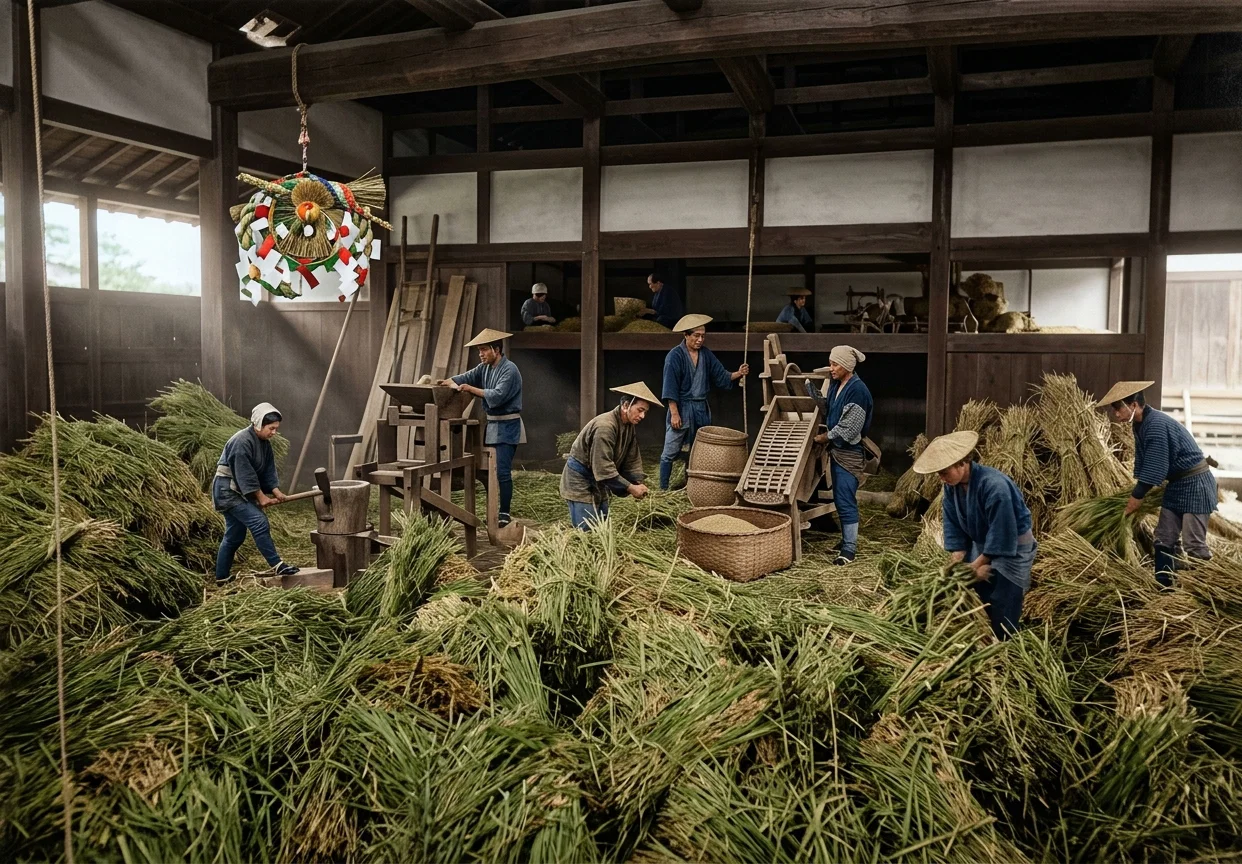
Mode of Threshing Rape, Sesame, and other Grains.
The oranges are of the so-called “kid glove” variety, because the peel does not adhere tightly to the pulp, and can be easily removed without soiling even a pair of kid gloves. They are neither so large nor so sweet as the Florida orange, yet they are palatable and wholesome. Small ones can be purchased for a half cent each, and the larger ones for a cent. But the peaches are decidedly inferior. Well do I remember the gustatory pleasure I anticipated, and the sudden disappointment that followed, when, in passing along the market street one day I was beguiled by the delightfully appetizing aroma of peaches into the purchasing of a few, I found them almost destitute of flavor.
Peaches are usually gathered before they are ripe, and put on the market. That in part accounts for their insipidity. The natives say that if they are allowed to remain on the tree, they will rot before they will ripen, and so they pick them while green in order to save them.
A story comes to my mind which illustrates the point. A Western man went out into the country, and discovered on the premises of a farmer a peach tree well laden with fruit. He purchased the fruit just as it hung on the tree, and paid for it. After the transaction was completed, he said to the Japanese farmer, “You understand now, that these peaches are mine, and are subject to my orders?” “Yes, sir,” was the reply. The Westerner continued, “Let them remain on the tree till I give orders to have them plucked. If they rot, it will be my loss; for I have already paid for them. You will not lose anything. Do you understand?” “Yes, sir,” was again the reply. The Westerner returned to the city, congratulating himself upon the prospect of enjoying some fruit that had been allowed to mature and ripen on the tree. But to his astonishment and disgust, in a few days the little Japanese farmer halted at his door, and informed him that he had plucked all the peaches and brought them to him, explaining that they would have rotted had he allowed them to remain longer.
The melons are a disappointment also. But after one has forgotten the fine flavor of the large luscious melons of our Southern States, he comes to enjoy them. They are good thirst-quenchers, and are eaten with a relish on a warm summer day.
Housekeeping.
Japan may be called the housekeeper’s paradise. As servants, the Japanese are faithful and painstaking. Our first cook was one who had been well trained in an English family, and knew how to prepare Western dishes. He went regularly, morning by morning, without any instructions, to the market, and bought the day’s supplies. At the end of the week he would always come and present his account, giving each day’s expenditures item by item. I would then refund to him as much money as he had spent during the week. This relieved me entirely of the burdensome task of marketing. In the kitchen he was equally as thoughtful and efficient as he was in the market. He soon discovered our favorite dishes, and without conference or instruction would prepare our meals, taking care to provide what was best liked. When the meal was ready and on the table, he would politely announce the fact, and then proceed to wait on the table.
But of all the servants we employed, the last one was in many respects the most satisfactory. He was an unusually large fine-looking man, with a great shock of black curly hair, something very unusual for a Japanese,—a great bundle of good nature and thoughtfulness. His name was Goto Shinaguchi, but we called him “Shin.” A single instance of his faithfulness will suffice. Our little girl became extremely ill. The nearest foreign physician was 350 miles away. We did all we knew for the little sufferer, but could not succeed in giving any relief. In the town was a Japanese physician who had graduated from the university of Tokyo. He was called. He came, diagnosed the case, and proceeded to treat it. After five visits we considered the child out of danger, and the physician discontinued his visits. I then wrote him a note, and asked him to send me his bill. He sent in a bill for $5.00, one dollar a visit. I cheerfully paid it, and dismissed the matter from my mind, thankful that our child was relieved. But “Shin” heard that the amount charged was $5.00. So he came to me one day shortly afterward, and said, “Danna san [lord], did the doctor charge you $5.00?” “Yes,” I replied. With ill-concealed indignation he said, “Danna san, that is an outrage. Please let me go to see him, and I will force him to refund some of that money.” I remonstrated, explaining that it was all right. “Shin” left me and walked away rather crestfallen. In about two or three hours he returned, and in great glee put a dollar bill in my hand, saying, “Danna san, you refused to let me go to see the doctor, but I went anyhow, and I made him give me one dollar back. Here it is.”
When we came back to America, I left faithful “Shin” behind with deep reluctance.
From these rambling remarks it can be seen that the Japanese are an interesting and promising people. They are ready for the Gospel of the coming kingdom. They must be warned, “And this Gospel of the kingdom shall be preached in all the inhabited earth for a testimony unto all the nations; and then shall the end come.” May the God of the harvest send forth laborers into His harvest, and in His distribution of workers may the little Island Empire receive her full quota.
THE FAMINE IN CHINA.
CHRISTENDOM'S great heart has been deeply touched by the woes of China. First came the devastating war, then the famine, sweeping off its millions of victims, and as a culmination to the catalog of afflictions, the floods along the Yangtse Valley, ruining the crops over a vast area, and drowning thousands of the rice-growing peasantry. After ruining the great dykes, levelling orchards, and sweeping thousands of little homesteads bare, the waters receded, leaving such a scene of misery and helplessness as is seldom the lot of any people.13
Such is the Yangtse Valley to-day, where the destitute and the homeless and the orphans are huddled together in helpless droves in the towns and villages, wholly dependent on charity.
During the summer of 1901 there were great floods along the middle course of the Yangtse River, destroying crops in a large part of the provinces of Kiangsu, Kiangsi, Ngankwei, Hupeh, and Hunan. U. S. Consul-general Goodnow says, in an appeal for aid, that at least 1,100,000 people of these provinces must be fed until the next crop grows, or they must starve. Relief-works have been started, and merchants, business men, and missionaries are doing what they can for the helpless, needy sufferers.
An American missionary, Miss Emma Mitchell, thus describes the flood:—
I am living just across from the worst section flooded. The Yangtse began to rise the last of June, and reached its climax in August. The heavy rains added much to its overflow; and many came from the flatlands across from Wuhu, and built mat sheds on the hills outside the city. Soon, on our own side of the river, dyke after dyke gave way with a boom like thunder, and the yellow, muddy water poured over the rice-fields far and near. Each hill soon became an island, and was only reached by boats. One small section was saved by strengthening the dykes. All living on the flats were drowned out, many losing their all. . . . As to the number drowned or killed, no one knows. In one night, during a high wind, it was estimated that one thousand were drowned just across the river, and their dead bodies floated down to a hill seven miles below Wuhu. The officials sent hundreds of coffins; but these being insufficient, many bodies were wrapped in matting, and buried. Whole families were found tied together, and of course dead.
Just now we have several thousands with us. We are feeding over 1,600 a day at our soup kitchen. . . . Each day over a thousand children are taught and fed. . . . At first, in answer to the question, “Why did Jesus come from heaven?” the children would say, “To help us broken-dyke people.”
The most needy have been clothed, over five thousand garments having been given away.
We trust the lessons learned will, in the spring-time, be scattered far and wide.—Condensed from the Christian Herald.
The following is from a missionary writing to the World's Crisis:—
The flood rose and rose until only the tops of the trees and peaks of houses were in sight. The poor people were swept away by the hundred, while those who did get away safe, did so in tubs, and lost almost all. . . . It is now five months after, and yet for miles upon miles in all directions there are great lakes where once was cultivated land. The land lies so low behind the dykes that the fields can not be drained, and so many will be unable to put in a crop next year.
The flood sufferers are still with us. It is so sad to see what we see, and to hear their pitiful cry for work. They don't ask for money, but for work at five cents per day. This will keep a family of three or four from starving. All relief money is spent in hiring them to build dykes. This will not only help them now, but will keep back the floods another time. Each mission here has its hands full and heart also. As we go out we can see them dying by the roadside, starved to death in some cases, and chilled to death in other cases, all the result of a great flood.
THE NARROW BLESSED PATH.
THERE'S a certain narrow, quiet path
Of daily thinking and living,
Of little deeds of sacrifice,
Of loving and forgiving,—
Of patience and obedience,
Of gentle speech and action,
Of choosing the right and leaving the wrong
With a sunny satisfaction.
And if we never leave this path
For the thing the world calls pleasure,
There will come to meet us a heavenly joy
Beyond all power to measure.
For on this narrow, quiet way,
God's angels move forever,
Waiting to crown with peace divine
Our every high endeavor.
Yes, this is what sheds on the lowliest life
The glow of the sweetest beauty,
Not the thought of the duty of happiness,
But the happiness of our duty!
—Anon.
GIRL-LIFE IN CHINA.
By Sel.
“How is your baby getting on?”
“Puh tsai lias,” which means “no more,” a very common Chinese expression for the word “death.”
“What!” we exclaimed, “your baby dead?”
“Yes,” she answered; “there was no one to take care of the child, so it was the best thing to do.”
“You don’t mean to say you killed your baby?” we asked.
“Yes,” was the answer, with her eyes on the ground.
“How did you kill your baby?” The answer was that she had just put it in a bucket of water.
We felt like fainting, and could not speak to her for a few minutes. There we stood face to face with a murderer of her own child, with no seeming shame or condemnation over what she had done. We felt inexpressibly sad, as she is a woman who has heard a great deal of the truth. So we asked her to tell us openly the reason for staining her hands with the blood of her own baby. Her argument is that of thousands of unhappy heathen mothers in China. When a girl is born, the husband is displeased, and thus this girl, who should be the center of home happiness and joy, is an object of dislike and derision. When the girl is three or four years old, the poor mother must begin to bind the child’s feet. This is a most painful process, but the feet must be very small, or there is danger that they will not get the girls married to well-to-do people.
Then comes the time for her marriage. If they are not well off, nearly all they have will go with the girl for her outfit when she leaves her father’s home to go and spend her lifetime with an individual whom she has never seen before the day she is married; then, in very many cases, begins a most unhappy and cruel life, which generally ends in the wife shortening her life with opium poison.
Thus, from the very commencement of a Chinese girl’s life is the danger of being an object of unhappiness and pain to her last moment. This is the way a poor mother argues at the birth of a girl. It is really awful to think how many dear little baby girls “not wanted” are murdered in this land.—Sel.
OUR WORK AND WORKERS.
Two THOUSAND quarts of fruit was found uninjured in the ruins of the Sanitarium at Battle Creek, Mich., recently destroyed by fire.
Brother B. L. House reports to the Welcome Visitor that five persons have accepted the faith at Coshocton, Ohio, through recent labors.
Of a special effort at Robbinsdale, Minn., Brother O. O. Bernstein reports twelve converts to the faith, and a Sabbath-school of twenty-one members.
Brother J. H. Camp, of South Australia, has been called, and is now on the way, to South Africa, to engage in the canvassing and publishing work.
At the last quarterly-meeting of the church at Highland Park, Tenn., four new members were added to the roll, besides two members received by letter.
At Bayside, Humboldt County, Cal., Brethren C. M. Gardner and A. S. Marchus report seven converts to the truth, and a Sabbath-school has been organized.
At Uniontown, Pa., five persons have accepted the faith under the labors of Brother W. F. Schwartz, and a good interest is reported. He has had the free use of the Dunkard church.
In a sermon before the late Union Conference at Topeka, Kansas, Brother W. A. Spicer said: “I know one Hindu—he is not a Hindu any longer—who was attending the University in Calcutta. He came in contact with our mission, and heard the truth of the Sabbath. And, Hindu as he was, he began, as far as he could, to keep it. He refused to attend lectures in the university on the Sabbath. And the Lord led him on step by step. His father disinherited him a little later. His father was a wealthy landowner. And that young Hindu came back and told me that he felt richer than ever before in his life. He had found the Lord Jesus.”
Brother O. Glass writes very encouragingly of the mission work in Fort Worth, Texas; that souls are receiving and accepting the truth who could hardly be reached in any other manner than through the mission.
One of our canvassers in India recently took seventy-seven orders in two weeks for “Ladies’ Guide” and “Man the Masterpiece.” Our health books are a ready means of introducing the Gospel to the people of the Orient.
The Record, published at Sydney, N. S. W., says that “Brother H. Harker is doing a good work with his Gospel wagon. At Trafalgar he found some people hunting for the truth, and was used by the Lord in helping them.”
Sister Estella Graham, Superintendent of Education for the Carolinas, reports schools in progress at Waynesville, Valle Cruces, Hickory, N. C., Oakwood, Blackville, Charleston, S. C., besides the school at Hildebran, N. C., which employs four teachers.
In the Keystone Gleaner we note this statement by Brother R. A. Underwood: “A sister in this conference, who has passed her threescore years and ten, said, ‘I will sell twenty-five “Object Lessons.”’ In a few days she had sold them, and then sent for thirty more.”
Field Echoes, published at Cedar Lake, Mich., says there are more calls for meetings in school-houses than the students of the Academy can supply. Of course the summer school is not so largely attended as the regular sessions. But these calls for meetings show that the Spirit of truth is at work among the people.
After laboring a year and a half in the Waldensian Valleys, Brother J. Cardy reports the baptism of eighteen candidates, and notes that several others are keeping the Sabbath. He says that in the winter the only comfortable place to be found is the stable, and there he visited and preached. Yet among these poor people there are souls that hunger and thirst after righteousness.
Brother F. R. Rogers, superintendent of education for Mississippi, writes to the Southern Watchman: “We have organized one mission-school and two Sabbath-schools that have reported this month [March]. I never knew of a deeper interest than is now manifested in Bible study and in seeking after God’s truth. Our schools are not overrun with numbers, not many increases, but much advancement in their work.”
Brother B. R. Nordyke, manager of the Pacific Press branch office at Kansas City, Mo., reports that the Central Union Conference, composed of the States of Iowa, Missouri, Kansas, Nebraska, and Colorado, and the Territories of Wyoming and New Mexico, was organized at Topeka, Kansas, April 20. Officers were elected as follows: President, E. T. Russell; vice-president, L. F. Starr; secretary and auditor, C. T. Caviness; treasurer, Pacific Press Publishing Co.; general field missionary, O. E. Cummings. The Southwestern Union Conference is to be formed of Arkansas, Texas, Louisiana, and Oklahoma and Indian Territories.
From a recent Supplement to the Review and Herald, we take this pertinent item: “It is cheering indeed to notice from week to week how vigorously our brethren in England are pushing the sale of their periodicals, Present Truth and Good Health. Present Truth has now obtained a weekly circulation of twenty thousand copies. A great majority of these are sold from house to house by agents who make a business of that work. If less than one thousand Sabbath-keepers in England can give the Present Truth a circulation of twenty thousand copies per week, what ought the circulation to be here in America for such splendid periodicals as the SIGNS OF THE TIMES and Good Health?”
In the Workers’ Bulletin we find this item: “A ‘shipwrecked sailor on Pitcairn Island,’ in a recent issue of the Inter Ocean gives a brief history of the island, with a description of some of the manners and customs of its inhabitants. He does not overlook their religious belief, but states the following: ‘Some years ago a missionary brig came to the island, and the inhabitants were converted to the S. D. Adventist religion. On the Sabbath no work whatever is performed. Not even a banana is picked. All food is prepared the previous day. Not a fire is lighted. We attend church, and hold meetings during the week, and have little entertainments that we enjoy fully as much as other people do their grand operas.’ The entire narrative is very interesting as well as instructive.”
THE UNDERTONE.
By Elsa Barker
How heavy must God's heart be as He hears
Ever the dropping, dropping of Love's tears!
Must not those bitter, murmuring waters drown
The melodies of angels in His ears?
—Elsa Barker.
WILL WE ENDURE?
By Ada D. Wellman
A TINY child, having been assured, when sick, that the medicine given her would make her well, begged piteously for more when suffering severely, and greedily swallowed the bitter potion.
Most of us as adults are less brave in spiritual matters than was this child in physical. Sometimes, in zealous mood, we pray for such perfection of character as only trial can produce; but when trials come, we are prone to cry out in protest.
Dentists usually employ a slow, tedious process in destroying the exposed nerve of a tooth, altho the work could be done effectually in a moment’s time, but few persons will consent to the moment’s excruciating ordeal.
Likewise the great Physician can not employ for us the quickest and most effectual remedies for our faults, but must needs let us linger through a long period of spiritual invalidism. We do not say, If it be Thy will, let this cup pass; but we insist, Take it away!
When shall we cease to fluctuate between declines and recovery, and the weak “be as David,” and the strong “as the angel of the Lord”?
MRS. ADA D. WELLMAN.
PUBLICATIONS WANTED.
CLEAN copies of Good Health and Pacific Health journal for missionary work. Address, post-paid, Allen Manly, Tunesassa, N. Y.