IN Portugal we now have three workers. Brother Paul Meyer, from Switzerland, has done well in learning the language; and beginning with 1912, he will have two halls open for meetings. He has been alone in Lisbon since the middle of October, and reports quite an interest. Brother Alberto Figueiredo, of Lisbon, is helping me here in Porto.
We have recently begun meetings in this city, and also have a mission hall in Gaya, on the other side of the Douro River. Here two from the Baptist Church have begun the observance of the Sabbath. One was taken into our church by vote. In October I baptized three converts in Lisbon, and on December 23 two more earnest believers followed in this sacred rite.
The law for the separation of church and state permits the believers to form an organization, which will give them legal recognition, and will secure to them the privilege of giving donations for the work. Complying thus with the law, we are assured of the protection of the authorities. The brethren in Lisbon have formed their corporation, and it remains with the ministry of justice to give consent to the statutes.
The leading bishops and patriarchs of the Catholic Church continue their rebellion, and most of them have been obliged to change their place of residence. The faithful in one place turned out the priest who rebelled, formed a corporation, called another priest, who, with them, separated from Rome, and started another church. They made a call for any others who wished to join them. The history of the Catholic Church in her attitude toward the state confirms the history of the past and present in other lands. But she is obliged to submit for a time.
We are glad to have been able to send another young man to our school in Gland, and pray that he may develop into a good worker. The distance is great, and twenty dollars is a large sum for a poor Portuguese to pay in passage money. We have two or three other young persons who ought to go, but they have not sufficient money. The young man we sent there over three years ago is now with me, and will, if faithful, make a good worker. Each scholarship cost two hundred fifty dollars.
A few words about Angola, Portuguese West Africa. I received a letter from Brother Jose da Silva Oliveira, in Loanda. He wrote in July: “We are anxious to receive news from you about our work here. Our soap factory is being repaired, and we have stone-masons, carpenters, and other working men — thirty or more persons. You can imagine their pointed surprise when at the end of the first week I made payment on Friday, and told them that on the Sabbath there would be no work, because it is the true day of rest. We are glad of this opportunity to have the true Sabbath called to the people’s attention in this manner. There are about forty persons to announce in the city of Loanda that in the soap factory no work is done on the Sabbath because it is the day of rest that the Lord ordains.”
In the same letter came a request for literature and Bibles. It is hoped that there will soon be a church in that place.
Australia
By J. E. FULTON
J. E. FULTON
Last Sabbath witnessed the departure of Brother and Sister C. H. Parker for Norfolk Island, en route to the New Hebrides. They will stop two months on Norfolk, to help the mission and people at that place. I am sure their visit there will be greatly appreciated. Brother H. Carr and his wife will follow a month later, and remain on Norfolk with Brother Parker a month. Then the two families will go on together. Norfolk is a training station for the Melanesian Mission (Anglican). As this mission has quite a number of men in training, our workers will get some idea of the people for whom they are to labor from what they see on Norfolk Island.
To-morrow, Brother J. A. Chaney and family leave for New Zealand, and I shall accompany them, to spend a little time with them in looking after the Maori work. Brother Chaney at one time engaged in mission work in West Africa, first for the Christian Alliance before he accepted the truth, and afterward for our mission there. We have recently appointed him to work among the Maories. He is looking forward with much interest to this work.
At our last union council it was voted that the Australasian Union Conference take over the Maori work in New Zealand at the request of the New Zealand Conference, and I wish to spend some time with Brother Chaney in visiting in the most populous of the Maori districts, with the object of finding suitable headquarters for our work. The Maori work has been carried on to some extent for the last fifteen years in New Zealand, but as it has not been systematic, but little has been accomplished. I hope we can get the work established now on a better basis. The Maories are an intelligent race, and I am hopeful that we may win some of them to the message.
The school is about to open again at Avondale. The prospects are that it will be very full this year. Some excellent young people have decided to attend.
Brother P. B. Rudge, who was appointed at our last council to take up work for the aborigines in Queensland, writes us encouraging letters about the start which he has made. I quote from a letter I received from him recently:—
“About a fortnight ago I arranged13with the protector to hold a meeting on Christmas day. So yesterday we went over, about thirty of our people from the Murgon church, ten of whom were children. We had a good day with the natives. First we had a song service, rendering four or five of our good hymns, and then we had the service of the day.
“I told them first why it was necessary for Jesus to come to this world; then gave them a short talk on the first advent, using my chart of the three angels’ messages to illustrate the wonderful appearance of angels. After singing an appropriate hymn, I told them the story of the wise men, making a point of gifts, the best of all being the giving of the heart to Jesus. The singing of ‘They brought their gifts to Jesus,’ and the doxology, brought the meeting to its close. Some were pleased with the effort, seeming to enjoy it very much.
“There were a number of women present, but only a few men. So after the meeting, we all went into the camp and started another song service. In a few minutes the natives began to gather, and by and by there were nearly two hundred. Between the songs I took the opportunity of presenting a few points of truth. On leaving, the aborigines gave us a good send-off, and as our cavalcade left the settlement, we saw them in the distance waving hats and handkerchiefs, quite a new thing in our experience, as we have not seen them so demonstrative before.”
Remember the work in the Australasian field in your prayers.
Nyassaland
By S. M. KONIGMACHER
S. M. KONIGMACHER
This is another beautiful morning [December 12], but we really need rain more than fine weather just now. If we have another bad season this year, there will be suffering among the natives. The native is very careless about the future. If he has a good crop of corn, he will not look ahead and save part of it, but will eat his fill, and sell the rest for cloth and salt, instead of saving his food and working for cloth and money.
The school year has now closed, and I hope some of the lessons will remain in the minds and hearts of those for whom we have labored. God has blessed our work and helped us.
I opened sixteen new schools in the Malamulo district, and Sister J. C. Rogers opened two in the Matadani district. This makes us, in all, forty-four out-schools, with two main stations. We now have eighty native teachers and assistants.
We also have permission to enter Portuguese territory in the district of Tete. This permission was gained through the American consul at Delagoa Bay. There are at least two missions operating in this field, but we are sure we can find a suitable place to plant the banner of the third angel's message. Surely God is going before us. We are crippled on account of lack of funds. If we only had the money, we could open up the Portuguese country at once. As it is, we must wait, wait, wait.
During our closing exercises of the station school, we were very busy preparing and correcting examinations, and in making shirts for prizes for good work in the native language. These were awarded to the two boys who spelled down the school in the vernacular, the boy who read twenty-five verses of John seven out of the native Bible without a mistake, and to the sixteen pupils who recited fifty-three verses and told where they were to be found. Each pupil had to recite separately. The verses were chosen from the first ten chapters of Luke.
The preceding evening I gave a lantern lecture on the life of Christ. Mrs. Rogers was present, and spoke a few words to the school through an interpreter. Fifty of our teachers were also in from the out-schools. I examined the school in English and in the vernacular, but awarded prizes for vernacular work only, to stimulate a greater desire for their own language. The desire for English is already great enough, yes, too great. All the exercises were carried on in the native language.
On Sabbath two hundred thirty-nine persons were at the Sabbath-school, and the church service was well attended.
We have finished a good brick house for Brother C. Robinson, our new superintendent, and are teaching him the language. He gave his testimony in church last Sabbath in the native tongue, which is very much like the one he knew in Rhodesia. Brother Robinson was formerly connected with the Barotseland Mission.
WORKERS IN GERMAN EAST AFRICA
Majita, East Africa
By B. OHME
B. OHME
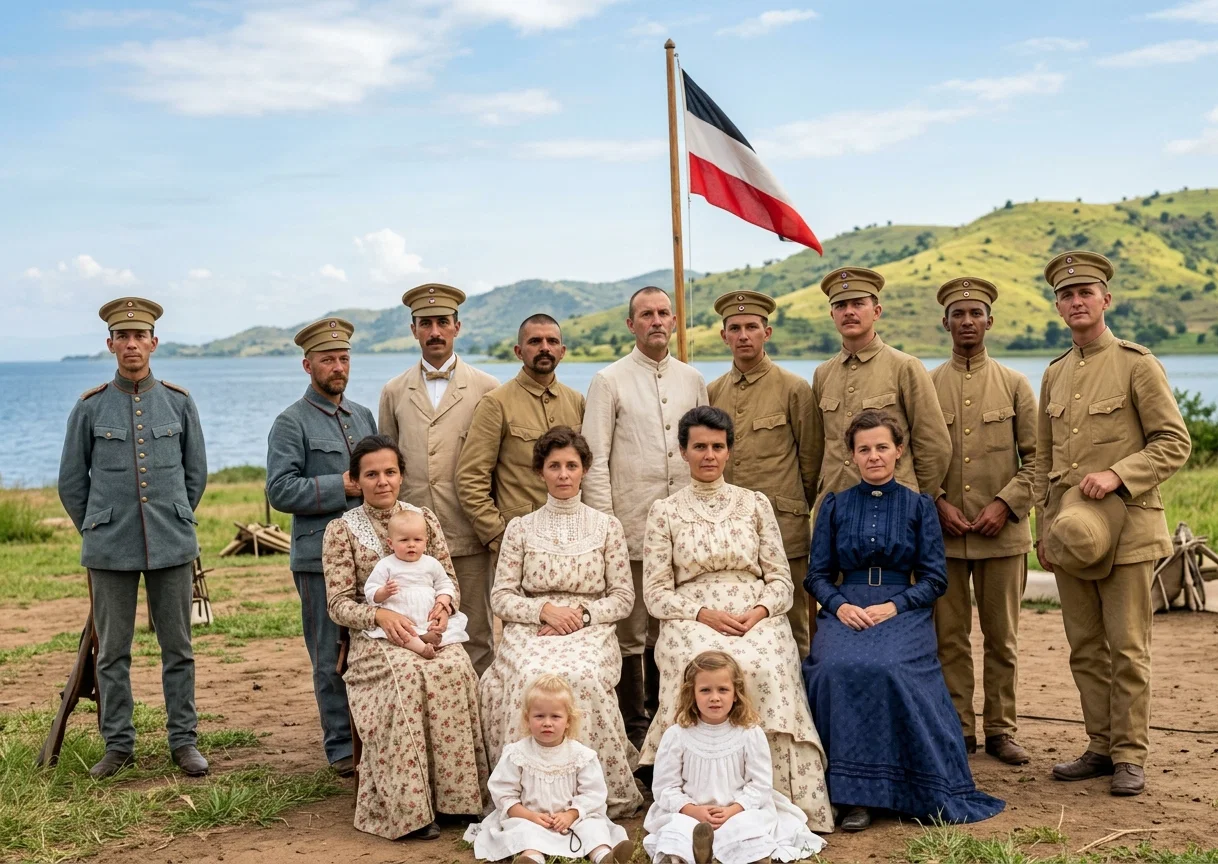
LAST month we began the erection of a mission house at Jramba, our fifth station here in the German Victoria Nyanza field.
When Brother Stein and I were seeking a place for the new station, a native Catholic Christian came to me after worship was over, and said: “You pray so that one can understand every word, and one can pray with you.” He desired to buy a New Testament in Kiswahili. He brought his wife with him, and said, “I have only one wife, and I desire to obey the commandments of God.” Besides the young people who came to attend our school, several older persons desired to come for instruction. Brother and Sister Stein have a good opening for work, and we trust that before long some souls here will wait for the Lord’s coming.
From all villages comes the cry to establish schools. The Usukuma, a large tribe, are waiting for us to open a school. The government has granted us eleven counties where we are at liberty to erect stations at once.
In the Shirati district we expect to build three new stations during the next few months. We are waiting for workers to help us. If we do our part, the Lord will do his.
Korea
By RILEY RUSSELL
RILEY RUSSELL
I AM now at old Wi-ju, on the banks of the Yalu River, the boundary between Korea and Manchuria. Four students are with us selling papers, and we are holding meetings at night.
There has been the most determined opposition here that we have ever met in Korea. This is a walled city of twenty thousand inhabitants. One denomination, claiming to have two thousand believers, has taught the natives that we do not believe in Christ, and that they should not even talk to us or look at our literature.
But the loud cry of the third angel's message can not be hushed by mortal man. Our audience, although small at first and ever changing, has steadily increased. One evening about seventy-five persons came out to listen. A few have signified their intention of uniting with the remnant people.
I have spent four Sabbaths at home since Aug. 10, 1911. Mrs. Russell and two Korean nurses care for the dispensary. We treated about six thousand cases during 1911.
The weather is quite cold up here,—about like that of Michigan. Since we do not see a stove from the time we leave home until we get back, we have to depend largely upon clothing to keep warm. At night there is a fire under the floor, which gets very hot.
Our Christmas dinner consisted of a bowl of rice, two eggs, and what food we had been able to bring with us. We get canned fruit from Montgomery Ward and Company, but it is heavy to14carry, and also expensive. Rice becomes quite monotonous in a week or two, so now I have a little alcohol-stove, and do some cooking. One great trouble is to keep our baggage down to carrying weight, for most of the time we are far from the railroad, often a hundred miles.
At one place where I was giving a Bible study, there were several in the little room, when all at once the lamp flickered, burned low, and suddenly went out for want of oxygen. This often happens here; for the only way to keep warm in the winter is to keep the one door shut tight.
It gives us courage to know that we are remembered at the throne of grace.
MAX HILL
By MAX HILL
Winning and Holding Boys—No. 2
MAX HILL
It takes time to win and hold boys. Everything worth while takes time. The difficulty with many is that they are not willing to take the time. Do you think Judge Ben Lindsey would be known all over the United States, to-day as the friend of boys if he had not taken time to win them? His start was through his work for juvenile criminals, so-called, of Denver. He has taken time to become intimately and actively interested in those for whom he labors.
We do not treat our older friends as we treat children, boys especially. With the older friend we are frank and pleasant; the boy gets the “short form.” When our older friend calls, we entertain him; the boy, if he calls, often entertains himself. Of course, he often does it with a veritable fusillade of insistent questions, and then we say he is an animated question-mark, and send him away, often with his important questions unanswered, and an ache in his heart.
Now that will not win him. How easy it is to take a little time to satisfy the craving for information in the mind just waking up to the wonders of life. If you really want to win the boy, take time to do it. Let some other things go. For the present it may seem more pleasant to spend the evening with older people.
It may seem that you must read on Sabbath afternoon; then take your paper or book and a boy, and read in the woods. But do not spend all the time reading; let him talk to you. Lead him out, do not fear a little latitude; a boy is a boy, and you must be, too. Take one at a time if you would get to the heart of boys. It may be an excursion with older ones would be more to your taste, but occasionally give yourself to a boy or a company of boys; give yourself freely, and see how young you grow, and what real pleasure you gain from the association. When you experience the joy of the conquest of hearts, you will never begrudge the time it takes to win a boy.
To sum up, let me give some do’s and some don’t’s:—
Get close to the boy.
Give him credit for having feelings.
Don’t preach to him all the time.
At the same time, don’t neglect to “talk straight” to him, but talk to him as to a man. Make him really believe that you consider him a man; make him believe it by believing it yourself.
Don’t believe all the bad stories about boys. Some people delight in passing on unsavory stories about others. But even if there is a possibility that the story may be true, refuse to believe it, and do not repeat it. Such a course will encourage the boy when he finds out.
Don’t be surprised if after you win the boy he avoids you sometimes. One of the dearest boys I ever knew used to turn aside sometimes rather than meet me. At such times I did the same thing with him; I ignored him entirely. A little severe letting alone is one sure method for occasional use in such cases, as well as in discipline. It also taught me not to intrude on his time. I found out all about it sooner or later; he always came to me in time. Now he thinks he is a man,—and he is,—but he always expects and gets a warm greeting from me when I see him, which is not oftener than once or twice a year. I doubt whether he will ever get too big or too old for the little tokens of affection I gave him when he wore knickerbockers.
It goes without saying that you must love boys if you would win them. When I attended my first teachers’ institute, one of the instructors made the remark that to make a success of teaching we must love children. To me that meant nothing then. I accepted the statement in a theoretical way, but I did not know that to love children means more than a general willingness to endure them if necessary. Later I found out that it15means a real, live interest in boys and girls as individuals. Then I found that I must take time for it if I would really succeed.
So much for winning the boy. Repeat the treatment many times to hold him. You can not always appeal to his reason; his course may not be guided by that star. You can not always appeal to his affection; he does not care to parade his feelings. You can not always appeal to his pride; he often seems utterly lacking in this characteristic, too. But study the boy; when you know him, you will know how to appeal to him. Remember to appeal to the man in him; there is more real man in him than his actions indicate; and he likes to feel it, to know that you recognize it in him. When you do this, you will hold him.
A Motto Prayer
Our Father, make our school to-day
A place where angels joy to stay,
Where thou canst come, and side by side
With each of us this day abide.
Sanitarium, Cal.
The Road to Happiness
By Annie Johnson Flint
THIS is the road to Happiness:
Start Now, from Where You Are;
Turn to the Right and Keep straight on,
And you'll not find it far.
Along the path of Willing Feet,
And over Heartease Hill;
Across the fields of Sweet Content,
The stream of Glad Good Will;
Then through the lane of Loving Heart,
The gate that's called To-day,
And down the steps of Little Things
Into the Common Way.
And take the cloak of Charity,
The staff of Wise Employ,
A loaf of Bread of Daily Grace,
A flask well filled with Joy;
A word of cheer, a helping hand,
Some good to give or share,
A bit of song, a high resolve,
A hope, a smile, a prayer.
And in the Place of Duty Done,
Beside the Door of Home,
You'll find the House of Happiness—
For Happiness does not roam.
— Annie Johnson Flint, in Northwestern Christian Advocate.
Prosperity at Barotseland Mission
THE following was gleaned from a private letter from W. H. Anderson, in charge of the self-supporting mission station at Barotseland, South Africa:—
“We have had nice rains, and all are hard at work on the farm. We have about twenty acres planted to peanuts, and a little more to mealies [corn]. We have three plows, the disk-harrow, and the planter going all the time. I hope we may be able to plant one hundred fifty acres of mealies this year. We have harvested our potatoes planted down at the spring. The ground was a little too wet for them to do real well, but we have about two hundred bags. That will mean two hundred fifty pounds [about twelve hundred dollars], as we are offered twenty-five shillings a bag. We shall double the number of irrigating ditches before we plant again.”
Greater prosperity for the mission in temporal things means greater opportunity for accomplishing the purpose of its establishment, the proclamation of the message among the peoples of Africa.
China’s Strife and Mission Work
In a letter dated January 24, Elder I. H. Evans writes:—
“Our general meeting begins this morning at ten o’clock. All our workers in China are here except B. L. Anderson. The Asiatic committeemen are all here except Brother Finster, who arrives to-day. Dr. Russell and Brother Oberg, from Korea, are also here.”
At that time the reigning dynasty had not resigned. Of the situation out in the provinces he further says:—
“Robbers are everywhere, and they are laying waste property, sacrificing the lives of the natives, and doing all sorts of destructive work. The whole country in the interior is in the hands of these armed bandits, and there is no force at present that is in a condition to overcome them. I suppose there are more than one hundred thousand armed men in the interior that are doing nothing but looting, burning, and destroying property. They seem to have no regard for life or property.”
This reveals something of the task the new republic has on its hands in restoring peace, but it is hoped that it will not be long until it will be comparatively safe for the workers to return to their stations, to resume their work.
The Perils of Young Women
By L. M. CROSS
L. M. CROSS
THE average life of the large class of unfortunate women is said to be seven years. A brief existence! but who can estimate the eternity of wretchedness and human degradation crowded into these few miserable years? These women are dying by the hundreds and the thousands everywhere, in hovels, almshouses, and penal institutions. Over sixty thousand girls are annually led into a life of shame, and many of them come from refined Christian homes.
Upon whom does the responsibility rest?—Mainly upon the mothers, because to them is given the first and greatest opportunity of molding the lives of their children. That influence is so potent that few of these sinful and sinned-against women would have become what they are if their own mothers had given them, when children, proper information.
A superintendent of one of our rescue homes, some time ago made the statement that about two hundred girls had been cared for, and that in a personal interview with each one, every one said that she had received no particular warning from her mother. The keeper of a notorious haunt of vice said to a mission worker, who was visiting its inmates: “Yes, you may come and talk to the girls all you want to; but I tell you, if their mothers had talked to them at home, there would be none of them now to need you.”
If young women are to be saved from this dreadful fate, it is certain that they must be forearmed by correct and healthy views of the nature and uses of those wonderful functions with which God has endowed them. They can not be kept in ignorance. As soon as they become conscious of the new powers stirring within them, they will seek to know the why and the wherefore. To attempt to keep them in ignorance is to drive them, through their curiosity, to impure sources, and pernicious ways may be suggested of viewing matters that should be sacred and holy.
A reverent knowledge is the surest safeguard of innocence, and it is every mother’s duty to see that the young girl committed to her charge is duly forearmed by being forewarned of the dangers that lie about her.
More and more, mothers are realizing the vital importance of imparting this information, but they shrink from doing it, because they do not know how. They desire their own daughters to avoid the snares and pitfalls that everywhere lie in wait for them, but they are naturally fearful that in approaching this delicate matter they may, by suggestion, do harm rather than good. Thoughtful and good mothers feeling this way will welcome an excellent book, written by a Christian physician,—herself a wife and mother,—Dr. Mary Wood-Allen, entitled “What a Young Woman Ought to Know.”
Mrs. Lillian M. N. Stevens, president of the National Woman’s Christian Temperance Union, was one of the first to commend this wonderful book. She says: “There is great need for carefully, delicately written books upon the subjects treated in this series. I am gratefully glad that the author has succeeded so well, and I feel that a great and enduring good will be the result.”
Mrs. Mary Lowe Dickinson, the general secretary of the Order of the King’s Daughters, says: “Any young woman knowing all that this volume teaches has an essential foundation for whatever other knowledge she may acquire. Get a copy of this book, mother. Read it yourself, and pass it on to your daughter. It will prove of priceless worth.”
The Wise Lawyer
They sat in the office of the man who drew up papers for folks.
“We’ve decided to separate,” the man said, “and we want you to get up the papers.”
Something like a sob came from the woman’s lips, and she drew the baby closer to her side.
The lawyer fumbled about among the papers on his desk, then took off his glasses and said quietly, “I wish you would tell me all about it.” Then the little woman broke in:—
“We would like to tell somebody about it—I would, anyway. You see, he’s a good man, but—he goes right on and does things without letting me know—buys horses and things and mortgages them, and somehow doesn’t pay for them.
“If he’d only tell me, so that we could talk it over, seems to me we might get along better. I expect the farm will have to go pretty soon. The man that has the mortgage says he can’t wait much longer. You couldn’t blame him; we haven’t kept the interest up for a good many years.
“And just yesterday he came home from an auction with a lot more of old bob-sleds. I don’t know what he is going to do with them.
“If he had only told me he was thinking of getting them, maybe I could have said something to make him see it was no use. But he didn’t. He never does. He thinks women don’t know anything about such things. I don’t understand all about business, but I would like to.”
“And so—”
“Well, do you really think a woman’s head ought to be bothered with such things, ’Squire? Honest, now.”
The man leaned forward, and looked expectantly into the face of the lawyer.
“I’ll tell you what I do think. If I were you, and had a wife as good and as kind and sensible as yours is, I should want her to counsel with me on all matters of business. Don’t you think she has a right to do so?
“She is your partner in life. You made her so when you married her. You have not made her so in fact. She has not been given her share of the burden to bear, and she wants to take her half of the load. Why don’t you let her?
“Now, I’ll tell you what I would advise you to do—not separate, but get closer together.
“Give your wife what she wants with all her heart—her fair share of the load to bear. Talk things over with her. Let her be really a partner to you.
“Don’t buy bob-sleds and old horses without letting her know about it. I know there is a temptation to bid on such things when we get a bit interested. Hold still when you feel that fire in your heart. Think of Mary, and keep still.”
“Do you suppose I can do it, ’Squire?”
“Of course you can, Sam! I’ll go with you and stay right by you if you’ll let me.”
And the ’Squire did not write the letters of separation. Another document was written in the book of hearts of that man and woman. Just such a document should be signed, sealed, and delivered between every husband and wife in all this land.— Exchange.
The Gospel Makes Decency Possible
By James Russell Lowell
WHEN the keen scrutiny of skeptics has found a place on this planet ten miles square where a decent man can live in decency, comfort, and security, supporting and educating his children unspoiled and unpolluted; a place where age is reverenced, womanhood honored, and human life held in due regard,— when skeptics can find such a place, ten miles square, on this globe, where the gospel of Christ has not gone and cleared the way and laid the foundations and made decency and security possible, it will then be in order for the skeptical literati to move thither and ventilate their views.— James Russell Lowell.
The Mount of Blessing
When I am alone with my Saviour,
In the hush of the dying day,
On the mount I seem to join him,
Where he has gone to pray;
And I tell him my grief and heartache,
And the burdens I have borne,
Misjudged, neglected, slighted,
Until I am all forlorn.
I seem to see his features,
All scarred but kingly sweet;
And I see his side all bleeding,
And the nail prints in his feet;
And his hands are raised in blessing,
As I kneel and cry, “Forgive!
I am dying with sin and sorrow,
But thou canst bid me live!”
And there alone with my Saviour,
In the awe of the dying day,
With my hand on his seamless raiment,
He answers as I pray,
And he says, “There is strength forever,
In the boundless stores above.
The Father only awaits thy prayer,
To crown thee with his love.
“And in his infinite mercy,
He will help thee and forgive;
He will spread his wings above thee;
He will teach thee how to live:”
And there on the Mount of Blessing,
When the discords of daytime cease,
I lay my sin and my sorrow,
And my Saviour gives me peace.
— The Bible Advocate.
The Message Through the Secular Press
By Walter L. Burgan
CONSIDERABLE success has attended the efforts of the Press Bureau to spread the third angel’s message through the columns of the newspapers. Since the bureau was inaugurated on January 1, reports on what Seventh-day Adventists are doing toward reaching every nation, kindred, and tongue in the world with the gospel have been sent broadcast through several States in this country.
Though our efforts to spread the gospel during the biennial session of the Atlantic Union Conference were crowned with success, the Lord opened the columns of the newspapers in the territory embraced in the Central and Northern union conferences in a more liberal manner. Articles averaging more than a column in length were published in the Lincoln, Nebr., newspapers practically every day during the joint session of these two union conferences at College View, and many of the leading papers in the nine States of the two unions also published reports.
That much good will come as the result of the publication of these articles in the Lincoln papers alone is evident from the interest that was shown by business men of that city. One business man said that he got more good out of the published reports of sermons preached by our brethren at College View than he would had he gone to church. The Associated Press was furnished reports each day, and the manager said he was sending something out over the wires to different cities in the Middle Western States.
The Lord also went before us at the Southwestern Union Conference session, which closed at Keene, Tex., February 13. The editors of the three newspapers in Cleburne, which is about six miles from Keene, used practically all that was furnished them. One paper—the Cleburne Review, a morning publication—printed a page and a third in one report. Nearly a page of that amount consisted of a history of the Seventh-day Adventist denomination, and the rest comprised reports concerning the conference session. This article had a heading which stretched across the page, and which read as follows: “The Biennial Conference of Adventists in Session at Keene. A Complete History of the Seventh-day Adventist Movement, and Complete Details of the Interesting Conference at Keene, Tex., Which Will Last for Several Days.” Double-column headings were generally the size given to the daily reports in the Cleburne papers. Reports were also sent each day to the leading papers in Fort Worth, Dallas, Houston, San Antonio, and other cities. Several of the delegates had clippings sent to them of articles which were published in their home papers.
Nearly two hundred full sets of lessons on newspaper reporting were given out among the delegates at College View, and nearly one hundred fifty sets at Keene. The brethren took much interest in the instructions, and promised to write for the newspapers upon their return to their homes.
WALTER L. BURGAN.
West Africa
By D. C. BABCOCK
LAST Wednesday we had a baptismal service at the Freetown church. Seven were baptized. It was quite an interesting occasion, as some who were baptized had attended the tent-meetings five years ago, and the evening of the baptism was just five years from the first meeting held in the tent. We have the work all planned for the present year.
Last Sunday I had an interesting time. I was at Waterloo, and quite anxious to get home, but we have no Sunday trains. However, while I was talking to some of the schoolboys, in came a train with three special cars. I ran down to the station, and found that it was the general manager's special train. I took courage, and asked him for a ride to Freetown.
My request was granted, and I boarded the car next to the manager's car. In a little while I was sent for. I felt a little strange to be called into such company, but gathered courage and went in. I was acquainted with the general manager, but was somewhat surprised to be introduced to the general manager of the railways in India, and the general civil engineer for the Sierra Leone railways.
The general manager remarked that Sunday trains just suited me. I said, Yes, and from that the Lord helped me to present the Sabbath of God's Word. I lost no time. They asked me if I worked on Sunday, and I told them I did, and that it was not simply a convenience as they looked at it, but a God-given right.
What they wanted was to talk over plans to get palm kernels out of the bush to the railway stations. They want us to build a one-wheeled truck to carry freight, so two men can run it in a narrow path in the bush. We are building one for a trial now.
The manager of the India railways is here in West Africa inspecting railways in Nigeria and Sierra Leone, under the direction of the British government.
Among other things, the general manager agreed to build us a good road from the station at Waterloo down to our factory. I sometimes wonder at the openings for us in our work.