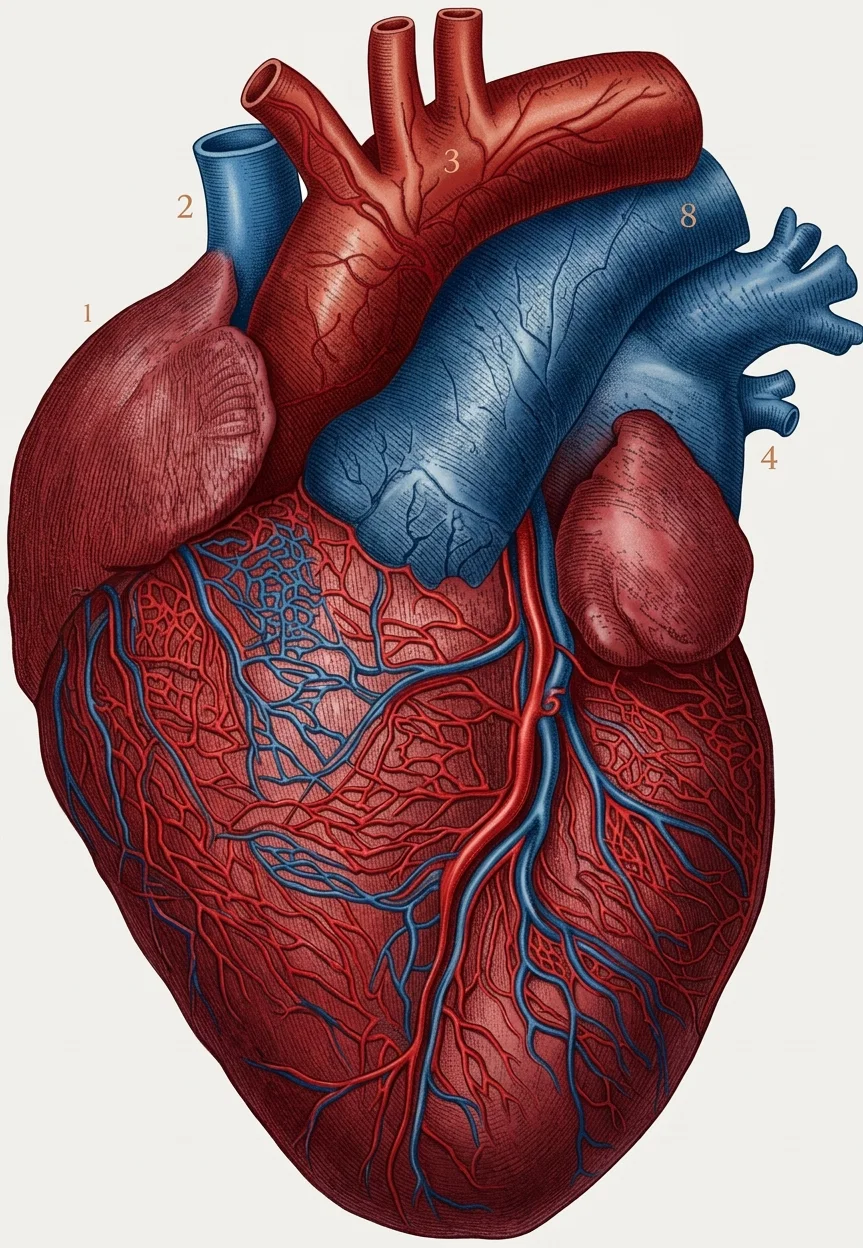
THE HEART. 1. RIGHT AURICLE. THE LEFT AURICLE IS IN THE CORRESPONDING POSITION ON THE OPPOSITE SIDE; 2. VENA CAVA; 3. AORTA; 4. PULMONARY VEINS; 8. PULMONARY ARTERY.
In this study we will consider briefly some of the principal facts pertaining to the anatomy and physiology of the circulatory systems. The circulatory system consists of a system of closed tubes through which the blood is forced by the heart is a conical-shaped, muscular organ, possessing four cavities—two auricles and two ventricles. The right auricle receives the venous, or impure, blood from the lower parts of the body, through the inferior vena cava, and from the upper parts through the superior vena cava.
While the venous blood is being collected in the right auricle, the arterial blood, which is being purified in the lungs by giving off the carbon dioxide it contains, and taking on the oxygen from the air, is being collected in the left auricle. When these two chambers are filled, they contract, and force their contents into the ventricles, the right forcing its contents through an opening between itself and its respective ventricle, the left acting in a similar manner. The openings are called the right auriculo-ventricular and the left auriculo-ventricular, and are closed by the tricuspid and mitral valves respectively. The simultaneous contraction of the auricles fills the right and left ventricles with venous and arterial blood. The right ventricle contains venous blood, and the left arterial blood. When the ventricles contract, the blood in them is prevented from escaping backward into the auricles by the closing of the valves guarding the openings.
The contraction of the ventricles forces the venous blood through a large vessel called the pulmonary artery to the lungs, to be purified, and the arterial blood through the aorta, which, by means of its many branches, carries blood to every part of the body, for its nourishment. These great vessels, which extend from the right and left ventricles of the heart, have valves at their orifices, which, by closing, prevent a return of the blood to the heart.
The blood vessels, like the heart, contain a considerable amount of involuntary muscular tissue, and in addition elastic tissue, both of which, by contracting, help to force the blood onward. The arteries become smaller and smaller as they extend farther from the heart, until they are only microscopic in size, and are so very thin that part of their contents passes through them into what is called the lymphatic circulation. Through the medium of the lymph, which is of practically the same composition as the blood, food material reaches the tissues. These very minute vessels, called capillaries, also collect the blood containing the impurities resulting from tissue activity and waste, and carry it to the veins, by means of which it is taken to the right auricle of the heart. It is impossible to tell just where the capillaries carrying arterial blood stop, and where those carrying venous blood start, because they are continuous. However, the capillary veins become larger and less numerous as they approach the heart, until finally there are but two large vessels—the superior and inferior venæ cavæ—carrying venous blood to the heart.
This whole system is under the control of the sympathetic nervous system, there being two kinds of nerves governing it; namely, the accelerator and inhibitory. When the inhibitory nerves are stimulated, the heart beats slower; when paralyzed, the heart beats faster. When the accelerator nerves are stimulated, the heart beats faster; when the accelerators are paralyzed, the heart beats slower, because the inhibitory nerves alone act. The same may be said with reference to the blood vessels: one set of nerves, the vasoconstrictors, when stimulated, cause a contraction of the vessels, and another set, the vasodilators, when stimulated, cause the vessels to dilate.
The lymphatic system, like the blood vessels, permeates all parts of the body, and is a channel through which the food material from the blood is conveyed directly to the tissues. The fluid conveyed by this system is called the lymph, which has been termed the middleman between the blood and the tissues.
In our previous studies we called attention to the close relationship existing, through the agency of the nervous system, between the skin and other parts of the body. The relationship between the skin and the circulatory system is as great, if not greater. By an intelligent understanding of this relationship, one can modify at will the amount of blood in almost any part of the body, by applying the proper stimulus to the skin.
In the treatment of disease it is the aim of the physician to regulate properly the circulation of blood. He knows that it is the blood that heals, and not himself; all he can do is to use the means which God has given him, to influence the flow of this current of life. The chief functions of the blood are to repair injury, convey food material to the tissues, and to carry waste materials away from them to the organs employed in their excretion, such as the skin, kidneys, lungs, etc. It is also a distributer of heat, and possesses the property of destroying germs and poisonous substances which may gain access to it.
What has been said with reference to the close relation between the skin and the internal organs, also applies to the mucous membrane of the alimentary canal. Through the agency of the nerves, every internal organ of the body is connected with some part of the skin, and when influences are brought to bear upon this surface, changes are produced in the organ itself. For example, the skin of the hands is related to the kidneys, and when the blood vessels of the hands are made to contract (as by cold), the activity of the kidneys is increased.
The blood vessels are so arranged that by increasing the caliber of the small vessels in the skin, less blood will reach the underlying structures; this is because the large blood vessels divide, and send branches both to the skin and to the deeper structures beneath it. Because of this wise arrangement, when a congestion of deep structures occurs, it can be relieved by producing a dilatation of the skin vessels. Blood may also be diverted from the interior of the body by dilating all the surface vessels, or may be diverted from the head by dilating the vessels of the lower extremities.
The following areas of the skin are in relationship to some internal organ, and by making the proper application to these areas the desired effects may be obtained:—
The skin of the scalp, back of neck, and face is related to the brain.
The skin of the neck is related to the nose, pharynx, and larynx.
The skin of the back, beneath the shoulders, and of the chest is related to the lungs.
The skin over the heart is related to the heart.
The skin over the lower right chest is related to the liver.
The skin over the corresponding area on the left side is related to the spleen.
The skin covering the small of the back is related to the organs contained in the pelvis, and also to the kidneys.
The skin over the lower sternum is related to the kidneys.
The skin over the stomach and the corresponding area on the back is related to the stomach.
The skin of the abdomen is related to its contents.
The skin of the feet and legs is related to the brain, lungs, bowels, and pelvic organs.
A thorough knowledge of the facts contained in this and the two preceding studies will enable one to comprehend why it is that water in its various forms, when applied intelligently, is capable of producing such marvelous results, and there is no reason why it cannot be used in the home in many cases of sickness with beneficial results.
In subsequent studies the subject of hydrotherapy proper will be taken up, but unless a thorough study has been made of this and the preceding ones, comparatively little practical benefit will be derived from them. The principles should be discussed in the family, and additional information obtained by reading Good Health, and other publications containing information on these subjects.
QUESTIONS FOR STUDY.
1. Of what does the circulatory system through which the blood flows, consist?
2. How does the food material reach the tissues?
3. Why is it that the blood vessels can be made to expand and contract?
4. What controls the capacity of the heart’s beat?
5. What controls the caliber of the blood vessels?
6. What is the difference between arterial and venous blood? Where is the venous converted into arterial, and the arterial into venous blood?
7. What is the lymph? What is its function?
8. What are the functions of the blood?
9. Why is it possible to modify the circulation of an internal organ by making an application to the skin?
10. Give an illustration.
11. If there were too much blood in the head, how could you decrease it?
12. What are the different areas of the skin which are related to internal organs? What are the related organs?
TO GOD'S GLORY.
By M. C. Wilcox
M. C. WILCOX.
It is a perversion of our Lord's words to declare that when He said, "Take no thought for your life, what ye shall eat, or what ye shall drink" (Matt. 6: 25), He meant that the kind or quantity or quality of food mattered not. He taught that the end of our life should not be the gratifying of appetite. That is the thought of the worldling; that was the thought of the foolish rich man in Luke 12. "Soul," said he, "thou hast much goods laid up for many years; take thine ease, eat, drink, and be merry." That was his climax of life's purpose. His god was his appetite. It is against this that our Lord warns us. Do not put your anxious thought upon that which ministers to carnal desire; do not make a means of life the object.
Neither would He have us understand from the scripture just quoted and from kindred texts that eating and drinking are unimportant. Man was created for God's glory; he is made God's steward in the use of things by which God may be glorified; and the Holy Spirit gives this positive instruction: "Whether therefore ye eat, or drink, or whatsoever ye do, do all to the glory of God." 1 Cor. 10: 31.
The questions, therefore, which the Christian will ask concerning his food, are such as these: What will best glorify God? What is best adapted to the service which is His due from me? What will build me up the strongest, healthiest body? What will give me the most active brain, the clearest mind? What will render my senses the most impressible, the most sensitive, to the influence of His Spirit?
Having settled these questions by the principles of God's living truth, having more fully realized in their settlement the great purpose of existence, it will not be difficult to decide what kinds of food, how much food, and what quality of food we shall use.
That which will best glorify God will separate from the lust for the fleshpots of Egypt, from the leeks, the onions, and the garlic. In other words, eating will be a matter of life, and not of lust. Eating to glorify God, we may ask and expect His blessing upon the means used to His glory.
Eating and drinking will also be enjoyable. Keen and appreciative will be the appetite; sweet and delicious the simple foods of God's furnishing. How much anxiety would be saved, how much blessing would come, did we but eat and drink to the Master's glory.
The Health Should Be as Sacredly Guarded as the Character
By Ellen G. White
The health should be as sacredly guarded as the character.—Mrs. E. G. White.
Christ, the Healer
By W. W. P.
These truths should be taught clearly in every one of our health institutions. Although agencies are employed in the treatment of the sick, and the recovery is gradual, yet it is true that every case of restoration to health is just as really the direct working of Jesus the Saviour, as when He healed instantaneously and without visible means the multitude that followed Him in His earthly ministry. When He changed the water into wine at Cana of Galilee, He drew back the curtain behind which He ordinarily hides His working in nature, and revealed the fact that it is himself, and not some impersonal force, who changes water into wine every season in every vineyard. And so His miracles of healing should make it clear to us that He, and not some impersonal agency, whether it be “medicine,” or “treatment,” is the one and only healer. And further, the truth should be taught that when it will glorify His name to do so, He can heal disease just as quickly as He can forgive sins. The same Jesus who said to the sick of the palsy, “Son, thy sins be forgiven thee,” said also, and on the same occasion, “Arise, and take up thy bed, and go thy way into thine house.” And when they saw the result, “they were all amazed, and glorified God.” “Jesus Christ is the same yesterday and to-day, yea and forever,” and upon the corner stone of every sanitarium should be inscribed these words: “I am the Lord that healeth thee.” W. W. P.
THE LAKE UNION CONFERENCE.
By Arthur G. Daniells
When the Lake Union Conference Committee held its council at Berrien Springs, July, 1901, it was agreed that it would be well to hold the first session of the conference in camp at Indianapolis during the month of May, 1902. The plan was to hold a large representative gathering of our ministers and conference officers, in one of the most suitable and accessible parks of the city, and to make a special effort to interest the citizens in the great message which the Lord has committed to us for the world.
Since that council we have been advised by those137best acquainted with the climate in Indiana that it will not be safe to undertake to hold a camp-meeting in Indianapolis at any time during the month of May. Oftentimes the weather is wet and cold during the latter part of the month, and it is thought that it will not be best to undertake to camp before the middle of June.
This date seems objectionable to most of our Conferences in the Lake Union Conference, as it would delay the opening of their tent-meetings, making it difficult to hold two series of tent-meetings during the summer. None of the States seem willing to place the Lake Union Conference so late as the month of June.
Another difficulty which has arisen regarding that date is the time of holding the General European Conference. After much study and correspondence, our brethren in Europe and the members of the General Conference Committee in America are convinced that the latter part of May is the best time for holding the General European Conference. In fact, this is the only date that will be advantageous to the work in Europe unless the meeting is deferred until late in the fall, and there are serious objections to this.
As my brethren all advise me to attend the European meeting, it will be necessary for me to sail from this country the last of April, and to be absent from three to six months. This will make it impossible for me to attend the Lake Union Conference unless it is held prior to the first of May.
All things considered, the presidents of the Conferences have advised that the meeting be held in Chicago, March 27 to April 6. This will make it possible for all the Conferences to send full delegations without in any way interfering with the summer's work. Then we shall have the decisions of the Union Conference regarding important matters of policy to guide in formulating our plans for the coming summer.
The Illinois Conference and the Chicago church have given the Executive Committee of the Lake Union Conference a hearty invitation to hold the conference in what is known as the Forty-sixth Street church, Chicago. This is a large building, capable of accommodating all the delegates, besides quite a large attendance of the public. It is so constructed that dining accommodations can be provided in the basement. It would be too much to expect the Chicago brethren to entertain all the delegates free. We are assured, however, that the Conference and church will unite in providing accommodation at the lowest reasonable price, and that they will spare no pains to make the stay of the delegates in Chicago as pleasant as possible. Elder Moon, the president of the Conference, has the arrangements in hand, and will shortly announce them through the REVIEW.
Chicago is an important center, and the coming meeting should prove a blessing to the cause in that city. All the Conferences should plan for a good delegation and a good meeting. We shall have more to say regarding this; but in closing, let me request all to unite in seeking the Lord for special help in preparing for the coming meeting.
A. G. DANIELLS.
LOSING REVERENCE FOR SUNDAY.
By L. A. S.
The Church Standard (Philadelphia), a leading organ of the Episcopal Church, declares that a remarkable change has taken place within a few years’ time in the sentiment of Protestant clergymen in this country touching Sunday as a day of divine obligation. There has of late, the Church Standard observes, been much discussion of the question of proper Sunday observance, particularly as regards the propriety of allowing Sunday saloons; but, says this authority, “in all the discussions of this subject that we have seen, perhaps the strangest thing is this, that no one, not even the most earnest of Christian ministers, seems any longer to entertain the question whether the observance of the Lord’s day is required by divine ordinance. Twenty, or ten, or even five years ago, no such observation could have been made; and the fact that it can be made now is a startling evidence of the rapid change of belief and sentiment that has been unconsciously taking place in the minds of Christian people here in America. The very idea of the religious obligation of the Lord’s day seems to have been dropping entirely out of people’s minds until, as a principle of action, it remains with only a few survivors of a bygone generation. It is surely a significant fact that one Presbyterian clergyman should openly favor a regulated permission of Sunday liquor selling, without the least apparent recollection that the standards of his Church attach to the first day of the week all the sanctions of the Fourth Commandment; and it is hardly less remarkable that ministers of nearly all other denominations should oppose the same measure on the ground of expediency, good morals, and even American prejudice, but hardly at all on the ground that it would authorize the violation of divine law.”
The Church Standard in some further comments expresses great fear “that the growing disregard of Sunday observance cannot be stayed, and that in the just reaction from arbitrary and very modern rules of mere human invention, all thought of the Sabbath and the Lord’s day as having any divine authority whatsoever is simply vanishing from the minds of men.” And here the Church Standard accidentally touches the root of the whole difficulty. Sunday observance is “of mere human invention,” and has long been treated as such, by agitators for Sunday laws, by the people, by legislatures, and by the courts. The assumption of the right to regulate Sunday observance by human law, is a denial of any higher authority for such observance than that of the human lawmakers. Hence the more agitation there is for Sunday legislation, and the more laws there are enacted or revived enforcing Sunday observance, the more must the idea of Sunday as a merely human institution eclipse the conception of Sunday as a day appointed of God. The proper remedy, therefore, would be to drop at once all efforts to secure Sunday observance by any exercise of human authority; but even this would fail, since, as stated, divine authority for the day is entirely wanting. Sunday is a human institution merely, and this truth has now obtained almost universal recognition in the Protestant churches. The only way out of the difficulty is to return to the day which God has sanctioned. “Remember the Sabbath day, to keep it holy. Six days shalt thou labor, and do all thy work: but the seventh day is the Sabbath of the Lord thy God: in it thou shalt not do any work.” Ex. 20: 8-11. L. A. S.
Sin and Its Remedy
THERE is in the final analysis only one disease, and that disease is sin. For this disease there is only one remedy, and that remedy is the gospel. There is only one physician who really cures, and that physician is Jesus of Nazareth.
Obedience and Health
If there had never been any sin in the world, there would never have been any disease in the world. Obedience to God's laws is in itself the experience of health. “Wherefore it shall come to pass, if ye hearken to these judgments, and keep, and do them, that the Lord thy God shall keep unto thee the covenant and the mercy which He sware unto thy fathers; . . . and the Lord will take away from thee all sickness, and will put none of the evil diseases of Egypt, which thou knowest, upon thee.” Deut. 7: 12–15.
The Gospel, God’s Power Unto Salvation
The gospel is “the power of God unto salvation.” This salvation is salvation from sin, which is “the transgression of the law.” The gospel is therefore God’s provision to save us from transgressing His law. This is accomplished by filling us with the life and power of His own word, the only medicine of any value. “My son, attend to my words; incline thine ear unto my sayings. Let them not depart from thine eyes; keep them in the midst of thine heart. For they are life unto those that find them, and health to all their flesh.” Prov. 4: 20–22. This is the one remedy for the one disease.
Jesus Unites Forgiveness and Healing
It is in and through Jesus of Nazareth that we have the forgiveness of sins: “In whom we have redemption through His blood, the forgiveness of sins.” “Be it known unto you therefore, men and brethren, that through this man is preached unto you the forgiveness of sins.” But the one who forgives our sins is the one who heals our diseases. “Who forgiveth all thine iniquities; who healeth all thy diseases.” When He “gave himself for our sins,” He gave himself for our diseases. He “bare our sins in His own body,” and “himself took our infirmities, and bare our sicknesses.” These were not two separate experiences, but were both involved in the one experience of appearing in the flesh as “the Lamb of God, which beareth the sin of the world.” In His work Jesus therefore united preaching and healing. “And Jesus went about all the cities and villages, teaching in their synagogues, and preaching the gospel of the kingdom, and healing every sickness and every disease among the people.” Matt. 9:35.
SAVED TO SERVE.
By William W. Prescott
THROUGH the love of the Father in the gift of His Son as our Saviour, we are delivered from the bondage of sin, that we may serve God in the freedom of righteousness. “Blessed be the Lord God of Israel; for He hath visited and redeemed His people, and hath raised up an horn of salvation for us in the house of His servant David; as He spake by the mouth of His holy prophets, which have been since the world began: that we should be saved from our enemies might serve Him without fear, in holiness and righteousness before Him, all the days of our life.” Luke 1: 68–75. We are saved to serve.
“Saved to serve in any station,
Saved to make His goodness known;
Saved to sing His great salvation,
Saved to live for Him alone.”
This purpose of salvation was shown in the message which the Lord sent to Pharaoh through Moses: “And thou shalt say unto Pharaoh, Thus saith the Lord, Israel is my son, even my firstborn: and I say unto thee, Let my son go, that he may serve me.” Again and again the command was repeated, “Let my people go, that they may serve me.” The children of Israel were not delivered from Egypt in order that they might spend their time in idleness. They were still to serve, but the service was under a different master, and of a different kind. “The Egyptians made the children of Israel to serve with rigor: and they made their lives bitter with hard bondage.” But how different is the service of the Lord! “The Lord is good to all.” “The Lord is gracious, and full of compassion.” “Serve the Lord with gladness: come before His presence with singing. Know ye that the Lord He is God: it is He that hath made us, and His we are.” We are saved to serve.
The call of the hour is the call to service, loving, faithful service. Consecrated workers are needed everywhere. Consecrated physicians, consecrated nurses, consecrated preachers, consecrated canvassers, consecrated teachers, a whole army of consecrated soldiers of the cross are wanted for service in the field. Any who may think that they are saved for any other purpose than to serve God and humanity should not apply. There are too many of that class already in the ranks. The Captain of our salvation calls for volunteers who are constrained by the love of Christ to present their bodies living sacrifices to be consumed in holy service. We are saved to serve.
And this call is really to every member of the Church. “Let the churches awake before it is everlastingly too late. Let every member take up his individual work, and vindicate the name of the Lord by which he is called.” The Lord has given “to every man his work,” and He is now pointing out with much definiteness what that work is. Many are recognizing His call to duty, and are taking up the work. Many are even now experiencing the blessing which is found in service. And still the command is, “Go ye also into the vineyard.” We are saved to serve. W. W. P.
“CHRISTIAN SCIENCE:” ARE ITS DOCTRINES TRUTH OR ERROR?
By George Ide Butler
Are There Evil Angels? What Does the Word Say (Continued)?
I HAVE not space for more than one or two other points in this great subject. Let the reader notice with especial interest the next quotation: “Son of man, take up a lamentation upon the king of Tyrus, and say unto him, ‘Thus saith the Lord God: Thou sealest up the sum, full of wisdom, and perfect in beauty. Thou hast been in Eden the garden of God; every precious stone was thy covering, the sardius, topaz, and the diamond, the beryl, the onyx, and the jasper, the sapphire, the emerald, and the carbuncle, and gold: the workmanship of thy tabrets and of thy pipes was prepared in thee in the day that thou wast created. Thou art the anointed cherub that covereth; and I have set thee so; thou wast upon the holy mountain of God; thou hast walked up and down in the midst of the stones of fire. Thou wast perfect in thy way from the day that thou wast created, till iniquity was found in thee. . . . Thou hast sinned: therefore I will cast thee as profane out of the mountain of God: and I will destroy thee, O covering cherub, from the midst of the stones of fire. Thine heart was lifted up because of thy beauty, thou hast corrupted thy wisdom by reason of thy brightness. I will cast thee to the ground. I will lay thee before kings, and they shall behold thee. . . . I will bring forth a fire, from the midst of thee. . . . and I will bring thee to ashes upon the earth in the sight of all them that behold thee. . . . Thou shalt be a terror, and never shalt thou be any more.’ Eze. 28:12-19.
Please notice the following points: (1) This can be no human being, for he is declared to be an “anointed cherub.” Again, no man who ever lived could be what the specifications in these texts present; (2) he is called king of Tyre, or “Tyrus,” on the same principle that Satan is called the prince of this world, in scriptures previously quoted. Tyre occupied a position in the ancient world similar to that of London or New York to-day. Satan was the great prince of it all; (3) this being was perfect “till iniquity was found in him.” In other words, he was a holy angel, but afterward became a wicked one; (4) therefore he was cast out of the mountain of God: he fell, and was banished from heaven, for heaven’s good; (5) why did he fall, morally speaking?—Because his heart became “lifted up” in pride because of his own beauty and talent, on precisely the same principle that multitudes of others have fallen—by cherishing pride and selfishness in their hearts, by ignoring and forgetting their allegiance to the Creator, and treating His claims with indifference and contempt. In this manner self is idolized. Beings are dependent upon God for their very existence, and for every blessing they enjoy; yea, for all of excellence or ability in any form they may possess. God alone is the one from whom they received them, and they are accountable to Him for the way they use all these gifts. It matters not how high in nature or in mental or moral powers they may be, whether angels or men, this dependence and this accountability exist; their responsibility and allegiance to God cannot be ignored. When it is ignored, God’s holy law is violated. That law requires that we love God with all our soul, might, mind, and strength; that we have no other gods before, or besides, Him. When self takes the place of God in our affections, this law is violated. “Sin is the transgression of the law.” When we transgress, we become sinners against God. And if this course is persisted in, we are in rebellion against our Creator.
The Scriptures quoted clearly demonstrate that “Lucifer,” “the day-star,” “light-bearer,” or “son of the morning,” the original title of this high angelic being, thus fell from his high estate, and became Satan, the great “adversary” of all good, the leader of the evil angels who fell with him. This same fact is made evident by another Scripture: “How art thou fallen from heaven, O Lucifer, son of the morning [or “day-star,” margin]! How art thou cut down to the ground, which didst weaken the nations! For thou hast said in thine heart, I will ascend into heaven, I will exalt my throne above the stars of God: I will sit also upon the mount of the congregation, in the sides of the north: I will ascend above the heights of the clouds; I will be like the Most High. Yet thou shalt be brought down to hell.” Isa. 14:12-15. How clearly this scripture reveals the motives which actuated this mighty angel when “iniquity was found in him”! He determined to be like the Most High, to exalt himself above the Son of God, or at least to be His equal, till finally it was necessary for the peace of heaven to thrust him and all who rebelled with him, out of that holy habitation.
The objection here arises in many minds, How could such high and holy beings sin? and is not God responsible for their sin?—Not in the least. Like man in his innocency, all these high intelligences were pronounced “very good.” But God, in His infinite wisdom, prefers that His intelligent creatures shall not be mere machines, with no power of choice. The service of such could afford no pleasure to Him. A forced service would be most inconsistent with His character. A service prompted by love, gratitude, reverence, and free choice, however, would be pleasing to Him or to any reasonable intelligence. But in order to have such service, His creatures of intelligence must be given freedom of the will, freedom to choose. In the very nature of things, this is absolutely necessary if there is to be such service as could be acceptable to God. But if free choice is permitted to His creatures, there must be the possibility of a wrong choice, otherwise there would be no choice at all. This contingency must necessarily enter into free moral agency. God so ordered it, knowing full well what might be the result. That result, the possibility of the incoming of evil, the Creator took; and evil has come in through the fall of Lucifer and his sympathizers and their temptation of the human family. What is the result?—A terrible exhibition of sin, death, sorrow, pain, wretchedness, and all the long category of evils everywhere visible. About six thousand years of this, God has suffered to continue. Our world has been filled with violence. Satan’s rebellion against the government of God has brought all this in. Meantime he has been exhibiting the true character of his great departure from God in the fiendishness of his treatment of God’s dear Son, who came to this earth on the heavenly mission of love and mercy, everywhere doing good to all. Satan murdered Him through the agents he employed. This one experiment in God’s great universe will be permitted to continue till all reasonable intelligences can discern the true nature of sin and rebellion. Then it will be brought to a close in the great Judgment day, when Satan and all his hosts of followers shall be consumed in the lake of fire. Rev. 20:7-15; 2 Peter 3:7-13. Then God will have evermore a clean universe. “And every creature which is in heaven, and on the earth, and under the earth, and such as are in the sea, and all that are in them, heard I saying, Blessing, and honor, and glory, and power, be unto Him that sitteth upon the throne, and unto the Lamb forever and ever.” Rev. 5:13.
This, in brief, is the final disposition of sin and rebellion in the universe, when virtue, obedience, faithfulness, and devotion to God will be rewarded, and sin, rebellion, and all the evil brood will be put down forever. This one great exhibition of sin and its final consequences in the utter destruction of its author and all its abettors will be enough to settle for eternity the question whether sin pays or not. It will be found that all self-seeking and sin is the most consummate folly, and true obedience and service to God the highest wisdom. All the universe of God through an endless eternity will never need another exhibition to be convinced that sin does not pay. This earth is but one of God’s smallest worlds. Six thousand years is a brief period with Him who is from everlasting to everlasting. God’s wisdom will at last be justified before the universe. Every intelligence will acknowledge the fact. He will be all in all to every created intelligence to all eternity. May God hasten the day.
GEO. I. BUTLER.
The Sabbath Above Legislative Power
By Editor
The Methodist Preachers' Association of Brooklyn and Long Island, at a recent session adopted resolutions against Sunday opening of saloons, and put forth the declaration that “the law of the Sabbath is a part of the Decalogue, and is thereby lifted above the franchise of any people.”
It being true, as it certainly is, that the law of the Sabbath is lifted above the franchise of any people, it follows that the Sabbath is equally above the legislative power of any people; and therefore that all man-made Sabbath laws are wholly without foundation in right. This the Methodist clergy of Brooklyn and Long Island have as really affirmed as they did the statement which they put into words. We trust they will recognize the logic of their position, and use their influence accordingly.