The Youth's Instructor, Vol. LI, No. 15

The Ascent of Mount Tamalpais

The Youth's Instructor

April 16, 1903

Review and Herald Publishing Company · Battle Creek, Michigan · April 16, 1903

The Ascent of Mount Tamalpais
THE ascent of Pike’s Peak, in Colorado, is made by means of a cog-wheel railroad. When the traveler reaches the summit, he is nearly three miles above the level of the sea.
The trip up Mount Lowe, near Pasadena, California, is made partly by a steep incline cable, and partly by a trolley-car, and the rest of the journey must be made on foot or on the back of a donkey. The scenery is very wild and picturesque the entire distance.
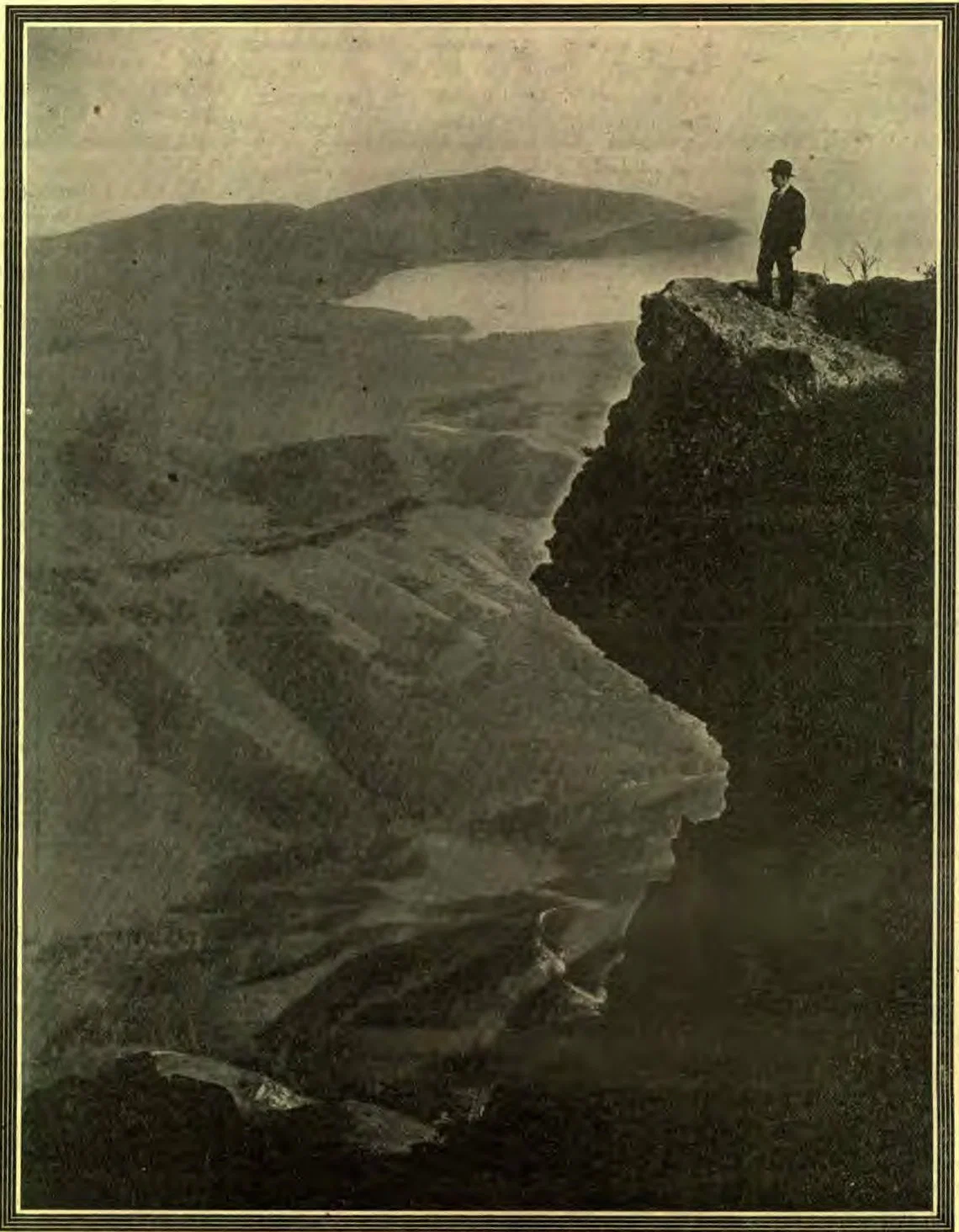
FROM THE SUMMIT OF MOUNT TAMALPAIS
The railroad on which the ascent to Mount Tamalpais, near San Francisco, is made, enjoys the reputation of being the most crooked in the world. It is a little more than eight miles in length, and in that distance has two hundred and seventy-seven curves. The longest piece of straight track is four hundred and thirteen feet, about half-way up the ascent.
In order to gain the top of a spur of the mountain, the road makes several sharp horseshoe bends on the hillside, in such a way that five tracks run parallel to one another, making the appearance, when viewed from the summit, of a double bow-knot.
As we climb upward, we cross and recross little mountain streams, which form here and there dainty miniature waterfalls. At almost every turn some new and wonderfully beautiful sight meets the eye. When the summit is finally gained, a grand view is spread before the beholder.
To the right can be seen the waters of the broad Pacific; in front and to the left, stretches San Francisco Bay, its shores dotted with clustering cities and villages. Away in the distance are the Seal Rocks and the historic Cliff House, and a little nearer the Golden Gate. On clear days one can catch a glimpse of the Sierra Nevada Mountain range, more than a hundred and fifty miles away.
DAVID PAULSON, M. D.

Our Great High Priest

THROUGH sin, man has been severed from the life of God. The soul is palsied through the machinations of Satan, the author of sin. Of himself man is incapable of realizing the sinfulness of sin, incapable of reaching the high standard of perfection. And were this standard placed within his reach, there is nothing in it that the natural heart should desire it. The bewitching power of Satan is upon man. All the ingenious subterfuges that the enemy can suggest are presented to prevent every good impulse. Every faculty given by God to man has been used by man as a weapon against the divine Benefactor. So, although God loves man, he can not safely impart to him the gifts and blessings he desires to bestow.
But it is God’s purpose that man shall stand before him upright and noble; and God will not be defeated by Satan. He sent his Son to this world to bear the death penalty of man’s transgression, and to show man how to live a sinless life. There is no other way in which man can be saved. “Without me,” Christ says, “ye can do nothing.” Through him, and him alone, can the natural heart be changed, the affections transformed, the affections set flowing heavenward. Christ alone can give life to the soul dead in trespasses and sins.
In heaven Satan was next to the Son of God. But he yielded to the desire for self-exaltation, and was expelled from the heavenly courts. He came to this earth, to exercise over man his debasing power. This power increased with the ages, but its evil was not recognized, and God could not arbitrarily condemn its author. Satan’s work was a deadly peril to the universe, but for the security of the world and of the government of heaven, he must be allowed to develop his principles in their true light.
Christ came to this world to save men from death; and from the manger to the cross his way was disputed by Satan. The enemy filled the minds of the Jews with hatred against their Redeemer. He rested not until Christ hung on the cross.
But in carrying out his enmity toward Christ till he crucified him,—hung him on the cross of Calvary, with bruised body and broken heart,—Satan completely uprooted himself from the affections of the universe. Christ’s death silenced forever the charge that with God self-denial was impossible. It was seen that God denied himself because of his love for mankind.
More than we could possibly endure Christ endured in our behalf. Sinless to the last, he died for us. Justice demanded not merely that sin be pardoned; the death penalty must be met. The Saviour has met this demand. His broken body, his gushing blood, satisfied the claims of the law. Thus he bridged the gulf made by sin between earth and heaven. He suffered in the flesh, that with his robe of righteousness he might cover the defenseless sinner.
To resist Satan’s temptations is no easy task. It calls for a firm hold on God. Christ has met every temptation which Satan can bring against man. He is the Way, the Truth, and the Life. In his strength man can keep the law of God.
Christ was crucified, but in wondrous power and glory he rose from the tomb. He took in his grasp the world over which Satan claimed to preside, and restored the human race to favor with God. And at this glorious completion of his work, songs of triumph echoed and re-echoed through the unfallen worlds. Angel and archangel, cherubim and seraphim, joined in the chorus of victory.
Christ is able to save to the uttermost all who come to God by him. He ever liveth to make intercession for us. In earnest appeals the cross continually proffers to the sinner complete expiation. In loving invitation Christ lifts his voice, saying, “Whosoever will, let him take the water of life freely.”
As you draw near the cross of Calvary, you see love that is without a parallel. As by faith you grasp the meaning of the sacrifice made on that cross, you see yourself a sinner, condemned by a broken law. This is repentance. As you come with humble heart, you find pardon; for Jesus stands before the Father, continually offering a sacrifice for the sins of the world. He is the minister of the true tabernacle, which the Lord pitched, and not man. The typical offerings of the Jewish tabernacle no longer possess any virtue. A daily and yearly atonement is no longer necessary. But because of the continual commission of sin, the atoning sacrifice of a heavenly Mediator is essential. Jesus, our great high priest, officiates for us in the presence of God, offering in our behalf his shed blood.
And as Christ intercedes for us, the Spirit works upon our hearts, drawing forth prayer and penitence, praise and thanksgiving. The gratitude which flows from human lips is the result of the Spirit striking the chords of the soul, awakening holy music.
The prayer and praise and confession of God’s people ascend as sacrifices to the heavenly sanctuary. But they ascend not in spotless purity. Passing through the corrupt channels of humanity, they are so defiled that unless purified by the righteousness of the great High Priest, they are not acceptable by God. Christ gathers into the censer the prayers, the praise, and the sacrifices of his people, and with these he puts the merits of his spotless righteousness. Then, perfumed with the incense of Christ’s propitiation, our prayers, wholly and entirely acceptable, rise before God, and gracious answers are returned.
MRS. E. G. WHITE.

VI—Lessons from Tillage

HAVING considered some reasons for the cultivation of the soil, gained from experience and scientific study, we can now better understand the deeper lessons of tillage. Before turning to these, notice one more reason from the standpoint of science. Cultivation increases chemical activities in the soil. The treasures of plant food are stored away in earth’s stronghold, and the door is well bolted. It needs unlocking. Stirring the soil is like turning the door-key. It lets the potash and nitrogen out to our plant roots, and lets our plant roots in to these and other food elements. It also promotes nitrification; that is, it puts the ground in better condition for receiving and holding nitrogen, besides hastening the decomposition of organic materials added to the soil for fertilizing.
These processes, called “chemical activities,” are nothing less than God’s ways of working in the soil. His working thus, to supply the necessities of all his creatures, and to give them pleasure, never ceases. So our Father has worked, and will continue to work, for our life and happiness; for we have his wonderful promise. “While the earth remaineth, seedtime and harvest, and cold and heat, and summer and winter, and day and night shall not cease.” Gen. 8: 22.
No person who tills the soil need be ignorant. It is doubtful if any subject has, during recent years, received more thorough scientific investigation throughout the civilized world than the soil and its management. Many prominent scientists and educators are devoting the best energies of their minds to this matter. The results of their study and experiment are published by every government and State, and you may have them for the asking. If you wish to learn about any particular thing connected with the soil, get the name of the representative in Congress from your district, and write him a letter telling him what you want. For instance, you might desire to learn more about the texture and physical properties of soils. Tell him so, and you will receive some valuable information in reply.
But the best way to learn from the soil is to study it yourself. Get some of it in a box, or set apart a little square any place. Till it with a spade, a rake, and a hoe. Watch its actions carefully for a week. Pour water over it. See what happens when the water falls upon it. Then watch it a few days longer. Before it gets dry, stir the first inch, making a mellow earth mulch over the surface. Observe for two or three days what takes place in your mulch. Now dig down a few inches, and see if it is still moist beneath. Next, plant some seeds in it, and pour plenty of water over it after the seeds are planted. If it is in a warm place, dig up some seeds after two days, and see what God’s power in the soil has done for them. Corn, wheat, peas, beans, pumpkins, squash, and melon seeds are good ones for experiments. Put in plenty, so you can dig up some every day for a week or two. Learn how the little plant first gets its food from the soil.
If you do this to learn how God works, he will teach you beautiful and wonderful lessons. In the book of Isaiah, the Lord is telling us something about the plowman,—one who tills the soil,— and says, “His God doth instruct him to discretion, and doth teach him.” So you may be sure of learning things worth knowing, while dealing with the soil, and having such a Teacher. “None teacheth like him.”
The soil requires frequent stirring. Left standing still, it hardens, and shuts out the rain and sunshine. So our minds, unless constantly stirred and occupied with the things which God has provided to keep them active, become incapable of receiving truth and light.
Weeds, rank and poisonous, thrive in uncultivated soil. In the same way will coarse, wicked thoughts fill the uncultivated mind. Diligent tillage is necessary to subdue harmful weeds. Nothing less will subdue the evils tending to fill the mind. The gardener must fight against his foes with shovel and hoe, early and late. Only such activity will keep the garden of our hearts clean.
Shallow, surface plowing is not sufficient. It will not give room for the firm hold required by the plant roots. The mind’s plowshare must sink deep into the soil of truth, in order that the storms of time shall not root up the growing tree. A superficial life, dealing with nothing deeper than surface feeling and sentiment, must end in disappointment and ruin.
The clods and cakes in the soil must be broken. It takes persistent hammering and harrowing to do this. The human heart gets caked and hardened by sin. Only thorns will grow in such a place. “Break up your fallow ground.” These sinful hearts need to be broken. It takes the mighty roller of God’s loving power to do the breaking. But he will do it gently, and he lets fall upon the bruised heart the cooling rain of his Spirit.
We should now turn our attention for a time to the seed. But the spring and summer will give you a good chance to continue the study of the soil by observation. You can add many members of the three soil families to your acquaintance before the fall, when we shall have a few more lessons on this subject.
J. C. ROGERS.

Other People First Always

I know a little boy who always puts himself first when speaking of himself in connection with anybody else. He always says, “Me and mama,” or, “Me and papa,” or, “Me and Freddie.”
And it is the same when he wants to divide anything,—he always helps himself first, and others afterward. What do you think of that way of doing? You don’t like to hear other children speak that way, nor do you like to see them act that way. It is not the right way to do.
The Bible says we ought to esteem others better than ourselves. Then we ought to speak of others first, and serve them first, and put ourselves last.
The commandment says, “Honor thy father and thy mother.” Then we surely ought to speak of them first, and wait on them first, and obey them first. VESTA J. FARNSWORTH.

The Shepherdess

LISTEN! Don't you hear the flutter Of a blue wing in the air? Don't you hear the pussy-willows Purring by the river there? Spring, the shepherdess, is coming With her flocks to pastures new, And their voices start the music We shall hear the summer through.
MINNIE ROSILLA STEVENS.

The Merry-Go-Round: Going Nowhere in Life

It was Johnny, the seven-year-old, who tired of the “merry-go-round.” The previous summer it had fascinated him, and he could not ride on it too often; this season a single trip satisfied him, and he declined another. “No, thank you, grandfather,” he said, in his quaintly polite way. “You see we ride and ride, but we stay under that old tent all the time. I guess when anybody gets to be seven years old, he’s too big to care about going and going that doesn’t get anywhere.”
“Now, may the boy hold fast to his wisdom!” commented the grandfather, relating the incident. “Selecting a goal and traveling toward it would seem to be a reasonable theory of existence, but there are plenty of grown-ups who are content to spend a lifetime in the sort of ‘going and going that never gets anywhere.’ I don’t know that it matters much whether it is an occupation, or society, or only a childish merry-go-round that carries us, if we are content with the mere round, and seek no worthy destination.”—Selected.

Inviting Bird-Neighbors

WITH the coming of winter, most of the birds left us, to spend the cold months in the warmer South, where they were more sure of finding food. But with the return of spring, each day brings thousands of little feathered home-seekers back to our northern States. Each one has his bright little eyes open for a suitable place to establish his home, and raise his family. For this purpose the birds desire and look for about the same conditions that men do when they are locating their homes. There must be a safe and sheltered place for the nest, plenty of food and pure water near at hand, and if possible, quiet and congenial surroundings.
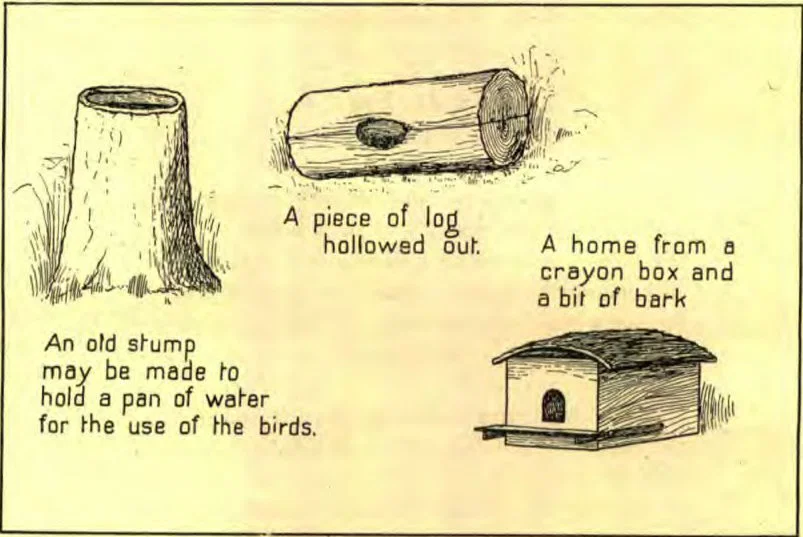
A piece of log hollowed out.

A home from a crayon box and a bit of bark

An old stump may be made to hold a pan of water for the use of the birds.
A piece of log hollowed out. A home from a crayon box and a bit of bark An old stump may be made to hold a pan of water for the use of the birds.
Now, birds are both pleasant and interesting neighbors, and with a little forethought and work we may in all probability induce some of them to build their homes near ours. This is very easy for those who live in the country, where they have large gardens and orchards; but if one really wants to entertain the birds, even a small city back-yard can be made inviting.
In the first place, the little gentlemen in feathers must be made to feel that they and their families will be safe. Cats are their sworn enemies, and the very sight of Sir Thomas dozing in the sun will be argument weighty enough to counterbalance many favorable points to the birds’ way of thinking. Neither does it take them long to learn to avoid places frequented by gunners or small boys with sling-shots.
Those are fortunate who have about their homes berry-bearing vines and shrubs, such as the Virginia creeper, mountain-ash, and the like, as these furnish a sure food supply during the weeks when the nests are full of wide-open, hungry mouths, and are never overlooked by the little home-seekers. However, we can do much for the birds by planting in our flower and vegetable gardens plants of whose seeds they are fond, such as the sunflower and blue corn-flower. A few stalks of mustard or lettuce, or a few radishes or turnips allowed to go to seed, will also help to furnish food for the birds. In addition to these, chopped apple or vegetables, bread crumbs, cracked wheat or oats, hemp, millet, or other small seeds, sprinkled upon the ground, fence, or shed roof, are always acceptable. A shelf fastened to a tree near enough the house to be watched by the inmates, and upon which food is regularly placed, will prove interesting to the family both summer and winter. For the birds will soon learn to come to it; and when food is scarce elsewhere, it will be the feasting-place for a motley throng of feathered folk.
After food and shelter are reasonably sure, water for drinking and bathing is the birds’ first consideration. For, especially in a country where there are few lakes and streams, the birds, during the hot season, suffer more for lack of water than for anything else.
If one does not care to trouble with any further preparation for the birds, he will find that a rather shallow pan, placed in some shady place, high enough to be out of the reach of cats, and kept filled with fresh water during the warm season, will be a never-ending source of pleasure and education. The water should be replenished several times a day and should not be more than two or two and one-half inches deep, as a bird wants to feel sure of his footing when he steps in for his bath.
Some birds take kindly to houses of human building and design. Particularly in places where hollow trees suitable for nesting purposes are scarce, these artificial homes are much sought after; and if they are made with an eye to convenience, and suitably located, they are seldom tenantless. In making houses for the birds, remember that they like privacy when they are home-making, and so do not build the house to accommodate more than two families; those with room for only one family are even more acceptable. “Flats” are as undesirable and as unnatural for birds as they are for the homing and raising of a human family. Care should be taken to place these houses in a cool, sheltered place, and to fasten them securely.
Building materials too are always gladly received by the birds at nest-building time, and bits of string, thread, cotton, horse-hairs, and other such things, which may be scattered about, will be quite sure to be used.
ETHEL REEDER FARNSWORTH.

Be Yourself

THE country is full of parrots. Never a great man surprises us with a remarkable style in voice or pen, but straightway a hundred lesser writers or speakers make themselves ridiculous by copying his ways. You see the same thing everywhere,—from the tiny boy who becomes a man by wearing papa’s boots, to the young lawyer who palms off on smiling jurors the thunders of Webster’s eloquence.
Trying to wear other people’s manners and expressions is one of the most common failings of young people,—but its “commonness” does not make it any the less hurtful.
A handsome young lady, who was staying with city friends, heard something very much to her advantage one day, without at all meaning to. She was quietly reading in the curtained window-seat when the sister of her hostess entered the room, and they began chatting.
“Nellie is such a sweet girl,” said the hostess; “I do wish she would be herself,—she doesn’t seem to know how much more lovable she is when she isn’t trying to ‘put on.’ I hardly know how to tell her.”
“Suppose, dear,” replied the sister, “suppose we call her attention to some of the ridiculous young things who are trying to be Miss Jones’s shadows. Don’t you suppose she would take the lesson?”
But it wasn’t necessary. Nellie had her lesson already, and before the winter ended, she was acknowledged one of the most charming girls of her circle. “So original!” everybody exclaimed,—and that was just the secret of her success. In the meantime the young ladies imitated her tone of voice, caught her expressions, practiced her smile in their mirrors, did their hair in the same way, and then wondered why it was “Nellie” this and “Nellie” that and never themselves.
Whatever you do, be in earnest about it, and be yourself. Perhaps it is a letter to your friend—make it your letter, not one of borrowed phrases and other peoples’ thoughts. Make it yours, and it will be prized.
I know the words will come to your mind,—
“Lives of great men all remind us We can make our lives sublime.”
But think! it is not by aping their actions nor parroting their words, that our lives become great. Their lives—the lives of great men—have been self-reliant lives, and that very self-reliance is what has made them great.
Learn to think your own thoughts, see the world through your own eyes, and act as God gives you to see the right; and you, too, will leave eternal footprints in the sands of time.
EDISON DRIVER.

The Canary’s Siege

(A True Story)
“DANNY,” the canary, had always enjoyed the long summers on the front veranda, where his roomy cage was hung early in May. Having no mate, he comforted himself with an interest in all the other feathered folk that came about his home near enough to be seen and heard. He began to imitate their notes. He soon learned the song of the oriole, whose nest hung in a maple-tree close by, the whistle of the old green parrot across the street, and the twitter of the little chickens, whose mothers sometimes led them into the front yard.
One morning in midsummer there arrived among the honeysuckles a pair of house-wrens, bent upon finding a place for a new home. Danny watched the noisy visitors with interest, and attempted an imitation of their notes. The wrens, however, flew into a rage instantly, and, alighting on the cage, silenced the astonished canary with a stream of angry chatter, such as he had never heard before. Moreover, their examination of the cage put a new notion into their heads: they decided that on its flat top they would build a nest, and live on the roof of a gilded palace, if not inside one. Away they flew, and in a jiffy they were back again, and had carefully, arranged a foundation of twigs on the top of the cage, Danny looking on in amazed silence.
But the invasion of his premises was not to be permitted, of course, and as soon as the insolent little squatters flew off for more building-material, Danny dragged through between the bars all the sticks they had arranged. Back they came presently with more twigs, and at once discovered what had been done in their absence. Instantly they dropped their sticks, and in a great passion began an attack on the poor canary, who curled up, a trembling ball of yellow fluff, on the floor of his cage, just out of reach of the long beaks they thrust with lightning-like swiftness through the bars.
At last, having, as they thought, reduced the canary to a state of fear that would keep him from further resistance, they picked up their twigs, once more laid the foundation of their nest on the top of the cage, and went off for another load.
The canary, however, was not yet wholly subdued, and no sooner were the wrens out of sight than he again pulled their foundation sticks through the bars, and, when he saw his besiegers returning, prudently retreated to the only safe spot beyond the reach of their beaks. The rage of the wrens when they found their second foundation destroyed knew no bounds. Over the bars of the cage they ran, screaming and scolding, and trying to seize with their bills the almost paralyzed canary, or to draw through the bars such of their twigs as they could reach. Finally they again rearranged their foundation, and Mistress Wren went alone for more material, while her mate remained to guard the foundation. The case of the canary was now hopeless; his strength was nearly gone, his courage wholly gone; and so his human friends, seeing the contest had reached this stage, came to his rescue.
The insolent invasion of the wrens was not to be borne, of course. Yet it seemed possible to make respectable and useful veranda-citizens out of these dashing freebooters, and plans were laid to that end. An old strawberry-box was found, a top fastened over it, a hole was cut in one side for a door, and it was tacked inside the cornice of the veranda near the ceiling. The wrens decided to accept the concession offered, but, in order to assert their independence and their intention to manage the affair their own way, they scornfully scratched out of the box all the twigs that had been placed there as a hint, and proceeded with wholly fresh material to furnish the home. Their subsequent airs of having won a great victory were exceedingly diverting.
Danny’s nerves were shaken, and his vanity certainly received a great setback; but in time he learned to listen to the wrens’ boasting without fear, while they ceased to resent his perfect imitation of the softer notes of their song.—Mary D. Leonard, in St Nicholas.

Take Courage

THEY'VE never named a place Where courage turned aside; And all the world can clearly trace, And all the world can show with pride, The paths that he has tried.
So, Master Courage, when You give the word, let’s go,— Strong in the strife with earnest men, Let’s fare the best we may, and grow Unto the best we know.
FRANK WALCOTT HUTT.

Thoughts That Help

A YOUNG People's Society that becomes a training school for missionaries is doing the very best kind of work.
It is a matter of little consequence, perhaps, to spend a five-cent piece for a thing you do not need; but it is of great consequence that you acquire the habit of using money rightly.
What affliction have we to fear, what calamity need we dread, what difficulty can discourage us, if God is leading? In the midst of the tumult and strife, the Christian stands immovable upon the word of God. And when this earth shall shake, and the mountains and the islands shall move out of their places, the word of God will still abide; and those who are standing upon that word will enter the peaceful rest of eternity.
A Christian Endeavor Society made up of school-children in one of the Armenian villages of Turkey, has shown some originality in appointing their committees. They are as follows: The Cleanliness Committee,—to look after the school-room, and see that the children have clean hands and faces; the Peace-making Committee,—to promote harmony, settle quarrels, reconcile enemies, etc.; the Politeness Committee,—to encourage gentleness and courtesy; the Merciful Committee,—to promote kindness to animals, help the needy, old, unfortunate, sorrowful, those who are behind in lessons, timid in playing, etc. Some of these “endeavors” might well be taken up by Societies in this country.
He arose awkwardly in the Young People's meeting. He was a country lad, earnest, honest, true, and good, but poor and uneducated. He was the first to respond to the appeal of the leader for a social service. He was so unused to speaking before others that he stammered when he began; his lips grew dry, and his tongue thick, in the effort to form the words. Merry eyes were upon him, and they sparkled and twinkled as he stood there looking so ill at ease. The situation grew more and more amusing to the onlookers. At last the boy finished a broken, ungrammatical sentence. He did not even attempt another, for clearly and distinctly a titter came from a score of rosy lips, and the confused lad sat down abruptly, his face scarlet, then white. After that no one seemed to want to take any part; and that faltering testimony was the only one given that afternoon. The dull country boy stayed away from the meetings after that. And the well-dressed, bright young people shrugged their shoulders, and said, “It was so funny.”
Was it “funny”?
MRS. L. FLORA PLUMMER.

OTTO J. GRAF

From College View, Nebraska

OUR Life Boat campaign was one long to be remembered by the students of Union College. The school session was shortened; we had our dinners an hour earlier than usual, and over a hundred enthusiastic students and teachers took the 1:10 car for Lincoln. An extra car had been provided by the traction company, and there was room for all. On the way to the city the front trucks of the car left the tracks, but no one could be induced to swerve from his plan for the afternoon; namely, the selling of The Life Boat.
The territory had been carefully assigned, and the companies were well organized. Each person had, from ten to twenty-five papers. Soon one could see Life Boat students on every hand. In an hour or two, nearly every paper had been sold, and the workers were trying to get more copies. About a thousand were sold in a few hours, and we could have sold more if we had had them. The following day we had a praise meeting for a chapel exercise, and many and stirring were the experiences of The Life Boat crew.
We pray that God will water the seed sown, and that this effort will be the means of starting many in permanent lines of missionary work.

OTTO J. GRAF

Was It You?

Somebody said an unkind word, which pierced a loving heart. Was it you?
Somebody passed by, and did not heed the cries and moans of the needy. Was it you?
Somebody carried an evil report. Was it you?
Somebody brought trouble and sorrow wherever he went. Was it you?
Somebody never said a kind word nor gave a kind look. Was it you?
Somebody always looked for trouble and thorns, and never to see the bright sunshine. Was it you?
Somebody never had praises or thanks to offer for the blessings of each day. Was it you?
Somebody carelessly turned a friend into a foe. Was it you?
Somebody always borrowed, and never had anything to lend. Was it you?
I. A. NELSON.

Papers Sought for Sabbath-School in the Woods

SISTER HATTIE A. SUMERIX, who made a request through the INSTRUCTOR a few weeks ago for papers to supply the little “Sabbath-school in the woods,” writes, thanking those who so kindly responded. She has sufficient papers for the present.

THE WEEKLY STUDY

The Sanctuary in Heaven

(April 19-25)
It is a tremendous thought that the scene described in Dan. 7:9, 10, is still continuing in heaven, and that the day is at hand when the Ancient of Days shall rise from the seat of judgment, and the destiny of every soul shall be fixed for eternity. Go over the subject of the sanctuary and its cleansing, allowing the Spirit to make it very real to all hearts joining in the study, that we all have interests to keep before the judgment throne by prayerful faith.
No better basis for the study can be suggested than chapter XXIII of “Great Controversy,” entitled, “What Is the Sanctuary?”
By studying the chapter, and fixing upon the main outline, the leader can lead the company in a brief yet very clear study. We have been warned that Satan will try to throw a veil of mysticism over this subject, and we all must know the reality of the things in the heavens, on which depends any reality in Christian experience on earth.
I would read the portion, “End of the Twenty-three Hundred Days,” page 45, “Early Writings,” as a part of the program. We need to know these statements regarding the Saviour’s ministry. More than one young Seventh-day Adventist has been so unfamiliar with the simple descriptions of heaven, and the sanctuary there, and of God’s throne and person, as to be quite unable to detect the subtle errors of the mystical and so-called scientific views of God and heaven which are cropping out in all directions nowadays.
Notice in the portion of “Early Writings” just referred to, the statement of Jesus that his ministry in the second apartment of the heavenly sanctuary would take but “a little while.” It may seem long to the aged believers. It has been longer than need have been; for Christ’s followers have been so slow to rise up and bear the invitation to the marriage supper into all earth’s highways and byways. But now there is to be delay no longer, and, thank the Lord, we now may join in passing on the invitation that is to compel men to come in, by the same power that caused the midnight cry to thrill through the land.
W. A. S.

Question Hints

(To be given to different members, and answered in the meeting)
UPON what one scripture did the brethren in 1844 base their hopes? What did they understand the sanctuary to be? What did they think its cleansing meant? What really is the sanctuary? What is its cleansing? Give Scripture proof.
Of what was the sanctuary on earth a type? Find the scripture which says that Christ entered the heavenly sanctuary.
What inspired writer was given a vision of the first apartment in the heavenly sanctuary? Find the account, and be able to give it in substance.
Why is it important for us to understand these things? What has delayed the coming of Christ? How can it be hastened?

The Bible

There is a book of beauty rare,— God's Holy Book, the Bible,— And on its pages white and fair,— The pages of the Bible,— Is told the story of God's love, And how his Son came from above, And died, that we his home might share,— You'll read it in the Bible.
It tells how he was born on earth,— 'Tis in the Holy Bible,— While angels caroled at his birth; The story's in the Bible. And how his life on earth was spent In doing good; and how he went Into the tomb, and then came forth;— 'Tis all there in the Bible.
So get the Bible down, my dear, Get down the blessed Bible, And read its words of hope and cheer; There's no book like the Bible. And when we reach our home at last, With all our trials and sorrows past, We'll praise God's love, which gave us here This Holy Book, the Bible.
ELIZABETH ROSSER.
Continue reading: A Bit of History