IN an ancient and very authentic history are the annals of a large and widely scattered family, claiming for their Head a mighty Prince named Emmanuel. According to the earliest records, their Prince walked and talked familiarly with the progenitors of the family. Through rebellion, however, they shut themselves away from his face and favor; so that, with rare exceptions, he was afterward compelled to communicate with them either through his ministers or by letter.
But even in the day of their rebellion, he solemnly promised that at some future day he would return, and make his home with them; but before that day they would have to pass through many and strange experiences.
In the early history of the family, its members were tall, strong, and very long-lived. We are informed that many of them lived to the great age of nearly one thousand years. Indeed, one of them was so well-pleasing to his Prince, that he was taken to the beautiful and blessed place where the Prince lives, and is even now enjoying all the glories of that land.
But in those members of the family inclined to evil, their long lives only gave them opportunity to increase in all manner of wickedness, until their Prince was forced, for the preservation of virtue in the race, to send a great destruction on their whole land, from which but eight souls, who were loyal, escaped. From this small remnant the land was again peopled, but as the seeds of evil and corruption had not been destroyed, the family was soon as debased as before, so that their Prince found but one obedient member among them. Him he called out from his home and from all his father's house, leading him by a way he knew not, into a strange country. This country the Prince promised that he should afterward inherit, though he possessed none of it while sojourning there. Hundreds of years later, his children did indeed dwell in the land, becoming a great nation.
But though their Prince spoke a holy law to them with an audible voice, and though he led them, giving them teachers and prophets, yet they rebelled more and more, until, in the very height of their rebellion, he fulfilled the promise made in the beginning of the history, and came and dwelt among them, visibly, personally, familiarly, as one of themselves.
And, though he voluntarily laid aside his glory and majesty to do this, his Father, the King, gave him all power and wisdom, so that great miracles were wrought by him, even the restoring of sight to the blind, hearing to the deaf, and life to the dead.
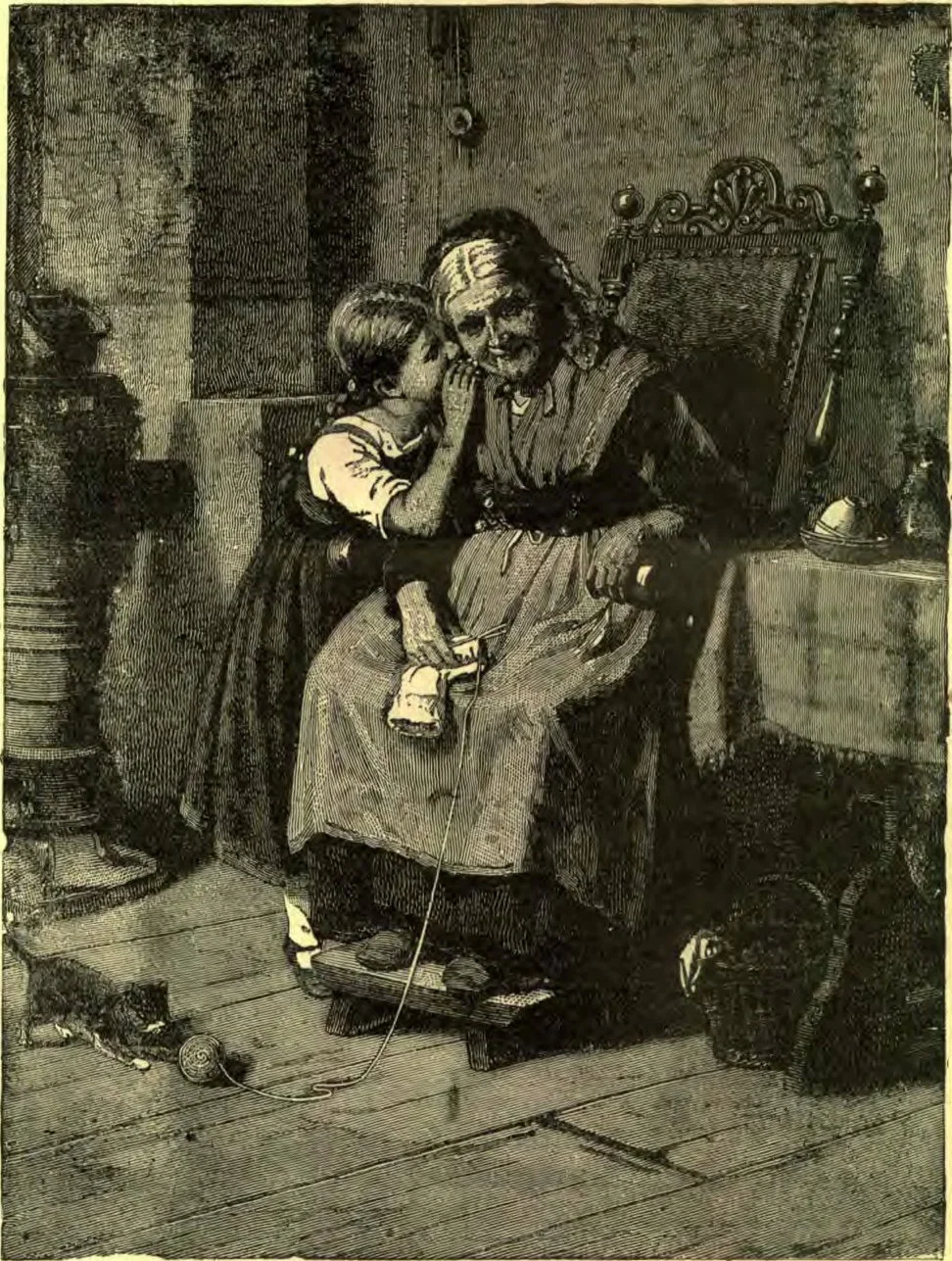
GRANDMA, HERE'S A SECRET
And yet it is written of him, in the history: “He came unto his own, and his own received him not.” “He is despised and rejected of men; a man of sorrows, and acquainted with grief.”
But a few members of the great family, one here, another there, were loyal to their Prince; and to them he said, while he was yet with them:—
“I go to prepare a place for you. And if I go and prepare a place for you, I will come again, and receive you unto myself; that where I am, there ye may be also.”
After giving them certain signs, by which they should know when his return was about to take place, he said: “When these things begin to come to pass, then look up, and lift up your heads; for your redemption draweth nigh.”
“And, lo, I am with you alway.”
With this promise he left them, to return and dwell with his Father, the King; while his followers entered a long period of working and waiting, watching and praying.
Their great enemy was ever busy, too, destroying the allegiance of as many as possible, and carrying even the faithful as captives to his land; but they had the blessed assurance from their Prince, “They shall come again from the land of the enemy.”
And in a letter he sent them after his return to his own land, he tells them that “when he ascended up on high, he led captivity captive.”
In his love for his family, he sent them many letters, which are included in the history, all filled with promises of his return, the very last letter closing with such a promise.
But this was all long ago. The signs which should immediately precede the return of the Prince have come to pass in these last days; not one of them has failed; and you can imagine with what joy the members of his family look up, and lift up their heads, until “they shall see the Son of man coming in the clouds of heaven with power and great glory.”
“For the Lord himself shall descend from heaven with a shout, with the voice of the archangel, and with the trump of God: and the dead in Christ shall rise first: then we which are alive and remain shall be caught up together with them in the clouds, to meet the Lord in the air: and so shall we ever be with the Lord.”
ELIZABETH ROSSER.
The Violets' Lesson
One bright day early in springtime a cluster of timid violets, which had pushed their way up through the damp mold, opened their eyes, and looked out on the world around them. They found themselves just within the edge of a large wood, filled with the music of the birds, which had flown north from some sunny clime to herald the approach of summer. Presently a bird perched himself on one of the branches of a graceful elm close by, and warbled as if he would pour out his very heart in music—such a song of life and gladness and love. “Oh!” sighed one of the violets, “if we could have voices like that to rejoice every living thing within hearing, it would indeed be something to live for. Would it not be a grand thing, sisters, if we could be of some use in this beautiful world?” Low as the whisper was, the bird, who was just poising himself on the bough above, preparatory to another outburst of melody, heard it, and,6looking down, said, “Why, you are of use, little ones! It is your business here to grow up just as fresh and lovely as you can, and help to make the world more beautiful. Every one can not sing, to be sure; but every one can do what is in his own power.” And so, having answered the violet, he launched out into his song again exultingly, joining the chorus of woodland minstrels that were rejoicing on every side.
But the violet whispered to her sisters, lower than before, “Ah, but I wish we could do something! It is all very well to be beautiful, although I doubt if such poor little tiny things as we are anything very wonderful in that way.”
The wind swept across them, and bent their heads over the clear stream. “Look at yourselves in the water, and see if you have not been made beautiful enough to help gladden the world, and do not sigh for more than has been given you. Live your own life to the utmost; be fragrant and blooming, and you do your part.” And the stream looked up to them, and sang also, in its low ripple, “Everything has its own work to do in the world! Mine is to freshen the grass and flowers, that, like yourselves, grow near my green margin, and the lofty trees that mirror themselves in my waters; and after a while, when I have expanded into a broad river, to bear on my bosom noble ships that carry men whither they wish to go. Rejoice in the sunshine and soft air, and be as lovely as you can,—as lovely as you were designed to be,—and in time you will know for what use you are destined.”
And the violets still looked up timidly, but they welcomed the warm, bright sun rays, when they shone in upon them, bringing to them fresh life and color; they breathed out their delicate fragrance lovingly on the soft spring airs, which gently caressed them. And so they bloomed in perfect beauty, unseen for a while by human eyes. But on one sunny day two young girls came wandering through the wood, searching for wild flowers, and listening to the birds. Presently one of them paused above the cluster of violets, “O Laura! see what lovely violets! I am going to paint them for mama. If I should gather them, they would wither long before I could take them to her; but if I copy them as faithfully as I can, they will be the loveliest reminder of the spring that I can send to her in the city.” So she sat down on a fallen tree near by, and sketched and painted the delicate wee things in the book she carried with her, while the violets stood in an ecstasy of delight at finding how much joy they could give by their beauty.
One golden morning there came a little pale-faced, blue-eyed girl, drawn by her brothers in a light basket carriage. The little girl had been ill for weeks, but with the opening spring she had revived, and now on soft, sunny days, she was able to go out in this way to take the air. As her brothers drew her along near the margin of the stream, she spied the violets, and the blue eyes grew bright with pleasure. “O Arty! Charlie!” she exclaimed, “won’t you take up the violets very carefully for me, roots and all, with the earth around them? I want to carry them home, and put them in a flower-pot in my room, where I can tend them myself, and see them whenever I wish, when I can not run about to look for flowers.” And Arty and Charlie, glad to please their sister, took up the delicate cluster with the greatest care, and laid the prize in Edith’s lap, and drew her home.
So the violets found their use. And day after day, as they breathed out their lives in bloom and fragrance, the breeze that wandered in at the open windows heard the violet which had spoken before whisper to her sisters, “Ah, when I sighed to be of some use in the world, I little dreamed that we could do so much just by growing up to be as lovely as we can—as lovely as we are designed to be—as the brook said to us. It was right. I am content.”—The Church.
VIII—Mental Stub Pens
By L. T. Curtis
I LIKE to write with a stub pen, for the broad mark it makes does not show the irregularities in my writing as much as a finer pen. If I want to draw a rude pencil sketch, a carpenter’s pencil will serve the purpose; but if I desire to retouch a photographic negative,—to fill up the tiny, transparent lines and patches on the film,—my pencil must have a point like a needle. So for the ordinary use to which I put language, I like to use a verbal stub pen or carpenter’s pencil, in the form of the short Saxon words in every-day use. The mental impression thus given is as plain and broad and forcible as the line made by a large paint-brush; but there are no delicate shadings of thought, no fine lines of exact expression.
To illustrate: In the little word “ask” I have a verbal paint-brush; for I may mean request, beg, petition, solicit, entreat, implore, beseech, or supplicate. “Dislike” may mean aversion, reluctance, repugnance, disgust, antipathy. “Say” is broad enough to include allude, remark, utter, pronounce, proclaim, and assert.
If these words are not the “Jacks of all trades,” they are at least Jacks of several trades; for you can see that they do the work—though with little attention to details—of half a dozen or more specialists. If you wish to build a wood-house, or a barn, or a fence, a Jack of all trades may do the work satisfactorily; but if it is a magnificent piece of architecture that you are planning to erect, you must have men who are specialists in their respective lines.
For ordinary use, and even for the beautiful, mist-enshrouded word-pictures of poetry, the paint-brush words are the best; but for the precise language of science, those words likened to fine-pointed pens must be used. The physician, when he talks to a miscellaneous audience, uses short words, and consequently general terms, to express his thought, because he knows that the precise, or technical, words are unfamiliar to the public. Thus he may be able to tell the audience about the location of some particular muscle or nerve in the body about as accurately as I could locate the Fiji Islands by saying they are in the middle of the Pacific Ocean, several hundred miles southeast of the Hawaiian Islands; or as accurately as I could locate a certain star in the heavens by saying that it is about half-way from the horizon to the point directly overhead, in the regions of the north.
But we all know that there is a way, by the proper use of some many-syllabled words, to locate any one of the hundreds of muscles and nerves of the body; to give the exact position of any square mile of surface upon the entire earth; to point out without possibility of being misunderstood, any one of the millions of stars visible to the eye on a clear night, yet all this involves the use of technical words, and these words are to the majority of people as mysterious and incomprehensible as Hebrew. So the learned man of good sense does not attempt to use exact terms when talking to those unfamiliar with technical terms, but he uses the shorter words that convey as nearly as possible what he has in mind. The wise always remember that it is better to use a short word, even if it does not express an exact thought, than to use an exact technical term that, to his hearers, may mean nothing at all.
The reason young people often make ridiculous mistakes when they use big words, is that they have no exact thought to express; and having nothing precise in mind, they have no occasion to use other than commonplace words. Another thing it is well to bear in mind: Better use a familiar word that you know does not exactly express your thought than a word you have recently met, and merely suppose will convey your thought exactly. If the boy had borne that rule in mind, he would not have said, “The scholars all treated the teacher very respectively;” nor would the dull boy, after explaining to his teacher that the reason he was absent the day before was because of his cutting his head, have added that there was danger of information setting in unless he was very careful.
So when you hear somebody condemning the use of long words, and insisting that they should never under any consideration be used; when you hear people using long words when short ones would do as well; when you hear people talking learnedly in long and learned words about something they do not understand, be charitable and reasonable enough to grant that long words have their places, even though we may not understand them, and remember that it is the height of folly to criticize the way anybody expresses his thought unless you yourself are an acknowledged authority on that subject.
L. T. CURTIS.
Correct English
By D. D. Rees
In the clause, “Our Father which art in heaven,” is “which” the proper word?
In the seventeenth century, when the authorized version of the Bible was printed, which was applied to persons as well as to things. It is now confined to animals and inanimate objects. Modern English requires the relative who or that when the antecedent is a person.
Is it correct to say, “I can do my best work after night”?
Not if you mean that you can do your best work during the night. After night means sometime the next day.
In the sentence, “She was a poor widow woman,” is there any authority for using the word “woman”?
There is none. Widow means a woman whose husband is dead.
Is “expect” misapplied in this sentence: “I expect he was a model student”?
Yes; suppose is the proper word. To expect is to look forward to; to anticipate. I may expect something in the future, but never in the past.
The sentence is often heard, “To-morrow is Friday.” Is the present tense correct?
The sentence should be, “To-morrow will be Friday.” It is as absurd to say to-morrow is as to say yesterday is.
What is the correct use of the pronoun “myself”?
Myself may be used in the nominative for emphasis, but always in apposition with the pronoun I. In the objective, it is either emphatic, or “implies reversion of the action upon the agent acting; as, ‘I will free myself.’” The sentence, “My father and myself are of the same opinion,” should be, “My father and I are of the same opinion.” Myself is correctly used in this sentence: “I myself am responsible for this delay.”
Is it correct to say, “The criminal was hung at twelve o’clock”?
Hung is applied to the suspension of inanimate objects; but the past tense of hung, meaning to take away life by hanging, is hanged. Pictures are hung on the wall, but criminals are hanged for murder. D. D. REES.
MEMORY VERSE: “Whether therefore ye eat, or drink, or whatsoever ye do, do all to the glory of God.” 1 Cor. 10: 31.
After the tabernacle was dedicated, the priests were consecrated to their sacred office. This required seven days, and on the eighth day Aaron, assisted by his sons, offered the first offerings for the people.
When everything had been prepared, Aaron lifted up his hands toward the people and blessed them. “The glory of the Lord appeared unto all the people. And there came a fire out from before the Lord, and consumed upon the altar the burnt offering.”
But in a very short time a fearful thing happened. “At the hour of worship, as the prayers and praise of the people were ascending to God, two of the sons of Aaron took each his censer, and burned fragrant incense thereon, to rise as a sweet odor before the Lord. But they transgressed his command by the use of ‘strange fire.’ For burning the incense they took common fire, instead of the sacred fire which God himself had kindled, and which he had commanded to be used for this purpose. For this sin, a fire went out from the Lord and devoured them in the sight of the people.”
These young men had been especially favored. Next to Moses and Aaron, they stood highest in Israel. But they did not appreciate the importance of following every word of the Lord. God is not pleased with half-hearted service. We can not please him and Satan at the same time. To do almost what he says, but not exactly, is displeasing to him.
We can learn another lesson from the experience of Nadab and Abihu. In their youth they had no doubt not cultivated the habit of self-control, but had been permitted to do as they pleased; and when they grew to be men, this habit had such a hold on them that even sacred things were treated as common, if this was the most pleasing thing to them. But God will not accept such service.
These men had not learned to be temperate in all things. By using strong drink, the knowledge which they had of God’s requirements was beclouded, and they were not able to discern the difference between holy and unholy and clean and unclean.
Temperance and intemperance reach further than just the use of liquor. We can be intemperate in eating, using those things which are not food, but which becloud the brain and render us unfit to serve Jesus. Or we may eat good food, but in such large quantities, or so often, that we shall become intoxicated from the condition of the food in the stomach. In the beginning Satan tempted man on the point of appetite, and he fell. When Christ came, he tempted him on the same point, but he gained the victory, not only for himself, but for us; and only as we accept his victory, can we have victory, for Satan is still tempting every boy and girl and every man and woman on this same point.
Questions
1. How was the first sacrifice offered by Aaron and his sons received by the Lord?
2. Who were Nadab and Abihu? How had these men been especially favored?
3. With what kind of fire did they attempt to burn their incense offering before the Lord? What do you understand by “strange fire”? Had the Lord told them what kind of fire to use?
4. What happened to them because of this wickedness?
5. With what kind of service alone is the Lord well pleased? Will he be satisfied if we do almost what he says?
6. What had led these men to commit this terrible sin?
7. Why could they not discern between the holy and the unholy, the clean and the unclean?
8. Tell other ways in which we can be intemperate besides in the use of liquor.
9. Can we benumb our senses by overeating?
10. On what point especially has Satan tempted man from the very beginning?
And for this cause we also thank God without ceasing, that, when ye received from us the word of the message, even the word of God, ye accepted it not as the word of men, but, as it is in truth, the word of God, which also worketh in you that believe. For ye, brethren, became imitators of the churches of God which are in Judea in Christ Jesus: for ye also suffered the same things of your own countrymen, even as they did of the Jews; who both killed the Lord Jesus and the prophets, and drove out us, and please not God, and are contrary to all men; forbidding us to speak to the Gentiles that they may be saved; to fill up their sins always: but the wrath is come upon them to the uttermost.
But we, brethren, being bereaved of you for a short season, in presence not in heart, endeavored the more exceedingly to see your face with great desire: because we would fain have come unto you, I Paul once and again; and Satan hindered us. For what is our hope, or joy, or crown of glorying? Are not even ye, before our Lord Jesus at his coming? For ye are our glory and our joy.
Questions
1. What gave the apostle great reason for rejoicing?
2. How did the Thessalonians accept the message which he brought to them? What was this message?
3. What is the result of receiving the Word of God, “not as the word of men, but as it is in truth, the word of God”?
The word of God received as the word of men is nothing. It is as the touch of Jesus by the curious, careless crowd. The word of men accepted as the word of God is nothing, and worse than nothing. It leads to deification of the human, to slavish tyranny, to fanaticism. It is not faith to receive men’s words; it is credulity. It is faith, and it is necessary to salvation, to receive the message of God as the word of God, letting it have free course in our lives, and then only will its creative power effectually work wonders.—S. S. Lesson Pamphlet.
It is well to note that this church in Thessalonica became imitators, followers, of the church of God in Judea. It is admitted by all candid students that the churches in Judea were Sabbath-keepers.—Id.
The joy of our Lord is the salvation of souls. Of this joy every Christian partakes here, and only in the kingdom of God will he be satisfied, when he sees those for whom he has prayed and labored. One is never too young to work for others. As rapidly as you see new beauties in the service of Jesus, carry these beauties to others, and lead them to taste and see that God is good. No earthly pleasure can equal the joy of leading one soul to know Jesus better.
Home; It Is What We Make It
By Mrs. L. D. Avery-Stuttle
It has been well said that home is not merely a room bounded by four walls,—home is the abiding-place of love.
“But,” says somebody, “it is easier to define the word ‘home’ than the word ‘love.’” So many people look upon love as a sort of sentimental feeling, with which one is liable to be afflicted in the early spring of life, and think that ordinarily it should take its departure long before the coming of the “sere and yellow leaf.” Alas that it should be so! this one-sided definition is too true in many cases.
The inspired definition of this sacred word is “charity.” If ever there was a place where charity, or in other words, love, should be exercised, that place is in the home. Indeed, the home in which dwells this divine attribute—for love is divine—is like a little corner of the kingdom of heaven. It matters not very much whether the walls of that home are adorned with the choicest works of art, or whether there be only the homely ornaments afforded by a light purse, and arranged by the hardened fingers of toil; it matters little whether the dinner be a “stalled ox” or a “dinner of herbs,” if only Love sit at the table as royal queen of the board, she will bring with her sweet Happiness as an abiding guest.
What shall we do to foster the spirit of love in our homes?—A kind tone and a pleasant, cheerful manner will go a long way toward it. But home is the place where so many little anxieties come to wear and vex the tired spirit. Home is where the baby worries, and the bread sours, and the pies run over, and the toast burns. Home is the place where the family washings accumulate so rapidly, and where the clothes of the little ones must be patched; where Johnnie hurries for refuge from the big boys who bully him on the street, and where Mary comes to relate her many youthful grievances.
How shall we preserve a pleasant face, and modulate the voice carefully, and keep back those aggravating little crow’s-feet from the corners of our eyes, and those discouraging perpendicular lines from between them?
One word alone will solve the problem and answer the query—“Love.” Love will put the patches on Johnnie’s coat and brush Mary’s curls without a protest or a murmur. Love will speak soothingly to the fretful baby, and tenderly to the peevish invalid. Love will follow the command of the great apostle, “be pitiful, be courteous.” Above all, true love will not reserve all the tender words and gentle caresses until those who would have prized them more than rubies have gone beyond our reach.
How shall we make our homes happy and peaceful?—By putting into practise the sweet precepts of that love which suffereth long, and is kind, which is not easily provoked, and which thinketh no evil. MRS. L. D. AVERY-STUTTLE.
Religion as Armor, Not Cloak
By Bunyan
RELIGION is the best armor in the world, but the worst cloak.— Bunyan.
One of Nature’s Beauty Spots
By H. E. Simkin
LAUNCESTON, in northern Tasmania, is a pretty little city of about twenty-eight thousand inhabitants. It is situated twenty-two miles from the sea, at the head of the Tamar River. This stream is really a branch of the sea, although it is formed, theoretically, by the union of the North and South Esk Rivers, which here come together. Above the city the water is fresh, pure, and unaffected by the tides; below, it is brackish and tidal.
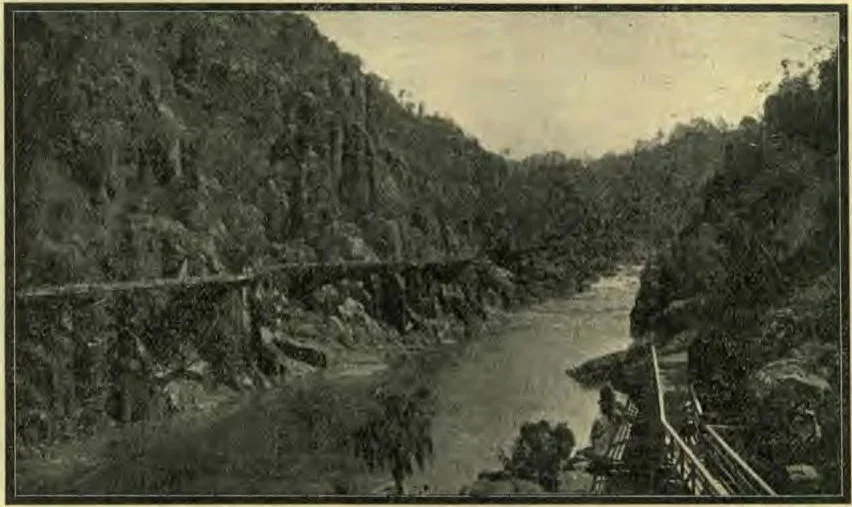
It is of the South Esk River back a distance of half a mile from its mouth in the harbor that we now wish to speak. The west side of the river is a high hill, and as one walks toward the harbor on this side, he comes quite unexpectedly, unless previously informed, to an iron bridge crossing the river, which here dashes through a narrow gorge in the mountain. The first view is enchanting. It is such a surprise to see the steep, rocky hill, at least three hundred feet in height, thus split to its base to admit the river. We enter through large gates, and pass a turnstile where a boy demands a penny for admission to the gorge,—but it is the most for a penny we ever saw anywhere. The ravine is so narrow, and the rocks on either side are so steep, that it is impossible to go up the stream on either side; but the city has built, at great expense, a path in the rocks on the side, blasting where necessary, and in many places building bridges from one point to another where it was otherwise impossible to get space for a path.
At various places where a little more room is found, seats have been built, and several little rustic houses, or shelters, have been erected and provided with seats. On the opposite side of the stream, a race has been built (though how it was done we could not imagine), to carry water to a mill below the bridge. An idea of the fall and force of the stream can be had when it is stated that the water in this race is raised over forty feet in about a third of a mile.
Words can not picture the scene to satisfaction. At every turn of the little winding path, new surprises await the visitor. The rocks on either side stand out in bold relief, many of them so perpendicular, and apparently so detached, that it looks as if they might fall at the least jar. In fact, an earthquake would undoubtedly cause many transformations in this pretty gorge. About a half-mile from the entrance one comes to a pretty villa surrounded with a beautiful lawn of about an acre in extent. In this is a pagoda-topped, octagonal band-stand, where music is frequently discoursed to visitors. A refreshment stall near by furnishes luncheon.
In the stream at this point is a sharp curve, which forms a broad basin of water; and across this, from another road, supplies are brought in a rowboat. At various places, life-buoys are hung for use in case of accident in the water. Above this pool the stream comes down a very narrow gorge, which contains many falls, and which people can not ascend on account of the steep rocks on either side. It is said that the sights in the gorge are wonderfully increased in winter, when the floods following the heavy rains of the season come tearing down the narrow, crowded channel. Boating is impossible, at all times, except in a few places, on account of the turbulence of the waters, although the amount of water is quite sufficient for good-sized boats.
The place is of special interest because its sights can not be duplicated by man. One can not look at the mountain of solid rock thus cleft for the stream to pass through, without being impressed with the power of the great Creator.
H. E. SIMKIN.
Soap: Its History and Manufacture
By Will T. Hale
Soap
While we know what soap is used for, we do not really know what there is in it which produces the effect it has. An explanation that does not explain is this: Soap, consisting of fat and alkali (lye), removes grease or other dirt by surrendering, when dissolved in water, part of its alkali, which thereupon proceeds to combine with the grease or dirt, forming a new material, or additional portion of soapy matter, which water will readily remove.
CATARACT GORGE, LAUNCESTON
Soap was made by the Gauls and Germans before the Christian era. According to Pliny, the Germans manufactured hard as well as soft soap while they were yet a wild people. The Romans learned to make it from them, though the Roman ladies used a caustic kind to dye the hair red or yellow. As further proof of its antiquity, there was found in Pompeii (destroyed A. D. 79) a complete soap-boiling establishment.
It is not known that this useful domestic article was manufactured throughout the first seven centuries of the Christian era, but it is probable that it was. There is authority for the statement that in the eighth century there were manufactories in Spain and Italy. About the twelfth century the industry was established at Marseilles, France, which section afforded two excellent materials, olive and soda. Two centuries later the business was begun in Bristol, England, and at London in 1524.
A few figures will show the importance to which soap-making has attained, but of course they do not give an adequate idea of the immense amount of soap made and used by private families. Every family used to make its own laundry soap, and this is continued in hundreds and thousands of neighborhoods. Though one of the essentials of the household, it was made of waste and refuse entirely, and the colonists of two hundred years ago made the family soap as it is made to-day in country homes. All the wood ashes were saved, as were bacon bones and rinds. Lye was made by running water slowly through the ashes collected in an ash hopper, and it and the bones and rinds were boiled together in a kettle, and stirred one way. After a day’s boiling, the soap was finished—a soft, jellylike, clean substance, showing no trace of the grease. About six bushels of ashes and twenty-four pounds of “soap grease” were required to make a barrel. But to the figures: At Marseilles alone more than one hundred and thirty-five million pounds were made in 1872. In 1852 there were made in Great Britain, not including Ireland, more than one hundred and five million pounds. In 1860 more than $6,300,000 was invested in soap and candle factories in the United States, turning out something like eighteen and one half millions of dollars’ worth annually. Since then the industry has of course grown with the importance of the country in which the manufacture is carried on.
Until the beginning of the nineteenth century, soap had been made according to the practise which had grown up in the various localities; but science has had to do with this since that time, the first scientific epoch being the introduction of a mode of making artificial soda by Leblanc, of Marseilles, who supplied that city the want caused by the war with Spain, which cut off the usual importations of barilla. Barilla, it should be understood, is a Spanish plant cultivated for its ashes, from which the best kind of carbonate of soda is obtained.
Many different kinds of materials are used. Tallow, suet, butter, whale-oil, fish-oil, goose grease, horse fat, and many more have been used.
A number of vegetable oils have been successfully tried—olive-oil, linseed-oil, nut-oil, castor-oil, sunflower-seed oil, and palm- and cocoa-oils. Fairly good soap can be made from turpentine, wax, and resin, with alkalies.
It will be impossible, in an article like this, to go into the particulars of soap-making, but the mode of making the celebrated mottled castile soap may be mentioned. It gets its name from the fact that it was first made in Spain, where soap manufacture was very ancient. This mottling is accomplished by keeping the soap thick, so that the dark ingredient, or “nigger,” as it is called, can not fall down through it to the bottom, but has to gather into streaks and veins throughout its substance, the purer and whiter soap doing the same. In case the coloring matter supplied in this way is not sufficient, a quantity of oxide of iron is added.
The manufacture of soap is more largely carried on in Great Britain than in any other country in the world.—Will T. Hale.