THE latest information from our brethren who are in bonds in Asia is as follows:—
I see the leading hand of God in many experiences, and am tasting the good and comfort of it. I leave all to the good Lord. I am quite at rest, or else I would not be able to bear my husband's imprisonment four days' journey away from me, and absent eight months. I do not expect easy times in preaching Jesus, but troubles will increase as his glorious coming draws near to destroy Satan, who has great anger against us. . . As I am a stranger here and my husband in prison, many sympathize with me, and wish me to go to them to visit them, and they, too, often call on me. Thus I have a good chance to read to them. They are hungry for the truth of the Bible. There is much work to be done here. I wish God may release my husband, and he would work among them. They have heard of his Bible lessons before his imprisonment, and now desire such lessons. They often say, “His preaching had a different taste from other preachers' preaching,” and they miss him much.
My husband was called for two trials, in which he gave his express testimony of the third angel's message. He preached to them in one trial two hours, and one and one-half hours in another trial. He writes that many persons from that city came to hear his trial, and they all listened silently to his Bible readings. The officials were writing down whatever he was telling, word by word. They are putting his letters before him, and asking him how their life is hung upon his message. My husband writes that God is giving him power to speak the truth. His life is in very much danger. They may sentence him to ten or fifteen years' imprisonment. Another thing they are asking is this, Why do you preach against the government now since you are forbidden? He has read the verse, “All power is given unto me, go and preach,” and has told them that a higher government bids him preach, and he must obey. I can not explain all things, but you see how the message is carried to the government officials, and in how delicate condition we stay. There are six brethren now in prison, but each in a separate room. They were together before, but after my husband's trials the officials are fiercely against them, and have separated them. All preachers and missionaries say that unless they give money, they can not escape. On the day they offer some money, about twenty pounds, they will be free. The people in the city are so much in sympathy with them that they have decided to gather the money and offer it secretly without his knowing, but my husband has heard their plans and opposed them strictly. He will not bribe. All the people are anxiously waiting to see the result of this case, whether God will help or not. We say God can do it if it pleases him. They say money must be the means. Without money they can not escape. How much we need to pray! Brethren and sisters, pray for us that God's name be glorified, the God of Israel.—Educational Messenger.
Never Delay Duty the Hour Brings
“NEVER delay
To do the duty which the hour brings,
Whatever it be in great or small things;
For who doth know
What he shall do the coming day?”
Why Not Report?
ARE not our young people in the Societies at work? If so, why not send in reports of the work you are doing? Only this morning I received a letter from a young man, saying that the young people in his church had read with interest the reports of the various Young People’s Societies, and had decided to organize one themselves. If this Society proves to be an active, earnest one, as we believe it will, surely all who have taken the trouble to send in a report of their work, will feel well repaid.
No Time for Delay
By Ellen G. White
THERE are among us many young men and women who, if inducements were held out, would naturally be inclined to take several years' course of study to fit themselves for service. But will it pay? Time is short. Workers for Christ are needed everywhere. There should be a hundred earnest, faithful laborers in home and foreign mission fields where now there is but one. The highways and byways are yet unworked. Urgent inducements should be held out to those who ought now to be engaged in work for the Master.
The signs which show that Christ's coming is near are fast fulfilling. The Lord calls upon our youth to labor as canvassers and evangelists, to do house-to-house work in places that have not yet heard the truth. He speaks to our young men, saying, “Ye are not your own; for ye are bought with a price: therefore glorify God in your body, and in your spirit, which are God's.” Those who will go forth to the work under God's direction will be wonderfully blessed. Those who in this life do their best, will obtain a fitness for the future, immortal life.
The Lord calls upon those connected with our sanitariums, publishing houses, and schools to teach the youth to do evangelistic work. Our time and energy must not be so largely employed in establishing sanitariums, food stores, and restaurants, that other lines of work will be neglected. Young men and young women who should be engaged in the ministry, in Bible work, and in the canvassing work, should not be bound down to mechanical employment.
The youth should be encouraged to attend our training-schools for Christian workers, which should become more and more like the schools of the prophets. These institutions have been established by the Lord, and if they are conducted in harmony with his purpose, the youth sent to them will be quickly prepared for the various lines of missionary work. Some will be trained to enter the field as missionary nurses, some as canvassers or Bible workers, and some as gospel ministers.—Mrs. E. G. White.
A Little Child Shall Lead Them
By Mary L. Ballou
The children did not know just what had happened. They had heard something about the Squire’s losing money which was in a bank, and that Mr. Lane’s crops were likely to be poor, and there had been sickness in Mr. Wright’s family; but this they were sure of, the church was to be closed, Mr. and Mrs. Harris were going away, and there would be no more Junior Union meetings.
When Mr. Harris brought his wife to the little parish, she had gathered the children about her, and for two years there had been an enthusiastic little band of workers, but this was all over because there wasn’t any money left with which to support the church.
The children missed their weekly visit to the church, which stood a little way back from the cross-roads leading to the large villages where the other churches were.
Three or four Sundays went by, and little Elsie March, the Squire’s only child, grew more disconsolate each week, and one bright Sunday afternoon a daring thought came to her mind.
“The Union’s all here. Only Mrs. Harris is gone.” The “only” made a big gap to Elsie’s mind. “But we could meet and have our Union a little all by ourselves.”
The church key was in the Squire’s keeping, and Elsie bravely took it down from its place, and started out to collect the children near by.
If the roads had been much traveled, and had Elsie been less of an acknowledged leader, the plan might have failed. As it was, most travelers took a shorter way between towns, and the people of the neighborhood never asked many questions if their children were with Elsie.
She gathered her little company, and led them to the church, all rather awestruck by the thought of opening the church themselves and being there without any “grown-up” people.
Elsie tried to fill Mrs. Harris’s place, and fortunately one little girl could play three or four junior songs nicely on the little organ. They missed their superintendent’s loving talk about the topic, but they enjoyed the meeting, and planned to come again. Instinctively they did not speak of their visit to the church. For several weeks they were undisturbed, but of course discovery finally came.
One afternoon the Squire happened to go by the church, and heard the notes of the organ. His temper had not been very good on Sundays, and his eyes flashed as he muttered, “Some of those pesky boys have got into that church. I’ll fix ’em!” Softly he crept into the building, and close to the heavy baize doors just in time to peep between the cracks, and see his own little daughter rise to make the concluding prayer as Mrs. Harris used to do.
This was what he heard:—
“Dear Father in heaven, we thank thee that we can meet and worship thee, but we do miss our superintendent. Dear Father, won’t you please bless the folks in this neighborhood so they won’t be so poor, and don’t let them be sick, because then it takes all their money to pay the doctor, and, Lord, please make the crops grow nice next year, and bless our pennies that we are saving up to help pay the minister, for we are going to ask thee every Sunday to send us one. Amen.”
The Squire had just time to make his escape during the last song. It took him a long time to get home, for he stopped at every house in the vicinity, and that evening a group of friends gathered in the Squire’s sitting-room to listen to his story of the children, and to plan for the immediate reopening of the church.
Again the children did not know what happened, but the very next Sunday there was Mr. Harris at the church to preach for them, and their own dear Mrs. Harris waiting to tell them how glad she was to be with her beloved Juniors again.—Mary L. Ballou.
Insects and Their Habits at Home, and What Harold Learned about Them
By Mrs. L. D. Avery-Stuttle
The next day Harold was ready to begin his study of bees, though his face was still somewhat swollen, and he had been careful to place a fresh handkerchief in his pocket.
“We will learn a little more about the queen bees to-day,” began Uncle Frank, as they seated themselves on the soft, cool grass, under the shade of an apple-tree.
“Yes, I thought maybe I could see a queen to-day; how do they look, uncle?” asked Harold, getting up and creeping softly toward the nearest hive.
“O, you might as well come back; I dare say you would not see a queen if you should watch for a long, long time; for she almost never leaves the hive. Should you see her, you would not see much difference between her and the workers. Her wings are a little shorter, and her body slimmer and longer, and she has a way of crossing her wings on her back.”
“Are the other bees nice to her, and willing that she should rule over them, Uncle Frank?”
“O, yes; and they are as polite to her as are the subjects of a human king or queen. They are as polite as a Chesterfield. There is a cluster of guards constantly around her; they never leave her, but as she crawls about the hive, they move along with her; and what is very strange, they never turn their backs upon her for a moment.”
“Does she eat the same food as the other bees?” asked Harold, for he was a great lad for good things to eat, and had sometimes longed to be a king, so that he could have royal dainties.
“I suppose you will be quite satisfied, Harold, when I tell you that at least when the young queen is an infant, she is fed with a very different food from that of the working bee,—a royal dainty indeed, much heavier and sweeter than the food of the common bee.”
“I wonder how many baby queens are in each hive.”
“The workers usually build about twenty royal cells. But out of them only one queen for each new swarm is allowed to live; for the stronger always kills the weaker.”
“They seem to be very cruel. I wonder, uncle, what becomes of the drones; papa says they will not work; maybe they are the soldiers.”
“On the contrary, Harold, the drones have no stings, and are quite incapable of fighting even in self-defense. The hot months of July and August are appointed by the workers to get rid of this part of the population, who eat, but will not work; so during these months the cruel workers chase and sting them to death. Then they suck the juices from the poor dead bodies, and cast the remains away. Can you tell me, Harold, if there is any race of human beings who act in much the same manner?”
“O, yes; I read about them in my history. Mama told me a great deal about them, too. They are called cannibals,” said Harold, his eyes growing very large, “and mama says they sometimes eat boys!”
“Yes, but let us be glad that the Word of God is being given to these poor people, and that its blessed effects are being felt mightily, even by these ignorant savages.”
Just then Uncle Frank noticed a peculiar buzzing among the bees in the hive nearest them. Taking his young nephew by the hand, he carefully stepped a trifle nearer.
“I think by the appearance,” said he, “that these workers are dealing with some enemy which is trying to enter their home.”
Just a step nearer, and the trouble was disclosed: a large snail was creeping into the door past the furious sentinels.
“Now for a great excitement!” exclaimed Uncle Frank; and in another moment a pompous-looking bee stepped up to his snailship and savagely attempted to stab him with his sting. But for once in his life, the snail was on time. Quick6as thought, he had retreated into his horny covering, leaving his enemies outside his impregnable fortress. But the bees were not to be thus outwitted.
“Look! look, uncle! do see; what are they doing now? They are climbing all over the shell.”
“Yes, my boy, they are closing the door of the poor snail’s shell, and he will very soon be sealed in his prison-house, waxed close in his air-tight coffin, where he must soon die.”
Just then the dinner bell rang, and Harold ran to the house, hardly waiting for his uncle, to tell all the strange things he had learned about bees during the morning.
“Well, Harold, where now?” asked Uncle Frank, the next afternoon. “It is very warm and pleasant, so I think we will take a walk over the fields, and sit by the river a little while.”
“O yes, uncle, so we will. Mr. Hill and his hired man are washing their sheep to-day, papa says, but I don’t think there are any bees down there.”
“Well, never mind the bees to-day, perhaps we may find something else to study that will be quite as interesting and instructive.”
“Maybe so, uncle; but to tell the truth, I am just getting interested in those little insects; I like to learn about them, even if they did sting me.”
“I am glad you do, and I surely hope you will keep on studying after I go away and can help you no longer. In fact, this has been my main object,—to point out to you just enough of the wonders of nature on every hand to beget in you a desire to know more of the things formed by that all-wise Being in whose sight nothing that he has created is small.”
“See, Uncle Frank, there are the men washing their sheep,” said Harold, as they sat down on a mossy log close to the water’s edge.
“Yes, and see here, Harold, I am always on the outlook for the little things. What do you call this?” pointing to an insect creeping leisurely toward them on the log.
“Ugh! it’s a horrid old sheep tick! look out, Uncle Frank, he’ll get on you!”
“Yes, it has strayed from the sheep that are getting their coats washed over yonder. I dare say he is hungry; let us see.” And Uncle Frank picked the little fellow up on a bit of stick, and placed him several inches away, on the other end of the log.
“How can you tell whether he’s hungry, that way?” asked Harold, whose curiosity was becoming aroused.
“Why, if he’s hungry, he will be pretty apt to turn around and start back after his dinner. You know he eats nothing but blood, and he is not very particular whether it is blood from a sheep or a person.”
“O see! he’s making back toward us as fast as he can go. Did you see him turn around, uncle?”
“Yes, and now let us go and sit on the farther end of the log, and see if he will turn ’round again and find us.”
They were scarcely seated before Mr. Tick had missed them, turned about once more, and, with a perseverance worthy of imitation, had started off again after his supper. This was repeated several times, until finally, not caring to furnish a meal for the tiny wanderer, they crossed the bridge that spanned the river, leaving the helpless insect to his fate.
“It is very wonderful how God has implanted a love of life even in the tiniest creatures, and has given them instincts which might almost in some cases be called reason.”
“See here, uncle, see this little ant; she seems to be having some trouble,” said Harold, pointing to the tiny insect that was crawling at their feet.
“I see; she is carrying home a bit of food much larger than herself; perhaps she is already laying up her winter provision. I tell you, laddie, the study of insects is a wonderful study. There are creatures too small to be seen by the naked eye, and yet they are as perfectly developed as the largest animal; and some of the smallest of them even build houses for themselves, and lay brick and mortar like a mason. What do you think of that, my boy?”
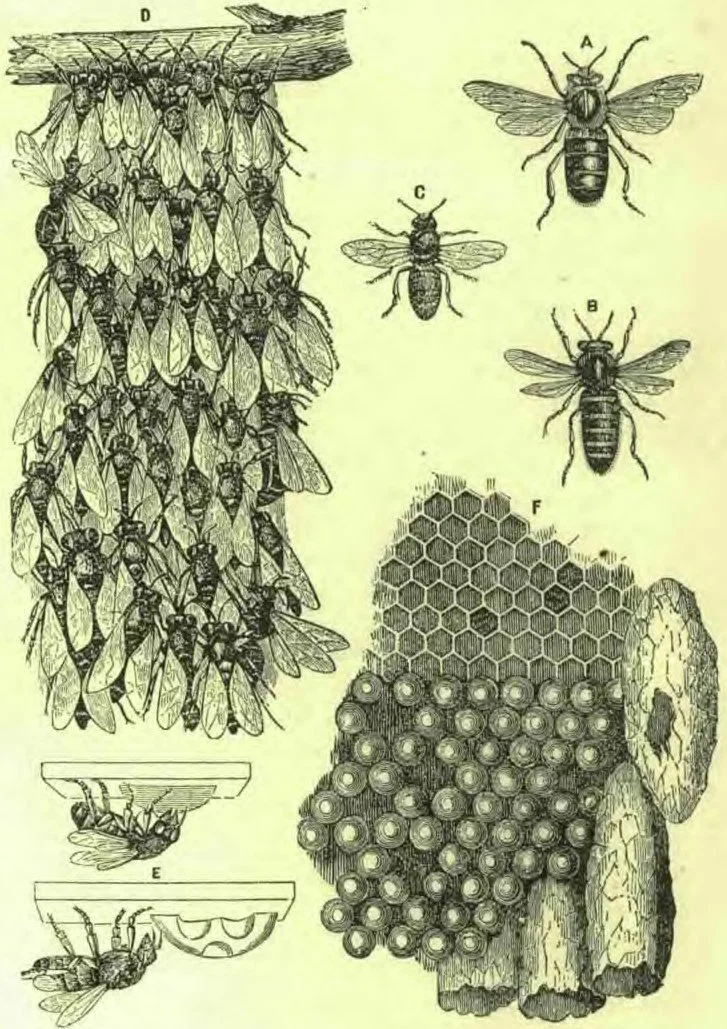
(A) Male bee; (B) Queen; (C) Worker; (D) Bees clustering while wax is forming; (E) Laying wax; (F) Empty, full, and queen cells.
“I should think,” said Harold, looking very serious, “that the Lord wouldn’t have any time to attend to such little things.”
“It is a constant source of wonder to me, my dear boy, and yet we know he does; for he says that not a sparrow falls to the ground without his notice. I do not so much wonder at the immensity of the starry universe, for our God is great and mighty; but that he constantly cares for the tiniest atom of his creation, fills my soul with wonder and love.”
“It makes me surer than ever that he will take good care of a boy like me; don’t you believe he will, uncle? and don’t you think he loves me, too?”
“To be sure he does;” and Uncle Frank glanced tenderly at the little figure by his side, and repeated:—
“The vast expanse of sea and land
Is only atoms, after all;
But fashioned by th’ Almighty Hand,
Nothing is lost and nothing small.”
MRS. L. D. AVERY-STUTTLE.
(To be continued)
Tell Me, Grandmother
By Celia Thaxter
O THE warm, sweet, mellow summer noon,
The golden calm and the perfumed air,
The chirp of birds and the locust's croon,
The rich flowers blossoming still and fair!
The old house lies 'mid the swarming leaves,
Steeped in sunshine from porch to eaves,
With doors and windows thrown open wide
To welcome the beauty and bloom outside.
Through the gateway and down the walk
Madge and grandmother, hand in hand,
Come with laughter and happy talk,
And here by the marigolds stop and stand.
“What a dear old pleasant place it is!”
Cries the little maid in a trance of bliss,
“Never anywhere could be found
So sweet a garden the whole world round!”
“Tell me, grandmother, which do you think
Is the dearest flower for you that grows,
The phlox, or the marigold stars that wink,
Or the larkspur quaint, or the red, red rose?
Which do you love best, grandmother dear?”
And the old dame smiles in the blue eyes clear—
“Of all the flowers I ever possessed,
I think, my precious, I love you best!”
— Celia Thaxter.
An Interesting Operation
By Edward Williston Frentz
It is an interesting fact that one of the most useful, indeed one of the most necessary, articles in the world is so cheap that no man hesitates to ask even a stranger for it, or dreams of paying him except by the conventional “Thank you.” That matches have come to occupy this position is due largely to American inventive skill.
The first friction-matches were made and dipped by hand. They sold for about three dollars a gross. To-day all matches are made, and most of them are dipped, by machinery, and one can buy from fifty to seventy-five for a cent. Between these two extremes stretches a long line of complicated and interesting machines.
Inventors began very early to give their attention to devices for making the sticks, or splints, cheaply. One plan after another was tried, until all finally gave way to the ribbon method. The machine for this process is a sort of lathe, in which is placed a cylinder of pine wood the length of seven matches. As this cylinder, previously soaked in hot water, or steamed, to make it soft and tough, is turned slowly, the circumference encounters a blade, which pares off a continuous shaving the whole length of the cylinder, and the thickness of a single match. This shaving, as it peels away from the log, again comes in contact with cutters, which divide it into seven strips, each as wide as a match is long.
When the ribbons have been cut into manageable length—say seven or eight feet—and freed from knots and crooked-grained portions, a large number of them—from one hundred twenty to one hundred forty—are placed in a machine like an ordinary paper-cutter. The mass is fed forward automatically, the width of a match at a time, and the descending cutter slices through the mass, making from one hundred twenty to one hundred forty splints at a stroke.
The splints are now dried and sifted in partitioned sieves, the motion of which lays the matches parallel, and prepares them for their places in frames, where they are dipped by hand. Some of these machines will turn out from fifteen to seventeen million splints a day. Rapid and cheap as this method is, it has been superseded in America by another system in which the hand work is reduced to a minimum. The raw material in this case is two-inch white plank. This is first sawed into blocks the length of a match, and thoroughly dried. The blocks are clamped to the bed of a machine, and cutters groove out a set of splints from the surface, not, however, taking the whole surface and converting it into splints at one impact, but cutting the matches out one fourth of an inch apart.
The splints, thus separated, are seized in iron clamp plates, which form an endless chain. These carry the splints across a steam-heated drum, which warms them nearly to the temperature of the melted paraffin into which they are next dipped. The heat prevents the paraffin from chilling, and insures a proper saturation.
From the first order to march, these companies of wooden soldiers have no permission to halt. They move on continuously and evenly from the paraffin bath to the rollers which carry the “heading mixture,”—phosphorus, chlorate of potash, and other substances,—and, as the companies pass by, these rollers place a red or a blue cap on the head of each individual. The line of march continues on through a room swept by a blast of cold, dry air, which hardens the newly deposited chemicals until the matches can be safely handled.
Still the companies march, until, just before they reach the starting-point again, the individual units receive their final order to “fall out” from an automatic and uncompromising punch, which deposits them side by side in a box placed in just the right place, and at just the right time, by another endless belt, a unique device.7
The cutters, meanwhile, have been eating away the ridges which were left between the places from which the first set of splints was cut; and so it goes until the whole block has been converted into slim little red- or blue-capped fellows, each one snappish and full of fire.—Edward Williston Frentz, in Youth’s Companion.
A Cheerful Home and Kind Household
“A CHEERFUL home, a household kind, Will breed no grief, leave none behind.”
INTERMEDIATE LESSON
I—Healing the Centurion’s Servant—Raising the Widow’s Son
MEMORY VERSE: “And Jesus said unto the centurion, Go thy way: and as thou hast believed, so be it done unto thee.” Matt. 8:13.
“Now when he had ended all his sayings in the audience of the people, he entered into Capernaum.
“And a certain centurion’s servant, who was dear unto him, was sick, and ready to die. And when he heard of Jesus, he sent unto him the elders of the Jews, beseeching him that he would come and heal his servant. And when they came to Jesus, they besought him instantly, saying, That he was worthy for whom he should do this: for he loveth our nation, and he hath built us a synagogue.
“Then Jesus went with them. And when he was now not far from the house, the centurion sent friends to him, saying unto him, Lord, trouble not thyself: for I am not worthy that thou shouldest enter under my roof: wherefore neither thought I myself worthy to come unto thee: but say in a word, and my servant shall be healed. For I also am a man set under authority, having under me soldiers, and I say unto one, Go, and he goeth; and to another, Come, and he cometh; and to my servant, Do this, and he doeth it.
“When Jesus heard these things, he marveled at him, and turned him about, and said unto the people that followed him, I say unto you, I have not found so great faith, no, not in Israel.” “And Jesus said unto the centurion, Go thy way: and as thou hast believed, so be it done unto thee.” “And they that were sent, returning to the house, found the servant whole that had been sick.
“And it came to pass the day after, that he went into a city called Nain; and many of his disciples went with him, and much people. Now when he came nigh to the gate of the city, behold, there was a dead man carried out, the only son of his mother, and she was a widow: and much people of the city was with her. And when the Lord saw her, he had compassion on her, and said unto her, Weep not. And he came and touched the bier: and they that bare him stood still. And he said, Young man, I say unto thee, Arise. And he that was dead sat up, and began to speak. And he delivered him to his mother.
“And there came a fear on all: and they glorified God, saying, That a great prophet is risen up among us; and, That God hath visited his people. And this rumor of him went forth throughout all Judea, and throughout all the region round about.”
Questions
1. Into what city did Jesus enter after he had given the sermon on the mount? Who met him as he came to the city? What request did these Jewish elders present to Jesus?
2. Who was this centurion?—A Roman soldier. What was his feeling toward the Jews? In what way had he shown kindness to them? How anxious were these elders that his request should be granted?
3. Where did Jesus immediately go? Who met him as he came near the centurion’s house? What message did the centurion send to Jesus? What did he himself not feel worthy to do? What kind of man did he say he was? How great was his authority?
4. When Jesus heard the centurion’s words, what did he say to the people who were following him? How was this a rebuke to the Jews? What did Jesus say to the centurion? Memory Verse. What did the centurion’s messengers find when they returned to his house?
5. Where did Jesus go the next day? Who were with him? What did this company see as they drew near to Nain? Who was the chief mourner? What is said of this mother? Who were with her?
6. How did Jesus feel when he saw her? What did he say to the mother? How did he stop the funeral train?
7. What command did he give to the young man? What did he who was dead immediately do? To whom then did Jesus deliver him?
8. What was the effect of this miracle on all who saw it? To whom did they give glory? What did they say? How far was this rumor carried?
9. Name two beautiful lessons in the life of Jesus taught by these events.
A Boy’s Hobby
MANY years ago a boy in the far West of America, says the Northwestern Christian Advocate, being suddenly thrown on his own resources by the death of his parents, hired himself out to a farmer. His eyes chanced upon the statement that every man should know something about everything, and also be a specialist in addition to his occupation. The next morning the boy decided to make the idea his own, and because the willow was the tree that was nearest him, he decided to become an expert upon willows. He found willows that were red, and willows white, and willows gray, and willows yellow, and willows blue; willows that stood up straight, and willows that bowed themselves down weeping. He collected choice specimens of willow seeds and leaves, and exchanged with agriculturalists in all parts of America. Then he gathered specimens of willows from China and Japan, from England and Russia.
The time came when teachers of forestry in lands beyond the sea sent to this farmer strange specimens of the willow for examination and classification. He lived and died a farmer, but, if his occupation confined him to his fields and meadows, his hobby made narrowness impossible, broadened the scope of his study and observation, lent him sympathy and made him friends in all the countries of the earth. There is not a single representative of the flowers or trees or insects or birds that is not waiting for some farmer’s boy to inspect it, and, in doing so, the youth who has thought himself cabined and confined will find that he has become the child of liberty, and at last his feet are in the pathway that leads to growth and happiness.—Selected.
A Leading Rule
By Benjamin Keech
If you'd like to be “healthy, wealthy, and wise,”
Keep clean, and do nothing that conscience
denies.
You can not be wealthy unless you are healthy,
You can not be healthy unless you are wise;
You can not be wise if you do not keep clean,
You can not be clean if your conscience is mean.
But if you are faithful, and do as you should,
You'll shortly reap beautiful harvests of good.
And sometime you'll see that no one is quite poor
Who's blessed with good health: and who keeps
it secure.
So, if you'd be healthy, and thus truly wealthy,
Keep clean, and do nothing that conscience
denies;
And then you'll be healthy, wealthy, and wise.
BENJAMIN KEECH.
Whittier's Words of Praise for Friend Coffin
JOHN G. WHITTIER wrote to Mr. Coffin in 1889: “I hear of thee very often, Friend Coffin, and always on the right side.”
Compensations of Service and Sacrifice for Others
“THERE are no compensations in life more delightful and soul-satisfying than those that come from service and sacrifice for the welfare of our fellow men.”
I—Lost and Redeemed
(July 1) *
MEMORY VERSE: “For the Son of man is come to seek and to save that which was lost.” Luke 19:10.
Two thousand nine hundred fifty copies of “Christ’s Object Lessons” have been sold by the training-schools, and four hundred by the church-schools during the last two years.
Seven hundred persons have gone out from our training-schools the last two years to engage in active missionary work. This is good; but we wish the number were doubled.
The first report of the Washington “surprise party,” recorded a gift of nearly six thousand dollars; the second showed that $8,899 was given to foreign mission work, and $5,439.18 to the Washington work. The third meeting, we hope, will greatly surpass in generosity even the second meeting.
Little Emma was studying her Sabbath-school lesson. Her mama thought she was not thinking about it, so started to reread the memory verse, “Whosoever drinketh of the water that I shall give him shall never thirst.” Emma quickly said, “You needn’t read it again. I was just thinking what a nice thing it would be to drink once and never thirst again.”
In the beautiful Australian woods of fern and palm, a little fellow was walking. His heart responded to the beauty all about him, and as he looked up into the arch of green above, where the feathery fronds of the fern and the graceful branches of the palm met, he said earnestly and sweetly to his teacher: “Mrs. Hughes, doesn’t it seem to you that the trees are all singing the doxology?”
If all the schools of this denomination had planted gardens this season, and the returns had been according to the returns of those who had gardens last year, nearly nine thousand dollars would have been thus dug out of the ground for the Mission Board. If all the Sabbath-school children had each planted a missionary garden this spring, several foreign missionaries could have been supported by their service of love. We are anxious to learn how many have been engaged in this good work.
Three provinces of China, with a population of seventy million, have been entered by our missionaries. Beyond are fifteen additional provinces, with an aggregate population of 325,000,000. Besides these, on her northern and western borders lie the great dependencies of China, which have an area greater than the eighteen provinces of China proper. These are Mongolia, Tibet, and Turkestan. The word of prophecy is that China shall be as thoroughly warned as the United States. Surely no further appeal than these facts is needed to make all see that men and means must at once be consecrated to China.
What Kind of Christian Are You?
I do not mean, Are you a true Christian or a hypocrite? but, Are you a happy Christian or a melancholy one? If you are the latter, the Lord does not approve of you. God wants all his children to be happy, for he says, “Rejoice always.”
It is right to weep with the soul that is repenting, and it is wrong to jest in the presence of the Holy Spirit. But at all times we should endeavor to bring to our faces the same light that is shining in our souls.
God is managing this universe in a perfectly correct manner. He made it, and he knows how to conduct it. Therefore, when we get despondent over his methods, we greatly dishonor him.
God does not desire us to tell him how to do things. All the assistance he requires from us is to become his children, be disciples of Christ, and win souls for him. Unless we are happy Christians, we can not enjoy complete success in doing his work. BENJAMIN KEECH.
Henceforth My Heart Shall Sigh No More
By Whittier
HENCEFORTH my heart shall sigh no more
For olden time and holier shore;
God's love and blessing then and there,
Are now, and here, and everywhere. — Whittier.