Review and Herald Publishing Assn. · Washington, D. C. · June 20, 1905
A Life of Faith and Works—George Muller
His Interest in Foreign Missions
Ten years passed after Mr. Muller's conversion before he entered fully upon his life-work. These years brought him disappointments and discouragements, but it became evident later on that the Lord was very near to his servant all this time, and that these experiences were God's means of preparing him for his real mission in life. During this time Mr. Muller kept his “eyes on the fields,” and applied to several societies for an opportunity to go to some foreign country. For various reasons his application was not received, war at one time being the hindering cause. He was to be a foreign missionary, but not until he had accomplished a marvelous work at home. By these experiences he learned that “continued uncertainty as to one's course is a reason for continued waiting.” God's hand is in the delay.
Once, after waiting six weeks for a society to respond to his offer, he concluded that it was not right for him to wait for his fellow men to set him to work, so “instead of lying like a vessel in dry dock for repairs,” he began at once to work for those about him, especially for the Jews in the city of London.
In 1826 Mr. Muller first attempted to preach. A gentleman whom he had been instrumental in bringing to Christ, invited him to come out to a schoolhouse and speak for an aged, infirm minister. Mr. Muller thought that by committing another man's sermon to memory and repeating it, he might be able to do some good; so he accepted the invitation. Twice in the forenoon he delivered his memorized sermon. He was asked to speak again in the afternoon. He had no sermon to give, but he felt that he could at least read and simply expound the fifth chapter of Matthew. As he began, the Spirit of God gave him wonderful assistance, both in thought and in presentation. He saw the great difference between the sermons of the forenoon and his effort in the afternoon. He decided that the way to speak was simply to expound the Word of God, a decision that gave the characteristic strength to his work as a minister of the gospel through the sixty years that followed.
In entering upon his ministerial work, Mr. Muller concluded that the taking of a stated salary was not right. Once decided that a thing was not right, he immediately abandoned it, whatever the apparent personal loss to himself. While he thought the people ought to support the minister, he held that it should be done by voluntary contributions, and not by subscribing a certain regular amount, nor by charging rent for pews. He claimed that pew rents made a distinction between the rich and the poor, and that to some, under certain circumstances, a promised regular amount would be a burden. He also claimed that there was a liability that those who gave the most would feel that they should receive special attention and favor from the minister, and that “one must be unusually faithful and intrepid if he feels no temptation to keep back, or in some degree modify, his message in order to please men, when he remembers that the very persons most open to rebuke and most liable to offense are perhaps the main contributors to his salary.”
He afterward took another step that he said was even more difficult than the refusing of his salary. To be consistent, he felt he must not even state his needs for traveling expenses and living, but look wholly to the Lord to supply every temporal as well as spiritual need. Then, later on, lest some would feel self-complacent over the largeness of their gift, and others humiliated because they could not give more generously, Mr. Muller had a box put up in the church, and each one was asked to deposit in it his offering.
Mr. Muller threw himself completely upon the mercies of the Lord, allowing man to have no part in the work only as the Spirit of God moved upon individual hearts; but he never lacked for means. Some years he was given as high as ten thousand dollars for his own personal use. While he received almost constantly money for the various lines of work he was conducting, he never used one cent for himself unless it was definitely stated by the donor that it should be so used. From his personal receipts, Mr. Muller was enabled during his life to return to the Lord in gifts more than four hundred and twenty thousand dollars. Surely it is not a vain thing to trust the Lord.
The Influence of Three Books
At Halle, in Prussia, where Mr. Muller attended school, there had been erected by A. H. Francke, in 1696, the largest enterprise for poor children then existing in the world. The founder of this orphanage was a man of faith, and was abundantly blessed by the Lord in his work. For more than two hundred years this institution had been doing a noble work. It was the reading of the life of this man of God that inspired Mr. Muller with the idea that he must do a similar work for his Master.
After he had fully entered upon his life-work, the reading of the life of John Newton stirred him up to bear a similar witness to the Lord's dealings with himself; so Mr. Muller began publishing an annual report, called “A Narrative of the Lord's Dealings.” This report has led to many conversions and renewed consecrations to the work of God.
There was still another book destined to influence the life of George Muller. This was the biography of George Whitefield. It was the reading of this book that convinced Mr. Muller that the remarkable power of Mr. Whitefield in winning souls to God was due to his habit of much prayer, and reading the Bible on his knees. So Mr. Muller formed the same habit, and afterward acknowledged that it had brought great spiritual blessings to him. These three books were used by God to direct George Muller into the fulness of the Christian life.
The Founding of a Great Institution
Happily Mr. Muller found in Mr. Craik, of Bristol, a man after his own heart,—a man as anxious as Mr. Muller to walk in just the path that God outlined for the Christian. These two young men united their efforts in evangelistic work, and had marked success in winning souls to Christ. In 1834 Mr. Muller, though already overtaxed with pastoral duties, was led of God to found the Scriptural Knowledge Institution, for Home and Abroad. The purposes of this institution, and the principles upon which it was founded, are given by Mr. Arthur Pierson in Mr. Muller's biography, as follows:—
Every believer's duty and privilege is to help on the cause and work of Christ.
The patronage of the world is not to be sought after, depended upon, or countenanced.
Pecuniary aid, or help in managing or carrying on its affairs, is not to be asked for or sought from those who are not believers.
Debts are not to be contracted or allowed for any cause in the work of the Lord.
The standard of success is not to be a numerical or financial standard.
All compromise of the truth or any measures that impair testimony to God are to be avoided.
The objects of the institution were also stated:—
To establish or aid day-schools, Sunday-schools, and adult schools, taught and conducted only by believers, and on thoroughly Scriptural principles.
To circulate the Holy Scriptures, wholly or2in portions, over the widest possible territory.
To aid missionary efforts and assist laborers, in the Lord's vineyard anywhere, who are working upon a Biblical basis, and looking only to the Lord for support.
Mr. Muller began this work with only one shilling in hand; and we must ever keep in mind that the unique and beautiful feature—a settled principle—of Mr. Muller's work is that he never appealed to man, either directly or indirectly, for help; he never took up a collection, but simply stated to the public that such a line of work was to be established. He would also state clearly the principles upon which it was to be founded. All the rest he took to the Lord alone, and expected him to find those who would voluntarily support the work.
Somehow the Lord never failed to do his part; so that Mr. Muller had nearly eight million dollars given him during sixty years for the work of God. This is more than our whole denomination has given in the same length of time, in both tithes and offerings, at least as far as the records show.
The fifty-ninth report given by Mr. Muller of the work, shows that the Scriptural Knowledge Institution during the year 1898 maintained seven day-schools, of 354 pupils; the number of pupils from the beginning was 81,501; the number of home Sunday-schools, 12; and of children in them, 1,341; but from the beginning, 32,944. The number of Sunday-schools aided in England and Wales, 25. The amount expended in connection with home schools, $3,680; from the outset, $549,960. The number of Bibles and parts thereof circulated, 15,411; from the beginning, 1,089,266. Money expended for this purpose the past year, $2,195; from the first, $205,450. Missionary laborers aided, 115. Money expended, $10,410; from the outset, $1,309,295. Circulation of books and tracts, 3,101,338. Money spent, $5,005; and from the first, $235,940. All the shillings and pence were omitted in expressing the various amounts in United States money; so the real expenditures were even greater than these figures show. This seems a great work for one man to accomplish in the cause of God; but Mr. Muller is best known to the world through his orphanages, which will be the theme of the next article.
(To be concluded)
Thou Anointest My Head
By Eliza H. Morton
Ps: 23, 5
In Eastern lands the shepherds watch
Their flocks on mountains lone,
Guarding with care from foes about,
Speaking with tender tone.
And when beneath the starry sky
The air is damp and cold,
A call rings out; the sheep respond,
And gather to the fold.
The shepherd rods the eager flock,
Thus holding back each one,
Inspecting it with tender care,
And leaving naught undone.
The knee that's bruised is bandaged up,
The scratch with tar o'erspread,
The worn and weary one is bathed
With oil upon its head,
A cup of water full to brim
To quench its thirst is given,
And then into the shelter safe
'Tis gently led, not driven.
And thus the Lord anoints my head,
My cup is running o'er,
My Shepherd kind with horn of oil
Is standing at the door.
ELIZA H. MORTON.
North Deering, Maine.
The Mystery of Life
By L. A. Reed
Do not forget that it is the chlorophyll-granules in the green leaves that perform the great work of starch-making, or food manufacturing of all plants.
The formation of plant materials always begins with the decomposition is carried on only by that protoplasm in which are imbedded chlorophyll-granules. This protoplasm can accomplish the task indicated only by the aid of these granules, and it is therefore the chlorophyll-granules upon which everything depends.
These granules always appear imbedded in protoplasm, but they are sharply defined from it, and in their entire development exhibit a certain separateness and individuality.
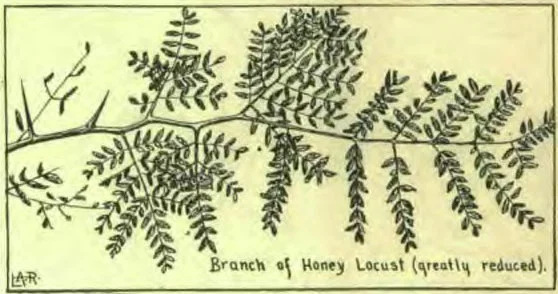
Branch of Honey Locust (greatly reduced).
The quantity of organic substances formed in a cell, by the decomposition of carbon dioxide, is greater the larger the number of chlorophyll-granules, provided all of them are arranged within the protoplasm in such a manner that they can discharge their functions. The granules must be so arranged that no one deprives another of light. Each granule must labor as if there were no other, and yet with due consideration of every other.
If the granules “get in one another’s light,” the shaded granules are deprived of their power, for they can work only under the influence of light. But there is perfect adaptation and harmony between these granules; they seem endowed with intelligence, perfect and efficient for all their tasks and conditions of existence.
Each species of plant requires a definite amount of light, and the chlorophyll is perfectly adapted to obtain this certain amount. Under all the varying degrees of light and shade they seek to obtain the required amount.
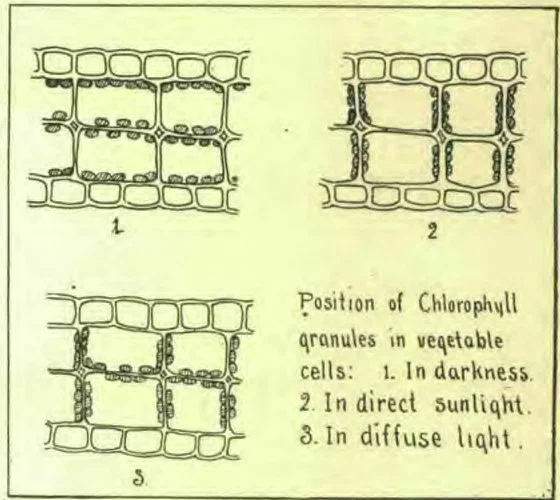
Position of Chlorophyll granules in vegetable cells: 1. In darkness. 2. In direct Sunlight. 3. In diffuse light.
If the foliage is weakly illuminated, the granules maintain a broader side, and more favorable position toward the light, in consequence of which they present the largest possible surface to the sun’s rays. If the foliage is strongly illuminated, they assume a narrower side, and less favorable position to the light, by which the smallest possible surface is exposed.
At the same time the leaves themselves assist in also adapting themselves to the light. For instance, the leaves of the honey-locust, when weakly illuminated, will spread their blades as broadly as possible to the light; when, however, they are strongly illuminated, they partly close, back to back, thus shutting out to some extent the intense light. This folding of the leaf is a common method in many plants. The wood-sorrel leaves are also an excellent example; each leaflet folds through the center, closing to shut out the light.
Of course, these actions of the chlorophyll-granules in the protoplasm all take place through the sensitiveness of the cells. The protoplasm acts in response to the stimulus of light. But to say this, is not, by any means, to clear the mystery. How happens it that there is this marvelous relation between light and the watery protoplasm? Instrumentality does not explain the why of things; it shows only part of the process.
When we seek to understand these things, “we find ourselves in the position of an inquirer who visits a chemical laboratory without a guide, and wishes to ascertain in what way some material — for example, a pigment — is manufactured. “He notices apparatus set up there, sees the raw materials heaped together, and also finds the finished product. If the manufacture is actually proceeding, he can also observe whether warmth or cold and greater or less pressure are brought into action as propelling forces, and he can, if entrusted with the manipulation necessary to the production of such pigment, imagine the relation of the different parts to the whole. Of the details, indeed, much must remain incomprehensible, or quite unknown. Especially with reference to the quantity of the transformed raw material, and with regard to the propelling forces, must the visitor’s knowledge remain incomplete.”
It is somewhat like this when we attempt to inspect the processes carried on in the cells where chlorophyll-granules develop their activity. “We see the effective apparatus, we recognize the food-gases and food-salts collected for working up, we know that the sun’s rays act as the motive force, and we also identify the products which appear completed in the chlorophyll-granules.”
“But what is altogether puzzling is how the active forces work, how the sun’s rays are able to bring it about that the atoms of the raw material abandon their previous grouping, become displaced, intermix with one another, and shortly appear in stable combinations under a wholly different arrangement.” — Anton Kerner von Marilaun, Professor of Botany in the University of Vienna.
Thus does a great scientist write concerning the chemical decompositions and combinations which take place in the cells of plants. He says that we are able to see that these chemical actions take place under the stimulus of sunlight, “but what is altogether puzzling is . . . how the sun’s rays are able to bring it about.”
L. A. REED.
The Message of the Clouds
By Nellie A. Honeywell
WHAT is the message the clouds bring to us? The sunshine brings us life and cheer; we rejoice in the warm rays, and we sometimes almost wish the sun would always shine. But if it did, the sunshine, which brings life and rejoicing if uninterrupted, would bring death and mourning. Who that has passed through the experience does not recall the feeling of almost hopeless despair which seemed to overtake him, as, day after day, under the parching heat of the sun, he saw the fruitful promise of the springtime withering, dying, and turning to dust? How anxiously every gathering cloud was watched, hoping that each one was the forerunner of the long-looked-for shower. Thank God for the clouds and the rain. “Nevertheless he left not himself without witness, in that he did good, and gave us rain from heaven, and fruitful seasons, filling our hearts with food and gladness.” This, then, is the mission of the clouds; without them we could have no fruitful seasons.
Now let us see what personal message the clouds bring. That it is an important one is shown in 1 Cor. 10:1: “Moreover, brethren, I would not that ye should be ignorant, how that all our fathers were under the cloud, and all passed through the sea.” This, then, represents an experience common to all. “Now these things were our figures,” 1 Cor. 10:6, margin. They are like the kindergarten blocks by which we teach spiritual truths to children; but let us not, as children often do, see only the figures, and fail to grasp the truths they represent.
“He spread a cloud for a covering; and fire to give light in the night.” Ps. 105:39. “The cloud . . . served as a protection from the burning heat, and by its coolness and moisture afforded grateful refreshment in the parched, thirsty desert.”—“Patriarchs and Prophets,” page 282. “For the Lord God is a sun and shield.” Ps. 84:11. The bright rays of the sun would3overpower us at times, and we need something to shield us. So when God desires to draw very near to his people, he covers his glory with a cloud, that they be not consumed. “And the Lord went before them by day in a pillar of cloud, to lead them the way.” Ex. 13:21. The cloud not only protected them, but it led them all the way they should go. “Yet thou in thy manifold mercies forsookest them not in the wilderness; the pillar of the cloud departed not from them by day, to lead them in the way.” Neh. 9:19. “They called upon the Lord, and he answered them. He spake unto them in the cloudy pillar.” Ps. 99:6, 7. “Clouds and darkness are round about him.” Ps. 97:2. Thus God draws very near in the cloud; and if we speak, he will answer us, as he did Moses and Aaron. But to our human sight, the cloud seems to separate us from God. We fear as we enter into the cloud. Luke 9:34. But listen! the Father speaks: “This is my beloved Son: hear him. And when the voice was past, Jesus was found alone.” What a blessed experience,— alone with Jesus on the mount.
But how thick the clouds seem sometimes! We think that God has forsaken us; we can not realize he is drawing very near to us in the cloud. “When thick clouds of darkness seem to hover over the mind, then is the time to let living faith pierce the darkness and scatter the clouds.”—“Early Writings,” page 62.
“Ye fearful saints, fresh courage take;
The clouds ye so much dread,
Are big with mercy,
And shall break in blessings o’er your head.”
Let us ever remember that every cloud has a bright as well as a dark side. Let us keep on the bright side, which is the way of obedience. If our path seems to be enshrouded in darkness, let us search and try our ways, to discover where we are out of harmony with our Leader. Let us submit ourselves fully to him, to be guided in the way he would have us go, and rise above the clouds on the wings of faith. Like the eagle, let us live above the clouds; then we shall see only their silver lining. When the cloud comes, the Lord is seeking to reveal to us some defect of character. By faithful work in overcoming we may dwell forever in the sunlight of God’s presence. MRS. NELLIE A. HONEYWELL.
Transmission of Infectious Diseases
By Mike Rose
There was formerly so much mystery regarding the transmission of diseases that it is not surprising that superstitious people attributed disease to the agency of evil spirits or offended gods. Now that the cause of various diseases is definitely known, and the action of these diseases in animals can be studied, many things which were once mysterious can be understood, and much done toward preventing disease. Instead of going through incantations and attempting to frighten away the devils, men now study the habits of the germs, how they gain admission to the body, and how they may be successfully combatted. The germs of anthrax (malignant pustule), tetanus (lockjaw), diphtheria, typhoid fever, yellow fever, tuberculosis (consumption), and perhaps some others, have been successfully studied. There is much yet to learn regarding these diseases; but what is already known has done much to put the prevention and treatment of the diseases on a scientific basis.
In diphtheria it is known that the discharges from the throat contain the infecting material. More than once a doctor has lost an eye because a diphtheria patient coughed while he was examining the throat, and a bit of the sputum went into the doctor's eye. In other cases doctors or nurses have died by getting infected around the mouth with the coughed-up matter from the little patient.
So now a careful physician, in examining such a throat, looks at it through a pane of glass, so that if the patient coughs, anything coughed up will strike the glass, and not the face of the examiner.
Doctors or nurses handling such patients have learned to disinfect their hands before eating, as their hands may have become infected while around the patient. Another excellent precaution is to wear a linen duster over the suit when in the room with the patient, so that the diphtheria germ may not get lodged on the clothing ordinarily worn.
In tuberculosis it is usually the sputum that contains the infectious matter, and here again the necessary precaution consists in taking proper care of the sputum. It should not be coughed upon streets or sidewalks or in rooms. The cities which have provided a fine for expectorating in public places are making a move in the right direction.
It is not only unseemly and filthy to leave such unsightly masses around, but it pollutes the air with myriads of tubercle germs; for as soon as the sputum dries, it turns to dust, and is carried everywhere by the wind.
All consumptives should carry a receptacle for catching the sputum, which should be emptied and disinfected at frequent intervals. It may be small enough to carry in the pocket, and may be covered with a handkerchief in order not to attract attention. Some persons carry loose squares of old cloth which may be used and burned. The handkerchief should not be used for catching the sputum, as it dries, and soon infects all the clothing.
With the best of care, the room of the consumptive will be found to contain large numbers of tubercle bacilli, so it should occasionally be gone over with a cloth moistened in bichlorid solution. It is dangerous to raise a dust in sweeping such a room.
COLONIES OF GERMS
Insects as Transmitters of Disease
Insects may carry disease germs in various ways. They may carry them on their legs, and leave them on food on which they crawl. Flies, perhaps, light on some loathsome material, and afterward make their way into the dining-room and kitchen. Fleas, bedbugs, and similar insects may bite people or animals suffering from some transmissible disease, and then carry the infection to some other person or animal. Flies caught in the rooms of persons suffering from consumption have been found to have living tubercle bacilli in their intestines.
But the most interesting forms of insect transmission are those connected with malaria and yellow fever. The malaria parasite is not a plant, but a microscopic animal which gets into the blood current, and there destroys the red blood cells.
For many years it has been believed in Italy that mosquitoes were responsible for the transmission of malaria, but only recently has it been definitely proved. The word “malaria” means bad air, and is a relic of a former belief that malaria was caused by the inhalation of impure air. Later it was generally believed that malaria was caused by drinking impure water; and that the prevention of malaria consisted in drinking nothing but boiled water when in a malarious district. Finally it was found that the mosquito (a certain kind of mosquito known as anopheles) is responsible for the transmission of malaria to man.
It was found that by protecting about one hundred laborers in a very malarious part of Italy, from mosquito bites, only three of the one hundred four persons were infected. At the same time the other laborers, who were not protected from mosquito bites, were suffering from malaria. Mosquitoes that had bitten a malarial patient in Italy were taken to England, and there permitted to bite a young man, causing in him a prompt appearance of malaria, though he had not been in a malarious country since he was a child.
You all know that a butterfly undergoes various transformations. It is first an egg, then a caterpillar, then a chrysalis, and finally a butterfly. The malarial parasites undergo a series of transformations, one of which must take place in the body of a mosquito; so it would seem, if there were none of this particular kind of mosquito, there would be no means of transmitting the malarial parasite from one person to another, and the malaria would soon cease to exist.
There have been found places where the anopheles lived, and there was no malaria. As long as there was no case in the neighborhood, the mosquitoes could not transmit it, but as soon as one person with malaria came into the district, the mosquitoes would bite him, and soon the disease would become general.
In order to avoid malaria, keep away from malarious districts. If necessary to be in such a district, avoid being bitten with an anopheles mosquito. This may be accomplished by having the house well screened, and keeping inside when the sun is out of sight. The anopheles do not bite when the sun is shining.
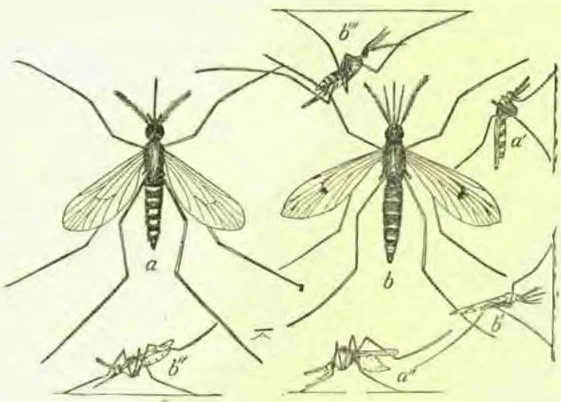
The anopheles may be distinguished from the culex, or ordinary mosquito, by the position of the body. The body of the culex stands parallel to the surface upon which it is resting. The body of the anopheles is directed almost perpendicularly or at right angles to the surface it is standing on, so that its head and bill are pointing down ready to strike. (See cut.) Another difference: the culex usually pauses a moment4after lighting before proceeding to business, while the anopheles begins as soon as it lights.
But remembering the tendency of the insect to bite only after sunset, one in a malarious country may, by taking proper precautions, avoid an attack of malaria.
Yellow Fever
Havana was formerly the hotbed of yellow fever. Efforts were made there and in the Southern States to quarantine against the disease, which was supposed to be highly contagious. These efforts were unsuccessful because the method of transmission was not understood. When it was discovered that a kind of mosquito (Stegomyia fasciata), differing from the culex and the anopheles, was the means of transmission, it did not take long to rid Havana entirely of yellow fever. All that was necessary was to isolate every person having yellow fever, and prevent his being bitten by mosquitoes, and to destroy all mosquitoes that succeeded in getting into the house occupied by yellow fever patients. Now yellow fever, which was once the scourge of the South, is no longer so dreaded.
Experimental work has proved conclusively that the disease is not contagious. People have been allowed to sleep for days in the soiled beds on which yellow fever patients had died, without producing the disease. At one time it was thought that all excretions from such a patient were highly dangerous. Now the evidence all seems to indicate that every case of yellow fever is transmitted from some previous case by means of the mosquito.
So you can understand that the work in the “canal zone,” on the Isthmus of Panama, is now progressing under much better hygienic conditions than when DeLesseps tried to dig the canal many years ago.
Hundreds of thousands of yards of wire screen have been sent to Panama, for protection against mosquitoes, and the physicians in charge are doing all in their power to destroy the mosquitoes.
Mike Rose.
THE WEEKLY STUDY
Paul Delivered from a Plot—Sent as a Prisoner to Caesarea
REFERENCE STUDY: “Sketches from the Life of Paul,” pages 225-234.
TOPICS FOR STUDY:—
A plot to kill Paul.
Conspiracy revealed.
Escort to Caesarea.
Letter to Felix.
Stop at Antipatris.
Arrival at Caesarea.
Interrogated by the governor.
Place of imprisonment.
Notes
Notice how the Lord always delivers his servants from the power of the adversaries. He was with Paul in all his trials on land or sea.
“Two questions easily asked, but not easily answered, suggest themselves,—whether Paul’s sister and nephew resided at Jerusalem, and if so, why he lodged not with them, but with Mnason.”—Conybeare and Howson.
Caesarea was provided with everything that was calculated to contribute to wealth. Magnificent places of amusement were constructed from white stone. It was here in the immense amphitheater that Herod was making his oration when he was smitten by an angel, and died. Caesarea boasted of its harbor. The stones in the breakwater are said by Josephus to have been fifty feet long, eighteen feet broad, and nine feet deep. It was here that Vespasian was declared emperor, and Eusebius was born. It contained residences for Roman rulers, and quarters for a number of the imperial troops.
“Little now survives on the spot to aid us in the restoration of this handsome metropolis. On the wide area once occupied by its busy population there is silence, interrupted only by the monotonous washing of the sea; and no sign of human life, save the occasional encampment of Bedouin Arabs, or the accident of a small coasting vessel anchored off the shore. The best of the ruins are engulfed by the sand, or concealed by the encroaching sea. . . . Its glory was short lived. Its decay has been complete, as its rise was arbitrary and sudden.”—Conybeare and Howson.
“Lysias gladly improved this opportunity to get Paul off his hands. He was the object of so great animosity, and his presence created so wide-spread an excitement, that a riot might occur among the people at any time, with consequences dangerous to the commandant himself.”
“How unlike his present escort was the humble Christian company that had attended him on the journey from Caesarea but a few days before! Notwithstanding his changed surroundings, he was recognized by Philip and others of his Christian associates, whose hearts were shocked and saddened at the swift realization of their forebodings.”
“The case of Paul was not the first in which a servant of God had found among the heathen an asylum from the malice of the professed people of Jehovah. In their rage against Paul, the Jews had added another crime to the dark catalogue which marked the history of that people.”