Your ShelfYour Projects

Signs of the Times, Vol. 22, No. 8.

Why Man Needs a Helper.—

Signs of the Times

Feb 20, 1896

Pacific Press Publishing Company · Oakland, California · Feb 20, 1896

Why Man Needs a Helper.—
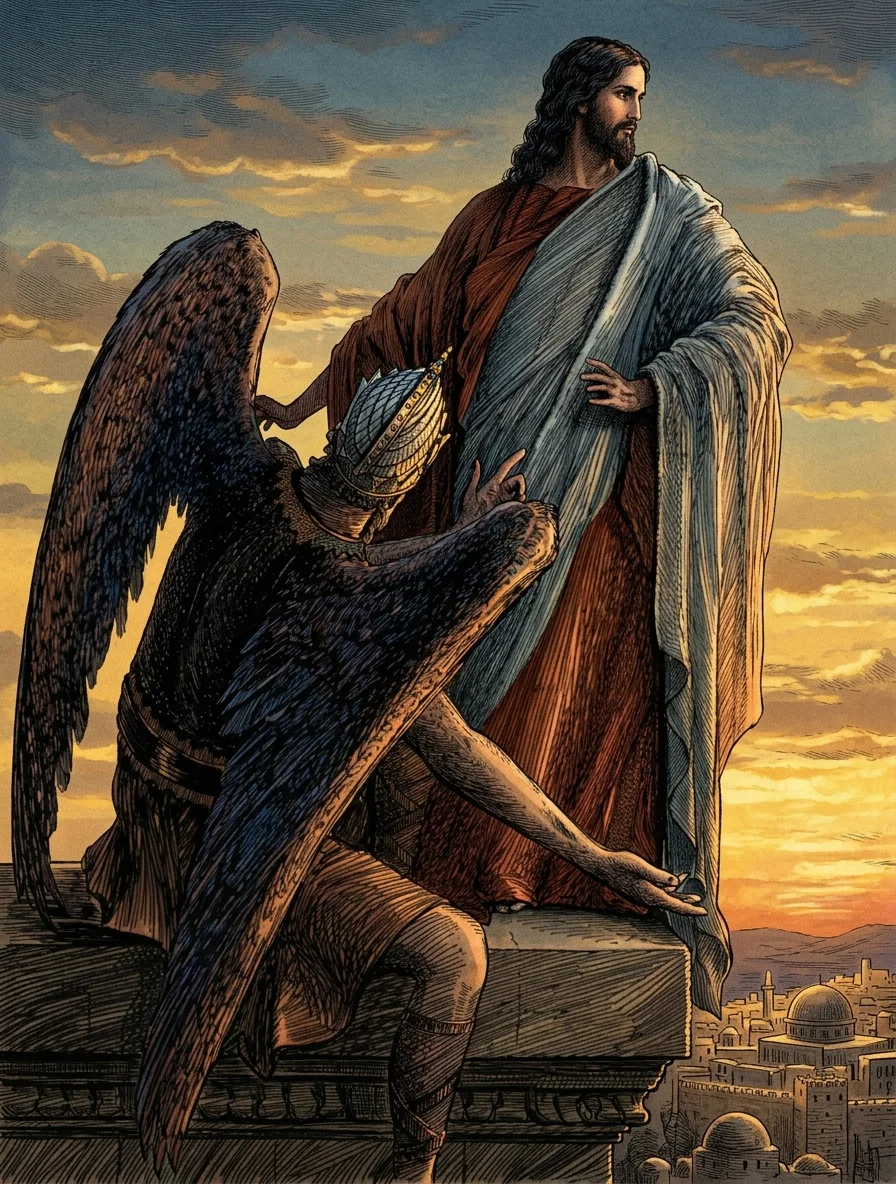
“Tempted Like As We Are.”— Says the Spirit of God in speaking of Jesus Christ:
“For we have not an high priest which can not be touched with the feeling of our infirmities; but was in all points tempted like as we are, yet without sin. Let us therefore come boldly unto the throne of grace, that we may obtain mercy, and find grace to help in time of need.” Heb. 4:15, 16.

Why Man Needs a Helper.—

When man yielded to the tempter in Eden, he sold himself a slave to sin. Rom. 6:16; 7:14. As the dominion of earth and all in it were given to him (Gen. 1:28), when he yielded himself to Satan, the earth and all within it passed from his control to that of the usurper (2 Cor. 4:4; Luke 4:6), and all creatures were made subject to vanity—death—by reason of man's subjection to Satan (Rom. 8:20). Man's flesh became sinful flesh, subject to the devil, its laws were perverted, and the holy emotions of purity became the unholy passions of selfish lust and sensuous indulgence.
The “Enmity.”— Man in yielding himself yielded all. But God's mercy did not leave him. “I will put enmity between thee and the woman, and between thy seed and her seed” (Gen. 3:15), are the words of the Lord to the triumphant deceiver. Therefore God implanted within the heart of man a longing for good, a hatred of evil, a conscience of sin. This may be blunted, stupefied, hardened by sin, but it is there, nevertheless, lightening every man that cometh into the world, and making it possible through the power of choice and exercise of faith to refuse the evil and choose the good. But this enmity to evil is subject to the carnal nature. In man is no power to extricate man. As one has said, “When I would do good, evil is present with me.” Rom. 7:21. While seeing beauty in God's law and delighting therein, it is still bound by the perverted law, the law of sin in the flesh. Verses 22, 23. It is the spirit dominated by the flesh, as the enslaved wife who longs to be free is bound by a tyrannical husband.
Christ the Deliverer.— But the same one found freedom in Christ Jesus. “For the law of the Spirit of life in Christ Jesus hath made me free from the law of sin and death. For what the law could not do, in that it was weak through the flesh, God [did by] sending his own Son in the likeness of sinful flesh, and for sin, condemned sin in the flesh; that the righteousness of the law might be fulfilled in us, who walk not after the flesh, but after the Spirit.” Rom. 8:2-4.
“Made Like unto His Brethren.”— In all things Jesus was made like men, save in yielding to sin. Yet he knew its power, for he had the same flesh. He was “made of a woman, made under the law” (Gal. 4:4), “made of the seed of David according to the flesh” (Rom. 1:3), and, in fact, was in the fullest sense the Son of man, clothed in all the weakness of humanity. As other men had sinful flesh, weakened by following perverted law through successive generations, responsive to the temptations of the threefold enemy, the world, the flesh, and the devil, so Jesus of Nazareth took the same flesh, that he might know man's temptations, that he might bear man's sins, and that the spirit born of God by faith might triumph over sin in the flesh.
A Triad of Trials.— The temptations of man sum up under three chief heads,—the inward cravings of the animal nature, the sin of presumption, or self-confidence, and the lust for the riches, fame, and power of the world. After the baptism of Jesus it is said that he “was led up of the Spirit into the wilderness to be tempted of the devil.” Matt. 4:1. He was there “forty days tempted of the devil.” Luke 4:2. The struggles of that forty days in the desolate wilderness we can never know. The doubts suggested as to whether he was the Son of God or not, as to whether his mission was to save men, as to whether he could conquer where Adam fell. In the sight of the visible glory of God, in less than forty days all Israel turned to a calf of gold. But Jesus proved faithful alone, surrounded with wild beasts, the chill air by night, the heat by day, the drear, desolate wilderness. Yet his faith pierced all the desolate atmosphere which enshrouded him and took hold upon God.
The Power of Appetite.— At the end of the forty days' fast, Satan came as an angel of light, with the words, “If thou be the Son of God, command that these stones be made bread.” That he came as an angel of light we know, because he is the great deceiver; he does not reveal his true character till the last resort. See 2 Cor. 11:1. His first temptation was upon the point of appetite. Here our first parents fell. Satan would show to the Divine Father that all this hunger was not necessary for the Son of God. He also conveyed in his temptation a doubt of Christ's divinity. You need not suffer hunger, you should not, if you are the Son of God; and if you are, you will change these stones to bread. Jesus did not yield. The lost and fallen race had counted daily food, the indulgence of the flesh, more than the bread of eternal life, the word of God, through which all life, all food, all supply comes. Christ saw the failures of four millenniums, the excesses of the antediluvians, the degeneration of the cities of the plain, the fall of luxuriant Babylon, the deplorable end of men who could conquer the world, but not self, even the drunkenness of God's professed priests—all to a greater or less extent the deplorable results of appetite. He knew this weakness of men, and he was fighting the battles for them, overcoming in his own flesh, that he might overcome in the flesh of the weakest and vilest. He answered the tempter just as every tempted soul must answer, by the word of God: “It is written, Man shall not live by bread alone, but by every word that proceedeth out of the mouth of God.”
“The Sword of the Spirit.”— Jesus met the attacks of Satan by the only weapon which God has ever furnished to his followers, namely, “the sword of the Spirit, which is the word of God.” Eph. 6:17. But that weapon when rightly used by living faith, is always effectual. In it is all the power of God to do what is commanded or promised. It brought into existence the world, covered it with a flood, gathered into the seas its superabundant waters, made a path through the Red Sea, gave bread in the wilderness and waters in the desert; it has abounded to every good work. It “is living and powerful, . . . piercing even to the dividing asunder of soul and spirit, and of the joints and marrow, and is a discerner of the thoughts and intents of the heart.” Heb. 4:12. It strengthened the soul of Christ, and defeated the enemy. The weakest physically, clothed with God's armor, wielding by faith the sword of the Spirit, is more than a match for the strongest foe.
Presumption.— Sometimes our greatest danger comes just after some great victory. We feel that we are strong, and we are inclined to lay aside anxiety and trust to our own resources. So Israel thought after the walls of Jericho fell, surely little Ai would fall; but it meant loss and humiliation to overconfident Israel. It was upon the sin of presumption that Christ's next temptation came. Satan came with scripture in his mouth. “Then the devil taketh him up into the holy city, and setteth him on a pinnacle of the temple, and saith unto him, If thou be the Son of God, cast thyself down; for it is written, He shall give his angels charge concerning thee; and in their hands they shall bear thee up, lest at any time thou dash thy foot against a stone.” Satan quoted from Ps. 91:11, 12. And is not the scripture true and the promise sure?—Yes, indeed, but not for self-salvation or honor. Not once may God's power or protection be asked to minister to selfish lust or fame. See James 4:3. It would not be to God's glory to yield to the tempter. It would simply call attention to Jesus, not to the Father who sent him. The meaning of this scripture was demonstrated to Satan on another occasion when his servants tried to destroy Christ. See Luke 4:28-30. Jesus met the tempter with the word, “It is written again, Thou shalt not tempt the Lord thy God.” The first scripture quoted by Satan must not conflict with the one our Lord quoted. When some passage is dark, when Satan suggests a meaning which will minister to self, it is well to remember, “It is written again.” And again by the word Jesus conquered.
“The Lust of the Eyes, and the Pride of Life.”— It was the world and all its glory next. Satan does not come this time with an “if,” a doubt as to Christ's divinity. He throws off disguise, takes Christ to a high mountain, shows him in panoramic view all the kingdoms of earth, with all their glory, contrasts it with Christ's appearance, surroundings, and future sufferings, and then declares: “All this power will I give thee, and the glory of them; for that is delivered unto me; and to whomsoever I will, I give it. If thou therefore wilt worship me, all shall be thine.” Heretofore Satan came as a solicitous friend, a candid doubter, with Scripture on his tongue. Patiently, altho he doubtless knew him, Jesus answered him instructively. But when at last Satan reveals his true character, putting himself in the place of God, Jesus answers, “Get thee hence, Satan; for it is written, Thou shalt worship the Lord thy God, and him only shalt thou serve.” The great temptation was ended; Jesus was victor.
Lessons and Comfort.— We learn by this great temptation Christ's regard for Scripture; and it is a remarkable fact that he quoted from the writings of Moses, which the “Higher Critics” have treated so irreverently and contemptuously. See Deut. 8:3; 6:16; 10:20. To use the word one must have the word. “By the word of thy lips,” says David, “I have kept me from the paths of the destroyer.” Ps. 17:4. “Thy word have I hid in mine heart, that I might not sin against thee.” Ps. 119:11. It is only by the truth of the word, by the love of the truth, that we can escape the devices of the enemy. 2 Thess. 2:10-12; Ps. 91:4.
While the world was delivered unto Satan by Adam, he has no right to its dominion. Adam was given dominion that he might rule to God's glory. Satan is a usurper. The earth and all in it is doubly Christ's—by creation and redemption. We are bought with a price; let us yield ourselves to God.
We truly worship him whom we truly serve. “Why call ye me, Lord, Lord, and do not the things which I say?” says Jesus. Vain is the worship of men when they follow their own ways in preference to his. They are yielding to him who exalts himself to the place of God.
Christ won the victory in every point over the prince of all evil. He met temptations so great, with himself so weak, that these temptations can never be surpassed. Christ conquered for us, for you, sinner, whoever you may be. He holds that victory for you now if you will take it. He lived his life in sinful flesh, that he might live it again in you. He was tempted in all things, even as we; he is therefore able in all things to succor the tempted. In his humanity every fiber has been tried. The life of God has overcome the sin. And that life, given freely through Christ to every heart of longing faith, throbs responsive to every pain, every trial, every temptation which comes to his children. O sinner, accept him! He is a complete, a perfect Saviour. He will live his life in you if you will let him, and make true your wish to be a true man, a loyal citizen of heaven, and heir of God.
Christ Jesus Our Example.— Where self is given, there is nothing reserved. In this sense God the Father gave himself; for “God is love,” and Love gave the dearest thing in all the universe. When Christ gave himself in that far-back beginning, he held nothing in reserve. When the time came for him to act as the Captain of the Lord's host of angelic messengers to this sinful earth, he who was in the image of God did not affect to reign on the throne of the universe, but took upon him the form of the servant. He served with the other heavenly messengers as Michael—the one like God. He came with messages of mercy to Abraham, Jacob, Moses, Joshua, Isaiah, Daniel, and others. When the time came to be manifest in the flesh, there was nothing to hold him back; he had already yielded. When the temptation in the wilderness came, he followed the leading of the Spirit, submitted to the long fast, the fierce hunger, and the fearful test. And so with all the other temptations,—the garden, the denial, the persecution, the ignominious death,—he submitted to all, for he had already submitted to all when he gave himself.
In all this Christ is our example. He says, “If any man will come after me, let him deny himself, and take up his cross daily, and follow me.” Luke 9:23. The only cross which avails is the cross of Christ. See Gal. 6:14. All the sins of the world were borne there by Christ Jesus. If we believe him, if we accept him as our Saviour, we count his sacrifice ours by living faith. We reckon our sins as being there. We reckon his death for our sins as our death, and to him we give all the sins. And as the root or basis of sins is selfishness, we give up, if we truly believe Christ, all of self. We are to do as Christ did, empty ourselves. He “emptied himself” of himself, and God filled him with all his fullness. Thus it was that God gave himself through Christ for the world. We are to empty ourselves of self, and Christ will fill us.

“HEIR OF THE WORLD.”

In our lesson last week we began the study of Abraham as a special illustration of the doctrine of justification by faith. We found that Abraham could not glory before God, because he was justified by faith only, and not at all by works. But the verses which follow will involve a sufficient review of the first part of the chapter, and therefore we will at once proceed to the study of

The Inheritance and the Heirs.

“For the promise, that he should be the heir of the world, was not to Abraham, or to his seed, through the law, but through the righteousness of faith. For if they which are of the law be heirs, faith is made void, and the promise made of none effect; because the law worketh wrath; for where no law is, there is no transgression.” Rom. 3:13–15.

Questioning the Text.

What promise was made to Abraham?
“That he should be the heir of the world.”
To whom was this promise made?
“To Abraham” and “to his seed.” “Now to Abraham and his seed were the promises made.” Gal. 3:16.
Who is the seed?
“He saith not, And to seeds, as of many; but as of one, And to thy seed, which is Christ.” Gal. 3:16.
Is Christ in his own person the only seed?
“And if ye be Christ’s, then are ye Abraham’s seed, and heirs according to the promise.” Gal. 3:29.
Of what are Abraham and his seed heirs?
“Of the world.”
On what basis was this inheritance promised?
“The promise, that he should be the heir of the world, was not to Abraham, or to his seed, through the law, but through the righteousness of faith.”
If they which are of the law be heirs, what is the result?
“Faith is made void, and the promise made of none effect.”
Why so?
“Because the law worketh wrath.”
If there were no law, what would there not be?
“Where no law is, there is no transgression.”
Why is it, then, that the law worketh wrath?
Because “by the law is the knowledge of sin.” Rom. 3:20.

Where Is the Promise?

A very natural inquiry upon reading the thirteenth verse would be, Where is there any promise that Abraham and his seed should be heirs of the world? Many think that no such promise is contained in the Old Testament. But there can be no doubt about the matter, for the apostle says that there was such a promise. If we have not found it, it is because we have read the Old Testament too superficially, or with minds biased by preconceived opinions. If we consider the connection, we shall have no difficulty in locating the promise.
Of what is the apostle speaking in this connection?—Of an inheritance through the righteousness of faith, and also of the fact that circumcision was given to Abraham as a seal of this righteousness which he had by faith, and therefore as the seal of the inheritance which was to come thereby. Now where in the Old Testament do we find the account of the giving of circumcision, and of a promise in connection therewith?—In the seventeenth chapter of Genesis. Then that must be the place for us to look for the promise that Abraham should be the heir of the world. Let us turn and read:—
“And I will establish my covenant between me and thee and thy seed after thee in their generations, for an everlasting covenant, to be a God unto thee and to thy seed after thee. And I will give unto thee, and to thy seed after thee, the land wherein thou art a stranger, all the land of Canaan, for an everlasting possession; and I will be their God. . . . And ye shall circumcise the flesh of your foreskin; and it shall be a token of the covenant betwixt me and you.” Gen. 17:7–11.
The reader will at once say: “Yes; it is plain enough that there is a promise here; but what we are looking for is the promise that Abraham and his seed should inherit the earth; and I do not see that here. All that I can see is a promise that they should inherit the land of Canaan.” But it is certain from the connection in Romans that we are on the right track, and we shall soon see that this is indeed the promise that Abraham and his seed should be heirs of the world. We must study the details of this promise. And first let us note the fact that the inheritance promised in this place is

An Everlasting Inheritance.

The Lord said to Abraham, “I will give unto thee, and to thy seed after thee, the land wherein thou art a stranger, all the land of Canaan, for an everlasting possession.” Note well that both Abraham and his seed are included in all the promise. The inheritance is not to be merely in the possession of Abraham’s seed forever, but Abraham himself is to have it for an everlasting possession. But the only way in which both Abraham and his seed may have everlasting possession of an inheritance, is by having everlasting life. Therefore we see that in this promise to Abraham we have the assurance of everlasting life in which to enjoy the possession.
This will appear still more clearly when we consider that the inheritance is

An Inheritance of Righteousness.

“For the promise, that he should be the heir of the world, was not to Abraham, or to his seed, through the law, but through the righteousness of faith.” Rom. 4:13. Well, that is just what we have in the promise recorded in the seventeenth of Genesis. For that covenant was sealed by circumcision (see verse 11), and circumcision was the seal of righteousness by faith. See Rom. 4:11.
Some one may say that this does not appear from the Old Testament itself, and that therefore the Jews could not be expected to have understood it as we do who have the New Testament to enlighten us. It is true that in studying the Old Testament we owe much to the New Testament, but it is also a fact that there is no new revelation in it. And it is a fact that one may see from the Old Testament alone that the inheritance promised to Abraham and to his seed was only on the condition of righteousness by faith.
This is the natural conclusion from the fact that the inheritance is to be an everlasting possession. Now the Jews well knew that everlasting life belongs to the righteous alone. “The righteous shall never be removed; but the wicked shall not inhabit the earth.” Prov. 10:30. “For evildoers shall be cut off; but those that wait upon the Lord, they shall inherit the earth.” Ps. 37:9. “For such as be blessed of him shall inherit the earth; and they that be cursed of him shall be cut off.” Verse 22.
The fifth commandment reads, “Honor thy father and thy mother; that thy days may be long upon the land which the Lord thy God giveth thee.” Now the keeping of the commandments has never made any difference in the length of men’s lives in this present world. But the inheritance which God promised to Abraham is one that will be everlasting because of the righteousness of its possessors.

The Promise and the Resurrection.

Another point we may get from the promise as recorded in Genesis, if we read carefully. The promise was to Abraham and to his seed. Now Stephen stated it as a well-known fact that Abraham did not have so much of the promised land as he could set his foot on. Acts 7:5. We may learn this from the Old Testament record, because we are told that he had to buy from the Canaanites, whom God had promised to drive out, a spot of land in which to bury his wife. As for his immediate descendants, we know that they dwelt in tents, wandering from place to place, and that Jacob died in the land of Egypt.
Further than this, we read the words of David, whose reign was at the time of the highest prosperity of the children of Israel in the land of Canaan. He said, “Hear my prayer, O Lord, and give ear unto my cry; hold not thy peace at my tears; for I am a stranger with thee, and a sojourner, as all my fathers were.” Ps. 39:12. See also his prayer at the consecration of the gifts to the temple, when Solomon was made king. 1 Chron. 29:15.
Still further, and this is most positive of all, we have the words of God to Abraham, when he made the promise. After telling him that he would give the land of Canaan to him, and to his seed, he said that his seed should first be slaves in a strange land. “And thou shalt go to thy fathers in peace; thou shalt be buried in a good old age. But in the fourth generation they shall come hither again.” Gen. 15:7, 13–16. Thus we see that Abraham was plainly told that he should die before he had any inheritance in the land, and that it would be at least four hundred years before any of his seed could inherit it.
But Abraham died in faith, and so did his seed. See Heb. 11:13: “These all died in faith, not having received the promises, but having seen them afar off, and were persuaded of them, and embraced them, and confessed that they were strangers and pilgrims on the earth.” They died in faith, because they knew that God could not lie. But since God’s promise must be fulfilled, and they did not receive the promised inheritance in this present life, we are shut up to the conclusion that it can be obtained only through the resurrection from the dead.
This was the hope that sustained the faithful Israelites. Abraham had faith to offer Isaac upon the altar, because his faith was in God’s power to raise the dead. When Paul was a prisoner on account of “the hope and resurrection of the dead” (Acts 23:6), he said, “And now I stand and am judged for the hope of the promise made of God unto our fathers; unto which promise our twelve tribes, instantly serving God day and night, hope to come.” And then, to show the reasonableness of this hope, he asked, “Why should it be thought a thing incredible with you, that God should raise the dead?” Acts 26:6–8.
The resurrection of Jesus Christ is the pledge and surety of the resurrection of those who believe on him. See 1 Cor. 15:13–20. The apostles “preached through Jesus the resurrection from the dead.” Acts 4:2. And one of them says for our benefit, “Blessed be the God and Father of our Lord Jesus Christ, which according to his abundant mercy hath begotten us again unto a lively hope by the resurrection of Jesus Christ from the dead, to an inheritance incorruptible, and undefiled, and that fadeth not away, reserved in heaven for you, who are kept by the power of God through faith unto salvation ready to be revealed in the last time.” 1 Peter 1:3–5. And then he adds that this faith is tried that it may “be found unto praise and honor and glory at the appearing of Jesus Christ.”
And this brings us to the conclusion of the matter, namely, that the promise to Abraham and to his seed, that they should be heirs of the world, is

The Promise of Christ’s Coming.

The apostle Peter says that it is necessary to remind us of the words that were spoken by the holy prophets, because “there shall come in the last days scoffers, walking after their own lusts, and saying, Where is the promise of his coming? for since the fathers fell asleep, all things continue as they were from the beginning of the creation.” 2 Peter 3:1-4. Note in this text that the promise of Christ’s coming is connected with the fathers. The promise was made to the fathers, yet, say the scoffers, it has not been fulfilled, but everything continues as it was from the beginning of the creation; and therefore they do not believe in the promise at all.
But they do not reason well, “for this they willingly are ignorant of, that by the word of God the heavens were of old, and the earth standing out of the water and in the water, whereby the world that then was, being overflowed with water, perished; but the heavens and the earth, which are now, by the same word are kept in store, reserved unto fire against the day of judgment and perdition of ungodly men.” 2 Peter 3:5-7.
Take notice that not only has the promise something to do with the fathers, but it concerns the whole earth. The complaint of the scoffers is that since the fathers fell asleep all things continue as they were from the beginning of the creation. But the apostle shows that when they say so they shut their eyes to the fact that the same word that in the beginning made the heavens and the earth, also destroyed the earth by the flood. Also the earth is by the same word now preserved until the day of judgment and perdition of ungodly men, when it will be destroyed by fire. “Nevertheless we, according to his promise, look for new heavens and a new earth, wherein dwelleth righteousness.” 2 Peter 3:13.
According to what promise?—Why, according to the promise to the fathers, which was that Abraham and his seed should inherit the earth. It has been a long time, as men count, since that promise was made, but the Lord is not slack concerning his promise. It has not been so long since it was made that he has forgotten it; for “one day is with the Lord as a thousand years, and a thousand years as one day.” The reason why he has waited thus long is that he is not willing that any should perish in the fires that will renew the earth, but he desires that all should come to repentance.
And so we find that we have as great an interest in the promise to Abraham as he himself had. That promise is still open for all to accept. It embraces nothing less than an eternal life of righteousness in the earth made new as it was in the beginning. The hope of the promise of God unto the fathers was the hope of the coming of the Lord to raise the dead, and thus to bestow the inheritance. Christ was once here on the earth, but then he did not have any more of the inheritance than Abraham had. He had not where to lay his head. God is now sending his Holy Spirit to seal the believers for the inheritance, even as he did to Abraham; and when all the faithful shall have been sealed by the Spirit, “he shall send Jesus Christ, which before was preached unto you; whom the heaven must receive until the times of restitution of all things, which God hath spoken by the mouth of all his holy prophets since the world began.” Acts 3:20, 21.
E. J. W.

Question Corner

“Enquire, and make search, and ask diligently.”

No. 264. Can Not Sin.

PLEASE explain 1 John 3:9, and tell me when “he is born of God so that he can not sin”? M. R.
The text reads as follows: “Whosoever is born of God doth not commit sin; for his seed remaineth in him; and he can not sin, because he is born of God.” The idea of committing sin, as will be seen by the context, is the habitual practice of sin. It does not imply that one may not make a mistake, or err from the right, but that he willingly does not choose sin. He can not, because he will not. It does not refer to a physical impossibility, but that the heart can not yield to sin, because it does not desire so to do. It is different in nature and purpose. For this use of “can not” see Luke 14:20. The man could not come because he would not, he had no desire. “He can not sin” is rendered by Rotherham, “He can not be sinning.” The Syriac by Murdock reads, “Every one that is born of God, doth not practice sin; because his seed is in him, and he can not sin because he is born of God.” This condition takes place when the soul yields all to God for all time and by faith receives Christ instead of self.

No. 265. Candlemas Day.

PLEASE tell us the origin of Candlemas day? M. F. B.
The word comes from the two words “candle” and “mass.” The day occurs February 2, and is said to be kept in memory of the purification of the Virgin Mary and the presentation of Christ in the temple. The great number of candles lighted are said to represent the expression in Simeon’s song, “a light to lighten the gentiles.” See Luke 2:32. Its origin is ascribed by Bede to Pope Gelasius in the fifth century. It was forbidden in England in 1548. The “Schaff-Herzog Encyclopedia” says: “In all its details, however,—the lighting of candles, the consecration by the pope of all the candles to be used in the service during the year, etc.,—the Candlemas, Festum Candelarum, shows itself to be a mere Christianization of an old pagan feast celebrated in Rome just at the same season, by purification of the whole house, in order to make it ready for the returning sun, and by lighting of candles and torches, in memory of Ceres searching after Proserpina.” Ceres was in the Roman mythology the goddess of harvests and Proserpina was her daughter. It will be seen that the sun-worship creeps in, as it does into most heathen feasts.

No. 266. Is It Transgression of the Second Commandment?

A correspondent—J. F. G.—quotes the second commandment, and suggests that illustrations in books and pictures on the walls are a transgression of God’s law, and that when we clean and dust the pictures, we are serving them.
It may be that this is so. There may be men and women—it may be so with our querist—who can not look upon pictures without adoring or worshiping them. Some men worship their houses, some their barns, and others their horses and cattle. But there are others who can build comfortable houses, who can adorn the walls so as to make home pleasant, who can keep their houses clean, without worshiping anything in it. The dusting of a picture is not the serving of it, but of our friends and loved ones, to whom home is made more pleasant; and we are “by love” to “serve one another.” The second commandment forbids idolatry—false worship—which first of all begins in the heart, and the root of which is selfishness. The temple of the Lord was adorned with images of cherubim and of pomegranates, to beautify, not to worship. If there is any transgression of the second commandment in the way our correspondent refers to, it is generally the worship of self, but this may take place in the bare walls of a prison as well as in a moderately furnished home. And yet we do not believe in extravagance; rather should the Christian deny self for the needs of others.

No. 267. Zech. 8:23.

WILL you kindly explain through your paper Zech. 8:23, and oblige, C. K.
The text seems to have reference to the time of the Christian dispensation, when men of all nations should take hold of the one Great Jew, the Shiloh of the tribe of Judah. See Gen. 49:10; John 4:22; 10:16. It would also refer to the Jerusalem of the Christian dispensation when Jesus as high priest reigns. See Heb. 12:22–24; Gal. 4:26. The taking hold is by faith, becoming one in him. This work goes on till the children shall all be gathered home.
Continue reading: WHAT IS OF VALUE WITH GOD