Your ShelfYour Projects

Review and Herald, Vol. 86, No. 31.

In Our Father’s Care
Earlier text: A New Magazine

Separation and Self-Surrender the Key to Abraham’s Life

R. D. QUINN
“As an educator, no part of the Bible is of greater value than are its biographies.” As we are all learners in the school of Christ, all things that were written aforetime concerning these Bible characters were written for our learning, that we, through patience and comfort of the Scriptures, might have hope. In the early dawn of history, the first great character that arrests our attention for any length of time is that of Abraham. We are surprised to note that God has devoted almost one fourth of the sacred history of the first twenty-five hundred years to him who is spoken of as the “friend of God.” Certainly there is much in the experience of Abraham worthy of our most careful study. Isaiah recognized this when he said: “Harken to me, ye that follow after righteousness, ye that seek the Lord: look unto the rock whence ye were hewn, and to the hole of the pit whence ye were digged. Look unto Abraham your father, and unto Sarah that bare you: for I called him alone, and blessed him, and increased him.” Isa. 51:1, 2.
Stephen began his masterly defense before the Sanhedrin by the words, “Men, brethren, and fathers, harken; The God of glory appeared unto our father Abraham, when he was in Mesopotamia.” Paul tells us that God preached before the gospel unto Abraham, and that he is the father of all them that believe. The key to Abraham’s life is in the word “separation.” God says that he called him alone, and blessed him. He was, from first to last, a separated man,—separated from his kindred and his native country; separated from Lot; separated as a pilgrim and stranger, without any certain dwelling place; separated from his own methods of fulfilling the promises of God; separated at last from Isaac, the son of his old age. Of all the separations and surrenders that Abraham was called upon to make, this last one is perhaps the hardest to understand. It may be that Abraham was looking more to Isaac than to the God who gave him, and so once more, in the evening of his life, God called upon him to stand alone.
It is a noticeable fact in Abraham’s life that whenever he fully obeyed God, the Lord appeared unto him and blessed him. When he had separated from his fatherland in obedience to the divine command, the record is that the Lord appeared unto him and blessed him. The next time we read of God’s meeting with him is when “Lot was separated from him.” Slow to comply with the divine call to separate from his kindred, he had at last obeyed, and then it was that God especially undertook his training, and showed him the land that he was to possess; and that land is the world to come. He was met and blessed again on his return from the slaughter of the kings. The obvious reason for this meeting and blessing was because he recognized that the Most High God is “possessor of heaven and earth.” And in grateful recognition of this fact, and of God’s ownership of all things, “he gave him tithes of all.”
The last recorded meeting of God with his “friend” was when he “did prove Abraham.” Next to God, who offered up his only begotten Son, Abraham was called upon to make the mightiest surrender that any man has ever been called upon to make. When his all was upon the altar of loving service, God said to Abraham, “Because thou hast done this thing, . . . I will bless thee.” “And what was this thing upon the doing of which the blessing of God came to him as never before? It was the yielding of his all to God in the surrender of his son. Child of God, have you done this thing? No other thing will avail. Constant prayer, importunate entreaty, wearisome waiting, attempts at believing, reckoning it done,—all these are of no avail if you will not do ‘this thing.’ This unyielded life is the very citadel of self. God will not force it; but when its key, the will, is voluntarily handed over to him, then he floods the life with his fulness of blessing. Would you know his ‘I will bless thee’? Then do ‘this thing,’ absolutely, unreservedly, confidingly; yield yourself, your life, your all, into his hands for time and eternity.” “That the blessing of Abraham might come on the Gentiles through Jesus Christ; that we might receive the promise of the Spirit through faith.”
God does not create a blessing and put it upon men. Instead, he calls men to the place where the blessing is. Abraham found that place on those untrodden heights of communion and privilege of Mount Moriah. Jacob found it at the Jabbok, when, through humiliation, repentance, and self-surrender, he had prevailed with the Majesty of heaven, and the record says, “And he blessed him there.” There is plenty of blessing in the place of blessing; and as long as one remains in the channel of blessing, he is blessed according to his needs; for when we have fully complied with the conditions of blessing, God has said, “I will bless thee.” And he can not and will not reverse it. So then our place of blessing is found in Jesus Christ and his righteousness, for “unto you first God, having raised up his Son Jesus, sent him to bless you, in turning away every one of you from his iniquities.”
This first blessing of deliverance from sin and sinning, when realized and enjoyed, will bring the fulness of the latter rain, and all other blessings in its train. Then, in an emphatic sense, the responsibility of this fulness of the Holy Spirit rests with us. Not that it is not all of God. Certainly it is, for “in him dwelleth all the fulness of the Godhead bodily.” And he “hath blessed us with every spiritual blessing in the heavenly places in Christ.” Consequently there is but one thing left to do, and that is to act our part. If we attempt to throw the responsibility of our lack of power on God, he will throw it back upon us, and rightly too, for that is where it belongs. It is not so much a question of receiving the Holy Spirit, as it is of yielding and surrendering to the Holy Spirit already received. The blessed truth is that we may have all the blessing we will make room for. Then let us be emptied of self, and filled with the light of the divine.
Bozeman, Mont.

Adornment

A. R. OGDEN
CHARACTER is the adornment which, in the sight of God, is of great price. It is the only thing that we can take with us from this world to the kingdom. How important, then, that we who are looking for the soon-coming King, and are preparing to be subjects of the kingdom, should have that adornment which is regarded so highly by God.
The Bible abounds with instruction to those who are preparing to meet their God. It also portrays in unmistakable terms the conditions prevalent in the world in the last days. The apostle, in summing up a catalogue of sins that will be predominant in the last days, mentions, among others, selfishness, covetousness, and pride. In other scriptures the Lord has spoken expressly concerning pride. “The fear of the Lord is to hate evil: pride, and arrogance, and the evil way, and the froward mouth, do I hate.” Prov. 8:13. “These six things doth the Lord hate: yea, seven are an abomination unto him: a proud look, a lying tongue, and hands that shed innocent blood, an heart that deviseth wicked imaginations, feet that be swift in running to mischief, a false witness that speaketh lies, and he that soweth discord among brethren.” Prov. 6:16-19.
We would all do well to give much thought and prayer to a consideration of the sins here mentioned. Especial attention is called to the first. The Lord mentions pride as one of the things he hates. Most people manifest pride by their attire — by the putting on of useless and gaudy apparel. Some, however, manifest it by lack of proper attention to personal appearance, and by their slovenly dress.
The Bible and the Testimonies abound in wholesome, good, common-sense instruction and advice along the line of proper dress for the Christian. To some of these statements we desire to call the reader’s attention. It is not a desire to criticize or find fault with any, but to call attention to the standard which we believe the Bible and the Testimonies sustain. Seventh-day Adventists, as a people, have endeavored to recognize and maintain this standard.
“In like manner also, that women adorn themselves in modest apparel, with shamefacedness and sobriety; not with broidered hair [margin, “plaited,” an ancient custom of plaiting threads of gold in the hair], or gold, or pearls, or costly array; but (which becometh women professing godliness) with good works.” 1 Tim. 2:9, 10. “Whose adorning let it not be that outward adorning of plaiting the hair, and of wearing of gold, or of putting on of apparel; but let it be the hidden man of the heart, in that which is not corruptible, even the ornament of a meek and quiet spirit, which is in the sight of God of great price.” 1 Peter 3:3, 4. These texts are certainly clear and explicit in their teaching that true adornment is not the dress we wear, but the character we bear. God’s purpose for his people is that their apparel should be for comfort and neatness, and not for outward show,—pride.
“One of the points upon which those newly come to the faith will need instruction is the subject of dress. . . . Are they vain in dress? Do they cherish pride of heart? The idolatry of dress is a moral disease. It must not be taken over into the new life. . . . There should be no carelessness in dress. For Christ’s sake, whose witnesses we are, we should seek to make the best of our appearance. . . . Our appearance in every respect should be characterized by neatness, modesty, and purity. But the Word of God gives no sanction to the making of changes in apparel merely for the sake of fashion,—that we may appear like the world. Christians are not to decorate the person with costly array or expensive ornaments. . . . Even the style of the apparel will express the truth of the gospel.”—Testimonies for the Church, Vol. VI, page 96.
Much more might be quoted from the Testimonies. How sensible and reasonable are their instruction and teaching! While we should guard ourselves in neatness and good taste, yet we should refrain from those things which are simply worn for show and ornamentation; such, for instance, as the wearing of jewelry, feathers, and artificial flowers. These things are specifically mentioned in the Testimonies, and the principle is laid down in the Bible.
It is a pleasure to see so many of our people living up to the standard recognized by our denomination. Is the standard too high? Is it a right standard, according to the Bible? If so, why should not all recognize it?
In some of our churches which we visit the standard is recognized and maintained by all the members. That it might be so in all the churches, and that this article might be a help toward the attaining of this end, is the hope of the writer.
Utica, Mo.

Home Ahead

L. D. SANTEE
WHILE men are rushing onward in their greed for gain or glory, Unheeding all the gathering signs that thicken day by day, The faithful heralds of the cross proclaim the wondrous story Of the gospel of the kingdom and the life that lasts for aye.
A little while we wander in the desert lone and dreary, And bear the heavy burdens till the day of glad release, Then we’ll join the throng triumphant in the land where none are weary, Where wars are all forgotten in a land of perfect peace.
We’ll clasp the glad extended hand of sister and of brother, And join the halleluiahs that the host redeemed shall sing, We’ll enjoy our Saviour’s presence from “one Sabbath to another,” And worship him who ransomed us — Redeemer, Priest, and King.
Moline, Ill.

Another Year at Malamulo Mission

JOEL C. ROGERS
ALL through the year we have felt encouraged by the good spirit and feeling manifested by nearly everybody on the mission. I trust it may be interesting to some to hear the relation of some of our experiences of the last twelve months in connection with the work here.
I may mention, as the first experience, the joy of seeing the same boys and girls returning in August who were with us the year before. We can not have the incentive of a four-years’ course to bring them back, but we see the majority returning, nevertheless. This gives us the opportunity to become thoroughly acquainted with them, so that we may select those who show ability and consecration to the work of the message. At present our greatest hindrance is the lack of trained teachers and evangelists. We have in training about twenty who have been with us since we first became connected with the work of the school here, and we hope that a majority of these will become efficient workers.
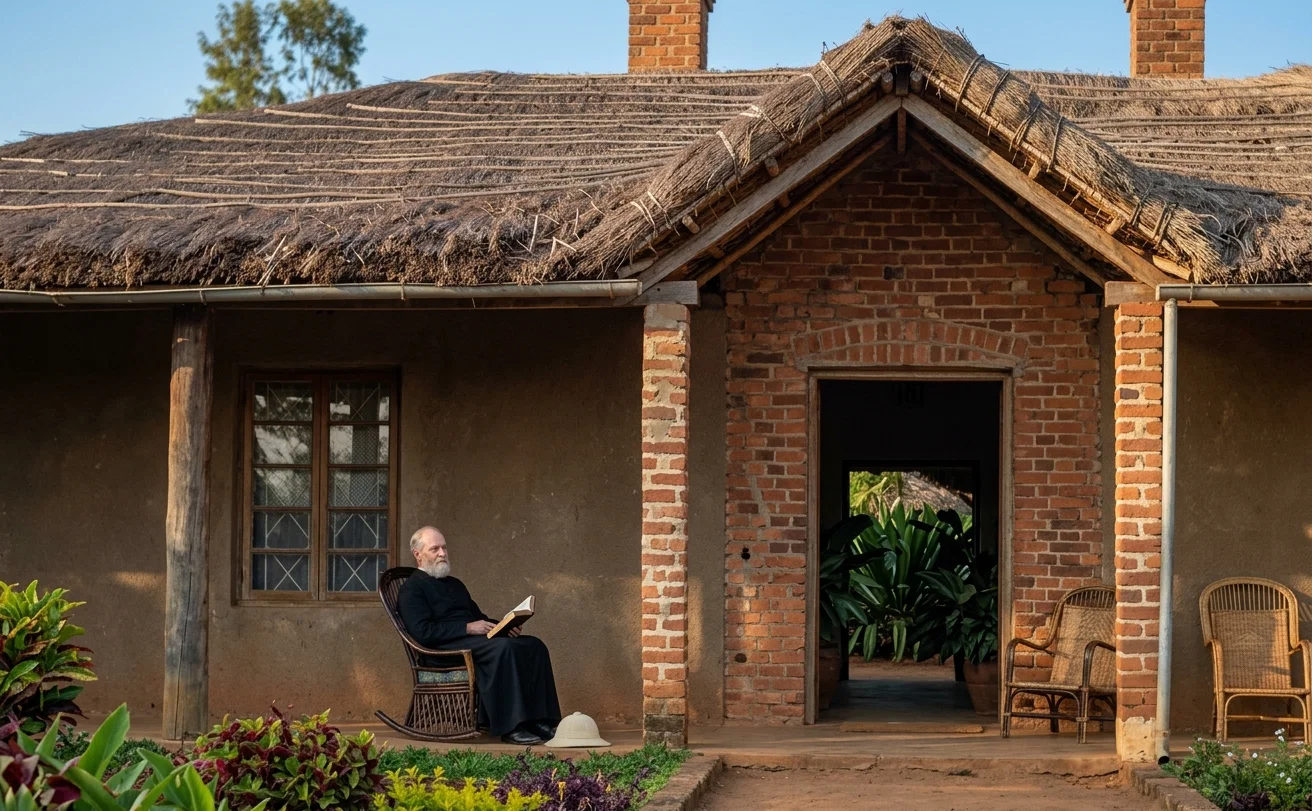
MISSION HOUSE, MALAMULO MISSION, NYASSALAND
Another impressive experience was our baptism services in the early part of the school year. Twenty candidates had been carried over from last year, being members of the regular candidates’ Bible class, which continues through each year. It is rather hard to explain the situation, unless the reader has been in a country like this. The native is strongly inclined to receive every word of the Bible as extremely literal. When he reads or hears read, ‘Repent and be baptized,’ he concludes that he must be baptized in order to be saved, and that the ceremony should not be delayed. But the gospel minister hesitates because the candidate has very little knowledge of gospel requirements. These twenty had been under definite instruction for a full year, and some of them had been hearers of the Word for a much longer time. I was called to attend the conference at Cape Town, requiring three months’ absence. So it was decided to have baptism for some from our out-station at Monekera, seventy-five miles to the north, and also for those best prepared from our class here. On Sabbath, November 14, thirteen from Monekera and five of our class were baptized in our little stream on the mission. Other members of the class, then numbering thirty-five, manifested disappointment that they could not also be baptized, and as we considered the matter, we saw no good reason for keeping them waiting longer. So another baptism was appointed for November 21, when thirteen others were added to our membership, making thirty-one for this school year. One of our most devoted candidates was sick, so he could not receive baptism with the others. My heart was made sad on hearing of his death while at the conference. We earnestly hope to meet him in the great resurrection day.
The prosperity of our out-schools has been marked. In these village schools we come into direct contact with heathenism. Three and four miles from our main station naked savages are found in all their primitive darkness. Almost any night we hear from the mission house the orgies of the heathen dance and drunken carousal. Our teachers, who go to hold schools in these villages, try to counteract heathen customs by teaching the ten commandments and the gospel of purity and salvation. We are glad that six out-schools are already in operation; but we feel that these schools should be multiplied much more rapidly than in the past. The expense of keeping up these schools is very little, and having as yet no native literature on present truth, it is our only means of reaching the people outside of our main mission station.
We are thankful for the practical interest taken in our native teachers by friends at home. The money which some have given to support these teachers is enabling us to put more teachers into the field, thus increasing the number of schools. We know that the prayers of our faithful brethren and sisters accompany their gifts, and this is encouraging to us, for we know that ‘effectual fervent prayer . . . availeth much.’
All our schools were closed the last of April for three months. It seems impossible to hold the native in school more than nine months. Some advantages come from the three months’ vacation. It permits most of our students to spend a few weeks at their village homes, where they have opportunity to teach the truth to their people. As some come from places two or three hundred miles distant, this scattering will soon make the truth known far and near.
Our closing exercises were held on the evening of May 2. Some weeks before, we had decided that the exercises should consist of class drills and music. By class drills is meant such exercises as had been a part of the regular school work. The recitation of Bible portions which had been memorized during the year formed an important part. The intermediate division repeated in concert thirty verses from John’s epistles,—verses on God’s love. Some children from two of our out-schools repeated the beatitudes—in their mother tongue, of course. The advanced division gave an interesting exercise in the book of Genesis, a part of the division repeating over seventy verses bearing on the creation and the history of the world to the call of Abraham, while part responded in the native language. Interspersed with hymns, which the native dearly loves, the exercises were both pleasant and profitable.
We are now in the holidays, and I am about to start on a trip to our outstations, intending to extend the trip into the interior, where some are calling for instructors to teach the present truth to their people. On July 1, we are to begin our teachers’ institute, to last four weeks, when about twenty teachers will be in training for next year’s school work, beginning August 1.
Cholo, Nyassaland.

En Route to Malamulo Mission

INA L. AUSTEN
[For many years missionaries have steamed and gone from the United States to South Africa to enter upon work at the missions established in the interior. It is with much interest that we present in this department this week the report of Miss Ina L. Austen, telling of the departure of herself and sister from Cape Town to engage in mission work among the natives at Malamulo. No doubt this is but the beginning of South Africa’s sending missionaries trained at the college at the Cape into the great mission fields lying to the north. Such workers can prepare more quickly than others, as they understand, in a general way, the habits and customs of those for whom they go to labor.—Ed.]
MARCH 19 the writer and her sister Etta left Cape Town for the Malamulo Mission, Cholo, Nyassaland. It seemed a sweet part of the going to have so many dear friends at the dock to bid us “Godspeed.” As we put out to sea, two boat-loads, as though loath to part with us, came gliding along in speaking distance of the steamer, thus affording us the opportunity of conversing with them for fully twenty minutes longer.
Long shall the memory of this “good-by” cheer us in our work, for we know that these same friends will remember us before the throne of grace. Mingled feelings of joy and sorrow filled our hearts,—the sorrow which always exists when parting from those whom we love, and great joy that the Father should deem us worthy to bear his name, and the news of his soon-coming kingdom, to those who sit in heathen darkness.
Our hearts are filled with praise and thanksgiving to our Heavenly Father for all his goodness. Every step of the way has his loving, guiding hand been with us. Truly he sent his angel before to prepare the way, as will be seen in the following brief description of our journey:—
The sea was rough, as it usually is at the “Cape of Storms,” and most of the passengers suffered with seasickness, from which the writer was glad to be free. We were sorry to miss seeing Elder R. C. Porter at Port Elizabeth, at which place we arrived Saturday morning, spending a happy Sabbath with the friends at Uitenhage.
The next day we reached East London. The sick passengers drew a sigh of relief as we left the bounding seawater, and glided into this quiet river-basin. Some immediately got into boats, and rowed to the pretty island about three miles farther up the river. We were just as anxious to put some distance between ourselves and the steamer, so filling a small basket with fruit and rolls,—the loving thought of our Cape friends,—we boarded a tram, which soon brought us to the finest beach in South Africa. Here we paddled and wrote letters and enjoyed ourselves generally.
The next day was spent in sightseeing, and necessary shopping. An elderly gentleman came aboard here, in whom we were glad to discover an old friend of our parents. Tuesday afternoon our steamer anchored at Port Natal. We were much impressed with the fine physique of the natives in this tropical clime, and became greatly interested in the ’ricksha men. However, their fine faces—quite handsome in many—and noble stature seem out of place with their grotesque apparel of horns, feathers, and pampas grass, and their monkey antics. They can not speak English, so when trying to arrest the attention of a prospective passenger, they shake the ’ricksha, and utter sounds between their teeth; such as, “tiss, tiss, shu.”
We were able to put in two days and a half sightseeing, and found everything very novel and interesting. At the “Back Beach” in Durban is a fine bathing-place, which is prettily illuminated in the evening. We spent about an hour on the pier watching the bathers. The botanical gardens are well worth seeing; and the museum, although small, has some very good specimens.
The greater portion of our time was spent with friends at a beautifully situated home on the Berea, from which place we had a grand view of the town and surrounding country through a good telescope.
At this port a lady was put in to share our cabin. We were very glad to make her acquaintance, as she, together with her husband and three other missionaries, is on the way to Nyassaland,—another mark of the Lord’s leading.
At Delagoa Bay we spent five days; but the time in port seemed none too long. Lourenco Marques is essentially a Portuguese town. The native here, unlike the fine Zulu, is very inferior looking, and it takes two to run a ’ricksha, one pushing. We had some amusing experiences in trying to find our way about, for the Portuguese in this part of the world are exceedingly uncommunicative, and no deaf-and-dumb language, such as we were obliged to resort to, draws from them more than a shake of the head, or a shrug of the shoulders. However, we managed to see all there was to be seen in this rather picturesque, though exceedingly warm place, where mosquitoes abound. Every good-sized house has its large veranda, as well as its windows and doors, barred by wire netting, against this obnoxious little insect.

Oriental Justice

NOTHING more takes the imagination of Orientals than an act of high authority in which stern justice is enhanced by a touch of grotesque humor. The story is still told of the warlike Ibrahim Pasha of Egypt that, when he was in possession of Syria, he one day saw from his house in Beirut a muleteer approaching with a loaded mule. He observed that on reaching an archway beneath which food was cooked for Arabic laborers and peasants, the muleteer, instead of going on a little farther to his destination and there unloading his mule, deliberately tied the animal up, and sat down to take rest and refreshment for himself. When the meal was about finished, two or three soldiers appeared, and by the pasha's order removed the load from the mule's back, and tied it upon that of its master, who, in turn, was made to stand there while his mule had a feed of barley and straw. —George M. Mackie, M. A., M. D.

Mission Notes

RECENTLY Elder J. T. Boettcher received a letter from a brother in far-off Siberia, which says: “About a year ago, five families of us moved to Siberia. We are keeping the Sabbath, and are in harmony with all the truths taught by Seventh-day Adventists. Since we came here, three other families have accepted the truth. Now we wish to unite with you; so please send us a worker who can instruct us further and organize us fully. We will gladly pay all expenses.”
ONE of the workers writes from Tonga Islands: “The last day of our Tongan school was an occasion of special interest. The pupils, who had no knowledge of English when they entered the school, were able to recite appropriate selections in English. Samples of the work done by the children were exhibited to the parents and friends present. Two of the highest chiefs in the island were there, and occupied seats on the platform. They spoke of their appreciation of the good work done by the school. Since the holidays began, about twelve others have made application to enter the school next year.”
THE number of Mohammedans converted to Christianity may be comparatively small, as it pleases critics of missions to disparagingly assert, but the leaven of liberty which was introduced into Mohammedan countries through Protestant missionary schools is responsible for the overthrow of the despotisms which have blighted those countries for centuries. In Turkey and Persia the movements for constitutional government may be traced to the influence of the schools alluded to. These struggles will be accompanied by social as well as political changes, the end of which it is impossible to forecast. Who will say that great religious changes will not also take place?—The United Presbyterian.

The Maine Camp-Meeting

THIS year the annual camp-meeting for the State of Maine was held two months earlier than usual. By making this change, it was possible for Sister E. G. White to attend. The meeting was held under Deering's Oaks, Woodford's Station, Portland, Maine, July 2-11.
The General Conference laborers and other ministers and special workers who were present during a part or the whole of the session, were as follows:—Mrs. E. G. White, Elders W. C. White, S. N. Haskell, E. W. Farnsworth, C. H. Edwards, F. C. Gilbert, H. J. Edmed of South Africa, and C. S. Longacre, Prof. B. F. Machlan, Dr. D. H. Kress, and Brethren R. J. Bryant and F. M. Dana.
Among those present from the Maine field were the following: Elders J. B. Goodrich, B. F. Davis, S. J. Hersum, John Wilson, H. C. Giles, A. J. Verrill, and Sister E. H. Morton.
The burden of the preaching seemed to be that there is but little time remaining in which to finish the work; and the special application to our own people was that one and all should enlist in the active work to give the gospel for the last days to the world, working according to the talents or abilities God has given.
There seemed also to be an impelling power working in many hearts, urging them to more active service than in the past, thus responding to the call of the hour. Sister White's five sermons, also Elder Haskell's discourses and early morning Bible studies, were especially filled with calls to service.
Sister White expressed herself as especially burdened over the work in Portland and vicinity, and urged that the camp-meeting be followed by a prolonged tent effort; that a strong company of workers, colporteurs, and evangelistic canvassers be immediately placed in this field; and that this field be worked now. Some response to this appeal for the Portland field appears, inasmuch as the large tent still remains there. Meetings have been kept up daily to the present time, and may continue for a few weeks longer. Elder C. H. Edwards has been conducting the meetings since the camp-meeting proper, holding a Bible study each afternoon at three o'clock, and a preaching service each evening.
Three of the Portland daily papers lent their columns quite liberally to reports prepared by us, and we were given an average of a column and a half each day. It was desired to keep up the work with the Portland dailies; therefore we have continued the reporting till now, about one fourth column a day in each of the morning dailies, the Portland Daily Press and the Daily Eastern Argus, and a column a day in the Portland Evening Express. Besides our own reports, these journals have carried quite an amount of additional matter pertaining to the meetings, and in most cases well put.
Our religious liberty secretary, Brother W. O. Howe, gives the word that our reports have been quite extensively copied over the State.
Under the evangelistic efforts and calls of Sister White and Elders Haskell, Farnsworth, Gilbert, Edwards, and Longacre, quite a large number went forward to a renewed consecration. In the aggregate this must have included nearly all our people who attended the camp-meeting. Quite a good number were of the precious youth and children just beginning to take a public stand under the cross of Jesus.
Some means was raised for the defraying of expenses of the meeting, also a subscription of about two hundred dollars for the encouragement of the brethren in Portland, who have begun the erection of a church building.
After the camp-meeting Elders H. C. Giles and A. J. Verrill, with some assistants, went to conduct a tent effort at Rumford Falls.
The attendance of our own people at this meeting was greater than at any previous camp-meeting in this State for the past four years.
Portland is a field which needs to be worked soon, and needs many workers. Pray for the handful of workers in this old cradle of the message, and that the truth may now find the hearts of those “who are the called according to his purpose.” C. W. KENISTON.

Work With the Colored People in Florida

Since my return from the General Conference, my time has been given to visiting our churches and companies, and I am glad to report progress.
After spending a few days with our little company of believers in Fernandina, where I held my last tent-meeting, I was thankful to leave them all of good courage. I held meetings at Jacksonville for eight nights, and many were interested. Two men took their stand to keep the commandments of God. I am glad to see our Jacksonville church growing, and trust to see them with their own meeting-house soon. At Hawthorn, there are some who are interested and desirous to know the truth. We hope to do something for these people soon. At Oakland are two families of believers. While they are keeping the Sabbath, yet they have no Sabbath-school; I hope to organize a school there before our next camp-meeting. Orlando is the oldest of our churches in this conference, and all seem to be of good courage. Because of the heavy rains, we made no plans for the meetings, but I believe much good was done.
The ordinance of humility was celebrated with each of the churches visited. All enjoyed much of God's Spirit in these meetings.
I ask the prayers of the readers of this paper for the work for the colored people in Florida.    J. W. MANNS.

Preparing for Service

As the REVIEW has come to us from week to week, it has been a pleasure and encouragement to read the reports from foreign mission fields. Many of the writers were boys and girls with us at dear old Avondale school in Australia, and some were our teachers and associates. Thinking that these friends would be interested to learn of our progress, we send this message through the REVIEW.
Prompted by the Spirit of the Lord, we desired to be of service in his cause, and promised him that if the way opened for us to obtain a medical education, we would use the knowledge in his service. Our many friends well know how the way opened. It is now seven years since we left Australia.
Since leaving Australia, it has been our privilege to attend the South Lancaster Academy, from which we were graduated in 1904. Our work from the academy was accepted in Edinburgh, after being indorsed by the Michigan State Board as sufficient for preparatory to a medical course. Our recollections of South Lancaster will always be pleasant, and the influence of the school has been such as to inspire us to faithfulness in service for the Master.
After leaving South Lancaster we attended the American Medical Missionary College in Battle Creek, completing the medical course in 1908. At the time of graduation we passed the Michigan State Board examination. We enjoyed our work in the medical college, and we shall always remember the kindness of our teachers and friends there. We feel grateful to the Lord for his keeping us in good health all through the course.
April 18 we left Battle Creek for Washington, where we stayed for one week. We were, indeed, surprised to see the progress of the work. Although we have tried to keep in touch with it by means of the REVIEW, we had but a faint conception of the work being done in Takoma. The Sanitarium is in an ideal situation, and there is such a sweet influence pervading the institution that it is no wonder the place is filled to overflowing.
One feels tempted to judge the work being done by the size and number of the buildings and the beauty of their surroundings, but we know these are secondary considerations. When we visited the publishing house, we were impressed more than ever that surely there is a great work being done by our people. The quantity of literature going out from the printing-office indicates that there is a demand for it somewhere by inquirers after truth. Do we who know the truth half appreciate what it has done for us, and what it will do for us if we are faithful?
Since it is our purpose to return to Australia to practise, it is necessary to obtain British qualifications. This will necessitate our remaining in Edinburgh for a while, to prepare for a final examination. It, no doubt, will be hard work, but we believe that if we do our part faithfully, the Lord will not fail us. We shall be very thankful when we complete our work so that we can be of use in the place that needs us the most.
A. V. HEYNEMANN, ETHEL MANNERS HEYNEMANN. Edinburgh.

Canvassing for “Christ’s Object Lessons”

I HAVE now canvassed for “Christ’s Object Lessons,” in connection with my other regular canvassing work, in six States and Territories—California, Arizona, New Mexico, Nevada, Oregon, and Washington. I find the plan, under God’s blessing, succeeds. It seems to call down blessings on all the rest of the work,—is a guaranty of its success, a safeguard, an insurance policy of its ultimate triumph.
I see many tokens of God’s love and care. I seek the Lord much in prayer. He does hear and answer. He never disappoints those who come to him in faith. No one ever faithfully sought the Lord in vain. “Ask, and it shall be given you; seek, and ye shall find.” O I wish our dear canvassers and workers would take hold of “Christ’s Object Lessons” and “Ministry of Healing,” and make the sale of these books a part of their work. God would surely bless in so doing. WALTER HARPER.

Camp-Meeting for the Colored People in Texas

THE time fixed upon this year to hold this annual convocation was July 8-18. In the selection of the town, the location, the advantages for water at a trifling cost, the easy access to and from the trains, all made us realize that the hand of Providence guided in our affairs. Truly the “Lord has been our helper.”
All wished to make the camp-meeting a success; consequently all were interested, and manifested it by their attendance at the services, and willingness to take an active part in the duties of each day. All have said, “It was good for us to be there.”
While there were many features which needed improvement, yet none need be discouraged, for our effort is to reach the highest point attainable. Truly, upon our camp-meeting of last year we have made a decided advancement, and hope to keep up the difference in point of excellence between the camp-meetings each year.
Our tract society was a pleasing feature to all at our camp-meeting. Of the eight dollars and fifty cents' worth of tracts sent us, more than half was disposed of on the ground, while in the sale of Bibles and small books we reached the sum of five dollars and thirty cents; making a total of ten dollars and ninety-five cents. We feel grateful to God for this small beginning, and shall ever praise him for his leading.
Baptism was administered on the ground, and seven candidates followed their Lord in that ordinance; some of those were rebaptized. To us these services were loud calls from him who is now viewing the guests who are being attired for entrance into that heavenly bridal room which all who will have a part in the kingdom of God's dear Son will soon have to enter.
There is quite an interest here now. Brother Gates and myself are still here, to follow up and develop it. You will rejoice with us for the results achieved through grace—two have decided to take their stand, and walk with the commandment-keeping people of God. Remember us in your prayers. M. JONES.
Continue reading: Selling Books in Mexico