"And there were certain Greeks among them that came up to worship at the feast; the same came therefore to Philip, which was of Bethsaida of Galilee, and desired him, saying, Sir, we would see Jesus. Philip cometh and telleth Andrew; and again Andrew and Philip tell Jesus." At this time Christ's work bore the appearance of cruel defeat, and to his disciples the case seemed hopeless. But Christ was approaching the consummation of his work. An event which concerned not only the Jewish nation, but the whole world, was about to take place. When Christ heard the eager, hungering cry, "We would see Jesus," his countenance lighted up, and he said, "The hour is come, that the Son of man should be glorified." He went out to the court of the temple where the multitude was assembled; for at the time when the disciples came to him, he was in that part of the temple from which all but the Jews were excluded. He met the Greeks and had a personal interview with them.
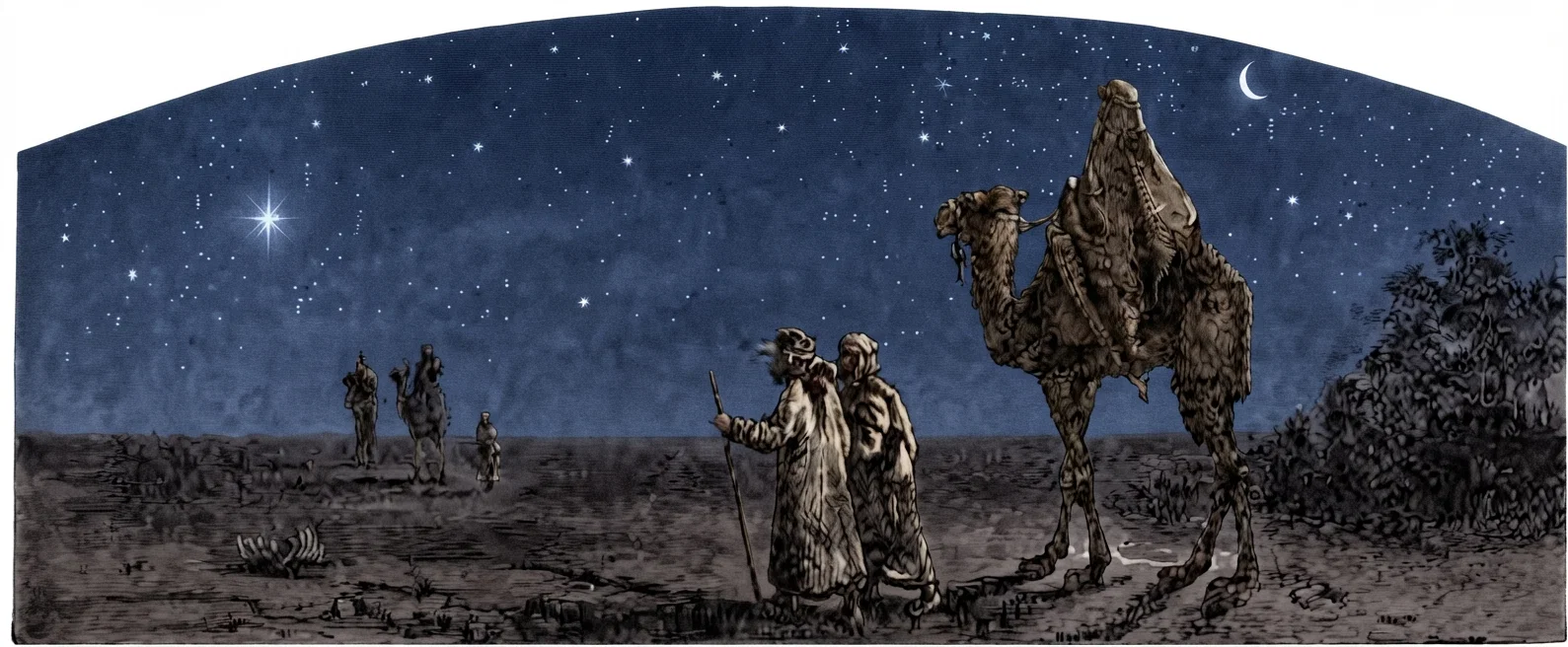
These men, coming from the west at the close of Christ's life on earth, represent what the wise men from the east represented at the beginning of Christ's life. At the time of Christ's birth the Jewish people were not studying the prophecies regarding the momentous events about to take place. So engrossed were they in their own ambitious plans that they knew not the time of the Messiah's advent. Angels found them unprepared to receive the Saviour, and the communication which should have been given to priests and rulers, was given to humble shepherds. These, guided by a bright star, came to the birthplace of Christ, and worshiped him. The magi, too, came to the manger with gifts, and frankincense, and myrrh.
So these Greeks, representing the nations, tribes, and peoples that would awake to their need of a power out of and above finite power, came to see Jesus. They had heard of Christ's triumphal entry into Jerusalem, and they longed to be instructed as to the hopes of the Jewish nation regarding the Messiah. Some supposed, and had circulated the report, that Christ had driven the priests and rulers from the temple, and that he was to take possession of David's throne, and reign as king of Israel. "We would see Jesus," they said.
Glorified through Death.
The hour of Christ's glorification had come. He was standing in the shadow of the cross, and the inquiry of the Greeks showed him that the sacrifice he was about to make would bring all who accepted him into perfect harmony with God.
He knew that the Greeks would soon see him in a position they did not then dream of. They would see him placed beside a robber and murderer, who would be chosen before the Son of God. They would hear the people, inspired by the priests and rulers, making their choice. As the bellowing of wild beasts their voices would be heard, saying, "Release unto us Barabbas." And to the question of Pilate, "What shall I do then with Jesus, which is called Christ?" the answer would be given, "Let him be crucified."
By making this propitiation for man's sins, Christ knew that his kingdom would be perfected and would extend throughout the world. He would work as the Restorer, and his Spirit would prevail. For a moment he looked into futurity, and heard the voices proclaiming in all parts of the earth, "Behold the Lamb of God, which taketh away the sin of the world." The anticipation of this, the consummation of his hopes, is expressed in the words, "The hour is come, that the Son of man should be glorified." But the way in which this glorification must take place was never absent from Christ's mind. Only by his death could the world be saved. As the grain of wheat, the Son of man must be cast into the ground, and die, and be buried out of sight; but he was to live again.
None of the people, not even the disciples, understood the nature of Christ's kingdom. O, how his patience must have been taxed by the low estimate placed by men upon his mission and character! They seemed unable to believe that he would not sit on David's throne, that he would not take the scepter, and reign as a temporal prince in Jerusalem.
Words true and full of significance when rightly placed are misleading when misapplied. The utterances of the prophet describing the second appearing of Christ were applied by the Jewish teachers to his first advent. The description of Christ's second coming is true, but this truth, the beautiful and grand, could not be made to harmonize with his first coming. The word was true, but it was truth placed in the wrong setting.
Christ had often tried to tell his disciples the truth concerning his work, but they were unable to take it in. He gave them lessons which they could in nowise comprehend. He longed to open everything before them; but he was obliged to say, "I have yet many things to say unto you, but ye can not bear them now." He was laboring to keep back the revelation he desired to make. He knew that if he told them what he desired to, his words would not be appreciated or understood. The impressions made upon their minds by the maxims and traditions with which they had been familiar from their youth, were difficult to efface.
But after Christ's crucifixion, Jew and Greek, barbarian and Scythian, bond and free, would be able to understand his work, and to comprehend the words which upon this occasion he addressed to his disciples, "Verily, verily, I say unto you," he said, "Except a corn of wheat fall into the ground and die, it abideth alone; but if it die, it bringeth forth much fruit."
Christ saw that the fallow ground of the heart must be broken up, the soil thoroughly worked, the good seed sown and carefully harrowed in. It was not pleasant for the disciples to submit to this. Many opposite influences had been at work confusing and beclouding their minds. But with what wisdom Christ presents his future, illustrating it by the things of nature, that the disciples might understand that the purpose of his mission was to be fulfilled by his death. "Verily, verily, I say unto you," he said. When Christ said, "Verily, verily," the disciples always understood that something of importance was to follow, and now, as they listened to his words, they saw divinity revealed in humanity. "Verily, verily, I say unto you, Except a corn of wheat fall into the ground and die, it abideth alone; but if it die, it bringeth forth much fruit." When the grain of wheat falls into the ground and dies, it springs up, and bears fruit. So the death of Christ would result in fruit for the kingdom of God. Life was to be the result of his death, in exact accordance with the law of the vegetable kingdom.
Lessons of Nature—Death of Self.
Every harvest this lesson is repeated. Those who till the soil have the illustration of the Saviour's words ever before them. Year by year man preserves his grain by apparently throwing away his choicest sample. For a time this must be hidden under the furrow, to be watched over by the Lord. Then appears the blade, then the ear, and then the corn in the ear. But this development can not take place unless the grain is buried out of sight, hidden, and, to all appearances, lost.6
The seed buried in the ground produces fruit, and in their turn the seeds of this fruit are planted. Thus the harvest is multiplied. So the death of Christ on the cross of Calvary will bear fruit unto eternal life. The contemplation of this sacrifice will be the glory of those who, as the fruit of it, will live through the eternal ages.
With this lesson Christ connects the self-sacrifice that all should practise. "He that loveth his life shall lose it," he declares; "and he that hateth his life in this world shall keep it unto life eternal. If any man serve me, let him follow me; and where I am, there shall also my servant be; if any man serve me, him will my Father honor."
This is the only honor we should seek. And we should seek it with a determination and an earnestness proportionate to the value of the treasure we have in view,—eternal life in the kingdom of God. Christ claims the complete consecration of man to himself. This is the condition upon which man is exalted. As he submits his mind, his body, his soul, to God, so he will be honored. Self-renunciation is the great law of self-preservation, and self-preservation is the law of self-destruction.
He who lives for self, and devotes his life to self-serving, will lose his life. He may gather much, but he imparts little. All such are as the grain that is eaten. Those who think and plan for self only, who desire everything to minister to their ideas and advance their interests, pursue a course of selfish idolatry. God says of them, "Ephraim is joined to idols; let him alone." Those who love this temporal life so well that they will scheme for themselves, and work upon worldly plans, will find at last that they are bankrupt; for they are without the eternal riches. But those who hate this life, who choose death rather than a life without Christ, win heaven. Those who devote their lives to God's service, who honor him, and commit the keeping of their souls to him as unto a faithful Creator, will bring forth fruit unto eternal life. The Lord will keep that which is committed to his trust against that day. He will honor the man who serves him with the whole heart. MRS. E. G. WHITE.
(To be continued.)
THE TURKS AND ARMENIANS.
By H. P. H.
Bearing of the Recent Massacres on the Eastern Question.
THE Eastern Question, or the future of the Turkish Empire, is one that has for many years occupied the attention of Europe more than any one political question. In the time of the Great Reformation, the Turks reached the zenith of their power, and for a time threatened to overrun all Europe; since that time they have gradually declined, till 1840, when the Turkish power practically lost its independence, and its affairs were taken in hand by the great powers of Europe, and since have been directed by them. It is generally understood that it is only a question of time till the Turk will have to leave Europe. Just when this will take place, and what disposition will be made of his territory, constitute the interesting phases of the Eastern Question.
During the last fifty years this question has many times come to the front, and often its final solution has been expected. But it has continued unsettled to the present. In 1895 new troubles with the Armenians broke out, and as a result, the Christian world has been agitated to an unusual degree. Christians have always held the Turk in horror, and felt that he has no right in Palestine or Europe; it was this feeling that led to the Crusades; the same spirit exists to-day, and has been so greatly intensified by the recent Armenian massacres that there is a strong demand for the extermination of the "unspeakable Turk." Decided action seems inevitable as the result of present complications. What the result will be, and its effect on the whole world, is hardly dreamed of by the masses!
To understand the situation more fully, let us consider briefly the position of the Armenians and their relation to the Turkish Empire.
The Armenians, a heathen people at the time of Christ, embraced Christianity early in the Christian era. They have lived in the vicinity of Mount Ararat, and at times extended their territory down to the Mediterranean. Altho a high-spirited, liberty-loving people, it has been their lot to be most of the time of their history subject to some foreign power. When the Turks conquered Asia Minor, the Armenians fell under their power, and have since been their subjects. To-day, the Armenians number about three millions; and while the body of the nation is in the country called Armenia, in the vicinity of Mount Ararat, large numbers are scattered throughout the Turkish Empire.
The high-spirited, liberty-loving, industrious Armenian is quite the opposite of the Turk in character; this has led to much friction; the Armenians have always groaned under the Turkish yoke, and sighed for liberation. They have employed every means in their power to gain this end. The more they did in this direction, the heavier the Turk bore down on them, to keep them in submission, until at times the strain became so great as to lead to an outbreak. One after another of the liberties of the Armenians were curtailed. They could not travel about as freely as other Turkish subjects, and were not allowed to carry arms. Being unable to do much in the interest of liberty at home, they began to migrate to other countries, especially France and the United States, where they printed revolutionary literature to send to their brethren at home. To hinder this work, the Turk interfered with their migration. Thus the strain continued to increase until the recent great outbreaks and massacres took place.
At the time of the Berlin Congress in 1878, when the affairs of Turkey and Russia were arranged by the great powers of Europe, England acted a prominent part; she was commissioned to secure certain reforms in the government of the Armenians, and act as guardian of their interests. In remuneration for this, she was given possession of the island of Cyprus, which she has occupied from that time to the present.
When the recent Armenian outbreaks began, England was in consequence the first to interfere and demand reforms in the administration of Armenian affairs. While various reforms were proposed and discussed, the situation of the Armenians grew worse, and the massacres continued and increased in severity till the indignation of the whole Christian world reached a high pitch, and almost with one voice it was demanded that the Turk be summarily dealt with. Now it was demanded not only that he be driven out of Europe and Palestine, but that he be exterminated.
It is not our purpose to study this question from the political standpoint, but from the standpoint of the Word of God. Again and again it has been thought that we had reached the time of final solution of this question, and often politicians have even made out a map of the division of the territory of the Turk. But soon some unknown feature would appear, and the map would have to be revised. There is no certainty in political speculation about this question, hence we shall lose no time in this direction. What we desire to know is the truth, and that we can know of a certainty only as far as the Word of God speaks on the future of this question. And as we shall see in our next article, the Bible speaks definitely of the Turkish Empire, and shows what will be its end, and the meaning of this event to all the world.
JEWISH CUSTOMS AND TRADITIONS.
By F. C. Gilbert
(By an Israelite.)
The Garment.
SOMETIMES it seems difficult to appreciate the real work of the Master in opposing the Jewish rabbis, and setting aside their fables and traditions. The bondage in which the people were held was a cruel one, and the Jews, both ancient and modern, who love freedom can much appreciate the words of the Master: "And ye shall know the truth, and the truth shall make you free." "If the Son therefore shall make you free, ye shall be free indeed." John 8 : 32, 36. The conditions of the people would not have been so apprehensive did the teachings of the scribes and Pharisees repudiate entirely the Word of God. But the leaders of thought claimed they were declaring what God stated in the law, and as teachers in Moses' seat, were giving the exegesis of those laws. Hence the Jews often called Christ a blasphemer, a transgressor, and many other abusive names, because his teachings concerning the truth were so opposed to those of the teachers.7
Prominent among their traditions was that concerning the garment. While the Saviour did not denounce them for using this article, he did condemn them for making the borders large. There is nothing whatever in the Old Testament which directly points to the use of such objects; but when ritualism became prominent with the Jews, after the Babylonian captivity, and the Word of God was not so abundant with them, virtue and righteousness were claimed obtainable by the performance of overt acts of the law, as interpreted by the elders.
The reason assigned for wearing the garment is based upon the following scriptures:—
"And the Lord spake unto Moses, saying, Speak unto the children of Israel, and bid them that they make them fringes in the borders of their garments throughout their generations, and that they put upon the fringe of the borders a ribband of blue. And it shall be unto you for a fringe, that ye may look upon it, and remember all the commandments of the Lord, and do them; and that ye seek not after your own heart and your own eyes, after which ye used to go a-whoring; that ye may remember, and do all my commandments, and be holy unto your God. I am the Lord your God." Num. 15 : 37-41.
"Thou shalt make thee fringes upon the four quarters of thy vesture, wherewith thou coverest thyself." Deut. 22 : 12.
These texts were interpreted to mean that a garment should be worn by the people, males only, upon which there should be a border of blue, and on the four corners a fringe. To this garment also was attached a sacred meaning, and the people were taught to believe that the Lord ordered the use of it as well as the form of benediction before wearing it. In the eleventh verse of this chapter in Deuteronomy is written that "thou shalt not wear a garment of divers sorts, as of woolen and linen together." This text is thought to tell how the garment mentioned in the next verse is to be worn. Hence the Jews make this garment of one kind of material only, and then put this ribband of blue upon it as is written. It is worn only by males who have reached the age of thirteen, in connection with the morning services every day throughout the year, save the day which commemorates the destruction of the temple; then it is worn at the service in the evening. The rabbis teach that the longer the garment, and the broader the band, the more piety does the owner possess. And the more pious a man is, the more will he be highly regarded and reverenced. It is worn in the synagog as people wear a shawl.
Before it is donned, the first two verses of the 104th psalm are repeated, which speak of garment and covering. Then, after an introduction of another prayer, the following is offered:—
The reason for the wearing of the garment of fringes is to establish the command of my Creator, as it is written, "And they shall make unto themselves fringes," etc. And as I cover myself with a garment in this world, so I hope my soul will be clothed with beauty in the world to come, even in the Garden of Eden; and through this commandment I hope deliverance will come to my body, soul, and spirit, and my prayer from my opponents.
Then the following prayer is offered:—
Blessed art thou, O Lord, King of the universe, who hath sanctified us through his commandments, and hath commanded us to wear fringes.—Jewish Prayer Book, edition 1875.
It is thus made to appear that the Lord himself commanded the wearing of this garment, and it would not be doing his will if it were not performed. Now there is a deep truth in this object, by which the Messiah can be seen, and it frequently makes a deep impression upon the mind of the Jew when his attention is called to it. But the wickedness of the scribes and Pharisees is that they made the tradition of man to appear as the commandment of God, thus turning the attention of the people away from God to man. And so the most pious of the Jews wear the garment so that it will cover them completely, from the crown of the head to the soles of the feet. And by making the border of it very wide, their virtues were made more prominent. It is in this they were such hypocrites, and not in simply the wearing of the garment. The Saviour did not condemn them for merely wearing it, as before stated, but for enlarging it so as to make it appear that the virtue was in the thing itself.
There is no doubt, however, but the Lord had a precious lesson to teach ancient Israel in the use of the garment. He told them to wear these things upon their clothing, and to look upon them, and to keep his commandments, that they might be a holy people. No holiness or righteousness could be obtained outside the Messiah, for in the Lord shall the seed of Israel be justified, and his name is Jehovah our righteousness. Jer. 23 : 6. It was a truth to teach them that the garment which alone could give them holiness was that worn by Messiah, which enabled him to be holy and keep the commandments of the Lord. So we read:—
"I will greatly rejoice in the Lord, my soul shall be joyful in my God; for he hath clothed me with the garments of salvation, he hath covered me with the robe of righteousness, as a bridegroom decketh himself with ornaments, and as a bride adorneth herself with her jewels." Isa. 61 : 10.
If the reader will read the entire chapter, he will see that it is a prophecy of Christ. So the pious of the Jews believe that Messiah will be their righteousness; and, as they cover themselves with this garment, they hope their soul will be clothed in the world to come with his righteousness. But instead of realizing that through him only this is secured, they are led to believe that the wearing of this now gives them present righteousness, and will be a part of the merit which will give them admittance into the kingdom of God; then the Lord will put upon them his righteousness. The hypocrisy and unbelief will never give them purity and holiness, however much it may be donned upon the outside.
But, thanks be to God, Jesus is made unto us wisdom, righteousness, sanctification, and redemption. 1 Cor. 1 : 30. He clothes us with his own garment now, which alone will fit us to wear the beautiful garments throughout all eternity. Thanks to him for light and truth, and for the unspeakable gift.
F. C. GILBERT.
WHAT CHRISTIANITY HAS DONE.
JAMES RUSSELL LOWELL, some years ago, in an after-dinner speech in London, thus replied to a sneer at religion: "When the microscopic search of skepticism, which has hunted the heavens and sounded the seas to disprove the existence of a Creator, has turned its attention to human society, and has found a place in this planet where a man can live in decency, comfort, and security, supporting and educating his children unspoiled and unpolluted; a place where age is revered, infancy respected, womanhood honored, and human life held in due regard, when skeptics can find such a place ten miles square in this globe where the Gospel of Christ has not gone and cleared the way, and laid the foundation, and made the decency and security possible, it will then be in order for the skeptical literati to move thither and ventilate their views. But so long as these very men are dependent upon the religion they discard for every privilege they enjoy, they may as well hesitate a little longer before they seek to rob the Christian of his hope and humanity of its faith in that Saviour who alone has given to man that hope of life eternal which makes this life tolerable and society possible, which robs death of its terrors and the grave of its gloom."
TRUSTING IN THE ARM OF FLESH.
By W. N. G.
A MINISTER in Auburn, N. Y., in course of a recent address in support of Sunday laws, said: “What we want is such a public sentiment that will demand the law and the Sabbath to be observed if it takes all the police force of the Empire State to enforce it.” The meeting was under the auspices of the churches of the city, and was to have been addressed by Mr. W. F. Crafts, of National Reform fame. In his absence, however, three of the ministers of the city undertook to fill his place. This may account for the expression of such a sentiment as that which we have quoted. It is a characteristic National Reform sentiment, as the National Reform idea of keeping the commandments of God is to have them enforced by civil law.
This reminds us of an expression of one of the speakers at the recent annual meeting of the California State Sabbath Association, held in this city. The speaker was a D.D. from San Jose, and he stated that about thirty members of his church could not keep the Sabbath because we had no State Sunday law. He meant that they held situations which they would lose if they refused to work on Sunday. Professing to follow Christ, and believing that Sunday is the Sabbath, their minister justifies them in disobeying what they believe to be the commandment of God because their employers are not compelled to observe Sunday. A fundamental theory of National Reformism is that the right of one to obey God’s law is dependent upon the compulsion of all to do so.
Logically, from the standpoint of such doctrine, obedience to the law of God is dependent upon its enforcement by the civil power.
It is a fact, however, that should be emphasized, that Jesus Christ kept the law perfectly at a time when paganism was upheld by the then universal government of Rome, and even the traditions enforced by the nominal people of God were adverse to the principles of his law. Christ lived upon the principle afterward announced by his apostles, that we “ought to obey God rather than men.” Acts 5:29. “And he said to them all, If any man will come after me, let him deny himself, and take up his cross daily, and follow me.” Luke 9:23. “And whosoever doth not bear his cross, and come after me, can not be my disciple.” Chapter 14:27. To this we may add the testimony of John: “He that saith he abideth in him ought himself also so to walk, even as he walked.” 1 John 2:6.
Neither Christ nor his apostles ever sought to have the civil law so framed as to make it easy for them to obey God. They never sought to have the civil power compel others to observe the Sabbath, or any day as the Sabbath. Such action was left for an apostate church, after she had committed fornication with the kings of the earth. All attempts of the church to secure the aid of the civil government in enforcing her dogmas is fornication; it is seeking alliance with the world; it is leaning upon the arm of flesh rather than upon the power of God. W. N. G.
WHO THEY WERE.
THE American revision committee consisted of Rev. Theodore Dwight Woolsey, D.D., LL.D., late President of Yale; Rev. John Henry Thayer, D.D., formerly Professor of New Testament Exegesis, Andover Theological Seminary; Charles Short, LL.D., Professor of Latin, Columbia College; Ezra Abbot, D.D., LL.D., Professor New Testament Exegesis, Harvard Divinity School; Rev. Jonathan Kelsey Burr, D.D.; Thomas Chase, LL.D., President of Haverford College; Rev. Howard Crosby, D.D., LL.D., ex-chancellor, University of New York; Rev. Timothy Dwight, D.D., Professor New Testament Exegesis, Yale Divinity School; James Hadley, LL.D., late Professor of Greek, Yale College; Rev. Horatio Balch Hackett, D.D., LL.D., Professor of New Testament Exegesis, Rochester Theological Seminary; Rev. Charles Hodge, D.D., LL.D., late Professor of Theology, Princeton Theological Seminary; Rev. Asahel Clark Kendrick, D.D., LL.D., Professor of Greek, University of Rochester; Rt. Rev. Alfred Lee, D.D., LL.D., Bishop Protestant Episcopal Diocese of Delaware; Rev. Matthew B. Riddle, D.D., Professor of New Testament Exegesis, Hartford Theological Seminary; Rev. Philip Schaff, D.D., LL.D., Professor of Sacred Literature, Union Theological Seminary; Rev. Henry Boynton Smith, D.D., LL.D., Professor Systematic Theology, Union Theological Seminary; and Rev. Edward Abiel Washburn, D.D., LL.D. This committee was fairly divided among all leading Protestant denominations.—Voice (New York), April 9, 1896.
Take Advantage of the Present
By Victor Hugo
TAKE all reasonable advantage of that which the present may offer you. It is the only time which is ours. Yesterday is buried forever and to-morrow we may never see.—Victor Hugo.
A Young Man’s First Drink
WHEN a young man takes his first drink, he gives the devil an iron-clad mortgage on himself.
"NATIONAL REFORM" IS CHURCH AND STATE.
By W. N. G.
THE movement called National Reform, and advocated in its various cumulative phases by all the principal so-called evangelical churches and religious or semi-religious reform associations in which such churches are interested, was inaugurated by a single church for the special benefit of that church. The first step ever taken in this direction, and the first publication ever issued in advocacy of the principles involved, were by prominent representatives of the Reformed Presbyterian Church. The Reformed Presbyterian, organ of that denomination, in the month of January, 1870, published an article on the subject, from which we take the following statements:—
1. "This important truth of the Lordship of Jesus Christ over the nations, was attained by our reforming and martyred fathers in Scotland, and has been transmitted down to us sealed with their blood, and is the precious and peculiar inheritance of the Reformed Presbyterian Church, and distinguishes her from all the other evangelical churches in this and other lands. No other church professes to maintain this great principle in its practical applications."
2. "The distinctive principles of the Reformed Presbyterian Church are the principles, and the only principles, of National Reform."
3. "The proposed amendment of the Federal Constitution is an acknowledgment by the government that God is the author and source of all authority and power in civil government; that the Lord Jesus Christ is the ruler of nations, and that his revealed will contained in the Bible is the supreme law of nations. Now the association for National Reform proposes to have these distinctive principles of the Reformed Presbyterian Church adopted into the Constitution of the United States, and annulling any part of that Constitution that may be inconsistent with these principles." "The adoption of this amendment into the Constitution would be the government's doing, the highest honor to the Lord Jesus Christ, and the greatest benefit to our church."
4. "The principles of National Reform are our principles, and its work is our work. National Reform is simply the practical application of the principles of the Reformed Presbyterian Church for the reformation of the nation."
In further proof of our position, we cite as authority the Reformed Presbyterian Synod. In 1885 that body said that this National Reform "is the tap-root of the Reformed Presbyterian Church." Again in 1886, in the report on National Reform, it said, "It is ours to hold up the ideals of God which have originated the National Reform cause." These utterances are sufficient to show that the success of the movement as originally designed would have resulted in a Reformed Presbyterian government for the nation.
The growth of the National Reform cause, and its direct espousal by the Woman's Christian Temperance Union, its virtual indorsement by the National League for the Protection of American Institutions, and its practical advocacy by the Young People's Society of Christian Endeavor, etc., has carried it beyond the control of the Reformed Presbyterian Church. It is no longer a distinctive feature of that church; as long as it was such its power for evil was insignificant. But the people should bear in mind that none of these later advocates of the principles involved have in any way sought to change the original purpose, namely, the control of the government by the church.
The idea that the National Reform movement is a distinctively Reformed Presbyterian doctrine has been overwhelmed by the flood of greater denominations enlisting to sustain the cause; but the Church-and-State principle remains the same. It matters not whether the government be conformed to Reformed Presbyterian lines, or to lines consonant with the principles of any other religious denomination, or to religious principles upon which they all may conjointly agree, the result is practically the same—it is Church and State union. And the "Christian Citizenship" agitation, in the progress of which the Christian Endeavor Society has become the vanguard, is but the interdenominational force of the National Reform scheme. W. N. G.
"HAD THEY KNOWN IT."
By Editor
THE true Christian can always find a reason for the exercise of charity towards those who do wrong or ill-use him in their ignorance. Peter said to those who crucified Christ, "I wot that through ignorance ye did it, as did also your rulers." Paul said in speaking of the same ones: "Because they knew him not, nor yet the voices of the prophets which are read every Sabbath day, they have fulfilled them in condemning him. And tho they found no cause of death in him, yet desired they Pilate that he should be slain." "Which [wisdom] none of the princes of this world knew; for had they known it, they would not have crucified the Lord of glory." And9Jesus said in speaking of those who would ill-treat and persecute his people, "These things will they do unto you, because they have not known the Father nor me." These thoughts came to us while reading the following, sent us by Mr. J. J. Williams, Wengerlawn, O. Mr. Williams states that the building in question was erected with the understanding that it should be free for all orthodox denominations when not occupied by the Brethren in Christ. The ground for this house was given by Mr. Williams, and he assisted largely in its building. Subsequently, he accepted the teaching of the second coming of Christ and the Sabbath of the Lord. For this reason he and his brethren were debarred from the church, and served with the following notice:—
THE BRETHREN IN CHRIST CHURCH
To the Sect known as the Seventh-day Adventists.
You are hereby notified that on and after the fifteenth day of March, 1897, you will not be permitted to occupy or to hold services of any kind, or Sabbath-school, in the building owned and occupied by the Brethren in Christ located at Wengerlawn, Ohio. The following are some of the reasons why we deny you further use of the house:—
1st. The doctrine taught by your sect is grossly incompatible to that taught by Christ and the apostles.
2d. It is radically and grossly incompatible to that of the Christian religion as taught and practised at the present time by the Protestant church, inasmuch as you adhere to the Mosaic law in theory and practise so far as to prove a dogma, no farther. If a part of the Mosaic law is binding upon you, why not all of it? See Gal. 3: 22-29.
3d. You teach the observance of the seventh day as the day of rest, the Sabbath day. For this position no proof exists in apostolic law; but, on the contrary, proof does exist that the first day of the week was consecrated to God by the apostles in honor of the resurrection of Jesus Christ, the Son of God. See J. L. Mosheim, page 27, arts. 3 and 4. We might cite also numerous passages of apostolic law to prove the falsity of your position, but it is not necessary here.
4th. You teach the doctrine that the Roman Catholic Church or its pontiff decreed that the first day of the week should be observed as the Sabbath, instead of the seventh day. For this you can not produce any proof whatever from any impartial writer.
5th. The doctrine you teach is confusing, and would work injury to society and injury to the cause of true religion.
6th. Your sect teaches that none will be saved but Seventh-day Adventists, a doctrine superfluous, selfish, and uncharitable in the extreme. You thus assume the right to judge the world, to divide the righteous from the unrighteous, a power that is dedicated to no man, sect, or creed. God alone reserves to himself that right.
Placing our trust in an all-wise Creator,
We are most truly yours,
Signed {J. A. FLORY,
{I. WENGER,
Trustees of Brethren in Christ Church.
As to the above reason it may be well to remark: (1) By the Word of God it should be decided whether "the doctrine" is or is not incompatible with that taught by Christ and his apostles. Certainly they all kept the seventh day, and taught our Lord's second coming. (2) The question is not, What is taught at the present day, or by the "fathers"? but, What does the Word teach? The Christian religion regards God's law in every jot and tittle. Ex. 20: 1-17; Matt. 5: 17-20. (3) Mosheim is not authority on apostolic teaching. The only true authority for the Christian is God's Word as held and given by Jesus Christ. (4) And the "more sure word of prophecy," and both Protestant and Roman Catholic testimony, teach the same thing, that in the common practise the day was changed by the apostolic church. See tract on "Who Changed the Sabbath?" (5) So the teaching of Jesus has always been confusing. But the confusion comes because of those who reject the truth, not from those who teach it. If all accepted, there would be no confusion. If all rejected it, there would be as much confusion as now exists. It is this doctrine that is God's healing balm to the wounded world. (6) No, not at all. Seventh-day Adventists do not know who will be saved; but they believe many will be saved from all the various churches, not because of error, but in spite of it. All who are saved will be so wholly on account of God's mercy. All judgment is therefore committed to him. The business of Christians is to preach the Word, and shun not to declare the whole counsel of God.
This much in brief for the above. Let the reader decide in the light of the blessed Word. The above action at Wengerlawn has, however, made it necessary for our brethren there to build a new church. And yet with the extra burden imposed upon them, which we hope they may receive help to bear, they may rejoice and be exceeding glad, and use more kindly than ever those who have thus unwittingly treated them. Had they known the truth, they would not have so done.
GIVE us some light on Matt. 27:52. Did the bodies of those "saints" spoken of rise at the time of the resurrection of Christ?
J. D. P.
Why not? Is not that what the Word says? When he was crucified "the earth did quake, and the rocks rent; and the graves were opened." This, at the death of Jesus. "And many bodies of the saints which slept arose, and came out of their graves after his resurrection, and went into the holy city, and appeared unto many." When Jesus ascended up on high, he led this multitude of captives, freed from the grasp of Satan, sin, and death, as trophies and pledges of his finished work for man while here on earth. See Eph. 4:8, margin.