The Youth’s Instructor, Vol. 37, No. 48.

Thanksgiving Day

The Youth’s Instructor

Nov 27, 1889

S. D. A. Publishing Association · Battle Creek, Mich. · Nov 27, 1889

Thanksgiving Day.

“Let winds blow cold, let winds blow high, Let days be dark and drear, Who cares? Thanksgiving’s drawing nigh, A time of mirth and cheer. Then something to the poor we’ll give, Who are always with us here, And we’ll forget all grief and care In sweet Thanksgiving cheer.”
The custom of publicly rendering thanks to God for the mercies and blessings of the year, is more than three thousand years old. The Lord told Moses to command the Israelites to observe annually the Feast of Tabernacles, when the whole nation were to come up to one place, and for seven days to dwell in booths, and rejoice before the Lord, in memory of their living in tents, when he redeemed them from Egyptian slavery, and brought them “with a high hand and an out-stretched arm,” into a good land. They were to take boughs of thick trees, and branches of palm, and willows of the brook, with which to build their booths, and they were to feast upon the fruit of goodly trees. Majestic psalms of thanksgiving were sung by thousands of voices in unison:—
“O, give thanks unto the Lord, for he is good; for his mercy endureth forever!”
It was the harvest feast, and all were to partake; “the stranger, the widow, and the fatherless that are within thy gates,” was the divine command.
Our American Thanksgiving was appointed by the colonists of New England, as a day on which to render especial praise to God for needful food through the year, for preservation from the Indians, and, too, as a day of family reunion. Having protested against the Church of England on account of its rites and ceremonies, they considered Christmas only another relic of popery. They therefore ostentatiously refrained from showing any regard for the day and its observances, and transferred all their family gatherings to Thanksgiving, a day of their own appointment. It came after the gathering of the harvests, at a time,—
“When the sound of dropping nuts is heard, though all the trees are still, And twinkle in the smoky light the waters of the rill, When the south wind searches for the flowers, whose fragrance late it bore, And sighs to find them in the woods and by the streams no more.”
The married children, with their families, returned on this day to the homestead, and the old rafters rang again with shouts of childhood’s glee and frolic. The brick ovens adjoining the capacious fire-places were filled with crackling hemlock and hickory sticks, until they were at a glowing heat. Then the ashes were raked out, and the broad space the wood had occupied was filled in with pumpkin pies, tarts, mince pies, and turkeys,—the seed that bore abundant fruit in midnight pain and hurried drives for the doctor; for our forefathers were but little educated in the principles of hygiene, and suffered from indigestion and nightmare accordingly.
After dinner, as the shadows of night began to gather, the children joined in playing “blind-man’s-buff,” “hide and seek,” and similar games in the spacious dining-room, where the ruddy back-log gave all the light necessary.
They kept the spirit of the day by dividing with the poor; and many widows and orphans were made happier for weeks, by the generous gifts of food and fuel from their richer neighbors on that day.
Thanksgiving Day was a distinctly New England institution until our Civil war. During the war, there came a period of great discouragement and disaster. Fasts were appointed. The prospect brightened, and God also crowned the year with abundant harvests. President Lincoln then issued a proclamation appointing a day of public thanksgiving, and that was the beginning of the national observance of the day.
The foreign element in New York and Brooklyn have an odd way of obeying the yearly proclamation of the President. They make it a day of noise and rag-a-muffin parades; for what reason, no Yankee can understand. Mingled with the sweet sound of the church bells are the discordant notes of hundreds of fish horns. Children, with blackened faces, and dressed grotesquely, parade the streets, blowing on tin horns. Even men attire themselves as harlequins, and ride in carriages through the principal thoroughfares, preceded by a band. They get a special permit from the Mayor for these processions. The police pay no attention to the children,—all of them pupils from the public schools,—who, with an importunity born of the occasion, solicit alms from the passers-by.
Until one becomes accustomed to it, it seems like Pandemonium let loose; and to a New Englander, a great desecration of the day and its purpose.
Mrs. L. E. Orton.

Four Rules for Doing the King's Business

THERE are four rules for doing the King's business: First, we are to do it heartily; second, diligently; third, faithfully; fourth, speedily.

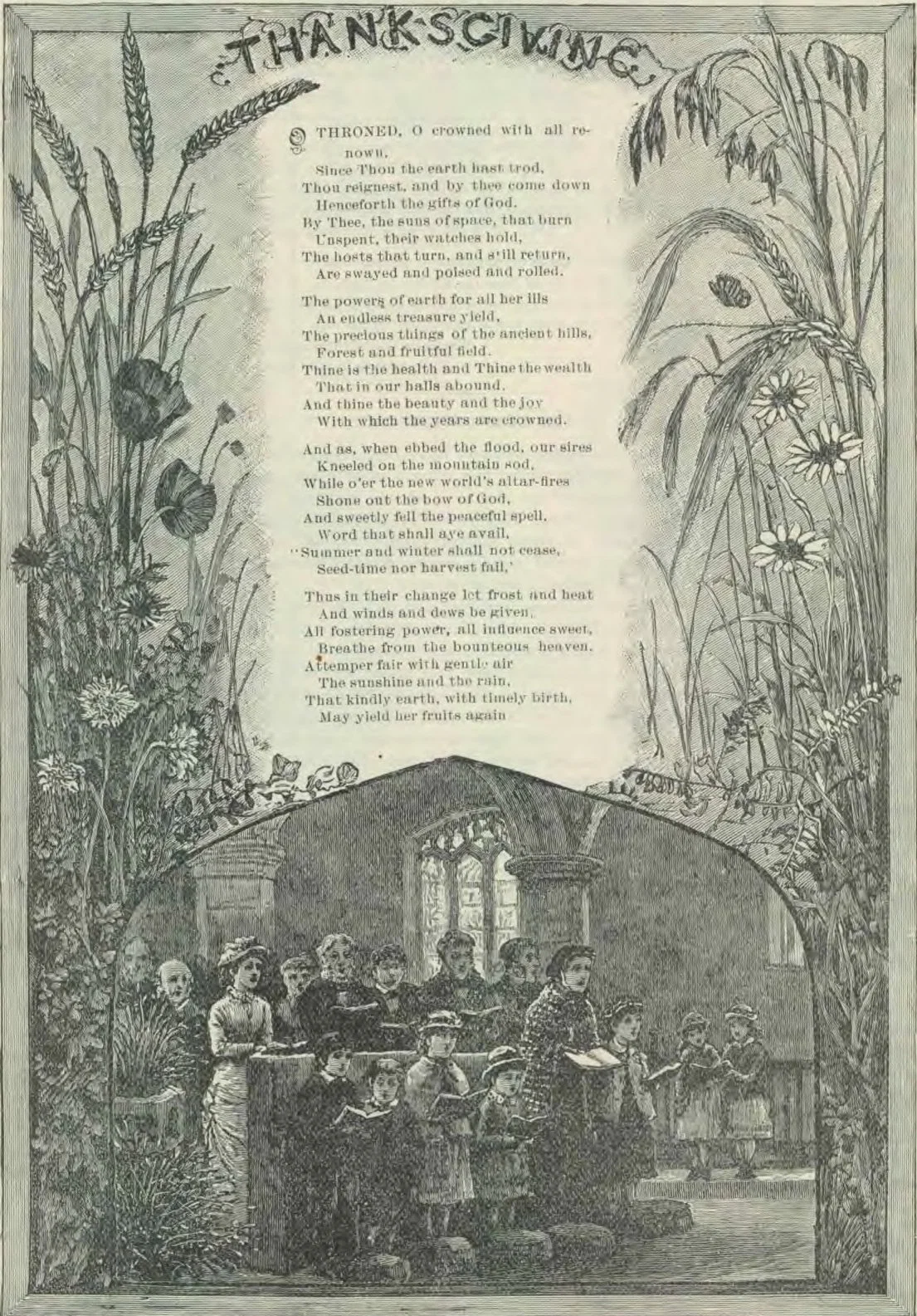
THANKSGIVING

ENTHRONED, O crowned with all renown, Since Thou the earth hast trod, Thou reignest, and by thee come down Henceforth the gifts of God. By Thee, the suns of space, that burn Unspent, their watches hold, The hosts that turn, and still return, Are swayed and poised and rolled.
The powers of earth for all her ills An endless treasure yield, The precious things of the ancient hills, Forest and fruitful field. Thine is the health and Thine the wealth That in our halls abound, And thine the bounty and the joy With which the years are crowned.
And as, when ebbed the flood, our sires Kneeled on the mountain sod, While o'er the new world's altar-fires Shone out the bow of God, And sweetly fell the peaceful spell, Word that shall aye avail, “Summer and winter shall not cease, Seed-time nor harvest fail,”
Thus in their change let frost and heat And winds and dews be given, All fostering power, all influence sweet, Breathe from the bounteous heaven. Attemper fair with gentle air The sunshine and the rain, That kindly earth, with timely birth, May yield her fruits again.

CHARITY

Mrs. Prescott had been cleaning paint and windows all day. The cupboard had been scrubbed, and its contents were still scattered around the kitchen. But she was tired. She sank down into her favorite rocking-chair, and said to grandma,—
“I hope no poor creature will come along to-day to be taken in and fed. Everything in the house is out of place. I tell Warren that charity begins at home, but he thinks every poor tramp is his brother, and takes him in.”
“Yes,” said grandma, “his father was just so.”
Just then the clock struck five. “There, it’s supper-time! Warren will be home from the city before I can get it ready.”
When supper was on the table, grandma walked out to see if Warren was coming.
“There he comes!” she exclaimed. “I do believe he has brought somebody with him.”
In a moment he drove up the lane. There was a little girl on the seat beside him.
“There!” said he, as he stopped at the horse-block, “I forgot all about it’s being house-cleaning time. Nancy’ll be all tired out. But never mind; she’ll welcome you when she gets rested.”
“I hope so. You are so kind.”
“Warren has brought company home, Nancy,” said grandma, hurrying into the house.
“Oh, dear!” said Mrs. Prescott. “Here I’m so tired I can hardly stand up.”
Just then Mr. Prescott came in, leading a ten-year-old girl, small of her age.
“Nancy,” he said, “I’ve brought home one of the girls from the Home. Dr. Mayhew said she couldn’t live through the summer in the city. Her father and mother both died of consumption. He said it would be a real charity to take her into the country. Her name is Charity, too.”
“I’m in a pretty plight this week to wait on the sick,” was all Mrs. Prescott said, as she put the meat and potatoes on the table.
“She doesn’t need any waiting on. All she needs is fresh air and new milk.”
“Supper is ready,” said Mrs. Prescott, and she sat down in the rocker.
“Aren’t you going to eat anything?” asked grandma.
“No; my head aches.”
“Then you’d better go to bed, and let me wash the dishes.”
“I could wash them, if you would let me,” said Charity, timidly.
So she washed the dishes, while Mr. Prescott milked, and brought in wood and shavings.
“You mustn’t feel homesick,” said grandma to Charity. “When we get things in order, it is pleasant here. I hope the croaking of the frogs in the pond won’t make you feel lonely.”
“There is no danger,” answered Charity; “I am sure it is lovely here in the day-time.”
“It will seem good to have a child around,” said grandma, laying her hand gently on Charity’s head. “How soft your hair is. It is like the silk that comes on corn when it begins to tassel out.” The words were nothing, but the manner was so loving that tears came into Charity’s eyes.
In the morning Charity woke early, and went downstairs. She found grandma putting the kettle over the fire.
“Well, if the little girl isn’t up!” she said. “I thought I’d try and get breakfast so Nancy could sleep.”
“You must let me help you. It would be nice to have it all ready before she wakes.”
“Well, you may set the table if you wish. My old fingers are all thumbs at that work now-a-days. We’ll fry steak and eggs, but I can’t find any bread in the cupboard.”
“Never mind. Let me make a johnny-cake. I learned how in the Home.”
She was watching it bake when Mrs. Prescott came in.
“Well,” said she, in a pleasant voice, “you seem to feel at home. How nice it is to find my breakfast all ready!”
Charity was happy when she praised her johnny-cake. She was happy all the week. She hunted hen’s nests in the barn, and blue violets and buttercups in the field, and peppermint by the creek. She rode Old White, and got acquainted with the cows, pigs, chickens, and little blind kittens.
One day Mrs. Prescott sat in the sitting-room while Charity combed her hair. Charity was a loving child, and when she had finished, she kissed that lady’s cheek. Just then Mr. Prescott came in.
“Nancy,” said he, “I’m going to the city. I guess Charity would better go back with me. She looks better now, and I suppose you’ve been bothered with her long enough.”
“Bothered!” exclaimed his wife. “You know the child helps me every day, and grandma’ll cry her eyes out if she goes back. No, indeed! Charity shall stay all summer. In fact, I’ve thought of keeping her always, for our own little girl. We’ve all taken a fancy to her.”
“Just as you say,” said her husband, smiling knowingly at Charity.
So she stayed, and for all I know she is there yet. The last time I saw her, she sat on the grass by the back door. She had been reading to grandma from the Bible, and the robins sang hymns near by.—Sabbath Visitor.

The Leaf-Cutting Bee.

Many interesting visitors have been received in our summer parlor, where the carpet is of green grass, and the ceiling the sky as it shows between horse-chestnut branches. Shy little Mr. Chipmunk ventures occasionally to come there, a tame “chippie” bird is a daily caller, and now and then a toad hops along our carpet, gravely regarding us.
Of all our visitors, however, the most interesting is the leaf-cutting bee, who comes to work upon an old-fashioned blush-rose-bush which forms part of a side wall of our parlor. Bees, you know, are such busy creatures that they cannot even make a call without taking their work with them, and it was the faint sound of his industry that first drew attention to our new friend on the leaf of the rose-bush. Looking closely to see what the stranger was about, we were amazed to find that, having placed herself astride of the edge of the leaf, the bee was deliberately cutting out with her jaws a piece of the leaf, rolling it up beneath her as she did so. We tried to trace her flight when the cutting was done, but this astonishing visitor baffled us in our pursuit by disappearing quite suddenly, into the earth apparently—just where we could not discover. And had not the bee continued her visits, giving us all an opportunity of forming her acquaintance and seeing her work, the truth of our account might still be doubted.
Happily she was not easily disturbed, and at a call from some watcher in the out-door parlor, “The bee is at work,” we could gather quite closely round to observe her, when she had carefully chosen the leaf that best suited her, and begun the work of cutting it. Toward the close of the summer, the selection of leaves was made with greater care, sometimes as many as six leaves being inspected before one was found sufficiently tender for her purpose. Often when Mrs. Bee started for home, her roll of work was so heavy that she fairly tumbled off the leaf with it, and had to pause an instant to recover her balance before bravely carrying it away. But where did she take her load? and what did she do with those nicely-cut pieces of leaf? She was too busy to tell us; and although we were eager to return her calls, we could not discover her home, and could not imagine why she cut rose-leaves so industriously, until we happened upon a book one day which told us all about it.
It seems that these bees build nests of the leaves of the rose and other trees, under the surface of the ground or in old wood. These nests are sometimes six inches deep, and generally consist of six or seven cells, each shaped like a thimble, the closed end of one thimble fitting into the open end of another. When a cell is formed of the pieces of leaf, such as we’ve watched the bee cut out, it is filled with honey; and so nicely are the cells built that they hold the liquid honey without leakage. On the cellful of honey an egg is deposited, and then the cell is closed with three circular bits of leaf for a cover. Mr. Ruskin says the bee pushes down the little cell covers “with a tucked-up rim quite tight, like the first covering of a pot of preserve.” Think of each young bee having a nice little pot of honey all to itself!—Harper’s Young People.

A THANKSGIVING HYMN.

For bud and for bloom and for balm-laden breeze, For the singing of birds from the hills to the seas, For the beauty of dawn and the brightness of noon, For the light in the night of the stars and the moon, We praise thee, gracious God.
For the sun-ripened fruit and the billowy grain, For the orange and apple, the corn and the cane, For the bountiful harvests now gathered and stored, That by thee in the lap of the nations were poured, We praise thee, gracious God.
For the blessing of friends, for the old and the new, For the hearts that are trusted and trusting and true, For the tones that we love, for the light of the eye, That warms with a welcome and glooms with good-by. We praise thee, gracious God.
That the desolate poor may find shelter and bread, That the sick may be comforted, nourished, and fed, That the sorrow may cease of the sighing and sad, That the spirit bowed down may be lifted and glad, We pray thee, pitying Lord.
For the blessings of earth and of air and of sky, That fall on us all from the Father on high, For the crown of all blessing since blessing begun, For the gift, “the unspeakable gift” of thy Son, We praise thee, gracious God.
—S. E. Adams, in the Century.

HOW HE DID IT.

Mark Boyd, in his autobiography, tells us that he once knew intimately a man named Christmas, one of the chief officials of the Bank of England, and, during an acquaintance of many years, never saw him moved or excited in any way. Mr. Boyd asked him one day how he managed to preserve this calm under great annoyances.
“On the first day that I entered business,” replied Mr. Christmas, “William Pitt gave me a piece of advice. It was ‘Never to lose my temper while at my desk.’ I resolved to observe the rule. For ten years, though naturally irritable, I was always master of myself from the hours of nine until three. After that time I was able to retain the control of myself throughout the whole day.”
William Pitt’s own highest ambition was probably to obtain complete mastery over all his weaknesses. It is said that he had a nervous dislike to the touch of a peach, and that he compelled himself for an hour each day to rub the skin of the fruit upon his hands. After some weeks the dislike was completely overcome.
Nothing will increase the strength of character more than a steady, persistent struggle to overcome a weakness or a fault.
Yet young people and their guardians should remember that this very struggle and victory require a strong, deliberative will, which a quick-tempered, emotional man may not possess. They should consider, too, that the power to be angry or to feel keenly is neither a weakness nor a fault.
The high-tempered man who holds his passion with a hard bit is likely to do stronger work in the world than his cold, apathetic neighbor, in whose nature there are no strong impulses.
“A fire,” said a successful teacher lately, “is a power, if it is kept in the right place. There are boys with temperaments like boiling water. Very good. One does not confine the steam until it expands to the bursting point. One gives it work to do.”
The nervous, sensitive boy or girl who has plenty of hard, congenial work to do will find it the surest escape-valve for the excitement which else will find relief in passionate outbursts of temper.
But the work must be congenial, one which will naturally develop the character, the taste, and faculty of the child.
Gardeners know exactly what kind of soil and exposure and food each of their plants requires. When will teachers learn what place and work in the world will suit each scholar?—Selected.

EXCUSES

No wiser remark was ever made by Dr. Benjamin Franklin than a severe sentence which he once uttered to a young man who had an appointment with him, and missed it. Next day the young man came, and began to make a very fluent excuse to the doctor for his absence the day before.
“Stop!” said Franklin. “You have said too much already, my good boy; for the man who is good at making an excuse is seldom good at anything else.”
An easy excuse made by a delinquent for a flat error or failure to do a duty seldom, indeed, softens the heart of an employer or superior. Of course an account of the reasons for a failure should be given when a demand for them is made, but they should be given simply and briefly, and without any attempt to make the case appear any better than the plainest statement of the facts make it.
A youth who is beginning a round of duties in any place which has any responsibilities may as well make up his mind that his employer will look with some disfavor, if not with suspicion, upon his explanation of failures.
He must be perfectly honest about them, and never slow to admit his mistakes. And there are few employers who are not willing to allow a beginner a liberal number of blunders and failures as a part of his education.—Youth’s Companion.

THANKING THE FATHER.

Can a little child like me Thank the Father fittingly? Yes, O yes! Be good and true, Patient, kind in all you do; Love the Lord and do your part, Learn to say with all your heart, Father in heaven, we thank thee.
For the fruit upon the tree, For the birds that sing of thee, For the earth in beauty drest, Father, mother, and the rest, For thy precious, loving care, For thy bounty everywhere, Father in heaven, we thank thee.
For the sunshine warm and bright, For the day and for the night, For the lessons of our youth, Honor, gratitude, and truth; For the love that met us here, For the home and for the cheer, Father in heaven, we thank thee.
For our comrades and our plays, And our happy holidays, For our lives but just begun, For the great gift of thy Son, For the joyful work and true That a little child may do, Father in heaven, we thank thee. —Mary Mapes Dodge.

IN INDIA.

INDIA is a very warm country. It is on the opposite side of the world from where we live. If we should go there, everything would appear strange. The trees and flowers are such as we have never seen; the houses are built in an odd way; the people wear a queer dress, and their ways of doing things seem strange, too.
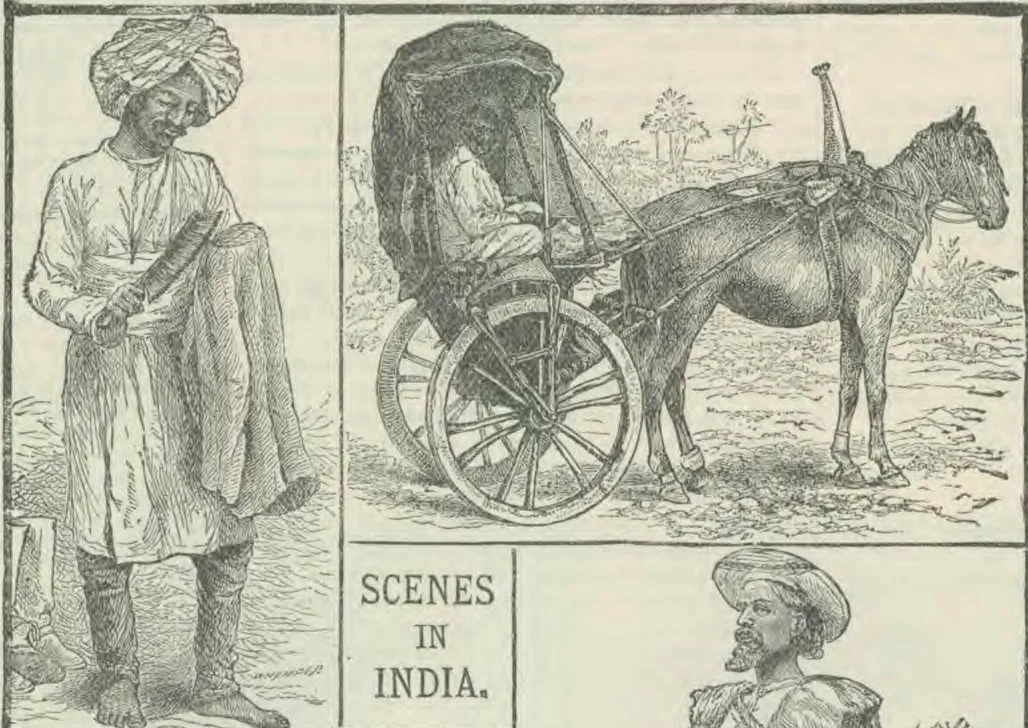
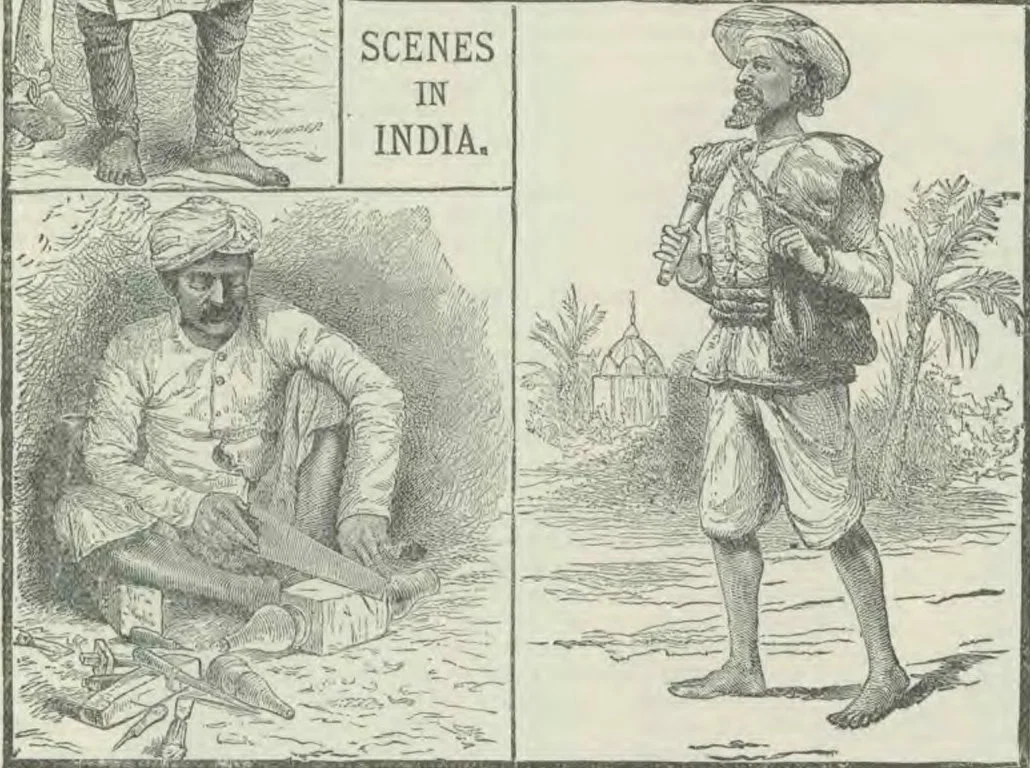
In our picture we see some of the strange sights in this land. The man in the upper left-hand corner is probably a servant to some Englishman who has moved to India. A person is obliged to have a great many servants in that country. For instance, the man who waits on you in your room will not bring your dinner on to the table. There must be another man for that. The one who brings clean water to fill your bath-tub will not empty it when you are done using it. He thinks it would be a disgrace for him to touch water that a white person has washed in.
SCENES IN INDIA.
SCENES IN INDIA.
SCENES IN INDIA.
SCENES IN INDIA.
The man who waits on you around the room, or the one who brings your dinner on to the table, will not pick up your book if you have dropped it on to the floor. Instead of that, you will have to send for the servant whose business it is to sweep the rooms, and ask her to pick it up for you.
And this same plan is followed in many other things. A native will do only the one thing he is hired to do. So it happens that the English people who live in India have to keep a great many servants, and they must keep a head man to look after the servants. If they want anything, they send to the head man, and he sends the right kind of servant to do the errand. I think we would find this a very slow and awkward way of getting anything done.
The man in the lower corner is a carpenter. It would seem strange to you to sit down to saw a block in two. Many of his ways of doing work are queer, yet he can build very beautiful buildings.
How would you like to take a jolting in the two-wheeled cart shown in the picture? Quite often a cow is hitched to a cart in the place of a horse. The cows of India have humps on their backs. They can trot quite fast. Often they go from twenty to thirty miles in a day.
Besides that, people ride on elephants. An elephant's back is not a very quiet or restful place to ride upon. The horses are afraid of the elephants. No matter how many times they have seen them, they never become accustomed to the sight of this huge beast, with his lumbering step.
Perhaps you would like better to ride in a palanquin. A palanquin is a little house carried on poles. It is not high enough to allow of sitting upright in it. But you can lie down, or sit in a half reclining manner, with pillows to support your head. It takes eight men to carry a palanquin. Four of them carry it until they are tired, and then change off with the other four. In this way they alternate until the end of the journey is reached.
The man in the lower right-hand corner is often seen on the streets of the larger cities. He is a water-carrier. His bottle is made of a pig's skin or of a goat's skin. More often it is made of a pig's skin, because that holds water better than the other. He sells water to the people who do not have water fixtures in their houses. If he works very hard indeed, he will be able to earn twenty-five cents a day. That seems like a very small amount, does it not? Many people in India do not earn that much.
There are a great many people in that country, four times as many as in these United States; and the country is only one-third as large.
A good many English people live in the large cities of India. They have gone there to trade and make money, or else to do business for England. India belongs to the British Government.
Some of the English-speaking people have gone there to tell the natives about the true God, and Jesus his son; for the most of the people in India worship idols. Let us pray that God will help and bless these good people in their work. W. E. L.

“I AM MY FATHER’S.”

“Will you not be my little girl?” I said one day to little Nannie Wheeler. “You do not know how much I love you, and how happy I will try to make you if you will only be my little Nannie.”
She looked earnestly into my face with her bright black eyes, and said, “I’m father’s.”
“Well, Nannie, I will give you such nice things if you will be my little girl. I will give you a beautiful new dress, and a hood, and such a fine little muff to keep Jack Frost from finding your fingers, and a little shawl, and new shoes. Now, do be my little girl!”
She looked up again in the same touching manner, and said, “I’m father’s.”
“Oh, now, Nannie,” I continued more earnestly, “when poor Aunt Carrie has no little girl, and your father has Augusta, and Willie, and Tooty, as well as you! Oh, I will buy you a new doll, very large, with black eyes bright as yours, and a little rocking-horse; and you shall have so many toys that I will give you a drawer on purpose to keep them in, all for yourself, and such picture-books! Dear Nannie, now do be Aunt Carrie’s little girl.”
She said again in her quiet, simple way, “I’m father’s.”
Dear little girl! How few would have withstood temptation so strongly set forth! She is only three years old, and yet she would not, for any inducement held out, give up her love for her father.
Little children, we all have one Father, even “Our Father, which art in heaven.” The world with all its allurements is held out to tempt us from his love. Do we turn from it, and with childlike faith and love answer, “I am my Father’s”?
Loving friends gather around us, and may lead us to forget that there is One whom we must love above all others; do we turn from them, and say, with little Nannie, “I am my Father’s”?
Comforts and luxuries are brought to us to tempt us on every side; do we take up the cross humbly, and walk in the footsteps of Him who had not “where to lay his head,” and answer, “I am my Father’s”?
Let us all take a lesson from little Nannie in her unwavering love for her father. Nothing can tempt her from his side; she follows him about like a little lamb, and she nestles in his arms, and lays her precious head on his bosom. May the good Shepherd watch over her and keep her; and may I hear that dear voice repeat those words, “I am my Father’s!” —Rays of Light.

PRINCESS WILHELMINE.

A LITTLE girl of eight years is the heiress to the Dutch Crown, and there is no knowing how soon she may be called upon to wear it. Her name is Princess Wilhelmine, and her wise parents are bringing her up just as any healthy girl should be, whether princess or not. In the royal park at Loo, their favorite residence, the little princess takes long rides on her own little pony, drives a pair of ponies, or a four-in-a-hand, boats on the lake in her own little yacht Emma, and feeds the deer and the pigeons near her chalet. She is very fond of country pleasures, and rides, drives, and boats to her heart's content.
Her teachers are not allowed to make any difference with her on account of her high position, not even to call her “Your Royal Highness.” The Queen herself teaches her to play the piano and to ride.
One day last winter the Queen and the little Princess were driving in a sledge over the ice between the palace and the Hague. They came upon a number of sturdy little Dutch children who were having a very good time snow-balling. The Princess was most anxious to join them, so the Queen stopped the sledge, and allowed her to get out. Off ran the happy little Princess, into the midst of the other children, as eager for the fray as any one of them; and for a whole quarter of an hour the future queen of the Hollanders took her part in a well-fought snow-battle, neither giving nor receiving quarter.
My opinion is that she will govern her people all the better one day for having made herself one with them even upon so small an occasion as this.—Our Little Men and Women.

LETTER TO THE HEBREWS.

LESSON II.—HEBREWS 6: 19 to 7: 3.

1. On what does our hope rest?
2. What does a true hope afford?
3. What is our hope called? Heb. 6: 19.
4. What is said in the Scriptures of the hope of the hypocrite? Job 8: 13, 14.
5. Is there any likeness between an anchor and a spider’s web?
6. How many hopes are recognized in the Bible? Eph. 4: 4.
7. What is the condition of those who have not obtained an interest in the promises of God? Eph. 2: 12; 1 Thess. 4: 13.
8. What is the nature of a true hope? Heb. 6: 19.
9. To where does our hope point us, or reach? Ib.
10. Who has entered within the vail for us? Verse 20.
11. In what scripture may we learn concerning the veil? Ex. 26: 31–33.
12. Was there more than one veil to the sanctuary? Heb. 9: 3.
13. Were the two veils alike? Compare Ex. 26: 31 and 36.
14. What was their use? Ex. 26: 33, 36.
15. To which veil does Heb. 6: 19 refer? See note.
16. Whose office was it to go into the sanctuary? Ans.—The priest’s. Ex. 28: 43; Num. 8: 1, 7.
17. Who had a special commission for the work of the sanctuary? Ans.—The high priest.
18. Who was Melchizedek? Heb. 7: 1.
19. What is said of him in the Scriptures? Gen. 14: 18–20.
20. Do we learn anything more of him in the Old Testament?
21. What did Abraham give to him? Heb. 7: 2; Gen. 14: 20.
22. Can you tell how Abraham learned about the duty to pay tithes?
23. What is the meaning of the name Melchizedek? Heb. 7: 2. See note.
24. What is said of his parentage, or descent? Verse 3, Revised Version.
25. In his priesthood, whom was he like in these respects? Ib. See note.

NOTES.

It is not possible, within the space of a Sabbath-school lesson, to give a full description of the work of the priest in the sanctuary. Every day in the year the priests ministered in the holy place, or the first room of the sanctuary. Ex. 27: 20, 21; 30: 1, 7, 8; Heb. 9: 6. The tenth day of the seventh month was the day of atonement, on which the high priest went alone into the most holy place, and sprinkled blood upon the mercy-seat, over the ark, which contained the law of God. Lev. 16. By this act he cleansed the sanctuary from all the defilement of sin. This was a type of the day of judgment. Our Lord ascended on high in the year A. D. 31. He said to his disciples: “I will pray the Father, and he shall give you another Comforter.” John 14: 16. And, “If I go not away, the Comforter will not come unto you.” John 16: 7. Within ten days after his ascension to his Father, his priesthood in the sanctuary in the heavens (Hebrews 8: 1, 2) began, for on the day of Pentecost his prayer was answered, and the Comforter came. Acts 2. This was the beginning of his priesthood, and he was then, of course, officiating in the holy, or the first of the two holy places. It is not until the seventh trumpet sounds, which is near the close of this dispensation, that the temple in heaven is opened, where the ark of the testament is seen. Rev. 11: 14–19. This is the most holy, within the second veil. Now, as Paul wrote the letter to the Hebrews in A. D. 64, but a little more than thirty years after the beginning of Christ’s priesthood, the veil within which he then entered must have been the first.
Paul says of the name Melchizedek, that it is “by interpretation, king of righteousness.” It is compounded of two Hebrew words, melek, king, and tsedek, righteousness. Most Hebrew proper names were thus significant. As Salem means peace, king of Salem is, also, king of peace. In both these names Melchizedek fitly represented the Son of God, who is truly the king of righteousness and the king of peace. It is on the throne of grace that he is our peace. Eph. 2: 14; Zech. 6: 12, 13.
Heb. 7: 2, 3 contains some of the most significant and interesting of all the statements of this wonderful argument. All that is known of Melchizedek is contained in Gen. 14: 18–20, and in these two verses in Hebrews 7.
The truth is, that if we could ascertain his genealogy, all the force of Paul’s reasoning would be lost, and he would no longer serve as the type of the priesthood of Christ. For it is the evident intention of the record to give Melchizedek as the type of Christ, in whose priesthood no genealogy or succession can be reckoned. Christ has indeed a genealogy, but that serves solely to prove his heirship to the throne of David, and does not refer at all to his position as a high priest on the throne of his Father in heaven. This will be seen with more and more clearness through all this chapter.
The original Greek says he was agenealogetos, literally, without genealogy. Authorities to almost any extent may be quoted to show that the method of expression used in Heb. 7: 3 was common among the Hebrews where no genealogical record was preserved.
Continue reading: SABBATH-SCHOOL LESSONS