The Youth's Instructor, Vol. LI, No. 20

The Lad with the Loaves

The Youth's Instructor

May 21, 1903

Review and Herald Publishing Company · Battle Creek, Michigan · May 21, 1903

The Lad with the Loaves

THERE were boys without number in Galilee, and many no doubt who sold bread to help support their families; but of all the boys with barley loaves, only one happened to be near the Great Teacher when he had need of loaves and fishes.
A great multitude had followed Christ across the sea of Galilee. They hung on his words, and watched for signs of his power to heal. The Saviour felt their spiritual need, and he felt also their physical hunger. He always knows both, the one as well as the other.
Turning to one of the disciples, he said, “Philip, where shall we buy bread that the company may eat?” He knew a lad was standing near with basket in hand, but he wanted to see if Philip had thought or had seen the way to meet the emergency. “I do not know,” said Philip. “We are where no bread can be bought, and besides, we have no money to pay for enough bread for this great company.”
Andrew had listened to the conversation between Teacher and disciple. He, too, had seen the hungry crowd. More than that, he had seen, although with faltering faith, the means of relieving their hunger. Pointing to a spot not far distant, he said, “There is a lad here who has five barley loaves, and two small fishes.” Five little cakes of bread and two small fishes—how far would they go among five thousand hungry people?
Jesus motioned to the boy, and he drew near. I can see him with his basket. He had often walked the streets with fish for sale. Now he stood beside the Master. A smile lighted his face as he held the basket up for inspection.
From the basket Jesus took the loaves. A hush fell over the seated multitude as he looked unto heaven and gave thanks. He thanked his Father that the little boy was there, and that he had even five loaves and two fishes. He gave thanks also that in God’s hand what seemed so small to man, was enough for all.
Then he broke and scattered the bread, those five barley loaves the lad had carried in his basket. And as the child watched, instead of feeding only a small part, to his utter astonishment it fed them all. And of the fragments there were gathered twelve baskets full,— at least twelve times as much as he had in the beginning.
Can you imagine that lad as he told the story to the home folks? “I stood by Him, the great man, and he gave and gave.” And in succeeding years, when the lad became a man, what a lesson that was to him! He might be poor, his education might be deficient, but to stand by the Master meant power without measure.
Other young men missed that blessing because they did not know the opportune moment when it was to be obtained. “Too little, I have too little to be of any use in such a multitude,” said other lads. But the lowliest gift, if nothing more than five loaves and two small fishes, when given to the Master, will feed thousands. But we should not lose sight of the fact that the loaves were brought to Jesus before they were used to feed the hungry people. It took the touch of the Master to increase them. So our efforts to do good, without his blessing, will be weak and ineffectual; but if we first come to him, he can use them to feed a hungry world.
M. BESSIE DE GRAW.

Two Boys and Their Opportunity

JAMES HOWARD was well formed by nature, both physically and mentally. His father was a steady-going mechanic, who saw that his family were supplied with the essentials of life without an anxious thought on their part. At fourteen James had a fair standing at school, though not so good as he might have had if he had been willing to apply himself more diligently. He was an expert in playing games, both physical and mental, which showed that he was not deficient in these respects. The father and mother, especially the mother, wanted the boy to have “a good chance in life;” so the harness of responsibility was not often adjusted. James was as successful in slipping his head and hands out as a young colt trained to tricks. An invitation to replenish the wood-box or water-pail usually met with an audible demur.
Charlie Faithful’s father died when he, the eldest of three children, was very young. The mother was not strong, and after the father’s death, her health continually failed under the added load. Nobly did Charlie stand at his mother’s right hand in those dark days. “Mother,” said he, “I can’t do as father did; but I will help you all I can, and we can keep together, and bring up the children, I am sure.” It is wonderful what a twelve-year-old boy can do in a garden, and also in disposing of produce when it is raised. The mother’s brain counted for more than the weak, though more than willing hands. Never knight in glittering armor was more loyal in his self-imposed labor than Charlie in all the minutiae of every-day home-helping. “Mother, that is too hard for you; let me do it,” he would often say, and oftener anticipate the necessities before the anxious hands had essayed the task.
The mother regretted, as only mothers can understand, the fact that for her brave boy there was so little opportunity for education. But Charlie was fond of his books; and where most boys would have felt that there was “no chance,” he found many a moment to add to his capital in this direction.
He enjoyed at the time, but never realized until after-years, all the mother’s wise helpfulness in true educational lines. Although her opportunities had been limited, she had improved to do them, and acquired a vast amount of valuable material that does not make a display, but the worth of which can not be estimated in the making up of true men and women. Hers was the rare gift of a born educator—not only the capacity to awaken thought, and suggest wise direction, but also to stimulate desire, and implant a firm determination to surmount obstacles. The tender, manly boy-love noticed the failing strength; but youth is hopeful, and he could not acknowledge to himself the possibility of sparing such a mother, till the sad day came when the “silver cord” was “loosed,” and the “golden bowl broken.” Friends came to the rescue to furnish a home for the children, especially the one who had proved so efficient in caring for others as well as for himself.
When the younger children were provided for, Charles set out to make his own way. Behind others of his age in graded school work, in breadth and depth of experience he was far in advance of them. Fortified by the excellent principles that had been instilled by a wise mother, he began, nothing daunted, to work and study, study and work, never losing sight of the goal he was to reach. He grew so rapidly that his trousers were not always long enough, and he was not oblivious to the smiles that followed him. He took it all good-naturedly, however. Shoes wore out with amazing rapidity; still he marched on, “conquering and to conquer.”
Do you imagine it was all a smooth and pleasant way? that he never had to plan how to secure a new, or oftener, a second-hand book? that by and by some rich man, seeing his struggles, came forward with the money and lifted the load? No such thing occurred. He often found it necessary to sew on buttons, or a patch; and his progress as compared with his desires, often seemed slow; but he soon became an encouragement to those younger than himself. After a few years he reached the point where he could assist in educating the younger members of the family, and did so. For years his life has been rich in helpfulness and inspiration to those who were situated as he once was. A busy professional career never prevents him from extending encouragement and counsel to those who seek him. He would not listen to the word failure, and true success is crowning a life not yet at its zenith.
What of James? The up-hill road looked too difficult of ascent to be desirable,—he excused himself from the things he didn’t like to do. This weakened his will power to do at all, as an unused arm loses muscular strength. He had many brilliant conceptions of future probabilities; so he spent, and still spends, the days in dreaming. He seems to expect that a wave will come some day to lift him, without special effort on his part, to the desired height, which position he fancies he is better fitted for than many who now occupy it. But such dreams are idle; he will have to prove his claim by a sturdy, continuous up-stream pull, or he will never secure it.
Idle dreaming, longing, scheming, Never grasp the sought for prize; Up and ready, constant, steady, If you e’er expect to rise. MARY MARTIN MORSE.

His Tender Mercies

His tender mercies are over us all, On the just and the unjust his rain doth fall, On the good and the evil his sun doth shine, Child of his tenderness, canst thou repine? He heareth the ravens that, hungering, cry; He, pitying, noteth the sparrows that die; He decketh the lilies, all snowy and tall: His tender mercies are over us all.
His tender mercies are over us all. Let nothing affright thee, let nothing appall, Nor earth-tempests fill thee with sudden alarm; By no means shall anything bring to thee harm. Eye hath not seen, and ear hath not heard, What hath been prepared for the loved of the Lord; His eye is upon us; he lists to our call: His tender mercies are over us all.
Elizabeth Rosser

Leave Your Flag at Home

We Should Travel to Learn, not to Criticize

“Oh, wad some power the giftie gie us, To see oursel's as ithers see us.”
Lessons in humility are among the first fruits of foreign travel. One soon learns that the world is a little larger than it appeared at home, that the people who inhabit it have customs and ideas equal to ours, and that our own little corner of the earth is a very small fragment indeed. We have dwelt so untiringly upon the magnitude of our country, “the pride of the nations, the favored child of the world’s old age!” we have heard so much of the “mighty West,” the “frozen North,” the “sunny South,” and the “conservative East,” that we are likely to forget that the world is made up of many great nations, among which the United States is a young, though thriving member.
It is not to be wondered at that we have such a magnificent conception of ourselves. From our earliest schooldays we have proudly admired the large, fine maps in our geographies, which represent the United States; and have not failed to observe that other countries are too insignificant to receive much notice. While the geography has affirmed that the world is three fourths water and one fourth land, we are tolerably well convinced that three fourths of the earth is the United States, and that the remaining fourth is divided up among the other nations.
Undoubtedly the bump of self-esteem is very well developed in the people of all nationalities. Naturally we love ourselves, our own institutions, and our own manners and customs; as Will Carlton very aptly says, in describing a certain member of a family:—
“There was Susan. Her heart was good and kind— What there was of it, mind. Nothing too good and nothing too nice; Nothing she wouldn’t sacrifice For one she loved; and that ’ere one Was herself, when all is said and done.”
A few years ago when Colonel Hay visited England, a banquet was prepared in his honor. Lord Balfour in a pleasant eulogistic speech referred with a bit of humor to the Americans as a people whom he greatly admired. “I can complain of them,” said Mr. Balfour, “upon one point only. They are great boasters.” Colonel Hay in his reply admitted the statement made by Mr. Balfour; but stated that the American people are rather proud of the characteristic, for there is no point upon which they so distinctly resemble their noble ancestry.

Knowledge the Basis of True Criticism

The American people would have far better ideas of the English, and the English of Americans, if they were better acquainted with each other’s institutions, and so better prepared to criticize each other intelligently. It was Cobden, I believe, who said that the English scholar who knows all about a little stream in Greece, that is hardly big enough to supply water for an English washing, knows nothing whatever of the breadth and length of the great “father of waters,” the Mississippi. Undoubtedly this is true; but it is equally true that the majority of Americans have as little conception of the great influence, the power, the wealth, and the beauty of their fatherland. Their idea of the size of England is aptly expressed in the statement so often heard, that surely the trains could not run very fast in England; for, if they did, they would run off into the sea.
Many books of travel have done injustice to both countries; for travelers have often written simply with the idea of catering to the present prejudices of the people; or, on the other hand, they may have erected a standard in harmony with their education and prejudices, and in measuring everything foreign by that standard their impressions have been unfavorable. Frequently a traveler will visit only a few places in the United States, and describe the abnormal condition in a boom town or the mode of living on some distant cattle ranch, and hold that up as the normal condition of things throughout the country. I once met on shipboard a young traveler who from his childhood had wanted to see the wonderful things of America. So he saved his money and came from Australia to San Francisco. He went by the Santa Fé Railway to the Texas Pan Handle, and decided that he had seen enough of America in that direction. From there he turned northwest to Wyoming. Being thoroughly disgusted by that time, he took the first train for San Francisco, and returned to Australia by the same ship that brought him over. It was thoroughly amusing to hear that young man’s description of the United States.

From Your Neighbor’s Standpoint

When visiting a foreign land, particularly if we are to remain there permanently as workers, it is of great importance that we permit our personal prejudices and customs to stand in the background, while we attempt to adjust ourselves to our new environment. We should stand where the people stand. We should see the things that they see, and not make any attempt to compare things with that which we have left behind. It is the height of folly to think that a thing is right or wrong simply because it is like or unlike something with which we have been familiar at home. Nothing is more unpleasant to an Englishman (and, unfortunately, there is nothing he has to meet more frequently in Americans) than the habit of introducing contrasts whenever any feature of scenery, building, or art is pointed out. “O, yes, I suppose the Bank of England is quite a place; but it does not show up very well compared with some of the buildings twenty-seven stories high in New York City.” “Yes, the Strand is a busy street; but you ought to see Broadway.” Piccadilly isn’t more than “half as wide as some of the streets in the little towns out West.” “O, yes, but—” Now, my dear friends, please drop all these “buts.” They will spoil the good time you might have, and the education you might receive from the splendid opportunity of going to London. What if the Bank of England isn’t twenty-seven stories high? Can you tell why it is better to have a building as high as that?
An amusing story is told of an American who persisted in comparing everything abroad in an unfavorable light with what he had seen at home. When traveling in northern Italy, his friend pointed out Mt. Vesuvius when active, and said, “Have you a bigger volcano than that in America?” “No,” said the American, “but I reckon that Niagara Falls would put that fire out in fifteen minutes.”

His Flag Spoiled His Pleasure

When I was a boy in school, we raised money to buy a beautiful United States flag to wave over our school building. This flag was the subject of conversation for many weeks. When the flag-raising day came, there was a fine program,—singing, recitations, and speeches. Among the students was a bright little English boy about thirteen years of age. He took little interest in the exercises; and after they were over, I chanced to pass him on the sidewalk, and said, “Well, Johnnie, what do you think of the United States flag?”
“I don’t think it is up to much,” said Johnnie. “Why, what is the matter with it?”
With a bit of sarcasm and well-directed national pride, Johnnie straightened up and replied, “It looks too much like States’ prison pants.”
How easy it is to look unfavorably upon foreign institutions, manners, and customs, because we do not appreciate them, and are not acquainted with the wonderful story of patriotism and love which they represent!
Take my advice, young friends, and roll up your national flag and leave it at home. Study the country to which you are going, and prepare to look upon its institutions, manners, and customs with an intelligent, appreciative eye. This will be the best preparation possible for a profitable trip through that fine old country; and it will enable you to find warm friends, who will give you a most cordial welcome, where otherwise you might meet with a rather chilling reception. No one can afford to assume such an attitude that he will deprive himself of the privilege of thoroughly appreciating the people, the institutions, and the country of England.
E. R. PALMER.

Finish Every Day and Be Done With It

FINISH every day, and be done with it. You have done what you could. Some blunders and absurdities have no doubt crept in; forget them as soon as you can. To-morrow is a new day; begin it well and serenely, and with too high a spirit to be cumbered with your old nonsense. This day is all that is good and fair. It is too dear, with its hopes and invitations, to waste a moment on the yesterdays.—Emerson.

IX—“There Is Life in the Seed”

The Growing Seed
THE other day I went into the garden to see if any signs of life were appearing in a bed where seeds had been sown. The cabbage seeds had been in the ground only three days, but the soil was mellow and moist and warm. As these cabbages were intended for transplanting, they were sown “thick” in the row. A canvas cover had been stretched over the bed to keep the soil warm during germination. As I lifted this cover, what an interesting sight was there! Some strong power was lifting the earth along that whole row of cabbage seeds.
When seeds are planted, the ground is usually “firmed,” or packed, over them, as they are supposed to grow better, and the growing plant is held in place by this packed soil. The ground over my row of cabbage seeds was firmed; so, as the life in these little seeds began to spring forth, it was obliged to lift an amount of earth many (I think hundreds of) times the size and weight of the seeds themselves. Have you not sometime seen a heavy lump of earth lifted by a seed growing right in the middle of a hard road? If as great a weight, in proportion to his size, were lifted by a man, the feat would be thought a miracle.
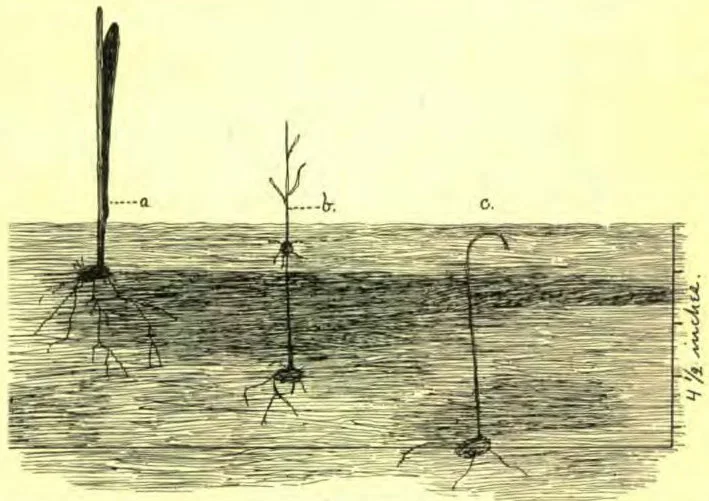
Fig. 9.—Growing Seed of Wheat. Rising toward light. a. Covered at right depth, where sun warms the ground. b. Covered too deep. Exhausts strength in cold soil, also is obliged to send out second set of roots near surface. c. Far too deep. Dies in struggle to reach light and warmth.
Seed represents the word of God, and in the growing seed is power that comes only from God. “The word of God is quick [living] and powerful.” Let us remember, every time we see a plant bursting from the ground, that there is the finger of power pointing to the word which is “mighty to save.” No stronghold of sin in our hearts can stand against this word of power.
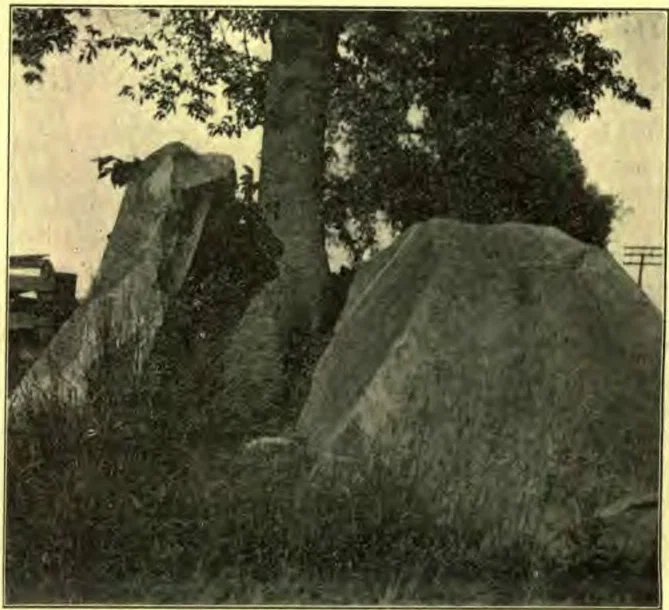
The growing seed does not spend all its power at the start. Any one paying a visit to the Michigan Agricultural College may see the living proof of this statement. By the roadside lies a great rock of many tons’ weight. Some twenty years ago it was apparently solid and unbreakable. Look at it now in the accompanying picture; it is split from side to side! A small cherry seed was dropped, probably by a bird, into a slight crevice. The little cherry-tree evidently had rather a hard time to get its start in the world, for you can see it had to press its way across the rock from one side to the other before it could grow straight up. But it did not give up the struggle in discouragement, even if a solid rock was in its pathway. Neither did it get angry because of the resistance with which it met, and destroy itself by fighting its opposer. Silently, steadily, it grows,—first by the power its Maker had implanted within the seed, afterward by the increasing power gained through using what it had at the start.
Though the opposing rock must be broken, the growing seed does the breaking so gently that it succeeds in winning the rock for its friend and protector. What a lesson for you and me as Christian workers! We bring the living seed—the word of life—to plant in human hearts. These “stony hearts” have not yet been changed to hearts of flesh, so they resist the seed. It becomes us to work as patiently and silently as the seed itself, pressing close to the resisting heart until it is broken and won by the love of Jesus.
“Every seed grows, every plant develops, by the power of God.” It is the Creator who puts within the seed its life principle. This seed and this life are intrusted to man for his co-operation in producing “seed to the sower and bread to the eater;” but it is the continual working of God’s power that brings the result. It is our part to prepare the ground by plowing and enriching it, to plant the seed, to till the soil, and destroy the weeds while patiently waiting for growth. While we are doing our part, God does not forget his. The Bible says of the land where God’s people dwell, “The eyes of the Lord thy God are always upon it, from the beginning of the year even unto the end of the year.” I think the Lord is just as mindful of the growing seed. The rain and sunshine, which it must have, come only from him. And here, again, we may be workers together with him. Careful cultivation saves the moisture of the rain, and keeps it longer in the soil for the use of the developing plant. It also enables the sunshine better to do its intended work of promoting growth.
As the Lord invites our co-operation in the growth of the seed, so he invites it in the spiritual growth of the soul. It is “the spiritual milk [R. V.] of the word” by which we grow in grace and in the knowledge of our Lord and Saviour. And we are to “desire” this milk. “As the plant receives the sunshine, the dew, and the rain, so we are to open our hearts to the Holy Spirit.” Look at the plant while the earth is cold and dry, or after a chilling frost. Its drooping leaves seem crying for warmth and moisture. Look again, when the sun comes out after a warm shower. Now its freshened leaves lift themselves as in a song of praise.
Many hearts are drooping in the coldness and darkness of earth. You and I are invited to work with God to lift them into the warmth of his sunlight (Son-light), where they may with joy “draw water out of the wells of salvation.” His tender Spirit pleads, “Son, go work to-day in my vineyard.” I want the living coal, warmed from the altar of love, to touch my lips, so that I can say, “Here am I; send me.” Don’t you?
Seeds are sometimes planted too deep. The earth is cold down there. The seed exhausts its strength before it can grow up through the cold soil into the sunshine. It is obliged to give up the struggle. It dies for the lack of a thoughtful hand to remove some of that cold earth. So “there are many from whom hope has departed. Bring back the sunshine to them.”
JOEL C. ROGERS.

Some Seed Lessons

Dr. Wayland Hoyt, in The Classmate, tells of a lesson that he learned from the planting of seeds in the window garden in his study. He says:—
FIG. 8.—POWER OF A GROWING SEED
“I have noticed that when the green leaves have appeared, and have lifted themselves a little above the soil, it often happens that a bit of soil adheres to them and seems to weight them. But, as the plants go on growing, they cast off these specks of earth, and push on valiantly. Some of my seed must have been dead, for, though they had abundant time for sprouting, they did not all appear; they lay there inertly amid the earth; which things have been a kind of parable to me. Though the living seeds in their growing have carried on their leaves some of the soil, as they grow they are flinging it off, while the dead seeds are helpless under the earth. A Christian may be carrying some mean and unseemly earthliness. But if he be really athrill with the new life, and growing, he will be quite sure to slough it off in time. Let me be patient with him and give him a chance. God does. The hopeful fact is that he is alive and growing. Dead seeds are powerless. So are dead souls.”

Sunrise

Across the plains of darkness The morning sunlight gleams. See! o’er the eastern cloudlands The radiant glory streams! O wake, and utter praises! The stars are pale above; The silent world is sleeping; Rocked in the arms of Love.
The glory swells, and journeys O’er all the skies afar; The morning, bright, victorious, Fades out the silver star. The sunlight—blessed sunlight!— Makes hills and valleys grand, And ’mid the morning chorals The dew-damp forests stand.
O sunlight, in full glory Sweep o’er my happy soul! Across its vales and darkness Let day its chariot roll,— Roll in full, regal splendor, The splendor of my King, Whose love illumines heaven, And makes the angels sing.
B. F. M. Sours.

Hymn to the God of the Seasons

Thou of the sunshine, Thou of the starlight, God of the seasons, Teach me to know How best to serve thee Morning and evening, Whether the hills wear Heather or snow. — Isabella Howe Fiske.

The Young People's Work in Oakland, California

An interesting report has been sent in by the Oakland young people. Of a membership of sixty, fourteen were added during the latter part of 1902. Their meetings are held on the second and fourth Sabbaths of each month. Topics are assigned to different members for several months ahead, practical subjects alternating with questions of a doctrinal nature. The Society collected $27.68 during the six months' term for which the report was made. Of this amount twenty dollars was expended for foreign missions. Other missionary work consists in visiting the sick and aged, filling two reading-racks, writing missionary letters to the sick and others, and mailing literature. Upon the topical card we notice that a welcome is extended to all “who desire to work for the Master.” That the Society is endeavoring to carry out this principle is evident from the following statistical report:—
Missionary visits made, 142; number of tracts given away or loaned, 524; books loaned, 12; papers mailed or given away, 4,774; letters written, 62; letters received, 25; subscriptions taken, 17; papers sold, 212; books sold, 11; number of children brought to Sabbath-school, 4.
Besides the Young People's Society, the Oakland church has a successful Youths' Society, with an enrolled membership of forty-five. A few weeks ago the Editor had the pleasure of attending one of their weekly meetings. A number of younger visitors had come in, but all were quiet and orderly; and when opportunity was given, they showed by their testimonies that they had listened attentively to the talks that had been given.
Like the Young People's Society, these youth plan their meetings for a number of weeks in advance. Different topics are assigned, and these young members take hold of the work cheerfully, conducting a study, giving a reading, or helping in whatever way they can to make their weekly meetings a real help to all who attend them.
But this little company do more than hold weekly meetings. They are well organized for work, and each one has a place to fill. Visiting the sick, missionary correspondence, writing to absent members, and the distribution of our periodicals are some of the lines of work carried on. Recently a new work has been taken up, that of the “home department” of the Sabbath-school. Eighteen names were given to different members to be visited.
Three books, “The Coming King,” and two copies of “Christ's Object Lessons,” were given to the Society. “The Coming King” and one copy of “Christ's Object Lessons” have been placed in the East Oakland reading-room; the other book put in the Temescal reading-room. During the quarter, collections and gifts amounting to $11.16 have been received. Most of this amount was expended for tracts, in carrying on home missionary work, and in placing The Life Boat in five hospitals, two reading-rooms, two prisons, and the Veterans' Home.
A comparative report of this Society for the first quarter of 1902 and 1903 will be of interest:—
1902 1903
Missionary visits 47 87
Persons supplied with food 3 3
Sick persons assisted 2 5
Readings from books, etc. 0 2
Tracts given away or loaned 0 150
Books loaned 12 6
Papers mailed or given away 466 2,417
Letters written 12 27
Letters received 6 9
Papers sold 0 243
Books sold 1 6
Children brought into the Sabbath-school 1 0
Books given away 0 3
Potted plants given away 0 1
When we note what one company of youth can do, and see the great work that is waiting on every hand, we can not but pray that the time may soon come when many more of our youth and young people will enlist in active service for the Master.

THE WEEKLY STUDY

Increasing Light and Facilities

(May 24-30)
THE decision to remove the Review and Herald Office to the East, adds to the interest of the study of the early days of the publishing work. An eight-minute talk can sketch the story, as told in “Rise and Progress,” chapters XV and XVI (pages 166-169), of the starting of the Review and the INSTRUCTOR, and the experiences in those days of small things, but also days of dependence on God and of consecration and power. Not every man is to be a printer, but every worker for God is a publisher. Isa. 52:7-10.
Let some one relate the incident of Annie R. Smith’s conversion, with the lesson it bears as to praying and working for definite results in individual cases.
Just at this time God led his servants into light upon the subject of the United States in prophecy (pages 159, 160), and enabled them to see more clearly the immutability of the law of God (pages 164, 165). The Bible study for this meeting may very appropriately be on the thirteenth of Revelation, the United States in prophecy, and the warfare against the law of God in these last days. Help in preparing a brief and clear study will be found in “Great Controversy,” chapter XXV, “God’s Law Immutable.”
Now we can see fulfilled and fulfilling all about us the prophecies concerning the working of Satan to pervert right ways by Sunday laws. Then men saw nothing but the sure word. Yet note how, as the believers saw the truth, and the needs of the cause, they sold of their possessions and gave of their means to send it forward. Our young people can do much to agitate the needs of the mission fields and secure means for the work. Help to keep the ten-cent-a-week plan up in your church.
As a short selection for reading, the “End of the 2300 Days,” “Early Writings,” page 45, describes the attitude of the two companies, the believers and the careless, in this time of the finishing of Christ’s work in the sanctuary above. Let us pray definitely for the converting grace of Jesus to take away all sin from our lives, and fit us for service in the “little time” that now truly remains before the Lord shall come. W. A. S.

The Young People's Work in Western Oregon

BECAUSE the young people in many of our churches are so scattered as to be unable to meet together, we have comparatively few societies in this conference. However, several good societies have been organized for some time, while a number of other churches are able to carry on this work during the summer months.
Good reports have recently been received from the Societies at Royal and Ashland, the former a Society of fifteen and the latter of eighteen members. Both are using the studies given in the INSTRUCTOR. The members are engaged in various lines of missionary work, such as selling “Christ’s Object Lessons,” The Life Boat, Advocate, Sentinel, etc., and maintaining reading racks in the depot and in offices of business men.
One secretary writes, “The interest is good, both old and young taking part. The members say it is the most interesting meeting of the day.”
EDITH STARBUCK.

A Good Report

THE following encouraging letter was recently received from the secretary of the Young People's Society at San Diego, California, accompanying a gift for the Fijian Island fund:—
“The enclosed post-office order for $4.25, to be applied on the Fijian Island fund, was donated by the San Diego Young People's Society. When the article in the Review of April 14 was read in our weekly meeting, and the suggestion offered that each one earn at least five cents to bring the following Sabbath, a little boy from the kindergarten department whispered to his mother, ‘Mama, what can I do to earn some money for the missionary? Will grandma give me five cents if I pile up her wood?’ The next Sabbath he told me he had earned five cents for ‘the missionary away over there.’ Thus this little boy is growing up with the spirit of service and sacrifice for the Master.
“Our Society is made up of children from six years of age up to young men and women. All are studying the lessons outlined in the INSTRUCTOR, though lately it has been thought best to divide the Society, and the primary division has its study separately, all uniting in the opening and closing exercises, which include reports from committees and any suggestions and helps that will be an encouragement to the Society as a whole.
“In our committee work we find various opportunities for true service, and with God's help we are going forward to do the work he has called us to do.”
It does us good to have the privilege of reading such reports as this and others that are found on this page, and we are sure that all who read them will feel the same thrill of courage and renewed determination in their own hearts. And as you read, we wish we could be at your side to urge you to write a report of your own Society and its work; for we know that other Societies besides those in California are doing faithful service for the Master, and receiving a blessing from him. Many of the Societies, indeed, most of them, fill out the report blanks from their State secretary, and forward them once a quarter. This is good, but we wish that they would at the same time, if not oftener, write a short descriptive report of their work, and send it to the INSTRUCTOR. Indeed, this is a part of our work. Let us not forget nor neglect it, nor put it off from week to week.
Continue reading: One Boy's Garden