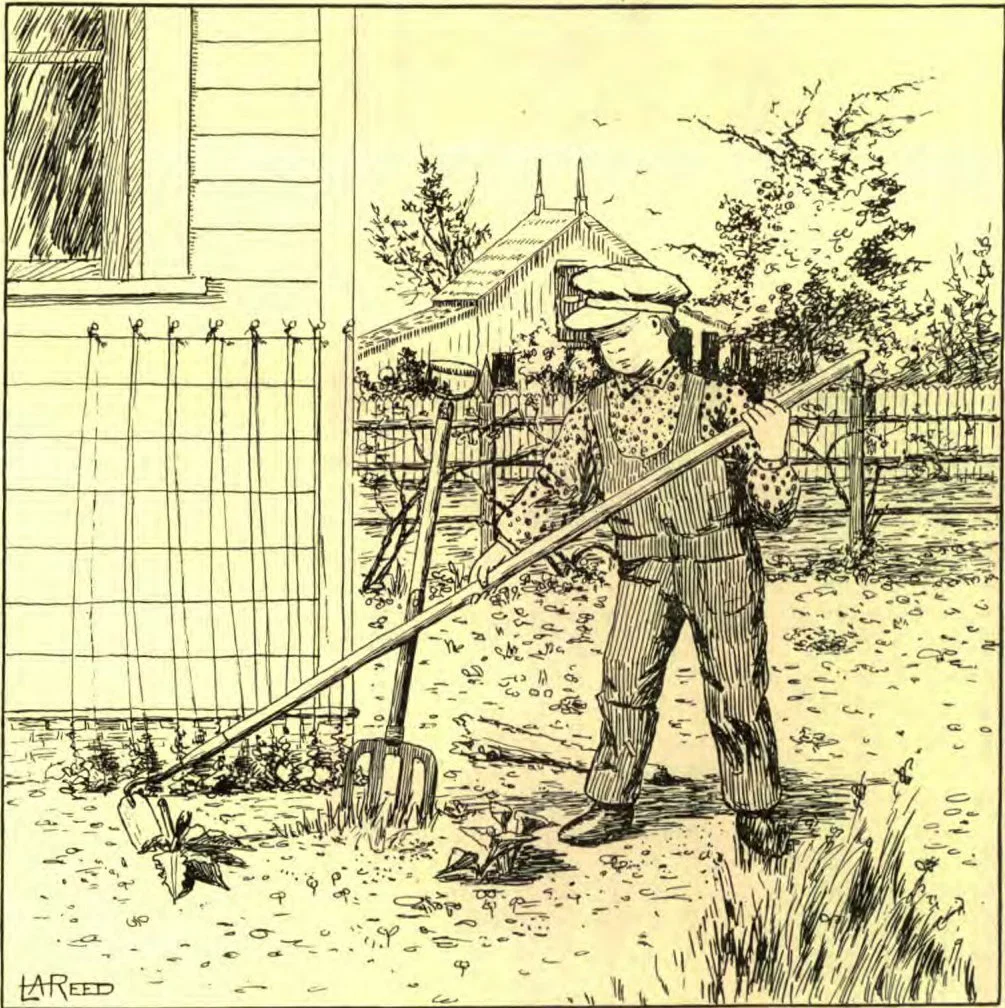
AMONG the early days of spring,
Almost before it's time to sow,
A happy boy starts out to swing
A shovel or a hoe;
And all around the house he looks,
To find the best of garden-nooks.
He lays his plans, and casts about
As wise and busy as a bee;
And some fine morning, looking out,
We're pretty sure to see
A little, fenced-in garden, set
Close to the house as it may get.
And many-colored banners tell
Just what is planted here and there;
And though some flowers are hard to spell,
The gardener takes care
That plants that run and twist and cling
Shall have no lack of good, stout string.
And who shall blame him, if, some day,
When budding-time seems very slow,
He gets impatient with delay,
And takes his spade and hoe,
And digs the tardy seedlings out,
To see if they've begun to sprout?
FRANK WALCOTT HUTT.
Polly’s Choosing
By Annie Hamilton Donnell
“POLLY!”
Mama waited a minute, and then called again, a little louder.
“Polly!”
“What’m?” came down faintly from the direction of the playroom. Then little steps clattered along halls and down stairs, and Polly’s face appeared in the doorway.
“Yes’m, here I—O, how do you do, Miss Cordelia?”
“Miss Cordelia wants to know if you would like to give some of your playthings to her Little Sufferers at the hospital, Polly,” mama said. “I told her you should answer for yourself.”
Miss Cordelia was—why, Miss Cordelia! Everybody knew Miss Cordelia, with her sweet, plain face and sunny ways. The Little Sufferers knew her—O, yes, indeed! She visited their big, bare ward in the hospital twice a week, and always carried them something that made the suffering a little easier to bear. Between visits the Little Sufferers tried to be patient for Miss Cordelia’s sake.
“There’s a little girl in the ward just your age, Polly,” Miss Cordelia said, gently. “I thought you might like to help her bear her pain. She can not move her legs at all, and her back always aches.”
“Oh!” murmured Polly. “Oh! I’ll go up an’ get her some things right away.”
“Thank you, dear. And to-morrow will you bring them to my house? I’ve got to go on farther to-day.”
Up in the beautiful, sunshiny playroom, Polly went around “choosing.” It was not so very hard; for of course she would not be expected to give the Little Sufferers her best things.
“I’ll give her Viola Verbena,” chose Polly. “Viola Verbena’s lost both o’ her legs, but she’s pretty good up-stairs. That little girl’s legs aren’t any good, either; so she can symp’thize with Viola.” Polly went on down the room, choosing further. She picked out a book with one cover gone, and a dilapidated paper doll, with a still more dilapidated wardrobe.
“There! I guess she’ll be s’prised to have three presents! I don’t b’lieve Miss Cordelia thought I’d be as gen’rous as that. But I’d just as lieves as not; Viola isn’t much good now, and the book’s torn, and the paper doll is all squiszly. I sha’n’t miss ’em much of any.”
When Polly dropped to sleep that night, she was thinking of Miss Cordelia’s Little Sufferers. She had been keeping her legs very still indeed under the bedclothes, and pretending she was one of them.
Suddenly the pretty, brightly lighted little room grew bare and big, very big; and a double row of narrow white beds seemed to start right up out of the floor. There was a Little Sufferer on every bed! Polly was the middle one in the left-hand row. She started up on her pillow, but a dreadful pain drove her back.
“A HAPPY BOY STARTS OUT TO SWING A SHOVEL OR A HOE”
“Why, it’s my back!” she said. “I never thought ’bout having a back before! I s’pose that’s an ache in it that hurts. My legs don’t move a speck—what’s the matter with my legs?” She began to cry softly, and somebody that looked like Miss Cordelia came hurrying up to her bed.
“What is it, dear? the pain again?” somebody said, kindly. “I’m so sorry; but here are some toys a little girl named Polly sent you. See if they won’t help you bear the pain.”
There was a legless doll that looked like Viola Verbena, a coverless book, and a paper doll all squiszly.
“They aren’t any of them very nice toys, dear; for the little girl couldn’t spare her nice ones. She wanted all those herself. You must make the old ones do.”
Polly thought she looked at the forlorn playthings, and wished that little well girl without any back, and whose legs would go, could know how she longed for something new and whole and beautiful.
“I s’pose it’s because I’m not whole myself,” she thought, wistfully. “It makes me want something that is. If I was a well little girl—”
It was broad daylight. Polly was in her own dear little room, and she hadn’t any back, and her legs would go! She wasn’t a Little Sufferer! When she went to Miss Cordelia’s after breakfast, it wasn’t Viola Verbena who went with her. It was stately, beautiful, whole Lady Rose, the loveliest doll in the playroom. And there was a dainty book and a paper doll with the prettiest of dresses.
“I shall miss them,” Polly thought; “but I’d just as lieves—I’d rather.”—Annie Hamilton Donnell.
Tommy’s “Thinking Trips”
It did seem good to Tommy to be in the convalescent ward. There was more to see, and there were visitors. One of these, a blue-eyed girl, had left a scrap-book, and it was almost Tommy’s turn to have it. He had asked to have it last.
When he told Miss Clara, the nurse, that he “might want to take some trips,” she understood and smiled. She and Tommy had become fast friends.
At last it was Tommy’s turn to take the precious scrap-book! Miss Clara made him as comfortable as possible and left him.
The first thing the big brown eyes saw was a butterfly—a large, beautifully colored butterfly!
Tommy leaned back and closed his eyes.
The butterfly was on a rose-bush now, in front of a dear little house! and see! two children come out of the house, and cry, “Oh, there’s a lovely butterfly!” And they chase the beautiful creature out across the soft lawn and into the field beyond, all spangled with daisies. And the little girl says, “Let’s pick the daisies.”
So the butterfly rests on a big swaying blossom, then flies on, on, into the grove, where the sunshine makes patchwork on the needles instead of the needles making the patchwork, and where a little brook sings to itself. But the butterfly loves sunshine, and away it sails over into the blueberry pasture, and ever so many children, picking berries, call, “Did you ever see a prettier butterfly?” And one of them—O dear!
Tommy started up, forgetting for the instant that it was only a “thinking trip,” and then he really laughed when he saw the pretty picture butterfly quite safe on the scrap-book page.
The next picture was a locomotive. Tommy shut his eyes again.
There were high buildings now, and the train was going by some back yards where children played, and clothes swung drying in the sun.
“Tommy!”6
The brown eyes opened with a smile in them.
“My mother has come, and wants to see my little friend Tommy,” Miss Clara was saying. “She has the book I told you I’d ask her to bring. I’ll read out of it some day.”
“O, I thank you!” cried Tommy, feeling overwhelmed with riches.
“Tommy,” she said, peeping into the scrap-book as she took that, too, “I see an elephant!”
“Oh, there will be jungles!” cried Tommy, in delight.—Selected.
Lessons from the Life of Daniel—III
By Ellen G. White
Early Training of Daniel and His Companions
AMONG the children of Israel who were taken as captives to Babylon at the beginning of the seventy years’ captivity, were Christian patriots, young men who were as true as steel to principle, who would not be corrupted by selfishness, who would honor God at the loss of all things. Upon these loyal and true young men the Lord looked with great pleasure. They had to suffer with the guilty, but in the providence of God this captivity was the means of bringing them to the front. Their example of untarnished integrity, while captives in Babylon, shines with heavenly luster.
Among those who remained true to God after reaching the land of their captivity, the prophet Daniel and his three companions are illustrious examples of what even youth may become when united with the God of wisdom. A brief account of the life of these four Hebrews is left on record for the encouragement of those who are called upon to endure trial and temptation.
After his return from the conquest of the Israelites, King Nebuchadnezzar “spake unto Ashpenaz the master of his eunuchs, that he should bring certain of the children of Israel, and of the king’s seed, and of the princes; children in whom was no blemish, but well favored, and skilful in all wisdom, and cunning in knowledge, and understanding science, and such as had ability in them to stand in the king’s palace, and whom they might teach the learning and the tongue of the Chaldeans. And the king appointed them a daily provision of the king’s meat, and of the wine which he drank: so nourishing them three years, that at the end thereof they might stand before the king. Now among these were of the children of Judah, Daniel, Hananiah, Mishael, and Azariah: unto whom the prince of the eunuchs gave names: for he gave unto Daniel the name of Belteshazzar; and to Hananiah, of Shadrach; and to Mishael, of Meshach; and to Azariah, of Abed-nego.”
It was not their own pride or ambition that had brought these young men into the king’s court, into companionship with those who neither knew nor feared the true God. They were captives in a strange land, placed there by Infinite Wisdom. Separated from home influences and sacred associations, they sought to acquit themselves creditably, for the honor of their downtrodden people, and for the glory of him whose servants they were. These youth had received a right education in early life, and now they honored the instructors of their childhood. With their habits of self-denial were united earnestness of purpose, diligence, and steadfastness.
The education which these four youth had received in Judea was not after the order of the worldly schools, but according to the purpose and plan of God. The school in which they were educated was not after the order of the schools existing before the destruction of the old world by a flood,—schools in which infidel sentiments prevailed, and in which nature was acknowledged and worshiped above the God of nature. These youth were brought up in homes where they were taught the fear of the Lord.
Daniel’s parents trained him in his childhood to habits of strict temperance. They taught him that in every act he must conform to nature’s laws; that his eating and drinking had a direct influence upon his physical, mental, and moral nature; that he was accountable to God for all his capabilities; and that by no unwise course should he dwarf or enfeeble his powers. As the result of this teaching, God’s law was exalted in his mind and reverenced in his heart.
And such an early education was to Daniel and his three companions the means of their preservation. The lessons learned in their earliest years led them to determine to avoid being corrupted in the courts of Babylon. The truth was truth to them. Its principles were stamped upon their hearts. They understood that with the heart man believeth unto righteousness, and with the mouth confession is made unto salvation. The first and great commandment, “Thou shalt love the Lord thy God with all thy heart, and with all thy soul, and with all thy mind,” was truth to them, and it must be obeyed.
In the schools established under God’s direction, the fear of the Lord was the foundation of all true education. The knowledge of God had been handed down from generation to generation. In Abel, whom Cain killed, and afterward in Enoch, Seth, Methuselah, Noah, and many others, the Lord had faithful witnesses, just men, who kept his fear before their generation. Their memories were not feeble and treacherous. They had received the words of instruction from Adam, and these they repeated to their children and their children’s children. Much important history and truth was expressed in song.
Daniel and his companions were familiar with the lives of Abel, Seth, Enoch, and Noah. They cherished the truths that had been passed down from generation to generation. The image of God was engraved upon the heart. When surrounded by an atmosphere of evil, these youth remained uncorrupted. No power or influence could sway them from the principles they had learned in early life by a study of God’s word and works.
Young men and young women, study the history of Daniel and his companions. Their lives should inspire you with a determination to be true to God. You must be either loyal or disloyal to him. Christian integrity is strengthened by serving the Lord faithfully. Uplift the standard on which is inscribed, “The commandments of God, and the faith of Jesus.” Make no compromise with evil. The line of demarcation between the obedient and the disobedient must be plain and distinct. Firmly determine to do the Lord’s will at all times and in all places.
MRS. E. G. WHITE.
What Is a Gentleman?
By Atkins
FIRST of all, let me tell you what he is not. He is not that well-known youth, with vacant, lamb-like expression, gorgeous necktie of many colors, immense cuffs, tight trousers, tiny shoes, and a buttonhole of huge dimensions. No; ladylikeness of exterior and a sort of “got-up-regardless-of-expense” appearance are not the outward and visible signs of gentlemanliness. Some of the roughest and most erratic men possess the truest hearts and the tenderest spirits. I shall always feel intensely grateful that the blind and blundering Peter was one of the disciples; for it shows that Jesus Christ can sympathize with men who are recklessly enthusiastic.
Some of the most useful, genial, and delightful men I have ever met have been impetuous Peters—true and honest disciples, but afflicted with7the unhappy knack of occasionally doing the right thing in the wrong way. They seem to possess every virtue except caution and prudence. And yet what a gentleman this erratic kind of fellow sometimes is! How sunny his smile, how loving his heart, how honest his voice, how firm the grip of his hand; but, alas! how unreliable his good intentions! Write him a long and important letter, and insist in several postscripts on an immediate reply. You may, by means of unusually favorable circumstances or a wet day, receive an answer within a week; but it is more likely that after many days he will be surprised by finding your letter in an odd corner, and write off an apologetic but almost illegible postcard.
He has boundless energy, never-failing vivacity, and a heart that overflows with love. See how he dries the falling tear; observe how he bears the bitterest inconvenience in order to do a service for a man who is “down;” notice how he stints himself that he may help any prodigal who happens to be “hard up;” see how the tiny children love this great-hearted, merry, boyish fellow, climbing all over him, caressing his rough face, and pulling his grizzly beard. Yes, this man knows something of the gentlemanly Carpenter of Nazareth, or he could not be so refreshingly frank, so transparently sincere, so sublimely unselfish. After all I would rather have the rugged warmth of a firework than the prim and pompous frigidity of an iceberg.—Atkins.
Behave Yourself
By B. F. M. Sours
ALL the time the preacher prayed,
Some one a disturbance made;
All the time a brother spoke,
Some one did a smile provoke.
All the time the people sang,
Merriment from somewhere sprang,
When the pious bowed the head,
Some one's mirthful cheeks were red.
While we prayed,— with playful looks
Some one scribbled in the books;
While our hearts the sermon stirred,
Some one didn't hear a word.
Worshipers, of erring ways,
'Tis God's house of prayer and praise!
Angels grieved, that hovered near,—
You to them are dear—so dear!
When the Master came to-day,
Came to hear his people pray,
O, he looked so grieved at you!
Will you not henceforth be true?
B. F. M. SOURS.
Not a Sparrow Falleth
By Amos Mitchell
ON a recent Sabbath, while taking my usual walk in the fields, I had an interesting experience. While passing along a lane skirted on one side by an apple orchard, and on the other by a small hill, at the bottom of which were miles of low-lying pasture land, divided by hedges and streams, with here and there a few trees, I was listening to the song of the robin, and the chirp of the sparrow; looking also for the blue jay and other birds, and thinking of the wisdom and kindness of our Heavenly Father and his care for all creation, when my attention was suddenly directed by the sound of a gun to two boys in an adjoining field. The gun was aimed into the trees, and my worst fears were realized.
I had just been reading of Buzz, the pet humming-bird, so I retraced my steps, and calling to the boys, asked them if they would like to listen to a good story. One of them seemed especially interested. After pointing out to both the wickedness of trying to shoot the birds, and leaving my copy of the INSTRUCTOR with them, I continued my walk. On my return I found them carrying out the suggestion made in our talk, and shooting at a target. Looking down, I saw in the leaves a wounded song-sparrow, which one of the boys recognized as one at which he had aimed his gun. I picked the poor little creature up, and showed them the wound in its breast, the pain of the little fellow being evident, though he seemed to realize that he had a friend. The boys were sorry for their actions, and one of them said, “I shall not shoot any more.”
Taking the suffering bird to a near-by house, I asked for water, and by dipping his bill into it, and then tipping him back, he was enabled to drink a little. The lady of the house brought a piece of soft bread; but on her approach the little fellow came closer to me, as if realizing that he was safe. After adjusting his wound the best I could, and placing the feathers across it in the hope that they might help to keep it in place, I left him to the care of our Heavenly Father, without whose notice not even a sparrow falls to the ground, hoping that the wound would heal, and the little bird live to help fill the woods with melody. AMOS MITCHELL.
— Frank Dempster Sherman
By Frank Dempster Sherman
Compensations
He found success most sweet
Who, having tried and failed,
The lesson of defeat
Upon his standard nailed,
Then straightway bade his soul
Take up the task begun,
Nor paused until the goal
Of his desire was won.
For joy the keenest seems
Where grief has been before:
After night's troubled dreams,
There, at the open door,
Thrice glorious she stands—
Dawn, with her roses gay,
And in her outstretched hands
The shining gifts of Day.
Memory Verses: “And as Moses lifted up the serpent in the wilderness, even so must the Son of man be lifted up: that whosoever believeth in him should not perish, but have everlasting life.” John 3:14, 15.
After the experience in the wilderness of Zin, Moses sent messengers to the king of Edom, asking for the privilege of passing through his country, but he refused. God had said that the Edomites should be afraid of Israel, and this would have been true, had they gone forward as the Lord intended, instead of murmuring at Kadesh. The Edomites were descendants of Abraham and Isaac, and God would have used Israel to help them become acquainted with him. But since the king refused, and they were not permitted to fight the Edomites, they had to go around Edom.
At Mount Hor the Lord told Moses to bring Aaron and his son up into the mountain, and Aaron should die there. For forty years he and Moses had been leading the children of Israel. Aaron could not go into the promised land, because of his sin at Kadesh, but he did not murmur. Moses removed Aaron’s priestly garments, and placed them upon his son. Aaron died in Moses’s arms upon the mount, and he and Eleazar, Aaron’s son, buried him. The people loved Aaron; and when they learned of his death, they mourned thirty days. As they continued their journey, the way seemed difficult, and they were full of complaints.
God had not forsaken the people because of their sins. When they would not go into Canaan, he still cared for them and protected them. He fed them with manna from heaven, and gave them water from the rock to drink.
The land where they were traveling was full of deadly serpents, but God had kept them from biting his people. But when they murmured against him and Moses, he withdrew his protecting hand for a moment, that the people might be brought to see how much they owed to his protecting care. Fiery serpents bit the people, and many died.
In the serpent of brass, by looking to which the Israelites were healed of their wounds, God gave them another object-lesson, to teach them the gospel. Jesus explained it in the words of our memory verses. The uplifted serpent was a type of him who was lifted up on the cross so that we might look to him and live.
It was believing and obeying the word of God that saved the people. There was no healing power in that serpent of brass made by Moses, yet all who obeyed God and looked to it were saved. The poison of the serpent lost its power over their bodies. Those who doubted, and would not look, because they could not understand how it could do them any good, died. Not looking at their grievous wounds, nor mourning over their sad condition, but looking away from themselves to the uplifted serpent, saved the people.
We have all been bitten by “that old serpent,” and the poison of sin is working in us to bring everlasting death. But God has made a way of escape for every one of us. The Son of man has been lifted up, “that whosoever believeth in him should not perish, but have everlasting life.” We must not waste time in looking at ourselves and mourning over our sins. We must look away from ourselves to our Saviour, and sin will lose its power over us, and new life from Jesus will fill us with his own righteousness.
Questions
1. When Moses asked for the privilege of passing through Edom, what reply did the king make?
2. Who were the Edomites? What did God intend that Israel should do for them?
3. What happened at Mount Hor? Why could not Aaron enter Canaan? Who were with Aaron when he died?
4. What sort of land was the wilderness where the Israelites wandered forty years? Deut. 8:15. Why were they not continually bitten by the serpents and stung by the scorpions?
5. What did they do, although God was so good to them? Num. 21:4, 5. What did God do to let them see how he had been preserving them? Verse 6.
6. What did the people then do? Verse 7. What did they ask Moses to do for them?
7. How did the Lord answer Moses’s prayer? Verse 8. How were the people saved? Verse 9.
8. Can you tell what this serpent represented? What did Jesus say of it? John 3:15.
9. Was it of any use for them to mourn and cry over their wounds? Is it of any use for us to spend time mourning over our sins?
10. Where must we look instead of to ourselves? If we do this, what will become of the sins?
IX—Practical Instruction for the Children of Light
MEMORY VERSE: “Rejoice evermore. Pray without ceasing. In everything give thanks: for this is the will of God in Christ Jesus concerning you.” Verses 16-18.
But we beseech you, brethren, to know them that labor among you, and are over you in the Lord, and admonish you; and to esteem them exceeding highly in love for their work’s sake. Be at peace among yourselves. And we exhort you, brethren, admonish the disorderly, encourage the faint-hearted, support the weak, be long-suffering toward all. See that none render unto any one evil for evil; but always follow after that which is good, one toward another, and toward all. Rejoice always; pray without ceasing; in everything give thanks: for this is the will of God in Christ Jesus to you-ward. Quench not the Spirit; despise not prophesyings; prove all things; hold fast that which is good; abstain from every form of evil.
And the God of peace himself sanctify you wholly; and may your spirit and soul and body be preserved entire, without blame at the coming of our Lord Jesus Christ. Faithful is he that calleth you, who will also do it.
Brethren, pray for us.
Salute all the brethren with a holy kiss. I adjure you by the Lord that this epistle be read unto all the brethren.
The grace of our Lord Jesus Christ be with you.— American Standard Revised Version.
Questions
1. What class are we especially admonished to recognize?
2. How and for what are they to be esteemed? With whom are we to be at peace?
4. What attitude are we to assume toward the disorderly, the faint-hearted, and the weak? What spirit will we show toward all men? Who has pursued this course before us, thus setting us the example?
5. In what practise can no Christian partake? Verse 15.
6. What spirit is he to manifest all the time? See also Phil. 4:4.
7. How often is he to pray? See Note 1. In how many things give thanks? Why?
8. How can we do this when the way seems dark? Rom. 8:28.
9. How are we to treat the Spirit of God?
10. How are we to look upon prophesyings?
11. What attitude are we to assume toward all things? To what only are we to hold fast?
12. From what are we to abstain? From how much of evil?
13. When we do these things, what will God do for us? What prayer is offered in our behalf?
14. What glorious assurance is given us that God will do this work for us?
15. What does every true servant of God ask in the inspired request of the apostle?
16. What token of affection is mentioned as manifest among believers?
17. To how many is this epistle written?
18. With what benediction does it close?
Notes
1. How can I pray without ceasing, and watch without intermission, I with my human frailties, I with my fluctuating powers?—You breathe without ceasing: make prayer the breath of your soul! Your heart beats without ceasing: make watchfulness the pulse of your nature!—Amos R. Wells, in “Help for the Tempted.”
2. “Despise not prophesyings;” that is, do not consider them as of no account. There will be in the last days prophesyings many, false and true. Both are of vast account, the one in leading to death and destruction, the other to light and duty and life. “Prove all things,” not by studying the false, but by knowing the true,—God’s word. Measure all voices by having God’s voice written in your heart, your life attuned to its principles.—S. S. Lesson Pamphlet.
Using the Moments
As goldsmiths sweep up the very dust of their shops, that no filings of the precious metal may be lost, so does the Christian man, when filled with the Spirit, use his brief intervals. It is wonderful what may be done in odd minutes. Little spaces of time may be made to yield a great harvest of usefulness, and a rich revenue of glory to God.—Selected.
Power of Purity
By F. W. Robertson
IT is a marvelous thing to see how a pure and innocent heart purifies all that it approaches. The most ferocious natures are soothed and tamed by innocence. And so with human beings there is a delicacy so pure that vicious men in its presence become almost pure; all of purity which is in them is brought out; like attaches itself to like. The pure heart becomes a center of attraction, round which similar atoms gather, and from which dissimilar ones are repelled. A corrupt heart elicits in an hour all that is bad in us; a spiritual one brings out and draws to itself all that is best and purest. Such was Christ. He stood in the world, the Light of the world, to which all sparks of light gradually gathered. He stood in the presence of impurity, and men became pure. Note this in the history of Zaccheus.—F. W. Robertson.
Dare to Be True
SOMETIMES we hear some one say that he is “discouraged,” and when we ask the reason, we learn that it is because somebody else has done wrong! or perhaps that same somebody or a number of somebodies haven’t treated him just right; therefore he’s “discouraged” and “ready to give up.”
If any one has it in him to give up that easy, you may be very sure he’ll give up soon. For people who profess to do right, who even call themselves Christians, and number themselves among the Lord’s chosen, are often falling into sin. They have exactly the same temptations to meet that we have; sometimes they fail, just as we do. But is that the time for us to fail,— for us to become discouraged, and make shipwreck of our souls?
It requires courage to be a good soldier; it takes a fine quality of courage to fight in the Christian warfare; for on that battle-ground is met the foe that is hardest to conquer — our own heart.
But what is courage, and how is it developed? Is any special display of courage required of a company of soldiers in camp, in a time of peace?—No; it is in the hour of conflict that their courage is put to the test, and the greater the stress, the more severe the trial, the brighter does that quality shine out.
A story is told that illustrates this point. “A craven hung along the battle’s edge,” and in the onslaught of the enemy his sword was broken. He dropped the weapon, and fled. Later the king’s son, who had been disarmed, passed that way; and seeing the broken sword, caught it up, rallied the disorganized remnant of the army, and led them on to victory. Only the coward gives up.
We admire the courage of that fine old soldier, Joshua, and of his faithful companion, Caleb. They were in the minority. “Everybody” was against them. They had given a faithful report of the land of Canaan, but it was not believed. Many persons would have felt themselves justified in saying, “Well, there isn’t any use, that I see, of keeping on with this people. Look at the way they treat us. We’ll have nothing more to do with them.”
Not so Joshua. The people lifted up their voice and wept all that night. In the morning, they were as madmen, murmuring against their leaders, and openly threatening to choose a captain who would lead them back to Egypt.
In this hour of danger to his own life, Joshua, pressing his way where the murmuring was loudest, lifted up his voice in tones of courage and hope and authority, and declared again that the land was theirs if they would only go up and take it. And had the people succeeded, in their frenzy, in killing this brave man, we are sure that with his last breath he would have honored the promises of God by his good report of the land, and his confidence that Israel was well able to possess it.
Just as long as sin and temptation are in the world, just so long will there be occasions to test our courage, our faithfulness, our loyalty to God and to his cause. And these occasions will increase—they are increasing—as the end draws near. The very fact that others are indifferent, or backsliding, or even deserting to join the ranks of the enemy, is a call to the loyal-hearted to stand true to God and to his cause. Many years ago we were told that “we must gather warmth from the coldness of others, courage from their cowardice, and loyalty from their treason.”
Do you expect to be among those who will have that experience at some future time? Then look to it that you have it to-day.
“Pilgrim’s Progress” in Matabele
BUNYAN'S immortal book has been translated into the language of the Matabele by Mr. Carnegie, missionary to this tribe. The illustrations are a new departure. It has a purely local coloring, but, as the artist says: “The Puritan classic bears the necessary change of local coloring without loss of any kind. Time and place do not affect essentials in the great allegory, and there is no reason against an interpretation according to local environment to suit any race in the world.” In its new dress we see Christian starting from a “kraal.” The mud-hole of the “veldt” is the “slough of despond.” Evangelist is a missionary. Apollyon appears as a creature with a wolf’s head, owl’s eyes, and crocodile’s scales and tail. A war-dance festival takes the place of Vanity Fair. This will help the Matabele to understand the great book better than any Western pictures could have done, without taking away any of its great heart-lessons that have been so beneficial to those of other lands and tongues.—Bombay Guardian.
How Liquid Air Looks
WHEN liquefaction is finally reached, air in its liquid form looks exactly like water, and may be poured out just as water is—with certain precautions. The fact that liquid air is at an extremely low temperature makes it dangerous to handle without precautions similar to those which are taken in handling hot bodies. With very cold bodies, heat passes from the hand to the object at a very rapid rate, just as heat passes from a hot body to the hand at a rapid rate. It is the rate at which the heat is transferred, either to or from the human body, which causes the pain and other troubles. When poured out on a table, liquid air runs about in small globules, just as mercury does, and disappears in a very short time. It has returned to its gaseous form.
When allowed to escape into the atmosphere, its presence is shown by clouds of mist, producing the impression that the liquid air is converted into fog. This is not so, however. What really happens is, the aqueous vapor which is always present in the atmosphere, particularly that of rooms in which a number of people are assembled, condenses, and then freezes, or forms a sort of hoar frost, and it is that we see, not the liquid air itself.—Selected.