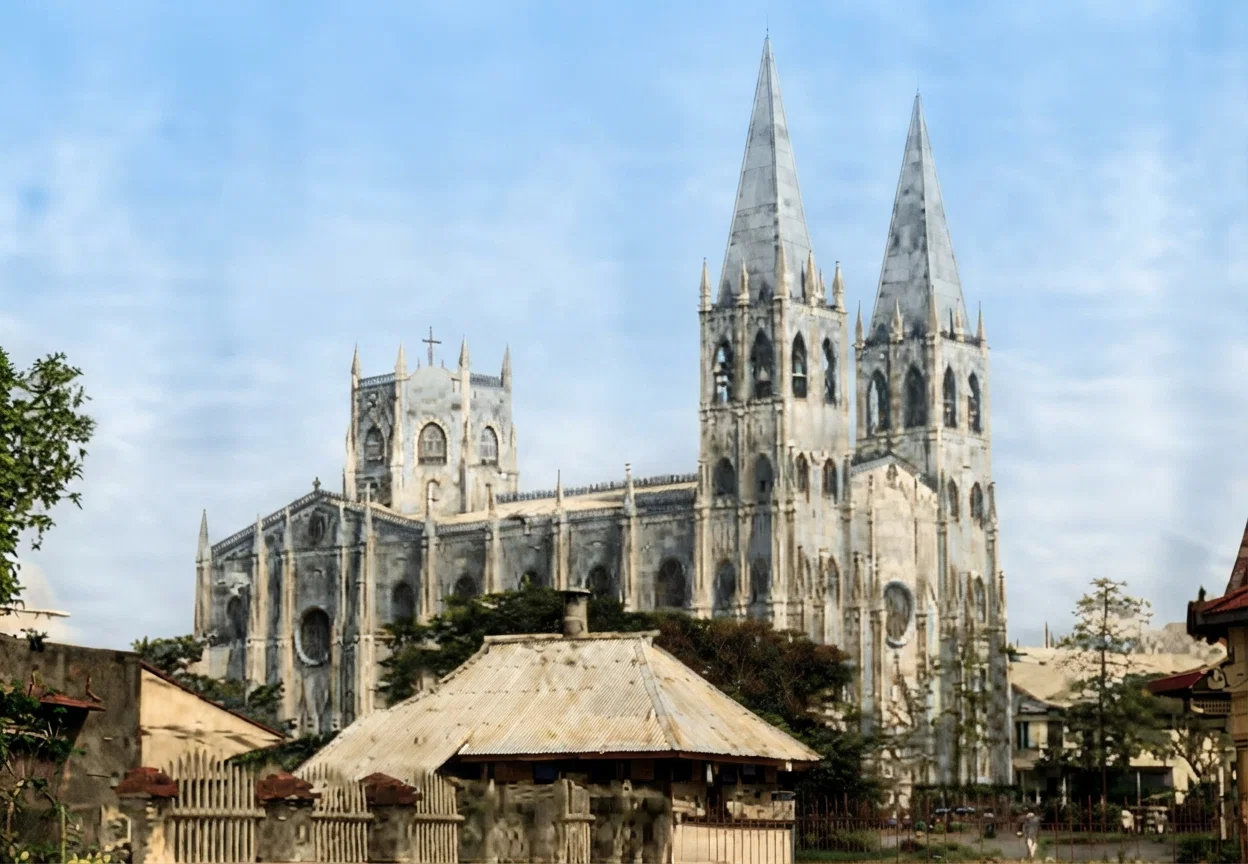
A STRAW is a very little and unimportant thing when found in a barnyard or stubble field. It indicates practically nothing except that straw has been there; but floating in the air it is more important sometimes than a mountain; it shows the way the wind blows. Here is a little straw showing the feelings of the Papacy toward this country and the demands that it will soon be making on the government.
President Roosevelt's daughter has been making a tour of the world, and like any other free, independent American girl is following her own fads and fancies, without much regard to others, only as they dance attendance at her pleasure. Yet in her pleasure mood she has deeply vexed the Roman Catholic church, at least, so a special cable despatch from Rome, which is friendly to Vatican authorities, tells us. The date of the despatch is August 30. It declares that the pope had prepared a letter praising President Roosevelt for bringing about peace in the East, but he is holding that letter until Miss Roosevelt's conduct is explained.
The great offense which she created was to give a little more than ordinary attention to the schismatic archbishop Aglipay, who some time ago bade adieu to the Roman Catholic Church in the Philippines. As soon as she arrived in Manila, he called. Several of the dignitaries of the Roman Catholic Church called also, but "Miss Roosevelt's conversation was mostly monopolized by the schismatic prelate, while the members of the Roman clergy stood and looked askance;" but worse than this, she, even she, the President's daughter, permitted herself to be "photographed side by side with the greatest enemy the Roman Catholic authorities in the islands have, or ever will have." Therefore great displeasure is felt at the Vatican. Some charitable souls think that it is probably due to a lack of diplomatic training on the part of the President's daughter, and do not regard it as a deliberate snub to the Catholic authorities, because "long experience has shown Vatican officials how the President and other United States officials have always manifested the most conciliatory spirit to the representatives of church interests in the islands ever since the American occupation."
"It is remembered here that Mr. Taft, when governor of the islands, went out of his way to make concessions to the Church authorities regarding the settlement of the Friar's lands question, and that he was sent to Rome as a special messenger to the late pope, who was much impressed with his earnestness and fairness, and discussed with him all the questions affecting church interests in the islands, getting from him many advantages for the church which no one at the time in Rome could expect."
Yet after Miss Roosevelt's display of her preference we are told that the pope's representatives and Catholic bishops in the Philippines felt compelled to refrain from calling on the President's daughter to pay their respects as Aglipay had done, and that no direct invitation was received by any of them from Mr. Taft or the party to attend any special functions while the schismatic archbishop was always within the privileged circle. We are still further told:
It is surmised here that the Catholic prelates of the archipelago feel deeply about the matter, and justly so, because of the great damage done to church interests there by Aglipay's scheme.
Even while Miss Roosevelt was in the Far East the church authorities in the Philippines had a suit in the courts against Aglipay and his followers for the restitution of the churches and church properties taken possession of since the American occupation, and it seemed strange that this was not taken into consideration by the diplomats in the Taft party before granting to the schismatic archbishop unusual facilities to approach the President's daughter and be entertained by her in familiar conversation.
The very fact that the schism has lost to the church of Rome hundreds of priests and thousands of communicants in the archipelago ought to have prevented the Taft party and the civic officials in the islands from extending to Archbishop Aglipay more than the usual courtesies, instead of allowing him a preference over the Catholic prelates which the Vatican regards as unwarranted.
One of the Catholic Church Edifices in the Philippines.
Effect on Natives Feared.
It is greatly feared here that the extraordinary courtesies shown Aglipay by the American President's daughter will have a damaging effect among the natives of the Islands, many of whom are already at odds with the church authorities, and that it will encourage Aglipay followers in their rebellion and defiance.
Some prelates in Vatican circles, among them Cardinals Satolli and Martinelli, formerly apostolic delegates to the United States, were called into consultation by the pope as soon as Mgr. Agius's report came. They expressed the opinion that the whole matter was pre-arranged by island interests inimical to Rome, probably by prominent Protestants, who are known to be very active in the Philippines in trying to convert the natives to their churches and beliefs. It is also known here that a close intimacy exists in the Philippines between Aglipay's followers and the Protestants, and that several of the latter have often expressed the opinion that eventually all his followers will join Protestant churches. Miss Roosevelt's deference to the schismatic Archbishop is considered here as most likely to soon cause this step to be taken, and then all hopes of putting a stop to the schism will have vanished.
The despatch closes with an intimation that explanation will be asked for, so that the natives may know that Miss Roosevelt's action was an oversight due to her innocence of diplomacy and her ignorance of local conditions. Pius X. was upset for several days after hearing of the affair.
We are glad that Miss Roosevelt exercised her own free American common sense in the whole affair, but we are sorry that the relations are such between this government and the Vatican as even to make the Vatican feel that it has any right to demand any explanation at all. Miss Roosevelt is the daughter of an American citizen, and she is in nowise an official of the United States Government; but even tho she were, neither she nor Mr. Taft is bound in any wise to recognize any religious body whatsoever. The rights of Aglipay, be he entirely wrong, are equal to the rights of all the Roman Catholic clergy in the Philippines, be they wholly right. It is for the United States Government to treat them as men regardless of their religion. Such things as these ought to stir every American who believes in primitive American principles. This American liberality of going "out of the way" in granting Rome "concessions," will mean that this government will be called upon to go "out of the way" to grant her demands, or will suffer through her influence upon politics. The American nation has entered upon a dark, dangerous road, at the end of which is death to liberty.
OUR EUROPEAN LETTER.
By Jean Vuilleumier
THE French bill providing for the separation of the church from the state has successfully passed through the Chamber. It will now soon be passing through the Senate, which is said to be quite inclined on the whole to sanction the work done in the Lower House.
Before I come to report on this event, I would like to keep my promise to give the readers of the SIGNS some of the gems gleaned from the discussion of the bill before the Chamber of Deputies.
Before the discussion of the articles opened, a multitude of amendments on almost every article had been proposed, and they kept coming in during the whole debate. No exception was taken by any one, however, to the first part of the first article, which reads as follows: "The Republic protects liberty of conscience and guarantees the free exercise of worship."
No one, certainly, could decently object to such a declaration. Catholic deputies, on the contrary, were eager to get all that this article implied, and to point out features in the bill which seemed to them to contradict it. One of them quoted an article of the Declaration of Rights of 1789, which says: "Liberty consists in doing all that does not injure your fellow-man. Law can only forbid actions harmful to society." And also the Declaration of 1793, which says: "Liberty is man's power to do whatever does not infringe upon the rights of others. Nature is its principle, justice its law," etc.
But the end of Article I. was not thought so safe by the same side of the House. It reads as follows: "The only restrictions (to freedom of worship) being those mentioned hereafter, in the interest of public order."
M. Benoist, a Catholic, quoted the following from an Englishmen, Bentham, to show that the expression "public order" was loose enough to cover a great deal of intolerance: "What is it to disturb public order? In the days of Louis XIV., public7order consisted in allowing no other than the Catholic religion. Therefore, the publication of any writing in favor of the doctrines of Luther or Calvin must have disturbed public order established by law."
Such a quotation, on the lips of a Roman Catholic, seemed like a bit of impertinence. The reply was given by M. Briand, who said with delicate irony that "he had not seen without astonishment and also without a bit of pleasure, the honorable speaker, as a passionate Catholic, burning so much incense upon the altar of Liberty that the whole House was perfumed with it."
Another speaker made the valuable statement that "the three fundamental principles of public law recognized by all civilized nations, are as follows: (1) The guarantee and respect due to liberty of conscience and worship; (2) The respect due to equality among citizens; (3) The respect due to property." This high recognition and honor given by a devout Catholic to liberty of conscience might have led one to ask him how he reconciled this with the Syllabus of Pius IX. which anathematized all modern liberties, but especially liberty of conscience.
This very question was put on another occasion by M. Jaurès to Abbot Lemire who was clever enough to dodge it. The same point, however, was made by some one who reminded the House of how Abbott Gayraud, one of the members, had said: "We want religious liberty in the Catholic sense," meaning by that evidently, that he wanted a liberty mainly for the Catholic clergy to the extent of enforcing upon unbelievers the respect and even the practise of its dogmas, while refusing the same to other denominations."
These bold declarations in favor of liberty, called out another taunt on the part of the liberals: "Why then, do you fight our bill?" they asked. And the reply was always painfully round about and hesitating, the only clear conclusion being the money side of the question. This gave the speakers on the other side a sad chance to rail over religion in general or to speak of the decrepitude of Catholicism.
"The reason why you do not want the separation," said Protestant Réveilland, "is because Catholicism is afraid of liberty, because it needs to be supported by the state in order to live." To which Catholic Lerolle replied: "No, no, we are not afraid of liberty. Look how our church is flourishing in the United States. But the situation there is not the same as here. We are not accustomed to liberty as they are in the United States. The United States has a government which—tho it supports no church—is essentially Christian (?) which dares to speak of God and to show its religious colors."
Again, the state was made responsible for the prosperity of the church. Again, God was left out of the question. Abbott Lemire betrayed the same lack of faith when he said, "I know the Catholic priests in England and in America. They are good priests, but they have more money than we have here."
At this point, an infidel, M. Allard, gave vent to his impious scorn: "God will provide," he said. "Catholics are too apt to leave God out of this matter. He who feeds the little birds and all nature will certainly not forget His ministers and leave them to starve to death (after the State ceases to feed them). It would not be like Him. Then I would say: Leave them all in God's hands (instead of keeping up their allowances for several years yet after the separation)."
With solemn melancholy, M. Briand summed up the whole situation amid a storm of applause and protests: "Everybody must recognize that the best interest of both state and church would be to live separately. But your church, gentlemen, the church which you have made, lives principally on the help given it by the state. There used to be a church who asked for no other birthright but her God; a church who remained aloof from all political agitations and party competitions; a church whose only desire was to grow and develop along spiritual lines. But, gentlemen, that church has ceased to exist, it is dead. It has ceased to exist, and I can well see that no one here thinks of raising it up, for no one has spoken in her name."
Does not this sad note kindle in every Christian heart a fond hope that the true Gospel church may soon again exert its blessed and growing influence on the soil of France, thus fulfilling the words of M. Lasies the Catholic leader, who replied: "Let me tell you, M. Briand, that these words which you intended as an epitaph on the grave of religious faith, may become words of resurrection. You may have caused this awakening, and religious faith may arise more enthusiastic than ever from under the funeral pall in which you thought it dead, and in which it was only asleep."
JEAN VUILLEUMIER.
Gland, Switzerland.
OUR LONDON LETTER.
By M. Ellsworth Olsen
The Anglo-Japanese Treaty.
THE publication of the Anglo-Japanese treaty has given rise to considerable newspaper comment. In England the new alliance is regarded with all but uniform favor. On the continent, France is naturally pleased, but Germany and Russia are evidently ill at ease. It is not unlikely that other understandings or alliances will in time be formed with a view of off-setting the gain in influence and prestige which the present alliance has secured for Great Britain. Meanwhile the latter regards her position as strengthened by the fact that her aims in the Far East are practically identical with those of the United States—the maintenance, namely, of the open door in China and of the status quo generally.
British politics are more and more taking account of the wishes of America, and while it is not necessary to suppose that an Anglo-American alliance will ever be formed, it seems likely that the two nations will act together in most matters, more especially because they agree pretty much in general policy. The friendship of England seems destined to be a not unimportant factor in securing for the Western Republic that position of leadership among the nations which is foretold in the 13th chapter of the Revelation. Certainly recent developments point to a near fulfilment of this prophecy.
Spiritism in Great Britain.
As pointed out in previous letters Spiritualists in Great Britain are rapidly growing in influence and numbers. But one hardly expected that an Archdeacon in the Church of England would come out as an avowed Spiritualist and propose to move at the next Church Congress the appointment of a committee to inquire into psychical phenomena, with a view to the acceptance of Spiritualism as a regular belief of the church. Yet this is precisely what Archdeacon Colley, Rector of Stockton, near Rugby, has done. He claims to have conducted his spiritualistic investigations for some thirty-three years, and thinks he has facts in his possession which will scientifically prove that there is a life beyond the grave. Truly, the church must be in great straits when forced to resort to Spiritualism to prove such a cardinal truth as the resurrection of the dead! But in the light of the general acceptance by clergymen and by the religious press of the extreme positions of “Higher Criticism,” it is not surprising that they should feel the need of some such bolstering up to make their position at all tenable.
Mr. Colley maintains that he has gained his knowledge by “experience and patient experiment and by constant fasting.” He says, moreover, that he feels it a duty to speak; and he can not cease to claim “that these manifestations should be received as being just as credible as Bible incidents in which angels appeared to men.”
Unfortunately he is by no means alone in his leanings toward Spiritualism. There is reason to believe that the church is honeycombed with this last-day delusion, which is the more dangerous as it works so insidiously, and usually under cover of a professed belief in the Bible and the accepted Christian doctrines.
Dangerous Heresies.
Christian science, a close ally of Spiritualism, is also making inroads upon the church, so much so that the Bishop of London, in a recent address before the Christian Evidence Society, thought it necessary to warn Christians against this heresy. He also mentioned in this same connection the dangers to the church from Theosophy and the “Higher Criticism,” and urged the necessity of fighting these foes of Christianity.
Meanwhile, what the Bishop of London and his fellow clergy do not seem to realize, is that loyal acceptance of Bible teaching as a whole, and obedience to every divine command, form the one sure safeguard against heresy.
Human Limitations.
The inherent helplessness of man in the presence of the great mechanical forces which he is supposed to have brought into subjection, is strikingly illustrated in the recent sad accident on the Great Eastern Railway. Altho the track was in excellent condition, and the engine and rolling stock apparently without flaw of any kind, a train running at full speed into Witham station was suddenly derailed and wrecked with considerable loss of life. Thus far all inquiry has left the public entirely in the dark as to the cause. The occurrence remains absolutely inexplicable. Railway accidents are comparatively rare in Great Britain, but the present year has witnessed several appalling ones.
Work continues to be scarce, and the outlook for the coming winter is ominous. What is England to do for her worthy poor? becomes a question of growing urgency and importance.
M. ELLSWORTH OLSEN.
DARK DAYS IN RUSSIA.
RED Anarchy seems to be ruling Russia these days. On October 30, Emperor Nicholas yielded to the ever-increasing demands of his subjects, and issued a manifesto which gives to Russia a constitution. There had been a strike on all the railroads of the czar's dominions, which made it impossible for troops to be moved from place to place except on foot. Food supplies were being cut off in all the cities. The granting of a constitution, making Russia a limited monarchy, was greeted by the better class through Russia with demonstrations of joy. But a very large portion of the people, led on by agitators of the Socialistic and Anarchistic class, demanded the suppression of the monarchy entirely. They paraded with red flags. Portions of the student class formed demonstrations of the same kind. They marched to the jails and demanded the liberation of the political prisoners. Many of these were released. Bands of rioters calling themselves loyalists, after marching to the churches and taking part in services there, have marched through the Jewish quarters of the city, pillaging, murdering, and burning. Disguised police have urged them on, and generally the military have refrained from interfering until scores had been slain and hundreds injured. In all the cities of Russia, blood has been flowing freely during the past week. Day after day, the reports have been the same—butchery, pillage, incendiarism, clashes between troops and mobs or between militia and Cossacks. So far as the Jews are concerned, the horrors of Kishineff have been surpassed many times over. What will come of it none can tell. The Socialists are demanding a democratic republic, the “loyalists” are opposed to this, and great mobs of thousands seem to be opposed to everything but destruction and riot and pillage. Finland is threatening to revolt, and in Poland there is heard the demand for independence.
THE UNIVERSAL FOE.
THE Commissioners of Lunacy for England and Wales report an increase of patients in each of the three classes—private, pauper, and criminal. Solemnly they direct attention to the fact that during the five years—1899—1903—intemperance was the cause assigned by the medical superintendents for 22.07 per cent. of the male cases and 9.4 of the female cases. In general hospitals a similar proportion of diseases may be accounted for in the same way; intemperance causes many wounds and prevents countless recoveries. It is not merely drunkenness which does this; but lifelong so-called “moderate use,” the result of which on heredity is often ascertainable, inferentially so in divers cases. —Christian Advocate.
EVOLUTION AND GEOLOGY
By Geo. McCready Price
HISTORICAL SKETCH.
Life-Succession.
THERE are few methods of investigation which can so show the beauty of a truth or the deformity of a lie as a study of its history and its results. "Ye shall know them by their fruits," said the Greatest of Teachers, long ago; and I know of no better way of studying even a scientific theory, providing of course we can get at its true history, considered from the right view-point.
My chief authority for the strictly geological part of this subject will be Karl von Zittel's "History of Geology and Paleontology to the End of the Nineteenth Century," London, 1901; and where other authorities are not directly referred to this may be understood to be the source of my information. Whewell and Lyell have given us the history of the earlier observations, and the almost countless theories which succeeded one another thick and fast till the opening of the nineteenth century; but Zittel gives the modern history as well, which is presumably the equal if not the superior of anything before written on the subject, altho on the very points of most interest to us in this connection they are all sometimes provokingly meager.
The vain speculations of the ancient Greeks, from Thales of Miletus to Plato, are not worth any serious consideration here. The Romans were somewhat more practical, and Strabo, Seneca, and the two Plinys wrote some on geological subjects with some gleams of common sense; but on the breaking up of the Roman Empire the world again relapsed into semi-barbarism, and for many centuries "a barren scholasticism" blighted the healthy development of the human mind.
When the Bible was called forth
from the tomb of the dead languages and given its rightful place as the true light of the world, in the Reformation of the fifteenth and sixteenth centuries, men awoke from the hypnotic sleep of ages, and began to inquire for new worlds to explore, and new realms of knowledge to study out. God's book of nature once more resumed the place in education which it had held among the peoples of remote antiquity, and—
Plants, animals, and rocks were studied with enthusiasm, were examined, described, figured, and classified, so that in a relatively short space of time a fairly extensive botanical, zoological, and mineralogical literature sprung into existence.—"History," page 13.
But another strange perversity now seized upon men's minds. For, while the Greeks and Romans had realized that the fossils were the remains of real plants and animals, the "scientists" of this period would hear of no such thing.
With the dawn of the fifteenth century began that long series of disputes about fossils which lasted more than three centuries. The questions under discussion were, whether fossil organisms had taken origin from a vis plastica, or from living seeds carried in vapors from the sea, or from any living force in the earth itself; whether they might be regarded as mere illusory sports of nature, or as mineral forms, or if they really were the remains of animals and plants that had once lived and had been brought by the Flood or some other catastrophe into their present position."—Id., pages 13, 14.
Fossils and the Flood.
The famous artist Leonardo da Vinci, George Bauer (Agricola), Bernard Palissy the inventor, with Steno, and Robert Hooke (1635-1703), of England, had the right ideas about the fossils, believing them to be remains of former living things. The latter is the first who suggested that the fossils might be made to reveal something of the past condition of the earth, and from the occurrence of Chelonias and large Ammonites at Portland Isle, he "concluded that the climate of England had once been much warmer."
Scarcely had the organic origin and historical significance of fossils been successfully vindicated, than the doctrinal influences of the day stepped in and claimed all fossil forms as vestiges from the earlier creation interred in the earth during the great Deluge. The "Diluvialists" formed a powerful party amongst the geologists of the seventeenth and eighteenth centuries, and were warmly supported by the church. In England, Woodward, Burnet, and Whiston, had strong convictions in this direction; while in Germany, Wedel and Baier, and in Switzerland Johann Scheuchzer, taught that all fossils had been spread through Europe during the Flood.—Id., page 20.
But the wild fancies of Burnet and Whiston deserve rather to be called travesties alike on science and the Bible. John Woodward (1665-1722) seems to have been more rational.
He strongly opposed the opinion that fossils could be mere imitative sports of nature, and said they represented past faunas and floras. But he supposed these remains to have been carried to their present position in the earth by a "universal flood, the Deluge of the Scriptures."—Id., page 29.
Nevertheless Zittel names him along with Steno, Hooke, and John Ray, as one who "guided scientific thought to the true explanation of fossil remains."—Page 19.
Unfounded Theories.
Happy would it have been for science and for the world if all students of the rocks had given the Bible credit for telling the truth and had curbed their fancies so as to conform to its record. Unfortunately during this same time there lived other writers on geology such as Moro, De Maillet, and others, men who, like Burnet and Whiston, were engaged in spinning fantastic theories of the origin and history of our world; or as Zittel puts it, "accepted the risks of error, and set about explaining the past and the present from the subjective standpoint."—Page 23. From what I have already shown of present geological teachings my readers may doubt whether modern uniformitarianism has yet outgrown these methods.
J. G. Lehmann who in 1761 was appointed Professor of Chemistry and director of the Imperial Museum at St. Petersburg by the Tsarina Catherine of Russia, is undoubtedly one of the real founders of geological science. He distinguished the "primitive" rocks from the subsequently formed stratified ones, the latter he regarded as having been laid down by the Deluge. His work in geology was principally confined to the rocks of Thuringia, since classified as Permian.
Dr. Füchsel (1722-73) studied in great detail those rocks of the same district now known as Triassic. He was the first to use the terms "stratum" and "formation." The latter term he used "to signify a succession of strata which have been formed immediately after one another under similar conditions, and represent one epoch in the history of the earth; and this is the significance which has continued to be attached to the term in geology."—Page 36.
He distinguished nine of these "formations," from the oldest to the middle Triassic. Füchsel's work first "gave to the geological formation a definite paleontological value," and, by being afterward taken as the model for the Wernerian school of geologists, had a vast influence over the science in Germany, and in fact the whole world.
Professor Arduino, in Padua, Italy, must also be mentioned here, for it was he who first subdivided the stratified rocks into "Primitive," "Secondary," and "Tertiary" groups, as representing successive ages.
Wandering from True Methods.
These three men, particularly Lehmann, were undoubtedly largely following true empirical or scientific methods. Their work was especially of value to subsequent generations in being detailed and almost exhaustive descriptions of particular localities,—descriptions that have seldom been equaled since. Tho in so far as they indulged in speculation about time and laid off the strata in groups of successive ages, as Füchsel and Arduino did, they were making these small localities, mere spots on the globe, the standard by which to judge all the rest of the earth, thus leaving safe inductive principles far behind. This monstrous assumption that because the rocks occur in a certain order in a particular locality, therefore they must occur in this order all over the globe, has ever been the stumbling-block of geological science; for it involves this palpable absurdity that different kinds of sediment could not be formed contemporaneously in localities distant from one another. Thus far however the rocks were being thus set off in "ages" solely on the grounds of their mechanical and mineralogical character. To work on the same principle with the fossils was an invention of a much later date.
(To be continued.)
ETERNAL GROWTH.
THERE is no dead-line while growth continues. Therefore, as has been well said, a man's permanent usefulness is conditioned by his power to grow. When growth stops, usefulness stops. But growth is not a matter of bodily strength alone. Altho the bodily powers must fail, some men give increasing evidence of their growth in qualities that shall outlast the body. Dr. Trumbull, when in the abounding strength of his intense nervous and muscular vitality, used to say laughingly that the Lord knew his temperament too well ever to make him a "shut-in," for he never could stand that. Not many years later the Lord tested him with just that trial, and for three years of partial physical helplessness the growing character that knew no "dead-line" gave evidence of continued growth at a point where its possessor had been sure he would fail if tested. If growth is checked in one direction, it must appear in another.—S. S. Times.
THE SABBATH GUARANTEE.
By Eugene A. Brown
BY EUGENE A. BROWN.
BEFORE probation ends every man and woman will have decided for or against the Sabbath of the Lord. How often, in refusing to honor the claims of the seventh day words like these are uttered: "Yes, I know that's all true enough; and if I had plenty of money I would keep the seventh day; but I believe a man's first duty is to support his wife and children. God doesn't expect a man to let his family starve." And choosing his own way, the poor man, weak in faith, takes the very course that ends in sheer failure.
But lo! ages ago our God saw those very thoughts afar off; saw that trembling faith; and in the volume of His Word placed a foundation of enduring promises whereupon the timid follower might step out and stand secure.
Before His assembled church in the wilderness Jehovah added a visible revelation of His eternal law and put it in tangible form—even upon two tables of stone—that its appreciation by the outward senses might awaken its spiritual counterpart in the heart.
"And He declared unto you His covenant, which He commanded you to perform, even Ten Commandments; and He wrote them upon two tables of stone." Deut. 4:13. In respect to this law (Ex. 19:5-8) the people made a covenant with God, and had promised, saying: "All that the Lord hath spoken we will do."
Then the Israelites started in to keep (?) their promises, just as many people had done before and continued doing. The flesh indeed was weak, and they failed to keep their agreement.
They looked up at those great words expressive of God's ways, and found as declared in Isa. 55:9: "For as the heavens are higher than the earth, so are My ways higher than your ways, and My thoughts than your thoughts." Human strength could not scale the height. To them the law virtually said:
"[I command that] thou shalt have no other gods before Me." "Thou shalt not make unto thee any graven image." "Thou shalt not take the name of the Lord thy God in vain." "In it [the Sabbath] thou shalt not do any work." "Thou shalt not kill." And so on.
Now, mark this: The Gospel was at that time no new idea. It had been preached in the patriarchal age (Gal. 3:8) and it was familiar to these people in the Levitical dispensation (Heb. 4:2). The Gospel always was and still is "the power of God unto salvation." Rom. 1:16. Israel could have received "the power of God" then just as truly as we can receive it to-day, to have saved them from transgressing the Divine law. But they had no faith (Heb. 4:2), just as many have none to-day.
Our own ability to-day to keep the law is just as ineffectual as was theirs, our promises fully as weak and as readily broken. Right here is where the Lord offers to come in with His mighty help. Read Jer. 31:31-34 concerning the great work He is ready to do for us.
"After those days, saith the Lord, I will put My law in their inward parts, and write it in their hearts."
It is the same law that was written on stone, not a jot or tittle changed; written by the same God, but placed in the fountain-head of our every motive, thought, and action. When we let the Lord do that for us, there is no room for further doubts, there is no place in the heart for sin. There can be no more sin lurking in our hearts than was expressed upon the fair tables of stone upon which the Holy One had written His holy law.
Before this transaction we halted on our own failing promises under the first covenant; but standing on God's promises we find it true that "He is the Mediator of a better covenant, which was established upon better promises." Heb. 8:6. With the law of God in our hearts we are sustained by His promises in it, namely: "[I promise that] thou shalt have no other gods before Me," etc. "Thou shalt not kill," etc.
The promise is right there in the law when God writes it on our hearts. The command is there when it is written merely on the tables of stone.
But the most satisfying promise is in the Sabbath precept, the very one that so many reject, the very one upon which Israel was especially proven. Ex. 16:4. Any attempt to keep the seventh day in our own strength (on our own promise) is futile. But with the law in our heart the Sabbath precept is the seal of perfect rest. Others may draw back, fearful of ridicule, oppression, and starvation, but to us it confidently speaks: "No power in heaven or earth shall rob you of My watch-care;" (I promise that) "six days shalt thou labor, and do all thy work." Blessed assurance! Thousands may join hands to rob you of your God-given time, but all in vain, for "six days shalt thou labor," has the Word of God spoken. "Lo, I am with you alway, even unto the end of the world." So the Lord has guaranteed the observer of His holy day a living, a period of work each week from Sunday morning till Friday night. Can a man starve with six days of labor and the blessing of the Lord added? The power of God unto salvation goes with that wonderful precept.
When the six days of walking with God in faithful service find their weekly ending, the second part of this Fourth Commandment promise will be fulfilled. The world may be turbulent with wild scenes of violence, but unto the one hidden in the secret places of the Most High, this precept assures safety and divinely-ordained repose: "In it [the Sabbath] thou shalt not do any work." With these words written in our heart, our Lord says that on His holy Sabbath we will be kept from doing any work—"Thou shalt not do any work."
Now, when we get to that place where we take God at His word and receive these precepts as divine promises in our hearts, He will work with us in power. Instead of our loved ones starving, "bread shall be given" and "waters shall be sure." Isa. 33:14-17.
And what of those who failed to enter in because of unbelief, who doubted the Lord and were afraid of starving if they served Him? who turned from the Sabbath to the man-made Sunday? Sad is the result: "My servants shall eat, but ye shall be hungry; behold, My servants shall drink, but ye shall be thirsty; behold, My servants shall rejoice, but ye shall be ashamed." Isa. 65:13.
A mightier hand than our own will lead us, if we are willing to be led in God's way. We can cast all our care on Him, knowing that He careth for us. Now the just shall LIVE by faith—not die by faith, not starve by faith, but LIVE by faith. My brother, my sister, "there remaineth therefore a REST for the people of God."