How checkered the life of man proves ever;
Filled with passionate longing to sever
The cords that bind him to sin's dullest pleasure;
That, freed from the curse, he might serve only God.
It was with the sense of such a conflict destroying the peace of my soul that I wandered out to quiet the troubled waters, and if possible draw a new inspiration from the visible tokens of God's power and favor in the hills that declare His strength, and the valleys that proclaim His loving gentleness.
Thus meditating, I wandered on and chanced upon an olive farm and a vineyard side by side. Grapes and olives had alike been garnered. However, in the utmost branches a few olives still clung to the trees; in the vineyard a few gleanings remained,—"not worth enough to bother with;" "undesirable for market." Such the thought of the harvesters. Right here a precious thought from God.
"The earth mourneth and fadeth away, the world languisheth and fadeth away, the haughty people of the earth do languish. The earth also is defiled under the inhabitants thereof; because they have transgressed the laws, changed the ordinance, broken the everlasting covenant. Therefore hath the curse devoured the earth, and they that dwell therein are desolate. . . . When thus it shall be in the midst of the land among the people, there shall be as the shaking of an olive tree, and as the gleaning grapes when the vintage is done. They shall lift up their voice, they shall sing for the majesty of the Lord, they shall cry aloud from the sea." Isa. 24 : 4-14.
Of not much worth to man this "nation not desired," but O, of how much worth to Him who reads the heart and builds for all eternity! "For ye see your calling, brethren, how that not many wise men after the flesh, not many mighty, not many noble, are called; but God hath chosen the foolish things of the world to confound the wise." 1 Cor. 1 : 26, 27. In these last days of measured time how precious in God's sight are the separate ones. "Come out from among them, and be ye separate," saith the Lord. Out from the lodges, the unions, the trusts, the partnerships, the theaters, and all those forms and fashions in which atheist and professed follower of Christ are so commonly found mingling on equal10terms; and of how few of these it can be said, "Surely thou also art one of them; for thy speech betrayeth thee." Matt. 26 : 73.
To be or not to be no longer troubles me. The goal is set; the pathway marked by holy blood. Darker and yet more dark the moral sphere of man becomes. But Jehovah's light the brighter shines as the crisis fast approaches. Why halt? Portentous signs and omens no longer mark the centuries, but days, weeks, months, and years alike bear testimony to the final doom. Arouse, my brother, "flee for thy life, tarry not in all the plain." God would save you; why not now?
Mountain View, Cal.
THE CONQUERING HOST.
By Samuel Longfellow
God's trumpet wakes the slumbering world:
Now, each man to his post!
The red-cross banner is unfurled;
Who joins the glorious host?
He who, in fealty to the truth,
And counting all the cost,
Doth consecrate his gen'rous youth,
He joins the noble host.
He who, no anger on his tongue,
Nor any idle boast,
Bears steadfast witness 'gainst the wrong—
He joins the sacred host.
He who, with calm, undaunted will,
Ne'er counts the battle lost,
But tho defeated, battles still,
He joins the faithful host.
He who is ready for the cross,
The cause despised loves most,
And shuns not pain or shame or loss—
He joins the martyr host.
God's trumpet wakes the slumbering world:
Now, each man to his post!
The red-cross banner is unfurled:
We join the conq'ring host.
—Samuel Longfellow.
STUDY THE WORD.
By Ellen G. White
PETER exhorts his brethren to “grow in grace, and in the knowledge of our Lord and Saviour Jesus Christ.” Whenever the people of God are growing in grace, they will be constantly obtaining a clearer understanding of His Word. They will discern new light and beauty in its sacred truths. This has been true in the history of the church in all ages, and thus it will continue to the end. But as real spiritual life declines, it has ever been the tendency to cease to advance in the knowledge of the truth. Men rest satisfied with the light already received from God’s Word, and discourage any further investigation of the Scriptures. They become conservative, and seek to avoid discussion.
The fact that there is no controversy or agitation among God’s people should not be regarded as conclusive evidence that they are holding fast to sound doctrine. There is reason to fear that they may not be clearly discriminating between truth and error. When no new questions are started by investigation of the Scriptures, when no difference of opinion arises which will set men to searching the Bible for themselves, to make sure that they have the truth, there will be many now, as in ancient times, who will hold to tradition, and worship they know not what.
I have been shown that many who profess to have a knowledge of present truth, know not what they believe. They do not understand the evidence of their faith. They have no just appreciation of the work for the present time. When the time of trial shall come, there are men now preaching to others, who will find, upon examining the positions they hold, that there are many things for which they can give no satisfactory reason. Until thus tested, they know not their great ignorance. And there are many in the church who take it for granted that they understand what they believe, but, until controversy arises, they do not know their own weakness. When separated from those of like faith, and compelled to stand singly and alone to explain their belief, they will be surprised to see how confused are their ideas of what they had accepted as truth. Certain it is that there has been among us a departure from the living God, and a turning to men, putting human in place of divine wisdom.
God will arouse His people; if other means fail, heresies will come in among them, separating the chaff from the wheat. The Lord calls upon all who believe His Word to awake out of sleep. Precious light has come, appropriate for this time. It is Bible truth, showing the perils that are right upon us. This light should lead us to a diligent study of the Scriptures, and a most critical examination of the positions which we hold.
God would have all the bearings and positions of truth thoroughly and perseveringly searched, with prayer and fasting. Believers are not to rest in suppositions and ill-defined ideas of what constitutes truth. Their faith must be firmly founded upon the Word of God, so that when the testing time shall come, and they are brought before councils to answer for their faith, they may be able to give a reason for the hope that is in them, with meekness and fear.
Agitate, agitate, agitate. The subjects which we present to the world must be to us a living reality. It is important that in defending the doctrines which we consider fundamental articles of faith, we should never allow ourselves to employ arguments that are not wholly sound. These may avail to silence an opposer, but they do not honor the truth. We should present sound arguments, that will not only silence our opponents, but will bear the closest and most searching scrutiny. With those who have educated themselves as debaters, there is great danger that they will not handle the Word of God with fairness. In meeting an opponent it should be our earnest effort to present subjects in such a manner as to awaken conviction in his mind, instead of seeking merely to give confidence to the believer.
Whatever may be man’s intellectual advancement, let him not for a moment think that there is no need of thorough and continuous searching of the Scriptures for greater light. As a people we are called individually to be students of prophecy. We must watch with earnestness that we may discern any ray of light which God shall present to us. We are to catch the first gleaming of truth; and through prayerful study, clearer light may be obtained, which can be brought before others.
When God’s people are at ease, and satisfied with their present attainment, we may be sure that He will not favor them. It is His will that they shall be ever moving forward, to receive the increased and ever-increasing light which is shining for them. The present attitude of the church is not pleasing to God. There has come in a self-confidence that has led them to feel no necessity for more truth and greater light. We are living at a time when Satan is at work on the right hand and on the left, before and behind us; and yet as a people we are asleep. God wills that a voice shall be heard arousing His people to action. —Mrs. E. G. White.
WHAT PREPARATION HAVE YOU?
By C. L. Taylor
BY C. L. TAYLOR.
THE young men and women who read these lines have been called of God to bear the last Gospel message to the world.
Many of these same young people, therefore, will be called upon to fulfil this prophecy, "Before governors and kings shall ye be brought for My sake, for a testimony to them and to the Gentiles."
This will not be the first time that young men and women have been called to stand for Christ in the courts of kings, but it will be the last; and, as the last, will be the most trying, yet most glorious, of all such experiences.
This is not speculation, it is the great inevitable; and all who hope to "endure unto the end" and "see the King in His beauty," would better prepare for the ordeal now.
As the greatest trials are only the greatest blessings in disguise; and as the greatest blessings are for those only who have the greatest capacity to receive them; so God will give this one of the greatest trials to those only who are best fitted to bear it to His glory.
The prophecy does not say that your church is to be called before kings. The call will come to you as an individual. You will probably be made to stand alone with God. And this being so, it behooves every one to see that his own personal preparation is made, whether he be associated with many or with few, with those who agree with him or with those who do not.
We have a grand illustration of what is needed in the life of Daniel and his companions.
There were but few among God's people of those days who realized their need of a preparation for the crisis which lay before them. But Daniel was one. He understood the times in which he lived and what he must be in his relation to them. He therefore made the most of his opportunities, and earnestly sought a knowledge of Jehovah. In the schools of the prophets he ardently devoted himself to gaining an education. And, better than all else, he lived whatever he learned. The result is faithfully told: He was a young man "in whom was no blemish, but well-favored, and skilful in all wisdom, and endued with knowledge, and understanding science, and [was] such [an one] as had ability to stand in the king's palace."
His call finally came,—and how peculiarly! Because of the unfaithfulness of the people with which he was identified, he was carried into captivity. As a slave he was taken away from all that was dear to him, and placed in a position of severe test and trial. Into the very court of the monarch of the great Babylonian empire he was brought, there to bear witness to the truth of God. And no sooner was he brought into the palace of the king than he was brought into direct issue with the king's commandment, made to face a question of life or death to him. He met the issue as only a Christian can, and in so doing he bore his testimony to the value and power of truth.
We often sing, "Dare to Be a Daniel," but how little it means to many of us. It is certain, however, that it meant much to Daniel. He stood alone, so far as human help was concerned; and yet he was not alone, for God was with him. In days that were past, he had learned to stand in the presence of Jehovah, the "King of Kings." The fear of God was in his life, and thus all fear of earthly rulers was taken away. To him who dwelt constantly in the palace of the Lord, it was but an incident to be called to stand in an earthly court. As a child of the King, he was at home wherever his Father's business called him.
It is said of him that he "purposed in his heart that he would not defile himself." This was not a new thing for him. That purpose had been carried out each day of his life,—at home, among friends, at his work, in the school. The circumstance of being called into conflict with the king's arrangement, was but an opportunity for him to express what was written deep in his soul. He was a young man of purpose and deep conviction, schooled in the art of righteous living. How beautifully and easily he dealt with the matter. He was a diplomat of the right sort. Without hesitation or weakness he quickly and wisely made his proposition to the steward, and his proposition11carried with it the conviction of truth. He gained the day for God.
Now, reader, wherever and whoever you are, let me ask, Are you, to-day, allowing God to prepare you for the time of emergency? Are you making the most of opportunities and privileges? Are you doing each day what you are able, and with all your might? Are you living a life of prayer and study of the Word of God? Are you in this accepted time learning as it were the testimony you are to bear when God shall more specially call you?
Think it over; and if you can not say before the Master that your purpose is formed, and that you can not defile yourself, even tho to resist be at the cost of life, then make your decision quickly, and be ready.
PRAYER.
By Geo. O. States
BY GEO. O. STATES.
"And He spake a parable unto them to this end, that men ought always to pray, and not to faint." Luke 18:1.
WE notice that prayer is a Christian duty and as soon as we cease to pray, we cease to live the Christian life. "I will therefore, that men pray everywhere, lifting up holy hands, without wrath and doubting." 1 Tim. 2:8.
As I study this question it seems that God deals with us as a kind and loving father. He not only tells us we ought to pray, but, in Phil. 4:6, tells us to whom we are to pray: "Be careful for nothing; but in everything by prayer and supplication with thanksgiving let your requests be made known unto God." Christ tells us in John 15:16: "Ye have not chosen Me, but I have chosen you, and ordained you that ye should go and bring forth fruit, and that your fruit should remain; that whatsoever ye shall ask of the Father in My name, He may give it you." In 1 John 3:22 we are told, "And whatsoever we ask, we receive of Him, because we keep His commandments, and do those things that are pleasing in His sight."
The text shows that obedience is the condition on which God answers our prayers. "He that turneth away his ear from hearing the law, even his prayer shall be abomination." Prov. 28:9. So, by refusing to walk in known duty, we place ourselves where God looks upon our prayer as abomination. This is forcibly illustrated in the case of Saul in 1 Samuel 28. The psalmist says: "If I regard iniquity in my heart, the Lord will not hear me." We are told in Matt. 5:23, 24, "Therefore if thou bring thy gift to the altar, and there rememberest that thy brother hath aught against thee; leave there thy gift before the altar, and go thy way; first be reconciled to thy brother, and then come and offer thy gift." No doubt the reason so many prayers are not answered is that we are not willing to comply with the conditions. After complying with all the conditions, we are told in John 15:7: "If ye abide in Me, and My words abide in you, ye shall ask what ye will, and it shall be done unto you." In our fallen condition we may not always know what is for our good, but it is a grand thought to know that our loving Father knows the sincere desire of our hearts and answers for our best good and His glory.
We are told in 2 Cor. 12:7-8: "And lest I should be exalted above measure through the abundance of the revelations, there was given to me a thorn in the flesh, the messenger of Satan to buffet me, lest I should be exalted above measure. For this thing I besought the Lord thrice, that it might depart from me. And He said unto me, My grace is sufficient for thee; for My strength is made perfect in weakness. Most gladly therefore will I rather glory in my infirmities, that the power of Christ may rest upon me." Paul had given his life to advance the cause of God, and he felt that his infirmity stood in the way of his usefulness in the Lord's work, he felt that if that could only be removed, he would be far more successful in winning souls to Christ. He earnestly prayed for its removal, but when he got hold of the thought that it was through his infirmity that the power of Christ would be manifested, and that they would see Christ through his infirmity, then he felt that he would gladly endure the affliction, only so the cause of God could be advanced.
Fifty years ago nearly every Christian home had family prayers; but it is a sad fact that, in the hurry and bustle of our time, too many neglect this means of grace, and children are growing up like the boy who was asked if his father was a Christian, who replied that he used to be, but had not worked at it for some years.
As long ago as I can remember my dear mother read the Bible and prayed. After mother's prayer my older brother and then I would pray. My father was not a Christian and seldom remained during prayers. I shall never forget the time he remained and knelt with us during prayers. After brother and I had prayed, I for the first time listened to my father's voice in prayer. It was indeed a happy time in our home. My dear mother wept for joy, and brother and I decided to be very careful not to do anything to irritate father, who was going to live a Christian life. Father and mother died years ago, and my children are grown up, some with families. It gives me great joy to know that they can look back to their early home, and remember it was a praying home. When one of my boys was quite small and did something wrong, I took him to a place where we could be alone and talked and prayed with him over the matter. When we arose from our knees, my little boy put his arms around my neck and asked my forgiveness. That was all that was necessary. It is worth much to a parent to feel that he has his children's confidence that he is living a Christian life.
Christian parents, do you have family prayers? Are you doing all you can to help your children to withstand the influences that are drawing away from faith in God's Word? We are nearing the coming of the Lord and must do all we can to turn the hearts of the children to their parents in order to be prepared for that great day.
Fernando, Cal.
BY THE SEA-SIDE.
By Augusta W. Heald
BY AUGUSTA W. HEALD.
"What are the wild waves saying?"
WHO can contemplate grand old ocean in all his majestic beauty without solemn thoughts of the great work of creation and of the Infinite Creator?
How accurately has the omnipotent One "measured the waters in the hollow of His hand!"—measured them that there be always enough for the formation of vapor, clouds, and the gently-falling rain which replenishes the earth, and refreshes man and beast. The rivers flow again to the sea, and so in Almighty wisdom the balance is ever maintained.
The ceaseless devisings of the wicked are compared to the restlessness of the vast ocean. "For they sleep not, except they have done mischief; and their sleep is taken away, unless they cause some to fall." Prov. 4:16. "The wicked are like the troubled sea, when it can not rest, whose waters cast up mire and dirt." Isa. 57:20.
The sea is considered cruel and relentless, and not without reason. Yet God hath His way in the sea at all times. By it, as a scourge in His powerful hand, the proud hosts of Pharaoh were overthrown, "Thou didst blow with Thy wind, the sea covered them; they sank as lead in the mighty waters." Ex. 15:10.
Yet how safe were the disciples, when tossed in their fisherman's bark on storm-swept Galilee, for the Master was with them. At His command the tumult ceased and "there was a great calm."
Notwithstanding its changeful moods and destructive characteristics, the sea is a symbol of righteousness: "O that thou hadst hearkened to My commandment! then had thy peace been as a river, and thy righteousness as the waves of the sea."
In that great day which hastens on apace, the sea will give up the dead. Its cruel waves can no longer hold the redeemed. "They shall lift up their voice, they shall sing for the majesty of the Lord, they shall cry aloud from the sea." Isa. 24:14.
And when by God's grace the new heaven and the new earth are ushered in "wherein dwelleth righteousness," there will be "no more sea," turbulent, cruel, relentless, but the "pure river of water of life" "shall make glad the city of God, the holy place of the tabernacles of the Most High,"—"clear as crystal, proceeding out of the throne of God and of the Lamb." Then shall the earth "be filled with the knowledge of the glory of the Lord, as the waters cover the sea."
THY WILL NOT MINE.
By Prather Laughlin
YET not my will but Thine be done,
O Lord, as thou hast said,
Be this my life from day to day,
Be this my meat, my bread,
To do Thy bidding, faltering not;
To fail not, tho I die,
Rememb'ring Thou didst drink the cup
That might not pass Thee by.
Thy will be done. But O, my Lord,
Thou knowest the flesh is weak;
Be Thou my strength, my shield, my guide;
To stay my falling, speak.
Forgive my frailty when I fall,
And heed my suppliant cry,
Thou who for me didst drink the cup
That might not pass Thee by.
Thou who wast tempted like as I,
Nor didst know aught of guile,
Help me to do Thy will on earth
For yet a little while,
Till I shall burst the bonds of death,
And sing Thy praise on high,
Thou who for me didst drink the cup
That might not pass Thee by.
—Prather Laughlin.
Christ Our Advocate, Satan Our Accuser
By E. J. Hibbard
Christ is our Advocate, our Intercessor, because it is His nature to be that. Satan accuses and condemns, because that is his nature. And in so far as I emulate either, I reveal the spirit I am of. Christ desires associates in His divine mission; the devil, in his diabolical work, seeks helpers also. And they both get them. E. J. Hibbard.
EAST INDIAN MISSION WORK IN THE WEST INDIES.
By L. E. Wellman
BY L. E. WELLMAN.
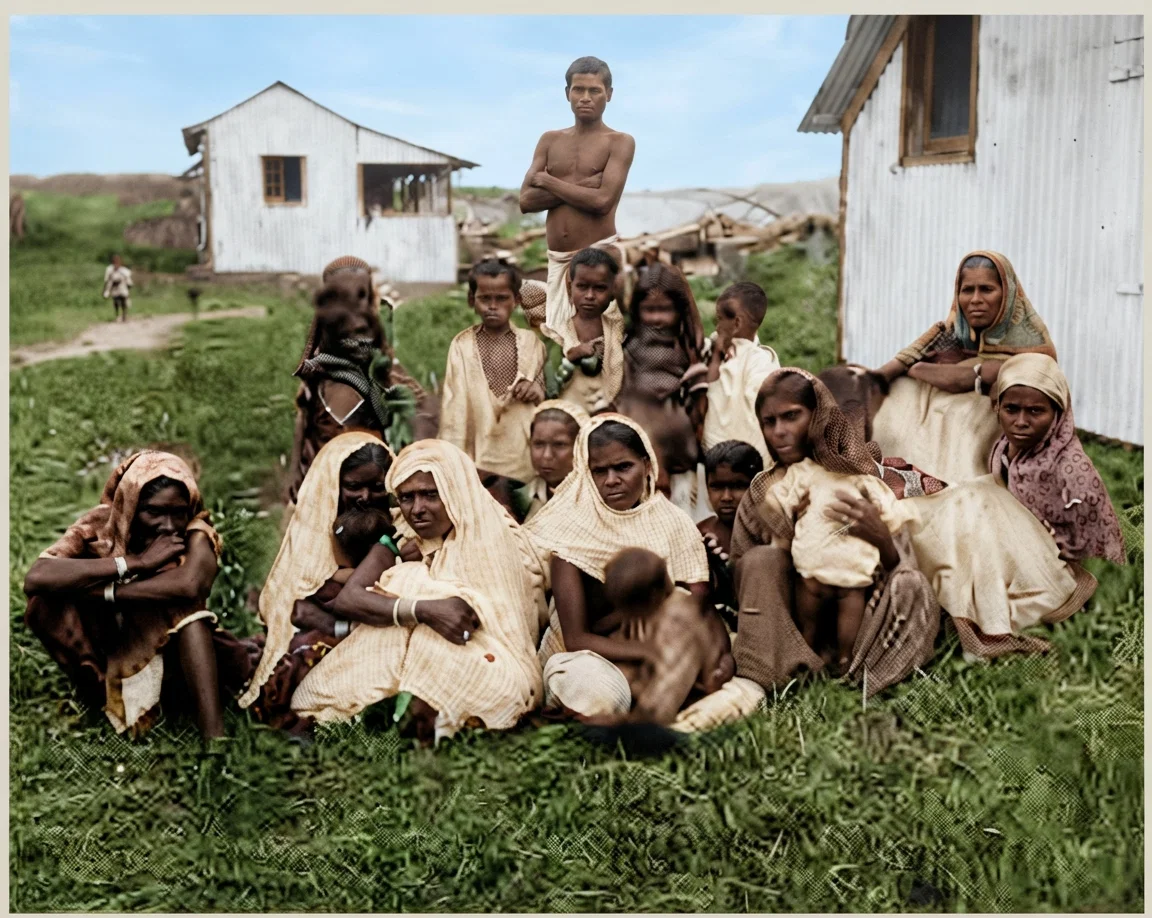
IN all the West Indies there is not a more needy or more neglected work than missionary effort in behalf of the East Indian immigrants, who are yearly brought out by the ship-load from the various parts of India, and destined to labor upon the sugar and coco estates of the West Indian planter.
For many years the present system of "indentured labor," as it is called, has been in vogue in several of the West Indian Islands, especially in Trinidad and Grenada, as also in British Guiana and to some extent in Jamaica.
The term of service is five years, and during that time the "immigrant" is in nowise free. He (and she also, for the women as well as the men labor by the thousand in the fields) is "indentured" or "bound out" to serve, and can not even leave the estate lands except he has a written "pass," signed by the estate manager. If he be found straying without this pass, he is subject to arrest and imprisonment at hard labor.
The stress of hard times, famine, etc., at home in India, is what induces so many of them to leave their own land and come to these far-off islands. The immigration agent in the various Indian ports is ever ready with his story of an easy life, plenty abounding, and riches easily acquired in the isles beyond the sea, and thus through deceit is able to beguile very many who afterwards would gladly shrink from the galling yoke were it possible. It is not possible, however; and, as a result, some lose heart altogether, and commit suicide, rather than endure the disgrace. Many of these persons have come from good families in the home land.
Their home life upon the estates can scarcely be called by that name, each family having perhaps one or two rooms where they eat and sleep, with a sort of gallery, sometimes, in front where cooking may be done. In order that they may wash their clothing they must seek out some running stream or muddy hole in a gully, and there with a flat stone or piece of board do their best to make themselves clean and respectable.
At the end of their five years of service they are free—either to return home at government expense, or to remain in the colony, in which case they receive a small grant of money from the government. A few each year do return, but the great majority remain and take up government lands which they can obtain for about $10.00 per acre. Upon this land they plant coco, sugar-cane, provisions, etc., on their own account. By dint of hard work and careful economy, some may make themselves in a few years independent.
Unlike many of their native West Indian neighbors, who are lazy, shiftless, and improvident, they are an energetic, hard-working people, and are fast taking up all available lands, until it is said that within a few years, at the present rate, all such lands will have been taken up.
In religion they are chiefly Hindus, with a good sprinkling of Mohammedans, and a few professed Christians, the fruit of the labors of the Canadian Presbyterian missionaries who have been operating here for some years.
They have among them many denominational schools, supported in large measure by government grants. They are quick to learn and are filling many lucrative government positions at the present time.
It seems to me that we ought to be doing much more for this people than we are doing. They number three hundred thousand in these colonies and many thousands of these are absolutely free and settled upon the land which has become their permanent home. Something has been done in a small way for those who have already been Christianized, but for those who are still in heathenism we have done practically nothing. Something could and would be done if we had the men, and the means to support them. We need an American laborer to learn the language, lead out in the work, and assist our native brethren in carrying it on. Without this help there is little hope of accomplishing much.
A Group of East Indians and their Homes on the Estates.
Our conference at the present time does not know how to man the field as already opened, and to take up this new work, which by all means ought to be taken up at once, means that we must have another American worker and money to support him.
Shall we have them? Shall this work for these three hundred thousand precious souls be undertaken at once, or must we still delay while souls are perishing? The answer rests with those who read these words.
If God impresses your heart to help in this important work, write at once to the Mission Board or to Elder D. E. Wellman, 31 Dundonald St., Port of Spain, Trinidad, B. W. I., stating what you will do.
And above all else, brethren, pray for the work and workers in this field.
San Fernando, Trinidad, B. W. I.
BROTHER IMMANUEL, THE BATTAK.
By R. W. Munson
[R. W. Munson, in Union Conference Record.]
I WAS sitting one Sunday in my home at Pedang, Sumatra, reading, when a Malay entered, and introduced himself as a Christian Battak. I was very glad to see him, and gave him a cordial welcome, for I had long been deeply interested in the work done by the Barmen Mission in the uplands of North Sumatra, the land of the cannibal Battaks.
In the course of our conversation it soon became necessary for me to allude to the fact that we were Sabbath-keepers, and I went on very briefly to state the scriptural reasons.
This young man, Immanuel by name, is the son of the oldest senior Battak minister, and has graduated from King's College, in the Battak country. When I gave him Bible studies on Daniel 2 and 7, he quickly comprehended all I said about the history of Babylon and the other three kingdoms. He can read music, and used to sit for hours at a time playing sacred music. Just before we left, he told me that when he first called he came with the object of convincing me that Sunday was the Sabbath. It seems the German missionary had told him we "keep Saturday like the Jews;" but when he heard the fourth commandment and studied other texts, his mouth was closed.
We had many earnest talks and some Bible studies together, until he came to love us, and seemed very sad at our leaving. He said to me, "Why do you go away now, just as I am getting interested in these great questions? Will you not stop here and teach me more concerning them? I want to know the truth, and mean to obey it, but I have not had sufficient time fully to consider these subjects. They seem to be true. I have sent for my Battak Bible, and want to read these proof-texts in my mother tongue before finally deciding. If I do become a Sabbath-keeper, I shall go back among my people and tell them the truth."
I gave him a copy of "Bible Readings" in Dutch, as he knows some Dutch, and can follow the line of argument with his Battak Bible.
He is a most promising young man about the age of twenty-four, and is already educated. He only needs to have the truth instilled into his mind thoroughly to make him a most efficient worker. The conditions are such that European missionaries can not enter the places where the Barmen Mission is strong, for opposition would set in; and without the consent of the Mission, the government would not give us permission to carry the Third Angel's Message to the 60,000 Battak Christians in North13Sumatra. Immanuel, however, can take the message, and nobody can hinder him.
The providences that brought him to Pedang against the advice and counsel of his father and the missionaries, are remarkable. He felt he must come. He entered a printing-office to assist in printing a Battak newspaper. I told him that the Lord had brought him there to show him the truth.
Pray for Immanuel, that he may be kept faithful, and rejoice in the fulness of the light of truth.
Native East Indian Brethren.
HE PLEASED NOT HIMSELF.
By Trench
HE might have built a palace at a word,
Who sometimes had not where to lay His head;
Time was, and He who nourished crowds with bread,
Would not one meal unto Himself afford;
Twelve legions girded with angelic sword
Were at His back—the scorned and buffeted!
He healed another's scratch, His own side bled,
Side, feet, and hands with cruel piercings gored!
O, wonderful the wonders left undone!
And scarce less wonderful than those He wrought!
O, self-restraint, passing all human thought,
To have all power and be—as having none!
O, self-denying Love, which felt alone
For needs of others, never for its own!
—Trench.
THE BIBLE IN CENTRAL AMERICA.
THE Bible societies are said to be doing an important work in Central America. When the British and Foreign Bible Society began operations there in 1812, it was a criminal offense to introduce the Bible into Spanish territory. But at the Central American Exposition, in 1897, the Bible Society was awarded a gold medal. Now the Guatemala State Press has been authorized to use the State Press for the publication of the Scriptures.
The bishop of Costa Rica has begun to import Spanish Testaments, published by a rival Roman Catholic Bible Society, which have scarcely any notes. The American Bible Society is said to be meeting with success under the guidance of a South American hero, Penzotti.
The British and Foreign Bible Society is the great Protestant force in Siberia, working for the pagans and for the higher life of the colonists. Bookstalls are found at a number of stations along the new railway where Bibles are sold. Russian scholars are co-operating with the Bible Society in bringing out translations for the aboriginal tribes of Siberia, and portions of the Bible are now available in seven of its languages.
The main reliance of the Bible Society, however, is not the bookstall or depot as agencies, but the colporteur, "who is now becoming a recognized institution in the land." Free passes are granted him on steamboats, and freight on paper is gratuitous. He goes everywhere and gains access to the convict, the exile, the miner, the peasant, and the high official.—Selected.
OUR WORK AND WORKERS.
By Editor
At Springfield, Ohio, September 30, nine candidates were baptized by Brother J. G. Wood.
A church-school building is to be erected at Ithaca, Mich., the means having been provided.
Work is about to be opened in Bombay, by Brother C. A. Hansen and wife, late of Michigan.
October 19, ten missionary nurses were graduated from our sanitarium training-school at Madison, Wis.
The South Dakota Worker notes the baptism of three students of the school at Elk Point, on the 14th ult.
A class of ten young ladies were recently graduated from the Nebraska Sanitarium Training School for Nurses.
Tent-meetings at Benton Harbor, Mich., closed on the 15th ult., with a visible fruitage of fifteen persons baptized.
Brother C. W. Olds desires his correspondents to note his change of address from 218 Broadway to 205 Bethesda Avenue, Waukesha, Wis.
A church of thirteen members was organized at Logansport, Ind., October 14. Services were conducted by Brethren W. J. Stone and B. Hagle.
As a result of the camp-meeting at Detroit, Minn., twelve persons were baptized, and fifteen more adherents are reported in connection with later tent meetings.
In connection with the recent camp-meeting at Rice Lake, Wis., sixteen converts were baptized. Brother B. L. Anderson was ordained to the Gospel ministry.
The brethren of Beath, Ind., are preparing to erect a house of worship between that place and Eaton. A site has been secured, and most of the lumber has been donated.
The branch sanitarium at Washington, D. C., has added to the medical force Dr. Patience Bourdeau-Sisco, who has been doing valuable service at Grand Rapids, Mich., the past three years.
Eastern Tidings, published at Calcutta, notes the beginning of the first tent effort by our people in India. Brethren H. Armstrong and G. K. Owen are conducting the work, and their location is Colombo, Ceylon.
The brethren at Woonsocket, S. D., have completed a new church building. Citizens not of our faith contributed $400, besides $250 toward expenses of the recent camp-meeting. In the past year eighteen persons have accepted the truth.
As a result of tent work near Sturgis, Mich., by Brethren W. C. Hebner and James Irving, a church of fourteen members was organized on the 14th ult. Brother A. G. Haughey, president of West Michigan Conference, conducted the service.
Writing from Memphis, Tenn., Brother H. C. Balsbaugh says that a brother and sister from Battle Creek, Mich., are making diligent effort to open treatment rooms in that city. They are trained nurses, and the church members are seconding the work.
That practise often preaches louder than precept, is shown in the following simple fact: "The banana plantation of one of our most faithful tithe-payers in Rarotonga is thriving so well that people stop to admire it as they pass. This is the second plantation in this island, belonging to faithful tithe-payers, that has caused the natives to wonder at its prosperity."
October 12 Brother E. W. Snyder and wife sailed from New York for Cuba, their new field of labor. They formerly labored in Argentine, South America, but returned to attend General Conference last spring, and have spent the summer in New Jersey. Surely Cuba is in need of the message that these faithful laborers bear to her people.
A note from Brother Walter Harper notes over three hundred dollars' worth of orders at Clifton, A. T. in a little over a week's time. The orders included a number for "Patriarch's and Prophets" and "Christ's Object Lessons." For the latter book Brother Harper states that in a small New Mexican town he took twelve orders in less than three hours.
The new house of worship of the 23d Street Church, Indianapolis, was dedicated October 8. An elaborate program was presented, and there was a good attendance. Of ministering brethren there were present, Brethren Allen Moon, president of Lake Union Conference; W. J. Stone, president of Indiana Conference; E. W. Farnsworth, W. D. Curtis, and W. A. Young.
From the Union Conference Record we take this significant paragraph, which is full of suggestion for these times: "In connection with the recent defeat of a faulty Educational Bill in Victoria, the member of Parliament that took the strongest position against the measure is a regular subscriber to the SIGNS, and others who spoke on the question, expressed not only the sentiment, but in some cases quoted the exact expressions found in "Rights of Man." This is but an illustration of the influence our literature is exerting, and shows the importance of getting it into the hands of our law-makers."