Your ShelfYour Projects

Signs of the Times, Vol. 21, No. 30.

M. C. W
Earlier text: UNGOSPEL METHODS OF REFORM

The Apostasy and the Sabbath

Lesson VII.—Sabbath, August 17, 1895.

The Apostasy and the Sabbath.

Review Questions.—(a) What is the distinguishing characteristic of the one true God? (b) What is his memorial and sign? (c) What was Christ’s attitude toward the law and Sabbath? (d) What is the universal testimony of the apostles in regard to the law?
1. What was the standard of faith in the apostolic church?
“All scripture is given by inspiration of God, and is profitable for doctrine, for reproof, for correction, for instruction in righteousness; that the man of God may be perfect, thoroughly furnished unto all good works.” 2 Tim. 3:16, 17. See also John 17:8, 17; 2 Tim. 4:1.
2. What was this word to them that received it?
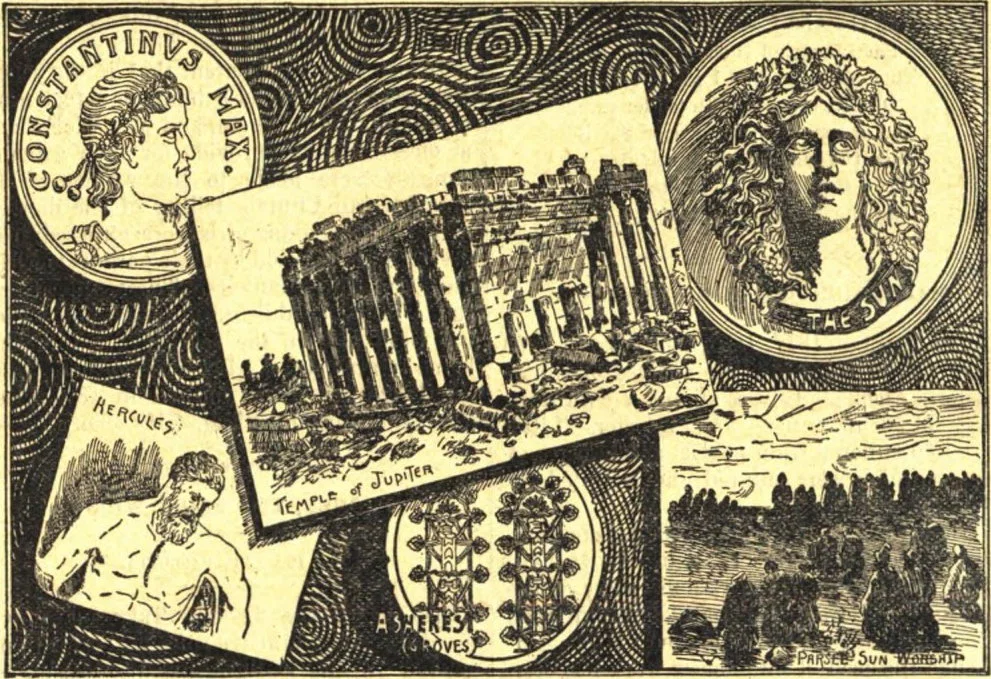
ILLUSTRATIONS OF SUN WORSHIP. (See “Lord's Day,” pp. 33-38, 88.)
“It is the spirit that quickeneth; the flesh profiteth nothing; the words that I speak unto you, they are spirit, and they are life.” John 6:63.
“For this cause also thank we God without ceasing, because, when ye received the word of God which ye heard of us, ye received it not as the word of men, but, as it is in truth, the word of God, which effectually worketh also in you that believe.” 1 Thess. 2:13.
3. Whom did it place within?
“I am crucified with Christ; nevertheless I live; yet not I, but Christ liveth in me; and the life which I now live in the flesh I live by the faith of the Son of God, who loved me, and gave himself for me.” Gal. 2:20. See also Col. 1:25–28; Eph. 3:17.
4. What therefore did each believer become?
“What? know ye not that your body is the temple of the Holy Ghost which is in you, which ye have of God, and ye are not your own?” 1 Cor. 6:19.
5. What did the entire church become when composed of such believers?
“Know ye not that ye are the temple of God, and that the Spirit of God dwelleth in you?” 1 Cor. 3:16.
“And what agreement hath the temple of God with idols? for ye are the temple of the living God; as God hath said, I will dwell in them, and walk in them; and I will be their God, and they shall be my people.” 2 Cor. 6:16. See also Eph. 2:19–22.
6. What is that power in the heart called?
“That their hearts might be comforted, being knit together in love, and unto all riches of the full assurance of understanding, to the acknowledgment of the mystery of God, and of the Father, and of Christ.” Col. 2:2.
“And without controversy great is the mystery of godliness.” 1 Tim. 3:16, first clause. See also Col. 1:26, 27; Eph. 3:8, 4, and elsewhere.
7. What is its work?
“And to make all men see what is the fellowship of the mystery, which from the beginning of the world hath been hid in God, who created all things by Jesus Christ.” “That Christ may dwell in your hearts by faith; that ye, being rooted and grounded in love.” Eph. 3:9, 17.
“Who gave himself for us, that he might redeem us from all iniquity, and purify unto himself a peculiar people, zealous of good works.” Titus 2:14. See also 1 Thess. 4:3; Rom. 8:4; 2 Cor. 3:3.
8. What therefore would be the proper name and character of that power which would usurp the place of Christ in the heart?
“Little children, it is the last time; and as ye have heard that antichrist shall come, even now are there many antichrists; whereby we know that it is the last time.” 1 John 2:18.
“For the mystery of iniquity doth already work; only he who now letteth will let, until he be taken out of the way.” 2 Thess. 2:7.
9. Why was not this mystery of iniquity immediately manifested?
“And now ye know what withholdeth that he might be revealed in his time. For the mystery of iniquity doth already work; only he who now letteth will let, until he be taken out of the way.” 2 Thess. 2:6, 7. See note .
10. What charge did Paul give to elders and preachers?
“Wherefore I take you to record this day, that I am pure from the blood of all men.” Acts 20:26.
“I charge thee therefore before God, and the Lord Jesus Christ, who shall judge the quick and the dead at his appearing and his kingdom; preach the word; be instant in season, out of season; reprove, rebuke, exhort with all longsuffering and doctrine.” 2 Tim. 4:1, 2.
11. What did he say would soon come upon the church?
“For I know this, that after my departing shall grievous wolves enter in among you, not sparing the flock. Also of your own selves shall men arise, speaking perverse things, to draw away disciples after them.” Acts 20:29, 30.
“For the time will come when they will not endure sound doctrine; but after their own lusts shall they heap to themselves teachers, having itching ears; and they shall turn away their ears from the truth, and shall be turned unto fables.” 2 Tim. 4:3, 4. See also 2 Peter 2:1, 2.
12. What was the prominent worship and prominent day in the pagan world in apostolic days? Ans.—Sun worship and Sunday. See “The Lord’s Day,” pp. 88–92.
13. From what were the Galatian Christians converted?
“Howbeit then, when ye knew not God, ye did service unto them which by nature are no gods.” Gal. 4:8.
14. In their backslidden condition what did they desire to do?
“But now, after that ye have known God, or rather are known of God, how turn ye again to the weak and beggarly elements, whereunto ye desire again to be in bondage?” Verse 9.
15. What evidence did they give of this?
“Ye observe days, and months, and times, and years.” Verse 10.
16. As they were formerly heathen and observed heathen times and days, to what times and days did the apostle refer?
17. How alone can the Christian oppose this?
“And now, brethren, I commend you to God, and to the word of his grace, which is able to build you up, and to give you an inheritance among all them which are sanctified.” Acts 20:32.
“For though we walk in the flesh, we do not war after the flesh; for the weapons of our warfare are not carnal, but mighty through God to the pulling down of strongholds; casting down imaginations, and every high thing that exalteth itself against the knowledge of God, and bringing into captivity every thought to the obedience of Christ.” 2 Cor. 10:3–5.
18. To what extent would this apostasy be manifest?
“Let no man deceive you by any means; for that day shall not come, except there come a falling away first, and that man of sin be revealed, the son of perdition; who opposeth and exalteth himself above all that is called God, or that is worshiped; so that he as God sitteth in the temple of God showing himself that he is God.” 2 Thess. 2:3, 4.
19. By what is this apostasy symbolized? Ans.—By a harlot, seated on a scarlet colored beast. Rev. 17:1–6.
20. In what way was this apostasy to oppose God and exalt itself above him?
“And he shall speak great words against the Most High, and shall wear out the saints of the Most High, and think to change times and laws; and they shall be given into his hand until a time and times and the dividing of time.” Dan. 7:25. See note .
21. What commandment in God’s law would be affected by a change in his appointed time?
22. In what commandment alone of the ten is there a difference between the papal code of morals and the Decalogue? See note .
23. What are the teachings of God’s law in this respect?
“Remember the Sabbath day, to keep it holy. Six days shalt thou labor, and do all thy work; but the seventh day is the Sabbath of the Lord thy God; in it thou shalt not do any work, thou, nor thy son, nor thy daughter, thy manservant, nor thy maidservant, nor thy cattle, nor thy stranger that is within thy gates; for in six days the Lord made heaven and earth, the sea, and all that in them is, and rested the seventh day; wherefore the Lord blessed the Sabbath day, and hallowed it.” Ex. 20:8–11.
24. What is the teaching of the Papacy? See note .
25. What express claim does the Papacy make? See note and Bible Students’ Library No. 134, “The Lord’s Day,” pp. 83–85.
26. For how long were the saints, times, and laws to be given into the hands of the Papacy?
27. What may we conclude would then take place? Ans.—God would send a message, calling men to repentance. See Acts 17:30.

NOTES.

THE SPIRIT OF GOD

ITS OFFICES AND MANIFESTATIONS TO THE END OF THE CHRISTIAN ERA.
By Eld. J. H. Waggoner.
THIS is a brief but comprehensive argument on the solemn and important subject of the Spirit of God. Its chapters embrace the following heads: The Holy Spirit of Promise; The Power from on High; Circumcision of the Heart; The Unity of the Faith; The Law and the Testimony; Try the Spirits; The Great Commission; Gifts in the Reformation; In the Present Century; Spirit of Prophecy Restored. These are subjects of vital importance to all and especially to those who are looking for the return of their Lord. 144 pp. Price, 15 cents.
Address,
PACIFIC PRESS. Oakland, Cal.

THE JUDGMENT

By the late J. N. ANDREWS
The Events of the Judgment and their Order. Following are principal chapter headings: The Investigative Judgment, Examination of the Books, God the Father the Judge, Offices of Christ, Messages to the World, The Sanctuary in Heaven, The Crowning of Christ, The Executive Judgment, The Saints Sitting in Judgment. Bible Students’ Library No. 55. 136 pages. Paper covers. Price, 15 cents.
PACIFIC PRESS PUBLISHING CO.
OAKLAND, CALIFORNIA
Kansas City, Mo., New York City, N. Y.

THE NEW HOME IN CANAAN

Lesson VII.—Sunday, August 18, 1895.

THE NEW HOME IN CANAAN.

Lesson Scripture, Deut. 6: 3-15.

3. Hear therefore, O Israel, and observe to do it; that it may be well with thee, and that ye may increase mightily, as the Lord God of thy fathers hath promised thee, in the land that floweth with milk and honey.
4. Hear, O Israel; The Lord our God is one Lord;
5. And thou shalt love the Lord thy God with all thine heart, and with all thy soul, and with all thy might.
6. And these words, which I command thee this day, shall be in thine heart;
7. And thou shalt teach them diligently unto thy children, and shalt talk of them when thou sittest in thine house, and when thou walkest by the way, and when thou liest down, and when thou risest up.
8. And thou shalt bind them for a sign upon thine hand, and they shall be as frontlets between thine eyes.
9. And thou shalt write them upon the posts of thy house, and on thy gates.
10. And it shall be, when the Lord thy God shall have brought thee into the land which he sware unto thy fathers, to Abraham, to Isaac, and to Jacob, to give thee great and goodly cities, which thou buildedst not,
11. And houses full of all good things, which thou filledst not, and wells digged, which thou diggedst not, vineyards and olive trees, which thou plantedst not; when thou shalt have eaten and be full;
12. Then beware lest thou forget the Lord, which brought thee forth out of the land of Egypt, from the house of bondage.
13. Thou shalt fear the Lord thy God, and serve him, and shalt swear by his name.
14. Ye shall not go after other gods, of the gods of the people which are round about you;
15. (For the Lord thy God is a jealous God among you) lest the anger of the Lord thy God be kindled against thee, and destroy thee from off the face of the earth.
Golden Text: “Thou shalt bless the Lord thy God for the good land which he hath given thee.” Deut. 8:10.
NOTE.—The Israelites having compassed the land of Edom, have now arrived before the Jordan, and are encamped in the fertile plain lying between its eastern bank and the mountains of Moab, at a point probably opposite Jericho. This tract is four or five miles broad. The time is a little over a month before the crossing of Jordan, and the occasion is the rehearsal of the law, and the giving of special instructions by Moses, just before his death. Some of the special occurrences included in the section are, the prophecy of Balaam; the new census; the conquest of the country east of Jordan, including the story of Og, king of Bashan; the settlement of two and a half tribes in the country east of Jordan, and the covenant renewed. The section includes the history in Numbers 21 to 26, and the whole book of Deuteronomy.

SUGGESTIVE QUESTIONS.

(1) What blessings were promised if the people kept the law of God? Verse 3. Note 1. (2) To whom was their attention specially directed? Verse 4. Note 2. (3) What special command was given as to their relation to God? Verse 5. Note 3. (4) Where were the words to find lodgment? Verse 6. (5) To whom were they to be taught? Verse 7. (6) In how many ways were they to be discussed? Verse 7. (7) Where were the people to bind the words? Verse 8. Note 4. (8) On what were they to be written? Verse 9. (9) What warning was given, and for what reason? Verses 10-12. Note 5. (10) What commands are given in verse 13? Note 6. (11) What command was given concerning other gods? Verse 14. (12) What would be the result of turning to them? Verse 15. (13) Why was the Lord so particular on this point? Verse 15, first part. Note 7. (14) In view of God’s care for his people, what should be the burden of their praise? Golden Text.

NOTES.

1. The blessing is continued from verse 2, where it is stated, “that thy days may be prolonged.” The promise was not limited merely to the temporal life; it included the eternal life,—the life in Christ. The keeping of the law was the way of life, of blessing. The opposite was the way of death and cursing. “Therefore choose life, that both thou and thy seed may live;” . . . “for He is thy life, and the length of thy days.” Deut. 30:19, 20; Prov. 3:1, 2.
2. Hear, O Israel.—Twice the call is to hear. The word means to hear intelligently, to consider, to contemplate, often, as in this case, implying obedience to what is heard. Jehovah our God is one Jehovah. Jehovah, “the everliving God, self-existing, the source of life.” God, Elohim, used in the plural nearly always. “The plural expresses not many Gods, but the manifold nature of God, including all the attributes of being, all good qualities, all powers, all authority.”—Peloubet.
3. With all thy heart, . . . soul, . . . might.—This was the first and great commandment, as stated by our Saviour. Matt. 22:37, 38. It includes the whole duty of man toward God, but can not be separated from the second, “Thou shalt love thy neighbor as thyself,” for on the two depend “all the law and the prophets.” They are an epitomized expression of the Ten Commandments,—God’s rule of conduct for the ages.
4. Thou shalt bind them for a sign upon thine hand, etc.—“It was a literal and formal interpretation of this command which led to the use of phylacteries upon the arm and upon the forehead. These are small cubical leather cases, in which are parchments containing four passages of Scripture in four columns (Ex. 13:1-10, 11-16; Deut. 6:4-9; 11:13-21). These are bound upon the arm and between the eyes by leather thongs. But the real meaning of this command is that God’s law should be in every deed of the hand, in the sight of the eyes, in the plans of the head. Every part of the daily life should be ruled by God’s law. It should never be forgotten.”—Peloubet. In like manner originated the Jewish Mezuzah, a parchment inscribed with the last two scriptures noted above, and inclosed in a small wooden or metal cylinder fastened to the right doorpost. The meaning was that the whole house is to be ruled according to God’s law; all goings out and comings in must be for right purposes.
5. Beware lest thou forget the Lord.—This is a danger that always comes with prosperity. The abundance of material comforts and blessings, the possession of riches, renown and temporal power are constant menaces to one’s spiritual condition. The temptation is to trust in these things rather than in God. Our Saviour illustrates this by the parable of the rich man in Luke 12:13-21. “So is he that layeth up treasure for himself, and is not rich toward God.”
6. Thou shalt swear by His name.—Not profanely, but as confirmation where an oath was necessary, as in the power of the true God, as distinguished from false gods. See verse 14 and Deut. 5:11.
7. The Lord is a jealous God.—Jealous of his name, reputation, and position. Not that he fears for their overthrow, but jealous for the sake of his chosen people, or for those who profess his name. His desire is that they shall have an abundant entrance into all he prepares for them, and because he can not tolerate sin, which always leads to the recognition of some other god. This command to Israel at this time was specially significant, for in the short stay east of Jordan, they affiliated with the surrounding heathen and bowed down to their gods. For this the Lord destroyed 24,000 of the people by a plague. Only in this way could they be taught to realize the truth of the actuality of God. Later ages are to learn from their example the same lesson. The punishment for sin is severe, but just only. On the other hand, all good things are in the hand of God for them that love and obey him.

Abiding Sabbath and Lord’s Day

By ALONZO T JONES
A pointed review of two prize essays which are, without doubt, the best contributions to the defense of Sunday as the Sabbath. Those desiring to find some $1,000 reasons for keeping the first day of the week will find them in this work. Bible Students’ Library No. 2. 173 pages. Paper covers. Price, 20 cents. Address
PACIFIC PRESS PUBLISHING CO.
Kansas City, Mo.  OAKLAND, CAL.  New York City, N. Y.

Publishers' Notice on Remittances and Subscriptions

Publishers.

  1. REMIT by Bank Draft, P. O. Money Order, or Express Order.
  2. If paper money is sent, register the letter.
  3. Drafts should be made payable to the PACIFIC PRESS PUBLISHING CO., on New York, Chicago, or San Francisco banks. Those written on other banks cost us exchange.
CHANGE OF ADDRESS.—Subscribers desiring the address of their paper changed, will please state in their communication both the old and new address.
POSTAGE STAMPS.—Please do not send postage stamps, as we have more now than we can use, and they often get stuck together in the mails, and are useless when received. Canadian and other foreign moneys cannot be used by us.
RECEIPT.—The change of figures on the address labels will be in all cases a sufficient receipt for money sent for the paper. If these changes do not appear in due time, and if books ordered by mail are not received promptly, please notify us.
Canvassers, librarians, ministers, etc., can send in their orders through the regular channels of the State Tract Society, and all orders will receive prompt attention.
Sample copies of the SIGNS, receipt book, etc., sent postpaid to any one who will solicit subscriptions for the paper. Renewals and new subscriptions all one price.
EXPIRATION OF SUBSCRIPTION.—All papers are discontinued at the expiration of the time paid for. The date opposite your name on the printed address label shows when the subscription expires. Please forward your money in ample time for renewal if you desire unbroken files, as we cannot always furnish back numbers.
DON'T MIX BUSINESS.—Please, when writing to this office do not mix periodical orders, book orders, questions for the editor, etc., all through your letter. If you do, then some part of the orders will be delayed and not filled promptly. The periodical department is in one building, the editorial rooms in another, and the book department in still another separate building. You can thus see the advantage of having your orders on separate sheets of paper, so that they can be handed to the proper clerk, and filled at once.

THE ATONEMENT.

AN EXAMINATION OF
A REMEDIAL SYSTEM, IN THE LIGHT OF NATURE AND OF REVELATION.
By Eld. J. H. Waggoner.
THIRD EDITION, REVISED AND GREATLY ENLARGED.
This work is a critical and exhaustive treatise on the plan of salvation as revealed in the Scriptures, showing its harmony with the principles of justice and mercy, its consistency with reason, and its final results as affecting the destiny of the human race. 368 pp.; cloth, $1.00.
Address.
PACIFIC PRESS, Oakland, Cal.

STRONG'S Exhaustive Concordance OF THE BIBLE

BY JAMES STRONG, S.T.D., LL.D.
At every point of comparison—Completeness, Accuracy, Simplicity—this Work of American Ingenuity and Scholarship Surpasses the Old Concordances.
Tracing every word of the text of the common English version of the Canonical Books, and every occurrence of each word in regular order, together with a COMPARATIVE CONCORDANCE of the AUTHORIZED AND REVISED VERSIONS, including the AMERICAN VARIATIONS; also brief

DICTIONARIES OF THE HEBREW AND GREEK WORDS

of the Original, with references to the English words.
Every item of this vast volume of information is accessible to every intelligent reader of English. It is not a book for the exclusive advantage of a few scholars, but for the most general circulation.
The entire work is published in a single large quarto volume of more than 1,800 pages, carefully printed from new type on good paper, bindings and prices as follows:
IN FINE CLOTH — $ 6 00 IN HALF AMERICAN RUSSIA, CLOTH SIDES — 8 00 IN HALF TURKEY MOROCCO, EXTRA STRONG — 10 00
Delivered anywhere in the United States at above prices when cash accompanies the order.
Send for 20-page Catalogue describing its advantages and showing specimen pages.
ADDRESS ALL ORDERS TO
PACIFIC PRESS PUBLISHING COMPANY,
KANSAS CITY, MO., OR NEW YORK CITY. OAKLAND, CAL.

LARGE TYPE BIBLES

FOR THOSE WITH POOR EYESIGHT

WE HAVE many inquiries for a Bible of convenient size to use and carry, and with large clear print. The Bible, specimen type of which is shown below, we think will meet the requirements of the case. Persons desiring such a Bible as this are usually elderly persons, and want simply the Scriptures themselves, without helps or references.
The burnt offering. EXODUS, The altar of incense.
32 And Aaron and his sons shall eat the flesh of the ram, and the bread that is in the basket, by the door of the tabernacle of the congregation. 33 And they shall eat those things wherewith the atonement was made, children of Israel, and the tabernacle shall be sanctified by my glory. 44 And I will sanctify the tabernacle of the congregation, and the altar: I will sanctify also both Aaron and his sons, to minister to me
SPECIMEN OF SMALL PICA TYPE IN BIBLE NO. 1730.
This Bible contains a FAMILY REGISTER, Tables of Weights and Measures, and 16 Excellent Maps, but has no References or other additional matter. It is printed from clear, new, small pica type, and is bound in French Morocco, limp round corners (see cut) and has gilt edges. Sent postpaid on receipt of price. Order by number.

PRICE:

No. 1730. French Morocco, Limp Covers, Round Corners, Side and Back Title in Gold, Gilt Edges, Postpaid, $2.00.
Cut Does not show Title on
Address

PACIFIC PRESS PUB. CO., OAKLAND, CAL.

Or Kansas City, Mo. New York City, N. Y.
Continue reading: CHURCH SERVICES