The Youth’s Instructor, Vol. 33, No. 36.

BABYLON
Earlier text: BABYLON

“SECOND WIND.”

EVERY boy who has run a mile knows what it is to gain a “second wind,” though he may not be able to explain why one minute he is out of breath, and the next feels as if he could run several miles. A writer in Longman’s Magazine gives this clear explanation of the fact:—
“The reader may not be aware that in ordinary breathing we use only a portion of our lungs, the cells at the extremity not being brought into play. This is the reason why those who are not ‘in training,’ and who try to run for any distance, soon begin to gasp, and unless they are courageous enough to persevere in spite of the choking sensation, are forced to stop. But if they will persevere, the choking goes off, and the result is what is technically known as ‘second wind.’”
“When the second wind is fully established, the runner does not become out of breath, but goes on running as long as his legs will carry him. I know this by experience, having been accustomed for some years to run three miles every morning over a very hilly road.
“The fact is, that on starting, the furthest portions of the lungs are choked with effete air, and the remainder does not supply air enough to meet the increased circulation caused by exercise.
“By degrees, however, the neglected cells come into play; and when the entire lung is in working order, the circulation and respiration again balance each other, and the ‘second wind’ is the result.
“Now let the reader repeat this experiment of holding his breath against time; but first let him force out of his lungs every particle of air that he can expel, and then draw as deep a breath as his lungs will hold. If this be repeated seventy or eighty times, by way of imitation of the whale, the experimenter will find that he can hold his breath for a minute and a half without inconvenience. Should he be a swimmer, he should always take this precaution before ‘taking a header,’ and he will find that he can swim for a considerable distance before he needs to rise for breath.”
—Youth’s Companion.

BABYLONIAN BOOK-KEEPING.

We may none of us ever visit the British Museum, but should we do so, among other ancient relics we must not fail to examine the Babylonian book-keeper’s tablets, the following description of which we copy from an exchange:—
“The British Museum has received the books in which the ancient banking firm of Egibi & Sons, of Babylon, kept their accounts. The books are two thousand tablets, bricks of baked earth, and contain a record of contracts, sales of land, slaves, and other property, as well as mortgage loans and promissory notes.
Many of the tablets represent the renewal of loans and mortgages, so that the documents referring to the first and the last of continuing transactions bear the dates of several different reigns. The dates thus extend from the fall of the Assyrian Empire to the reign of Darius Hystaspes, including dates in the reigns of Nabopolassar, father of Nebuchadnezzar, Evil-Merodach, Cambyses, and the elder and the younger Cyrus.
“The dates of the tablets, therefore, furnish very important chronological landmarks. The rate of interest current in Babylon on loans was generally 10 per cent, and much light is thrown on the social life of the Babylonians from the circumstance that witnesses of deeds are always described by their trade or profession.
“The most important tablet is what seems to be the office calendar of the firm, and is well preserved. It contains a complete calendar of the year, with explanations to indicate what days are fortunate and what are unfortunate, what are feast or fast days, and what are appropriate for traveling, building, or engaging in any labor.”

GOLD-BEATING AND GOLD-LEAF.

You have already obtained some idea of the process of gold-beating, in an article entitled “One of the Noble Metals,” but the following additional particulars will be read with interest. A writer in Golden Days says:—
“The anvil is a block of marble weighing two hundred and fifty or three hundred pounds, or more, at pleasure, with a face of nine inches to one foot square, carefully made even and smooth. This is set in a frame of woodwork, strong and solid, and upon a firm foundation. A ledge five or six inches high runs around three sides of the frame; to the remaining side an apron of leather is attached, which is lifted by the workmen. The object of all this is to catch and retain fragments of the precious metal.
“The hammers are ordinarily four in number, varying in weight. Their faces are from three to five inches in diameter, and slightly convex. The weight of the first, or flat hammer, is about fifteen pounds; the second, which the French term the commencing hammer, weighs from six to eight pounds; the third, or spreading hammer, with a smaller face and more convex, weighs about five pounds only; and the last, or finishing hammer, is again a heavy one of ten or twelve pounds, with quite a convex face.
“The skins are of parchment and vellum and the intestine from the colon of the ox, cut into squares. The knives are pieces of cane, set into a frame, both four-square and cruciform, with sharpened edges that divide the attenuated leaf better than any other implement, by pressure downward only. When the leaf becomes very thin, any other motion would drag it.
“Each leaf is laid on a piece of the vellum, as nearly as may be in the center, with their edges even. About twenty extra vellums are placed on top and at the bottom, and the pack is then of proper size to be pushed smoothly into one of the parchment envelopes, which is then, in its turn, pushed into its mate, and the whole thus inclosed on all four sides.
“The pack is then laid on the marble anvil, and beaten until the small leaf is extended to the size of the vellum. It is in the judicious uniformity of direction and force of the blows that the skill of the workman is displayed.
“When the leaf is considered as finished, the last thing is to put it in the square books, such as we see in commerce. These are made of smooth paper, frequently reddish colored, on purpose to heighten the luster of the gold, and well rubbed with Armenian bole to prevent adhesion.
“There are two sizes, one about 4¼, the other 3¾ inches square. The pack, withdrawn from its parchment envelopes, is held by one of its angles; and with a pair of wooden pliers, each leaf is withdrawn, and laid, aided by the breath, upon a leathern cushion, where, with the cane knives, it is parted at once or successively into four pieces the size of the book.
“These pieces are then similarly transferred to the book, each between separate leaves. The books hold, very uniformly, twenty-five leaves of gold. When filled, it is pressed hard with a piece of wood of its own size, so as to bring its edges close, and with a piece of linen, any projecting pieces of gold-leaf are readily wiped off. Afterward, the books are put up in packages of a dozen, ordinarily, for sale.”

Dickey Bird Society Protects Birds in England

EIGHTY thousand children in the north of England form the “Dickey Bird Society.” They are pledged to protect birds, never to destroy a nest, and to feed birds in winter.

BE KIND TO ANIMALS.

The birds were making a great outcry the other morning, twittering, and scolding, and uttering shrill calls, till at last I went to the door to see what was the trouble.
“Why, Jack,” I said to a little friend who was up in the tree, “what is the matter with the birds?”
“Oh, I was just having some fun to see them fly and make a noise. Here is the nest and the young ones; they think that I am going to hurt them. See how near they come to me. I could almost catch them.”
“Yes, but see how badly they feel,” I replied. “Poor little things; hear them cry! See how alarmed they are; they fear you are going to kill their little ones. They feel just as your mamma would, if a big bear was about to carry off little Georgie. It may be fun for you, but it is very painful to them. You ought not to have fun that hurts any one else.”
“Oh, does it hurt them?” he asked in wonder. “I did not think of that.”
“Why, certainly it does, Jack, they would not act that way if they did not feel badly; besides, don’t you think the Lord sees those little birds, and cares for them, just as he does for you?”
“Why, the Lord care for the birds! I did not think he did,” Jack replied thoughtfully.
“Well, who made the birds?” I asked.
“Why, I suppose the Lord did,” he replied.
“Then don’t you think he would care for them?”
“Why don’t the Bible say so then?”
“I think it does, Jack. Come down here, and let us see what it does say about it. There, read that verse in Heb. 4:13.”
So Jack read: “Neither is there any creature that is not manifest in his sight; but all things are naked and opened unto the eyes of him with whom we have to do.”
“I don’t see that it says anything about birds,” said Jack.
“No, but it says the Lord sees every creature, and a bird is one of them. But now read this verse: ‘Are not five sparrows sold for two farthings, and not one of them is forgotten before God?’”
“I did not know that it read that way,” said Jack.
“Well, you see, my boy, that the Lord thinks about even the little birds. Jesus says he does not forget one of them. I think, then, he saw you up in the tree, bothering those poor little birds. Now, if you will turn to Deut. 22: 6, 7, you will read that the Lord cared even for a bird’s nest, for he told the little boys in Moses’ time that they should not be cruel to the old birds when they found a nest.
“Now read what he says about our being kind to animals, in Deut. 25:4. He says that you must be good to the ox, and let him have enough to eat when he is hard at work. In Prov. 12:10 it says that a good man will regard the life of his beast. That means that a man who will not do it, is not a good man.”
“Well,” said Jack, “I saw Tom Jones take a club, and strike his cow real hard, when she had not done anything; then I guess he does not feed his horses very good, for they always look awful poor.”
“Tom Jones is a cruel man, Jack, or he would never do that. Do you know that the Lord feeds all the animals? Now you turn to Ps. 104: 27, 28, and you will find that the Bible says so; and here is another verse: ‘Thou openest thine hand, and satisfiest the desire of every living thing.’ You see that the Lord has made provision for every living thing, even for the little birds. They have feeling, and it is cruel to torment them in any way. Little children who take delight in killing and tormenting animals, will be cruel persons when they are grown up.
“I am sorry that I plagued the birds,” said Jack with a thoughtful air, as he rose and gave me the book; and I did not know that the Lord cared about it. I will not do it again.”
D. M. Cantright.

“ON EARTH AS IT IS IN HEAVEN.”

JOSEPHA was not in a very good humor that Sabbath, though it was her birthday, her tenth birthday.
In the first place, a Sabbath birthday was a dull thing, she thought; and then baby Fritz had been so sick that mamma had not had a chance to get any little present ready for her. It is true that was only put off—the present was to come; but still Josepha felt out of sorts.
And when mamma called her to get her Bible verses, she pouted, and grumbled out that it was hard she couldn't have any fun at all on her birthday, not even a holiday from Bible verses.
Mamma at once shut the Bible and laid it on the table.
“I can't let you learn your verses while you are in a bad humor, daughter,” she said, “so I will tell you a little story instead.”
“Once there was a little boy who used to beg his father every morning to keep him away from the bees; but instead of helping his father to keep him, he went straight out and played with their hives, and of course, they stung him again.”
“Well, what next?” asked the little listener.
“That's all,” said mamma.
“Ah! why, I don't call that a story.”
“Yes, it is,” answered mamma, “but it is a short one, and it has my little daughter for a moral.”
“Now, mamma, you know I never do anything like that?” exclaimed Josepha.
“I think I can show you that you do something very much like that every morning. When you are repeating the Lord's Prayer, what do you say after ‘Thy kingdom come’?”
“‘Thy will be done on earth as it is in heaven,’” repeated the little girl briskly.
“That is, you ask God to make you do his will just as the angels do it. How do you suppose the angels do God's will?”
“I don't know,” said her listener, slowly.
“Of course we don't know exactly, but of some things we may feel confident; I am sure they do it promptly; I am sure they do it cheerfully; I am sure they do it perfectly.”
“The angels know just what God's will is, but I don't,” answered Josepha, who felt as if she needed somehow to defend herself.
Her mother pointed to an illuminated text hanging on the nursery wall: “Children, obey your parents.”
There was a long, quiet time then.
“I won't give you any verses to get to-day,” she said, gently, “but I give you this to think about. Every time you say, ‘Thy will be done on earth as it is in heaven,’ remember that you are asking God to make you do what you are told—promptly, cheerfully, perfectly. And then you must help the Lord to answer this prayer.”—The Churchman.

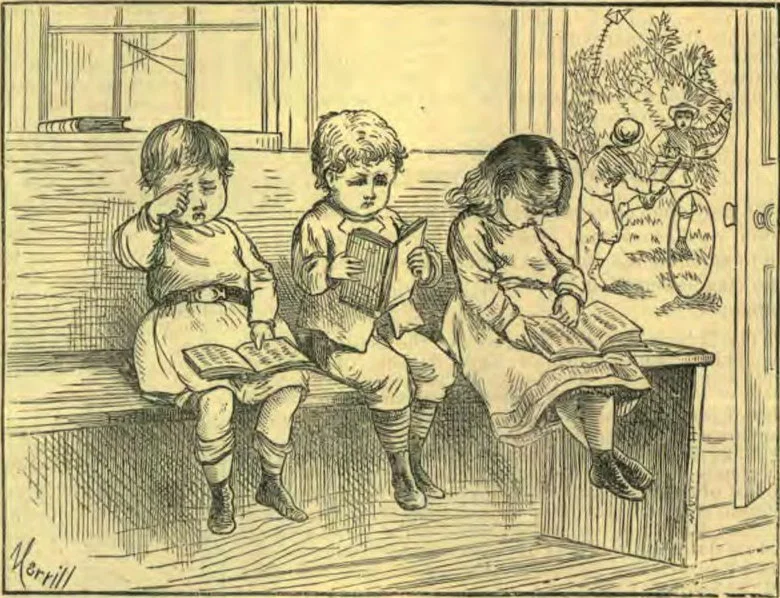
KEPT IN.

Two little lads and a maiden gay, Kept in from play One August day, Sit all in a row, and with surly looks, Con over lessons from dog-eared books.
But Ernie's thoughts are far away With the boys at play; And I hear him say, As he rubs his eyes, and thinks of “leap frog,” Over and over, “d-a-w-g,” dog!
Orvie is trying to catch a strange “bird,” And battles unheard Are fought with that word [an “i;”] Which he thinks should be spelled with a “u” not If he wasn't a man, he would give up and cry.
Wee Bessie sits by the open door, Where the sunbeams pour Aslant on the floor, And wishes she was a sunbeam too, With no lessons to learn and nothing to do.
Now, children, come here; a way I will tell How you may spell Every word well. When you study, remember that one thing is true,— The words that you don't catch, will always catch you.
Work away with a will. Don't think of your play Till lessons you say And books put away. You all may be sunbeams if patient and true, But sunbeams, like children, have something to do.
S. ISADORE MINER.

Nature as God's Handwriting and Poetry

The Creator is the great poet. All that is beautiful to eye, ear, or heart, is his handwriting. Whenever a bud opens, a rivulet slips along, its pebbly path, or a leaf shadow dances in the sunshine, there he has written a poem which he meant should be read with delight by every passer-by.

Letter Budget.

Have you noticed, little friends, that for some weeks you have been given more space for the Letter Budget? Because you have a special interest in this department, we like to make it please you. But either you have not written much during vacation, or else because we have published so many letters each week, we are coming toward the bottom of the letter box, which means that somebody will need to write pretty soon. But with this hint, we have faith to believe you will keep us supplied with letters. What we want is, that your next letters shall show marked improvement. Take time to be sure that you have something to say, and then tell it the best you know how. Look over your little note books for the things you have saved up for the Budget, and then let us see if you can’t have a letter department that everybody will like to read. You cannot have lived all this long, beautiful summer without having something to write. We have had many excellent letters in the past, and we want many more. The box is not entirely empty, as this Budget will show. The first is a letter from Nebraska.
LENA J. ADAMS, of Valley Co., Neb., writes: “I am a little girl nine years old. I keep the Sabbath with my parents. I used to go to Sabbath-school, and learned my lessons in Book No. 2; but we moved to this place, where there is no Sabbath-school. I have four brothers, but no sister. I love to read the INSTRUCTOR, and the letters in the Budget, although I have not written any before. I have a pet lamb, and I have lots of fun with it. I hope to meet you all in the earth made new.”
We hope it may not be a very long time, Lena, before you can report a Sabbath-school in your new home.
CELIAN COLCORD writes from Greene Co., Iowa: “I have thought of writing for the INSTRUCTOR for some time. We take it, and it is a fine little paper. I have my lesson every Sabbath out of it. We have a good meeting and Sabbath-school. I have kept the Sabbath all my life. I am trying to do right. I am reading the ‘Story of the Bible.’ It is splendid, and helps me a great deal in my lessons in the INSTRUCTOR. We think of going to camp-meeting at Des Moines. I hope to meet you all in the new earth.”
May Celian improve her many privileges wisely and well.
EDWARD W. SILSBEE, of Osborn Co., Kan., says: “This is the first letter I have written for the Budget. I am twelve years old. I keep the Sabbath, and take the INSTRUCTOR, which I like very well. I have four brothers and one sister. Last Thursday the church of this place had a picnic, and they all seemed to enjoy it very well. After the picnic broke up, we had a very heavy rain. A railroad is being built a few rods back of our house, and it is intended to have the cars running by the first of December. I send my love to all the INSTRUCTOR family.”
Perhaps Edward will some time give the name of the new railroad that is being built so near his own home.
LILLIE FARRAND writes from Genesee Co., Mich. She says: “I am a little girl twelve years old. I keep the Sabbath with my parents. I go to Sabbath-school every Sabbath. I learn the lessons in the INSTRUCTOR, and like them very much. I wrote a letter for the Budget once before, but did not see it printed. I wish I could see this one printed in the paper next week. I am trying to be a good girl. I hope to meet all the INSTRUCTOR family in heaven.”
We cannot always print the letters as soon as the writer desires, Lillie; but yours has not waited very long.
ORA I. REDBURN writes from Anderson Co., Kan. She says: “I am a little adopted girl, twelve years old. I have a little brother nine years of age. He takes the INSTRUCTOR, and we are so anxious to get it to read, we can hardly wait until our work is done. The nearest Sabbath-school is eight miles away, so we don’t go very often. I don’t go to day school. My own father died when I was but three years old, and my mother kept me till about four months ago. We have been keeping the Sabbath since three years ago last March. I am trying to be a good girl, that I may meet the INSTRUCTOR family in heaven.”
Eight miles is a long distance to drive every Sabbath, rain or shine. In the new earth, all the people will go up to Jerusalem every Sabbath to worship. What a long way some will have to travel! But they will not go at our slow rate of speed; neither will they tire from traveling long distances.

You have reached the end of this edition.

The Youth’s Instructor · Sep 23, 1885