The Youth’s Instructor, Vol. 34, No. 23.

THE OCEAN

The Youth’s Instructor

Jun 9, 1886

S. D. A. Publishing Association · Battle Creek, Mich. · Jun 9, 1886

THE OCEAN.
THE ocean is God’s great treasure-house of wonders and mysteries,—a world in itself! Though you may visit it every day, the charm remains the same, whether you walk upon the shell-strewn beach, and examine the different specimens of star-fish, crabs, and sea-weed, or whether you sit on the shore and meditate. Its restless, roaring waves seem sounding a never-ceasing requiem over the unnumbered throng who lie quiet and lifeless in its chilly bosom or on the wreck-crowded sands. However fiercely the winds may shriek, and dash the waves mountain-high upon the surface of the ocean, there is eternal calm and silence in the depths below. The first sensation one experiences on nearing the beach comes from the delicious draughts of fresh air one inhales if the breeze is blowing in-shore; for the air of the sea is in a state of almost perfect purity, and rapidly drives before it the pestilential atmosphere of thickly crowded cities near its coast.
They “that do business in great waters, these see the works of the Lord, and his wonders in the deep;” and the submarine divers are, perhaps, the ones best entitled to give us information of the mysterious dwellers in the ocean’s depths, as they are the only ones who ever come back to tell their experience. Even they know little of its immensity, for in the latest reports of deep sea-soundings taken by our government vessels, the water in some places was found to be 4,579 fathoms, which is a little more than five miles deep, and the limit of a diver’s descent is one hundred and sixty feet.
The divers all have a thick rubber suit, with heavy weights of lead attached to their feet, and a copper helmet for the head, with small glass windows for the eyes. The helmet is tightly riveted to the suit at the neck, and the man’s only chance for fresh air to breathe lies in a rubber tube inserted in the back of this head-gear, and passing up through the water to the boat above, where two men are constantly engaged in pumping air into it. He also has a signal line connected with his belt in front.
The atmospheric pressure upon our bodies is twenty-one hundred and sixty pounds to the square foot; but in the sea, at ten feet in depth, the weight of the water is six thousand two hundred and fifty pounds, while at a depth of one hundred and sixty feet, it reaches the enormous sum of one hundred thousand pounds to every square foot of the diver’s body. The metal helmet prevents this pressure from being equally distributed, and that is where the diver’s chief danger lies. The weight on his rubber suit forces the blood to his head; and if lowered too quickly into deep water, he would be instantly killed. For instance: the steamship Oregon, which was sunk a few miles off Fire Island, about two months ago, lies in one hundred and thirty-two feet of water. The divers went down by means of the tail masts which are standing a few feet above the surface, and they had to “coax” themselves down little by little, till they could bear the weight of the water; and only after two or three attempts could they stay below long enough to make an examination of the ship.
If by any chance the diver’s air-tube or life-line becomes entangled while searching a wreck, he signals to his friends above, and they immediately haul him up. Sometimes they do not understand the signals, or other mistakes occur, and when he is finally pulled up, they find only an inanimate body in the armor. It is a perilous avocation, but there is a certain fascination about it; besides, men will risk great dangers to gain a livelihood. There seems to be always a supply of divers to equal the demand for them.
Divers sometimes use what is called a water-glass. It is a square tube, like a long box, with a pane of thick glass at one end. By placing this end beneath the water, and putting the face close down to the upper end, to exclude the light, the diver is enabled, if the sea is calm, to look through many feet of water to the bottom, and can see the different fish swimming silently among the long, waving, beautifully colored grasses and sea-weed, or darting from under the rocks upon their prey; for in ocean, as on land, the strong continually harass and devour the weak.
The sea-weeds are rootless plants, deriving their subsistence entirely from the water. They adhere to rocks and stones by means of a flat disk on the end of the main branch.
There is also in the ocean a curious flower, called the sea-anemone. It is fastened to a rock, and waves its long, brilliantly tinted leaves on the water. One might easily imagine a delicate fragrance coming from it; but woe to the small fish who comes near enough to be reached by those same leaves! They quickly enfold him, and he is literally tucked into the stem, which is only the open throat of a living creature, with a ravenous appetite and a good digestion. After the fish is swallowed, the leaves unfold, and again wave gracefully to and fro, appearing as harmless as they did a moment before.
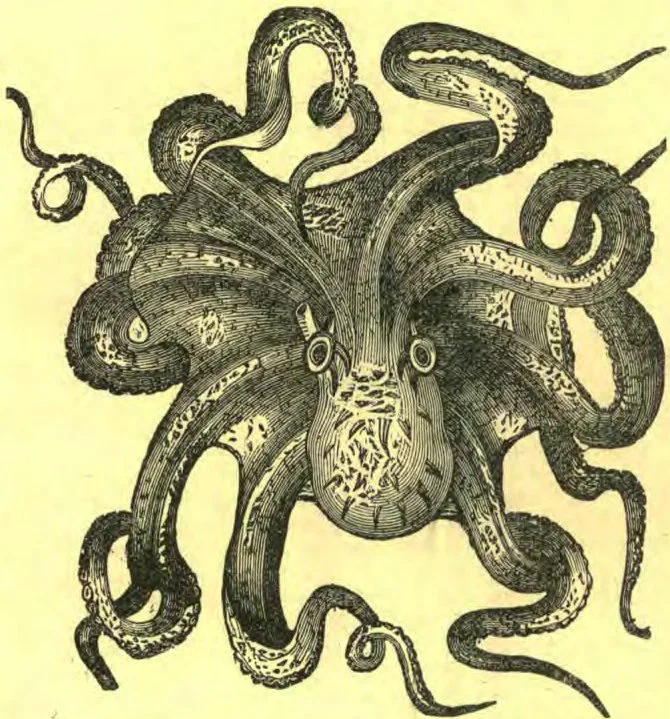
Divers are in danger, too, from sharks and other marine monsters who may, with one snap of their teeth, sever the air-tube. Sidney Dare, the well-known diver, says of the devil-fish, or, as the naturalists call it, the octopus: “One of these fish one night parted my life-line; and another time, one was settling down over me, to devour me, when he was seen by the crew in the boat, who struck at him with an oar, and frightened him away. If he had once got his arms around me, nothing could have saved me from being sliced up by his jaws.”
The octopus is a repulsive creature. It has a great, fleshy, bulbous body, with two round, glassy eyes as large as the top of an ordinary tea-cup, and a horny beak. It has seven or eight long, flabby arms attached to a thick, muscular collar at the neck. These arms are bristly, and of a brown color outside; underside they are white, and are furnished with a row of suckers to retain the prey when caught. Usually the fish are five or six feet long, arms and all, but they are sometimes found of great size. One enormous specimen captured by an English war-ship weighed eight tons; and another, sent to the New York aquarium several years ago, had a body ten feet long, and its arms measured thirty feet. When it attacks its victim, it belches forth an inky fluid, that darkens the water; and from this fact it is sometimes called an ink-squid.
In sailing out of port, one often sees the porpoises, which to me resemble small whales. They frequent nearly all our salt-water harbors in search of smaller fish for food. Whenever they come upon a school of mackerel, herring, or porgies, they do murderous work with their jaws, which are armed with from forty to fifty sharp teeth. It is a wild, rollicking scene to view a lot of them plunging and tumbling through the foam, often lifting their black bodies nearly out of the water. To a landsman, it seems as if they were doing it in playfulness; but it is serious work for them, and more serious for the small fish, who are trying to escape their pitiless pursuers. Porpoises vary in size all the way from fifty to eight hundred pounds.
Whenever they can, fishermen are always glad to capture a porpoise for its commercial value. Every part of it is marketable. The skin when prepared is even better than the alligator’s hide for carriage leather and for shoes. The blubber, or fat, yields an oil equal to that of the whale; and a superior grade, which comes from the jaws, is much used by jewelers and watch-makers. Some parts of the meat are esteemed delicate food, and the rest of the fish is sold for fertilizing purposes.
Another frequenter of harbors is the shark. I saw, one summer, a man-eating shark which had just been caught in North River, where the street boys were in the habit of swimming daily. He was six feet long, and weighed nearly four hundred pounds. He had a wide, cruel-looking mouth, and rows of terrible teeth. I thought, while looking at him, that if I had met him alive, and in his native element, distance would certainly have “lent enchantment to the view.”
I feel as if I had only touched upon the marvels of old ocean; but if I have succeeded in awakening in any of you a desire to study for yourselves, and to find out about the pearl divers, coral builders, sponge gatherers, and other delvers in the sea, and to lead you to know more about the many wonderful things of the deep, I shall feel amply repaid for writing this article.
L. E. ORTON.

AT SEA.

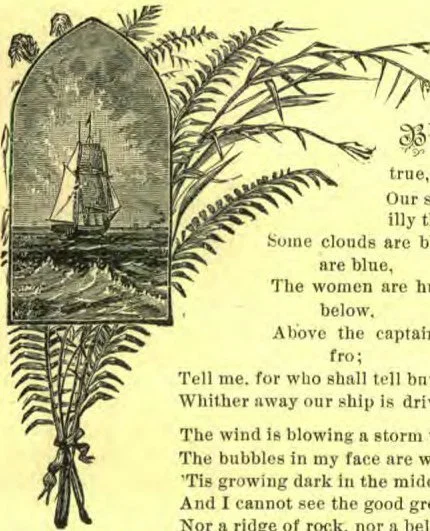
BROWN-FACED sailor, tell me true,— Our ship I fear is but ill thriving. Some clouds are black, and some are blue. The women are huddled together below. Above the captain treads to and fro: Tell me, for who shall tell but you, Whither away our ship is driving!
The wind is blowing a storm this way, The bubbles in my face are winking— 'Tis growing dark in the middle of day, And I cannot see the good green land, Nor a ridge of rock, nor a belt of sand;
O, kind sailor, speak and say, How long might a little boat be sinking? More saucily the bubbles wink; God’s mercy keep us from foul weather, And from drought with nothing but brine to drink. I dreamed of a ship with her ribs stove in, Last night, and waking thought of my sin; How long would a strong man swim, d'y' think, If we were all in th' sea together?
The sailor frowned a bitter frown, And answered, “Aye, there will be foul weather,— All men must die, and some must drown, And there isn't water enough in the sea To cleanse a sinner like you or me; O Lord, the ships I’ve seen go down, Crew and captain and all together!”
The sailor smiled a smile of cheer, And looked at me a look of wonder, And said, as he wiped away a tear, “Forty years I've been off the land, And God has held me safe in his hand: He ruleth the storm—he is with us here, And his love no repented sin can sunder.” —Alice Cary, adapted.

SENDING LETTERS IN OLDEN TIMES.

Almost everybody, now, writes letters and receives them. It is pleasant to go to the post-office, and get a letter from a friend. Some people go to the post-office regularly, twice every day or more. But the post-office is a modern affair. In ancient times, they had no such thing; no regular mail-carriers for the common people; nor did they have railroads, nor even stage-coaches. There were few public roads, anyway, and only a few of these were much traveled. Hence, if a person desired to write to a friend at a distance, he had to send a person all the way there on purpose to carry the letter, and this, you see, would be a long and costly affair; or else he had to find some one who was going to that place, and get him to take it. He might have to wait several weeks, or a year or more, to send his letter after it was written. So you see that absent friends were not likely to hear from each other very often in those times. How unpleasant that must have been!
But kings and rulers, from the most ancient times, were accustomed to have couriers on purpose to carry their letters and dispatches from one place to another. But these did not go at regular times, and only carried matter for the king. The first regular system of carrying letters seems to have been established by the Romans. The word post, as applied to this, is derived from a Roman word. As the Romans had a vast extent of territory subject to them, and a large amount of official business to do, it became necessary for them to have mail-carriers on established routes. For this purpose, they built public roads through all the most important provinces of the empire. These roads are easily traced to-day. Starting from Rome, the capital, at the end of the first day's journey was a camp, with a band of soldiers, equipment of men, carriages, horses, and things necessary for the work. Then, every few miles, there were horses kept, so that the mail-carriers could ride one very rapidly awhile, and then exchange the exhausted horse for another, and so go on their journey at a high speed. Along these highways, the couriers bore public letters. Sometimes they carried a few private letters. They often traveled at the rate of one hundred and sixty miles a day. But these public routes were few and expensive; hence not many letters were sent.
During the Dark Ages, that is, from about A. D. 700 to A. D. 1200, these roads were abandoned; people ceased to read and write as much as formerly; there were no papers published, and very few books. Only a small number of persons could read at all. But beginning with the thirteenth century, things began to brighten up; people began to read more. This led to a renewal of the intercourse between the different parts of the country, and by slow degrees, the ancient highways were opened again. Men went first by horse-back, and afterwards by carriages. These matters were generally conducted by the authority of the king, though sometimes private parties did the work. The introduction of stage-coaches in England, during the last century, opened the way for easier communication than ever had been before. These coaches carried persons, mail, and small packages. About one hundred years ago, regular mails were carried in this way throughout England.
In America, our own country, the post-office, in some form, has existed from the earliest times. Originally, it was a very loose affair. Letters arriving in a town were left at some public place, as in the tavern or store, and then they were sent for by neighbors or friends. The first law made, relating to the post-office, was in 1639, about two hundred and fifty years ago. This directed that the house of a certain man in Boston was to be the place where all letters must be left, and he was to have one penny for each letter. In Virginia, in 1657, it was required that every planter should forward the mail to his next neighbor, and so on.
Gradually the postal service was established between the different colonies, and in 1672 there was a post to go monthly between New York and Boston. That would be rather slow mail for our days, wouldn't it? Only one mail in a month between Boston and New York. One of the earliest acts of the Continental Congress, that body which ruled the country during the Revolutionary war, was the establishment of the mail routes, from Maine to Georgia. Benjamin Franklin was the first postmaster-general, but he at first had only about seventy-five post-offices in the whole country. In his day, for the first time, newspapers were sent through these mails. They were sent free at first, no regular postage being charged on them till 1792. In this year, the rates of postage, which continued for about fifty years, were first established. But it cost a good deal to send a letter in those days. It cost six cents to send a letter thirty miles, and from that on up to twenty-five cents to send a letter four hundred and fifty miles. So you see the farther a letter was sent then, the more it cost. The postage was so high that few persons could afford to write. Hence few letters were sent.
As late as 1845, the whole number of letters mailed in the United States was only 29,000,000; whereas in 1875, the city of Boston alone sent 39,000,000 letters. Now we send ten times as many letters in one year as they sent in fifty years, a half century ago. The introduction of railroads and steamboats has greatly facilitated mail carrying. Postage is now cheap. Everybody has learned to read and write, so that now almost everybody sends letters, since they can be sent for a few pennies, in a few days, to almost any part of the world. The consequence is that millions of letters are written now, where only a half dozen were written in former ages. But this wonderful change has largely been brought about within the last one hundred years.
D. M. CANRIGHT.

A GOOD MEMORY.

UNDER the above heading in the last issue of the INSTRUCTOR, we promised some rules this week, for the cultivation and strengthening of the memory; for we believe the young have it in their power to do much to discipline and develop this all-important faculty of the mind. And I do not think I can do better than to quote a portion of the rules found on this subject in Emerson’s “Watts on the Improvement of the Mind.” After devoting several pages to general remarks on the memory, he gives the following rules:—
“1. Due attention and diligence to understand things which we would commit to memory, is a rule of great necessity in this case. When the attention is strongly fixed to any particular subject, all that is said concerning it makes a deeper impression upon the mind. There are some persons who complain they cannot remember divine or human discourses which they hear; when, in truth, their thoughts are wandering half the time; or they hear with such coldness and indifference and a trifling temper of spirit, that it is no wonder the things which are read or spoken make but a slight impression upon the brain, and get no firm footing in the memory, but soon vanish and are lost.
“It is needful, therefore, if we would maintain a long remembrance of the things which we read or hear, that we should engage our delight in those subjects, in order to fix the attention. Sloth and idleness will no more bless the mind with intellectual riches, than it will fill the hand with grain, the field with corn, or the purse with treasure.
“Let it be added, also, that not only the slothful and the negligent deprive themselves of proper knowledge for the furniture of their memory, but such as appear to have active spirits, who are ever skimming over the surface of things with a volatile temper, will fix nothing in their minds. . . . There must be the labor and diligence of close attention to particular subjects of thought and inquiry, which only can impress what we read or think of upon the remembering faculty in man.
“2. Clear and distinct apprehension of the things which we commit to memory is necessary, in order to make them dwell there. If we would remember words, or learn the names of persons or things, we should have them recommended to our memory by clear and distinct pronunciation, spelling, or writing. . . . Faint, glimmering, and confused ideas will vanish, like images seen in twilight. Every thing which we learn should be conveyed to the mind in the plainest expressions, without any ambiguity, that we may not mistake what we desire to remember. . . .
“For this reason, it is necessary, in teaching children the principles of religion, that they should be expressed in very plain, easy, and familiar words, brought as low as possible down to their understanding, according to their different ages and capacities; and thereby they will obtain some useful knowledge, when the words are treasured up in their memory; because at the same time they will treasure up those divine ideas too.”
“3. Method in things we commit to memory, is necessary, in order to make them take more effectual possession of the mind, and abide there long. . . .
“4. A frequent review and careful repetition of the things we would learn, and an abridgement of them in a narrow compass, has a great influence to fix them in the memory. . . .
“5. Delight in the things we learn, gives great assistance toward the remembrance of them. Whatever, therefore, we desire a child should commit to memory, make it as pleasant to him as possible; endeavor to search his genius and his temper; and let him take the instructions you give him, or the lessons you appoint him, as far as may be, in a way suited to his natural inclinations. . . .
“6. “When you would remember new things or words, endeavor to associate them with some words or things which you have well known before, and which are established in your memory. This association of ideas is of great importance, and may be of excellent use in many instances of human life.”
To these valuable rules, we wish to add a few thoughts; for memory must not be estimated on the basis of its acuteness and accuracy alone, the treasures it contains must come into the account. Is it a mine rich with thought, jewels treasured with the choicest care? Or is it like a net cast into the sea, which gathers of all kinds, alike of the good and the bad? We estimate the value of a book from the character and influence of its contents, and the freight of a loaded vessel from the nature of its cargo.
1. Then, as you value a sound body and a vigorous memory, be careful of your health.
2. Guard with sacred care your morals. Shun the vices and follies of youth. Be pure in thought, word, and deed.
3. Be careful whom you choose for your associates, and what you allow yourselves to read. Vile associations and poison literature will assuredly weaken the powers of the mind to retain or appropriate that which can be used in the formation of a symmetrical and pure character. Do not listen to lectures or counsel which would lead you to disrespect God, or the Bible, or the religion of Him who gave his life for us.
4. Early give your heart to the Saviour, and learn of him. Treasure up and meditate upon good things. Enlarge and strengthen the memory with wisdom’s choicest gems, and “wisdom shall give to thine head an ornament of grace; a crown of glory shall she deliver to thee.” A time, place, and order for every thing will greatly assist memory and save much confusion.
5. Aim for innocency in childhood, purity in youth, and virtue and honor in manhood, that memory may ever bear happy and soul-cheering recollections of the past.
A. S. HUTCHINS.

SLOW TO SPEAK.

“Grandma, what do you think?”
Beth burst into grandma’s room in a whirl of excitement.
“What is it, dear?” asked grandma, looking up quietly from her knitting.
“A new girl came to school to-day, and Miss Wharton put her in the seat right next to mine, and I didn’t want her there at all, for she’s just a horrid girl, she is so homely and shabby looking; and besides she has to sweep out the school room to pay for coming to school; but that isn’t the worst of it. She’s a thief, grandma!” and Beth, breathless with indignation and excitement, paused to see what effect this startling announcement would have on grandma.
“That is a very hard word to use, Beth,” said grandma. “Are you sure she deserves it?”
“Yes’m, because she stole something from me this very day. I’m going to tell all the girls about it the very first thing in the morning, so they can keep watch of her. You know my lovely knife that papa gave me on my birthday? Well, I was using it at recess; and when I got through sharpening my pencil, I put it back in my desk and went out to play. That Mollie Peters was sitting there watching me, and I suppose she wanted it because it was so pretty, for just as soon as I went out, she took it.”
“Did you see her take it?” asked grandma.
“No’m, I didn’t see her, but I am certain sure she took it, for when I went to look for it after school, it was gone; and I thinks it’s just awful in her, so!” and Beth’s curls and ribbons and ruffles fairly quivered with righteous indignation.
“I expect you didn’t put it in your desk,” suggested grandma. “I know a little girl that was very sure once that she had put her gold pen away in her bureau-drawer, and found it under some newspapers on the table just where she had left it.”
Beth blushed.
“Well, I did make a mistake that time,” she admitted, “but I am perfectly sure this time. I forgot all about the knife till I was half-way home from school, and then I ran back after it and it was gone; so she must have taken it.”
“Beth,” said grandma, “I want you to promise me something.”
“What is it, grandma?” asked Beth.
“Promise me that you will wait at least a week before you say anything to any of the other girls about the loss of your knife. You would be very sorry if you found that you were mistaken in your suspicions, and had caused the girls to distrust an innocent school-mate.”
“Well, I will promise it just to please you, grandma,” said Beth, reluctantly, “but I expect she’ll steal every thing in the school before the week is gone.”
“‘Be slow to speak,’” quoted grandma, as Beth went away to practice her music-lesson.
“Grandma, my pocket is torn,” said Beth, a few days later. “Will you please mend it for me?”
Grandma began the task, and presently she made a discovery that brought a smile to her kindly face.
“Beth,” she said, “here is something hard caught in the lining of your dress. Will you take it out?”
Can you guess what Beth, with a crimson face, brought to light? Her knife! which had slipped through a tiny hole in her pocket, so small as to be unnoticed, then into the lining of the skirt.
Beth hid her face on grandma’s shoulder.
“Oh, just think how perfectly dreadful it would have been if I had told all the girls that Mollie was a thief, and then had to take it back!”
“And how dreadful it would have been for Mollie to know that she was falsely accused,” added grandma. “Now Beth, dear, remember this when you are tempted to judge any one hastily, and take for your watchword, ‘Slow to speak,’ that you may not have to regret a hasty accusation.”—Minnie E. Kenney, in the Well-Spring.

TEMPERANCE NOTES.

“THERE are five murders and fifty fights in that barrel,” said an Indian, pointing to a cask of whisky; and his estimate was none too high.
I have four good reasons for being an abstainer: my head is clearer, my health is better, my heart is lighter, and my purse is heavier.—Dr. Guthrie.
A gentleman remarked that he had eight arguments in favor of prohibition; and when asked what they were, replied, “My eight children!”
“What good has the liquor-seller done?” asked a public speaker. “Can anybody think of one whom the liquor business has benefited?” The silence was broken by some one crying out, “The grave-digger.”

IMPORTANT BIBLE SUBJECTS.

LESSON 10.—CHRIST THE END OF THE LAW.

(Continued.)
[NOTE TO THE STUDENT.—Do not consider the lesson learned until you can give at least the substance of every text, with the correct reference for each. The references in black letters indicate those texts that should be committed to memory. A little diligent application each day will enable you to learn them, although this need not be considered a test of scholarship.]
1. To whom is Christ the end of the law? Rom. 10:4.
2. For what purpose is he the end of the law to believers? Rom. 10:4.
3. What is righteousness?—Obedience to the law. See Deut. 6:25.
4. What will those have who keep the law? Rom. 10:5; Matt. 19:17.
5. Then since it was designed that men should keep the law, to what may the law be said to have been ordained or designed? Rom. 7:10.
6. But since all men have violated the law, what does it now bring them? Rom. 7:10; 6:23.
7. By what means has life again been brought to view? 2 Tim. 1:10.
8. Who has life to bestow? John 5:25, 26.
9. For what purpose did he come to earth? John 10:10.
10. To whom will he give this life? John 3:16.
11. Since the law, which was ordained to life, cannot, because of sin, give us life, who is now our life? Col. 3:4.
12. Then how, as a whole, is Christ the end of the law? —He secures to believers justification before God (Rom. 3:24, 25; 8:1); he enables us to keep the law (Rom. 8:3, 4), a thing that without him we could not do (Gal. 5:17; John 15:5); and as a consequence of our continued faith and obedience, he secures to us eternal life (John 3:16; Matt. 19:17; Rev. 22:14); thus enabling the law to fulfill its design, which was to give life (Rom. 7:10).
13. Then what may Christ truly be said to be to those who believe in him? 1 Cor. 1:30.
14. In whom alone can we be complete? Col. 2:8–10.

LOVE LAYING DOWN LIFE.

An aged woman, who for many years had loved and walked with her Lord, was startled one night by a summons to the room of a beloved daughter who had been seized with sudden illness. The mother gave one look at the dear face, and believing that she saw the child of her love slipping from her, rushed from the room to summon help. Out into the dark, chilly night, wholly unconscious of herself, went the tenderly cherished, feeble woman, just risen herself from a sick-bed, with one thought impelling her, “I must have help for my child.”
The physician lived just across the way. She rang his bell, bade him come quickly, and then sank down, never to rise again, the slender thread of life snapped short by this supreme act of self-forgetful love! They bore her tenderly to the beautiful home in which all rose up to call her blessed, and then a few more breaths, the low murmuring of “Our Father,” and the precious old saint had passed “beyond the smiling and the weeping.”
Now and then, right into this prosaic, common-place life of ours, comes some striking object-lesson like this to call attention to the central truth taught by our Lord—that love lays down life. Love is not sentiment; it is sacrifice. Love forgets itself in remembering others. Love throws its own life away that life dear to our Lord may be saved! “Whosoever will lose his life for my sake shall find it.”
Is not this lesson of practical import to us as Sabbath-school teachers? If we be rightly moved toward this work, it is love that moves us. If we let love draw us whither it will, each child intrusted to our care will be a dear one, because one of His, and therefore one for whom we will gladly lay down life, to the putting aside of our pleasures, our plans, our engagements, where these may possibly conflict with a chance for ministry to “one of the least of these.”
If we let love move us, our service will be delightful, though it may cost much of time and strength and heart interest. The teacher who loves much will have great reward, for the joy of life is in loving, not in being loved. “He who loveth is born of God.”—S. S. Journal.

Measuring a Teacher's Real Influence on Scholars

Not the number of scholars in the class, but the number of scholars really reached and impressed for good by the teacher, measures the immediate work of the teacher. The larger number measures the teacher’s opportunity; the smaller number measures the teacher’s performance.

The Value of a Good Opinion of Oneself

A good opinion of one's self is not usually numbered among the Christian virtues. And yet what the world and the Church greatly need to-day is more men who have a good opinion of themselves—so good an opinion of themselves that they would scorn to cherish low aims, or to do a dishonorable action, or to consent to anything on which falls the shadow of a falsehood, or to do wrong to another in word or deed. Thrice miserable is he who has so low an opinion of himself that he does not think these things beneath him, and who consents still to justify that low opinion of himself.

HOW CAMPHOR IS OBTAINED.

The spirits of camphor, so commonly used in nearly every household, is a solution made by dissolving camphor gum in some kinds of spirits; but this aromatic gum is not so easily obtained as the spicy pine, spruce, and hemlock gums that the boys find so readily in some of the swamps in the United States. Camphor gum is procured principally from Japan, the islands of Formosa, Borneo, and Sumatra, and one species, it is claimed, is found in China.
There are two kinds of the gum in trade, one kind of which is monopolized by the Chinese, who, it is said, “pay for it at the rate of $1,000 to $1,200 the picul (133⅓ lbs.), or for a very superior quality even $3,000 for one cwt.” This species is procured in some parts of Borneo and Sumatra, from trees which sometimes reach one hundred feet in height, and six or seven feet in diameter. One tree is described as measuring fifty feet in circumference. The Chinese value this kind as worth 70 or 100 times more than the other. The “American Cyclopedia” says the gum of this species is found in “solid masses, deposited in fissures and crevices which run lengthwise of the heart of the wood, and is extracted by splitting the trunk in pieces and picking out the lumps with a pointed instrument or the nail, when they are small. Some lumps have been found as large as a man’s arm; but the product of a large tree does not often reach twenty pounds. Half this amount is a good yield for a middling-sized tree, and in hunting for one, many are cut down and split up with great labor that furnish no camphor; hence the high price of the camphor.”
Japanese camphor, which supplies the trade principally in this country, is largely exported from one of the Japanese islands. The following concerning this species we gather from an article in Popular Science Monthly:—
“Many of the trees grow to great size; in some parts of the island they measure ten or twelve feet in diameter, while in other parts are trees measuring twenty feet across. After growing twenty or thirty feet without limb, they branch out in all directions, forming a well-proportioned and beautiful evergreen mass. The wood is valuable for cabinet-work, and for purposes of ship-building [because it is never attacked by the destructive insects which swarm the East]. The camphor tree is necessarily destroyed in the manufacture of camphor, but the law requires a new one planted in place of every one taken away.
“The gum is extracted from the chips by distillation, the whole tree being cut up for the purpose, and steamed in a tight vessel or box. The steam, camphor, and oil, the immediate products of the process, are conducted through a bamboo tube to a second tub, and from this to a third, which is divided into an upper and a lower compartment. The partition between the two divisions is perforated with small holes to allow the oil and water to pass to the lower compartment. The upper compartment is supplied with a layer of straw, which catches and holds the camphor in crystal. The camphor is then separated from the straw, and packed in wooden tubs containing a picul, or 133⅓ lbs. each, for the market. [It is rated at only twelve or fifteen dollars the picul.] The oil is used for illuminating and other purposes.”

Providence Spring.

A CORRESPONDENT of the Inter-Ocean Curiosity Shop asks the following question concerning Providence Spring:—
“Is it true that in the Andersonville prison-pen, during the late civil war, at a time when the water in the creek had become very scarce and foul, and the captive Unionists were dying from this cause, a spring suddenly burst from the hillside?”
In answer to this question the Curiosity Shop quotes Mr. John McElory, who spent fourteen months in the Jacksonville prison, as follows:—
“Toward the end of August, 1864, the water in the creek was indescribably bad. Before the stream entered the stockade, it was rendered too filthy for any use by the contaminations from the camp of the guards, situated about half a mile above. Immediately upon entering the stockade its pollution became terrible. The oozy seep at the bottom of the hillsides drained directly into it all the filth from a population of 33,000. . . . The prisoners dug wells in the swampy earth with their pocket-knives to a depth of twenty to thirty feet, pulling up the earth in pantaloon legs. But a drought came on, and these wells, which at best were not free from pollution, began to fail. To approach too close even by a hair’s breadth, to the ‘dead line’ where the creek entered, in the effort to get water as free from filth as possible, was to sign one’s death warrant. . . . Sickness had multiplied in this horrible prison-pen until the wretched victims of such barbarism sat constantly face to face with despair. At this awful extremity, what was the astonishment and gratitude of the camp one morning when it was discovered that during the night a large, bold spring had burst out on the north side, about midway between the swamp and the summit of the hill, and was pouring out a grateful flood of pure, sweet water, in an apparently exhaustless quantity.”
This was the morning of August 13, 1864. The overjoyed prisoners christened it “Providence Spring,” a name quite fitting; for why would not God cause water to gush from the hillside to save the lives of those men suffering in the attempt to put down the same cause from which he was delivering the Israelites when Moses smote the rock, and the waters gushed forth for the thirst-stricken hosts of Israel? J. W. FULTON.
Continue reading: MAKING THE ALLIGATOR USEFUL