The Youth’s Instructor, Vol. 34, No. 23.

THE OCEAN
Earlier text: THE OCEAN

MAKING THE ALLIGATOR USEFUL.

THE following letter from Florida to the Chicago Times, as published in the New York World, May 16, 1886, may express the high value that is set upon this animal by some, at least, in the land of its nativity; but we think most any Northerner would incline to feel, “Too much-ee alligator.”
“A heathen stranger would certainly say that the alligator was the totem of the tribe and the presiding genius of the place; for it is no exaggeration to say that one may see that reptile here in a thousand appearances—dried or stuffed in the shops, highly ornamented in the stores, alive in the tanks, big alligators in pens, imitation wooden alligators on the streets, little alligators in tubs, alligators of assorted sizes in museums, skeletons of alligators in the drug stores, alligator skins tanned in the leather stores, and hundreds of different articles of jewelry of alligator teeth mounted on gold, silver, or nickel. You can buy a live alligator from six inches to two feet long, or a dead, dried, and stuffed one fourteen feet long.”
“A favorite device here is thus manufactured: An alligator two feet long, with a tail as much longer, is split down the front. After taking out the entrails, the tail is bent up so that the creature can be put in a sitting posture, when they sew up the front and color it to conceal the opening, afterward drying it to solidity. Then, with open mouth and glistening teeth, the cadaver is set upon a stand at the door, and smiles a saurian welcome on the customers. The forelegs are often bent around a cardboard basket or Japan saucer; and if for sale, a placard held in its mouth announces, ‘I want to go North,’ or ‘I smile to see a customer,’ or the like. One is surprised to find the ugly reptile the source of so much art and wit. When the basket is made of some sea creature’s carapace and is filled with assorted shells, the richness of the design is complete.”

THE LACE-LEAF OF MADAGASCAR.

One of the novelties of the vegetable kingdom is the beautiful lace-leaf plant of Madagascar. It is a rare plant, because so difficult to obtain. It grows in many of the rivers of the island; but traveling through the tangled forests and swamps of Madagascar, as well as over steep hillsides, in a palanquin, occasionally having to risk the danger from deep holes and ugly-looking crocodiles in fording the streams, does not make botanizing very desirable; and so this lovely plant thrives all unseen, save by a few, more venturesome than others, who persevere in spite of all difficulties until they grasp the coveted treasure. Belonging to this class of successful persons is a missionary, who, accompanied by his young son, and borne in a palanquin by the natives, journeyed until he found the object of his search. Alice May, in the St. Nicholas, gives several interesting incidents of the trip, from which we quote a few paragraphs which will give you a good description of this lovely, delicate plant. Speaking of the missionary’s diligent search for the lace-leaf, she says:—
“And now at last he had found it, bobbing backward and forward in a fantastic dance just above the eddying waters of the beautiful forest river. As soon as they recognized it, both Mr. Steedman and his son were on the ground in an instant, and bending eagerly above the clear stream. The water was so pure and limpid that every pebble could be counted, and in the cool, bright current they saw, to their delight, a perfect labyrinth of lace-work. Dozens of lace-leaves, green, gold, olive, and brown, were floating just beneath the surface of the water.
“‘O papa! did you ever see any thing so lovely?’ said Harry, excitedly.
“‘Ah, my son,’ said Mr. Steedman, ‘this plant is both lovely and rare. See, the young leaves are light green and yellow; the older leaves are darker,—shades of green and olive. A few are even black, and all growing from the same root. How perfect is every leaf, in spite of its delicate texture! Some of those larger leaves must be ten or twelve inches long. The strong midrib in each serves as a support for the fragile threads forming the meshes on each side.’
“Harry now plunged his hand into the lace-like web, half expecting it to dissolve in his grasp. But no! the wiry little yellow leaf, which he raised from the water, was perfect in form, and a gleam of sunlight, falling upon the shining meshes, transformed them into threads of glistening gold.
“He now discovered, as he examined them carefully, that the under surfaces of the leaves were glistening with little pearly bubbles of air.
“‘O papa!’ he cried, joyously holding the glistening meshes aloft, ‘the lace-leaves are jeweled!’ “ ‘Yes, Harry, those diamond drops are made by the breathing of the plant.’ *
With some difficulty they secured a plant, and “Harry carefully placed the leaves of it in his herbarium, while his father packed the root, with its native soil, in a tin case, preparatory to sending it to the Botanical Society in London.”

SOUNDS FROM A RAINBOW.

ONE of the most wonderful discoveries in science that has been made within the last year or two is the fact that a beam of light produces sound. A beam of sunlight is thrown through a lens on a glass vessel that contains lampblack, colored silk, or worsted, or other substances. A disk having slits or openings cut in it is made to revolve swiftly in this beam of light, so as to cut it up, thus making alternate flashes of light and shadow. On putting the ear to the glass vessel, strange sounds are heard so long as the flashing beam is falling on the vessel. Recently a more wonderful discovery has been made. The beam of sunlight is made to pass through a prism, so as to produce what is called the solar spectrum, or rainbow. The disk is turned, and the colored light of the rainbow is made to break through it. Now, place the ear to the vessel containing the silk, wool, or other material. As the colored lights of the spectrum fall upon it, sounds will be given by different parts of the spectrum, and there will be silence in other parts. For instance, if the vessel contains red worsted and the green light flashes upon it, loud sounds will be given. Only feeble sounds will be heard when the red and blue points of the rainbow fall upon the vessel, and other colors make no sounds at all. Green silk gives sound best in red light. Every kind of material gives more or less sound in different colors, and utters no sound in others. The discovery is a strange one, and it is thought more wonderful things will come from it.—Set.

BEST OF ALL.

Be noble—that is more than wealth; Do right—that’s more than place; Then in the spirit there is health, And gladness in the face; Then thou art with thyself at one, And, no man hating, fearest none. —George MacDonald.

WHAT MAIDIE LOST.

Such big, brown eyes! And how lonesome and hungry they looked! At least Maidie thought so when she passed their owner at recess.
Noon-time came, and the same little girl was in the same quiet place down by the big rock, all alone. She was eating dinner now, and though there was only an apple and a cooky in her basket, the hungry look in the big, brown eyes meant more than want of food.
Maidie sincerely pitied the lonesome stranger. She longed to go to her and put both arms around her neck, and say: “No matter if you are a new girl. We are all glad you are here. Come right along and play with us.”
But she didn’t say this. No, nor any thing else. She thought, “Helen wouldn’t be pleased to have me notice a girl who wears such poor clothes and lives in a tumble-down house, and I wouldn’t do any thing to offend Helen for the world.” And Maidie went off to her play, and nobody spoke to the little girl by the rock.
It seemed a long, long day to the little girl. She was so glad when it came night, and she could go home to her mother, and have a hug and kiss, and feel that some one in the world loved her. But she did not want to go to school again. She begged and pleaded that she might stay close by her mother all the time. The mother shook her head. She loved the child too well to yield to her wishes, and the next day with a sad heart the little girl took her place again in school.
Maidie had tried not to think of those brown eyes; but the more she tried to forget them, the more they haunted her. She even dreamed about them; and before she knew it, she was asking herself, “How should I feel to go among strangers, and not know a single soul to speak to, ’specially if I had to wear calico dresses and ten-cent stockings?”
But she could not make up her mind to speak to the “new girl.” Helen’s family were very aristocratic. Maidie would be ashamed to have Helen see her do it. She loved Helen dearly. If the truth were known, she feared her, too. She would leave the little stranger for somebody else to pity.
Somebody else, however, seemed of the same mind as herself, for the girls went on with their games without noticing the stranger. But where was Helen? Maidie missed her. Ah, there she was! and could Maidie believe her eyes?—leading the new girl by the hand!
The brown eyes did not look hungry now. They were bright and happy.
“O Maidie,” called Helen, “come and get acquainted with Jessie. Isn’t it queer, she was here all day yesterday, and nobody found it out. In our class, too. I wasn’t at school, you know. You’ll soon feel at home now, Jessie.” The last sentence was accompanied by a bright smile.
Jessie did soon feel at home, for of course none of the girls would be unfriendly with one whom Helen noticed. Maidie was glad for the stranger. She felt somewhat ashamed of herself, however, and determined never again to neglect doing right for fear of what any one might say.
That night in her own little room she thought the whole matter over again. She had a habit of talking to herself when very much in earnest. This is what she said that night:—
“Somehow I feel as if I had lost something, though what it is I can’t imagine.” A moment later she added: “I know, I lost an opportunity for doing good, and I think I lost besides what grandma calls a blessing.”

Letter Budget.

ANNA M. HANSON writes from Shelby Co., Iowa. She says: “This is my first letter to the Budget. I was eleven years old the 16th of January, but I kept my birthday the 17th. I had company and ever so many nice presents. Mamma gave me such a nice workbox. She said I should have it for being a good girl. I have three sisters and two brothers living. We are all trying to keep the Sabbath and serve the Lord. Will you pray that I may be saved when Jesus comes? I like the INSTRUCTOR. It teaches me many good things. Many thanks for it. I send my love to the editors, and to all the readers of the paper.”
SARAH E. HANSON writes from the same post-office as the above. She says: “I am Anna’s sister. I will be ten years old the 21st of March. My youngest sister is nineteen months old, and brother Henry is about three months old. They are our only pets. We love all our little brothers and sisters. We had a great many doves, but the cat robbed the nest of the little ones, and took many old ones too, so now all have left us. I go to day school, and am going to have a fourth reader for next term. I study in Book No. 3 at Sabbath-school. During vacation Anna and I help mamma all we can about the housework. Mamma says we are about as good as a hired girl. I love to read the Budget. I have seen all the nice letters in it. I am trying to be a good girl. I want you to pray for me, that I may be saved when Jesus comes.”
HERE we have a letter from Boulder Co., Colo., written by ELVA GREEN. She says: “I am twelve years old. At the Sabbath-school I am in Book No. 4; and at the day school, I am in the fifth grade. I have three sisters and one brother. One of my sisters is taking music lessons, and my brother is working in the mission at Denver. Papa raises small fruits to sell. He hires it picked, so he gives us the same that he does others, and we tithe it, and give some of the rest in to the missionary box. I like to read the INSTRUCTOR. I hope to see this letter printed, as I have never seen any letters written from this place. I want to be a good girl, so I can be saved.”
ANNA RUSSELL, of Aroostook Co., Me., writes: “I am ten years old. I go to Sabbath-school every Sabbath, and study Book No. 2. I know all of the commandments, and the books of the Old and the New Testaments. At the day school I study fifth grade spelling book, arithmetic, and geography. My little brother goes with me to school. He has not missed a day in this term. Our teacher had a spelling school, in which twenty-six scholars took part, and my brother and I stood up longest of any in the school. I am ten years old, and he is eight. I want to meet the INSTRUCTOR family in the new earth.”
ERNEST HARRISON, of Compton, Quebec, writes: “Not having seen any letters from this place, I thought I would write one. I came from England last March. I saw many different kinds of fishes when I was crossing the ocean. I saw some flying fishes. I never heard anything about the seventh-day Sabbath until I came here. I am thankful for the Sabbath and its kindred truths. We have a little Sabbath-school, and I get lessons in Book No. 3. I hope so to live that I may have ‘Well done’ said to me.”
ADDIE DICKENS, writing from Faribault Co., Minn., says, “I am thirteen years old. I have two sisters, and with our parents, we all keep the Sabbath. I go to school and to Sabbath-school. My parents and elder sister learn lessons in the INSTRUCTOR, and my younger sister and I study Book No. 2. We live three miles from Sabbath-school. My father is seventy-two years old. I love the INSTRUCTOR.”

Summer in the Country.

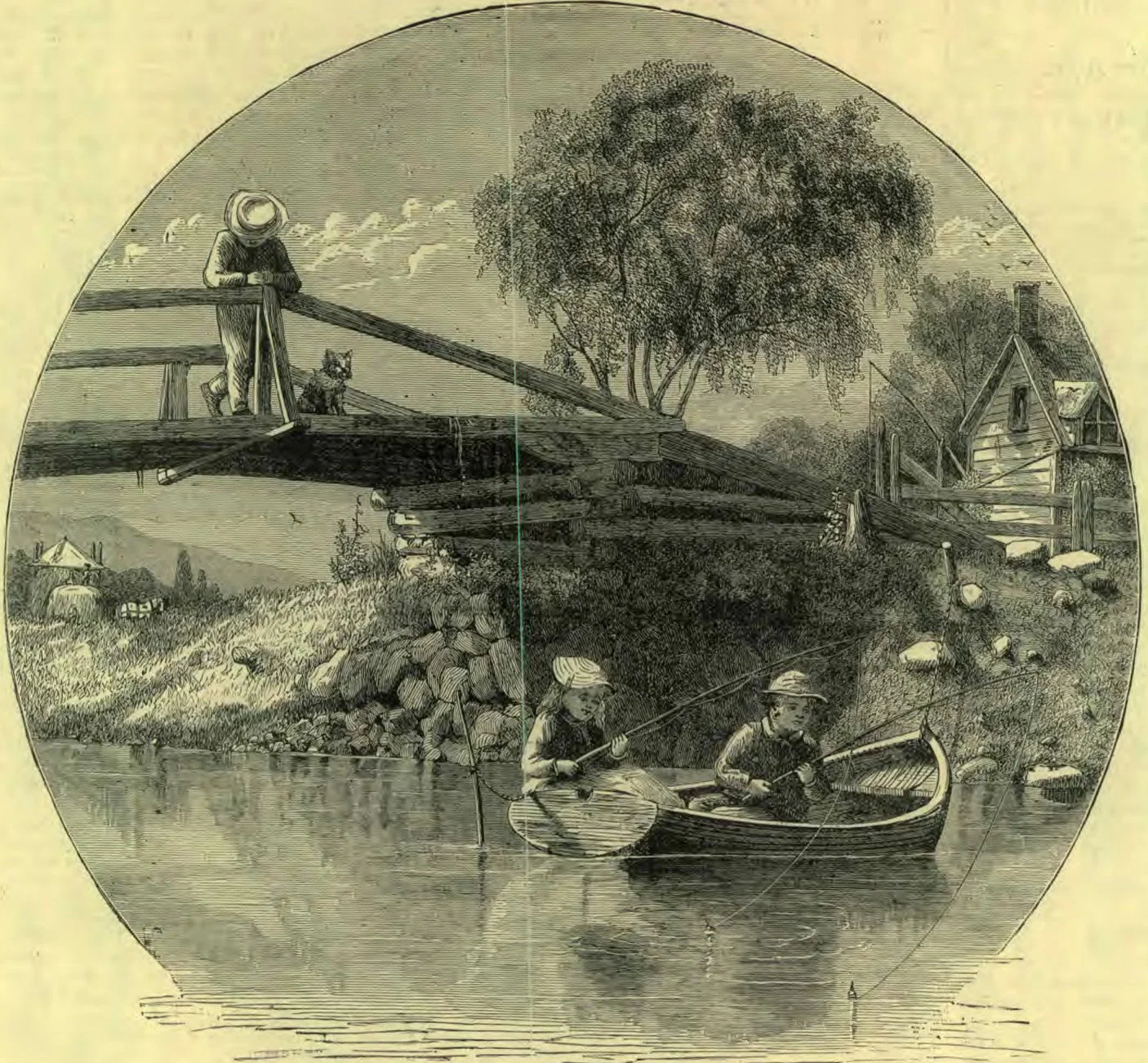
Sweet are the hours of summer, Sweeter the joys they bring; And over its golden treasures The farmer reigns as king.
The sky is a dome of azure, The clouds have a fleecy look, The weeping-willow bends to see Its form in the rippling brook.
The fragrance of fresh-cut clover Is borne on the balmy air, While birds and bees and flowers Are springing everywhere.
Sweet are the hours of summer, Sweeter its many joys, And to none do they come completer Than to farmers' girls and boys.
They scatter the fresh-cut clover, They ride on the loads of hay, And gather blue-bells and golden rod That border the dusty way.
Or, tired of their woodland rambles, And moored in a shady nook, They float the dreamy hours away And fish from the rippling brook.
When the cows come home in the twilight, And the stars begin to peep, They seek the low, gabled farm-house, And live o'er their joys in sleep.
Oh, Time may steal our treasures, But its theft of theirs is vain, For the scent of fresh-cut clover Will bring them back again.
S. Isadore Miner.

Erratum: Edinburgh Children's Record Correction

ERRATUM.—In Vol. 34, No. 21, in about the middle of the article, “An Executioner's Sword,” by some inadvertence appeared Edinburgh [England] Children's Record, instead of Edinburgh [Scotland] Children's Record.

You have reached the end of this edition.

The Youth’s Instructor · Jun 9, 1886