In the previous article we gave some facts which show that the chief geological changes recorded in the rocks must have been accomplished in a sudden and violent manner. The evidence for this is that fishes, shellfish, and other creatures are found buried in immense hecatombs, gigantic graveyards, often miles in extent, wherein uncounted myriads of those creatures appear to have been destroyed by some sudden or violent catastrophe. These conditions are of course not universal around the earth; but they occur in so many instances and in such widely scattered localities, and comprise so many various orders or kinds of creatures, that they may be said to constitute a universal phenomenon of the rocks.
Geologists, it is true, always admit the abnormal conditions in each single or particular instance; but according to their evolutionary theory they arrange these various catastrophes in a prolonged series, separated by long ages of what they term quiet and normal action. This is indeed the keynote of their system. But as has been shown, there is absolutely no scientific evidence to prove that these various catastrophes were merely local in extent, and occurred one after the other during long ages of time. It is really much more scientific to correlate all these various abnormal events together as merely parts of one great world catastrophe; and then these events assume a familiar form, and become merely the scientific aspects of that great event during which “the world that then was, being overflowed with water, perished.” 2 Peter 3:6.
In a previous article we also spoke of the evidences of a sudden and world-wide change of climate. That a wonderful climate, springlike and balmy, seems to have prevailed over the entire globe, is abundantly proved by other conditions besides the elephants and different animals found frozen in the ice of the arctic regions. For example, in many localities the arctic regions contain rocks full of certain kinds of corals; and we know that corals cannot exist except in warm water, which maintains a steady temperature of nearly 80° F. These corals are widely distributed in the arctic regions, and they show that during their lifetime a mild climate must have prevailed over all that part of the world.
Another evidence tending in the same direction is furnished by the immense coal deposits abounding in those regions. Every one has heard of the coal beds of Alaska; but not all are aware that these coal deposits seem to grow richer and better as we go northward. Cape Lisburne, a point of land some three hundred miles north of Nome and about one hundred sixty miles within the arctic circle, contains forty or fifty successive beds of coal, ten of them being each four feet thick, and one more than thirty feet through.
The leaves of the plants composing this coal are well preserved in the rocks, and consist of ferns, horsetails, club mosses, with cycads and palms, which now live only in warm, semitropical regions. We can well understand why the Government bulletin describing these coal deposits says that they indicate “a mild and probably frostless climate.” But at the present time this region is cold and desolate, the soil is frozen many hundreds of feet down, and thaws out only enough on top during the short summer to allow a scanty vegetation of the hardiest herbs and shrubs to appear.
All these facts, with others that might be given, are conclusive evidence that our world once enjoyed a climate of uninterrupted springlike mildness. If we considered these coal beds alone, there might be some chance to suppose that the change from that climate to the present one of terrific extremes of heat and cold was a gradual process; but the moment we begin to speak of a gradual change of climate, those elephant mummies, so splendidly preserved by nature’s system of cold storage, rise up before us to testify that the change was not gradual, but sudden, indeed sudden beyond human comprehension.
Some who are unacquainted with the geological facts have supposed that these remains in the arctic regions merely indicate that these regions constituted the tropics of that ancient world, and that at that same time some other portion of the world was suffering the rigors of an arctic climate. But there is no scientific evidence whatever, either geological, astronomical, paleontological, or any other sort, to prove or to hint that the poles were ever in any other position than where they are at present. And I do not know of any scientist who holds the view that the great change of climate which is so evident from the study of the fossils, was due to the shifting of the polar regions. Indeed, the evidence is all the other way. There are proofs, which need not be enumerated here, which show conclusively that this mild climate was formerly universal over the whole globe.
The generally larger size of the fossils found in the rocks, is another fact of much significance in this connection. I do not wish to convey the idea that all the fossils which we find in the rocks are abnormal monsters. True, there are some huge, unearthly looking monsters, some of them seventy or eighty feet long, the bones of which are found in Wyoming, Nebraska, and elsewhere. There are two such creatures in the Carnegie Museum at Pittsburgh, Pa., and one whole animal and parts of many others, nearly as large, in the Natural History Museum of New York. But I refer to the fossil remains of lobsters and clams and fishes and butterflies and bears and lions, and indeed almost the whole range of animal life. For practically all the fossils furnish specimens which are larger and more thrifty-looking than similar kinds alive at the present time. It is also a very significant fact that this characteristic of larger size is common to all the kinds of fossils found in all the various “formations,” and in all parts of the globe; and that when we pass over into our modern world, the change in the appearance of the fossils is just as sudden and complete as is that of climate.
Another very important aspect of modern discovery has to do with the conditions now prevailing around our ocean borders and on the deep floor of the ocean itself.
It was formerly taught that parts of the coast of Greenland, Sweden, Italy, and other countries, are rising slowly and gradually above the sea, and other parts are gradually settling beneath the waters. It is true there are old shore lines or raised beaches around all the continents, in some places fifty or7one hundred or five hundred feet above the present level of the ocean. In other places we have submerged forests, with the stumps of trees still visible beneath the water hundreds of feet out from the shore. However, these are an evidence, not of gradual, but of sudden changes of level; while the raised beaches at least are inseparably connected with the other vast geological changes which took place in the great long ago, and cannot be separated from them in explanation.
In addition to this, it was long supposed that definite markings placed on the shores of the Baltic and elsewhere during the last hundred years, tended to prove that changes of sea level are now going on. But a very full and complete examination of this supposed evidence has been made in recent years by some of the leading scientists, such as Sir Henry Howorth and Professor Suess; and their conclusion is that there is no sufficient evidence of this supposed gradual change of sea level, the latter author declaring that “displacements susceptible of measurement have not occurred within the historic period.”
Thus another of the teachings of evolutionary science turns out to be merely a myth, without any substantial facts in its support. The sea coasts of the continents are not now on the seesaw, up and down; and this alleged modern movement, which turns out to be based upon mistakes, cannot be appealed to in order to explain the great changes of sea and land which we find recorded in the rocks. These past changes of the sea and the land were wholly abnormal and without any explanation from similar changes which were once supposed to be still going on.
It was long taught that in our deep seas and oceans the currents are all the time wearing away in some places and building up in others. Therefore it was supposed to be necessary only for these beds of sandstone or limestone, which had been formed beneath the ocean, to be lifted up above the waters, in order to constitute the lands as we now find them, where mountains and plains are composed of strata of limestone containing corals or crinoids, alternating with sandstone containing shellfish, and shales full of the leaves of land plants.
But the investigations of the “Challenger” Expedition (1872-76), which was sent out by the British government, with other similar expeditions which have since been organized by the American and other governments, have proved that the bottom of the ocean is not being subjected to any such movements of the waters. The ocean currents do not extend below a thousand or two thousand feet, while the movements made by the mightiest storms are even more superficial in their action. On the contrary, over the whole bottom of the ocean there is a perpetual calm.
Around the borders of the oceans, extending out in some places a hundred miles more or less, the waves and currents are still at work, and deposits brought down from the land by the rivers and streams, are still being laid down. But as all kinds of sediments tend to be precipitated about twenty-five times as rapidly in salt water as in fresh, these sediments brought down from the land never get very far from the shore. The result is that there is what is termed a “continental shelf,” or border, around all the continents, on which these deposits are still accumulating, but beyond which they do not extend. Indeed, the true oceanic area begins with the edge of this continental shelf; and from this edge, the bottom rapidly sinks to the general level of the ocean floor.
Over this bottom of the ocean, with its cold, dark waters, there are no beds of sand or clay now being shifted or deposited; nothing but the slow accumulation of the slimy ooze formed by the silent dropping into these depths of the minute fragments of the millions of creatures, many of them microscopic in size, which live and die in the surface waters from one to six miles overhead. No gravel, no sand, no clay, is being moved or disturbed from end to end of the whole true bottom of the ocean. The materials now found throughout the whole of this vast extent are absolutely different from any deposits which we have yet discovered as composing the hills and lands of the continents—different, I mean, in their mechanical texture and make-up, and different in their method of formation.
Yet in the chalk cliffs of the south of England, of Kansas, and of many other localities, we have strata hundreds of miles in extent, composed of the very same kinds of microscopic remains which we now find over the larger part of the Atlantic bottom. In other localities we find brachiopods and crinoids, exactly like the modern kinds which live a mile or more down in the depths of the ocean. And the remarkable and telltale fact is that, in all these instances, these relics of the deep ocean are found mixed with or alternating with clays or sands or other materials derived from the lands, but which are not now associated with these deep-sea animals throughout the whole range of our modern ocean.
Thus in still another way we have evidence that the deposits composing our mountains and plains must have been formed by some very abnormal action of the waters of the ocean. Indeed, whenever we see these kinds of rocks, which now underlie such cities as St. Louis, Chicago, and London, they speak to us of that awful time in the long ago, when “the fountains of the great deep [were] broken up.” Practically all the limestone rocks found so generally throughout the world are composed of materials which thus afford us reminders and conclusive proof of the truth of the universal deluge.
Accordingly, we see that wherever we turn, the rocks contain within themselves evidence of the truthfulness of the Scriptural record.
Jesus Only
IN Jesus the Christian finds the final answer to all vital questions, such as:
What is Religion? The eternal bond which binds him to Jesus Christ as His glad and grateful “bond servant.”
Theology? In Jesus “dwells the fulness of the Godhead bodily.”
Philosophy? Jesus is “the way, the truth, and the life.”
Creed? Belief in Jesus as Saviour and Lord.
Life? “To me to live is Christ.”
The Church? “The body of Jesus Christ.”
The Law? Jesus says, “If ye love Me, keep My commandments.”
Hope? “Looking for the glorious appearing of our Saviour Jesus Christ.”
Heaven? The servants of Jesus “shall serve Him, and they shall see His face.” — Sunday School Times.
Experiences at Solusi Mission, South Africa
By H. M. Sparrow
H. M. SPARROW
RECENTLY we held an institute for the native teachers here. It lasted four weeks, and there were more than seventy teachers in attendance. We had a profitable time together, and every one of the teachers left feeling that the time has come for deeper consecration for the finishing of this great work. We tried to impress upon them as never before that in order to finish this work, there must be some sacrifice on their part, and that the Lord is looking to them to help carry some of the heavy responsibilities. I believe we had the most successful institute we have ever held.
A few weeks ago we baptized thirty-seven persons here at old Solusi. It was the largest class that has been baptized here for a long time. The beauty of it is that nearly all of them are entering the work. Later we hope to baptize several others. Our work is making good progress, especially among the out-schools.
Jim’s work in Bulawayo is being blessed of the Lord. He has been there only about a year, and some workers have already been developed, so we feel that the Lord is leading in this work. It is really marvelous to see the educated people taking their stand. We have been hoping to get hold of them for some time. It takes only a short time here on the main station to get them established, and then they are ready for work.
We are planning to hold a camp-meeting here for all our natives, and expect a feast of good things. The Holy Spirit has never disappointed us on such occasions. At that time we shall also have the ordinances. It is a great privilege to many of our believers to be present at such times. Quite a number live some distance away, and do not often have the privilege of celebrating the ordinances.
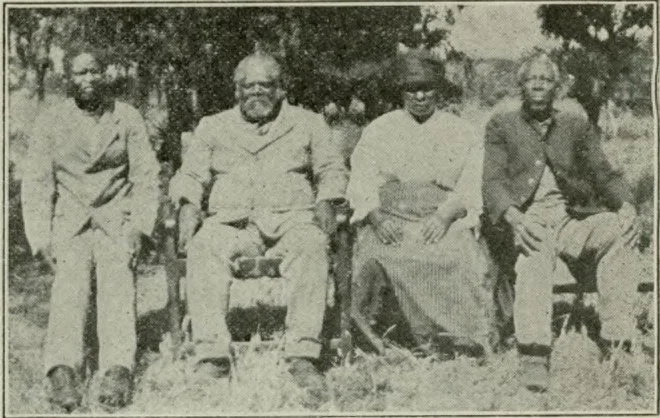
The Fingo Chief, Mzimende, and His Family
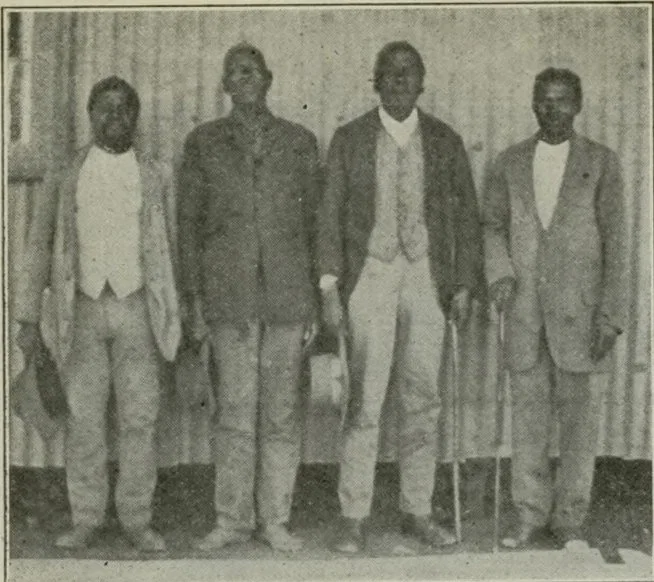
A Group of Workers on the Solusi Mission: Jim, Our Head and Oldest Evangelist, in the Center
At present we are building a new dining-room for the boys. Old Solusi has gone about as far as possible without putting up some new buildings. The buildings which we still have are the original ones built years ago. They have stood well, but need replacing now.
Recently I took a trip to two of our outschools where we have lately opened work. The Lord has been doing great things for us there. The people are ready to accept this truth. At the first place we held two meetings each day for five days. Each meeting lasted two hours, making four hours a day in the midst of harvest, which means much to a native. At first we did not suppose they would be willing to attend, but once they saw the chart and heard the explanation of the prophecies, they could not keep away. The Matabeles, the natives of this place, are a very influential people. Up to the present, most of our work has been for the Kalingas, but now we are making an effort for these people.
We held these meetings in the chief’s kraal, with an average attendance of more than fifty. It was remarkable how the people came. The chief is a Christian, a very conscientious man. He has full control in the Matoppo district. He has accepted the truth; and when we made the call for all those who wished to identify themselves with the people of God, he, with twenty-three others, responded. These were not moved by impulse, but they are accepting increased light. The chief’s own brother is here in our school, and when he went home last vacation, he traveled all through his country, telling the people what he could about the truth and our school. Our evangelists are now there, endeavoring to establish the believers in the truth. After we left, the chief continued to hold meetings daily with the people. On Sabbath no work is done anywhere near his kraal.
Our second school is also doing well. While in the Fingo Reserve we had some interesting experiences. The people there, as in the former place, are anxious to hear the truth. I opened the chart and explained the prophecies to them, and to many it was their first privilege of hearing anything on the books of Daniel and the Revelation. Already we are seeing fruit. One very influential man has been won to the message. A few Sabbaths ago we had the pleasure of seeing this man follow the Lord in baptism.9Later reports tell us that he is arousing a good interest among his own people.
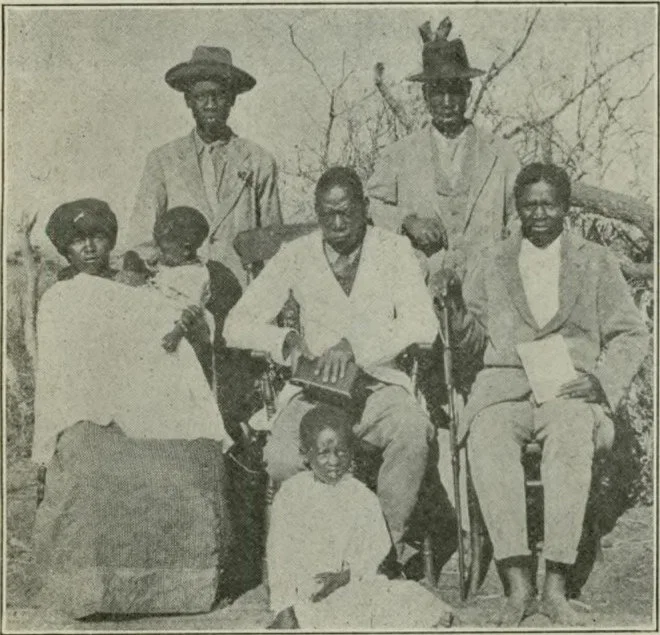
Evangelists and Teachers of the Solusi Mission, South Africa
While we were holding these meetings, some of our boys had a discussion. Isaac and a few of the others said that we should send to Kafirland for a Fingo worker to be sent to this field, but old Jim said, “No; if the Lord wants us to do a work for these people, He will raise up some one from among them to do it.” And, sure enough, He has done it. The Lord has opened the eyes of the very man that could do the most for his people, and has shown him the truth. This is very encouraging to all of us.
Our courage is good, and we thank God for what He is doing for us. O, may God impress it upon us as young people that now, while people are ready for the truth, is the time to work!
“We Are Afraid About Jesusi Coming”
By G. F. Jones
G. F. JONES
SINCE beginning the work in the Solomon Islands, we have never before encountered so many hindrances or conflicts as during the last few months. There has been a series of them rising up here and there like waterspouts on the sea, to the danger of navigation. We must expect troubles in these days, but God says, “Who would set the briers and thorns against me in battle? I would go through them.” Isa. 27:4. So with firm faith in Him, we need not fear, and our work will advance over all obstacles until completed.
During the second quarter of this year we placed in unentered districts, three more of our mission school boys, two of whom have wives and children. In spite of the difficulties, we feel that this is our day of opportunity, and we must move on, “for God is with us.” We are forced by these calls to send our young people from our mission schools with only slight preparation, yet the Lord is blessing them. We have a number of them out already, and have five districts yet unoccupied, waiting for other boys. We need more money to support them, and more teachers capable of preparing them for the work.
The boy in charge of one of our districts is only fifteen, but he is succeeding in arousing some who are most debased in heathen practices and desperate deeds. An old chief sent me a message the other day to come at once and have a council with them, saying, “We are afraid about Jesusi coming.” Yesterday another message came from him, “Tell us the day you will arrive, so we will be all together.” These calls are like springs in the desert. Do not think by this that all the Solomon Islanders are calling us, for it is as difficult to lead them out of their spiritism as it is to turn many in the homeland from their set religious ideas and theories when the light of truth is presented to them.
A native who has been on the police force for some time, returned to his island home, determined to have a “seven days” mission. (This is the name some of our opponents have given us, but it takes well with the natives.) A few weeks ago the native just mentioned braved the journey across a rough, open sea in his frail canoe to catch us on the “Melanesia.” Hearing that he had reached a certain place, I went there to find him, but he had left the night before. We missed each other, but he left a message, “Tell Jonsi to send a missionary, white or black, to my place!” O that I could find one!
Those who are thus calling us are the ones who have withstood the efforts of other missionaries. They belong to small tribes, and while not having the numbers, they possess stronger characters than the others who are afraid not to follow the multitude. I wish we had several more of our mission boys ready to be placed among these tribes, but they are nearly all out. Several of these missionary boys are meeting with opposition and persecution, but they are holding on well, and I will tell you more about them in my next report.
Solomon Islands.
Growth in Grace and Subtler Temptations
“GROWTH in grace will do away with many forms of temptation, and make it far less likely that the mature Christian will sin in those old ways. But the same secret of victory by grace is needed, for the temptations become more subtle according to the spiritual growth.”
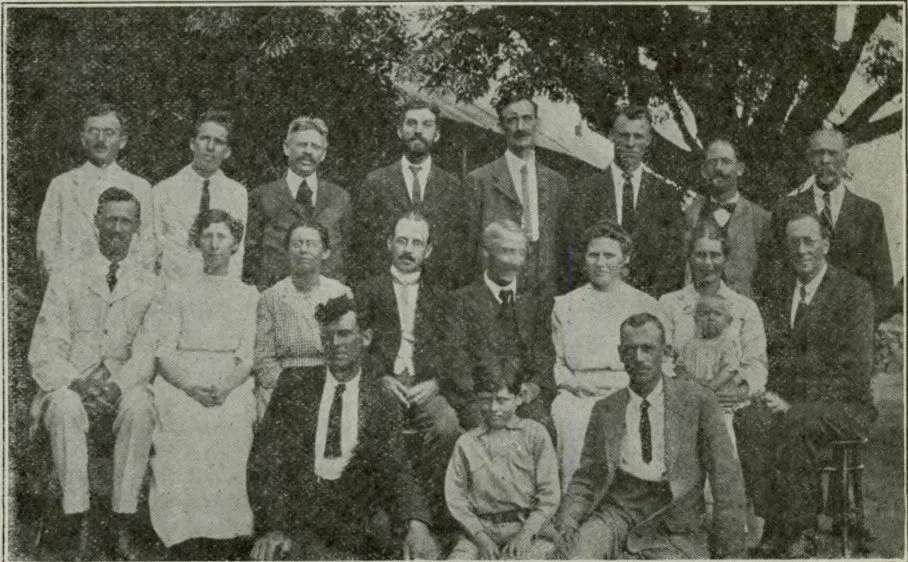
Our Workers in the Zambesi Union Mission
THE CAROLINA CAMP-MEETING
By W. H. Heckman
The Carolina camp-meeting and conference were held in Charlotte, N. C., August 19-29. The grounds were beautiful, and were conveniently situated in a desirable section near the center of the city.
There was a good attendance of our people, and the meetings were especially appreciated by the members of the Charlotte church, most of whom were new and had never before attended such a meeting.
The election of officers for the ensuing year took place, and there were practically no changes made. Elder J. W. MacNeil, who has for some time done such excellent work as president of the conference, was released to go to Africa, with the understanding that he should continue to serve until his place could be filled. Since that time, Elder L. T. Crisler has accepted the call, and is now carrying on the work in this conference.
Under the efforts of the faithful workers here, there has been a decided growth in the membership the last year. A gain of 222 — 126 in the white department and 96 in the colored — does not include the work of the present summer, as some joined the church in the effort in Charlotte and a large number in the effort for the colored people in Fayetteville. Three new churches have been raised up in the conference during the last year.
The tithe of the conference was $32,662.21 in 1919. For the first seven months of this year, the tithe for the conference was $24,035.26, representing a gain over the first seven months of 1919, of $6,659.59.
For the year 1919, the mission offerings amounted to $13,834.85, or about $4,000 more than the quota on the Twenty-five-cent-a-week Fund. During the present year $9,887.56 has been raised, while for the first seven months of 1919, the mission offerings were $6,443.59; thus a gain of $3,443.97, or over 50 per cent, was made in mission offerings for the first seven months of 1920 over the corresponding period of 1919.
The colporteurs have had remarkable success in the sale of our books. Up to the time of the camp-meeting, they had taken orders for $173,974.74 worth. For the first seven months of 1919 the total orders taken amounted to $94,908.95, while for the corresponding period in 1920 the total sales were $155,026.95, making a gain of $60,118, or 61 per cent.
Besides the local workers, all the departmental secretaries and the writer were present from the Southeastern Union. We greatly appreciated the help of the General Conference laborers. Elder R. D. Quinn gave us timely messages, driven home with his usual power and enthusiasm. Elder W. W. Eastman's heart-to-heart talks touched the needs of the people and were of interest and value. Elder J. H. Behrens gave excellent Bible studies.
The meeting closed with unusual services the last Sabbath. The meeting in the forenoon, conducted by Elder Quinn, was characterized by the presence of the Spirit of the Lord in great measure. A desire was shown by the people for a deeper consecration and a greater willingness to sacrifice for the cause of truth.
W. H. HECKMAN.
THE MAINE CAMP-MEETING
By H. W. Carr
The fifty-second annual camp-meeting of the Maine Conference was held at Lewiston, August 26 to September 5, according to announcement. The meeting was favored from first to last with continued blessings. The weather was favorable, the attendance good, and the instruction seemed to reach the hearts of the people, for they responded promptly to the invitation for a deeper consecration and for means to finish the work. The Sabbath school offerings alone were $200.
Maine is the most easterly conference in the United States. It is the birthplace of the message, and we are looking for a great awakening here as the message returns to the East with power.
In the six years that the writer has been in Maine, the conference has nearly doubled its membership and much more than doubled its tithes and offerings. The colporteur work, led by Brother E. E. Covey, has made a very encouraging showing. Twenty-five thousand dollars' worth of books were sold in the first eight months of this year. We hope to reach the forty thousand mark by the close of December.
This work is being systematically followed up by the missionary department, and much interest is awakened and new Sabbath keepers are taking their stand. This is proving to be the most effectual way of reaching the people in this State.
The educational work has grown until there are eleven schools, and has reached the stage where a school of higher grade is necessary. A beautiful farm and commodious buildings, which seemed awaiting us, have been secured. Insurance agents readily offer to insure the buildings for six times the amount the farm cost us. Prof. W. E. Howell and other leading educational men have visited the farm, which is two miles out from the cities of Auburn and Lewiston, and have expressed their hearty approval of our choice. This school will be known as the Pine Tree Academy, and as soon as possible we shall welcome the children of our people to attend it.
Elders S. N. Haskell, E. W. Farnsworth, J. S. James, E. K. Slade, Prof. C. A. Russell, and other visiting brethren assisted in the meeting. At the close, twenty-two candidates were baptized.
Conference officers were elected with but little change, and all renewed their determination to finish the work.
H. W. Carr.
THE HONDURAS CAMP-MEETING
By W. E. Lanier
THE Honduras camp-meeting was conducted in La Ceiba, May 28 to June 6. Besides local help, Elder E. W. Thurber of Guatemala, and Brother Carl Staben of El Salvador, were present and rendered efficient help throughout the meeting.
A four weeks’ tent-meeting had preceded the camp-meeting, and prepared the way for it. We had planned to conduct two tent-meetings, one English and one Spanish, before the camp-meeting, but owing to the fact that serious illness compelled both Elder W. G. Kneeland and Brother V. P. Hulse to return to the States just at the time we planned to begin, we were compelled to unite the English and Spanish meetings, and hold them alternately. While it was impossible to have as good interest with alternating meetings as we11would have had with continuous meetings, it was the best that we could do, and God blessed the effort.
We eliminated as much of the business routine as we could, so as to give as much of the time as possible to devotional work. And the general verdict was that it was a very spiritual meeting.
The English delegation was small, outside of the La Ceiba church, but we had a fairly good Spanish delegation. To the best of my knowledge it was the first time that delegates from the interior have attended any of the camp-meetings. The combined delegation numbered about one hundred.
One night was given to the Spanish and the next to the English. There was a good attendance at all night meetings. The English attended the Spanish meetings almost as much as they did the English. The Spanish greatly enjoyed the help rendered in the music by the English. Elder Thurber did most of the speaking in Spanish. The writer conducted most of the English meetings at night. Brother Staben gave most of his time to the devotional meetings, which were greatly enjoyed by all. We truly hope that these brethren can be with us next year.
On the last day of the meeting, eight were baptized. Six others were baptized two weeks later, making fourteen in all, and there are several others preparing for baptism. I hope that the total number may reach twenty. More than half of these are Spanish.
On the last Sabbath of the meeting, our Sabbath school offering was more than $50 gold, or an average of about fifty cents a member. The preceding Sabbath it was nearly $25. This was quite a good offering for a mission camp-meeting. I am sure that if we can properly finance this mission for a few years, it will become a strong, and an almost or quite self-supporting, mission.
W. E. LANIER.
Chesapeake Colored Camp-Meeting
By F. H. Robbins
The annual camp-meeting for the colored people of the Chesapeake Conference was held in Wilson Park, in the city of Baltimore, Md., September 16-26. A village of tents was erected to accommodate the members of the churches and the friends who came in from various parts of Maryland and Delaware. There was a dormitory tent, a guest tent or sleeping quarters for visiting ministers, a prayer tent for private devotion and meditation, a parlor or women’s reception tent, an office tent, a large audience tent, a dining tent, a kitchen tent, and thirty-two family tents.
Elder M. C. Strachan, who was in charge of the meeting, had the camp artistically arranged, and there was thorough organization in every detail throughout the meeting. Elder A. S. Booth, president of the Chesapeake Conference, gave his assistance and hearty co-operation to make the meeting a success.
There were present from the General Conference, Elders E. E. Andross, J. L. Shaw, Charles Thompson, and Prof. C. A. Russell. A number of union and local conference workers were also in attendance.
The Sabbath school offerings for both Sabbaths amounted to $300. The total offerings for missions were about $1,200. An impressive service was held when seven were buried with their Lord in baptism in a beautiful, clear pool on the grounds.
The work for the colored people is progressing in the Chesapeake Conference. God is greatly blessing our brethren and sisters there. The spirit of liberality is seen in the gifts for missions. Earnest work is being done for those not of our faith, and many are responding to the message of the third angel. Elder M. C. Strachan and his people are full of courage, and they are faithfully doing the work which God has committed to them.