'Twas grand old Martin Luther said:
“There’s naught on earth more sweet to see
Than a loving woman’s tender ways,
Whose heart is filled with piety.”
He found it so that dreadful night
When, up and down the frozen streets,
He sang his choicest songs for bread,
’Mid biting winds and beating sleets;
Yet ever sang and sang in vain,
And touched no heart, but only got,
Instead of bread to soothe his soul,
A “stone” for his unpitied lot.
When lo! from out a goodly house,
A flute-note on a mission sped;
He stopped, and, softened by the sound,
Again he sang his song for bread:
“The foxes to their holes have gone,
And every bird unto its nest;
But still I wander here alone,
And still for me there is no rest.
“My Christ was hungry, he was poor,
And I but follow where he led,
And he will feed me from his store,
And daily give me daily bread.”
“A child’s voice, surely,” quoth the dame;
The weary wanderer found his rest:
O good Dame Cotta! dost thou know
How by thy deed a world was blest?
Dame Ursula, an angel thou,
An angel didst from want relieve;
A world has shared in thy reward,
A world’s deep gratitude receive!
O men and women, to whose hands
The Lord commits his wealth to keep,
Remember that you stewards are,
And not your own the gains you reap!
O men and women, for whose souls
The Christ has given his life, in love,
Give freely of your lesser things!
He will not fail to mark above.
— Benjamin B. Warfield.
THE BEES AT HOME.
Some beehives are made of glass, so one can see how the bees keep house and manage their honey business. If you should ever look into one of these glass houses, you would see how they help one another.
Did you ever notice, for instance, the humming sound that comes from a beehive on very warm days? If you will watch the door of an ordinary hive on a July day, you will see a number of bees near it, continually moving their wings rapidly, as in flying. By doing this, a current of air is sent back into the hive, keeping it cool and well-ventilated, even if the temperature is high. If the bees did not do this, some of those inside would be suffocated; for there is only a small opening in each hive, and the crowds of bees coming, and going, and working at the honey-making and cell-building, would soon make the air as bad as that in the Black Hole of Calcutta. But the untiring, unselfish little fanners at the entrance keep the air pouring in so that everything is comfortable.
Another set of bees, called the “nurses,” spend their lives in taking care of the little grubs that will one day develop into bees. They feed them, watch over them, and never seem to tire of their helpless charges. Still other bees are “workers,” provisioning the hive, collecting honey and wax, making the cells, and defending the hive from any attack.
—Selected.
Cultivating Faith: The Knowledge Most Essential to Acquire
“The knowledge of what the Scripture means when urging upon us the necessity of cultivating faith, is more essential than any other knowledge that can be acquired.”
Notice that it is the knowledge of what the Scripture means as to the “necessity of cultivating faith,”—not particularly having faith, but cultivating it.
There is not much said in the Scriptures about any necessity of our having faith, while very, very much is said about our cultivating faith.
The reason of this is that to all people there is given faith to begin with: and all they need to do is to cultivate faith. Nobody can have more faith than is already given him, without cultivating the faith that is already given. And there is nothing known to man that will grow so fast as faith, when it is cultivated—“faith groweth exceedingly.”
Faith is the expecting that the word of God itself will accomplish what that word says; and the depending upon “the word only” to accomplish what the word says. To cultivate dependence on the word of God, “the word only,” itself to do what the word says, is to cultivate faith.
Faith is “the gift of God” (Eph. 2:8); and that it is given to everybody is plainly stated in the Scriptures: “God hath dealt to every man the measure of faith.” Rom. 12:3. This measure of faith which “God hath dealt to every man” is the capital with which God endows and starts “every man that cometh into the world;” and every man is expected to trade upon this capital—cultivate it—to the salvation of his soul.
There is no danger of ever lessening this capital when it is used: as certainly as it is used at all, it will increase, it will grow exceedingly. And as certainly as it grows, the righteousness, the peace, the joy, of the Lord, are assured to the full salvation of the soul.
Again: faith comes by the word of God. Therefore it is written: “The word is nigh thee, even in thy mouth, and in thy heart: that is, the word of faith, which we preach.” Rom. 10:8. Thus faith, the very word of faith, is in the mouth and in the heart of every man.
How is this?—Thus: when the first pair sinned in the garden, they wholly believed Satan; they gave themselves wholly to Satan; they were taken completely captive by him. Then there was perfect agreement and peace between them and Satan. But God did not leave it so; he broke up this agreement, he spoiled this peace. And he did it by his word, saying to Satan: “I will put enmity between thee and the woman, and between thy seed and her seed.” Gen. 3:15.
“It is God alone that can continually put enmity between the seed of the woman and the serpent’s seed. After the transgression of man, his nature became evil. Then was peace between Satan and fallen man. Had there been no interference on the part of God, men would have formed an alliance against heaven; and in the place of warfare among themselves, carried on nothing but warfare against God. There is no native enmity between fallen angels and fallen men. Both are evil, and that through apostasy; and evil, wherever it exists, will always league against good. Fallen angels and fallen men join in companionship. The wise general of fallen angels calculated that if he could induce men, as he had angels, to join in rebellion, they would stand as his agents of communication with men to league in rebellion against heaven. Just as soon as one separates from God, he has no power of enmity against Satan. The enmity on earth between man and Satan is supernaturally put there. Unless the converting power of God is brought daily to bear upon the human heart, there will be no inclination to be religiously inclined; but men will choose to be the captives of Satan rather than to be free men in Jesus Christ. I say God will put enmity. Man can not put it. When the will is brought into subjection to the will of God, it must be through man’s inclining his heart and will to be on the Lord’s side.”—Unpublished Testimony.
This enmity against Satan, this hatred of evil, which God puts in every person by his word, causes each soul to long for deliverance: and the deliverance is found alone in Jesus Christ. Rom. 7:14–25.
Thus this word of God, which plants in each soul enmity against Satan,—this hatred of evil that calls for deliverance, which is found alone in Jesus Christ,—this is the gift of faith to men; this is “the measure of faith” which God has dealt to every man; this is the “word of faith,” which is in the mouth and in the heart of every person in the world.
This “is the word of faith, which we preach: That if thou shalt confess with thy mouth the Lord Jesus, and shalt believe in thine heart that God hath raised him from the dead, thou shalt be saved. For with the heart man believeth unto righteousness; and with the mouth confession is made unto salvation.” Rom. 10:8–10.
Therefore say not in thine heart, Who shall ascend into heaven, to bring faith to us? Neither say, Who shall descend into the deep; or, Who shall go far off; to find faith and bring it to us?—For “the word is nigh thee, even in thy mouth, and in thy heart: that is, the word of faith, which we preach.” Deut. 30:11–14; Rom. 10:6–8.
Say that: and exercise the faith which God has given to you, as to every other person in the world; for “understanding how to exercise faith, this is the science of the gospel.”
Unity in the Body of Christ Through the Spirit
“WE must come to the place, where, instead of reaching out to one another for help, we shall reach up to the Spirit of God, and take help from the source where life and power are. When this is done, every Seventh-day Adventist will be a minister of the Lord Jesus Christ.”
WHOEVER is baptized with the Holy Ghost is thereby baptized into the unity of Jesus Christ; for “by one Spirit are we all baptized into one body.”
God is one. Jesus Christ is one. The Holy Spirit is one. And these three are one: there is no dissent nor division among them.
The body of Christ, which is the church, is one. Though they be many members, they are but one body—all the many are one. “For as the body is one, and hath many members, and all the members of that one body, being many, are one body: so also is Christ.”
The Holy Spirit is the only element of unity in this body composed of many members. Nothing but the all-pervading, all-gracious, all-gentle, and all-powerful, Spirit can possibly be the element of assured unity in this body of many members, which is the church.
And this blessed Spirit is this element of assured unity. It is so just now; for wherever that Spirit is, there is unity in Jesus Christ. All who have this Spirit are one in Christ Jesus. Any two, or any number, of persons, who have the Spirit of God, are one. We do not say they ought to be one: they are one. The very fact of their having the Spirit makes them one; for the baptism of the Spirit is “into one body.”
Whosoever, by whatever connection, professes to belong to the church, the body, of Christ, and yet indulges in criticism, dissension, or division, is self-deceived. He is not a member of the true church of Christ at all. He has not the Spirit of unity, which is the Spirit of Christ. And “if any man have not the Spirit of Christ, he is none of his.” Rom. 8:9. And as surely as any man has the Spirit of Christ, there is not, there can not be, with him, any criticism, any dissension, or any division. He has the Spirit of unity, and unity he will ever seek.
This unity of the church of Christ is just as complete as is that of the most perfect human body. All the members of the body of Christ move in just as complete and harmonious action as do the members of a perfect human body. For Christ is the Head of the body, the church: and just as all the members of the human body are set together, each in its proper place, and are, each in particular, directed by the head through the will; so all the members of the body of Christ are set together by God, “as it hath pleased him,” and are all, and each in particular, directed by the Head through the Spirit of God.
By the Holy Spirit each individual member is joined to Christ, the Head; and from the Head the one Will actuating all the members, perfect unity is fixed and maintained. But in the body of Christ, as in the human body, which is the figure, the members are not, each in particular, joined immediately to the head. In the human body, which is the figure, the members are joined to the head by being joined one to another,—the fingers to the hands, the hands to the forearms, the forearms to the upper-arms, the upper-arms to the trunk at the shoulders: yet each particular member is connected with the head, and is entirely controlled from the head, though it be through other members. Each member in the connection is essential to the efficiency of the other members; and each member must be strictly in its own place, in order efficiently to perform its own mission in the body of which it is a25part. And “the eye can not say unto the hand, I have no need of thee: nor again the head to the feet, I have no need of you.”
So it is in the body of Christ: “Now ye are the body of Christ, and members in particular.” 1 Cor. 12:27. And “we, being many, are one body in Christ, and every one members one of another.” Rom. 12:5. And just as God alone, through his creative Spirit, is the author of the symmetrical connection and unity of all the members of the human body, so it is God alone, through the brooding creative power of the Holy Spirit, who is the author of any symmetrical connection, organization, and unity, in the body of Christ, which is the church.
Have you been, are you now, baptized by that one Spirit into that one body? Have you been, and are you now, baptized by the Holy Ghost into this divine unity of the true church of Christ? If you have been, and are now, baptized with the Holy Ghost at all, you are baptized into this divine unity; if not, not. And just now the line is being drawn, by the Lord himself, between those who are of this divine unity and those who are not. Those who are, are being sealed with the seal of the living God; those who are not, are being weighed in the balances of the sanctuary, and pronounced wanting. Where stand you?
“Ask, it shall be given you.” “Receive ye the Holy Ghost.” “Be filled with” “the Holy Spirit of God, whereby ye are sealed unto the day of redemption.”
“THE SHEET-ANCHOR OF AMERICAN REPUBLICANISM.”
In these times when self-government is denied to the people of the new accessions of the United States, and even the principle is being abandoned by American Republicanism, it is well to revert to original principles.
No American ever understood this better than did Abraham Lincoln; and no one ever made it plainer, nor proclaimed it more fully. He hoped that “government of the people, by the people, for the people,” would not perish from the earth. And now that it is really being abandoned by the leading men of the United States, and the masses are following, it is well to recall the attention of the American people to what Abraham Lincoln declared to be “the sheet-anchor of American Republicanism.”
He was speaking at Peoria, Ill., Oct. 16, 1854, and said:—
I trust I understand and truly estimate the right of self-government. My faith in the proposition that each man should do precisely as he pleases with all which is exclusively his own, lies at the foundation of the sense of justice there is in me. I extend the principle to communities of men, as well as to individuals. I so extend it because it is politically wise as well as naturally just—politically wise in saving us from broils about matters which do not concern us.
The doctrine of self-government is right—absolutely and eternally right. . . . If the negro is a man, is it not to that extent a total destruction of self-government to say that he, too, shall not govern himself? When the white man governs himself, that is self-government; but when he governs himself, and also another man, that is more than self-government,—that is despotism. . . .
No man is good enough to govern another man without that other's consent. I say this is the leading principle, the sheet-anchor, of American Republicanism. Our Declaration of Independence says:—
“We hold these truths to be self-evident: that all men are created equal, that they are endowed by their Creator with certain unalienable rights; that among these are life, liberty, and the pursuit of happiness. That to secure these rights, governments are instituted among men, DERIVING THEIR JUST POWERS FROM THE CONSENT OF THE GOVERNED.”
I have quoted so much at this time merely to show our ancient faith,—the just powers of government are derived from the consent of the governed. . . . Allow all the governed an equal voice in the government; and that, and that only, is self-government.
Abraham Lincoln understood perfectly what American Republicanism is. And since he has here so clearly defined it, what is this thing now being advocated by the expansionists, who must needs deny to whole peoples the exercise of self-government?—This is the distinct abandonment of every principle of republican government.
CENTURY TWENTY AND THE CALENDAR.
By Uriah Smith
As we have now entered upon the year 1899, the query prevalent a few years ago, whether or not this year closes the century, is again revived. The answer is, “It does not.” The nineteenth century will close with the year 1900; the twentieth will begin with 1901.
This will be made plain by keeping in mind one thought: a century consists of one hundred years; and it begins with one, and ends with the hundred. Take the first century, for an example: it began with the year 1, and ended with the year 100, including within itself, as will be perceived at once, the hundredth year. And this shows that the hundredth year of every century belongs with the ninety-nine years that preceded it, to make up the century. It took the year 100 to make up the first one hundred years,—the first century; so it took the year 1800 to make up the eighteenth century; and so it will take the year 1900 to make up the nineteenth century. And the twentieth century will not, of course, begin till the year following; that is, with the year 1901.
Somewhat allied to this subject is the question of the calendar: that is, the method of computing months and years, on which subject, especially as relating to the change from what is called the “old style” to the “new style,” queries are often sent to us. Thus the question is raised, Is this the nineteen hundredth year since the birth of Christ? or did the Christian era begin at some other point? and what change was made when what is called the “new style” took the place of the old?
The question as to the beginning of the Christian era, is that the point of its beginning designed, of course, to be placed at the birth of Christ, has been, by a mistake, placed between three and four years this side of that event. This error arose from a failure to understand some historical facts, which have since been searched out. Thus the Christian era was not invented till about a third of the sixth century had passed by. Before that time, Christians had dated their documents and public acts from the death of Christ. But in 532 A. D., Dionysius Exiguus, a Roman abbot, but a Scythian by birth, undertook to change the date from the time of the death of Christ to that of his birth, and make that the beginning of the Christian era. Consequently, he set about to fix the date of the birth of Christ. To do this, he had recourse to the old Roman era, reckoned from the building of the city of Rome. This was expressed by the Latin words, “Ab urbe condita,” meaning, “From the building of the city,” the abbreviation of which was “A. U. C.,” or, omitting the first word ab, was more briefly expressed as “U. C.,” “the city having been built.” So a Roman recording important events which took place twenty-five, thirty, or forty years after the building of Rome would have written thus: in the year 25 U. C., or 30 U. C., or 40 U. C., etc.
Now, the best information Exiguus had at his command when he undertook to fix the beginning of the Christian era, was that Christ was born in the year 753 U. C., that is, seven hundred and fifty-three years after the foundation of the city of Rome. It was afterward ascertained, from reliable evidence, that Herod died in the year 750 U. C.; but Herod was alive when Christ was born; for it was this Herod who endeavored to destroy Jesus by slaying all the children of Bethlehem from two years old and under. If we allow the events recorded in Christ’s life before the slaughter in Bethlehem to have occupied a few months, as would be probable, his birth is thrown back into the closing portion of 749 U. C., between three and four years earlier than the date at which Exiguus placed it. Hence at the year which Exiguus marked 1, of the Christian era, Christ was between three and four years of age. And this is why, at the time of his baptism, which is placed in the year A. D. 27, Luke says that Jesus began to be about thirty years of age. This error of assigning the birth of Christ to the wrong year is of no practical consequence whatever; for no dates are disarranged thereby. But some one may ask, Is not the present year, then, really 1902, instead of 1899?—No; because it is not reckoned from the true date of Christ’s birth, but from the year which has been fixed, in the way here stated, as A. D. 1. So with all dates both before and after Christ. There is no confusion.
A word now on the change from the old style to the new. This was simply a change in the calendar. The word “calendar,” from the old Latin word calendas, means “a method of adjusting the months and other divisions of the civil year to the natural, or solar, year.” Various systems were resorted to in ancient times; and through the ignorance of the priests, who had charge of the matter of keeping the reckoning of the time, the utmost confusion gradually arose. To remedy this, Julius Cæsar, the Roman emperor, in the year 46 B. C. introduced a new calendar, called, after him, “the Julian calendar.” This calendar gave every year three hundred and sixty-five days, and made every fourth year, without exception, a leap-year, with three hundred and sixty-six days. This made the years average three hundred and sixty-five days and a quarter, or six hours, each. But this is eleven minutes and ten seconds too much, the year being strictly only three hundred and sixty-five days, five hours, forty-eight minutes, and fifty seconds in length. The Julian calendar was so much better than anything that had been in use before that the world adopted it, and was quietly jogging along under it at the time of the Council of Nicæa, A. D. 325. From that time the festivals of the Christian church began to be the prominent dates of the year throughout Christendom. But the surplus eleven minutes26and ten seconds in the calendar each year gradually threw these festivals out of their season, so that in the time of Pope Gregory XIII, in the year 1582, the accumulated time amounted to ten days, making the vernal equinox fall on March 11, whereas it should have been March 21, as at the Council of Nicæa. This shifting of days caused disturbance by unsettling the time of the celebration of Easter and all the other movable feasts of the church. Accordingly, Pope Gregory XIII, after much study and calculation, ordained a new and reformed calendar, called after him, “the Gregorian calendar,” to take the place of the old Julian calendar.
By the new calendar it was ordained that ten days should be dropped from the year 1582, in the month of October, taking the day which, by the old calendar, would have been the fifth of the month, and calling it the 15th. This would bring the vernal equinox to the same date as at the Council of Nicæa; that is, March 21. And that the displacement might not again occur, it was further ordained that no hundredth year, though divisible by four, should be counted a leap-year, having three hundred and sixty-six days, unless it was also divisible by four hundred. This method of reckoning brings the civil and solar years so near together that the difference between them would not amount to a single day in five thousand years. It is a very ingenious and accurate arrangement. In Spain, Portugal, and a part of Italy, it was at once adopted. In France the change took place the same year, but two months later, the 10th of December being called the 20th. In the Low Countries the change was from the 15th of December to the 25th.
Though Catholic nations generally adopted the new style, it was no part of the religious system of Catholicism, but a purely scientific matter. But Protestants at that time were too much inflamed against Catholicism, in all its relations, to receive even a merely scientific improvement at such hands. Protestant countries, therefore, did not adopt the change till over a century later, or A. D. 1700. It was adopted in England in 1751, but not carried into effect till 1752. This was not done as in any sense an act of concession to Catholicism, but simply to make the calendar of England conform to that of the continent of Europe. By 1752 the difference between the calendars had grown to eleven days. It was therefore enacted that the 3d of September, 1752, should be reckoned as the 14th.
Russia still adheres to the old style; and as the year 1800 was not a leap-year, by the new style, that interjected another day’s difference, making twelve days’ difference between the calendar followed in Russia and that of the other nations of Europe, so that what would be January 14 in one case, for instance, would be January 2 in the other.
Such is the story of the change from the old style to the new. It pertained wholly to the day of the month and year; but did not touch the week, nor make any change whatever in regard to the Sabbath. U. S.
AN EVIL ACKNOWLEDGED.
By Uriah Smith
Among the signs of the last days, that are to be noted, is a remarkable spiritual declension in the religious world, which is predicted to reach such a fearful degree that it will be necessary that the true followers of Christ be called out of all organizations bearing such characteristics: “Come out of her, my people, that ye be not partakers of her sins, and that ye receive not of her plagues.” The developments in the religious world to-day give painful evidence that the time foretold has now come, and that now especial watchfulness and prayer are incumbent upon the church. Every individual believer should examine himself, and know that his spiritual standing is such as meets the approval of God because it tallies with his word.
On such a subject as this, we prefer not to use words of our own, lest it be charged that the descriptions of the state of the churches in the different denominations are prompted by theological antagonism or partisan feeling. But it is not necessary that we speak from our own point of view; for there are yet many in the various churches who are aware of the worldliness and spiritual apathy everywhere abounding, who deeply deplore the state of things, and who desire with all their hearts to see a reform effected. Such speak out in no uncertain terms. Such will perhaps be ready for the separation, when it can no longer be delayed. All that we have occasion to do is to note how the descriptions they give us, of themselves, answer to the declarations of prophecy, and constitute one of the startling signs of this present time.
Under the heading, “A Call for an Old-time Revival,” C. E. Cornell, lay evangelist, in the Ram’s Horn of December 17, gives some serious facts on this subject. He quotes Hugh Price Hughes, the eminent British Wesleyan, as saying that “the greatest need of modern Methodism is not more conversions, not more money, but a deepening of the spiritual life of the ministers, lay officers, and church-members;” and the writer adds that “this is not more true of Methodism than of all other denominations; not more true in England than in America. It is a conceded fact,” he says, “that the standard of piety throughout the American church is extremely and deplorably low. The spirit of the world has deeply pervaded, and exceedingly engrossed, the heart of the church.”
Referring to what outward acts appear to prove this, he says: “It is not uncommon to see church-members at theaters, balls, horse-races, card-parties, drinking wine or serving it to their guests. More than three fourths of the church-members never attend a prayer- or class-meeting. . . . The immense wealth of the church is largely unconsecrated. . . . The ignorance of many preachers, and of thousands of believers, on the subject of personal holiness, or entire sanctification, . . . is woeful.” There is “a substitution of mere formalism in regular church services, for liberty and joy in the Holy Ghost; ‘having a form of godliness, but denying the power thereof.’”
As illustrating the present tendency, an anecdote is related of a devout colored woman, who gave vent to her feelings by shouts of “Glory! halleluiah!” The usher told her she must keep quiet, or he would lead her out. She joyfully exclaimed, in answer, “Massa, I’se done got religion!” The usher forcibly replied, “Shut up; this is a church, and no place to get religion!”
Statistics show, it is said, that fourteen hundred Congregational churches did not report a single conversion in 1897, while it is asserted that there have been in Massachusetts, for years, one hundred and forty Congregational churches that have not reported one conversion a year. Rev. Thos. Dixon is said to have made the astonishing statement, in the Academy of Music, New York, that “the eighty-six Methodist churches of that city, with over seventeen thousand members, run at an expense of five hundred and fifty thousand dollars a year, could report a gain of only two hundred and forty-one members.” Other instances are named where the showing is even worse than this.
The writer next points out the baneful effect of this low state of spirituality on the educational, philanthropic, charitable, and missionary institutions of the land; and cries out that “something is wrong;” and asks if we can not have, to save the church and Christianity, an “old-fashioned, mighty, sin-cleansing, devil-chasing, prayed-down Holy Ghost, pentecostal revival.” Something of this kind is an absolute necessity; and if communities will not receive it, the faithful must retire from them if they would be saved.
To the student of prophecy, the cause of this great declension is not far to seek. Christ laid it down as one of the conditions of true worship that it must be done in “spirit and in truth.” But the religious world is buried in tradition, superstition, and the grossest errors. Look at the Sabbath, baptism, the coming of Christ, the Holy Spirit, the millennium, the nature of man, immortality alone through Christ, etc., etc. The Lord has sent light, which they have rejected. The great Advent messages would have revived them; but those messages the churches would not receive. Truth rejected, and light spurned, can only leave one in darkness and error. If this condition of things, as a whole, can not be remedied, some may be brought to the light, and rescued. “Come out of her, my people.” U. S.
HOW TO UNDERSTAND THE BIBLE.
By H. E. S.
In the Christmas number of the Outlook, under the heading “Notes and Queries,” a correspondent who has evidently had his attention called to the second advent, asks the following question:—
What is the probable meaning of Christ in Matt. 24:29-34, where he says, “The sun shall be darkened, and the moon shall not give her light, and the stars shall fall from heaven, and the powers of the heavens shall be shaken: and then shall appear the sign of the Son of man in heaven”? These things did not happen at the destruction of Jerusalem, so they could not have been a prophecy of that; while if we take them as a prophecy of the end of the world, we run against verse 34: “Verily I say unto you, This generation shall not pass, until all these things be fulfilled.” J. H. C.
The answer given, instead of being even a “probable” meaning, expresses an improbable vagueness with as unmeaning a collection of words as could be imagined in such a connection. Here it is:—
Such a passage as Isa. 13:9, 10, 13, shows that Jesus, in reference to the approaching calamity of27Jerusalem, borrowed the imagery of the Old Testament, in which the convulsions of the state and the extinction of its glory are figured as the darkening of the heavens, etc. Conformably to this, the coming of Christ, through the rapid transit of the gospel in those stormy times, to his throne of religious supremacy, is figured as a coming in the clouds.
The questioner not only asks that a meaning be given to the words of the Saviour,—as if Christ himself could not combine words with sufficient clearness to express a meaning,—but shows a doubt, in the word “probable,” that any one can really understand the divinely uttered words. Instead of taking them for what they mean, and believing what they say, the one who answers the query makes the words teach imagination and unlikely ideas.
No one would question the meaning of a letter from a friend in which the words here used might appear; but it seems to be a common thing nowadays, and considered a mark of intelligence, to question the word of God, and to doubt the revelations and statements of the Scriptures. How much better it is to believe just what is written,—to believe the statement that signs in the heavens shall precede the coming of Christ, in order that his disciples, represented by those standing before him on this occasion, who see all these signs in the heavens, may know that his coming is near, even at the door.
The darkening of the sun and moon occurred in 1780; the falling of the stars in 1833. There is now distress of nations, with perplexity; and men’s hearts are failing them for fear, and for looking after those things that are coming on the earth. And the generation that “shall see all these things” may be sure, without asking for any “probable meaning,” that that generation “will not pass away” till Christ shall come in the clouds of heaven. The generation now living sees all these things; and soon, the powers of heaven shall be shaken; and then shall they “see the Son of man coming in the clouds of heaven with power and great glory.” H. E. S.
Working for Others' Salvation Reveals Our Weakness
“Do you desire to know where you are the weakest, where you are liable to fall? Then go to work for somebody’s salvation; and you will discover your weakness quicker and more surely than by any other means.”
QUEBEC
By D. T. Bourdeau
MONTREAL.—The work in Montreal is encouraging. Five French-speaking adults and a few French Canadian children have received the message there since the close of the second brief effort with the tent. There is also a good interest among some of the English-speaking people in Montreal, a few of whom have already begun to walk in the way of all the commandments of God. At a recent Sabbath meeting, nearly thirty believers were in attendance. Elder A. C. Bourdeau is now spending a season in Montreal. My present address is 172 Kalamazoo St., Battle Creek, Mich.
D. T. BOURDEAU.
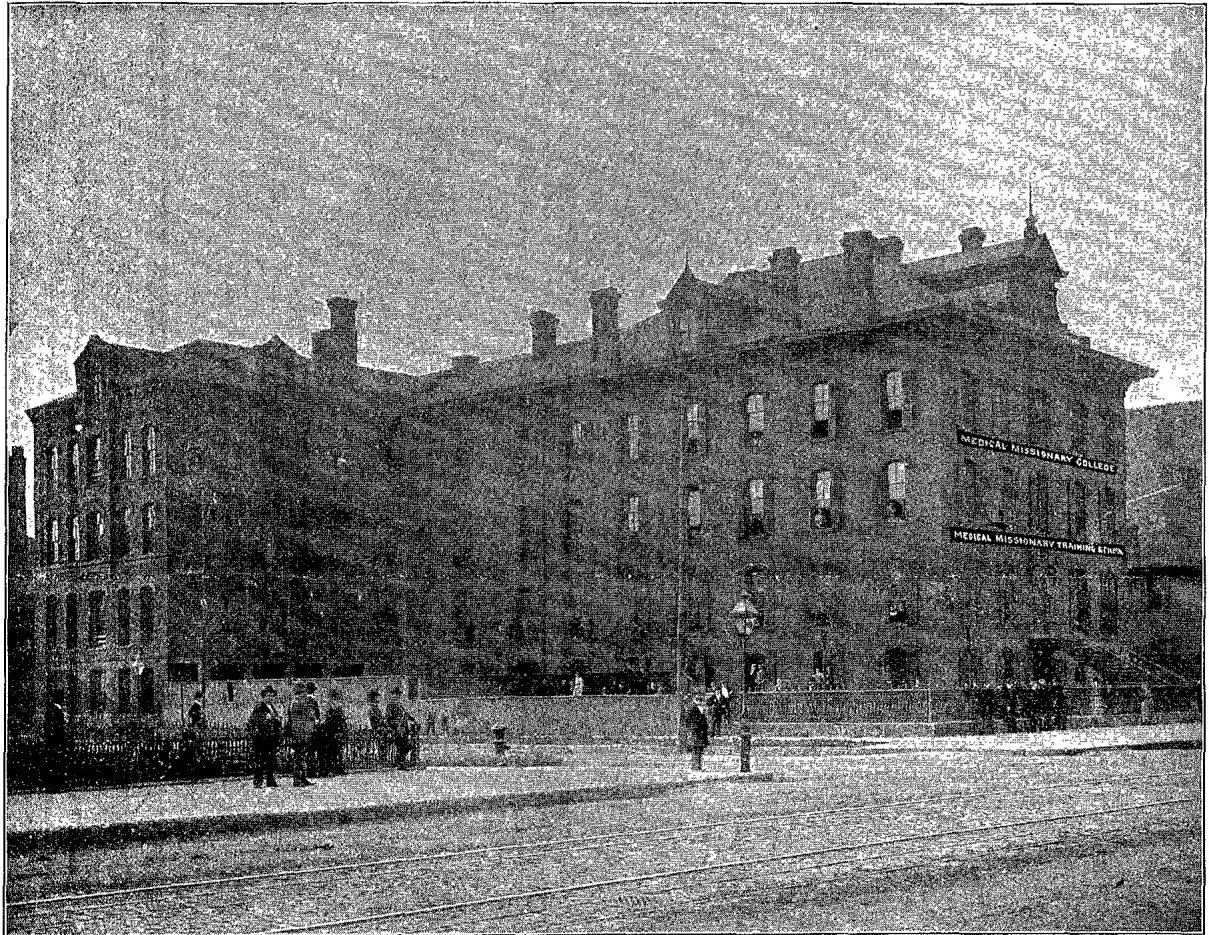
THE MEDICAL MISSIONARY TRAINING-SCHOOL.
By E. J. Hibbard
As ANNOUNCED in the REVIEW a few weeks ago, the training-school in Chicago began its winter term, December 14. About one hundred persons are in attendance. This includes the members of the senior medical class, who were already here, and the nurses who have recently come from the Sanitarium.
The Lord has greatly blessed us, both in the class work and in the work for those who know him not. There is not a drone among us; all have a mind to work. If you were to call on us about nine o’clock in the morning, as the workers are going out, you would be reminded of a beehive in the month of June. What do they find to do so early in the morning?— They go out to sell the Life Boat, and to do general missionary work in connection with it. What is the Life Boat?—It is one of the brightest twenty-page monthlies published anywhere. What is in it?—It is filled with the experiences of the different workers among the outcasts of Chicago, and also contains many testimonies from redeemed men and women. It has a field peculiar to itself, and therefore crowds no other paper. This also gives it room in which to grow. It is only nine months old, but it has a subscription list of seven thousand yearly subscribers. The last three issues have been of ten thousand each. A few of the October numbers remain; but the November and December numbers are practically gone at this writing. Last week over three hundred orders for yearly subscriptions came in. All this has been accomplished with no effort on the part of the publishers, save the sending out of one circular letter since the journal started.
CHICAGO TRAINING-SCHOOL.
Friday, December 23, while one of our poor boys was canvassing, he called at the home of a wealthy family; and on being refused admittance by the servant, succeeded in persuading her to show the Life Boat to her mistress. The lady called the brother in, bought his paper, talked with him about his work, invited him to a Christmas dinner at her house, and on that occasion presented him with a good suit of clothes.
The poor men rescued from the gutter are also canvassing for the Life Boat, and are succeeding in almost every case. This work solves, in part, the problems of how poor students can pay their way while attending the school; how our workers can find openings for cottage meetings among those who are seeking God; how the homes of the wealthy can be entered; how hope can be inspired in the breasts of the hopeless both in the gutters and in the prisons; and how many of those who are rescued can earn a living, and at the same time be doing good to their fellow men.
There is nothing like the Life Boat for the prisons. Of those in prisons who were converted through reading the November issue, five men have voluntarily written us of the fact. Talk of enthusiasm! You ought to see our workers—no, God’s workers—as they go out each morning with the Life Boat, and each afternoon and evening to the missions and cottage meetings.
While teaching the Bible classes in the College, I longed for a field where all the students could go out, every day, and give to the people what they learned in class. This is done here; and how they are growing!
“The end of all things is at hand.” We esteem it a pleasure to be permitted to co-operate with angels in carrying the gospel to those in the highways and hedges.