“Why, setting yourself up in opposition to all your friends and to old, established rules, as though you knew more than anyone else.”
Mabel could not trust herself to answer, and continued her work as though she did not hear the sarcastic words, but it was not so to be.
“Mabel, do you intend to answer me?” angrily this time and in a louder key.
Mabel raised her earnest eyes and announced quietly that she did not intend to offend anyone, but dare not offend God.
“Oh, how can you act so, Mabel? You know Mr. Brown said last Sunday that it was not the custom in this enlightened age to follow the literal word, that the Spirit was all that was needed, and all the Jewish practices were annulled under this dispensation. And you know your dear father died justified, and he never kept the Jewish Sabbath. Why do you not hear to your friends? People now are beginning to call you fanatical, and what would they say if they knew you contemplated giving up your office as postmistress? O Mabel, Mabel, do not be so foolish!” pleaded her aunt, nearly in tears.
“Auntie, do not think it is hard for me to follow the word as the Spirit enlightens me; please do not worry so about me. I must do what I think is right.”
“Yes, but why are you right and all the rest wrong on this question?”
“Because, dear aunt, there does not happen to be any one of our friends who has been led to see this truth, but surely there are more of this doctrine, and I will try to find them.”
“And will you leave old and tried friends and go to strangers for a mere whim? Are you crazy?”
“No, Aunt Mary, I am not crazy, but determined with the help of God to find a home among the people of God.”
“Mabel, Mabel, what an aggravating girl! Who are the people of God if they do not include Mr. Brown and the Christian friends of your lifetime?”
“Dear aunt, the people of God are those who love him and keep his commandments, and walk in all the light they see. The seventh day should be kept as a memorial of our God and a sign of our citizenship. As an officer of the United States, I am obliged to labor in the post office on the seventh day and close up on the first day. I am resolved to assert my loyalty to my King by showing my colors; and as I find I must give up my office or hide my colors by working on the day that God sanctified for an everlasting Sabbath, I am really driven to the choice between God and mammon. For some time this passage has been ringing in my ears: ‘What shall it profit a man, if he gain the whole world, and lose his own soul? or what shall a man give in exchange for his soul?’” and Mabel’s earnest eyes were again riveted on her aunt.
Years previous both her parents had died, and this aunt had been both father and mother to Mabel, and they dearly loved each other, although, as Mabel grew into womanhood, she developed a strength of character never possessed by her aunt, who consequently could not understand it. Mabel had been appointed assistant postmistress, and fulfilled the post so well that on the death of the postmaster she had been elected to the chief place, with the good wishes of all who knew her. An earnest Christian was Mabel Graham, and in her searchings of the Book she loved, she found to her amazement that there was no authority of the Scriptures for the sanctification of the first day of the week, that the words “Christian sabbath” were of clay, and her feet were on sand instead of resting on the Rock. Mabel prayed earnestly and sought diligently, like the noble Bereans of old, and found the pearl of great price, the truth as it is in Jesus. But she found, too, that her foes were of her own household. Her aunt strongly opposed her whims, as she called them. Why must Mabel set herself at defiance? why not worship the same as their friends and neighbors?
Loyalty to her God required Mabel to give up all her living, and, despite the tears and entreaties of her aunt, and the sneers of her friends, she sacrificed all to her principles. When she was entirely free from her postal duties, she realized as she never had before that her sole dependence was on the Lord for daily bread. Her aunt was too deeply incensed at her foolishness to assist her, and Mabel left her home and friends and sought employment in a neighboring town.169
Oh, how Mabel prayed on that journey! And the Lord heard her and prospered her accordingly; for when a child of God asks him for bread, will he receive a stone? Mabel had a school friend in that town, and on her arrival she was astonished to find that she too had come to the light on this test question, and was just entering business, in fact, had already advertised for a helper who was also a Sabbath keeper. And here was just what she needed—a companion and friend, as well as the help needed in her business.
The two friends gained the confidence and good will they so much merited. Some time afterwards Mabel’s aunt acknowledged that Mabel was correct, and to her niece’s great delight yielded her heart to observe the Lord’s day.
God rewarded Mabel richly for her loyalty, and in after life success crowned her efforts. The friends formed a partnership in the business, and conducted it on the gospel plan, by being diligent in business, serving the Lord.
Loyalty pays both in spiritual and temporal matters, as Mabel often declared. And her aunt thanked her niece for so staunchly avowing her citizenship by obeying the law of God.
Hudson, Pa.
HOW TO MAKE THE SABBATH A DELIGHT TO CHILDREN.
By Mrs. Z. A. Adams
BY MRS. Z. A. ADAMS.
I have frequently been asked the question, “How do you manage to make the Sabbath a delight to your children?” and have also been asked to give some suggestions upon this point, to which I have replied, “I scarcely know what to suggest, for, although I have four children, I have never had any occasion for perplexity on this score, for the Sabbath is, and always has been to me and my children, ‘a chief delight,’ a precious boon, its advent always hailed with a glad welcome. Day of all days the best.”
On one occasion, upon being asked this question, I replied, “When I have opportunity to do so—for I was then absent from home—I will ask my children how it is or why it is they love the Sabbath so much; then I will be better prepared to answer your question in their own words.”
Accordingly, at the first favorable opportunity, I called them into my presence and said: “Children, I have been requested to tell why it is you take such delight in the Sabbath, why you enjoy it so much. I thought you could best answer for yourselves. I wish you to give me your own reason. Why is the Sabbath such a delight to you?” After a moment’s pause, the eldest, in a reverential manner replied, “Because the especial blessing of God always comes with it in our home, our Sabbath evening devotions, our Sabbath school, our meetings, and all through our pleasant study and talks and walks heaven seems so near.” Six-year-old Delbert then said: “I know; ’cause we are doing just what the Lord did. He kept the Sabbath.” “Yes,” said eight-year-old, “that is it. And he made it so nice, and blessed it and sanctified it.” Then twelve-year-old daughter said in a quiet, solemn manner, “I cannot give the whole reason, but it is so sacred and blissful and peaceful and happy and so delightful.”
These answers, though short and containing but few words, expressed much, though perhaps they come short of satisfying the inquiry, the query being, “How shall we spend the Sabbath with our children, how amuse and entertain them, how interest and instruct in a pleasant yet profitable way?”
I may not be able to mention any new or untried plan as to how this may be done, but the various ways in which it may be done—and all to the glory and praise of Him who has given us this day of blessings—are legion.
This subject, like every lesson and circumstance in life, is two-sided; and as we all like best the pleasant side of the picture, though it be but a word picture presented in homely language, we will consider it. And as actual experience is practically profitable, while untried plans or imaginary methods could but prove valueless, we will give account of how we have observed the Sabbath with our children for nearly twelve years, during which time it has been, as before stated, a welcome visitor, hailed with delight.
We have ever endeavored to impress upon the minds of our children the thought that it was infinite love that gave us the Sabbath; that it is a special gift, given for a special purpose, with an especial blessing pronounced upon it, of which everyone is a recipient who appreciates this fact; and that, being especially blessed and sanctified holy time, an especial preparation is necessary or due on our part that we may properly and acceptably observe the day thus set apart for man, and designed for a special blessing “throughout all your generations.”
When the Lord was about to meet with the children of Israel upon Mount Sinai, he instructed Moses to see that a special preparation be made on the part of the people that they might be ready for the occasion. Ex. 19:10, 11. As it was the presence of the Lord on that occasion that made it one of sacred solemnity, so it is the presence of the Lord in the Sabbath that makes the day holy. Children readily understand these things when they are presented to them in that simplicity which characterizes the word of God throughout. Our children take the word of God as we give it to them. They take it as we make it. Oh, that parents might so talk of God’s word before their children that they would learn to appreciate its lovely simplicity, and let their children do the same! It was the simplicity of Christ’s gospel that made it so precious to the common people, the unlearned, and ignorant. It is only as children—and grown people too—grasp in simplicity the story of God’s great love that that love is responded to, and a glad, willing, happy service of love rendered to him in return. Only let us learn and teach our children that all God’s dealings toward us are in love, and that the Sabbath is a token of that love, and that as we accept and receive the Sabbath, we accept and receive Christ, who is the Author and Creator of the Sabbath and all things, then will our children joyfully engage in the necessary preparation on the sixth day—according to his word—that will meet the approbation of the Lord. In quiet and order, with songs of praise and grateful hearts, will they be ready to greet the commencement of the holy Sabbath at the going down of the sun.
Having previously set the house in order, and each member of the family refreshed themselves with a good bath, and provided with clean clothes—and this may be done in the humblest cottage or even sod house—the chairs, stools, or boxes, as the case may be, are neatly arranged, the table is drawn into the center of the circle, and upon it are placed the Bibles, hymn books, and lesson papers if desired. Let the children understand that it is their privilege to select the song for the commencement of the evening’s devotions, or, if parents suggest, let it be with care that the selection be appropriate to the childish understanding. It is well to repeat some or all of the words, and talk together of their meaning, not in a listless, but appreciative, enthusiastic manner, ever holding forth170the love of God. The devotional exercises for the evening consist of songs of praise, a family social meeting, which brings love and unity, tenderness of heart and contrition of soul, thus bringing in a spirit of prayer, and in which the children are encouraged to bear testimony and offer prayer, indeed, made to feel that much depends upon the part they act in the bringing in of the blessing of God; then the repeating of Scripture texts, a consideration of the lessons for the day, and a Bible story by way of illustration, an evening song, the “good-night” talk, and committing of ourselves to our Father. Thus ends the eve of the commencement of the delightful Sabbath.
An evening thus spent and the sweet rest in slumber, with the perfect confidence of the child that the angel of the Lord is watching over him, can but bring a quiet, happy awakening with the dawn of the Sabbath morning, attended by gratefulness and thanksgiving to God for renewed mercies, and the privileges that each Sabbath brings. Through the day we attend the Sabbath school, in the church or home, the other services, the pleasant walk or ride to and from church, we behold the Creator and Redeemer in everything around us,—the singing birds, the growing grass and trees, the fragrant flowers, the flowing stream, the grain and vegetables, the fuel and water, food and raiment, sunlight and air, and time would fail me to speak of the many, many things which we see around us, and each furnishing a text, an illustration of God’s love.
Call the attention of the children to all these things. Ask God to help you to draw from each a lesson for yourself and child. Do not fear you will exhaust these resources. This cannot be done. A lifetime of Sabbaths thus spent will not do it, but each day will bring with it new ideas, new truths, new illustrations, new developments, new views of God’s goodness and infinite love, to talk about to your children, that will fill them with the desire to love God more and more, and serve him better and still better, and be made more like him; and, joyful in the thought that he is soon coming to take us to be ever with him and be privileged to go up from one new moon to another, and from one Sabbath to another, to worship before him in the New Jerusalem (Isa. 66:22, 23), where the Sabbath will be everyone’s delight.
Hanford, Cal.
DAILY BREAD.
By Emily Tolman
BY EMILY TOLMAN.
“Give us this day our daily bread”—
What need have I to pray this prayer
Whose table every day is spread
With bounteous fare?”
“Hast thou no hunger, then?” one said.
“Is every want quite satisfied?
And for thy mind’s sustaining bread
Hast never cried?”
“Or, if thy mind has all its share,
Is there no hunger of the heart
For love, that in this daily prayer
May have a part?”
“Are body, mind, and heart all fed?
Yet surely then thy soul hast need;
‘Give us this day our daily bread,’
Thou still mayst plead.
“Whatever hungry want be thine,
Thy Father’s house hath bread to spare.
Oh, then thou canst no longer pine;
Enough is there!”
—Selected.
Spinning Our Own Web Instead of Christ's Righteousness
“By nature we are all weavers and spinners. We shut our eyes against the garment ready wrought, and, like silkworms, we shall die and perish in our web if the Spirit of God does not unravel it for us, and lead us to the righteousness of Christ.”
THE BABY'S HAMMER.
By William D. Murray
In a certain city lives a family which, until quite recently, consisted of a father and mother, and a strong, healthy boy, just two years old at the time of which I write. Ever since he has been able to use playthings, his main source of joy has been a hammer. Indeed, he usually has two or three of them among his belongings. Nothing pleases him more than to drive tacks into a board, or to mend the furniture with repeated blows.
He sleeps with his hammers. When he was photographed, he insisted upon holding one in his hand. Some time ago, while at his grandmother's house, he found a large carpenter's mallet. This was the biggest and heaviest hammer he had ever seen, and at once it became his chief treasure. It was carried about by day and taken to bed at night.
Not long ago a little sister was born into his world, and the boy was finally taken to see her. His parents wondered how he would receive the little stranger. He gazed upon her for a few minutes, while they told him who she was, and then went to the nursery and tumbled over his toys. Soon he returned, bearing his “heavy hammer,” as he calls it, and presented it to the little girl. It was his most precious possession, and he showed his love by giving it to her.
Would that we were more childlike in our love! Would that we who bear the name of Christians might show our love by being willing to give up our most precious things for Him whom we profess to love! It may be that the things we value most highly are really of as little worth as the baby's hammer, but we can use them to show that we sincerely love Him who died for us.—William D. Murray.
THE CHARITY PROBLEM.
By Prof. C. C. Lewis
BY PROF. C. C. LEWIS.
How and when to bestow charity so as to relieve real want and at the same time preserve the self-respect of the receiver; how, further, to avoid being imposed upon by undeserving persons and still guard against doing anyone injustice, and above all how to do what we do in the right spirit, without sounding a trumpet in honor of the deed, and feeling that we are in some measure more respectable because of its performance,—these are questions of long-standing perplexity. We hope merely to add our mite in contribution to their solution. And what we have to say shall be in harmony with three Scripture exhortations, as follows:—
1. “Every man shall bear his own burden.” Gal. 6:5.
2. “Bear ye one another’s burdens, and so fulfil the law of Christ.” Gal. 6:2.
3. “Cast thy burden upon the Lord, and he shall sustain thee.” Ps. 55:22.
These statements, we believe, justify the following propositions:—
1. As everyone must finally bear his own burden of sin, so he should now, as far as he is able, bear his own burden of responsibility.
2. As every man is liable to fall through temptation, and to become needy through misfortune, so he should be ready to help those who may have been overcome by temptation, or who may be needy.
3. As there are burdens too great to be borne alone, or even with the aid of others, so we should learn to cast our burden on the Lord.
And we believe that in the light of these propositions we shall not be far from the truth in making the following observations:—
A person who, to carry the burdens he has voluntarily taken upon himself in bringing into existence a family, asks for help before he has exhausted his power to bear those burdens himself, thereby injures his self-respect, which lies at the foundation of true manhood.
A man having means who sees a fellow-being exhaust his resources, and waits to be asked for aid before he proffers it, or proffers it in a surly spirit, intimating that the object of his charity lacks in management, has forgotten that he inherited his own prosperity possibly from his father and his own good management, certainly from his God.
The best way to bestow charity is to furnish work, as that preserves the manhood of the receiver.
There is no justice in the notion that property should be divided, giving to every man an equal share. They who advocate it doubtless expect to be benefited by the transaction. It is a self-evident truth that the man who toils hard for years, practicing self-denial and economy, is entitled to reap and enjoy the fruit of his labors, though, if he is a good man, he will take delight in sharing his store with those in want. Community of goods among the early Christians?—Yes, the circumstances demanded it. Many were away from their homes, and all men were against them. Coming to similar times, are we? Very well; when we do, Christians should and will do likewise. But the man who makes that prospect an excuse for sitting down in idleness to patiently wait for that blessed time, does not deserve to share in the community of goods; but we presume he will be on hand, nevertheless.
Work is the law of the universe. One of the best ways to worship God is to do something useful and honorable. Man has no more sacred duty than to toil with brain or brawn for the care of the dear ones God has given him. Up, then, fellow mortal, and find something to do, though you get but a pittance for pay. He that travels along Do-Nothing Way may expect to arrive at Have-Nothing Borough.—College View Enterprise.
Something About Madagascar.
[Condensed from the San Francisco Chronicle.]
I do not think that the people of Madagascar can be considered religious, but they certainly cling to their ancient customs with marvelous tenacity. The most ancient of these, and certainly the most interesting, is the fandroom, as they call it, or the feast of the bath. The main idea of this novel celebration is to worship the queen, and follow her example. In truth, it is a great occasion.
Every year, in November, two weeks and a half are devoted to the fandroom—the annual bath of the nation. At this time the queen bathes in public, in the presence of as many of her subjects as can crowd into the palace courtyard. She wears a loose robe and disappears behind a screen. Here the ablutions are performed amid much splashing. The screen was introduced to satisfy the missionaries. When the queen emerges from behind the screen, her complexion is at least three shades lighter than before. Then all the loyal subjects shout, and, taking it for granted that the queen has bathed, they disperse to their homes and do likewise.
After the bath the Malagasys call upon their friends, as we do on New Year’s. They also make presents, but the presents are always of meat. If you are very popular, probably seventy or eighty pounds of meat may be given you. This you are expected to eat. The Malagasys give meat to the Caucasians, and vice versa, and all the white men on the island would much prefer to receive their Malagasy friends immediately after the fandroom, as the rooms are small and the climate is hot.
The Malagasys were in former times idolatrous. Neither temples nor altars remain in the island, nor are there any traces of sun or moon worship among the natives. But the Malagasy does not care specially for religion. When the queen gave up idolatry, they gave it up also, being willing to have one true God or no god at all, as might be most profitable to them. If there is money to be made through the Christian missionaries, the natives are ready to become Christians at once. Many of them simply believe nothing at all. The Sakalavas, for instance, have no religious convictions. They are, however, naturally honest and truthful.
You can always believe them, and a Sakalava never breaks his simple promise. When he wishes to make an agreement still more binding, he kills a young heifer and broils the liver, which is divided into two parts and eaten by the parties to the contract. All sorts of incantations are pronounced over the liver, and each party expresses his hope that dire disaster may befall him if he fails to fulfill his portion of the agreement. Such a compact is never broken.171
The Hovas, on the contrary, have been converted, to all appearances, but they cannot tell the truth if they try. The Hovas take very kindly to French methods, and in agreements always leave a loophole through which they may slip out. The Hova is a natural lawyer and diplomat.
The native dances are not religious in any sense. They are merely designed to express joy, and a native never dances so well as when he has been drinking domestic rum. Everybody dances, from the governor of the province to the tiniest and blackest slave child. Frequently they sing as they dance, and in their low, rich voices, the effect is like that of a negro melody, but they have little idea of time. Peculiarly enough there is no dancing at funerals or weddings, but when a child is born in the village, all the relatives dance about the house, singing and shouting at the top of their voices.
In Madagascar everything comes down at last to an insatiable desire for wealth. The Hovas, who do not understand the seriousness of religion, will become anything if there is any money in it, and the chiefs turn the natives out of their houses and make them go to church at the rate of so much a head. The missionaries of the various Protestant sects are competitors for native favor. They actually offer a reward to the parents to send children to school. At Ancazhe I took a photograph of the little blacks who were in attendance at the missionary school. Many of their parents received money for sending them there, and some of them were fed and clothed by the missionaries in the bargain. The Methodists have the largest following in the island. The queen’s church at Antananarivo is of that denomination. It is quite a fine edifice and the queen goes regularly.
I believe that the queen is sincerely religious, in spite of an amusing incident which I happened to see. It was on my first Sunday in Antananarivo that I went to the queen’s church. The royal person and all her court ladies were there, and I watched them with interest. All at once I observed that the queen was taking snuff out of a small box. This snuff, made of tobacco and ashes, she placed between her under lip and lower teeth. In a few moments a little cuspidor, which had the appearance of a tin cup, was passed down the pew to the queen, who gravely rid herself of the snuff, and passed the cuspidor to each of the ladies in turn, who also used it. Then they settled themselves to listen to the sermon again, and I held my nose lest I should laugh aloud and be summarily ejected. The operation was repeated at intervals, and reminded me strongly of the women snuff takers among the poor whites of the South. I have seen women in the back counties of Missouri who swabbed their teeth with snuff on the end of a splintered stick, much in the same manner. The fondness of the queen for snuff explains the popularity of snuff taking among the Malagasys, for in Madagascar they all play at the game of “follow the leader,” and the queen is the leader.
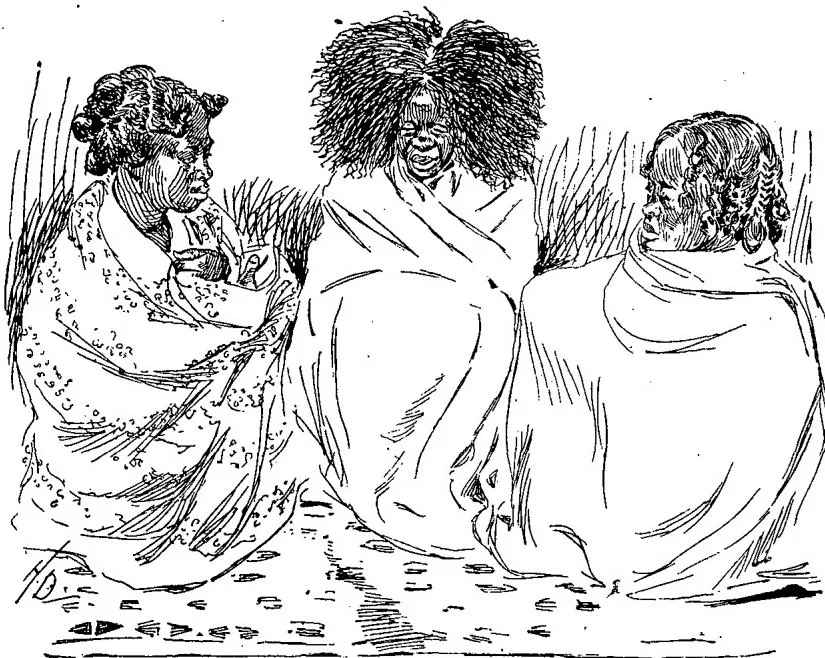
MALAGASY WOMEN.
One Sunday I entered a village and was attracted by the singing in a large bamboo church, where a native preacher was holding forth. He invited me up to the pulpit and I accepted, but was paralyzed when he followed it up, inviting me to address the natives. I declined on the ground that I could not speak Malagasy, but the preacher overruled that objection by saying that it didn’t matter, as the natives rarely understood the missionaries anyway. Finally the native continued his discourse, which had been interrupted by my entrance.
Afterwards I learned to speak Malagasy, so that I could read it and converse with my attendants. The language is not particularly difficult, but it is not acquired half as readily as French and English are by the natives, who learn to speak in these tongues with ease in a very short time. The natives pronounce the Malagasy words with great rapidity, which makes it difficult at first to understand.
The Malagasy language is singularly rich in proverbs, which the common people constantly use. Almost all of our proverbs have equivalents in their language, and their pithy sayings are indicative of the national character. For instance, the Hovas, who do not believe in honesty, have nothing to indicate that they consider honesty the best policy, which is not a moral precept anyway, but a utilitarian one. The Hovas, however, do acknowledge that “lies behind the back are like fat quail, but when they are discovered they are like lean snipe.” The Hovas also say that “business lies are like early rice,” in that they supply a present need. Another proverb is, “If I am to die, let my friend die, but if my friend is to die, let his ox die.”
To the lazy they say, “You expect the wild boar to come to you, so you don’t go into the forest.” The Malagasy proverb which is the converse of “Nothing succeeds like success,” is, “No one pets the poor calf.” One of the most common proverbs, which shows that the Malagasy appreciates the selfishness of his own nature and of human nature in general, is expressed in this way, “The clothes are dried on the rocks, but when it rains, no one cares that the rocks get wet.” This proverb, which is always on their lips, means, As long as you are useful to me, I will care for you; when you cease to be so, look out for yourself. Another sententious saying is, “Don’t show love like a flood, that comes with a rush and soon passes.”
It is hard for anyone who has never heard them to realize how frequently these proverbs are used by the natives. They make them answer a hundred different purposes and mean many different things. They are very idiomatic and lose much force in translation.
A favorite amusement with the Malagasys is to sit in a circle and propound conundrums to each other. They like to exercise their wits, and many of their riddles are difficult of solution. All of them are original. Some of them seem to an American to lack sense, but all are poetic, and show that the Malagasys observe a fancied and poetical resemblance between things which with us might pass unnoticed.
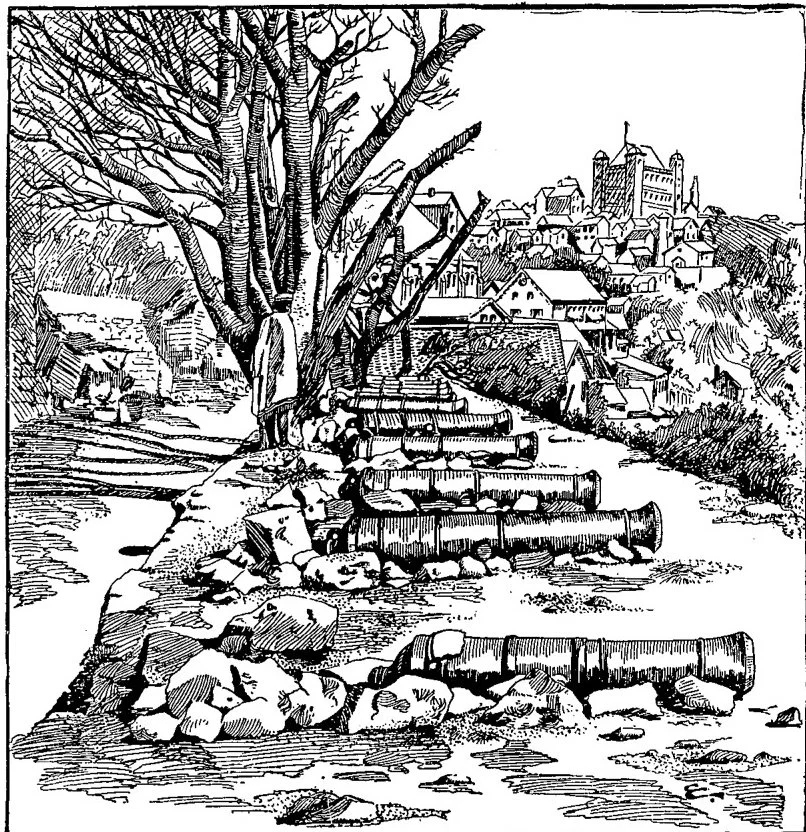
THE ROYAL BATTERY—THE QUEEN'S PALACE IN THE DISTANCE.
The Malagasys have many peculiar ideas, like those of children. One is the poetic way in which they account for the difference in color between the white and black races. They say, in their quaint speech, that the white man and the black man are both the children of God, but the white man is the eldest son; and in Madagascar the eldest son has all the privileges. Hence they expect that the white man will rule the black brother, but, they add, he must be kind to the younger brother, for his mother watches over him.
Few Malagasys will pronounce their own names. If you ask one his name, he will shake his head and tell you to ask his neighbor. Some tribes will not eat chickens, and some refuse to taste ducks. Others will not pass a certain place. Of course there are penalties attached to disobedience in these things. If a native should do one of these things forbidden by custom, and should then become sick, his illness would be attributed to this cause. If you ask a native his reasons for avoiding these things, he will shrug his shoulders and answer, “Fumba,” that is, it is the custom. The reason they reverence custom so highly is not so much on account of the superstitious dread they have of the consequences, as because of the reverence they have for their ancestors. A sufficient reason for anything is that their ancestors did it. They, of course, must have had a good reason. This almost Roman reverence for dead forefathers is strange when one remembers how very little affection a Malagasy has for his living relatives.
“RAM'S HORN” BLASTS.
A LAZY man's clock always runs too fast.
Mercy counted is trouble rubbed out.
Small fish will nibble at any kind of bait.
No vice has any more ugly face than self-conceit.
Many people think nothing can be wrong that pays well.
The back-seat professor wants a front seat at a circus.
The man who lives a lie does it with a sword over his head.
The devil is afraid of the man who can praise God in the dark.
A wise man can see more with one eye than a fool with two.
The favorite employment of a conceited man is to brag of himself.
If we keep close to Christ, we will never find any weight in his yoke.
Don't go security for the man who lets his gate swing on one hinge.
JOYS IMMORTAL.
By D. E. W.
BY D. E. W.
“Henceforth there is laid up for me a crown of righteousness, which the Lord, the righteous judge, shall give me at that day; and not to me only, but unto all them also that love his appearing.” 2 Tim. 4:8.
Joys immortal wait the faithful;
Crowns of life they soon shall wear;
Pearly portals swinging open
Welcome all who enter there.
Sweet will be their rest in heaven;
Grief and pain will all be o’er;
Joyful songs they’ll sing in Eden,
Songs triumphant, evermore.
UNSELFISH SERVICE.
By Ellen G. White
“For we preach not ourselves, but Christ Jesus the Lord; and ourselves your servants for Jesus’ sake. For God, who commanded the light to shine out of darkness, hath shined in our hearts, to give the light of the knowledge of the glory of God in the face of Jesus Christ. But we have this treasure in earthen vessels, that the excellency of the power may be of God, and not of us. We are troubled on every side, yet not distressed; we are perplexed, but not in despair; persecuted, but not forsaken; cast down, but not destroyed; always bearing about in the body the dying of the Lord Jesus, that the life also of Jesus might be made manifest in our body.”
The sufficiency of the apostle was not in himself, but in the presence and power of the Holy Spirit, whose gracious influences filled his soul, bringing every thought into subjection and obedience to Christ. His ministry was fruitful. The first great commandment is, “Thou shalt love the Lord thy God with all thy heart.” “And the second is like, namely this, Thou shalt love thy neighbor as thyself.” On these two commandments the whole interest and duty of moral beings hang. Those who do their duty to others, as they would that others should do to them, are brought into a position where God can reveal himself to them. They will be approved of him. They are made perfect in love, and their labors and prayers will not be in vain. They are continually receiving grace and truth from the Fountain Head, and as freely transmitting to others the divine light and salvation they receive. In them is fulfilled the language of the scripture, “Ye have your fruit unto holiness, and the end everlasting life.”
Selfishness is abomination in the sight of God and holy angels. Because of this sin, many fail to attain the good which they are capable of enjoying. They look with selfish eyes on their own things, and do not love and seek the interest of others as they do their own. They reverse God’s order. Instead of doing for others what they wish others to do for them, they do for themselves what they desire others to do for them, and do to others what they are most unwilling to have returned to them. Love is of God. The unconsecrated heart cannot originate or produce this plant of heavenly origin, which, in order to flourish, must be watered constantly with the dew of heaven. It can flourish only in the heart where Christ reigns. This love cannot live and flourish without action; and it cannot act without increasing in fervency, and extending and diffusing its nature to others.
God’s ministers must have the truth in their hearts, in order to successfully present it to others. They must be sanctified by the truths they preach, or they will be only stumbling blocks to sinners. Those who are called of God to minister in holy things, are called to be pure in heart and holy in life. “Be ye clean that bear the vessels of the Lord.” If God pronounces a woe upon those who are called to preach the truth and refuse to obey, a heavier woe rests upon those who take upon them this sacred work without clean hands and pure hearts. As there are woes for those who preach the truth while they are unsanctified in heart and life, so there are woes for those who receive and maintain the unsanctified in the position which they cannot fill. If the Spirit of God has not sanctified and made pure and clean the hands and heart of those who minister in sacred things, they will speak according to their own imperfect, deficient experience, and their counsels will lead astray from God those who look to them and trust to their judgment and experience.—Testimony for the Church, No. 19.