The Youth’s Instructor, Vol. 48, No. 9.

FARMING IN QUEENSLAND

The Youth’s Instructor

Mar 1, 1900

Review and Herald Publishing Company · Battle Creek, Mich. · Mar 1, 1900

FARMING IN QUEENSLAND
Any one familiar with the great farming districts of the Western States would be likely to look with some amusement upon what he would see of farming operations in Queensland while traversing the country by rail. The people have not departed very far from the primitive methods employed by most English and Old-World farmers, who till their small patches of land on a sort of one-horse principle. Nevertheless, a large amount of produce is turned out in this way. Much of the small grain is harvested before ripening, and then cut into feed, called chaff, and thus sent to market in bales. Corn is more extensively raised here than in any of the other colonies, and always brings a good price. It is now selling for one dollar a bushel. What a treat this would be to our Kansas and Nebraska farmers! Potatoes are extensively raised, and can always be seen growing in different stages of development. Fresh garden vegetables of some variety are to be procured the year round. In the later winter months of August or September, frosts may come on the higher lands.
Fruit-farming is carried on to some extent, but pests and disease often rob the orchardist of his reward. In the warmer sections, pineapples, bananas, mangoes, oranges, and lemons are extensively grown. In the Brisbane market, bananas cost from two to four cents a dozen; and in the season, good “pines” may be had for twice that price. When a banana stalk has grown one bunch, it is cut down; but from its stock spring up other shoots, so that a plant is constantly bearing, there being no special season for the fruit. After a time the plants deteriorate, and require renewing; but they bear well for a term of years, during which they continually increase in size and capacity. The same is partly true of pineapple plants. The first crop produces one pine from each plant; but the number of plants increases with each crop, until the entire ground is a solid mat of bristling plants, well-nigh impenetrable, unless it be kept within bounds by vigorous training. Brisbane is said to be the center of the finest pineapple district in the world. Perhaps none but a Brisbaneite would say it; but we had a ten-pound pineapple on our table, bought out of a common lot.
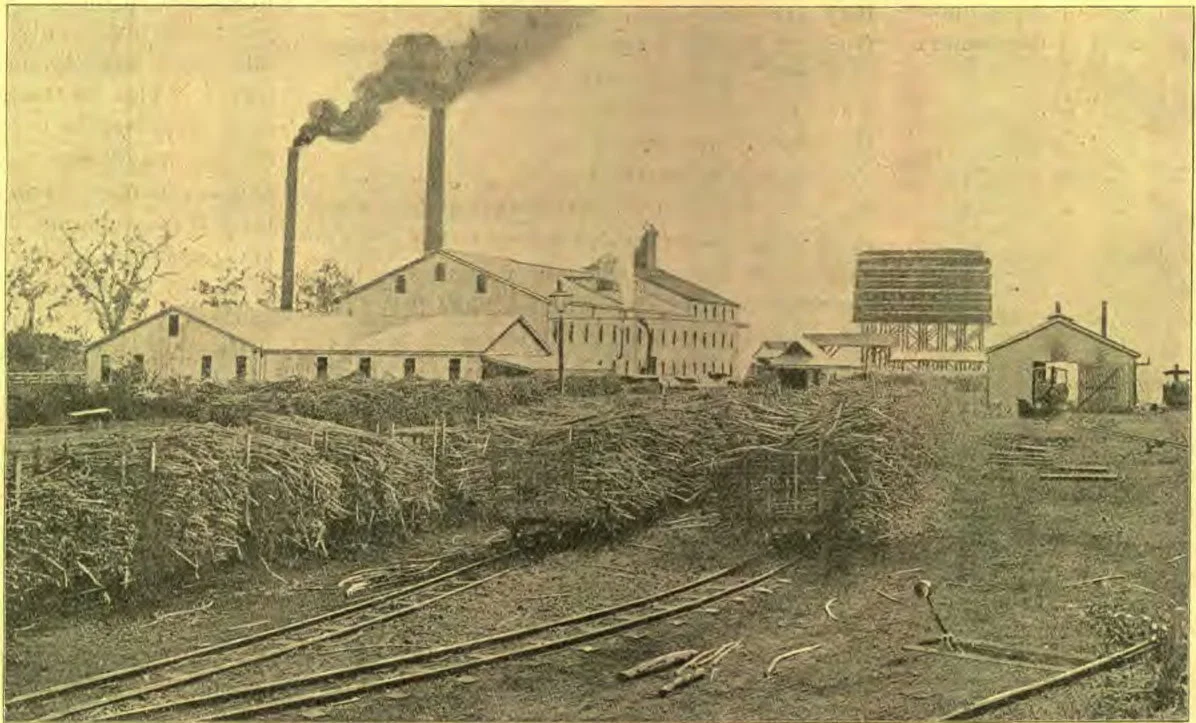
A QUEENSLAND SUGAR-MILL.
Leaving the lines of railway, and penetrating the broad interior districts, one enters a region that might be regarded as a world of its own. It is the sheep world. Here on vast ranges live hundreds of thousands of these gentle quadrupeds, tended by a set of men, who, being cut off from the outer world, by long years of association have in some instances become assimilated to the society of their quiet companions. In northern Queensland shearing begins in early spring, and extends southward with the season, until nearly the entire year is occupied, and an army of men have sheep-shearing as their sole occupation. It is said that except at shearing time, many of the sheep-tenders never see human beings. Their food is left at certain specified places; and when it is required, they visit the repository to obtain it. Wool is brought to the railways by long teams of oxen or horses. The annual wool crop of Queensland brings not less than fifteen million dollars. The amount exported last year was 84,814,139 pounds.
Another industry rapidly gaining ground along the coastal regions of Queensland is sugar-planting. For this labor, men are imported from the islands. These men are known as Kanakas, and their introduction and inhuman treatment have been the source of endless controversy. The latter feature is greatly modified by laws regulating the traffic, and controlling the treatment of the poor laborers, who, in the past, have been treated more as slaves and chattels than as human beings. The principal objection to their being employed now is on the part of white laborers, who think the work should be performed by themselves, at prices that would give white men a support.
Many branches of small farming could be profitably carried on in Queensland. Bee-keeping is one of these, though good strained honey can be had for four cents a pound. But bees work nearly or quite the entire year; and two hundredweight from one colony is not an unusual yield for a single season.
But for the lack of rain to which the country is exposed, Australia in general, and Queensland in particular, would be the garden of the world. The climate of Brisbane is, on the whole, a most desirable one. In the hot summer months the forenoons are sultry, but the evenings and mornings are delightful, or at least have been so up to the present time since our coming.
On one of the famous palaces in Delhi, India, is found this inscription: “If paradise be on earth, it is here, it is here.”
I would not quote that sentiment for Queensland. The if is so overtowering as to render the whole legend nonsensical. Paradise is not on earth. It will be: but “how unlike the present world will be the one to come.”
G. C. TENNEY.

Sunlight and Fresh Air as Health Aids

WHERE the sun does not go, there goes the doctor. All sorts of diseases, from consumption down, are mitigated or cured by sunlight and pure air. Watch for the sun; for life and health dwell in its beams. When it is shining, open every window in the house until it goes down again. Not only has the sun the power of making germs die, but it is equally endowed with the potency of making men live. Let men and women make sure that not only themselves, but also their children and their servants, have the fullest opportunities of taking in unlimited quantities of the inexpensive, life-giving sunshine.—The Hospital.

LIGHT, CAMERA OBSCURA, AND LENS

Light is defined as “radiant energy,” propagated by the wave-like motion, or vibration, of a hypothetical something called ether. Ether is indefinable, immeasurable, almost inconceivable. We simply presume that it is capable of transmitting the wave-like motions of light and heat, and that it fills universal space.
Toss a pebble into the water, and immediately there spring up many little waves, which travel, in gradually widening circles, from their starting-point. Just so with the waves of light; only instead of creeping along at a snail’s pace, they move at the rate of more than one hundred and eighty-six thousand miles a second. When light-waves strike the surface of an object, they are reflected, or “bounced back,” and thus we are able to see the object. Some surfaces absorb light instead of reflecting it; these appear black to us, simply because we can see nothing in the space that they occupy. Other surfaces reflect light-waves of one sort and absorb those of another. This gives them color.
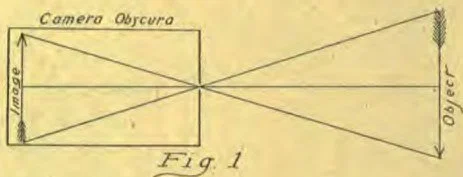
When not interfered with by some outside influence, light moves in a straight line. In the camera obscura, light is admitted at only a small aperture; consequently the rays coming from the bottom of an object move upward, while those coming from the top must move downward, to reach the interior of the camera. These rays all cross at one point, and each continues its course until intercepted, when it gives an inverted image, as illustrated in Fig. 1.
Fig. 1
Fig. 1
A simple experiment will clearly demonstrate this truth. Take an empty tin fruit can, which has had one end removed. In the middle of the other end make a hole with a tack or small shingle nail. Now black the inside of the can with boot-blacking, or anything convenient, to prevent reflections. Cover the open end with oiled paper, and the camera obscura will be complete. In order to see the image formed on the oiled paper, it will be necessary to cover your head with a dark cloth, just as the photographer covers his in focusing. Unless the object is well lighted, the image will be dim and indistinct.
Cameras, as now made, are truly marvels of convenience and compactness. But good photographs depend more upon the care and skill of the operator than upon the tools with which he works. All that is necessary to take a prize-winning picture is a light-tight box, with a small hole at one end, and a sensitive plate at the other.
Although photographs may be taken without a lens, the lens is, generally speaking, of greater importance than the camera. I advise my readers to become reasonably expert in photographing with a lens before they attempt to photograph without one.
A perfect photographic lens will condense every light-wave that reaches it from an object, and of them form an image of the object, which is its exact counterpart, except in size. An absolutely perfect lens has never been made, but some come sufficiently near perfection for all practical purposes.
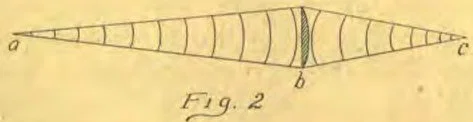
The action of a lens in forming an image is quite simple, and it should be understood by all who expect to use one intelligently. Figure 2 illustrates the manner in which a simple form of lens affects light-waves. A is a point on some object, from which the light-waves are reflected. B is a plano-convex lens. C is the point where the light-wave is condensed to form the image.
As the wave leaves a, it grows larger, but only that part of it is shown that will ultimately reach the lens. The middle of the wave strikes the flat surface of b first. As it moves through glass much more slowly than through air, the ends of the wave “catch up,” and it becomes more nearly straight. The back of the lens being curved, the ends of the wave emerge first, and run ahead of the middle, so that when it finally does get free from the glass, it is curved in the opposite direction. Before it can regain its former curve, it must come to a point, which it does at c. The image is made up of countless numbers of waves of light, reflected from every point of the surface of the object, and condensed to a corresponding point in the image.
Fig. 2
Fig. 2
The light-waves do not affect one another, no matter how often their paths cross. But if they are intercepted at any point, either in front or behind c, they will remain crossed, and the resultant image will be indistinct. The farther from c the image is intercepted, the less distinct it will be.
Now if a is moved farther away, the waves of light will be much flatter when they reach b, as they will be arcs of a larger circle. The nearer flat they are when they reach the lens, the more curved they will be when they leave it, and the sooner they will come to a point. The farther a is from b, the nearer c will be, until a has been removed so far that the light-waves are practically flat when they reach the lens. After this point has been reached, c remains stationary, no matter how far a is removed. When a has reached this point, the distance between b and c is the focal length, or equivalent focus, of the lens.
The focal length of a lens is proportionate to the curvature of its surface. It will be seen, by referring again to the drawing, that if the lens was thicker in the middle, the light-wave would be still more curved when it had passed through. It would, consequently, come to a point sooner.
If any of my readers have found this article rather dry and hard to understand, I advise them to study it carefully, until they do understand it. Photography has been made a pastime by many; but if I did not believe that at least some of the INSTRUCTOR family would make it a study, I would not write another word.
J. EDGAR ROSS.

JUSTIFICATION BY FAITH

I

FAITH in Christ is the only condition upon which justification can be received; and the gift is bestowed only upon those who realize that they are sinners, and undeserving of mercy. The merits of the blood of Christ must be presented to the Father as the offering for the sins of men. When sinners seek God, and in repentance confess their sin, he pardons their transgressions, remits their punishment, and receives them into fellowship with himself, as if they had never transgressed. He imparts to them the righteousness of Christ.
The faith that accepts Christ as One who is able to save to the uttermost all who come unto God by him, means perfect belief and trust. To be intelligently convinced is not enough. The apostle James writes: “Thou believest that there is one God; thou doest well: the devils also believe, and tremble.” Many there are who believe that Christ has died for the sins of the world, but they make no appropriation of this grand truth to their own souls. Their hearts are not enlisted in the service of God, their lives are not reformed. They are not sanctified by the truth they profess to believe. Not having the faith that works by love and purifies the soul, no genuine good appears in their lives. “Was not Abraham our father justified by works, when he had offered Isaac his son upon the altar?” asks the apostle. “Seest thou how faith wrought with his works, and by works was faith made perfect? And the scripture was fulfilled which saith, Abraham believed God, and it was imputed unto him for righteousness: and he was called the Friend of God.”
The offering of Isaac was designed by God to prefigure the sacrifice of his Son. Isaac was a figure of the Son of God, who was offered a sacrifice for the sins of the world. God desired to impress upon Abraham the gospel of salvation to men; and in order to make the truth a reality, and to test his faith, he required Abraham to slay his darling Isaac. All the agony that Abraham endured during that dark and fearful trial was for the purpose of deeply impressing upon his understanding the plan of redemption for fallen man. He was made to understand in his own experience how great was the self-denial of the infinite God in giving his Son to rescue man from ruin.
To Abraham no mental torture could be equal to that which he endured in obeying the command to sacrifice his son. But he girds up his soul with firmness, ready for the work that God requires him to do. With a breaking heart and unnerved hand, he takes the fire, while Isaac inquires, “Behold the fire and the wood: but where is the lamb for the burnt-offering?” But oh, Abraham can not tell him now! Father and son build the altar, and the terrible moment comes for Abraham to make known to Isaac that which has agonized his soul during all that long journey,—that Isaac himself is the victim.
Isaac is not a lad; he is a full-grown young man. He could refuse to submit to his father's design, should he choose to do so; but he does not even seek to change his purpose. He submits. He believes in the love of his father, and that he would not make this terrible sacrifice if God had not bidden him do so. Isaac is bound by the trembling, loving hands of his pitying father, because God has said it. The son submits to the sacrifice because he believes in the integrity of his father. But when everything is ready, when the faith of the father and the submission of the son are fully tested, the angel of God stays the uplifted hand of Abraham, and tells him that it is enough. “Now I know that thou fearest God, seeing that thou hast not withheld thy son, thine only son from me.”
MRS. E. G. WHITE.

Learn to Laugh: Advice for Cheerful Living

Learn to laugh. A hearty laugh is better than medicine.
Learn how to tell a story. A well-told story is as welcome as a sunbeam in a sick-room.
Learn how to keep your own troubles to yourself. The world is too busy to care for your ills and sorrows.
Learn to hide your aches and pains under a pleasant smile. No one cares whether you have the earache, headache, or rheumatism.—Selected.

BE GLAD

Be glad when the flowers have faded? Be glad when the trees are bare? When the fog lies thick on the fields and moors, And the frost is in the air? When all around is a desert, And the clouds obscure the light? When there are no songs for the darkest day, No stars for the longest night?
Be glad when the heart is failing, And the brain is losing power, And the cunning skill of the strong right hand Wearies in one short hour? We are glad in the merry morning, And glad at the noon again; But the wintry night is a tired time— Do we look for gladness then?
Ah, yes! for the truest gladness Is not in ease and mirth: It has its home in the heart of God, Not in the loves of earth. God's love is the same forever, If the skies are bright or dim; And the joy of the morning lasts all day When the heart is glad in him.
—Marianne Farningham.

OBJECT IN SCRIPTURE STUDY

If everything that Jesus said and did while here on earth, was written, the world itself, says John, “could not contain the books;” “but these are written that ye might have life.” In 1 John 5:11 we read that eternal life is in Jesus Christ; and again, that “this is life eternal, that they might know thee the only true God, and Jesus Christ, whom thou hast sent.”
The object, then, for which the stories and incidents in the life of Jesus were written, was that we might know Jesus; hence it follows that something of Jesus is to be learned in every bit of his life that is recorded in the Scripture story. Of Jesus it is said that he came to declare the Father; and he himself said, “He that hath seen me hath seen the Father:” therefore in knowing Jesus, we also know the Father.
If we truly appreciate the real object of Scripture study, we shall keep our spiritual eyesight bright with prayer and faith, that we may be able to distinguish Jesus in everything that is recorded of him in the Word. Shall we not look upon the wording of these incidents as the frame holding a beautiful picture, or as the setting to a precious gem? and should we not be careful lest we so study and admire the frame, or setting, that we do not appreciate the beauty of the picture or the value of the gem?
If, then, each incident in the Scripture story contains a precious gem of truth, and the object of study is to know Jesus, who is the Truth, we are to deal with each particular only so far as it will help us know the Jesus found therein. I have read somewhere of an artist who, from the chippings of stone discarded and trodden underfoot by his master, with skillful cutting and setting, inspired by artistic genius, formed a mosaic excelling that of the master himself. To find the precious gem of truth in each bit of inspired story, and to give it its proper place, must certainly be the object of all study; and each incident, if studied with this end in view, becomes a part of Jesus, who is the all in all of the Scriptures. W. D. LARKIN.

OUTDOOR SKETCHING

In drawing outdoors from nature, there are some difficulties that one does not meet in drawing from still-life groups, or in drawing indoors. The light changes; the shadows remain in one place hardly long enough for the beginner to draw them; there is the constant swaying of trees and vines in the wind, and the fluttering of one’s paper: yet in spite of all these difficulties the student will realize that the most crude efforts bring with them a deeper delight than a finished study of still-life or any indoor work.
It will be best in the beginning for the student to take only the most simple subjects, such as a group of trees, or several old buildings, or a road. If these are too difficult, a single tree, a vine, or the corner of some building will do, until he becomes familiar with the work.
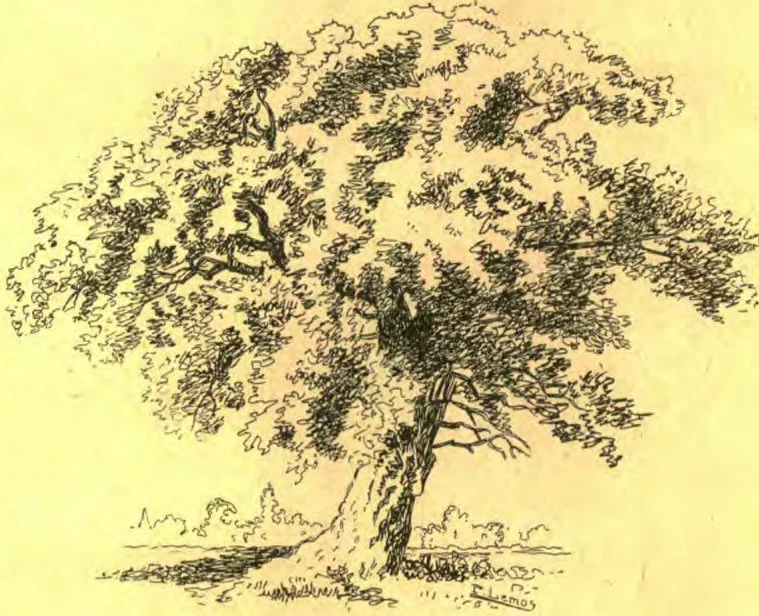
Many hours must be spent in the study of trees alone, to insure a good drawing of them. The individuality of trees is as strong as that of persons. The different species differ in form, color, and foliage; while no two, even of the same species, have just the same manner of growth. These all need careful study.
One of the most important matters in drawing is to know how to place upon paper the subject one is about to draw. The interesting scene may become flat and unattractive if drawn on a scale too large for the sheet of paper, or if drawn too high, too low, or so close to the edge of the paper as to leave no margin for possible needful additions. All sketches or drawings should be placed so as to leave an ample margin on all sides. If, after the drawing is made, there proves to be too great an expanse of paper, it can be easily cut down to a suitable size; while the opposite difficulty — the addition of an inch or two to the margin — can not be so easily remedied.
Having decided on your subject, sit so that you can see it from the best point of view. This point being once chosen, keep to it. Many an otherwise good picture has been spoiled from the inability of the artist to draw his choice of subject, and that alone. The temptation is strong to add, to this side and that, points which in themselves are interesting, but which, if added, will detract from the general interest of the picture. No more should be put in the drawing than is essential to complete the idea to be expressed. Parts that are not necessary to complete the idea should be omitted or suppressed. To suppress these parts, we should make them lighter, or in outline, so that the main idea shall be seen first; then the suppressed, or secondary, parts will be seen without interfering with the main idea.
Make your drawing at the time when the shadows are most interesting,—a point that can be determined only by previous observation. Shadows are strongest in the afternoon, so that for some the afternoon is the most desirable part of the day in which to sketch.
Having placed your drawing, and sketched in the main forms, it will be best to outline all the shadows carefully; and no matter how much they change afterward, keep your drawing of such shadows within the limit of the penciled indications. This will prevent a mistake frequently made in outdoor work; namely, the different shadows in one picture appearing as if cast at different times in the day.
All the houses, sheds, roads, and windows that enter into outdoor sketching must conform to the principles of perspective with which we first started. Houses are only big blocks, so to speak, and all their vanishing lines retreat in accordance with the principles that govern the elementary forms. Use such knowledge with judgment, however, lest your drawing become too architectural and stiff.
PEDRO LEMOS.

HOW TO HELP

To have willing feet, A smile that is sweet, A kind, pleasant word For all that you meet,— That's what it is to be helpful. In a mild, gentle way, To help through the day, To make some one happy In work or in play,— That's what it is to be helpful. — Union Signal.

THE TRUE KING OF BEASTS

M. Foa has a great admiration for the elephant, of which he says: “The elephant has only one enemy—man. It fears none of the animals. In addition to the intelligence relatively superior to theirs, it possesses strength, size, courage, and, moreover, a sense of touch more delicate than that of any of them, even the monkey. It travels everywhere, swims like an amphibian, and crosses ravines and rivers, forests and thickets, without distinction. Everything gives way before it. It climbs and descends hills that one would think inaccessible to it; it crosses whole countries in a night, like an undisputed master in his vast domains; it is here, there, everywhere, hiding like a mouse, despite its great size, and noiselessly disappearing like an unseizable Proteus, much to the discomfort of the hunter; finally, if its life is spared, it is ready to become once more, as in former times when it fought by his side, the ally, the friend, the servant, and the protector of man. The elephant is the true king of animals. Compare this noble animal with the useless lion, the nocturnal prowler at the mercy of a pack of wolves.”

BEREAN LIBRARY STUDY

Dan. 10:1-21; “Thoughts on Daniel,” pages 213-221
THE regular Outline of these studies is published in the Review and Herald and also in the Missionary Magazine. What is here given is only supplementary, and should be studied in connection with the Outline.

NOTES ON LESSON 14

(March 4-10)
1. Hired Counselors.—Two years before the events of this lesson occurred, the decree of Cyrus had been issued, which provided for the return of the Jews to Jerusalem and the restoration of the temple. As before stated, this work began, but it was successfully opposed by the Samaritans,—the mixed races of Samaria, who were then spread over into desolate Judea. An interesting account of their doings is recorded in Ezra 4:1-24. The efforts against the Jews were systematic and determined, so that “weakened the hands of the people of Judah, and troubled them in building, and hired counselors against them, to frustrate their purpose, all the days of Cyrus king of Persia.” Daniel must have had an intimate knowledge of all this; for he was still prime minister at the court of Cyrus. Doubtless he became greatly concerned for the success of the work of God, but instead of scheming against those ancient lobbyists, he simply appealed to God, with the result recorded in our lesson.
2. An Ancient Custom.—Reference is made to the general habit among the Hebrews and other Oriental nations of anointing the hair, head, and beard with oil or specially prepared ointments. The omission of this was an outward sign of fasting and mourning. The real intent of this ancient custom had become so perverted in the days of Christ that he gave the instruction in Matt. 6:16-18.
3. A Sentence from the Spirit of Prophecy.—In the study of this lesson it will be noted that the description of the one who appeared to Daniel in vision (Dan. 10:5-7) is strikingly similar to the description of Christ in Rev. 1:14-16, and that the effect of his presence is about such as was experienced by Paul and his companions when the Lord appeared to them as they were going to Damascus. In “Great Controversy,” Vol. IV, page 470, after a comment on Daniel’s prayer, the following statement is made: “And when at a later time the Son of God appeared, to give him instruction, he declares, ‘My comeliness was turned in me into corruption, and I retained no strength.’” From this we learn that it was the Son of God who appeared to Daniel in the vision. The prophet was so overcome that he fainted, or “was in a deep sleep,” lying with his face toward the ground. He was aroused by the touch of a hand, which seems to have been, not the hand of the One whom he had seen in vision, but the hand of the angel Gabriel, who proceeded to instruct Daniel still further in that which he did not understand.
4. Titles of Christ.—In this lesson Christ is referred to by the name Michael, which means “like unto God.” The significance of the different names by which he is called is an interesting study. Christ, or Messiah, means “anointed.” Jesus, meaning “Saviour,” was the common name used by the writers of the Gospels, although Christ refers to himself eighty-one times as the “Son of man.” The sacrifices of the Jewish dispensation make the name Lamb of God, used by John the Baptist, a peculiarly appropriate one. The word Redeemer indicates the “paying of a price.” False teachers are called “wandering stars,” in Jude 13; and in contrast Christ is called “the bright and morning Star.” Rev. 22:16.
5. Greatly Beloved.—Twice is the message given to Daniel, “Thou art greatly beloved.” Is it not a beautiful thought that unswerving loyalty to God inspires in heaven a love for an individual person that is different or greater than the love that has been made manifest for the human race? “Thou art greatly beloved”! Who does not long with his whole heart thus to be beloved by heavenly intelligences?
6. “Whom Jesus Loved.”—The words “greatly beloved” will doubtless call to mind that other expression of special regard that is used four times in reference to John, the disciple of Christ. What could betoken a more mutual, loving, sympathetic companionship than the simple declaration given us in John 13:23? “Now there was leaning on Jesus’ bosom one of his disciples, whom Jesus loved.” John is again singled out, in the dying moments of Jesus, as one specially loved. See John 19:26. Lazarus and his sisters seem also to have been very dear to the Saviour. When Lazarus was sick, the sisters sent the message, “He whom thou lovest is sick.”
7. Most Wonderful of All.—It is a wonderful thing to be so loved that the life of the only begotten Son of God should be given that one might be saved. But when that lost one accepts the sacrifice, and pours out his heart’s love in trusting obedience to the One who is his salvation, then it is that the divine love is realized in all its blessedness. Then it is that the heart’s longings are more than satisfied. Then it is that poor humanity is endeared to the heart of divinity, as was Daniel, as was John, as were Lazarus, Mary, and Martha. And the richness of that mutual love, the blessedness of that communion, the overwhelming power of that responsive love, are the most wonderful of all.

MARCH STUDY OF THE FIELD

Part I: “In the Land of Mexico”
(March 4-10)
1. Basis of Study.— Part I of the study for March will be based on the article in the Missionary Magazine of that month, entitled, “In the Land of Mexico.”
2. Explorations in Mexico.— Before the introduction of railroads in Mexico, exploration was difficult and dangerous, and was rarely attempted. There were no roads and no inns; barren and waterless tracts had to be crossed; the people were inhospitable, and life and property were not safe. A large portion of the country has not been penetrated, especially on the Pacific Coast and in the southern part. There are some tribes that have never been brought in contact with the white man.
3. Mexican Foods.— Tortillas and frijoles are national foods, and are used by rich and poor alike. The tortilla is prepared in the following manner: Corn is placed in a jar of hot lime-water to soak overnight, the lime being used to soften the corn. When desired for use, the corn is ground on a stone roller into a paste, and is then slightly dried, or baked, on an earthen tray, or pan, over a small fire. Frijoles are boiled black beans. Among the poorer classes the tortilla serves as bread. It is rolled together like a spoon, and used to scoop up the frijoles, all being eaten together. Both green and red peppers are eaten with every meal, and are regarded as almost indispensable. Meat is rarely used by the laborers; but when it can be obtained, every part of the animal is eaten. Lard is largely used, even in sweetmeats. Coffee and chocolate are the principal beverages.
4. The Maguey, or Metl.— This plant is largely cultivated throughout the temperate regions. It requires from ten to seventy years to mature, according to the climate. It is used in many ways. Pulque, an intoxicating drink, is made from the sap. Other intoxicating drinks are also made from it. Strong thread and tough paper are made from the leaves. Sandals are also made of the plaited fibers of this plant. Another name for the maguey is the century plant.
5. Mexican Towns.— The towns are generally situated on the upland plains. The streets are broad and straight. The houses are large, built of sun-dried bricks, in the form of a quadrangle, with a court. They are one story high, with flat roofs. The cathedral is usually in the form of a dome, richly ornamented. The central square and the public pleasure-grounds are usually laid out with great taste, and are made beautiful with trees, shrubs, and fountains. Most of them also have shady promenades.
6. Vera Cruz.— This is the most important seaport on the Atlantic coast of Mexico. It is a very unhealthy town. Malaria is prevalent, though not fatal to the natives. Yellow fever rages for eight months of the year. It is fatal to foreigners, and does not spare the Mexicans. Sanitary conditions are bad. Vera Cruz was formerly a flourishing town, but is now decaying. The ruins of many palaces are seen, and are the homes of carrion-kites. These birds may be seen hopping about in search of food, or perched on the roofs of the houses. There are no trees, shrubs, nor springs. The cisterns contain muddy, warmish water. The people either have to drink this or go to the taverns for liquor. These places are frequented by half-drunken, brawling men.
7. Popocatapetl.— This is an Aztec name, meaning “smoking mountain.” The volcano is 17,784 feet high. The crater is at the summit, is from one thousand to sixteen hundred feet deep, and measures about two thousand feet across. Its walls are almost perpendicular. About three hundred years ago the volcano was active, but since then there have been only two or three moderate eruptions. The mountain still smokes, is constantly emitting gases, and sometimes throws up cinders and stones. Pine forests encircle it to the height of about twelve thousand feet. About two thousand feet higher the snow-line begins. Between these two altitudes, grains of sulphur are found in the loose sand.

Character Revealed in How We Portray Others

NEVER does a man portray his own character more vividly than in his manner of portraying another.—Richter.

OUR DAILY KEY

Just to be tender, just to be true; Just to be glad the whole day through; Just to be merciful, just to be mild; Just to be trustful as a child; Just to be gentle and kind and sweet; Just to be helpful, with willing feet; Just to be cheery when things go wrong; Just to drive sadness away with a song; Whether the hour be dark or bright, Just to be loyal to God and right; Just to believe that God knows best, Just in his promises ever to rest; Just to let love be our daily key,— This is God’s will for you and for me. —Emma C. Dowd.
Continue reading: A SPOILED VISIT