Early one beautiful morning last fall I had a long-wished-for opportunity to visit a lonely sister in the country. The ride was a pleasant one, and the dear sister and her children gave me a cordial welcome. Margaret, the eldest, is about ten years old, and is an unusually bright, active little girl. Six-year-old Jamie is quiet and grave, while little May is a living picture of good health and good nature.
After a reasonable time had passed in first greetings and general conversation, the mother said, gently, “Margaret, this is an opportunity for which we have sometimes prayed. Now if you will finish up the kitchen work, we will all give the afternoon to Sister Wilson’s company.”
“O mama!” exclaimed the child, impetuously, “why not let the work go? I want to hear every word Sister Wilson has to say.”
There was a reproachful look in the mother’s eyes, but nothing more was said; and Margaret brought a comb, and sat down for her mother to rearrange her long braids, all the time chatting gaily concerning things that seemed important to her. Finally her mother said, “Daughter, won’t you keep quiet until Sister Wilson tells us about the late meeting she attended?”
I began the recital, and by and by the mother remarked, “I wish Sister King was here today. She called last Tuesday, and spoke of how glad she would be to hear about that meeting.”
“No, mama!” broke in Margaret, “it was Monday—don’t you remember?”
“I thought it was Tuesday,” said the mother, but Margaret reiterated, “No, it was Monday. Little May fell down the back steps—don’t you know?”
“No, dear, only one made from another garment,” I replied.
“It looks as nice as new,” she continued, examining it critically. “The trimming is new, anyway, isn’t it?” Another ten minutes of precious time passed in discussing the merits and demerits of my wrap.
“Elder Gains called on us the 23d,” I said, as soon as the cape question was settled; “and—”
“Oh, it was the 22d, Mrs. Wilson; I am sure it was,” came from Margaret, and the mother exclaimed, “Margaret! Margaret!” with an expression of real pain in look and voice.
“But it was the 22d,” persisted the child, “don’t you remember that Mary Jones came out from town to see me the 23d, and it was Jamie’s birthday?”
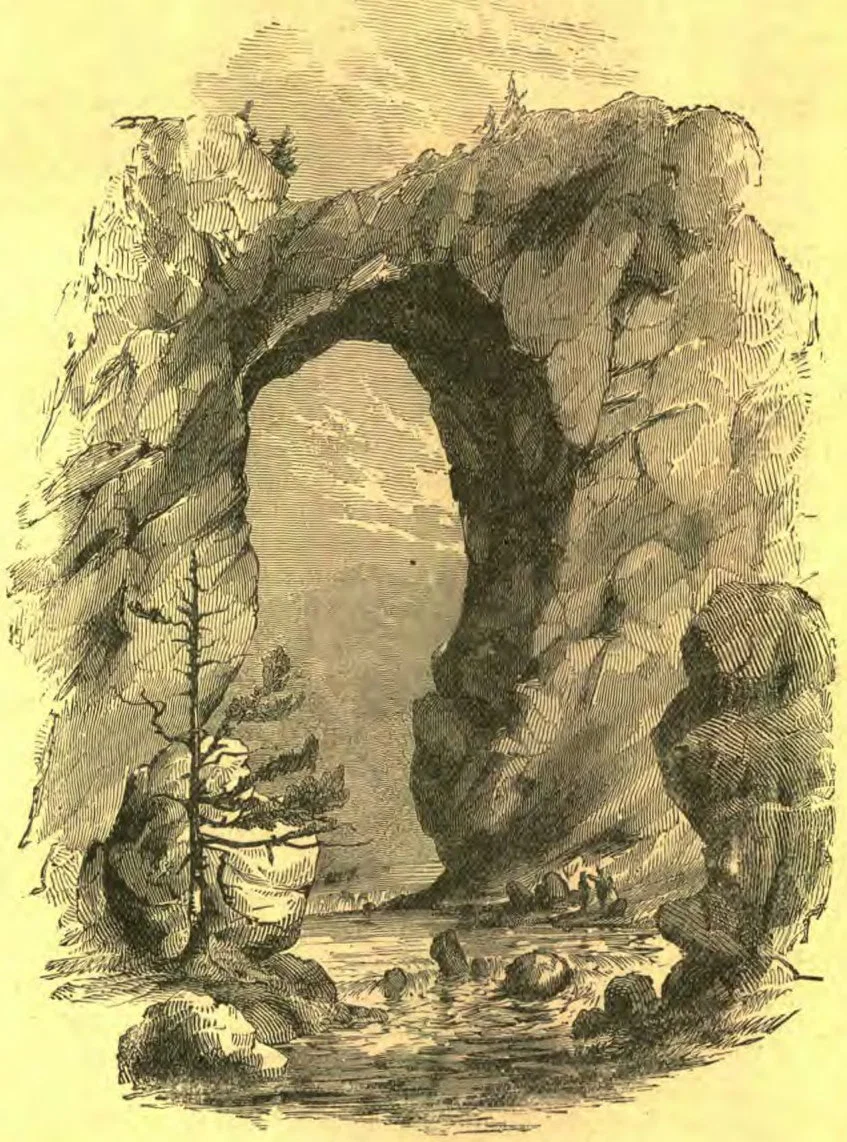
THE NATURAL BRIDGE OF VIRGINIA.
Fearing another loss of time, I said, “It is immaterial as to the day; it is rather the importance of the message he brought us of which I desire to speak. His visit was short; he came on the evening train, and our meeting was a kind of ‘call meeting’—”
“Oh, he came on an afternoon train, Mrs. Wilson!” said Margaret, decidedly; “Mary Jones said on the four-o’clock. She said—”
“My dear,” interposed the mother, “there are some things I have wished to talk over privately with Sister Wilson. Put baby in her carriage, and take her down the lane for her afternoon ride.”
“Yes, Maggie,” piped in Jamie, who had been devoting himself to his playthings in the corner.
“Go, dear,” said the mother, as Margaret hesitated. “Jamie needs the walk, and baby needs the ride. The fresh air for a few minutes will do you all good.”
“Oh, let us miss it this one afternoon, mama! Sister Wilson hardly ever comes, and I want to hear every word she has to say,” and the child seated herself as if to listen intently.
Glancing down the road, I saw my neighbor coming; there was only time for a few parting words with the mother, while Margaret exclaimed many times, in tones of real regret, “What made him come so soon? You mustn’t go! Can’t you stay all night? We wanted to hear about the meeting and Brother Gains’s visit; and mama has been wanting to have a long talk with you, too.”
“Too late,” I said, as I tenderly kissed the dear child, who has so many things to learn.
“Pray for my dear children,” said the mother, tears in her eyes; “pray that I may have wisdom and patience. My daughter is so helpful when we are alone. I do not see how I could manage all my work without her, and I know she loves the truth of God; but she has some grievous faults.”
With a fervent clasp of her hand, I said good by, and rode home, thinking of the visit I had looked forward to so long; of the many things I had hoped to say; of the sister’s desire to unburden her heart, hoping for Christian counsel, love, and sympathy—all spoiled by a thoughtless child’s selfishness. At first it seemed as if the afternoon had been wasted; then the thought came that if I would tell the INSTRUCTOR family about my spoiled visit, it might help some little Margaret to be more thoughtful under similar circumstances.
AUNT RUTH.
THE NATURAL BRIDGE OF VIRGINIA
AMONG the remarkable natural curiosities of the United States, the Natural Bridge of Virginia occupies a prominent position. Its peculiar and picturesque formation has gained for it the admiration of thousands of tourists, and the attention of geologists the world over, by many of whom it is supposed that the bridge and chasm are remnants of what was once an immense cavern. However this may be, the present scene is one of almost indescribable charm and beauty.
The bridge is situated in the county appropriately named Rockbridge, and is formed of a limestone stratum fashioning an arch two hundred and fifteen feet high. Its length is ninety-three feet, and the thickness of the crown of the arch is about forty feet, while the average width of the arch is eighty feet. From the public road there may be had an ample and enchanting view both of the solemn chasm below, through which a little stream dreams its way along, and the distant Blue Ridge Mountains. The bareness of the rocky walls and road is relieved by the great forest trees, which wreathe themselves in vivid green foliage from the floor of the chasm far up the rocky height, and protect both sides of the road with steadfast guardianship.—Baptist Union.
AN ISLAND FAR AWAY
By Ada D. Wellman
Often I have wished that some of the children in America could be with me for a little while on one of these islands of the Pacific Ocean. I would not wish that you should stay long; for I know you would be lonely so far from home, among these half-wild people, whose language you could not understand.70You would find the climate very warm; and you would not like the foods we have to eat here, and would miss many things that you have in America.
Sometimes I think of how we would spend the time if you were here just for one day. Were you as seasick on the way as I always am when at sea, you might not be strong enough to walk about much for a few days; but as children generally do not become as seasick as older persons, we will suppose you would be able to go sight-seeing with me as soon as you arrived. You might be landsick on leaving the ship; and if so, you would stagger about so much that the island people might think you were drunk.
There are but few horses on any of these islands, so we must either walk or else hire strong natives to carry us. This island, like many others of the Pacific, is mostly mountains, with only a narrow strip of level land along the shore. You will find no wild animals here larger than rats, and no snakes; but there are scorpions, centipedes, and many troublesome insects. There are many sea birds, and tall, wading birds, and, on some of the islands, wild parrots, but no singing birds. When once I told some of the children about our American song-birds, one girl asked whether the birds sing English, the same as I do. Then I had to explain that bird-music is more like whistling than like our singing.
As we walk along the shore, we see many of the dark-skinned people crouching in the doorways of their huts, or lying on the ground, or strolling along the beach. They wear but little clothing, usually merely a strip wrapped about the hips. This one garment may be of cloth shipped from America or Europe, or it may be made of bark, or woven of grass or leaves. Some have other garments, which they have bought from white traders. These people never wore hats till they learned that custom of white people, and many of them still wear none.
By the wayside are women washing clothes in a small stream, which flows down from the mountains to the sea. They crouch in the water, wet the clothing, and lay it on smooth stones, then pound it with a stick. Those who own flatirons sit on the floor of their huts to iron, and spread their garments before them on the floor.
If we pass a hut when the people are eating, they are sure to call to us to come and eat; or if they are cooking food, they may ask us to stop and wait till it is done. That is their idea of politeness. Some of their manners would not seem very polite to you. Visitors, when about to go away, say to those on whom they have been calling, “You stay here.” Then the one at whose house they are, says, “You go away.” These people would think us very rude if, when they are ready to leave our house after calling upon us, we should fail to tell them to go.
When your grandparents were of your age, they would not have found a visit to this island as pleasant as you would now find it; for then the islanders were savage pagans. But missionaries came here, even though it was not a pleasant place, and through their efforts the people have become greatly changed. Still, there is much to be done for the natives of all these islands, and there is need of many more missionaries to teach the islanders how to live.
— Mrs. Ada D. Wellman.
HOW TO CLASSIFY WHAT IS STUDIED
By David Paulson, M. D.
In order to receive strength and nourishment from the food you eat, it is not necessary that you remember every detail concerning its purchase and preparation. Likewise the exact source of every statement or quotation that you meet in your reading from day to day need not be carried in your mind, in order for you to secure mental discipline and power from what you read. Nevertheless it is certainly convenient, and sometimes almost absolutely necessary, to possess just such knowledge. None but a giant mind could be expected to do this, without some artificial aid; so it is essential to adopt some plan of systematically classifying the choicest and best portions of what you read. Who has not spent hours in trying to find some statement that he felt sure he had read in a certain book, only to find at last that he had read it in some other book?
I will briefly outline a plan that has proved of great value to me. No doubt there are other systems which, in the hands of others, may be of greater value to them, and perhaps they will feel disposed to give the readers of the YOUTH'S INSTRUCTOR the benefit of their experience. I have one plan for preserving what I read in books, which may be referred to at any time, also bound volumes of magazines, journals, etc. By another plan I keep extracts from floating literature, such as newspapers, etc.
Years ago I discovered that the ordinary scrap-book is a delusion and a snare. It soon becomes bulky and unwieldy if its owner does the right thing by it, and so is of no use when traveling. Therefore I have adopted the plan of securing a number of cheap envelopes, about twelve by nine inches in size, and setting aside one envelope for each general subject on which I am saving material, having a definite place for it on my shelves. When the envelope becomes conveniently full, I simply get another, and put it on top of the first one. On the outside of each envelope are written the titles of the articles dealing with the particular topic treated, so that at a moment's notice I can see exactly what it contains.
To make this quite clear, I will take up at random one of these envelopes. It is marked “Tuberculosis and Milk.” Here are a few of the titles on the envelope devoted to that subject: “Channels of Infection with Special Reference to Water and Milk,” Dr. Smith; “Dangers in Milk and Its Products,” Dr. Edson; “How to Avoid Tuberculosis,” Dr. Wise; “Lecture on Tuberculosis and the Milk Supply, and the Dangers of Bad Milk,” Dr. Delphine; “Milk Legislation,” W. H. Ford. It will thus be seen that I have at a glance not only the name of the article but also that of the author.
In my class work I am constantly saved hours of useless labor because of taking pains, whenever I read an article, to preserve it then and there. It takes only a moment of time to do this; and none but those who have had the experience know what a quantity of valuable material on scores of important subjects can thus be collected in a few years.
To enable me to refer readily to what I have read in books, bound magazines, etc., I adopt a different plan. I have a book called an Index Journal, having in the front two pages for each letter of the alphabet, which indicates the place in the book at which the subject may be found. For instance, I turn to “M” in the Index, and take the same subject that was classified as “Milk” on the envelope. There I find such titles as these: “Cows' Milk Cause of Disease,” Modern Medicine, Vol. V, page 220; “Milk an Ally to Tuberculosis,” Dietetic and Hygienic Gazette, Vol. XIII, page 352. These two instances will make my meaning clear.
It is not necessary to have a large and expensive book for this purpose; one can be bought for a few cents that will do excellently for a beginner. The letters of the alphabet can be written for an index, and the work begun. It is only necessary to put down in a few words the chief thought, which perhaps it takes a paragraph to state in the original. It is an excellent drill for the mind to practice condensing into a single line a great quantity of material, and then put at the end of it the book and page where it may be found enlarged upon. Thus you have located it forever. It is a wonderful satisfaction to be able to turn to such an Index Journal, and there find a hundred references to some important subject, when you know you could recall only two or three without some such aid.
DAVID PAULSON, M. D.
(Concluded next week.)
WHO IS YOUR MASTER?
By MRS. M. C. DU BOIS
MANY a young man boasts that he is his own master, meaning, of course, that he can do as he pleases, without restraint. Such forget that if they are not under the direction of our great Master, Christ, they are under the control of Satan; for “know ye not, that to whom ye yield yourselves servants to obey, his servants ye are to whom ye obey?”
What think you, young man? Are you really your own master? Are you strong enough to master yourself? Others have tried to master themselves, and have failed. If by being your own master, you mean that you can do as you please, and cast off all restraint, you are in most abject slavery to a hard and cruel master. To give loose reign to evil passions, to indulge in selfish pursuits, is not real freedom.
You have been bought with a price: you belong to God. He gave his Son to die for you. You owe your service to him. He is your rightful Master,—a tender, loving Master, whose service may be your joy and delight. Why will you leave his service for that of Satan, the worst paymaster in the universe, whose wages are death? Be deceived no longer. You are not your own master; unless you acknowledge your allegiance to Jesus, you are on Satan’s side. Your rightful Master, who says he is no longer a master, but a friend, to those who love him, does not compel any one to enter his service;71he invites, he entreats, he sets before you the results of obedience, the terrible destruction that will surely come to those who enter the service of the enemy of souls,—all this he does, but leaves you free to choose your service. O choose Christ for your master! Let him keep your conscience, cultivate your heart, govern your temper, and instruct you in the way everlasting. Then will your life be indeed a grand success. MRS. M. C. DU BOIS.
Queen Wilhelmina of Holland's Wealth
Queen Wilhelmina of Holland is said to be, with the exception of the czar, the richest monarch in the world. Her annual income is fifteen million dollars.
THE DAY OF SMALL THINGS
By Elizabeth Rosser
GIVE the boy a hammer, an auger, and a saw,
Some little bits of boards, and some nails to drive and draw;
Fence him off a workshop in a corner of the shed;
Pat him on the shoulder, and bid him, “Go ahead!”
Let him make for mama a table or a chair,—
Funny things they’ll be, no doubt, but mind you speak him fair.
By and by he’ll tinker up the invalided clock,—
But if you always carry him, how’ll he learn to walk?
Give the girl a needle, teach her how to sew;
Let her have some patty-pans and a piece of dough:
Let her test her muscles wrestling with a broom:
Soon her proudest act will be to “tidy up” a room.
Let her set the table, and learn to set it right;
Teach her, what she finds to do, to do it with her might.
By and by she’ll learn to cut and make herself a frock;
But if you always carry her, how’ll she learn to walk?
Time: A. D. 31. Place: Jerusalem. Persons: Jesus, Pilate, priests and elders, Herod, soldiers, Barabbas, mob, Pilate’s wife.
QUESTIONS
1. What question did Pilate at once ask when Jesus was brought before him? What answer was given? John 18:29, 30. What did Pilate tell them to do? What did they retort? V. 31. In their dilemma, what lying charges did the priests make? Luke 23:2.
2. Turning to Jesus, what did Pilate say? What reply did Jesus make? V. 3. As Jesus made no answer to the accusation of the Jews, what were Pilate’s feelings? What did he further say to Jesus? Mark 15:3–5. Amazed at Jesus’ silence, what did he then do? Relate the conversation that took place. John 18:34–38; note .
3. When Pilate returned, what did he say to the Jews? Luke 23:4. What stormy answer followed? V. 5. What did Pilate, as a result, decide to do? Why? Vs. 6, 7; note . What were Herod’s feelings when he saw Jesus? What took place in his court? Vs. 8–11.
4. Displeased at having Jesus returned to him, what irritable remarks did Pilate make to the Jews? Vs. 13–16. To what custom did he refer in saying he would “release” Jesus? Mark 15:6; Matt. 27:15. About this time what remarkable message did Pilate receive? V. 19.
5. What noted prisoner was at this time held by the Romans? Mark 15:7. Hoping to create sympathy for Jesus, what did Pilate ask? Matt. 27:17; Mark 15:9. Who excited the people against Jesus? Matt. 27:20.
6. As the mob wildly called for Barabbas, what questions did Pilate ask? What answer was shouted out by priests and people? Mark 15:12–14. In harmony with his proposition to chastise Jesus, what did Pilate do? John 19:1–3.
7. Thinking the people would be touched at sight of the bleeding prisoner, what was he led to do and say? With what result? Vs. 4–6. When Pilate learned that Jesus claimed to be the Son of God (v. 7), what were his feelings? What conversation passed between himself and Jesus? Vs. 8–11; note .
8. Seeing that Pilate still sought to release Jesus, what strong argument did the Jews bring? V. 12; note . When Pilate again called Jesus their King, what reply did they make? V. 15. What did the governor then do and say? Matt. 27:24; note . What terrible curse did the Jews invite upon themselves? V. 25. What was then done with Jesus? V. 26.
NOTES
To Reach BATTLE CREEK
FROM
CHICAGO, BUFFALO, DETROIT, OR TOLEDO,
Purchase Tickets Reading over the MICHIGAN CENTRAL
“The Niagara Falls Route.”
A First-class Line for First-class Travel between Chicago and New York and Boston. Elegantly equipped through trains pass Battle Creek in each direction daily.
R. N. R. WHEELER, Ticket Agent, Battle Creek.
O. W. RUGGLES, Gen'l P. and T. Agt., Chicago, Ill.
TAKE THE Canadian Pacific Railway
for . . . CHATHAM, OTTAWA, MONTREAL, LONDON, GALT, QUEBEC, WOODSTOCK, TORONTO, BOSTON, PORTLAND, and
All points in New England, the Maritime Provinces, Great Britain, and the Continent.
Illustrated literature, time-tables, and full particulars, upon application to—
J. FRANCIS LEE, GEN. AGENT,
Passenger Dep't. 228 SOUTH CLARK ST., CHICAGO
Branch Offices: 76 Ottawa St., Grand Rapids, Mich. Room D, Chamber of Commerce, Cincinnati, Ohio. 315 Chestnut St., St. Louis, Mo.
Cincinnati Northern Railroad Co.
TIME TABLE NO. 3.
IN EFFECT SEPT. 24, 1899.
Trains Pass Battle Creek, as follows:
WEST-BOUND.
No. 21, Mail and Express .................... 6.58 P. M.
No. 23, Accommodation ........................ 2.07 P. M.
No. 27, Local Freight .......................... 8.25 A. M.
EAST-BOUND.
No. 22, Mail and Express .................... 8.25 A. M.
No. 24, Accommodation ........................ 1.45 P. M.
No. 28, Local Freight .......................... 5.30 P. M.
Direct connections are made at Toledo with all roads diverging. Close connections for Detroit and Cincinnati.
J. L. READE,
Ticket Agt., Battle Creek.
E. R. SMITH, City Pass. Agt., 6 West Main St.
GRAND TRUNK RAILWAY SYSTEM.
Time-Card in Effect November 19, 1899.
C. & G. T. DIVISION.
WEST-BOUND FROM BATTLE CREEK.
No. 2, Mail and Express, to Chicago. 12.15 P. M.
No. 1, Chicago Express, to Chicago. 9.00 A. M.
No. 3, Lehigh Valley Express, to Chicago. 3.40 P. M.
No. 5, Pacific Express, to Chicago, with sleeper. 1.10 A. M.
No. 75, Mixed, to South Bend. 8.20 A. M.
Nos. 9 and 75, daily, except Sunday.
Nos. 1, 3, and 5, daily.
EAST-BOUND FROM BATTLE CREEK.
No. 8, Mail and Express, to Pt. Huron, East, and Detroit. 3.45 P. M.
No. 4, Lehigh Express, to Port Huron, and East. 8.27 P. M.
No. 6, Atlantic Express, to Port Huron, East, and Detroit. 2.25 A. M.
No. 2, Leih. Exp., to Saginaw, Bay City, Pt. Huron, and East. 6.50 A. M.
No. 74, Mixed, to Durand (starts at Nichols). 7.15 A. M.
Nos. 8 and 74, daily, except Sunday.
Nos. 4, 6, and 2, daily.
A. S. PARKER, Ticket Agent,
Battle Creek.
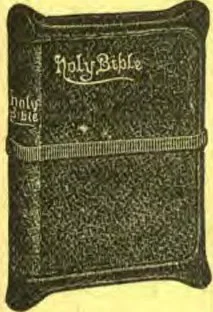
Self-Pronouncing S. S. Teachers’ Reference Bible.
By Editor
CONTAINS the celebrated _Teachers’ Helps_, comprising nearly 400 pages. Also a complete series of fifteen new maps.
_Description._ — Imperial Seal Binding, Tuck Edges, known as “Divinity Circuit,” Rounded Corners, Full Red under Gilt Edges.
We offer this Bible, post-paid, for only _SIX NEW YEARLY SUBSCRIPTIONS_ at 75 cents; or _TWELVE NEW SIX MONTHS’ SUBSCRIPTIONS_ at 40 cents.
We will also send it, post-paid, with the INSTRUCTOR one year for $2.25. For 20 cents extra we will stamp your name in gold upon the cover.
Common Mistakes in Judging Others and Life
It is a great mistake to set up our own standard of right and wrong, and judge people accordingly; to measure the enjoyment of others by our own; to expect uniformity of opinion in this world; to look for judgment and experience in youth; to endeavor to mold all dispositions alike; to look for perfection in our own actions; to worry ourselves and others with what can not be remedied; not to yield in immaterial matters; not to alleviate all that needs alleviation, so far as lies in our power; not to make allowances for the infirmities of others; to consider everything impossible that we can not perform; to believe only what our finite minds can grasp; to expect to be able to understand everything. And the last and greatest mistake of all is to live for time alone.—Selected.
FOR EVERY DAY OF THE WEEK
SUNDAY:
The world is too much with us: late and soon,
Getting and spending, we lay waste our powers.
— Wordsworth.
MONDAY:
If any work is really God’s giving, and he puts it either into our hearts to devise or into the power of our hands to do, no fear but he will also provide stuff sufficient, whether metal or mental.— F. R. Havergal.
TUESDAY:
“Being perplexed, I say:
Lord, make it right!
Night is as day to thee,
Darkness as light.
I am afraid to touch
Things that involve so much;
My trembling hand may shake,
My skill-less hand may break;
Thine can make no mistake.”
WEDNESDAY:
Sins of commission are the usual punishment for sins of omission. He that leaves a duty may well fear that he will be left to commit a crime.— Gurnall.
THURSDAY:
“Being in doubt, I say:
Lord, make it plain!
Which is the true, safe way,
Which would be vain?
I am not wise to know
Nor sure of foot to go;
My blind eyes can not see
What is so clear to thee.
Lord, make it clear to me.”
FRIDAY:
“An empty soul is always in danger. It is not enough to cast out evil; the entrance of good must follow, or the soul is not safe. We sometimes forget this in urging a sinner to forsake his sin. That is only the negative side. The only remedy for any sin is the opening of the heart to God, so that he may fill it and possess it.”
SABBATH:
“I have blotted out, as a thick cloud, thy transgressions, and, as a cloud, thy sins: return unto me; for I have redeemed thee.” Isa. 44:22.
Credit Correction for Science Letter from Uncle John
By Editor
By an oversight no credit was given to the “Science Letter from Uncle John,” in the INSTRUCTOR of February 15. It should have been credited to Miss Ethel Terry Reeder, who has written many valuable articles for our paper.
Notes for the Missionary Reading Circle
ARE you reading carefully the Notes prepared on the two topics under consideration by our Missionary Reading Circle? You will all be likely to read the notes on the field; but let me urge you not to neglect those on the Berean Library study. They are prepared with earnest thought and prayer, and it is important that all should read and reread them. Those for this week are especially valuable.
DOES YOUR SUBSCRIPTION EXPIRE
In March? Look at the yellow address-label on the first page of your paper, or on the wrapper; and if it bears any date in March, fill out and mail to the Instructor Office, at once, the blank included in last week's paper. This will insure the paper's reaching you promptly, and will save considerable extra work at the Office.
An Answer of Peace
The great king of Egypt was perplexed. Strange dreams troubled him at night, and their memory haunted his waking hours. All the wise men of the kingdom, who spent their whole time in studying and trying to explain mysteries, were summoned before him; but when Pharaoh had told them his dreams, they were dumb. They could not interpret them. What should he do? When the wisdom of the wise men failed, to whom should he turn?
Then the chief butler spoke to the king, and told him of a certain “young man, a Hebrew,” Joseph by name, who had interpreted a dream for him when he was in prison, and whom he had promised to remember when his liberty should be restored. It was a strange thing for the king to do—to send to a prison for a despised slave, in hope that he might throw light on a matter that had baffled the magicians and wise men; but Pharaoh’s anxiety was great, and he sent “in haste” for Joseph.
When Joseph came before the mighty ruler, and Pharaoh told him what he wished, Joseph quickly gave to his God the glory for the gift of interpretation granted him. “It is not in me,” he said: “God shall give Pharaoh an answer of peace.”
And as the king repeated his dreams, and the interpretation was revealed to him, he recognized that it came from a Power high above that of the gods he worshiped, and showed his confidence in it by following the advice of Joseph. So the thing that had puzzled the king, and caused him deep anxiety, resulted in great good: the end of the perplexity was peace.
So with the things that trouble us. We may take them to Him who invites us to bring our burdens to him, and waits to bear them for us, sure that he will give us an answer of peace. “I know the thoughts that I think toward you, saith the Lord, thoughts of peace.”
Miss Jessie Taylor Thanks Instructor Readers from Syria
Miss Jessie Taylor, of Syria, to whom the Instructor Mission Fund contributors are sending two copies of the paper for use in her girls' school at that place, says: “I shall always feel an interest in your excellent paper, which we greatly enjoy. Allow me to thank you most cordially for still sending it. May the Lord prosper more and more your every effort to send forth pure literature. Long may the Youth's Instructor continue, to give pleasure and profit to its readers.”