Your ShelfYour Projects

Signs of the Times, Vol. 25, No. 33.

The Tempter

Signs of the Times

Aug 16, 1899

Pacific Press Publishing Company · Oakland, California · Aug 16, 1899

The Tempter
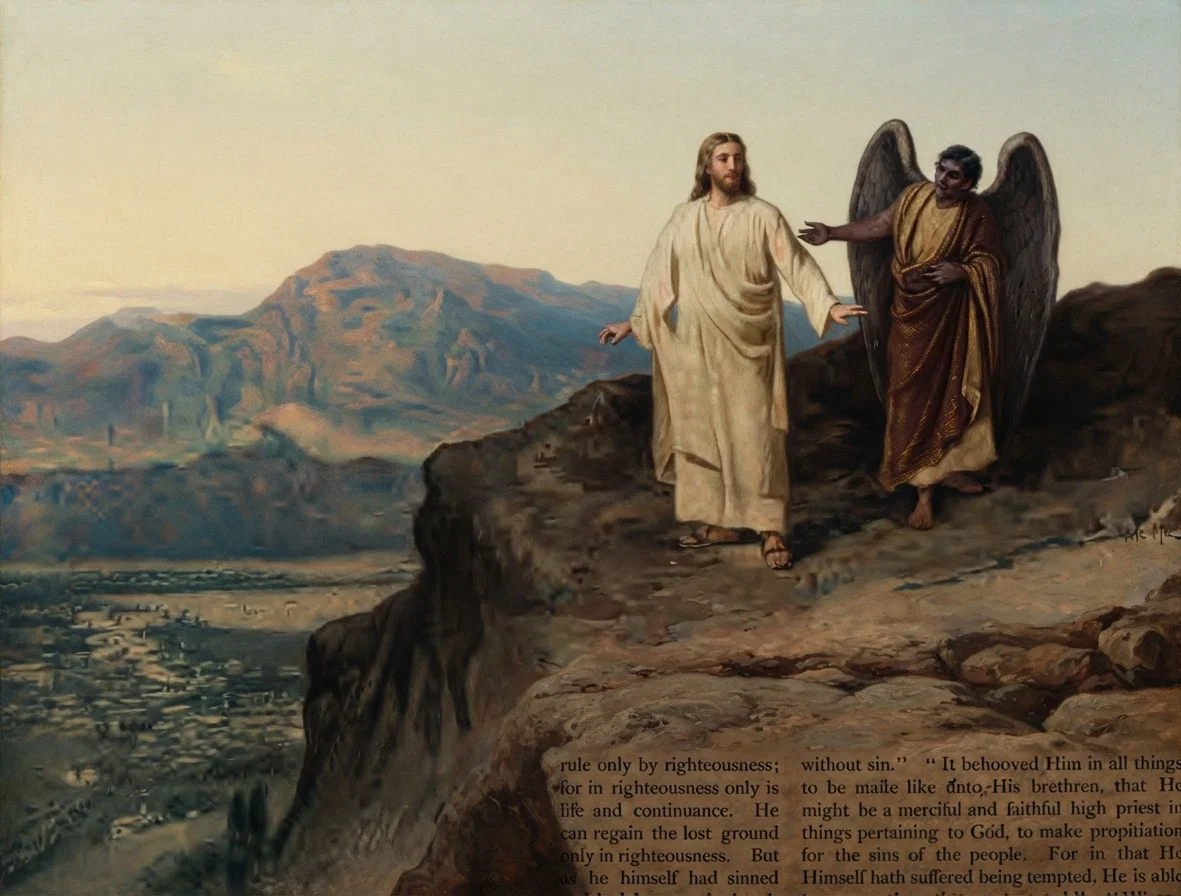
The Tempter.—"Again, the devil taketh Him up into an exceeding high mountain, and showeth Him all the kingdoms of the world, and the glory of them; and saith unto Him, All these things will I give Thee, if Thou wilt fall down and worship me." Matt. 4:8, 9.
The Lost Dominion.—God created the earth for the home of man, to be ruled in righteousness. Man, created upright but free to choose, was given dominion over the beautiful world. In an evil hour, to that fair home, came the tempter. Our first parents listened, argued, parleyed with him, and fell. The dominion held by the prince, Adam, was yielded to Satan. Yielding himself to Satan's power, man yielded all under him, and Satan became ruler de facto, tho not ruler de jure. Tho ruler in fact, he is not ruler by right. He is a usurping satrap, under the sentence of condemnation by the Suzerain Lord of the entire realm, who waits that all may choose, and that righteousness may be seen to be life, and that sin and rebellion and departure from God may be seen to be death.
The Means of Restoration.—Man fell by sin; sin became incarnate. Man could maintain his rule only by righteousness; for in righteousness only is life and continuance. He can regain the lost ground only in righteousness. But as he himself had sinned and had become the bond-servant of Satan, through self and sin, it is manifest that never of himself nor in himself could he conquer the usurper and win back his own. God saw the pitiable condition into which man had brought himself and his posterity, and He "so loved the world, that He gave His only-begotten Son, that whosoever believeth in Him should not perish, but have everlasting life." The Son of God gave Himself. God became incarnate in the flesh where sin was incarnate. The battle was fought in the flesh between the lusts of the flesh inherent through sinful birth, and the Spirit of God inhering through faith, and the Spirit won; man's liberty was assured.
“All these things will I give Thee if Thou wilt fall down and worship me.”
The Temptations.—The Son of God became Son of man. He took all man's limitations, infirmities, weaknesses, temptations, that by faith He might win for man all victories. He was "in all points tempted like as we are, yet without sin." "It behooved Him in all things to be made like unto His brethren, that He might be a merciful and faithful high priest in things pertaining to God, to make propitiation for the sins of the people. For in that He Himself hath suffered being tempted, He is able to succor them that are tempted." "Wherefore also He is able to save to the uttermost them that draw near unto God through Him."
The Temptation, the Weapon.—Christ was the Tempted for all; He is the Saviour for all. The victim of hellish hate and temptation for all becomes the Victor over all satanic power for all. He met and vanquished the enemy with the same weapon we must use—the simple Word of God. Satan presents the glory of the world and authority to rule. He tells the Second Adam that He need not take the hard way of rejection by His own, of persecution, of Gethsemane, of the blood-stained cross, of the closed sepulcher; he asks not pain and toil and crucifixion, only an act of homage, "and all shall be Thine." Jesus met him with: "It is written, Thou shalt worship the Lord thy God, and Him only shalt thou serve." Jesus, the Loyal, could not crucify one principle of righteousness; He could not sever one single fiber which bound Him to the Father’s throne, to save Himself from eternal death. And right was might, tho right met the death of the cross for our sakes.
The Lesson.—Not for the sake of Jesus personally was this temptation recorded, but for all who follow. When power, position, wealth, fame, honor are offered to a soul at the cost of the sacrifice of one principle of right, Satan is making the offer; and that soul who yields the principle bows in worship before the prince of evil. As Satan came to Christ, so he comes to the church of Christ. He came to the persecuted church in the early centuries, offered her ease, wealth, emolument, if she would but yield just a little of the Word of God, that she more readily might win the heathen; and she yielded. The result was the heathening of the church, the union of Church and State, and all its fearful harvest of crime and death of the Dark Ages. Satan is before the professed Protestant churches to-day. He is offering wealth, culture, influence, power. He says: "You may have power through politics. You may control caucuses. If necessary, you may fill the ranks of the armies of the world with Christian men. Thus you may conquer the world. True, to do these things will be a departure from the Word of God, from the simplicity and purity of the Gospel, from faith in your professed Master, Jesus, from following in His example. But here are the glories of earth, the splendor of magnificence, the plentitude of power; only fall down and worship before me, and all shall be thine." And, O, the sad, pitiful thing is, the once sweetly pure and beautiful church is yielding, yielding, oftentimes without shame; oftentimes "Her shame is her boast and pride."
The One Way.—Reader, there is but one way to meet the devil, the straightforward, unyielding, uncompromising course of righteousness as revealed in Jesus Christ. It is the way of the cross. It is not the way of the world. "What would Jesus do now?" you ask. He would do now just what He did when He met the tempter, when He walked the hills of Judea, when He prayed under the somber shadows in the paschal moonlight. "They are not of the world, even as I am not of the world. I pray not that Thou shouldest take them from the world, but that Thou shouldest keep them from the evil one. They are not of the world, even as I am not of the world. Sanctify them in the truth; Thy word is truth." O, for a worldless church, filled with the Word of God, the heavenly life! But, reader, whatever others may do, let us stand with Jesus Christ. X.

YOUR CROSS.

You have not the making of your own cross; your cross is prepared and appointed for you by Divine Love, and you are cheerfully to accept it. This day Jesus bids you submit your shoulder to His easy yoke. Jesus was a cross-bearer; He leads the way in the path of sorrow. Surely you could not desire a better guide! And if He carries a cross, what nobler burden would you desire? The Via Crucis is the way of safety; fear not to tread its thorny paths. It is a wooden cross, and a man can carry it, for the Man of Sorrows tried the load. Take up your cross, and by the power of the Spirit of God you will soon love it.—C. H. Spurgeon.

ROGER WILLIAMS—AMERICA'S LUTHER. No. 4.

"I WILL found a community," said Roger Williams, "where all men may walk as their consciences persuade them, every one in the name of his God." But the task was one of herculean proportions. "For fourteen weeks," he tells us, "I was sorely tossed, in a bitter season, not knowing what bread or bed did mean." His wanderings have been beautifully depicted in verse by Judge Job Durfee, and I can not refrain from giving a few of the stanzas here:—
"High branched the pines, and far the colonnade Of tapering trunks stood glimmering through the glen; Then joyed our father in this lonely glade, So far from haunts of persecuting men, That he might break of honesty the bread, And blessings crave in his own way again— Of the piled brush a seat and board he made, Spread his plain fare, and piously he prayed. "Father of mercies! Thou the wanderer’s guide, In this dire storm along the howling waste, Thanks for the shelter Thou dost here provide, Thanks for the mercies of the day that’s past; And, O, may still Thy tender mercies last; And may Thy light on every falsehood shine, Till man’s freed spirit owns no law but Thine! "Grant that Thy humble instrument still shun His persecutors in their eager quest; Grant the asylum yet to be begun, To persecution’s exiles yield a rest; Let ages after ages take the boon, And in soul-liberty for e’er be blest— Grant that I live until this task is done, And then, O Lord, receive me as Thine own!" "Our father ceased, and with keen relish he Refreshed his weary frame in that lone dell; Ah! little can his far posterity Conceive the pleasures of that lonely meal; For naught he knew of pampered luxury, And toil and fast had done their office well, And not the dainties brought o’er India’s sea Or wrung from sweat of modern slavery, "Are now so sweet as was his simple fare. His banquet past, he would have sought repose; But at the kindling blaze, heard wide and far, The howlings drear of forest monsters rose; And, lured around him by the vivid glare, Came darkling with light foot among the snows Whole packs of wolves from their far mountain lair, And the fierce cat, which scarce the blaze might scare. "Growling they come, and in dark groups they stand, Show the white fang, and roll the brightening eye; Till, urged by famine’s rage, the shaggy band Seemed e’en the flame’s bright terrors to defy— Then 'mid the group he hurled the blazing brand; Swift they disperse, and raise the scattered cry; But rallying soon, back to the siege they came, And scarce their rage paused at the mounting flame. "Yet Williams deemed that persecution took A form in them less odious than in men; He on their dreary solitude had broke— Aye, and had trespassed on their native glen; His human shape they scantily too might brook, For it had been an enemy to them; But bigot man did into conscience look, And for the secret thought his brother struck."
At first Williams settled within the limits of the Plymouth Colony, and altho the Pilgrim Fathers were never nearly as bigoted as the men of Massachusetts, he was not even allowed to stay there. Accordingly, with five others, he embarked in a canoe, and sailed down the Seekonk River, still in quest of another spot where he might found a colony where only soul weapons might be used in soul matters. Tradition tells that as the frail little bark approached the eastern bank of that river, at a point known as "Slate Rock," the little company was greeted by a band of Indians with the friendly salutation, "What cheer, Netop? What cheer?"
After landing and exchanging salutations with the Redskins, they re-embarked and passed around the headlands to a spot near the mouth of the Mooshausiek. Here they landed, and upon the slope of the hill which rises from the river they commenced the first settlement of Rhode Island. In gratitude to "God’s merciful providence to him in his distress," Williams gave to this hallowed spot the name of Providence.
"What sought they thus afar? Bright jewels of the mine? The wealth of seas? the spoils of war? They sought a faith’s pure shrine! "Aye, call it holy ground, The soil where first they trod. They have left unstained what there they found,— Freedom to worship God!"
Once free and untrammeled, Williams proceeded to carry out his convictions and his sacred principles. He had told the men of Massachusetts Bay that he did not believe that the king’s charter could, of itself, give to the white man a just title to the lands of the Indian. Canonicus and Miantonomoh, the chiefs of the Naragansett tribe were the owners of this land. He purchased from these, and they gave him a deed. He might, like William Penn, have secured this land forever to himself, and become the proprietor of his colony, thus enriching himself and his family. But such was not the purpose of this great man; it was not for such an earthly pageant of glory as this that he had suffered banishment and distress. "Principle, not profit; liberty, not power; conviction, not ambition,—were his impelling motives, which he consistently maintained, then and at all times."
When the confirmatory deed was made in 1661, he incorporated its purpose in its recital. "I desired it might be a shelter for persons distressed for conscience. I, then considering the condition of divers of my distressed countrymen, communicated my said purchase unto my loving friends [whom he names], who then desired to take shelter with me." And long years after he wrote: "Here, all over this colony, a great number of weak and distressed souls, scattered, are flying hither from Old and New England—the Most High and only wise One hath, in His infinite wisdom, provided this country and this corner as a shelter for the poor and persecuted, according to their several persuasions."
Soon the men of Providence found that it was necessary to enter into some form of compact or agreement to serve as a basis of government. This is a notable document, and it was signed by all inhabiting there:—
We whose names are hereunder written, being desirous to inhabit in the town of Providence, do promise to submit ourselves, in active or passive obedience, to all such orders or agreements as shall be made for public good of the body; in an orderly way, by the major consent of the present inhabitants, masters of families, incorporated together into a township, and such others whom they shall admit into the same, only in civil things.
Those little words, seemingly so innocently tucked on to the end of the document, were pregnant with meaning and happiness to that and future generations. They secured to all the freedom to worship God according to the dictates of conscience.
The first case of attempted persecution which ever came up in the little colony is a unique and interesting one. There was a man of the name of Joshua Verin. His wife was desirous of attending the religious services of Roger Williams. But Joshua Verin said her nay. A town meeting was called to consider the subject and the case. The discussion was long and spirited. Loyalty to their cherished principle prevailed, and the town record states that "it was agreed that Joshua Verin, upon the breach of a covenant for restraining of the libertie of conscience, shall be withheld from the libertie of voting till he shall declare the contrarie."
And now the character of Williams shines out more brightly than ever before. His former persecutors are in peril of their lives. Dark clouds hung over New England. The Narragansetts proposed to wipe out the men of Massachusetts Bay. The magistrates of this colony, his former persecutors, appealed to Williams for help, begging of him to act as mediator between them and their enemies. He promptly complied, and started upon his hazardous mission:—
"The Lord helped me immediately to put my life into my hand, and scarce acquainting my wife, to ship myself alone in a poor canoe, and to cut through a stormy wind with great seas, every minute in hazard of my life, to the sachem's house. Three days and nights my business forced me to lodge and mix with the bloody Pequod ambassadors, whose hands and arms, methought, reeked with the blood of my countrymen, . . . and from whom I could not but nightly look for their bloody knives at my own throat also. God wondrously preserved me, and helped me to break to pieces the Pequods' negotiation and design; and to make and finish by many travels and changes, the English league with the Narragansetts and Mohegans against the Pequods."
Despite all his kindness to them, the men of Massachusetts seemed determined to pursue the founder of Rhode Island, if possible, until the crack of doom. They accused him of being a theorist, a crack-brain, of having a "windmill in his head," and of being short of good sense. Steadily but surely, however, the small colony grew up. In 1637 a small island was added, to which Williams gave the name of Prudence; and shortly afterwards two smaller islands were added, one of which he named Patience and the other Hope.
If ever mortal worked for the good of others, unselfishly, it was Williams. He lived and died a poor man, working constantly with his hands to maintain himself and his family. According to his own words, "Time was spent day and night, at home and abroad, on land and water, at the hoe and at the oar, for bread." His eldest son was the first white male child born in Rhode Island, and he christened him Providence.
Constant were the efforts made by the leading men in other colonies to prove that Rhode Island, on account of its religious liberty principles, was the very hotbed of anarchy, and that Williams was responsible for the supposed disorder in civil things, on account of his teachings. But the teachings of the founder never led to disorder in the affairs of civil life. Williams believed in the rights of civil government. Nevertheless, aspersions continued to be heaped upon him, until he finally wrote his famous "Parable of the Ship," which set forth clearly and succinctly his true views upon the subject of the proper jurisdiction of civil government. It is so original and entertaining, besides being a masterpiece upon the subject, that I give it in full:—
"That ever I should speak or write a tittle, that tends to such an infinite liberty of conscience, is a mistake, and which I have ever disclaimed and abhorred. To prevent such mistakes, I shall at present only propose this case: There goes many a ship to sea with many a hundred souls in each ship, whose weal and wo is common, and is a true picture of a commonwealth, or a human combination, or society. It hath fallen out, sometimes, that both papists and Protestants, Jews and Turks, may be embarked in one ship; upon which supposal I affirm that all the liberty of conscience that ever I pleaded for, turns upon these two hinges—that none of the papists, Protestants, Jews or Turks, be forced to come to the ship's prayers or worship, if they practise any. I further add that I never denied, that, notwithstanding this liberty, the commander of this ship ought to command this ship's course, yea, and also command that justice, peace, and sobriety, be kept and practised both among the seaman and all the passengers. If any of the seamen refuse to perform their services, or passengers pay their freight; if any refuse to help, in person or in purse, toward the common charges or defense; if any refuse to obey the common laws and orders of the ship, concerning their common peace or preservation; if any shall mutiny or rise against their commanders or officers; if any should preach or write that there ought to be no commanders or officers, because all are equal in Christ, therefore no masters or officers, no laws nor orders, nor corrections nor punishments;—I say, I never denied, that, in such cases whatever is pretended, the commander or commanders may judge, resist, compel, and punish such transgressors, according to their deserts and merits. This is seriously and honestly minded, may, if it so please the Father of Lights, let in some light to such as willingly shut out their eyes."
House in Roger Williams' Park, Providence, Rhode Island, Occupied by One of Williams' Descendants.
Williams' "parable" is plain, but grand in its simplicity. No plethora of words covers the sacred principle annunciated in the Old World by the Saviour, and first in the New by Roger Williams.

SATAN'S FORCES COMBINING.

THE great intoxicating liquor companies are now effecting a union which will control the entire output of spirituous liquors of the United States. There are the Bourbon Whisky Co., The Kentucky Distillery Co., and The Wines and Spirits Manufacturing Co. The aggregate wealth of these combines is said to be about twelve billions of dollars ($12,000,000,000), a sum almost incredible, being much greater than that of all other trusts put together.
The liquor traffic is one of Satan's great powers to hasten the world on to its terrible doom. The enemy of all righteousness is giving close attention to this branch of his work, and is succeeding in dragging millions away from the "hope of the Gospel" by this one great evil.
A recent number of the Louisville News makes the startling statement that there is in that city alone, enough whisky to furnish each inhabitant of the United States with two-thirds of a gallon. And still the work goes on. Satan is determined that his arsenals shall be kept full of the deadliest, soul-killing weapons, and he will also see that there are plenty of agents to use them.
His forces are directed against every home of every land on earth. Love, life, liberty, reason, property, prosperity, peace, are destroyed. Fathers are made fiends, wives made widows, children made orphans and left to grow up in ignorance, vice, and crime.
How much wo there is in store for the world in these 50,000,000 of gallons found in this city! How many hopes dashed to the ground, hearts broken, brains gone wild, sons gone astray, wife-beatings and wife-murders are barreled up in these 1,063,829 barrels of whisky. And what shall we say of the millions elsewhere? We would that men might see what an enemy is being nourished in our land!
O Christian, pray for power from above! While Satan is combining his forces, and intensity is taking hold of every earthly element, and power is springing up from beneath, then is just the time to "look up" and remember that "it is time to seek the Lord, till He come, and rain righteousness upon you." Pray that this flood of iniquity may be driven back by waves of righteousness. And let every individual who reads these lines see that the command of Eph. 5:18 is fulfilled in his case: "Be not drunk with wine, wherein is excess; but be filled with the Spirit."
E. W. CAREY. Frankfort, Ky.

Life’s Desert

WELL? Suppose life be a desert? There are halting-places, and shades, and refreshing waters; let us profit by them for to-day.—Thackeray.

Truth in Absolute Simplicity

TRUTH always comes as Christ came, in the garb of absolute simplicity.—R. L. Gallienne.

Our Resurrection Life

"We should now endeavor to live our ideal of what we want our resurrection life to be."

Two Kinds of Companionship

ONE man pins me to the wall, while with another I walk among the stars.—Emerson.

OUT OF EGYPT.

The Singular Nation—Choosing a King.

FORTY years the Lord led and fed His people in the wilderness.
All this time He was teaching them the way of allegiance to Himself—the way of faith.
This He did in order that His purpose might be fulfilled through them in the land whither they were going to possess it.
At the end of the forty years they were encamped in the plain of Moab, opposite Jericho, preparatory to entering the land of their possession.
While there encamped the will of God concerning them was declared by an irresistible inspiration upon the prophet Baalam, and in words of instruction to His people for all time.
And the words are these: "Lo, the people shall dwell alone, and shall not be reckoned among the nations." Num. 23:9.
At that time the Lord's people composed "the church in the wilderness" (Acts 7:38); and in thus declaring that they should dwell alone and not be reckoned among the nations, He plainly declared His will that His church should be forever separated from every State and nation on the earth.
God never intended that His people should be formed into a kingdom, or State, or government, like the people of this world; nor that they should in any way be connected with any kingdom, or State, or government, of this world.
They were not to be like the nations or the people around them. They were to be separated unto God "from all the people that are upon the face of the earth." Ex. 33:16. The people were to dwell alone, and were not to be reckoned among the nations.
Their government was to be a theocracy pure and simple—God their only King, their only Ruler, their only Lawgiver. It was indeed to be a church organization, beginning with the organization of "the church in the wilderness;" and was to be separated from every idea of a State. The system formed in the wilderness through Moses, was to continue in Canaan; and was intended to be perpetual.
"The government of Israel was administered in the name and by the authority of Jehovah. The work of Moses, of the seventy elders, of the rulers and judges, was simply to enforce the laws that God had given. They had no authority to legislate for the nation." For God had declared plainly: "Ye shall not add unto the word which I command you, neither shall ye diminish aught from it." Deut. 4:2.
Thus the principles of their government were solely those of a pure theocracy. And such "was and continued to be the condition of Israel's existence as a nation." In any government it is only loyalty to the principles of the government, on the part of its citizens, that can make it a success. Consequently, on the part of Israel, it was only loyalty to the principles of a pure theocracy—God their only King, their only Ruler, their only Lawgiver—that could possibly make that government a success.
But loyalty to these principles demanded that each one of the people should constantly recognize and court the abiding presence of God with him as the sole King, Ruler, and Lawgiver, in all the conduct of his daily life. Yet it is "by faith" that God dwells in the heart and rules in the life. And "without faith it is impossible to please Him." Therefore the existence of the original government of Israel, and the existence of Israel as a nation, depended upon a living, abiding faith in God, on the part of the people of Israel.
And just here, the only point where Israel could fail, Israel failed. The people did not abide in faith. They did not remain loyal to God as their King. And "Joshua the son of Nun, the servant of the Lord, died, being an hundred and ten years old. . . . And also all that generation were gathered unto their fathers; and there arose another generation after them, which knew not the Lord, nor yet the works which He had done for Israel."
"And the children of Israel did evil in the sight of the Lord, and served Baalim; and they forsook the Lord God of their fathers, which brought them out of the land of Egypt, and followed other gods, of the gods of the people that were round about them, and bowed themselves unto them, and provoked the Lord to anger. And they forsook the Lord, and served Baal and Ashtaroth." Judges 2:8-13.
Then all the evils that came upon them only as the result of their apostasy and idolatry, they charged back upon the government of God. In their unbelief and apostasy, they could see in the continued raids of the heathen, by which their country was sacked, and themselves were oppressed, only evidence that for all practical purposes the government of God had failed.
They therefore reached the conclusion "that in order to maintain their standing among the nations, the tribes must be united under a strong central government. As they departed from obedience to God's law, they desired to be freed from the rule of their divine Sovereign; and thus the demand for a monarchy became wide-spread throughout Israel." Accordingly, they said to Samuel, "Make us a king to judge us like all the nations." 1 Sam. 8:5.
As their hearts were fully set on having a king like all the nations, and as practically they were much like all the nations anyhow, the best thing the Lord could do for them was to let them have their king. Nevertheless He said to Samuel, "Protest solemnly unto them." 1 Sam. 8:9.
Samuel did so, but still they insisted: "Nay; but we will have a king over us; that we also may be like all the nations; and that our king may judge us, and go out before us, and fight our battles." 1 Sam. 8:19, 20.
And of it all the Lord said to Samuel, "They have not rejected thee, but they have rejected Me, that I should not reign over them." And Samuel said unto them, "Ye have this day rejected your God," and "have said unto Him, Nay; but set a king over us." 1 Sam. 8:7; 10:19.
It was the same story of Babylon, Assyria, and Egypt, over again. When they knew God they glorified Him not as God. And as they did not like to retain God in their knowledge, the arch-deceiver seduced them into idolatry, and from idolatry into monarchy, in order that he might gain supremacy over them, and by worldly influence entice them, or by force prohibit them, from the service of God.
It was to save them from all this that the Lord had said of them, "The people shall dwell alone, and shall not be reckoned among the nations."
If they had remained faithful to this principle, there never would have been amongst Israel a State or a kingdom.
Therefore, in announcing this principle, God intended forever that they should be completely separated from any such thing as a State or kingdom on the earth.
And as when that word was spoken they were "the church," it is absolutely certain that in announcing that principle, God intended to teach them and all people forever that His plainly-declared will is that there shall be a complete separation between His church and every State or kingdom on the earth; that there shall never be any connection between His religion and any State or kingdom in the world.
And further: As that people were then the church, and as the Lord said they rejected Him when they formed that State and kingdom, it is perfectly plain by the Word of the Lord that whenever the church forms any connection with any State or kingdom on the earth, in the very doing of it she rejects God.
But it is impossible for the church ever to form any connection with any State except by the individual members of the church forming a connection with the State. Therefore, as the church in forming such connection rejects God, and as it is impossible to do this except by the individual members of the church, it is perfectly plain that the teaching of the Word of God is, that for members of the church to form connection with the State is to reject God.
And from ancient time all this was written for the admonition of those upon whom the ends of the world are come. Will the people to-day be admonished by it?
ALONZO T. JONES.

THE GROWTH OF TRUSTS.

THE Los Angeles Times had a recent editorial on the subject of trusts, some of the paragraphs of which are as follows:—
Within the past decade the industrial world has witnessed a remarkable change in the methods of production and distribution—a change amounting almost to a revolution. The transformation is still in progress, and no man can predict, with any assurance of accuracy, what the ultimate outcome will be.
Reference is made to the growth and development of the system of co-operative organization known as the "trust" or "combine." The tendency of modern industrial and commercial interests is steadily toward centralization, or the aggregation of large amounts of capital in productive and commercial enterprises. This movement is not confined to any one country. It is seen and felt, not alone in the republic of the United States, but in the monarchical countries of Europe—and, in fact, throughout the civilized world. Wherever there are great industries and great commercial activities, there the modern trust lives and flourishes. The tendency toward co-operative organization is as wide as the scope of human activities, and this is equivalent to saying that it is of world-wide extent.
More and more the great enterprises of production and distribution are being brought under the control of central organizations, until the time is apparently not far in the future when each and every line of business will be controlled by a trust, which will dictate the prices at which the commodities it controls shall be sold, and the rate of wages paid to its employees. This is practically true in many great industries at the present time, and the process of organization, or consolidation, is going forward rapidly in both the industrial and the commercial world.
One of the gravest features of this modern tendency toward centralization is the disastrous effect of the trust upon competition. Independent firms, corporations, and individual dealers or manufacturers, are compelled either to go into the trust or to go out of business. The great department stores in the larger cities are driving the smaller merchants to the wall by thousands. In the manufacturing business, the independent firm, corporation, or individual can not hope to compete successfully with the great aggregations of capital which virtually control the production of this and that commodity. The smaller manufacturers and merchants, thus driven out of the field of independent production or distribution, have no alternative but to seek employment under the trust, or to engage in some other occupation; and if they turn to other occupations, they are apt to be confronted with the same problem—employment under a trust, or starvation.
Where is all this to end? The question is a difficult one to answer. It can not, in fact, be answered satisfactorily at the present time. The correct and final answer must come from the future. Attempts to answer the question are as various as the personal views and characteristics of the persons who make such attempts. The pessimist sees in the evolution of the trusts only a foreboding and a menace of evil, with revolution and social chaos at the farther end of the vista. The optimist sees only an evolutionary condition which will work itself out to right conclusions in the end. The Socialist professes to see in the development of the trust system the dawning of the day which shall find his dreams of universal co-operation realized. The politician sees in it only an opportunity to make political capital. The statesman views it with apprehension, not unmixed with hope that in the process and the course of evolution all will be well. The political economist, the philosopher, and the student of sociology regard the new problem with varying degrees of hope, distrust, disapproval, or alarm, according to their individual temperaments, their environment, or the intellectual methods to which they are most addicted.
It is distinctly a problem of the future.
The foregoing presents an unbiased view of the trusts as most people look at them. And the fact is made very clear that the Times sees possibilities for great dangers and evils to grow out of the trusts. But no present solution of the menacing problem is seen. To look at the matter in this light is highly pessimistic.
There is a solution for the trust evil. We need not wait upon the future in order to understand all about it. We may know right now what all this combining of wealth means. And if you do not already understand the meaning of it, please read the following words of the Lord:—
“This know also, that in the last days perilous times shall come. For men shall be lovers of their own selves, covetous.” 2 Tim. 3:1, 2.
“Go to now, ye rich men, weep and howl for your miseries that shall come upon you. Your riches are corrupted, and your garments are moth-eaten. Your gold and silver is cankered; and the rust of them shall be a witness against you, and shall eat your flesh as it were fire. Ye have heaped treasure together for the last days. Behold, the hire of the laborers who have reaped down your fields, which is of you kept back by fraud, crieth; and the cries of them which have reaped are entered into the ears of the Lord of sabaoth. Ye have lived in pleasure on the earth, and been wanton; ye have nourished your hearts, as in a day of slaughter. Ye have condemned and killed the just; and He doth not resist you. Be patient therefore, brethren, unto the coming of the Lord. Behold, the husbandman waiteth for the precious fruit of the earth, and hath long patience for it, until he receive the early and latter rain. Be ye also patient; stablish your hearts; for the coming of the Lord draweth nigh. Grudge not one against another, brethren, lest ye be condemned; behold the Judge standeth before the door.” James 5:1-9.
Think carefully over each sentence in the foregoing scriptures and you will see that even tho man can not penetrate the future of the trusts, yet God was able nearly two thousand years ago to point out their work fully.
The greatest danger to the world to-day is not the trusts, or any of the menacing social problems, or anything else of that kind. Our danger is that we will not read and heed the Word of the living God. He has not only told us what all these present-day dangers mean, but He has told us how to avoid them.
A. O. TAIT.
Continue reading: A CRUCIFIED AND RISEN SAVIOUR