SUCH is the display heading in a San Francisco daily (Examiner July 29), of a report of conditions in Europe, based on an interview with Archbishop Ireland, recently returned. Here are a few sentences from the noted Catholic prelate's remarks:—
"We are watched in Europe now with a keen intensity that I have never known before. In many of the countries over there we are still regarded as an experiment.
"The motto of the United States ought to be 'Liberty with authority and authority with liberty.'"
"All the statesmen of Europe prefer arbitration to war.
"I do not believe that the Peace Conference at The Hague will succeed in bringing about any disarmament of Europe. The situation in Europe is so critical that for the present at least disarmament is an impossibility. But the result of an arbitration will be an ultimate disarmament."
"Ultimate?" When? The situation is growing more and more critical all the time. The nations will never disarm till the great battle of Armageddon is in the past.
America's friendliness to Roman Catholicism is thus indicated:—
"It is the universal opinion on the other side of the ocean that the interests of the Roman Catholic Church in the Philippines will be safer and better guarded under an American than under a native government."
And yet the natives are said to be Catholics. This would naturally mean that this government is expected to do more for Catholicism than professed Catholics. Will she?
Rome's Double Working.
It is an undeniable fact that most of the disturbers of the peace in our large cities, whether their cause is just or unjust, are members of the Roman Catholic Church. Many of them have been members of this church for years, and their parents before them have also been members for generations. They may well be considered as the finished work of Roman Catholicism. Their outbursts against law must be laid at her door, the direct result of generations of teaching. Lord Robert Montague, for many years a member of the Roman Catholic Church, tells us that the Catholic Church has her emissaries among the unrestful element, stirring them up to strife. When they thus become so great and wide-spread, the church steps in, controls some local disturbance, and is hailed as the angel of peace by unthinking officials. The "Church" takes occasion at such time to say, "Make me arbiter, restore me to my rightful place, and all these labor troubles will cease."
Here is an instance in point. In the difficulties in Cleveland a conflict took place between riotous strikers and the police in front of the Bohemian Catholic Church. The yells of the mob who were endeavoring to kill two policemen stopped the church services. Priest Purauska, clad in his robes, left the church, passed through the 2,500 angry men to the two policemen, wounded and sore beset. "In the name of the church I defy any man to touch these men," rang out from the priest as he stretched his arms over the shoulders of the officers of the law. The rioters hesitated, advanced, fell back, and the priest led the policemen into the church. Of course that church will be hailed as a benefactor. But if, in the name of the church, that mob, excited, mad-blind and defiant, could be quelled, why in the name of the church were the men not kept from entering mobs. If that church could stay the mad mob at its height, at its climax, why did it not prevent the mob at all? There are other questions of interest here which will suggest themselves.
An editorial in the N. Y. World is authority for the statement that Captain Crozier, of the ordinance department, and one of the American peace delegates to The Hague conference, "has been instructed by the war department to use all possible efforts to secure for this government the right to use luddite, the British army explosive of enormous powers for destruction. The ordinance bureau proposes to secure this explosive or some other of approximate possibilities for the shells to be used in the fall campaign in the Philippines." Can it be possible that the tender, the sympathetic, the self-sacrificing, the loving Christ can be the author of such barbaric cruelty? Never! Then why should we call a government "Christian" that proposes to do such deeds? And how deeply sad it is that the poor heathen have the Lord Jesus Christ so grossly misrepresented to them, by being taught that one of the "greatest Christian nations" comes to them with such instruments of death! Christians, who are Christians indeed, should hasten to them with the true message of the cross.
UNDER date of Chicago, July 11, Mr. D. W. Reavis, secretary of the International Religious Liberty Association, writes: "We have just returned from the International Epworth League Convention at Indianapolis, Ind. All the speakers at that convention were frank in their admissions that there is at the present time a union of Church and State in this country. We were surprised to hear them acknowledge this fact. One speaker at one of the principal meetings called the attention of the congregation to the fact that that meeting was being guarded by the police, and presided over by the governor of the State, that the building was decorated with the American flag and Union Jack, and the choir singing national songs and waving the American flag, and asked the question if these were not indications of the State helping the Church. Great stress throughout the entire convention was placed upon the importance of 'loyalty to the government.' The young people at the present time are being educated that their highest duty is loyalty to the civil law. In fact, according to the speeches, it is more important to obey the civil law than to obey the law of the Lord."
A WORLD revolution is just before us; and men but little realize the scenes that will be enacted then. A strike is in progress in New York and Brooklyn. A few days ago two dynamite bombs were exploded under one of the elevated railway stations. The labor leaders who are superintending the strike denounce the deed and offer to help seek out the perpetrators. But they will be hard to find, no doubt. Strikes and general disorders of that kind furnish the great opportunities for irresponsible and desperate men to do their terrible work. And the fact that the world is so full of that class of men to-day makes the outlook from every human standpoint so very dark. It is only he who looks upon the condition of things to-day through the great telescope of prophecy that can view them calmly. And he can view them calmly only because he sees not alone the evils that overhang the world, but the protection that is offered by the Father in heaven.
THE announcement of a British American syndicate with a capital of $40,000,000, proposing to build more than 2,000 miles of railroads in China, is one among the many evidences that show that the money-power of the various nations is making vast international combines. This means a money empire of the world under the controlling power of a few men. And such is the insatiable greed to corner still more and more millions, that these men seem to be under a spell that keeps them entirely oblivious to the frightful conditions that they are bringing upon the world. Capital is growing more and more grasping, and labor is more and more determined. The local demonstrations here and there all over the world show the spirit of the times, and reveal the fact that the universal break-up cannot be long delayed.
THE New York Sun thinks that it has evidence to show that the labor troubles in Brooklyn are occasioned by some Wall Street brokers, who are trying to affect the market on certain stocks. And thus it will be in these struggles that are before us. It will not only be a conflict in which capital and labor will be arrayed against each other, but capital will be fighting capital, and the laborers in one camp will find themselves aggrieved against the laborers in another; and all together will combine to make the indescribable scenes of strife that have been so fully foretold in the prophecies as characteristic of these last days.
THERE are some who fear that the Alaskan boundary dispute may be the occasion for a serious quarrel between this country and England. Notwithstanding the strong expressions of friendship that have been passing back and forth between the two countries, it takes but a very small matter to start a contention that has all the possibilities of war in it. These are days in which no friendship seems strong enough to subdue the supremacy of self-interests.
DR. OSCAR LOEW, of Washington, D. C., a German bacteriologist in government employ, is said to have discovered a ferment from the bacteria themselves which destroys them. He discovered that microbes after a time secreted a ferment which dissolved them. This is called enzym. It has been known for a long time that bacteria, after a certain period of activity, ceased to act, in which it was said that the disease, like typhoid or scarlet fever, had run its course. Dr. Loew discovered by experimental tests that it was enzym, a bacterial secretion, which destroyed the germs. From experiments it is believed that many diseases may be successfully treated. But this may be, and probably will be, as disappointing as Dr. Koch's discovery.
Two Catholic priests in Boston, on a recent Sunday evening, headed a choir of sixteen voices and two cornetists, and marched through the streets of that city, stopping frequently to make short addresses to the crowd that followed them. They finally reached the Catholic church, where another short address was made from the steps, and the crowd was invited to attend the services that were to follow on the inside. They propose to continue this of Sunday evenings in order, as they say, "to reach the non-church-going masses." You can think about this and see what significance you can see in it.
MORE expansion is in the air. There is trouble in the little dark republic of Santo Domingo. President Heureaux, who was really a czar, has been assassinated, and insurrection is becoming formidable. General Gomez, of Cuba, goes back, it is said, to his native island to fight for rulership. Later despatches say that the United States will interfere and assume a protectorate, and now the European nations are becoming uneasy.
NOT only is Santo Domingo having a social revolution, but the elements have added to the disturbance. On July 28 a disastrous hurricane swept the roadstead and went forty-four miles inland on the island. Three large schooners were wrecked, and only one man of the crews of the vessels was saved. Great damage was done to property both along the shore and inland, but the extent is not yet known.
THE Hon. Charles Emory Smith, L.L. D., Postmaster-General of the United States, says: "The whole country is united now as it has not been since the foundation of the republic." And this is true as regards North and South, but there are great and enormously vital issues on which the nation is dividing, namely, Republicanism and Imperialism, and also the hostile camps of Labor and Capital.
A DESPATCH dated July 31, from Bombay, India, says: "At Poonah, capital of the district of that name in this presidency, there have been fifty-nine cases of plague and fifty-six deaths from that disease in fifty-eight hours. At the cantonment in the city 310 cases of plague and 261 deaths have been reported. Several fresh cases have occurred among the Europeans."
A YOUNG lady, Miss Grace Kafka, on the evening of July 20, after a hard day's work, took from dictation in shorthand and transcribed on her typewriter 1,269 words in thirty-six minutes. In the first five minutes' dictation she took 602 words; in the second five minutes, 667 words. She transcribed the 1,269 words in twenty-six minutes.
GENERAL ULISES HEUREAUX, president of the republic of San Domingo, W. I., was assassinated July 26, by Ramon Caceros. The vice-president, General Weuceslao Figueroa, immediately on the announcement of the president's death, assumed the direction of affairs.
THE spirit of revolt is perplexing the nations of earth. The last we hear is in the hermit nation of Korea. A party of dynamiters, led by a prince of the royal family, endeavored to wreck the residences of the premier and members of the royal household.
NEWS comes to us from Tokyo, Japan, that July 13 a train was wrecked by a cyclone, twenty-four passengers being injured. The coupling links were broken, and a middle section of the train taken out by the tornado, leaving front and rear uninjured.
YELLOW FEVER is raging in the Soldiers' Home at Hampton, Va. July 30 thirty cases were reported, and ten deaths within two days.
A TERRIBLE hurricane swept the coast of Japan, July 8-11. Much property was destroyed and many lives lost.
LABOR IN THE PHILIPPINES.
A KNOWLEDGE of the wages paid for labor in Manila and of the conditions one must meet, should be sufficient to keep American laborers at home. If they wish to take their labor to that market, it must be sold as cheaply as the labor of their competitors, as they will receive no larger wages because the Philippine Islands are a possession of the United States.
The best skilled labor at Manila receives the equivalent of $15.00 per month in gold, while the average earnings of the working classes will not equal $4.00 per month in gold, out of which provision must be made for the support of one's family. The best clerical labor, such as accountants, cashiers, bookkeepers, and the employees of the larger houses, receive from $30 to $60 per month in gold. The small number of Europeans, excepting the Spanish, who are engaged in business in the Philippines, are either the proprietors or responsible managers of established firms.
The total absence of European and American laborers in the Orient is a sufficient demonstration that their employment is not needed. It is quite true that the cost of living is merely nominal in comparison with the cost in the United States, but even if one should save one's entire income, it would scarcely amount to a competence.
It is a mistake to indulge the supposition that the Filipinos are uncouth savages, incapable of performing skilled labor that requires the exercise of judgement. The population living along the coast and in the cities has attained a surprising degree of civilization, and the workmen of this class produce an infinite variety of articles of their own manufacture that would be creditable to a more enlightened country. They are, in my
judgment, superior to the same classes in Cuba, Porto Rico, and Hawaii, and possess in a great measure the cleverness at imitation, of the Japanese, whom they resemble in physical appearance and in the similarity of many customs.—Review of Reviews.
FROM FIJI.
By J. E. Fulton
THERE is much to encourage us with reference to the Lord's work in Fiji. A number of influential natives have taken their stand on the Lord's side, and this has stirred up a general interest to hear the truth. The Lord has gone before us, and our faith has not been large enough—the Lord has turned hard hearts we scarcely hoped for. One very high Fiji chief, with his family, has turned to the "path of God's commandments." He is earnest and enthusiastic in telling his people of the good way. He has never been a Christian. In fact, he has been a very bad man, but we are hopeful he will spend his life henceforth for the Lord.
One of the first to step out to obey the Lord's Sabbath was a native preacher. He has had a long experience in the Lord's work, having preached for the Wesleyans twenty-nine years. He has been a missionary in New Guinea for ten years. After his return he was ordained, and has had charge of several responsible districts in Fiji. He has been studying the truth for a year and a half, during which time he has been puzzling the white ministers with many questions. He got no satisfaction, and, seeing his duty plain, he has cast his lot with us. We praise the Lord for his help. His heart is with the cause and he is willing to aid us in every way. His wife and four children are with him in this work.
Earnest efforts have been made to overthrow the company who have taken their stand, but they are steadfast and growing in knowledge of the truth. A few weeks ago, when the Wesleyan minister (white) preached on the Sabbath question in this village, our native brother had the opportunity at the close of the sermon of asking some very pointed questions, and of defending the truth before a very large audience. One or two points would bear repeating. When Brother Pauliasi Bunoa, our native preacher, was told by the white minister that it is wrong and foolish to turn from the religion in which one is brought up, he replied: "Did Martin Luther do wrong to turn from Catholicism? Was John Wesley brought up a Wesleyan? I am simply following the advancing light as they did. Give me one text to show I am wrong and I will turn back to Wesleyanism, where I have labored hard so long."
Again he said to the Wesleyan minister: "You say I am wrong, and I say you are wrong, but neither you nor I will be the judge, but God is Judge. If, in the day of Jesus' coming I am found wrong, I will accuse Moses, who brought the Ten Commandments from Mt. Sinai; I will accuse Jesus, who kept them and never said He changed it; I will accuse Matthew, Mark, Luke, and John, who, if Jesus changed the day, never told us; I will accuse the great apostle Paul, who never told us, in his many books, of any change, but, contrariwise, speaks of keeping the Sabbath. Now if you are found wrong in that day, who will you accuse?"
Interior of a Richly-decorated Catholic Church in the Philippines, Made at One Time to Do Hospital Service for Sick Soldiers.
There are requests coming in all the time from other towns and islands for preaching. We can not fill all the openings. Our little Fiji tract seems to be doing good.
Young men are waiting an opportunity to come to our school we have promised. We have as yet no schoolhouse, and we know the Lord wants us to have one, so we wait with expectancy for the way to open up and the means to come in.
The Pitcairn left us yesterday morning, June 26, having been with us about ten days. She sails directly for California.
Pray for the work in Fiji.
J. E. FULTON.
DO YOUR BEST.
By Anon.
ALWAYS do your best, should be applied to everything we do. A man who had risen from a very humble beginning to distinction, even to great eminence, when asked the secret of his successful life, said he had always sought to do his best in whatever he undertook, summoning the best thought, the finest skill, the greatest energy, of which he was capable, to every piece of work he was doing. He demanded of himself, too, that to-day's best should always be better than yesterday's.
It were well for us if we all would make and follow inflexibly such a rule as this. No most trivial thing should we ever do carelessly. All work is for God, and it is a sacrilege to do11anything for Him in a slovenly, negligent manner. It is a desecration to put marred or careless work on any block we carve for God's temple. The workmen on the old cathedrals wrought as conscientiously and as perfectly on the parts of the building which would be high up, far out of human sight, as on the altar-rail or the carvings of the great doors, which every eye should see and admire.—Anon.
AND I?
Is THERE some desert or some pathless sea
Where Thou, good God of angels, wilt send
me?
Some oak for me to rend; some sod,
Some rock, for me to break;
Some handful of Thy corn to take
And scatter far a-field,
Till it in turn shall yield
Its hundredfold
Of grains of gold,
To feed the waiting children of my God?
—Christian Register.
Victory in All Conditions
To LOVE equally as much the grace that comes through being instructed how "to be hungry" and to suffer, as you love the faith required to know how to be "full" and to abound in health—that is victory. Phil. 4:12.
THAT MISSISSIPPI CRIMINAL
By R. S. Owen
THE editor's note concerning the "Criminal Brought to Book," in the Independence Number of the SIGNS, has doubtless created in some minds an interest to learn the fate of this man. I write to tell you that his trial was held on the 19th of July, and that he is still at large. I am glad to say that the SIGNS is correct in its estimate that "the major part of the people of this State do not believe in this thing," i. e., prosecuting the Adventists.
The crime, if such it be, was that of obeying the law of God in regard to the Sabbath. This man had brought an offering to the Lord on the seventh day of the week, and God had blessed him richly in obeying His command, and had respect unto his offering. Now this man had several brothers, being the sons of Adam, and they brought as an offering of their time, the first day of the week, and to their offering God had not respect, and promised them no blessing for so doing.
And these brothers became very wroth, and their countenance fell, and it came to pass that, when the Sabbath-keeper was in his garden, attending to his own business, these brothers rose up and took counsel together how they might destroy his influence and put him to shame. So complaint was made to the officer, and the man was arrested and brought into court for not respecting the first day of the week.
Now it was supposed that this Sabbath-keeper would be subjected to heavy fines and perhaps imprisonment; but the men to whom the matter was left for decision were honorable men—men who feared God. And they found written in the book of the law these words—
"No preference shall ever be given by law to any religious sect or mode of worship, but the free enjoyment of all religious sentiments and the different modes of worship shall ever be held sacred."—Constitution of Mississippi.
Then said these gentlemen of the jury: "We find the accused not guilty." And further, they added: "We could not condemn a man for obeying the law of God."
Moreover, these brothers were not to be discouraged with the first defeat. Learning of another Sabbath-keeper, who had failed to respect the venerable day of the sun, they entered complaint against him, and he was called to attend court two days later. This time they brought with them a certain orator, whose fame extended over no inconsiderable portion of the country. He was a lawyer of such breadth of mind that he was willing to argue either side of the case. Having offered his services for the defense in the first case, he found that it had been entrusted to a Higher Power; so he offered to prosecute the second case for the moderate sum of $2.50. The securing of this amount necessitated some persistent begging, and met several embarrassing rebuffs; but in some way the lawyer was secured, and he stood before the justice to bring the Sabbath-keeper into trouble. Again were honorable men found to sit in judgment on the case, who, when they had heard the evidence, read the law, listened to the eloquence of the lawyer, brought in a verdict of, "Not guilty." And thus has ended an experience which has been attended with sweet communion with God, a refreshing of His Holy Spirit to the church, a wide circulation of the truth, and an acquaintance with many friends, who are brought into a knowledge of the truth by this event.
R. S. OWEN.
OUR WORK AND WORKERS.
By Editor
THE address of Elder C. N. Martin is 1059 Castro Street, Oakland, Cal.
FIFTEEN converts are reported by Brother C. P. Haskell, at Ironton, Ohio.
A CAMP-MEETING is now in progress at Alexandria, Ind. It will close on the 20th inst.
JULY 1 four persons united with the church at Springfield, Ohio, having been baptized by Brother W. W. Miller.
MINNESOTA CONFERENCE has nine tents in the field this season. At Deer, Kitson County, eight persons were baptized July 16.
THE church at Indianapolis, Ind., distributed 10,000 32-page tracts, previous to the assembling of the Epworth League Convention in that city.
TWO LOTS in Fort Worth, Texas, have been donated to the purpose of a new house of worship, and other pledges give hope that the enterprise will soon be under way.
AN appeal goes out from the city mission in Lincoln, Neb., for pillows, pillow-slips, sheets, and carpets for six rooms. Also for beans, peas, potatoes, flour, and fruits. Adress, J. A. Skinner.
THE variations in the work of the canvasser are illustrated by the report of one found in the Nebraska Reporter: "Monday, and till Tuesday noon, I did not sell a book, but gave away reading to the value of seventy-five cents. Thursday I took orders to the amount of forty-five dollars."
Items of Interest
By Editor
Four members were added to the church in Akron, Ohio, at the last quarterly meeting. Three of these were baptized by Brother H. H. Burkholder, prior to the administration of the other ordinances.
The folly of the claim that "this is a Christian nation" is demonstrated in a note from one of our book agents in Nebraska, who says: "About nine out of ten whom I have met the last few days are infidels."
The first church school in Ohio, conducted under the auspices of Mount Vernon Academy, was that at Hamler. The closing exercises of the first term were held July 14, and the results are said to have been very encouraging.
At the Oak Street Church, Jersey City, N. J., July 8, a union meeting was held, at which Brother Stall baptized two candidates, who united with the German church, and Brother A. E. Place baptized two, who united with the English church in Brooklyn, N. Y.
Brother S. N. Haskell, well known to our brethren in almost every conference and mission field, is now conducting meetings and other missionary work in Wallsend, a suburb of Newcastle, N. S. W., Australia. He went there after a protracted effort, with others, at Brisbane, capital of Queensland, where a church of sixty members was organized, and a house of worship erected.
The News contains a brief report of a Fourth-of-July meeting at Cheswold, Del., by Brother Fred H. Seeney. We cull this extract: "A few days before the Fourth, it puzzled us where to go with our children for exercise, but when the day came the dear Lord just lead us out into a nice little grove. There were about seventy-five present, and they became so interested that they urged us to return and hold another meeting, so to-day, July 9th, we held a meeting in the same grove. I spoke upon the subject of baptism, and as the result eight souls went forward in the ordinance, in the presence of over three hundred persons. We have had another call from the people around Cheswold to come up near the little town and hold meetings in a grove there."
The Sixth Annual Calendar of Keene Industrial Academy, Keene, Texas, is received. It is a pamphlet of twenty-eight pages, printed by the academy press, containing general and detailed information regarding the institution, including illustrations showing the Academy Hall and the Home. A perusal of this calendar will give to any one a good idea of the advantages to be gained by attending the school. For a copy of calendar, and further information, address Prof. C. C. Lewis, principal.
A. J. Morton.
Fine.
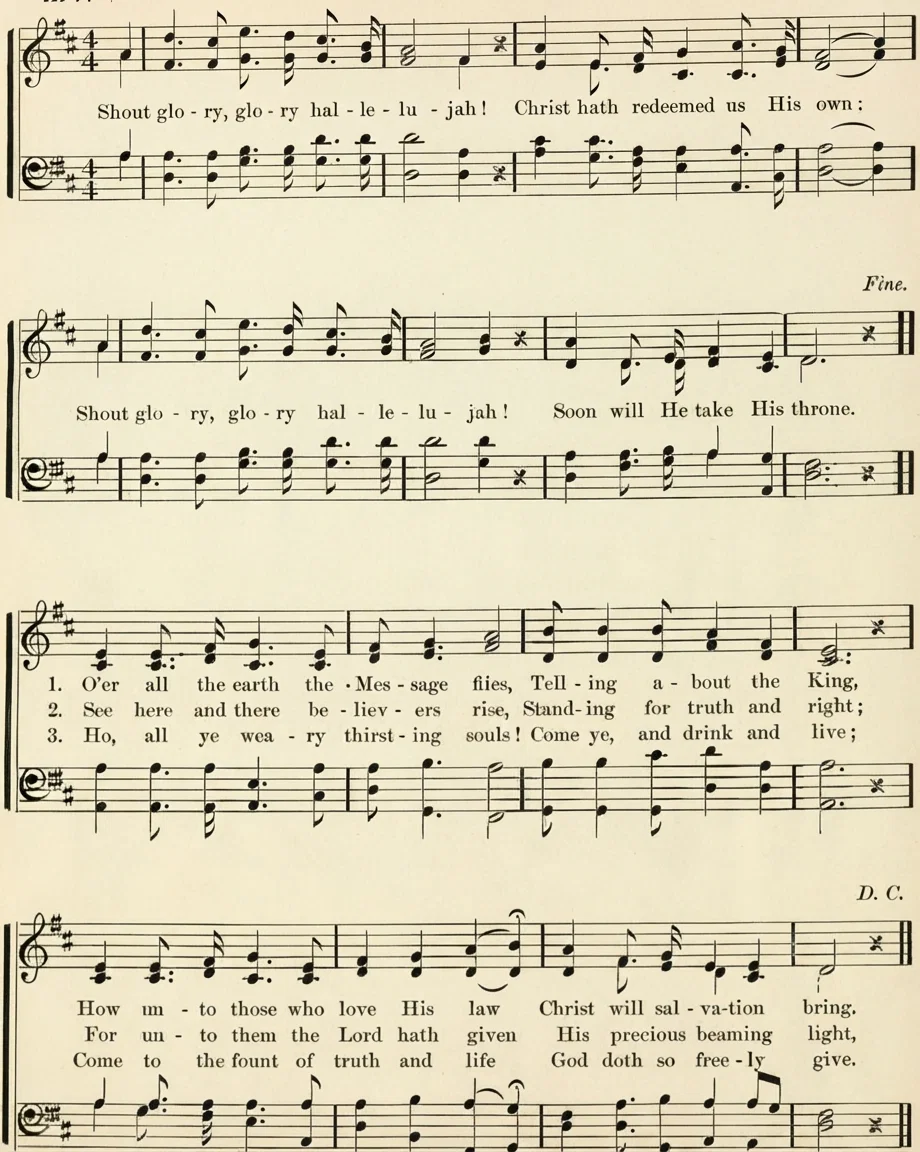
THE MESSAGE OF THE KING.
"Blessing, and honor, and glory, and power, be unto Him that sitteth upon the throne, and unto the Lamb forever and ever."—Rev. 5:13.
SANTA ANA CAMP-MEETING.
By William M. Healey
THIS meeting, appointed to begin August 10, should be looked forward to by all our people in southern California as a time when God is going to draw near to His people, and through them attract unconverted souls to Himself.
It will be held on commodious grounds, a few rods from the depots of both Southern California (Santa Fe) and Southern Pacific Railroads, and close to the city.
The fare from all points on both railroads will be the usual rate going and one-third of that returning. In buying a ticket to the meeting a certificate of purchase must be taken from the ticket agent, or full fare will be asked for return. The Santa Fe agents will have these certificates in blank to fill out. The general agent of the S.P.R.R. tells me that he will see that all agents of the roads in this part of the country get certificates for the Santa Ana meeting.
Keep all your baggage checks till you reach the ground for our own baggage man. It is but a short walk to the camp from the depot.
Tickets will be on sale August 8 and any time during the meeting.
W. M. HEALEY.
THE HARVEST OF HEALTH.
By David Paulson, M.D.
THE normal condition of all God's creation is health, not disease; until sin came into the world there was no such thing as sickness. The nearer we get into harmony with God, the nearer will we approach that condition. The whole idea in getting a sick person well is to get him into harmony with God, but the usual plan is to give him drugs, which will make him feel better, when he is really worse.
Let me illustrate the folly of that. Suppose I take a little child and lift it high into the air. A child may think that it is as tall as I am, but is it?—No, as soon as I put it down again it is the same as it was before. So when people indulge in stimulating drugs, they may feel for a little time as if they had reached the summit of health, but soon there comes a letting down, and then they are worse than they were before. How is the child to get to be as tall as I am?—By growing; and in the same way the sick man is to be restored to his health. He has to plant good seed, and then give it time to develop, and the harvest will be sure.
An acute disease is generally cured as soon as the cause is removed, but a chronic disease is not cured so promptly. It comes as a result of a persistent course of evil-doing, and can usually be removed only by a persistent course of right living.
Some one asks whether people have to work as long to get their health back as they did to secure disease. Does it not take as long to raise a crop of wheat as to raise a crop of tares?—Yes, but God is very merciful, He is continually trying to build us up and strengthen us. He says, "Turn ye, turn ye, for why will you die?" When we have wholly submitted ourselves to God's law, it is wonderful how rapidly health returns.
A sick man is like a heavily-loaded wagon going uphill with the wheels locked, adding to its burden. He is like a child digging his heels into the carpet while his mother is trying to lead him across the floor. He is like these things because he is usually resisting the efforts of nature to make him well.
I recall a striking instance of this kind. A man who had had Bright's disease for many years, and had made a fairly good recovery by a strict diet and conscientious adherence to health principles, one day yielded to appetite, and ate something which he ought not to have eaten and which he knew would hurt him. The punishment was immediate; his kidneys became paralyzed—went on a strike—and the man was dead in less than thirty-six hours, in spite of the best medical attendance. Had he been true to principle and refrained from eating that which he knew was not for his good, he might have lived for a long time.
When a man can get hold of the thought that God is working in him and trying to make him well, and can be induced to co-operate with Him in an intelligent way, that removes the locks from the wheels of life, and lessens the burden placed on nature.
One thing is essential in order to make a good recovery, and that is for the man to dedicate himself wholly to God, and resolve to use the strength that he may regain in God's service. Under these conditions, most remarkable recoveries are made, for there is wonderful power locked up in the simple remedies used, when God has a chance to impart the fulness of His blessings.
DAVID PAULSON, M.D.
LOVE FOR MOTHER.
WHEN gruff old Dr. Johnson was fifty years old, he wrote to his aged mother as if he was still her wayward but loving boy: "You have been the best mother, and, I believe, the best woman in the world. I thank you for all your indulgence to me, and beg forgiveness for all I have done ill, and for all that I omitted to do well." John Quincy Adams did not part with his mother until he was nearly or quite as old as this; yet his cry even then was: "O God, could she have been spared yet a little longer! . . . Without her the world seems to me like a solitude." When President Nott, of Union College, was more than ninety years old, and had been for half a century a college president, as strength and sense failed him in his dying hours, the memory of his mother's tenderness was fresh and potent, and he could be hushed to needed sleep by a gentle patting on the shoulder, and the singing to him of old-time lullabies, as if his mother were sitting by his bedside in loving ministry, as she had well-nigh a century before. The true son never grows old to a true mother.
WHY SHE DID NOT DINE ON THE TRAIN.
A PATHETIC little incident occurred not long ago on a Michigan Central train, and the Chicago Tribune thus tells it:—
A tall, fine-looking young man and a handsomely dressed woman sat just in front of a plainly dressed, sweet-faced lady of perhaps seventy years. Once in a while—pretty often—the man turned and made some remark to the elderly woman, whom he called mother, and whose eyes showed that she was proud and fond of her son. The younger woman, his wife, seemed somewhat less cordial; but she, too, once in a while, turned and dropped a word or two into the conversation.
By and by the porter announced that dinner was ready in the dining-car, and the young man said:—
"Well, mother, Emma and I will go now and get a dinner. You know she needs something warm. You have brought your luncheon, and I'll send you a cup of tea."
After the couple had gone, "mother" sat looking out of the window in deep thought, apparently, and perhaps not altogether happy. Finally she reached under the seat, and brought out a little worn, black basket, and began fingering the ribbon with which it was tied.
Just then the train stopped at a station, the door was flung open, and a cheery-faced man stepped inside. He looked eagerly up and down the car, and his glance fell upon the old lady. "Mother!" he cried.
"John, my John!" answered the lady, and the two were clasped in a loving embrace.
"Where are Frank and Emma?" he demanded after a few moments.
"They have gone into the dining-car. Emma isn't strong, you know, and has to have a hot dinner."
This last remark she repeated in answer to a curious look in John's eyes.
"And you didn't want any dinner, I suppose?" His eyes fell upon the basket. He mustn't hurt his mother's feelings, and he checked himself.
"Aren't you glad to see me?" he said. "Aren't you surprised? I found I could meet you here instead of waiting until you reached Chicago. And say, mother, isn't that the same basket that Frank and I used to carry to school? Yes, I thought so."
By this time there was a smile on the mother's face.
"Well," said John, "I'm pretty hungry. Suppose we keep this for supper, and you come with me and get a hot dinner. No; no excuses."
As they left they met the other couple.
"Hello, John! Where did you come from?"
"How do you do, Emma? Mother and I are just going to dinner."
At Chicago the people who had seen all this saw a handsome young man, with a little black13basket on his arm, tenderly assisting a sweet-faced old lady through the crowd to a carriage. As for the other couple, nobody had any eyes for them.
NOW.
By Ella Wheeler Wilcox
I LEAVE with God to-morrow's where and how,
And do concern myself but with the now.
That little word, tho half the future's length,
Well used holds twice its meaning and its strength.
Like one blindfolded, groping out his way,
I will not try to touch beyond to-day.
Since all the future is concealed from sight,
I need but strive to make the next step right.
That done, the next! and so on, till I find,
Perchance, some day, I am no longer blind;
And, looking up, behold a radiant Friend,
Who says: "Rest, now, for you have reached the end!"
—Ella Wheeler Wilcox.