ALAS for the trees that have only leaves
For the Master's piercing gaze!
Who have lived and flourished and
bloomed in vain
After these many days.
What if the Master should say to them,
“Never shall fruit be seen
On the trees that cumber the useful
ground,
And have nothing to show but
green”?
Patient Master, be patient still;
Smite not the trees to-day
With the blighting word or a stern rebuke,
Bringing the swift decay.
Let them linger a season yet,
If perchance there soon may be
Not leaves alone for thy searching
glance
But ripened fruit for thee.
— Marianne Farningham.
Hath Redeemed Us
By G. B. Thompson
G. B. THOMPSON
“CHRIST hath redeemed us from the curse of the law, being made a curse for us: for it is written, Cursed is every one that hangeth on a tree.” Gal. 3:13. “Hath redeemed us.” “’Tis done, the great transaction’s done.” It is ours to rejoice in the fact.
“Redeemed! how I love to proclaim it!
Redeemed by the blood of the Lamb;
Redeemed through his infinite mercy,
His child, and forever, I am.”
Redeemed—when? “Some time ago an evangelist traveling on the cars was singing to himself the song, ‘I’ve Been Redeemed.’ A fellow passenger, hearing him, joined in the song. After singing, the evangelist put the question to the stranger, ‘Have you been redeemed?’
“‘Yes, praise the Lord!’
“‘May I ask how long since?’
“‘About nineteen hundred years ago.’
“‘The reply was astonishing, and thoughts of insanity were astir in the mind of the evangelist. ‘Nineteen hundred years ago?’
“‘Yes, sir; but I’m sorry to say it’s not much more than a year that I’ve known it.’”
There are many other persons in a similar sad condition. There are some among us, perhaps, who are not quite sure that they have been redeemed. But He “hath redeemed us.” We can go back more than nineteen hundred years. We were chosen “in him before the foundation of the world.” Christ is “the Lamb slain from the foundation of the world.” The blood which was shed in fact on the cross, was in the plan of redemption shed when man sinned. It was at the fall that Christ bridged the gulf, and man was redeemed.
What we need to know is that the price has been paid, that the lost have been found, that we have been purchased with an incorruptible offering; and, knowing this, by faith to accept the wonderful provision for our redemption. We should do this now; we should do it to-day, and forever. This is righteousness by faith, and it brings joy and peace into the heart.
Takoma Park, D. C.
Be Brave!
By H. Bonar
Be brave, my brother!
He whom thou servest slightst
Not e'en his weakest one;
No deed, though poor, shall be forgot,
However feebly done;
The prayer, the wish, the thought,
The faintly spoken word,
The plan that seemed to come to naught,—
Each has its own reward.
Be brave, my brother!
Enlarge thy heart and soul;
Spread out thy free, glad love;
Encompass earth, embrace the sea,
As does the sky above;
Let no man see thee stand
In slothful idleness,
As if there were no work for thee
In such a wilderness.
Be brave, my brother!
Stint not the liberal hand;
Give in the joy of love:
So shall thy crown be bright, and great
Thy recompense above,—
Reward not like the deed,
That poor, weak deed of thine,
But like the God himself, who gives,
Eternal and divine.
— H. Bonar.
J. J. BELL, M. D
By J. J. Bell
Chilblains
J. J. BELL, M. D
CHILBLAINS are local congestions of the skin, caused by exposure to damp and cold. They usually occur on the toes, fingers, and sides of the feet, less often on the heels, ears, and tip of the nose. Local swellings of a pink or purplish color, with much itching, especially when warm, are the chief characteristics. In more severe cases, the formation of small blisters occurs.
A frequent abuse of chilblains is to sit with the hands or feet before the fire after exposure to cold.
To prevent chilblains when the extremities are cold, the parts must be warmed by exercise. This causes a quickening of the circulation of the blood through the tissues. A brisk walk or run in the open air, or gymnastic exercises with the feet and hands, will also accomplish this.
Persons suffering from chilblains should avoid chilling the extremities, (1) by active exercise, and (2) by wearing loose, warm garments. Tight-fitting boots and gloves and the use of garters should be avoided. It is a good plan to change the stockings frequently.
One of the most effectual remedies for chilblains is the dipping of the parts alternately into hot and cold water. The hot water must be kept as hot as can be comfortably endured by the patient, and the cold may be as cold as can be obtained. The affected parts may be kept from thirty to forty-five seconds in the hot water, and about ten seconds in the cold. This may be kept up for ten minutes at a time, and repeated at least three or four times daily. Always finish with the cold water, dry the parts thoroughly, and give friction. The alternate hot and cold acts in a manner somewhat similar to exercise. It brings to the parts a large supply of blood, which promotes healing.
If the skin is broken, the parts should be kept clean, and some mild antiseptic ointment applied after the use of the water.
Natal, South Africa.
Trifling Ailments of the Baby
No child passes its babyhood without days of indisposition, no matter how well cared for. These ailing times are usually due to overfeeding, to exposure to cold, or to excitement. If the baby is nursed, some indiscretion of the mother may induce in the child a serious disturbance. The baby has a mercurial temperament, and it doesn’t take much rise and fall in the domestic thermometer to register changes in the child.
Let the mother get excitedly angry, and then sit down to nurse her little one, and in nine cases out of ten the child will be seriously affected. Convulsions and fatal illness have resulted from such an indiscretion. When the mother is overheated, she should not nurse her child until she is restored to a natural condition.
Carelessness in the choice of her own food will react upon the child. While she should not pamper it by too much self-denial, and need not, if she keeps within a sensible range of wholesome, nourishing food, yet pronounced acids, like vinegar or lemon juice, and such indigestible substances as pickles, corned beef, cabbage, sauerkraut, etc., should be avoided.
The sensible mother should be the authority in her child’s care. How much or how little the child shall be tossed about and fondled when it should be quietly resting, is for her to say; and she should pronounce unmistakably against any disturbance of its rest-time. Taking babies out in the evening, and subjecting them to the excitement of crowds and of unnatural homes, is a pernicious habit, and can not be too carefully avoided. A quiet, restful childhood will go far toward making a happy, healthy baby, that will be a comfort to itself and all the household and friends. On the other hand, a disturbed child will bring fretfulness and discomfort.
The old notion that a teething baby must necessarily be fretful and troublesome is a false one. If the stomach is in a good condition, there need be little trouble at this time. The child is developing in every way at teething time, and needs healthy digestion to nourish it properly. This, carefully attended to, will make the teething months a natural time, and robbed of the discomfort which so often attends this period. If the child is bottle-fed, indispositions must be traced to some carelessness in its food, or if milk is used, to some fault in the dairy. A change of food for a few days may be the only thing needed. The breast-fed baby gets a change in the mother’s varied diet; and a change, for an artificially fed child, will often work wonders.
Give another food for a few days. A gruel made by cooking oatmeal thoroughly, straining, adding cream and a little salt, will often be a welcome change to the child. The white of an egg, well beaten and added to water, is sometimes well received. After a few feedings with one of these, the babe will return to its usual food and thrive. Avoid beginning the pernicious practise of giving the little one “a taste” of everything on the table. If it is not brought to the table, it will not expect it.
Bowel disturbances may be due to a cold or to the food, and if the child is taken off its regular diet, and fed sparingly on barley water or a weak preparation of malted milk for a day or two, the bowels will in most instances be corrected without the aid of medicine in a well-cared-for, healthy child. These slight ailments need little medication.
Very early in its life, accustom the babe to outdoor air; this will be a strong ally in preserving its health. Take it outdoors daily; and if the weather is warm enough, let its naps be taken in the open,—on a sheltered porch, where the sun streams in, or in a protected angle of the house, where it will drink in health and happiness every day of its life.
Give the child plenty of cool water daily. Many children suffer from the lack of this life-giving fluid. A high fever may be induced by a cold, by faults in diet, or by simply overloading the stomach. Withholding a feeding or two, and giving plenty of cool water, will usually be all that is needed.
A cold in the head is relieved by cleansing the nose frequently, and applying vaseline outside and inside. Feed sparingly for a day or two. A cold on the lungs should call for a physician at once, as delay is dangerous when the lungs are invaded.
Don’t be a fussy mother. Constant anxiety, and fretting and worrying over every little change, make one unfit to care properly for a child, either well or sick. Calmness and common sense will take you through these trying times successfully.—American Motherhood.
Our Indian Sisters
By Edith E. Bruce
EDITH E. BRUCE
“And God said, Let us make man in our image, after our likeness: and let them have dominion over the fish of the sea, and over the fowl of the air, and over the cattle, and over all the earth.” Gen. 1:26. In the beginning man and woman were placed upon an equal footing by an all-wise Creator and a loving Heavenly Father. In speaking of the creation of man, some one has very fittingly said: “God did not take woman from man’s head to rule over him; neither did he take her from his feet, that she should be his slave, or that he should trample on her; but he took her from his side, that she should be his companion and helpmeet.”
This divine blessing and privilege and responsibility assigned to woman in the beginning is the standard maintained wherever the religion of Jesus Christ is believed and practised. Paul said that in Christ Jesus “there is neither male nor female: for ye are all one.” This is the freedom, the privilege, the God-given happiness, of the women in civilized countries; but how about the millions of women—our sisters—sitting in heathendom to-day? It is the purpose of this series of articles to bring before the minds of our own people, whose work it is to give the last message of warning and mercy to all the world, some of the conditions and needs of the women of this great Indian empire. Of these we can only hope to give a glimpse as they really exist in this country, in this enlightened twentieth century. The pen is too feeble, our words are too inadequate, to begin to portray all the wrongs heaped upon Indian womanhood.
Consulting the census report, we find that of the three hundred million inhabitants of India, two hundred seven millions are Hindus, and sixty-two millions Mohammedans, while the remaining millions are distributed among the other races living in the land. When we consider that of this number there are twenty-six million (or more than one fourth the population of the United States) widows, many of them little girls who never knew what it meant to be a wife, and to this enormous number add the nine million child-wives, we can then begin to realize what is meant by the wrongs inflicted upon the suffering women of India.
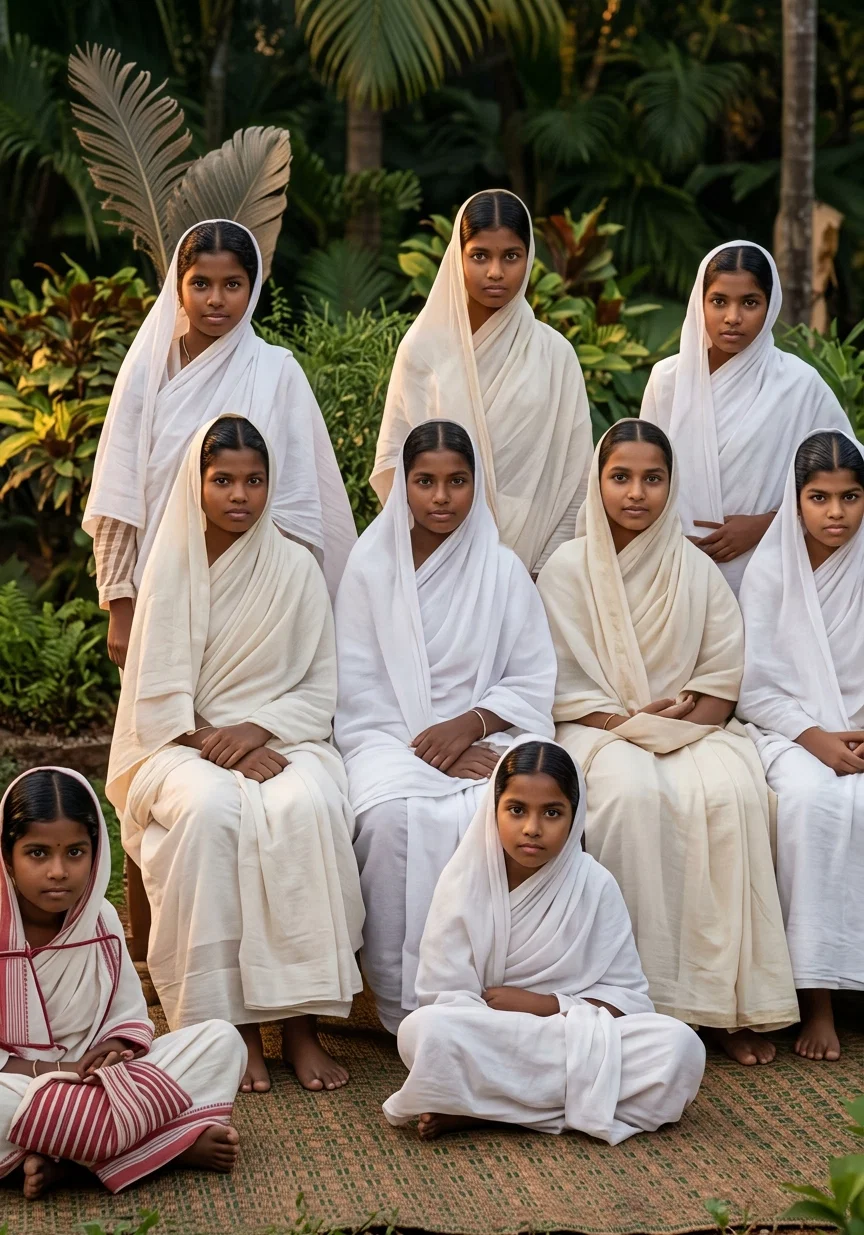
INDIAN GIRLS
In his effort to degrade the human race, Satan made his first attack upon woman; and to-day in India, with its idol-worship of more than three hundred million false gods, his diabolical work can be seen manifested against woman as in perhaps no other country under the sun.
This evil has not been brought about in a day or in a generation. History tells us that in the early days, when the Aryans first came from Western Asia, they were a noble race, and that their women held an honorable position. Sir W. W. Hunter says: “Women enjoyed a high position, and some of the most beautiful hymns were composed by ladies and queens. Marriage was held sacred. Husbands and wives were both rulers of the house, and drew near to the gods together in prayer.”—“Hunter’s Indian History,” page 55.
But “the dark places of the earth are full of the habitations of cruelty.” “Their sorrows shall be multiplied that hasten after another god.” This was so more than three thousand years ago, and it is just as true to-day, because it is according to an eternal law.
Under this false religion four castes were formed (more than 2,300 castes and tribes were named in the last census report): (1) The priest, or Brahman; (2) the warrior, or fighting companions of the king, called Rajputs,—literally, “of the royal stock;” (3) the agriculturists; and (4) the Sudras, or serfs. From these four divisions innumerable other castes have been formed. The Brahman, or priest, caste framed the laws, and made them a part of the religion of the people.
Besides the Vedas, believed by the devout Hindu of to-day to be the eternal, self-existing word of God, revealed by him to different sages, there are more than twenty-five books of sacred law ascribed to different inspired authors, who wrote or compiled them at various times, and on which are based the principles, customs, and religious institutions of the Hindus. Among these the code of Manu, composed in its present final form between 100 and 500 A. D., ranks highest. This moral and political code, as compounded by Manu, is reputed to have been revealed to that sage by Brahma himself; hence we can easily see what a wonderful influence it has on the mind of the Hindu. In his history of India, Epinstone says, speaking of this code: “Its statements relating to women are very copious; and while some of them are just and human, others of them are simply detestable.” To show how detestable are some of these rules, which are so rigorously adhered to by the Hindu, we will quote from the code the following:—
“Hear now the duties of woman! By a girl, by a young woman, or even by an aged one, nothing must be done independently, even in her own house.”
“Though destitute of virtue, or seeking pleasure elsewhere, or devoid of good qualities, yet a husband must be constantly worshiped as a god by a faithful wife.”
“No sacrifice, no vow, no fast, must be performed by women apart from their husbands; they will for that reason alone be exalted in heaven.”
“Day and night, woman must be kept in dependence by the males of her family. Her father protects [?] her in childhood, her husband in youth, and her son in old age; a woman is never fit for independence.”
“The wife is the marital property of her husband.”
“Let the husband neither eat with his wife nor look at her eating.”
“Stealing grain, base metals, or cattle, slaying women or the Sudras [inferior caste], and atheism are all minor offenses.”
These are but a few of many like statements in regard to the unfortunate women of India, and this sentiment is so firmly established in the minds of the Hindu people that it would take generations to root it out; nothing but the pure and undefiled religion of Jesus Christ can ever eradicate it. It is true that English rule has done something for Indian women, but law without public sentiment is, as we know, almost useless; then, too, so much that is degrading and against woman is couched under the guise of religion, that sometimes the situation looks hopeless.9
This diabolical system of false religion, born of satanic agency, has placed millions of women behind the purdah, where they are kept in greater bondage than that of an African slave. The wife is declared to be the marital property of her husband, and is classed with the cows, she-goats, mares, female camels, slave-girls, buffalo cows, and ewes.
Think of it, women! You who are enjoying all the privileges of freedom and education, think what it would mean to you to be kept in the back room of your own house; never allowed to eat with your own husband; never allowed beyond your own threshold without being accompanied by a guard, and so closely covered as to prevent your breathing the pure, fresh air that God intended for every creature. These women are kept in gross ignorance and superstition. Hindu mythology declares ignorance to be ‘woman’s chief adornment.’
My pundit said to me one day, when I had finished my language lesson: “I love my books. When I am tired or worried, I always find refuge in my books, and I always tell my wife never to allow me to be disturbed at such times.” To see what he would say, I asked, “And how about your wife? does she enjoy her books, too?” “O,” he said, a mingled look of amusement and contempt upon his face, “My wife is an ignoramus; she can not read. But she is a very obedient wife.” These words fell from the lips of a highly educated Hindu, long a teacher in one of the colleges of Calcutta. It is a part of his religion to see that his wife is kept in ignorance, while he is at liberty to go and come as he chooses, and to acquire an education and place among men.
But the purdah system, deplorable as it may be, is not the worst offspring of the Hindu religion. The most blighting evil connected with the whole system is child marriage, which means helpless widowhood to millions. It is encouraging to note that those who have been snatched from this cruel system, and given an opportunity, are bright and intelligent and very susceptible to good influences. May the time speedily come when many of these precious souls shall hear the gospel of the third angel’s message, and be saved for the soon-coming kingdom of our Lord.
Calcutta.
C. E. KNIGHT
By C. E. Knight
Argentina
C. E. KNIGHT
The annual conference of Argentina was held in Florida, a suburb of Buenos Aires, Nov. 2–12, 1910. This was about one month later than is customary, but it was thus arranged to permit the attendance of Elder L. R. Conradi, of Europe. No regrets were expressed on account of the change in time, and the attendance of our brethren was all that could be expected.
The conference was preceded by a five-days' workers' meeting, in which sessions were held twice each day. About twenty different topics were studied relative to plans and methods for more effectively presenting the truth. These were supplemented by forcible addresses by Elder Conradi after his arrival. His valuable suggestions on methods of labor were much appreciated, and will be helpful in prosecuting our future work.
Several important departmental meetings were held, which were full of interest, and served to demonstrate the growth of the various branches of the work and the possibilities before us. November 9 the new publishing-house was dedicated. Although the new machinery was not fully installed, a marked contrast was observed between our former facilities and what has now been provided to publish our periodicals and tracts.
November 10 an educational meeting was held, with an exhibit of industries which reflected much credit to both students and instructors. On the last day of the meeting, a Sabbath-school convention was held, a live interest being taken in the discussion of helpful papers and discourses upon different phases of Sabbath-school work. In all these various interests Elder Conradi was ready to aid with his wide experience and observation, and we were sorry that his stay was necessarily very short.
We were also favored with the presence of the following laborers other than those of the Argentine Conference: Elder J. W. Westphal, president of the union conference; Elder J. V. Maas, from Uruguay; Elders Julio Ernst and Luis A. Rojas, from Paraguay; and Elder Ignacio Kalbermatten, under appointment for the Bolivian Mission, and who has since started for that field. The conference officers were re-elected, with an executive committee of five.
The canvassing work was shown to be an effective method of reaching the people with the truth, and was made very prominent throughout the meeting. Brother Max Trummer, director of this work in the River Plate fields, was present, and organized a band of twenty canvassers, the larger part of whom are students who will work until school opens in March.
After the conference, a general meeting was held at the school near Diamante, for the benefit of the brethren in that part, who could not attend the conference in Florida. Elders Conradi and Westphal were present, and there was a good attendance and interest. After this meeting the sanitarium and school work received attention before these brethren left for Brazil to attend general meetings.
The year has been a prosperous one in the financial affairs of the Argentine Conference. In comparing the fiscal years ending June 30, 1909, and June 30, 1910, the gain in tithes and offerings is seen to have been fifty per cent for the latter year, the Sabbath-school offerings alone being one thousand dollars gold, and the tithe nearly ten thousand dollars. The severe drought and failure of the harvest this summer will no doubt affect our funds for the coming year; but we are broadening our plans in faith, and believe that the means will be forthcoming.
In Buenos Aires tent-meetings are in progress, the first of their kind in the city. Some interest is already shown, even though the meetings have just begun. Interested families are being discovered in other parts of the city, and we expect to develop the work so as to organize a second church in this great city during the coming year. Our brethren here are becoming aroused concerning the needs of the large cities; and at the conference, pledges and cash were received to the amount of six hundred fifty dollars gold for a city mission fund.
Buenos Aires.
The Campa Indians of the Upper Amazon
By T. E. Bowen
T. E. BOWEN
In the Bible in the World for November, 1910, H. H. Pulling gives a very interesting account of his adventures among the Campa Indians on the headwaters of the Amazon, where the gospel, as found in the Bible, had not hitherto entered. He explains that this tribe is located principally in that portion of Peru between 10° and 12° latitude south, and 73° and 75° longitude west. He estimates the Campa Indians to number between seventy and one hundred thousand, the largest tribe, excepting the Quichuas, in Peru.
The region where they live is hilly, and has scarcely been explored. The Indians scatter themselves over the face of the country by single families, and in obscure corners. They are also nomadic, and can not be counted upon to stay in the same place for any length of time. They are commonly found along rivers in which fish are plentiful.
The road leading to the place which this tribe inhabits, is the only one in all that section, and even it, Mr. Pulling says, hardly deserves to be called a road. It leads back into the country for two hundred miles, and, in many places, narrows down to a mere track eighteen inches wide, threatened on either side by encroaching vegetation. It is only from April to September that the road is usable, as the rains are almost incessant during the rest of the year. About every fifteen miles, public inns are stationed, where a meal, and sometimes a bed, may be obtained. Outside of this, almost the sole inhabitants are Indians. In describing them, Mr. Pulling says:—
“I found the Campas an intelligent race, remarkably honest, frank, and truthful. Though docile as a rule, they are reserved and suspicious. Generous in disposition, they willingly share with one another, and with the traveler, whatever food they may have. They are accustomed to take life easily, and are great laughers. The laughter of a Campa is something which must be heard to be appreciated. It sounds forced, however, and lacks the ring of true10mirth. Beginning on a low note, the laugh goes up by a series of jerks to a high pitch; at the same time the face reveals but little, and is instantly composed, and the eyes resume their usual lack-luster appearance.”
“In color the Campas are a coppery brown. Though not tall, they are well built, with strong, muscular bodies, and well-formed limbs. Their foreheads are somewhat flat, and their eyes strongly almond-shaped. Their hair is black, straight, and coarse, and is worn fairly long.”
“Their only dress is the cushma, which is worn by both sexes. This garment extends from the neck to the feet, and is best described as a sack turned upside down, with slits left, through which to pass the head and arms. It is woven of wild cotton, and dyed a rich nut-brown, so that the cloth has the appearance of coarse, unbleached calico. The Indians say that their fathers used to go unclad, until some men (probably the Jesuits) came and taught them to make the cushma.”
“Like most savage races, they are fond of ornaments, which are worn almost as much by men as by women. Their favorite decoration is the skins of birds of bright plumage. The men usually wear a band of split cane about an inch wide, which sets on the head like a coronet, and serves to keep the hair down. This, with a tall feather standing up at the back, gives them a rather stately appearance. Necklaces of birds, seeds, monkey’s teeth, etc., are freely worn. They also paint and mark the face and arms, and sometimes the entire body, with red and black dyes. I saw no signs of tattooing.”
“Evidently they consider a broad, flat nose beautiful, for I frequently met men and women with pieces of sticks passed through the inner cartilage of the nose, to extend the nostrils.”
“Their houses are simple roofs, thatched with palo leaves, standing on four corner poles, and serve for little more than shelters from the sun and rain. Furniture they have none, except a few earthen pots to hold their favorite drink, with a bundle of bows and arrows, and odds and ends. They prefer to build on a sunny spot upon the shoulder of a hill, and they usually depend upon the river for fish, though they choose to live retired from its banks.”
“The only native weapon is the bow, to which the Campas accustom themselves from childhood, using it with great skill. They shoot up into the air, so that the arrow falls down upon the prey or foe. Arrows are made in different shapes and lengths, and are pointed with bone or hard wood. They are sometimes poisoned.”
“The Campas can not be called industrious. The men especially are idle. Almost all work falls on the women, while their lords lie around the fire, no matter how hot the weather. It is common to see a woman carrying a large, heavily laden basket hung on her back and suspended by a broad band around her forehead.”
“Notwithstanding the wonderful fertility of their country, the Campas live a hand-to-mouth existence. During the wet season, they are often driven to eat snails and mice. The Campa does not build his house to last, and it is pulled down upon the slightest impulse,—from a vague suspicion that an enemy is about to make a raid, or from a sudden desire to seek other fruitful hunting-grounds, or even from pure restlessness. He will eat gluttonously of whatever food may come to hand, and suffer hunger to-morrow.”
“The average age of the adult Campa is only thirty-five years. This is due, doubtless, to their ignorance regarding the common laws of health. They are great lovers of the water, and swim with ease; they are also skilful in making dugout canoes, for which they employ the giant cedars of the forest. When shooting the river rapids, the Indians keep up a continuous whistling as they ply the paddle, nor does a ducking at all disconcert them. Should the raft ‘turn turtle,’ they keep laughing, and speedily right it again, going on as if nothing had happened.”
“Polygamy is common, but it is seldom that a man has more than two wives. Marriage is accompanied by no other ceremony than a dance lasting all night. When a wife dies, it is common for her husband to kill or cast adrift the younger of her children.”
“Like most savage tribes, these folk also have their medicine-man, whom they credit with power to bewitch and kill at his pleasure.”
“The Campa language would not be difficult to master. Roman Catholic priests have compiled a prayer-book in this tongue; but so far as is known, no portion of the Bible has yet been translated into the language.”
“So far as I could ascertain, the Campas have no religion. They seem to have no idea of God, and stoutly deny that they worship idols. Upon every opportunity I closely questioned them on this subject, and was met every time with a blank denial. In his notes upon the tribes of the Upper Amazon, Mr. Bates, the naturalist, significantly remarks: ‘None of the tribes of the Upper Amazon have any idea of a Supreme Being, and consequently have no word to express it in their own languages.’ This certainly would appear to be correct concerning the Campas.”
Here is a large tribe of Indians, within the borders of the New World, in dense heathenism. They literally know not God. They know not that Jesus has been sent into the world to save sinners. But God loves these children of the forest. Some one must teach them of the love of God. What a precious work it would be for missionaries, whose hearts have been touched with the third angel’s message, to pioneer the work of giving the gospel to them!
Takoma Park, D. C.
Ramabai's Wells
THOSE who have visited Pandita Ramabai's settlement, at Mukti, India, will remember the large wells, with their abundant supply of water. The Mukti Prayer Bell tells of the naming of these sources of life after the names of the fruits of the Spirit,—Priti (Love), Anand (Joy), Shanti (Peace), Dhir (Long-suffering), Upakar (Goodness), Vishvas (Faith), Kripa (Mercy), Upalati (Springing Up), Sanjeevani (Reviving), Asha (Hope).
On the morning of April 7, 1910, Pandita Ramabai and a number of her workers and visitors met for praise and prayer with the workmen at a spot which had been chosen for a new well. The fifty-fifth chapter of Isaiah was read, a chapter which the Christian workmen who were about to dig the well had learned by heart. It was remarked by a worker that the men would often think of that chapter as they worked in the sun. The name of the new well is Jehovah-Shammah.
The spot is already marked for another well, which is to be called Jacob's well. It is to be on the roadside, where any passers-by may have a drink of water, and hear the gospel of Jesus Christ. “Please pray,” says the Prayer Bell, “that the wayfarers may hear, believe, and be saved.”—Bombay Guardian.
The Message Reaches Cartagena
“THERE was one sister that I greatly enjoyed seeing,” writes Brother Guy Dail, from Spain; “she is a fresh convert to the message from that oldest city in the country — Cartagena — which was settled, so I am informed, by Hasdrubal and the Carthaginians in B. C. 228, and served as a rendezvous for them in the Punic Wars. This sister is a shopkeeper in that old city. She found the truth through one of our canvassers. She was so happy to receive the message, and with a joyful heart she carried it to her friends; but they only looked at her coldly, and warned her against the heresy. However, she kept on reading and studying, and felt sure of the genuineness of the Bible truths God has given us for this time, and stepped out in the face of great persecution. Another believer was baptized from Cartagena at the meeting, so there are now two in that city. I am so glad that already we have the work started, at least, in seven of the forty-nine provinces of that land.”
The Secret of a Victorious Life
“THERE is in the heart of every man an earnest desire to know how he may be victorious in the time of temptation. There is one sure way of escaping from the overmastering power of the tempter, and that is to keep busy. When David was idle, he sinned; when Peter was not toiling, he failed; and it was when you were drifting idly along in Christian experience, that you denied your Master. The secret of a victorious life is to keep busy.”
The Printed Page
By Editor
Editorial
The Printed Page. — As the publishing work was well established in the ’60’s, our brethren were urged to greater earnestness in scattering the printed page. We read, in our early volumes, of a brother who read himself into the truth in Canada, and came all the way to Battle Creek to learn further. The brethren started him home again with two wheat-sacks full of publications to scatter.
Broadcasting the Seed. — Writing from Monterey, Mich., in March, 1869, Elder Joseph Bates, who had published our first Sabbath tract in 1846, said of his methods of work:—
Mingling with fellow passengers on the highway, plank, and railroads, I find many who gladly receive and read the interesting tracts presented to them. And thus with railroad speed these little flying messengers are passing throughout our vast continent, and crossing the trackless ocean to other kindred, nations, and people.
A Watchful Providence — How one torn leaf, under a watchful Providence, was used to kindle a light in Wisconsin, was told by Brother John McMillan, of Saint Croix County, in the REVIEW of Feb. 15, 1870. Five years before, he says,—
I had seen part of a leaf of a tract on the Sabbath, which I picked up in an army hospital. The leaf had been torn diagonally; but there was enough left to cause me to search the Scriptures as I had never done before.
So he found the truth, and was scattering the publications in his home county. A bountiful harvest has come from those earlier times of seed-sowing.
Leading the Campaign. — The REVIEW of Nov. 9, 1869, opened a “Book and Tract Department,” edited by James White, to foster the missionary campaign. He wrote:—
The field is opening before us wonderfully. May God help us to take it, and labor in the harvest-field till the work be finished. At present the laborers are few. Much must be done by our publications.
And this campaign is still with us, more pressingly than ever. If the ministerial laborers have increased since those times, so has the field expanded, and the need of workers is just as pressing, and the scattering of literature just as imperative as a means of supplying the need.