1. Is there any phase of the Hawaiian question into which the Church and State principle enters? 2. Has republicanism a divine right? 3. Will the United States become the moral and religious arbiter of the world? 4. Is this the mission of our Government? 5. What is the nation’s present duty?
In answer to the first question it is sufficient to cite an extract from an article in the December number of the North American Review, entitled, “Our Present Duty,” by the Hon. William M. Springer:—
The pretext for this intervention (with the government of the Hawaiian Islands) is based upon the alleged fact that the government of the queen of the Hawaiian Islands was a “semi-barbaric monarchy resting on no solid or moral foundation, dead in every thing but its vices, coarsely luxurious in its tastes and wishes, constantly sending out impure exhalations, and spreading social and political demoralization throughout the islands.” This is the indictment made against the monarchy by the late minister, Mr. Stevens, who, after leaving the islands, further assails the government to which he was so recently accredited as a diplomatic representative, by charging that the queen has sustained scandalous and immoral relations with one of her ministers. This being the alleged condition of the government of Hawaii, an appeal is made to the moral sentiment of the American people to justify the overthrow of that government and establish in its stead what its friends and supporters have denominated “a Christian government,” by which we may assume, is meant a government whose administrators profess the Christian religion.
It may be freely said that this is but one, and among the first, of the perplexing diplomatic questions which the Government of the United States will be called upon to settle, now that she has enlisted herself in the crusade of the nineteenth century, first, by denominating herself a “Christian nation,” and then, by her “Christian” legislation in ordering the gates of the World’s Fair closed on Sunday, to preserve the sanctity of that day.
While important considerations, other than the moral phase of the Hawaiian question, arise, it is nevertheless true that one of the main, if not the main prop of Ex-Minister Stevens’ plea for annexation, rests upon morality or “Christian civilization,” as any one will readily conclude by reading his “Plea for Annexation,” in the December number of the North American Review. The opening sentence of this plea is:—
A grave question is now before the American people, the wrong solution of which will deeply affect the moral standing of the United States before the world; followed by the question, “Will the American nation stand by its century’s record in favor of republican government and of free Christian civilization, or will it repudiate its past by using its power to murder its offspring and to stamp out the reforming work of pure and noble men and women who have made the Hawaiian Islands what they are, thus following the once infamous example of the Austrian Hapsburgs in stifling the noble aspirations of Italy and Hungary?”
So, according to Mr. Stevens, the grave question before the American people in regard to the Hawaiian annexation, is its “moral standing,” and whether it will maintain its record in favor of “free Christian civilization,” or follow the “infamous example of the Austrian Hapsburgs.” The truth of the relation of the Austrian Hapsburgs to Italy and Hungary was whether Austria or Italy should be its own pope and oppress the other; and whether Hungary should maintain national Protestantism or whether the papal house of Hapsburgs should domineer. So they went to war over these questions and Austria gained supremacy over Italy for the time being, and put down Protestantism in Hungary.
Now, shall the United States “stifle the noble aspirations” of Hawaii by letting her alone, or shall she compel her to become “Christianized”? While Mr. Stevens himself would follow the “infamous example” of the Hapsburgs, in persuading the United States Government to enforce “Christianity” upon Hawaii, which is the papal principle and ought not to be supported, yet is it not a difficult question for the United States to settle and be consistent with the position to which she has committed herself in national compulsory Christianity? Isn’t Stevens’ plea consistent with our nation’s recent conduct in religious legislation? And isn’t she bound to listen to his plea or repudiate this religious legislation to which she has committed herself and shake herself clear of it? Can she not see that in transforming her republican and liberty-loving character to that of a religious despot, she has taken a long step downward toward decay and ruin, and that she has committed herself to a course which will inevitably lead her to destruction?
As further evidence that morality is one of the mainstays of Mr. Stevens’ plea for annexation, read the following extract from President Cleveland’s message to Congress on the Hawaiian question, which shows that he not only recognized the moral side of Stevens’ plea, but even regards it the most prominent and places it first in characterizing that plea. Speaking of Stevens, he says: “He addressed a long letter to the Secretary of State, in which the case for annexation was elaborately argued on moral, political and economical grounds.” It is rather significant that the President does not, in this21message, antagonize this phase of Stevens’ plea.
The national Government has not granted and may not grant Stevens’ plea, on the basis of morality or on any basis, but she is bound to meet questions of this very nature at every turn she makes henceforth.
The question as to whether the American nation will “stand by its century’s record in favor of republican government,” introduces our second question, “Has republicanism a divine right?” Let Hon. Mr. Springer answer in the forcible language of the same able article referred to:—
There is no divine right of republicanism in this world, any more than there is a divine right of kings. The divinity in all these matters is in the right of the people to govern themselves. . . . Our own right to self-government is no more sacred than the right of the handful of ignorant Hawaiians in the Sandwich Islands to govern themselves. If they prefer a monarchy, feeble and inefficient though it may be, it is their business, and not ours.
But, now, since the Government has decided that the individual has no right to govern himself in matters of religion, but that he must obey the dictates of this “Christian nation,” does it not logically and inevitably follow that the same principle will permeate her diplomatic attitude toward other nations? If this be a “Christian nation,” then, since it is republican, is not republicanism Christianity? And if this “Christian nation” can enforce Christianity, can it not enforce republicanism? This is a logical result of the assumption of this nation that it is Christian, and hence can regulate Christian practices.
Will the United States become the moral and religious arbiter of the world? Hon. Mr. Springer has the following to say:—
But it is claimed that the provisional government is one composed of Christians, and that they are representatives of advanced civilization. The United States, being a Christian nation, should sympathize with and render moral and material aid in sustaining that government; and it is alleged that we have no right to consent to its overthrow. It may be conceded, for the sake of argument, that the provisional government is composed of Christians, and that it more nearly corresponds to our ideas of a just government than does the government of the monarchy; but, as suggested before, this is foreign to the controversy. We have no more right to interfere on this ground with the government of Hawaii than we have to interfere with the government of China or Japan or Turkey, none of which are Christian or administered by Christian statesmen, and none of which, we have a right to assume, are any more just to the subjects of such government than is the monarchy of Hawaii to its subjects.
Such a claim would make the United States the moral and religious arbiter of the world; would constitute us self-appointed crusaders, going about the earth pulling down and destroying alleged heathen and semi-barbaric monarchies, and establishing Christian governments and civilization in their stead.
This language is clear and forcible, and the argument is invincible, yet it cannot be accepted by the United States Government, because it has already assumed the right to interfere with the Christianity of the individual, and in order to be consistent with itself it must assume the right to interfere with governments or nations, and hence cannot accede to Mr. Springer’s argument, whatever weight it might have had upon Congress before it enlisted in this religious warfare. Congress cannot ignore Mr. Stevens’ plea. Having adopted the papal principle, it cannot reject a measure based upon it, without repudiating this principle and retracting its course directed by it. Unless it does retract its course it is destined to become a moral and religious arbiter whenever diplomatic questions arise involving the services of one.
Is this the mission of our Government?
President Cleveland says in the message referred to:—
If national honesty is to be disregarded and a desire for territorial extension, or dissatisfaction with a form of government not our own, ought to regulate our conduct, I have entirely misapprehended the mission and character of our Government and the behavior which the conscience of our people demands of their public servants.
Hon. Mr. Springer says:—
This is not the mission of our Government. Whether the government of Hawaii was a just one, a moral one, or an efficient one, is a matter which does not concern the American people. We have no more right to overthrow a monarchy in Hawaii because it does not conform to our ideas of a just government, than we have to overthrow a monarchy in Canada or Great Britain, or Russia or Turkey, or Spain or elsewhere. If we have any concern as to the imperfection of these so-called barbaric governments, we may send our missionaries to them to convert them to our religion or send our statesmen among them to convince them of the superior advantages of our form of government. But to send our naval forces to the ports of other governments, to land them upon their soil, and to allow them to be used for the purpose of overthrowing, in connection with foreign subjects or aliens, the established government would make our Christianity a fraud and our boasted republicanism a mockery.
What will she do?
W. E. HOWELL.
Study the Texts Again.
By C. P. B.
The Christian Reformer, formerly the Political Dissenter, has in its issue of January 6, this editorial note, which we give entire:—
The AMERICAN SENTINEL, in commenting on the recent National Reform Convention, says that Rev. W. F. Crafts, who discussed “The Kingship of Christ, forgot to mention, or did not know, that while the Kingship and Saviourship are frequently mentioned in close connection, the two offices do not in fact run contemporaneously. It is when Christ comes again that he comes King of kings and Lord of lords. ‘Christ is now a priest upon his Father’s throne.’ Will the editors of the SENTINEL please study again the passages of scripture which speak of Christ’s exaltation? The time is yet to come when all things shall yield obedience, but he is now Lord of all. “He must reign till he hath put all enemies under his feet.” The SENTINEL thinks he will not reign till this is done. Like Melchisedek he is a priest upon his (not his Father’s) throne. Melchisedek was king of Salem while he was priest of the most high God.
Our most serious objection to this note is that it squarely contradicts the Scriptures. In Rev. 3:21 we have recorded the words of our Lord himself, telling us what throne he now occupies: “To him that overcometh will I grant to sit with me in my throne, even as I also overcame, and am set down with my Father in his throne.” Again in Heb. 8:1 we have this testimony: “Now of the things which we have spoken this is the sum: We have such an high priest, who is set on the right hand of the throne of the Majesty in the heavens.” This is positive but it is not all there is directly on this subject. Zech. 6:12,13 is equally conclusive: “Thus speaketh the Lord of hosts, saying, Behold the man [Christ] whose name is the BRANCH; and he shall grow up out of his place, and he shall build the temple of the Lord [the Father]: even he [Christ] shall build the temple of the Lord; and shall bear the glory [of the Lord, the Father], and shall sit and rule upon his [the Father’s] throne; and he [Christ] shall be a priest upon his [the Father’s] throne: and the counsel of peace shall be between them both.”
The present position of Christ cannot be mistaken by the devout student of the Scriptures. He is a priest upon his Father’s throne; “and the counsel of peace” is “between them both.” Says the apostle: “We have not an high priest which cannot be touched with the feeling of our infirmities; but was in all points tempted as we are, yet without sin. Let us therefore come boldly to the throne of grace, that we may obtain mercy, and find grace to help in time of need.” Heb. 4:15, 16.
Thus it is seen the throne occupied jointly by the Father and by the Son is the throne from which mercy or grace is dispensed. It is plainly called “the throne of grace.” And as there can be no throne without a kingdom, the text in effect asserts a kingdom of grace. In this kingdom Christ is a priest-king “after the order of Melchisedek.” But Christ has not yet entered upon the possession of the dominion promised him as the seed of Abraham (Gal. 3:16 and Luke 1:31,32). The Jews would have taken him by force to make him king; and now National Reformers are attempting the same thing in effect, namely, to themselves seize civil power in Christ’s name and to rule in his stead. But Christ has himself told us (Matt. 25:31-34), when he will take the kingdom: “When the Son of man shall come in his glory, and all the holy angels with him, then shall he sit upon the throne of his glory: and before him shall be gathered all nations: and he shall separate them one from another, as a shepherd divideth his sheep from the goats: and he shall set the sheep on his right hand, but the goats on the left. Then shall the king say unto them on his right hand, Come, ye blessed of my Father, inherit the kingdom prepared for you from the foundation of the world.” Evidently the editor of the Christian Reformer should “study again the passages which speak of Christ’s exaltation.”
C. P. B.
Christ and the Sabbath.
THE SABBATH NOT A BURDEN.
God never intended that the Sabbath should be a burden to any one, but rather a blessing; and he will now make it such to all who honor him in its observance.
We read of the testimony that the Father bore of Christ when he was here upon the earth (Matt. 3:17): “And lo a voice from heaven, saying, This is my beloved Son, in whom I am well pleased.” Another translation gives this version of this text: “Lo a voice out of the heavens, saying, This is my Son, the beloved, in whom I did delight.” Read, in connection with that, the prophecy of Isa. 42:1: “Behold my servant, whom I uphold; mine elect, in whom my soul delighteth.” This is a prophecy of Christ. So, when Christ came, the testimony was, “This is my Son, the beloved, in whom I did delight.” Now read that familiar Scripture in the fifty-eighth chapter of Isaiah, the thirteenth verse: “If thou turn away thy foot from the Sabbath, from doing thy pleasure on my holy day; and call the Sabbath a delight, the holy of the Lord, honorable; and shalt honor him, not doing thine own ways, nor finding thine own pleasure, nor speaking thine own words, then shalt thou delight thyself in the Lord.”
Another translation brings out the idea in a little plainer way, although not changing the sense at all. It says: “And hast cried to the Sabbath, ‘A delight.’” Our version says, “And hast called the Sabbath a delight;” this translation says, “And hast cried to the Sabbath [called22out as the Sabbath came], ‘A delight!’” and to the holy of the Lord cried out also, “Honored!” Put these texts together. The prophecy in Isa. 42:1, speaks of Christ as God’s delight; and when Christ came, the record is in Matt. 3:17, “This is my Son, the Beloved, in whom I did delight.” When the Sabbath comes, we are instructed to call out to it, to cry to it as it comes, “A delight!” Why?—Because he in whom the Lord did delight, the delight of the Lord, the delight of the soul, is in the Sabbath. Jesus Christ is in the Sabbath, and so when the Sabbath comes, we are to call to the holy of Jehovah, “Honored!” It is the holy of Jehovah. And Christ was the holy child Jesus, and it is the holy day because Christ is there in the day. And the Scripture says that if we do call to the Sabbath, “A delight!” and to the holy of Jehovah, “Honored!” “then shalt thou delight thyself in the Lord.” Why?—Because the Lord, who is the delight of the soul, is in the Sabbath.
And so we shall delight ourselves in the Lord on the Lord’s day. That makes the Sabbath a glorious thing. At every step of the way, when it is properly understood, the Sabbath is suggesting Christ and his work for us. At every point it is Christ and his power; it is the creative power pledged for our redemption. It is the sign of Christ to bless, to give rest, to make holy, to sanctify. It is the sign of Christ, the delight of the soul; it is the sign of Christ, the Holy One. It is the sign of Christ, whom we are to honor. As the Sabbath suggests at every point, Christ as Creator, as Redeemer, as Saviour, and as we are to honor the Son even as we honor the Father, it is therefore impossible that one should honor Christ when he knowingly dishonors Christ’s day. For that reason no people can exalt Jesus Christ as the people who honor him in the observance of the day which he has blessed and sanctified. Therefore, there is no way in which we can exalt Jesus Christ from first to last, as Creator, as Redeemer, as Saviour, when we knowingly and willfully trample upon the seventh day, the day which he has blessed and sanctified.
THE SABBATH A SIGN OF GOD’S POWER.
Notice what a close connection there is between the power of God as manifested in creation and the Sabbath idea. The ninety-second Psalm is a psalm, or song, for the Sabbath day. That is the title of the psalm. “It is a good thing to give thanks unto the Lord, and to sing praises unto thy name, O Most High; to show forth thy loving-kindness in the morning, and thy faithfulness every night, upon an instrument of ten strings, and upon the psaltery; upon the harp with a solemn sound. For thou, Lord, hast made me glad through thy work; I will triumph in the works of thy hands.” How is it that the Lord makes us glad?—Why, when we behold his works, and behold his power in those works, we remember that that power is pledged to us for salvation. And so we triumph in the works of his hands, and it is indeed a psalm, or song, for the Sabbath day, because that day reminds us of the power of God in Christ manifested in creation, and with that comes the blessed assurance that he who has created has also redeemed. The Creator is the Redeemer. The power in creation is the power in redemption.
The Sabbath always will be, a sign of the power of God manifested through Christ. The reason given in the commandment for setting apart the seventh day as the Sabbath, is, that “in six days the Lord made heaven and earth, . . . and rested the seventh day.” The Sabbath day, therefore, is a sign of creative power. This sign of creative power always calls our attention to the One who made the heaven and the earth; and it is true that if the Sabbath had always been kept, there never would have been any false religion or idolatry; for the minds of men would have been constantly kept upon the true God, the Creator of the heaven and the earth, as revealed in Jesus Christ.
And the Sabbath is the one sign to men of this creative power of God whenever it is manifested. There is a striking example of this in the experience of the children of Israel: “For ask now of the days that are past, which were before thee, since the day that God created man upon the earth, and ask from the one side of heaven unto the other, whether there hath been any such thing as this great thing is, or hath been heard like it? Did ever people hear the voice of God speaking out of the midst of the fire, as thou hast heard, and live? Or hath God assayed to go and take him a nation from the midst of another nation, by temptations, by signs, and by wonders, and by war, and by a mighty hand, and by a stretched-out arm, and by great terrors, according to all that the Lord your God did for you in Egypt before your eyes?” Deut. 4:32-34. Mark the inquiry. You ask from one end of heaven to the other, and you go back to the very day that man was created, the first display of creative power, and inquire whether there has been from that time to this present time such a display of the power of God as was seen in the deliverance of the children of Israel from Egypt.
A moment’s thought will show that it was creative power then displayed. This people were delivered by signs and wonders, which were a display of creative power. It took the same power to change Aaron’s rod into a serpent when it was cast down before Pharaoh as it did to create the serpent in the first place. It took the same power to bring darkness over all the face of the land—darkness that could be felt—and yet have light in the dwellings of the children of Israel, as it took in the first place, when God said, “Let there be light,” and there was light. It took the same power to divide the waters of the Red Sea, that the children of Israel could go through on dry land, as it did in the first place when the waters were created. That is, there was at that time a display of the creative power of God. So, after the children of Israel had been delivered by such creative power, the Sabbath obligation was repeated, and the Lord said: “And remember that thou wast a servant in the land of Egypt, and that the Lord thy God brought thee out thence through a mighty hand and by a stretched-out arm; therefore the Lord thy God commanded thee to keep the Sabbath day.” Deut. 5:15. Some make the mistake of thinking that the Sabbath was merely a sign to the children of Israel of their deliverance from Egypt, and has nothing to do with any other people. The fact is simply this: In the first place, the Sabbath was the sign of creative power. When the children of Israel were delivered from Egypt, that same power wrought for their deliverance. When the same God uses the same power, he calls attention again to the same sign as the sign of that power; and so to the children of Israel after their deliverance, the Sabbath was a sign of God’s creative power manifested through Christ in making the heaven and the earth, and it was also a sign of his creative power in delivering them from the land of Egypt.
But the deliverance of the children of Israel from the land of Egypt is but a type of the deliverance of the Christian from the power of sin. The Israelites could not observe the Sabbath while in bondage. God delivered them by his own creative power, and thus opened the way for them to keep his Sabbath. He then called attention anew to the Sabbath as the sign of that power which had delivered them, and upon which they were to depend in all their experiences through to the promised land.
(To be continued.)
Who Pays the Taxes?
THE following is a complete list of the religious denominations owning property in the State of Ohio, together with the value of their holdings. These figures are from the Allied American, of Cleveland, Ohio, and are significant when we realize that this property, amounting to nearly forty-two millions of dollars, is exempt from taxation:—
Church of the New Jerusalem — $103,500
Cumberland Presbyterian Church — $60,500
Reformed Episcopal Church — $33,709
German Evangelical Synod of N. America — $836,200
German Evan. Protestant of N. America — $438,800
Amish Mennonite Church — $17,850
Apostolic Mennonite Church — $1,200
Reformed Mennonite Church — $6,350
Mennonites Brethren in Christ — $6,100
Brethren or Dunkards (Conservative) — $153,365
Brethren or Dunkards (Progressive) — $30,709
Wesleyan Methodist Church — $46,500
Independent Churches of Christ in Christian Union — $114,350
Reorganized Church of Latter-day Saints — $43,000
General Synod Lutheran — $1,039,950
General Council Evangelical Lutheran — $483,100
Synodical Conference Evangelical Lutheran — $409,975
Joint Synod of Ohio Lutheran — $839,272
Norwegian Evangelical Lutheran — $3,000
German Augsburg Synod, Lutheran — $26,800
Immanuel Synod, Lutheran — $25,500
Independent Congregational Lutheran — $122,000
Reformed Church in America — $8,100
United Presbyterian — $697,550
Salvation Army — $875
Advent Christian Church — $20,500
Seventh-day Baptist — $3,000
Brethren in Christ — $14,100
Moravian Church — $37,400
Roman Catholic Church — $7,395,640
Mennonite Church — $34,450
Old Mennonites — $5,765
Defenceless Mennonites — $2,800
African Methodist Episcopal Church — $318,250
Church of God — $99,550
Society of Shakers — $5,600
Society of Separatists — $3,000
Communistic Societies — $8,000
Reformed Church in the United States — $1,128,275
Christian Reformed Church — $19,500
Orthodox Jewish Congregational — $67,000
Reformed Jewish Congregational — $636,215
Society of Friends (Orthodox) — $202,250
Society of Friends (Hicksite) — $61,350
Society of Friends (Wilberite) — $24,900
Reformed Presbyterian in the U. S. A. — $55,600
Reformed Presbyterian in North America — $36,500
Associate Church of North America — $6,800
Spiritualists — $3,350
Presbyterian Church in the U. S. A. — $5,754,350
Welsh Calvinistic Methodist Church — $111,575
Disciples of Christ — $1,462,250
Christians or Christian Connection — $392,500
Evangelical Association — $491,975
Primitive Methodist Church — $2,400
Seventh-day Adventists — $25,450
Methodist Episcopal Church — $8,749,970
Congregational Churches — $2,044,525
Protestant Episcopal Church — $2,069,787
Methodist Protestant Church — $441,000
Free Methodist Church — $29,900
Evangelist Missionary Church in America — $800
Universalist Church — $344,80023
Unitarian Church — $80,000
African M. E. Zion Church — $13,000
Free Will Baptists — $149,359
Old Order Brethren (Dunkards) — $44,000
Churches of God in Christ Jesus — $21,500
Regular Baptists (North) — $2,543,888
Primitive Baptists — $88,090
Old Two Seed Baptists — $400
United Brethren in Christ — $1,198,870
United Brethren in Christ (Old Const.) — $237,940
Plymouth Brethren III. — $100
Christian Scientists — $14,000
Independent Congregations — $22,800
Total — $41,993,257
Of the sum total of this property and its exemption from its just share of taxation, the Kansas City American says:—
What an enormous sum! How many laborers would have to bunch their property to equal that figure if each one was worth $2,000? You will be surprised at the number. We find it would equal the holdings of 20,997 laboring men. Think of it! Nearly 21,000. If each State equalled the Ohio record there would be nearly $2,000,000,000 worth of untaxed Church property in the United States, which would equal the holdings of more than 1,000,000 laboring men; of more than 500,000 merchants or of more than 1,000,000 farmers. While some of the States are not so unfortunate, some of them are even worse off, and from the above figures we believe the people will soon have to cast about for a remedy, or awaken some day and find the country in the same condition England was at one time, in the same predicament that Mexico and France were, and in the same position every country has found itself which has granted Church property immunity from taxation. In such countries the Church grew richer and the people poorer until the government found it necessary to confiscate the holdings of the church in order to perpetuate or lengthen its own existence.
True the trouble in those countries was due to the insatiable greed of the Roman Catholic Church; and you may say there is no immediate danger from that church in this country. . . . Let us review the table published in the Allied American.
We find there are seventy-six denominations in the State of Ohio holding $41,993,257 worth of property, and that the Roman Catholic Church holds more than one-sixth of the whole amount. In other words, the Roman Catholic Church holds $7,395,640 or more than the Immanuel Synod (Lutheran), the Presbyterian Church (in all its branches), the Salvation Army, the Seventh-day Baptists, the Norwegian Evangelical Lutheran, the Orthodox Jewish, the Primitive Methodist, the Reformed Jewish, the Christian Scientists, the German Augsburg Synod (Lutheran), and the Spiritualists—more than all these combined. The Roman Church owns more property than the Wesleyan Methodist, the Reformed Episcopal, the Congregational Churches, the Protestant Episcopal, the Methodist Protestant, the Free Methodist, the A. M. E. Zion, the Free Will Baptists, the Regular Baptist (North), the Society of Shakers, the Society of Separatists, and the Reformed Church in America. In fact, the Roman Church has more property in Ohio than sixty-four of the seventy-five denominations reported. The holdings of these sixty-four denominations only aggregate $6,837,280, while the total holdings of the Church of Rome reach the enormous figure of $7,395,640. Of the ten remaining denominations the Church of Rome is possessed of more property than one-half of them combined. To be plain, the Church of Rome owns $7,395,640 worth of property and five of the remaining denominations own but $6,497,817 worth. She has more than three of the five remaining denominations and $138,480 worth more than one-half of the combined holdings of the remaining two denominations, and excelled by but one.
In the face of these figures what sane man will contend that there is no danger to the country if the hoarding of the Roman Catholic Church is allowed to go on unchecked; in fact, if we continue to pay her a premium to accumulate and hold vast and valuable tracts of land? The weaker denominations will not object to their property being assessed, but Rome will fight for immunity from taxation to the end. She will resort to anything in order to defeat men who may be nominated for office who favor the taxation of Church property.
A few years more of crafty scheming by the Church of Rome, a few years of inactivity by Protestants, and the liberties which they pretend to prize so highly will be a mere faint recollection. Liberty will be defined obedience; religious toleration will be measured by the Inquisition; and free speech will mean “that which the church authorizes.” Would this suit you?—It would not. Then your duty is plain. Take care of your birthright.
But will the American people heed the warning? Will they take care of their birthright? Will they?
The evil complained of is a gigantic one; but is Rome alone at fault? How about the larger amount of untaxed property held by the Methodist Episcopal Church? And why is nothing said about that immense sum? If, as is intimated by the American, the willingness to pay taxes decreases in direct ratio to the increase of the value of the exempt holdings, the Methodists must be more unwilling to pay their just share of the taxes than are the Catholics. And if the evil, as is also intimated, is proportional to the value of the exempted property, is not the Methodist Episcopal Church in Ohio, the greater sinner? But we do not think that the evil is to be determined in any such way. The principle is wrong. One of the denominations named has officially admitted this, namely, the Seventh-day Adventists; and at their General Conference, in Battle Creek, Mich., last March, they passed a resolution declaring in favor of the taxation of Church property, and expressing their willingness to bear their just proportion of the burden of supporting civil institutions. Will the Methodists be as truly Protestant?
Some Pertinent Questions.
THE NEW YORK Voice, very religious, and fanatically prohibitive, is nevertheless in some degree amenable to reason and in a measure susceptible to the promptings of the spirit of justice. Referring to the persecution of the Adventists in Maryland and other Southern States, it says:
These people are, we assume, sincere in their religious beliefs, and they are said to be unusually orderly and law-abiding. It is a serious question whether the Sunday law should not be flexible enough to grant such men, who conscientiously observe another day as the Sabbath, the right to engage in work in their own fields, where they disturb the religious devotion of nobody else.
It is a serious question indeed, but we wish to ask Rev. Mr. Funk whether those only who believe in some holy day have any rights on Sunday? If the Freethinker who engages in work in his own fields, where he “disturbs the religious devotion of nobody else,” is to be fined or imprisoned, while for the Adventist, who takes Saturday for his holy day, the law is to be made “flexible enough” to secure him immunity if he works on Sunday, what becomes of the equality of citizens before the law? What becomes of religious liberty when one man’s belief gives him opportunities which the lack of that belief denies to his neighbor? What has belief to do with work or play on Saturday, or Sunday, or Monday, except in so far as the individual has scruples which impel him to voluntarily abstain from either or both? What constitutional right has law to make any inquiry regarding the religious belief of the American citizen? Will Mr. Funk answer these questions? One thing, at least, he should tell his readers, and that is that the Adventists have never asked for the suspension of the Sunday laws for their benefit because they keep Saturday. They demand their unconditional repeal as being not only unjust but a factor of Church and State union, and therefore unconstitutional.—Truth Seeker.
OUR PRISON LIGHT
Trial year. Indorsed by SENTINEL. Wants active agents everywhere. Good pay. 15c. Particulars free. MYERS, PRISON LIGHT, Newfane, Vt.
10,000 Names and Addresses for $1.00.
By P. L. Graves
P. L. GRAVES, Camans Well, Va.
THE PHILOSOPHY OF THE PLAN OF SALVATION
By An American Citizen
By “an American Citizen”
Is something that every Christian ought to read. It is a valuable book, though not entirely free from remarks which indicate wrong ideas. But as these occur only incidentally, and are in no sense essential to the author's course of reasoning, they are unimportant. The book can be safely put into the hands of any one, and would be especially valuable in dealing with the candid skeptic.
Nearly 200 pages, Bound in Cloth.
—Price 25 cents.—
Address this office.
THE PARLIAMENT OF RELIGIONS.
By Editor
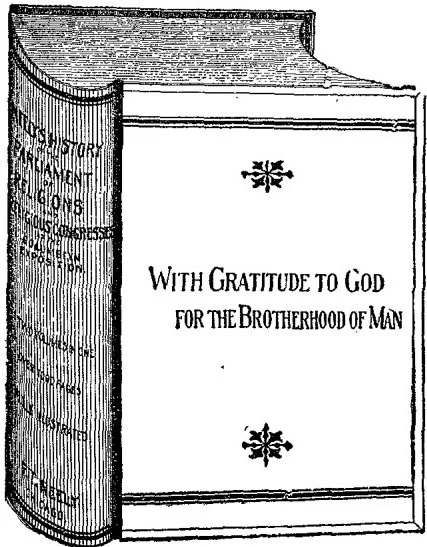
This work is complete in one large octavo volume, and is a careful compilation of all of the proceedings—at once a fascinating story and a book of universal value. The book gives the origin of the Parliament of Religions; proceedings of every meeting of the Parliament; speeches delivered and papers read at every session of the noted gathering; the beliefs of the various religious denominations; opinions of eminent divines in regard to the Parliament; influence of the Parliament upon the religious thought of the world. Published by F. T. Neely, Chicago.
1000 pages. Price: Cloth, $2.50.
We have made arrangements with the publisher so that we can offer this book to our subscribers, together
WITH THE AMERICAN SENTINEL FOR $2.75,
only 25 cents more than the price of the book alone. This offer applies to either new subscriptions or to renewals. We will supply this book alone at the regular price, $2.50.
This book is not offered because we approve the Parliament of Religions, but because it is a history of one of the most remarkable and significant religious gatherings ever held.
Address, AMERICAN SENTINEL, 43 Bond Street, New York, N. Y.