The Youth’s Instructor, Vol. 34, No. 43.

THE “PILGRIM'S BATHING-PLACE.”

The Youth’s Instructor

Oct 27, 1886

S. D. A. Publishing Association · Battle Creek, Mich. · Oct 27, 1886

THE “PILGRIM'S BATHING-PLACE.”
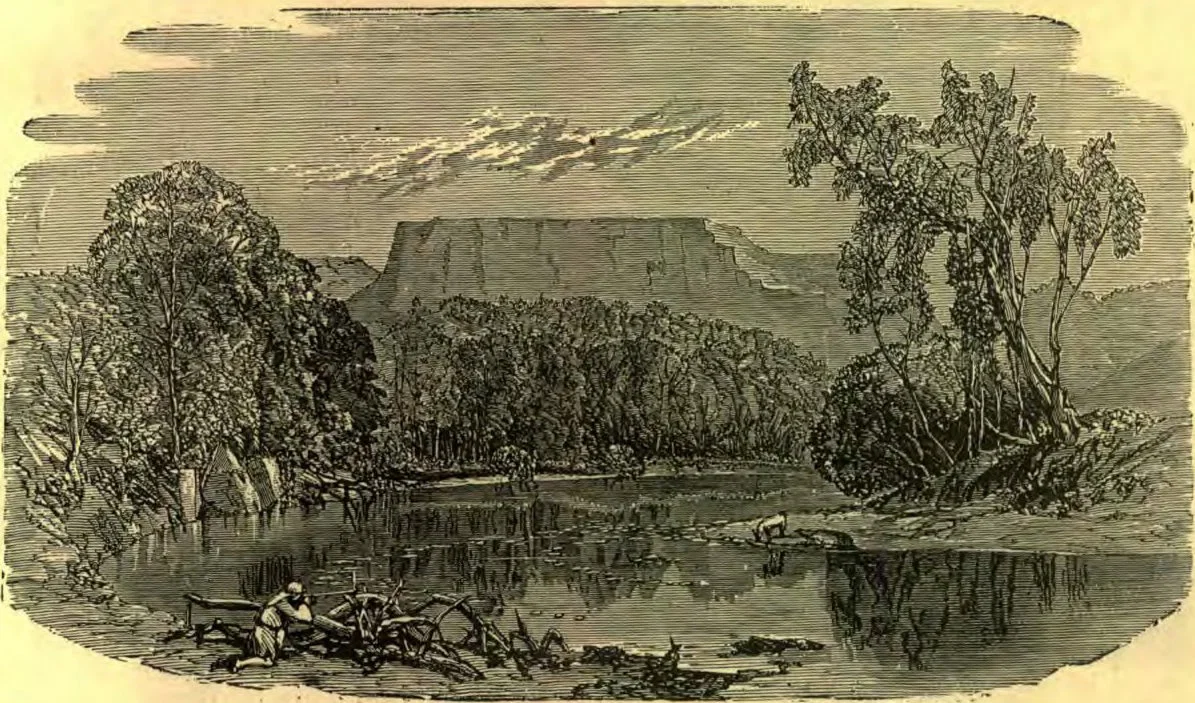
Perhaps the most interesting spot on the Jordan at the present time is that opposite Jericho, and called the “pilgrim's bathing-place.”
Thither resort every year large companies of pilgrims, to bathe in the river made sacred by the baptism of our Lord. In describing this ceremony, a recent work on Palestine says:—
“The mouth of the Jordan is seldom visited except by European travelers; the crowds of pilgrims visit the river higher up, near what is called Helu ford, though each sect of Christians has a special spot for the completion of the pilgrimage. . . . The Greek pilgrims bathe at a spot where there is a narrow clearing down to the water's edge; the Latin sacred place is higher up, near the ruins of an old convent. The ceremony is most interesting and picturesque from the start from Jerusalem to the return. In former times the crowd of pilgrims was said to number hundreds of thousands, and even now they amount to several thousands. The day fixed is Easter Monday, and the Turkish Government has for many ages guaranteed the safe conduct of the convoy. It starts from the neighborhood of the Church of the Holy Sepulchre [at Jerusalem], in front of which the pilgrims generally assemble, preceded by a white flag and noisy instruments; the rear-guard being composed of Turkish troops with the green flag of the Prophet. A merry, joyous crowd they seem, the roar of voices often drowning the incessant clatter of the tomtoms in the front and rear. Few of them are on foot except the Russian peasants. Every kind of quadruped, camel, horse, mule, and ass, have been impressed for the occasion, and the hapless camels flounder down the steep descent to Jericho with huge baskets of women and children on either side. The Bedouin of the neighborhood hangs about the desert cliffs and dells ready to cut off any incautious straggler, and to send him to rejoin his company prematurely stripped for his bath. . . . Arrived long before sunset at Er Riha, the modern Jericho, but really near the ancient Gilgal, the motley crowd bivouacs for the night.”
“A stroll among the tented and untented groups will afford one of the most varied and picturesque scenes which even in that land of the picturesque the traveler can encounter. Every custom, from the sheepskin-clad and odoriferous Russian to the bright dresses of the Bulgarians, the quaint robes of the Georgians, the brilliant colors of the Greek, and the solid richness of the Armenian, is collected from all Eastern Europe and Western Asia. But soon all is hushed, and the camp fires are smouldering embers, and the long, straggling camp, stretching some three miles across the plain, is buried in sleep, recalling the camp of Israel first pitched at Gilgal, this very spot. Long before sunrise, about three o'clock, there is a sudden roll of kettle-drums, and lights are struck all over the plain. There is none of the merriment of the preceding day, but by torchlight, in solemn silence, with the paschal moon hanging forward out of the deep black sky and dimming the glare of the torches, the mixed multitude presses on to the bank of the sacred river. Just after daybreak the head of the procession reaches the open space on the river's bank, and before the sun has well overtopped the hills of Moab, the first comers are plunging in the whirling eddies of the turbid stream. . . . Most of those who have come in families bathe in a long white garment, which after this Jordan baptism is carefully preserved as the winding sheet of its owner. I have noticed devout families joining hand-in-hand in a circle in the water, the women having their babes slung round their neck, and reciting the creed, ducking at each sentence, while they hang on to the overhanging boughs. One remarkable feature is the number of little children and infants; but the age of the pilgrim matters not, and the Jordan baptism needs never to be repeated. Primitive and rude the scene may be called, but there is no indecorum or irreverence, and very little superstition. Who that has stood by the brink of that river could have turned back without having washed in the Jordan? Who is so utterly devoid of sentiment as not to sympathize with that pilgrim multitude? and who can look on the Eastern baptism without feeling that he has reproduced before his own eyes the scenes and the surroundings that accompanied the preaching and the baptism on this river bank of the great forerunner, John the Baptist?”
“The ceremony is not a long one. After it is over, every one cuts a stick or bough to preserve in memory of the visit (a palmer's staff); and most come provided with a bottle, which is filled from the sacred stream. Silently the crowds remount and gradually depart; the last Turkish fez has closed the rear-guard two hours before noon. The camp of the previous night is reoccupied, and the pilgrims rest and sleep till sunset, when they eat their evening meal. At dead of night they set out, roused by the kettle-drum, and in silence resume their march back to Jerusalem. The last act of the great pilgrimage has been completed, and every one of the caravan is now a true ‘palmer.’”

TEDDY'S DISCOVERY.

It was a real warm Sabbath, and she wasn't our own teacher. Miss Nellie is all pretty pink flushes, and she laughs with her eyes. She likes boys, and she doesn't think it dreadful if we tell her about something that isn't in the lesson; though she manages to twist it in pretty quick in some interesting way that makes a fellow feel as if the lesson joined right on to what he was thinking about. But Miss Nellie had gone off on a vacation. I wonder why grown people have to go away when they have a vacation? And the lady who took our class was a nice, proper lady, with a stiff black silk dress and gold spectacles .
I suppose she meant all right, but the first words she said were:—
“Now, boys, you must be very attentive. I like good boys, and I hope you will be very attentive.”
She kept telling us that every few minutes all the way through, but she didn't tell us much else, and it isn't easy for a boy to be attentive unless there's something he cares enough for to attend to. It was so warm, and I grew tired of saying, “Yes, ma'am,” every time she looked at me and asked, “Don't you think so, my son?” Besides, I wasn't her son. There were lots of flies buzzing about, and Bob started a menagerie with two or three that he caught and shut up in the hymn-book box. Then he found a spider and put him in, too, and I got to watching them, and wondering how many flies a spider could eat. So I didn't hear exactly what was said for a little while, until I caught the words, “On guard.” Then I started up, for I thought maybe she was going to tell us about soldiers, or something nice, at least. But she didn't,—she only said:—
“And so we mustn't neglect even the small duties. Things that we think of little importance may be very great in their consequences. We should always be on our guard; don't you think so, my son?”
I answered, “Yes, ma'am,” once more, just out of politeness, for I really hadn't thought anything about it. But I did the thinking the next day.
We were going to discover America that day—Bill Sykes, Jimmy Flynn, and I. We had made a ship of two old cellar-doors, piled one on top of the other, and some boards, and we named her The Squadroon. We meant to discover America over on a little island in the middle of the pond, and we had saved half a bunch of fire-crackers from the Fourth of July, so that we could scare the natives and take peaceable possession. Our bombs and arrows were on board, and some potatoes to roast, and we were all ready to embark when somebody called:—
“Teddy! Ted—dy!”
It was Aunt Susan's voice, and I was almost sure she wanted me to bring in some wood or to go to the store. I don't know how Columbus would have felt if Queen Isabella had called him back when his ship was just starting, and had wanted him to run down to the store for a quart of molasses; but I know how a boy feels. All the badness in him boils up in a minute, and he wants to say the crossest thing he can think of. I didn't answer, and Jim Flynn said, sort of low,—
“Hurry up!”
So we got on board and pushed off, and the others didn't act as if they'd heard anything, and I didn't either, though I splashed the water a good deal so I shouldn't hear it again. It took quite a long while to get to America. I think Columbus would have despaired worse than he did if he'd had such a boat as ours, for we had a good deal of trouble in keeping it together, and then, when we sailed near the shore, it stuck on the roots of an old tree. We pushed and pushed, and at last, when it loosened, it went with a dip and a plunge that made it seem as if we were going clear down through the pond. We were all so dripping wet when we got to the island that we would have been almost glad to meet some real Indians, if they'd only had a fire where we could dry our clothes.
We built our own fire and got dry after awhile, though, and then we founded a settlement, built a fort and a school-house, and by that time our potatoes were roasted and we stopped for dinner. It was lots of fun, so Bill and Jim said, but the other Teddy—the one inside of me, I mean—wouldn't let me enjoy it. Sometimes I think he is the meanest fellow that ever lived. If he'd just speak up sharp and loud in the first place, and make me do what he wants, I wouldn't mind so much. But he is so soft and meek that I can have my own way, and then afterward he grumbles and grumbles like the toothache. But I'll own up to one thing—he's the pleasantest company in the world when I do what he thinks is right.
Well, this day he kept bringing up that miserable quart of molasses, or whatever it was, that Aunt Susan wanted and I didn't get, every few minutes. I told him that it was only a little thing, not worth making a fuss about; that Bridget could go for once, and it wouldn't matter. It was of no use.
Of course everything was all right when I got home; nobody seemed worried. And when I told where we'd been all the afternoon, Uncle Nathan laughed, and so did Aunt Susan, and she did not speak of any inconvenience, but all at once she said:—
“Oh, Teddy, Hiram Barker stopped here to-day, and wanted to take you with him over to the logging-camp to stay a day or two. He said he had promised that you should go sometime, but he was afraid this would be your best chance this summer. He was in a great hurry, but he stopped and looked around for you some, and I called you, but we couldn't find you. I suppose you were over at the island.”
Hiram Barker had come and gone, and I had missed the one trip I'd been wanting more than anything else all summer! I couldn't say a word, and when I remembered that I had heard the call and wouldn't come back, I felt all choked up, and I didn't want any more supper. It seemed too hard to lose so much for such a little thing—just a little neglect, a little selfishness. Then, suddenly, I remembered what that Sabbath-school teacher said about our not knowing what duties were little, and what ones great, because we couldn't tell what the consequences would be to ourselves or to other people; and I thought—
Well, I can't put it all in words, but I'm sure of one thing, and that is, that America wasn't all I discovered that day.—Interior.

THOUGHTS ON THE SEASONS.

FLATTERED with promise of escape From every hurtful blast, Spring takes, O sprightly May, thy shape Her loveliest and her last.
Less fair is summer riding high In fierce solstitial power, Less fair than when a lenient sky Brings on her parting hour.
When earth repays with golden sheaves The labors of the plough, And ripening fruits and forest leaves All brighten on the bough;
What pensive beauty autumn shows, Before she hears the sound Of winter rushing in, to close The emblematic round.
Such be our spring, our summer such; So may our autumn blend With hoary winter, and Life touch, Through heaven-born hope, her end! —Wordsworth.

DRAWN BY THE HAIR.

THERE was a young girl who worked in a factory. The day was done, and as she was getting ready to go home, she stooped to brush some lint from her dress. As she bent forward, the quickly-revolving machinery caught her hair and drew her by it. She could not get away, and in a moment her head and body were crushed to a shapeless mass.
Only her hair was touched at first. We look at the fine threads, and think they are so fine they would snap and break in a moment in the great machine. But no; while each hair is so very, very small and brittle, together they are stronger than a rope, and the poor victim is drawn by them to a dreadful death. Just so it is with our evil habits, dear children, our little sins. It is but a little fault, you say; we can stop it any moment. But to-day's fault is added to yesterday's, and to-morrow's will be added to to-day's, and by doing this wrong again and again, the habit is formed that binds the soul in a strong chain of wickedness.
“Woe unto them that draw iniquity with cords of vanity, and sin as it were with a cart-rope,” the Bible says; and this is the meaning: Sin at first is just a thread, fine and weak as a hair; a great many twisted together make it a strong rope, that will draw the soul down to death.—Selected.

W. S. C

SEA TALES.—NO. 3.

The night following the one when the beautiful rainbow was seen, of which I told you in a previous INSTRUCTOR, set in with rain squalls, accompanied by heavy peals of thunder and blinding flashes of lightning succeeding each other so rapidly as to make one’s eyes ache. At midnight the wind shifted, and turned into the “North East Trades.” The change was a pretty sight. All ahead were dense masses of ugly looking clouds, with a light streak on the starboard quarter. Then came a lull, and a light wind from the south. The bright streak on the starboard began to fade, and a faint light streak appeared on the port bow; the wind freshened, veering slowly to the northeast, the light streak brightened and broadened, the clouds broke up astern, and in half an hour the wind had completely changed, the north wind overpowering that from the south, and giving us the trade winds we had anxiously looked forward to during six weeks of monotonous calm. By sunrise we were in a very heavy sea, and fairly bounding before the gloriously steady wind. Every face was smiling, and each one said to those he met, “We’ve got ’em!”
The trade winds north of the equator blow from the northeast, and south of the equator from the southeast, and in olden times blew steadily all the year through. Forty years ago or so, they could be implicitly relied upon, and trading vessels calculated upon meeting them within certain latitudes, and were seldom disappointed; hence their name, “trade winds.” But of late years, since in the eastern continent the disastrous disturbances in the elements have multiplied, the trade winds have become capricious and uncertain, and in some seasons disappear entirely.
A few days afterward, we passed over and out of a region which, according to Prof. Maury, is of volcanic character, showing signs of gradual but constant upheaval of the bed of the ocean. We entered it in the night, the ocean being covered at sundown with thousands upon thousands of flying fish, dolphins, bonitos, and albacores. At sunrise not a fish was to be seen, nor for several days thereafter; and when finally flying fish were again visible, they were found to be much larger than those above the equator, and of a chocolate brown instead of a silver gray color.
For a week or two after passing this region, the wake of the vessel was as beautifully luminous at night as though a bright electric light hung over the stern. Occasionally the illumination would not be constant, occurring only upon the rise of every fifth or sixth wave, when, as the brig descended into the trough of the sea, the entire wave astern would break into a dazzling white light, so clear and intense that one could read by it. Flashing, rolling, and darting through the waves in every direction, were objects like a “Portugese Man of War,” emitting a clear blue light similar to the blue flame that starts from a fresh coal fire, only more vivid. The large body of white light resembled greatly the milky way of the heavens, except that it was intensely and blindingly white. Then these floating objects, from the size of an egg to that of an orange, filled the wave to a depth of thirty feet or more, lighting up the water like strings of lanterns. I took the trouble to dip up a bucketful of the water several times, but could not discover any animal life in it, though the best authorities consider the luminous property to be imparted to the water by a species of jelly-fish. Yet as often as the water was stirred rapidly by the hand, it gave out the same light as was seen in the water astern.
The sun begins to go south some time in June, and travels at the rate of twenty odd miles per day. At the time of which I write, our vessel had caught up with and passed the “old illuminator,” and then for the first time in my life I was south of the sun, south of the equator, and out of sight of the north star. When I realized that this star was disappearing, how eagerly I watched it night after night, descending nearer and nearer the horizon; and when, a few nights after, I found it had vanished, my heart gave a great throb as it would had I lost some dear old friend.

W. S. C

MIGHT HAVE BEEN.

I might have been more patient— Ah! would the angry word Upon my lips had perished, Unuttered and unheard! Some heart would now be lighter To wend its toilsome way: Some life would be more cheerful, More sunny to-day.
I might have been more kindly— How trifling is the cost Of simple deeds of goodness, Whose power is never lost! The golden moment vanished, And never to return; The glory of bestowing, Too late, too late I learn!
I might have been more loving To those who hold me dear; What little deeds, neglected, Had soothed their pathway here! The hasty word or action That pained a gentle heart, Ah! will its mournful memory From out our life depart?
“I might have been!”—sad burden Of life’s remorseful song, Within the heart forever Its haunting echoes throng. Oh, youth, upon the threshold, To this sweet lesson bow: For deeds of love and kindness, Life has one season—Now!
—George Cooper.

MY HAND IN HIS.

A LITTLE boy who came before the pastor to be received into the church, was asked how he expected to lead a Christian life, and he sweetly replied, “I will put my hand in Jesus’ hand, and I know he will lead me right.” This is just the thing, for us all to do, and if we did it, we should not so often stumble and fall. We are so apt to try to walk alone!

DECISION

DECISION of character should be early taught to the young, and diligently cultivated by them. Unwavering firmness, a determination to do right, is a solid platform on which every child should stand as the basis of true and honorable manhood and womanhood.
All of our young people have heard more or less on the subject of temperance; and perhaps many have signed the temperance pledge. If so, you will be brought many times where you will need decision of character. Your honor and your firmness will be tested.
I have just read of a gentleman who some years since lived in Virginia, and whose little boy, six years old, wanted to sign the temperance pledge. But the father, feeling that his son did not realize the obligation which would rest upon him, refused to grant his request. The little boy was so deeply in earnest in the matter, and begged so hard, that at last the father’s consent was obtained, though he felt quite sure the little fellow would in some way break his pledge.
The father and the rest of the family were interested in the cause of temperance, and when this little fellow had signed the pledge, they were a family of teetotalers. “Not long after this,” said the writer, “the father was traveling. The stage stopped at a tavern, and he called for some water. He waited some time, and no answer came. He called again; still no answer. At last the servant came, bringing a glass of cider. He was very thirsty, and being afraid he would get nothing else, drank it in violation of his pledge. When he returned home, he related the circumstance when the little boy was present. After he had finished, the little fellow went up to him, his lip quivering and his eyes full of tears, and said, “Father, how far were you from James River when you drank the cider?”
“I was fifteen miles from James River, my son.”
“Well, father, I would have walked to James River and back again before I would have broken my pledge.”
That was decision. A true boy will make a true man.
I once rode on the cars some hundreds of miles with a little boy about eight years of age. He was traveling alone. I became very much interested in him, and learned that his father was a drinking man, and that he abused his mother and himself so much that they had to leave him. The little traveler told me that he had signed the pledge, and said, “If any one signs the pledge, he should stick to it.”
That is the right principle to work upon. I hope all our young readers will be true, and dare to do right.
A. S. HUTCHINS.

SOMETHING ABOUT EARTHQUAKES.

Scientists claim it a fact that our earth is a-tremble in every part of its surface. As proof of this, one writer has said:—
“When Professor Paul was looking for a site for the United States Naval Observatory at Washington, D. C., he fixed a little dish of mercury so that it would reflect the image of a star. By and by a train came along a mile away, yet the motion was felt. Sometime ago a professor at the Greenwich Observatory in England was trying to get the image of a star in a tray of mercury. But something stirred the mercury so much that he was unable to do it. Then he remembered that it was the evening of the bank holiday, and that one slope of Greenwich Hill was being used as a playground by thousands of boys. In their tumbling they shook the ground so much that the mercury was kept in constant commotion. And Professor Milne, one of the great authorities in such matters, assures us that there is ‘an earthquake in some part of the world every day in the year.’”
It is by studying the going and coming of tremors in the earth’s crust that scientists hope, by the aid of very delicate instruments, to give warning of the approach of earthquakes. And of those who make this subject their study, an exchange says:—
“One of the most tireless students of earthquakes is Professor Rossi, of Italy. That boot-shaped peninsula, thrust out into the Mediterranean Sea, is much subject to disturbances of the sort. There are tremors every day in parts of Italy. We all know of Mount Vesuvius, that buried in ashes the cities of Herculaneum and Pompeii, and Mt. Etna is almost as famous. Well, Professor Rossi has an underground study in that volcanic part of Italy, and there he passes his days and nights. With delicate instruments he takes note of every shock or tremor, and he has invented the microphone, now known all over the world. Moreover, he has done something better than that. He has discovered that underground ‘storms’ usually come before earthquakes. Sometimes these storms are felt days before the great shocks. Professor Rossi hopes some time to be able to warn people in earthquake countries, just as our signal service officers now foretell storms on the surface of the earth. This Professor says that some of the sounds heard in his study are bell-like, some mere tinklings, some roarings, some explosions. When Vesuvius is active, sounds come as though great volleys of musketry were being discharged far down in the earth. In time he hopes to be able to warn people, just as the prisoner of Lima warned the inhabitants of that city. This prisoner was named Viduari. He was cast into a deep dungeon. While in this quiet tomb, he heard strange sounds beneath him, and felt tremors in the rocks. He knew that there was going to be an earthquake, and calling the keeper of the prison, told him that Lima was in danger. The keeper and the guards laughed at him. They took it for granted that Viduari was only trying to get out of the dungeon, so they bolted the iron doors. The next time the doors were opened, they were shaken open by an earthquake that ruined the city of Lima, slaying thousands of people.”

PARABLES OF CHRIST.

LESSON 7.—THE PRODIGAL SON.

1. WHAT two parables are given in the first part of Luke 15, to show how great God’s compassion is toward those who have strayed from the path of duty? Luke 15:1-10.
2. Relate the first of these parables.
3. Relate the parable about the lost piece of silver.
4. What parable did Jesus then give to show how God pities and loves the truly penitent, no matter how great their sins may have been?—That of the prodigal son.
5. How is this parable introduced? Luke 15:11.
6. What did the father do for these two sons? Last part of verse 12.
7. What induced him to take this step? First part of verse 12.
8. What course was taken by the younger son? Verse 13.
9. What misfortune overtook him in that strange land? Verse 14.
10. How did he seek relief? Verse 15.
11. What employment did the citizen give him? Same verse.
12. What would the suffering young man have been glad to do? Verse 16.
13. What unconcern was manifested toward him? Last part of verse 16.
14. When he had come to himself, what were his reflections? Verse 17.
15. What is probably meant by his coming to himself?—That affliction brought him to look upon things in their true light.
16. What did he determine to do? First part of verse 18.
17. How did he propose to humble himself? Verses 18, 19.
18. How was the forlorn wanderer received by his father? Verse 20.
19. Repeat the son’s confession. Verse 21.
20. How did the father honor him? Verse 22.
21. What other token of joy did the happy parent manifest? Verse 23.
22. How did his happiness find expression in words? Verse 24.
23. Where was the elder son when his brother came home? Verse 25.
24. What surprised him as he came near the home? Same verse.
25. How did he try to ascertain the cause of these things? Verse 26.
26. What explanation was made by the servant? Verse 27.
27. How did this elder son receive the news of his brother’s return? Verse 28.
28. What complaint did he make when his father entreated him to come in? Verses 29, 30.
29. How was he assured of his father’s love and appreciation? Verse 31.
30. How did the father justify the unusual tokens of rejoicing by which he was celebrating the prodigal’s return? Verse 32.

Patience and Perseverance for the Sabbath-School Teacher

But few who have not had the experience know the trial of patience that the earnest Sabbath-school teacher often undergoes while in the faithful performance of duty. There has much been written about the “art of securing attention,” “the use of illustration,” etc., but notwithstanding our nicest-cut theories, the teacher will have moments and hours of bitter discouragement. Patience will be worn out, and gloom and sadness sit triumphant on the throne. Boys and girls there are who seem never to appreciate the kindness bestowed on them. No amount of tact or talent, grace or grit, force or fervency, can move them. They hardly ever look at the lesson; they are indifferent, listless, and morose; they would rather talk about the fashions and the fairs than about Jesus and his love. Has this ever been your experience? Have you ever found that point where patience ceased to be a virtue? It is a trying ordeal. But why lament? “My word shall not return unto me void, but shall accomplish that whereunto I have sent it.” Put all such refractory cases in the hands of the Lord. He can melt the hardest heart, and subdue the roughest nature. It may be a long time ere the work is done, but God will take care of the seed sown. Do your part, and God will take care of the results. Weary and worry not.—S. S. Times.

STORY OF A FLOATING ISLAND.

Probably most of you read in No. 3, of the present volume of the Instructor, how floating islands are formed. These may be found in almost every country. A curious story is told of one which broke away from the land on a small lake or pond on the line of two of the New England States several years ago. C. F. Holder, in Golden Days, gives it as follows:—
“The top of this strange bit of New England soil was about four feet out of water, and covered with a fine crop of grass and a number of trees, the latter forming a sail, so that when the wind was from the west, the island slowly sailed away until it stranded on the New Hampshire shore, we will say; and when an easterly gale came up, away it went again, crossing the State line and arriving in Vermont. So it belonged to either State, according to the direction of the wind; and often cows, chickens, horses, and stock of various kinds, tempted upon the treacherous island by the green grass, were transported across the border, much to their astonishment and the annoyance of their owners.
“Finally, an old hermit who lived in the vicinity bought the island from its alleged owner, and built a small house upon it, and for some time lived in peace and happiness. But one day the tax collector came around, and, as it happened, the old man was out; but hearing that he was coming again the next day, he cast off the moorings of his island craft, and towed it out into the pond, just over the State line into Vermont, and when the tax man came, he claimed to be a ‘Vermonter.’
“Some time after, the Vermont tax collector appeared, but the old hermit had heard of the expected visit, and when the official appeared, the island was in the State of New Hampshire.
For some time this went on, until finally the two tax collectors, it is said, joined forces, and advanced on the island from both sides. They found it anchored on the State line by a long rope, and as the wind was blowing down the lake, it was swaying about, now in Vermont, now in New Hampshire, so that by the time one collector established his claim, it was evident that it was not legal; and they became involved in such a war of words that at last accounts the hermit had not paid his taxes, though he expressed himself as willing to do so when the collectors could decide where he lived. As far as he was concerned, he ‘claimed neither State!’”

“HE’S A BRICK.”

The above is usually classed with slang expressions, but do you know that instead of having just sprung up among rowdies, the phrase “He’s a brick,” originated way back in the time of Agesilaus II., king of Sparta, four hundred years before Christ? Plutarch tells how, on a certain occasion, an ambassador from Epirus, on a diplomatic mission, was shown by the king over his capital. The ambassador knew of the monarch’s fame—knew that, though nominally only king of Sparta, he was ruler of Greece—and he had looked to see massive walls and embattled towers for the defense of the city, but found nothing of the kind. He marveled much at this, and spoke of it to the king. “Sire,” said he, “I have visited most of the principal towns, and I find no walls reared for defense. Why is this?”
“Indeed, Sir ambassador,” replied Agesilaus, “thou canst not have looked carefully. Come with me to-morrow morning, and I will show you the walls of Sparta.”
Accordingly, on the following morning, the king led his guest out upon the plain where his army was drawn up in full array, and pointing proudly to the patriot host, he said, “There thou beholdest the walls of Sparta—ten thousand men, and every man a brick.”
So you see that in the original meaning of the phrase it was considered a grand thing to call a man “a brick.”—Sel.

AGE AMONG THE CHINESE.

The Chinese method of reckoning age differs so materially from our own that it gives it a very novel appearance. The Brooklyn Magazine says of their custom:—
“The Chinese do not reckon their age from the day of birth, but from New Year's day. It is on this account sometimes difficult to find out the true age of young children. Here is a tiny shaven-headed bundle of humanity, scarcely able to stand alone for a moment, and you are gravely assured that he is three years old! If you have left the sacred rules of propriety at home, you venture mildly and politely to cast just a faint shadow of doubt upon the statement; or if you do not discredit the parent's assertion, but are still unacquainted with the mode of reckoning, you probably condole with its parents on the slight degree of progress he has made toward maturity. Should a child arrive in this world at five minutes to twelve on New Year's eve, the fond father will proudly assure you next morning that the new arrival is two years old, and never so much as think that what he says is untrue. Seeing that clocks are very scarce articles except along the coast, and that even where a clock is found, time is a very elastic and variable quantity, one wonders how such matters are determined in certain cases. The Chinese do not conceal their age, nor do they ever try to represent themselves as younger than they are. There is a much stronger tendency to add to the stated number of their years than to diminish it. On being introduced to a new acquaintance, the first question is, ‘What is your distinguished surname?’ and the second is, ‘What is your honorable age?’ You reply to one as readily as to the other. Age is so much respected that it is considered a distinction to be advancing in years. There are eight or ten different names which correspond to ‘Mr.,’ according to the appearance of age, or real age, to which a man has attained, and the same for women. Besides, it is a matter of greater congratulation, as years go by, that one has been spared to add another year to the term of life. The length of the reign of the emperor, the term of official service, the engagements of servants, the period of residence in a locality—all are dated from the New Year.”

ORIGIN OF PUBLIC BANKS.

THE term “bank” is derived from the Italian banco, a seat or bench, because the early custodians and dealers in money in Italy were accustomed to sit on benches in the market-places of the principal towns.
The earliest public bank established in modern Europe was that of Venice, which was founded in 1157. About the year 1350 the cloth merchants of Barcelona, then a wealthy body, added the business of banking to their other commercial pursuits, being authorized so to do by an ordinance of the King of Aragon, which contained the important stipulation that they should be restricted from acting as bankers until they should have given sufficient security for the liquidation of their engagements. In 1401 a bank was opened by the functionaries of the city, the first of the kind ever established in Europe.—Selected.

A Rose-Colored Pastor in an English Garden

In an English garden, one day this summer, a lady put up her hand to pluck what she thought was a bunch of pink azalea blossoms. But before she could grasp the flowers, lo! they took wings and flew away. Then she knew that she had mistaken a bird for the pink blossoms. The bird was a “rose-colored pastor,” which sometimes visits England. It is really a semi-tropical bird of the starling kind. It has the back, breast, and sides of an exquisite pale pink.

KINGS AND QUEENS.

Oh where are kings and queens of earth? The monarchs born to rule? They are here, and there, and everywhere— At home, at church, at school.
The kings and queens in glad array A conquering army stand; Bright, glad-hearted boys, Full of frolic and noise, Laughing-eyed girls With their sun-kissed curls, An army born to command.
‘Why are they kings and queens, you say Bend low, then, while I tell; They are the kings whose hearts are true; Who love their parents, and honor them too; Who haste at the sound of father's voice; Whose truthful words make mother rejoice; Who not only mean to do the right, But are doing it now, with all their might, Soldiers who love to do well.
And why are the fair-faced girls the queens? My friend, they are royal born. They are loving to mother, To sister and brother, To father a shining light. They feel above doing wrong, And with smiling and song Make the dear home nest bright.
O dear little kings and queens of earth, March on to conquer and win. Lift up the fallen, comfort the sad, Shine in the lives of the weary and bad, Help raise the sorrowing, pitiful earth Nearer the land where love had its birth, Till as saintly kings and queens at last, The burdens all borne, the trials past, You joyfully wait, at the palace gate, For King Jesus to let you in.
—Mrs. C. E. Fisher.
Continue reading: THE BARNACLE