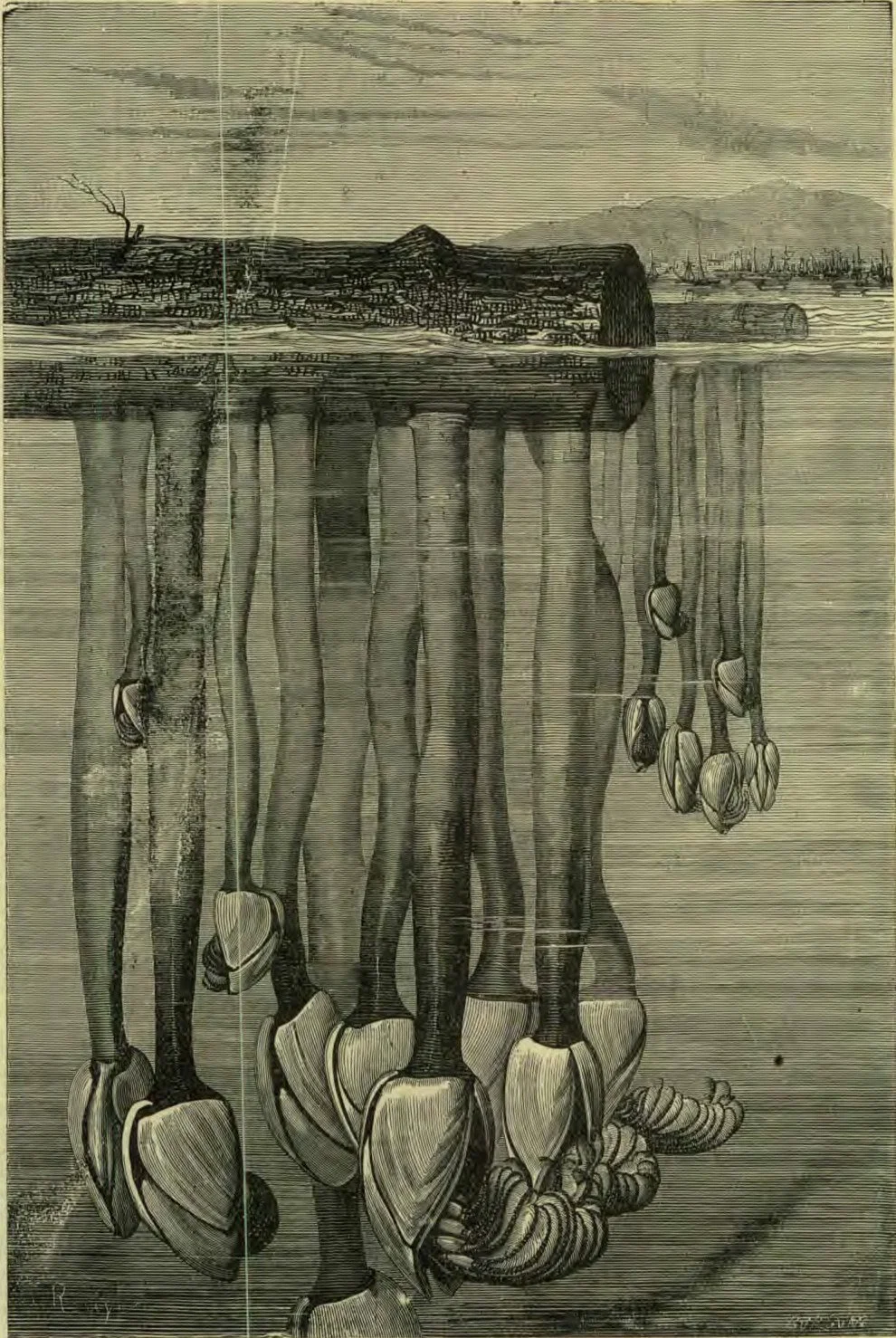
Could you have thought, for a moment, that the curious thing in the picture is an animal? Nature has given to some of the creatures that live in the sea as odd a shape as possible. This curious animal belongs to a family called Cirrhipedes; but we do not give it this grand name every time we speak of it. We call it a barnacle.
It is fastened, as you see, by a kind of stem to some substance from which it seems to be growing. The substance, very often, is the bottom of a ship or boat. At the end of the stem is the body of the animal, which looks a little like the fruit or the flower of a plant. It is covered with a strong case or shell, which is composed of valves, and from between the valves a number of feelers are put forth. The feelers are called cirrhi, and the creature does nothing but keep drawing them in and out. It has a round, soft body, not quite transparent, and is of a brown color above, and of the color of flesh below.
For a time naturalists were very much puzzled what to do with the barnacle. They could not tell to what order it belonged. Now they have given it an order to itself, and put it between the worms and crabs.
It is a very stationary being. It never moves from its pedicle; but the pedicle, or stem, to speak more plainly, does contrive to keep up a little movement of its own. It goes up and down, and to the right and left; just, in fact, as the animal pleases to make it. The feelers, which you see put out from between the valves of the shell, are often called arms: they have tiny rings, like the body of a worm, and they are clothed with cilia, which gives them a very plume-like appearance. Indeed, when they are at rest, they look like the young leaves of the fern.
There was a silly story once told about the barnacle. Its oddness so puzzled people that they pretended to believe it was a bird. Or rather, I should say, that a bird came from it. The name of the bird was the barnacle goose. The fishermen pretended that they could hear the little goose making a noise within the shell; nay, some said they had seen it fairly come to life. First it put out its feet, then its body, then its beak,
then it dropped into the sea, and presently feathers began to grow upon it. It was the barnacle goose!
For many years, numbers of persons who ought to have known better believed this story; and an account of the bird was printed by a learned society, and circulated as a fact. I need not tell you that very few persons are found to believe it now.
What does the barnacle feed upon?—It devours tiny insects, and minute creatures, which swarm in the sea. It has no eyes, at least not in this stage of its being; but its feelers serve it instead. It spreads them out like a net, and catches all that pass by that way. It has a famous mouth and jaws, too, like those of the crab or the lobster.
When the barnacle was newly come into the world, it had no stem. It floated about in the water, and had a number of little fins to swim with. And it had one large eye in the middle of its body. How very different it was from its parent!
When it grows up, the fins and the eye both disappear. Then it begins to have a stem, and fixes itself to some convenient place, like a true barnacle.
There is one family of Cirrhipedes which has no stem at all. It does not want one. It fixes itself to the shell of the turtle, or to the skin of the great whale. It follows the whale about wherever it goes; in fact, it lives upon the huge body. A strip of flesh taken from the lip of a whale is in the Museum in Paris. It has forty-five of these parasites upon it. They are arranged in order, like the stones in the pavement.—The Sea and Its Wonders.
Letter Budget.
It so happens that it is a group of little girls who will entertain you in the Letter Budget this week, and the first to speak is—CLARA L. GODDARD, of Franklin Co., Mass., who says: “I like to read the letters from you all, and thought you might like to hear from me. I am fourteen years old, and with my mamma, sister, and two brothers have kept the Sabbath five months. My father and eldest brother do not observe the Sabbath, and there are no other Sabbath-keepers in town; but we have an uncle and cousin five miles away, in an adjoining town, who keep it. There is no Sabbath-school nearer than fifteen miles, so we do not often go. I learn my lessons in Book No. 4, at home. I go with my brother half a mile to day school. We live on a farm, and my brothers have a small missionary garden. We are all going to try to earn something for the mission work picking berries. I want you all to pray that my father and brother may soon keep the Sabbath. I want to meet you all in the new earth.”
Clara’s letter is very welcome to the Budget. It has a good ring, as though she was trying to do what she could.
ANNIE S. PARKER writes from Syracuse, N. Y. She says: “I am a little girl nine years old. I have a brother nineteen years old. We have all embraced the Sabbath but my brother, and we hope he will some day. Papa and mamma belong to the missionary society. Papa is building a new house for us in a beautiful location in the southern part of the city. He is hanging the doors to-day. I go to Sabbath-school regularly; I would not like to miss it. I think a great deal of the INSTRUCTOR, and could not be without it. I give my love to all, especially my little Sabbath-school sisters.”
We should like to take a peep into your pleasant home, Annie, which will seem still more cheery when the brother unites with you all in keeping God’s commandments.
GERTRUDE and BERTHA WELCH send a letter from Tippecanoe Co., Ind. They say: “We are twins, nine years old. We have a sister twelve years old, who is canvassing for the INSTRUCTOR. We have a baby brother one year old, and we love him dearly. We keep the Sabbath with mamma. We live in a brick house, and our yard is full of green trees. We have some flowers and roses, and we have a trumpet vine on the south side of the house. We have a cow and calf, and chickens, and we have two birds, which have three eggs. We have a plenty of apples and pears. We go to Sabbath-school at Mrs. Peret’s. This is our first letter, and we would like to see it printed.”
We think we hear these little girls daily trilling their songs of praise with the birds among the trees and flowers for the good gifts God sends them, and we hope they may join in the song of triumph with immortal birds and flowers under the tree of life.
WINNIE WESTON, a little girl ten years old, writing from Blue Earth Co., Minn., says, “I keep the Sabbath with my mamma and little brother. There are but few Sabbath-keepers here, and Sabbath-school is at our house. I learn lessons in Book No. 1. Sometime I hope to meet the INSTRUCTOR readers in the new earth.”