THERE are many little things in nursing that make a great difference to the comfort of a sick person, which appear trifles not worth notice to one who is well. Perhaps the mention of some of these may be helpful to those who are called upon to care for sick ones in their own homes or families.
A patient who is very ill should be questioned as little as possible. The nurse should watch the patient, and learn to know what needs to be done and when to do it, without reference to the patient. Questions at such a time are often intensely aggravating to the sick person, though no complaint may be made. Neither should a patient be left to ask for needed attentions. Many will suffer in silence rather than take the trouble to make a request. A good nurse is very watchful of her patient, and gives constant but unobtrusive care.
On the other hand, the nurse should not be overcareful, or fussy, so that her attentions become burdensome. It takes a great deal of tact to deal with a very sick person, and to strike the happy medium between needful care and overattention.
Another thing to be avoided is the admittance of many visitors. In cases of serious illness, quietness is essential. Conversation is much more fatiguing to one who is ill than most people realize.
A very few moments’ talking will sometimes so exhaust a patient as to take several hours for recovery from the effects. The patient will not show this while talking; but after the visitor has gone, the effects may be plainly seen, and will be still more plainly felt.
In chronic cases and convalescence more visitors, of the right kind, may be allowed; but at all times, care must be exercised in this respect.
A patient should never be asked by the nurse what he would like to eat. Such a question will almost certainly destroy what little appetite there may be. The invalid’s tastes should be ascertained from others, and humored as far as is consistent with the doctor’s orders. If a desire is expressed for any wholesome food that has not been forbidden, it should be gratified. Many times, if the meals are served daintily, with no word to the patient until they appear, they will be eaten as a matter of course. The meal is there, and it is easier to eat it than to argue about it. Usually, the less said about food, the better.
There are many other little things that add to a patient’s comfort, such as keeping the room well aired, so that it always feels fresh; changing the bed linen frequently; keeping the windows properly shaded, so that the room is neither too dark nor too light; keeping the room at the right temperature, and such coverings over the patient as are needed for comfort. The nerves of a patient who is seriously ill are usually very irritable, and trifling departures from the happy medium in these things are acutely felt.
The nurse who gives the thoughtful attention to all these things will do much for the recovery of her patient, and will certainly earn the gratitude of the one she has cared for.
Treatment of Chronic Rheumatism
THE diet is of first importance, and the popular notion that a fruit dietary is to be strictly avoided in rheumatism has no foundation in fact. For many years the writer has practised placing rheumatic patients upon a strictly fruit diet whenever evidences of autointoxication were marked. Not infrequently the patient is required to eat exclusively fresh apples, grapes, or any other seasonable fruit for several days in succession.
A fruit diet is certainly incapable of increasing the accumulation of uric acid, as it does not furnish the necessary material for the production of this toxic element. It is not sufficient simply to withhold flesh meats in cases of rheumatism. The patient must be furnished8with an ample supply of easily digestible foods which he can relish, and which will furnish to the body the needed nutritive elements with the least outlay of vital energy. If dyspepsia be present, which is true in many cases, cereals must be used in a dry and well-dextrinized condition (zwieback and other cereal-food products dextrinized by heat). Mushes must be carefully avoided, also starchy vegetables. Purees of peas and beans may be eaten in moderate quantities, but the skins of these legumes must be excluded. Mustard, pepper, and condiments of all sorts must not be used; the use of tobacco in any form must also be strictly prohibited for the reason that the nicotine not only depresses the heart, but greatly taxes the liver and kidneys,—first, in the work of oxidizing and destroying the poison; and, second, in eliminating it.
Water Drinking Essential
To the great thinning of the blood which follows copious water drinking, is due the remarkably increased activity of the kidneys, skin, and bowels. Examination of the urine not only shows that the quantity is increased by water drinking, but that the urea and other solid constituents are increased in amount. By the continued employment of this measure, the tissues may be thoroughly washed free from accumulated waste, and to such an extent that uric acid, urates, and a number of other products of imperfect oxidation may be reduced to almost imperceptible amounts. The quantity of water taken should be from two to three quarts daily. Distilled water is preferable to mineral waters of any sort. Distilled water, or water containing the smallest possible amount of mineral, is most readily absorbed. In most cases it is best to take the water at the ordinary room temperature. Deluging the stomach with hot water relaxes the organ, and lessens its digestive power. Hot-water drinking is to be recommended only in cases of gastritis accompanied by a profuse secretion of mucus, and in cases of hyperpepsia.
The Value of Exercise
Next in importance to diet and water drinking is exercise. Every chronic rheumatic must be made to perspire daily. It is not well to produce constant and profuse perspiration, but the highest activity of the skin short of actual sweating may be maintained with benefit. The skin ordinarily eliminates from an ounce to an ounce and a half of liquids an hour. In profuse sweating, this amount may be increased to from fifty to sixty ounces hourly. Such an increase for a short period is highly beneficial. Rheumatics generally do better in a warm, dry climate, and suffer less in clear, dry weather, than at other times, as activity of the skin is promoted under these conditions.
Rheumatics need exercise more than almost any other class of persons. This is one of the most efficient means of burning up wastes. Vigorous exercise increases the amount of oxygen absorbed, and the output of carbon dioxid.
This is evidence of the improved oxidation of the nitrogenous wastes. Although rheumatic patients need exercise more than any other class, they are unfortunately so crippled that general active exercise, such as walking, horseback riding, etc., is out of the question. Exercise is also likely to be followed by an exaggeration of the pain. Rheumatics suffer from other embarrassments in relation to exercise, among which may be mentioned shortness of breath and general muscular weakness. These difficulties must be overcome by carefully graduated muscular work, beginning, if necessary, with the more gentle forms of massage, gradually increasing the vigor of the manipulation. As soon as able to do so, the patient must be encouraged to take active voluntary exercise. The amount of exercise to be taken each day should be increased as the patient's capacity for muscular work increases. The outdoor gymnasium, affording an opportunity for exposing the body to the air and sun, is of the highest value in cases of this sort. Sand baths are particularly helpful. The patient should be very careful to avoid chill from evaporation after exercises which produce perspiration.
Hot Baths
The value of hot baths in rheumatism, both chronic and acute, has been recognized from the earliest ages. There are, in various parts of Italy, the ruins of many ancient Roman baths, in which the rheumatic and obese gourmands of the degenerate days of ancient Rome were daily subjected to hot-water baths, as well as vapor and hot-air baths, followed by massage and exercise, for the purpose of combating the effects of their luxurious living.
All forms of hot baths are beneficial in rheumatism; but the hot-water bath, the vapor bath, and the electric bath, especially the latter, are to be preferred, for the reason that these are the quickest and most efficient means of securing an elevation of bodily temperature, and thus increasing nitrogen oxidation.
But hot bathing alone is not sufficient in this disease. Hot baths of all sorts are attended by the inconvenience that they produce a decidedly depressing effect. All the vital processes are depressed; the heart action, in particular, is diminished in vigor. The relaxed condition of the blood-vessels of the skin, produced by the hot bath, exposes the body to danger from rapid loss of heat, resulting in chill. These several inconveniences may be wholly avoided by a proper cooling procedure immediately after the hot bath. The method must depend upon the various circumstances. If a hot-bath immersion has been administered at a temperature of one hundred five degrees to one hundred eight degrees (about the proper limits), the temperature of the water may be lowered, within one or two minutes, to eighty degrees. The patient may be kept in the tub with gentle rubbing for from two to five minutes, by which time the temperature of the skin should be sufficiently lowered to make it safe to remove him from the bath, wrapping him in a Turkish sheet and woolen blankets, and permitting him to lie quiet until his skin is thoroughly dry, and the equilibrium of the circulation restored.
The hot-blanket pack may be followed by a short wet-sheet rub, the vigor of which may be gradually increased from day to day by lowering the temperature of the water employed, starting at sixty-eight degrees, and lowering the temperature one or two degrees daily to fifty-five degrees, and by increasing the duration of the application from one-half minute at the beginning to two or three minutes later on. In very feeble cases, the cold-towel rub or cold friction may be employed.
Local Applications
Chronic as well as acute rheumatism is a general rather than a local disorder; hence comparatively little need be said respecting applications to the diseased joints. There are valuable measures, however, whereby the local curative process may be hastened, and pain and other symptoms greatly mitigated. The most important of all local applications is heat, which may be employed in the form of the fomentation. The dilatation of the vessels by heat leads to an accumulation of the blood in the part, and it is the blood that heals. These hot applications may be applied with advantage twice daily, and should be followed by a heating compress. The heating compress consists of a folded linen cloth or a moderately thick layer of cheese-cloth wrung dry out of cold water, and wrapped around the joint. This compress is covered first with oiled muslin or rubber sheeting, and then with several thicknesses of flannel, so as to retain the heat. Thus the superheating induced by the hot application is maintained.
Another measure of great value is local massage. When tenderness exists, much care must be used. The first manipulations should consist of a light stroking or friction movement; later, digital kneading should be employed about the joint in such a way as to follow the natural contour of the bones.
Joint movements should likewise be employed in connection with massage. If the movements of the joint are limited, the first attempts at flexion and extension should be applied with great care; only a moderate amount of force should be used. From day to day, the latitude of the movements should be increased until the greatest degree of mobility possible is established. Gentle massage and joint movements may be best administered after a hot pack or fomentation, or some other hot application, which has been followed by a very short cold application to prevent chilling by evaporation.
The building up of the general health is a matter of primary importance in chronic rheumatism. Every effort must be made to improve the general physical condition of the patient.—Modern Medicine.
Trusting God Instead of Fearing
WHAT a vast proportion of our lives is spent in anxious and useless forebodings concerning the future, either our own or that of our dear ones! Present joys, present blessings, slip by, and we miss half their sweet flavor, and all for want of faith in Him who provides for the tiniest insect in the sunbeam. O, when shall we learn the sweet trust in God our little children teach us every day by their confiding faith in us! — we who are so mutable, so faulty, so irritable, so unjust, and He who is so watchful, so pitiful, so loving, so forgiving! — Selected.
Power of the Word
THERE are many avenues along which the Bible comes home to us in a different way from any other literature in the world. Modern reviewers are fond of telling us, for instance, that before we can appreciate any great book, or grasp its meaning, we must first of all sympathize with the idea and intention which inspired it; we must read it from its author's point of view. So also, before we can appreciate and understand the Scriptures, we must come into harmony with God's will, we must be informed and possessed by his Spirit, we must sympathize with his purpose for mankind. And concerning this Book we may say that the Author is never absent or out of reach: he would have us converse with him and inquire of him even while we read.
Again, it comes true concerning the gifts of this world, that they seem most golden when we first receive them; but in course of time they turn stale with keeping, they grow threadbare with use. Whereas the best wine of the Bible always seems reserved until the last. Its revelation remains unexhausted and inexhaustible. Has not the New Testament still many things to say unto us, as we are able to bear them? Why, we have never yet fathomed some of its simplest words about elementary Christian duties — about the virtue of absolute forbearance, of utterly forgiving our enemies, about the irresistible might of peacefulness, about the deadly danger of riches, about the beatitude of literal simplicity and poverty. The church has not outgrown the Gospels. Often we find that an old man has lost interest in the literature which entranced him when he was younger. But at the end of the day, as the shadows lengthen, the Bible becomes more and more wonderful to those who have loved it longest, who know it best. Amid all the disappointments and disillusionments of this world we may still hear it whisper: “Not as the world giveth, give I unto you.” — Selected.
Calcutta, India
By L. G. MOOKERJEE
L. G. MOOKERJEE
IT is almost two years since we left the United States. During that time we have seen marked evidences of the Lord's soon coming. In February, 1909, I took charge of the Bengali work in Calcutta, where they had been having one meeting on Sabbath on my father's veranda. Immediately we organized a Sabbath-school, and began holding an evening service, and soon had a prayer-meeting started. Within six months we had two baptisms.
In our Sabbath-school we began taking donations, and from February 6 to the end of the year the donations amounted to about nineteen dollars. We thank the Lord that every cent of this went to missions and not for the expenses of our church or school. The first of May we began taking collections at the evening service, and this amounted at the end of the year to thirty-five rupees, besides fifteen rupees given to help a leper brother in east Bengal while he was building his thatched house.
Our tithe last year amounted to 595 rupees. This year we are averaging about sixty rupees a month, so that the tithe pays our three workers. When we started our work in February, 1909, we had not a single worker. Now we have three earnest workers who can give to any one a reason for their hope. They can explain the prophecies of Daniel and the Revelation, and are well informed on all doctrinal points of the message.
At present eight persons desire baptism, but we are waiting until they shall be fully established. Several others are interested, and our cottage meetings are well attended. I am using the stereopticon to good advantage.
The question of support is a great obstacle in the way of many who would otherwise accept the truth. Some simple-hearted Christians intend to take their stand soon, but how will they live? In America a man who accepts the truth may become a canvasser, an evangelist, a teacher, a tent helper, a clerk in an office, a nurse, a doctor, or a Bible worker. But our people here have no way to support themselves and keep the Sabbath. They can not support themselves by selling our half-cent paper, for they can not sell more than twelve copies a day in a city like Calcutta, where such literature has been freely scattered.
We need a medical worker for our Bengali people in Calcutta, and a zenana Bible worker. There are many calls to which I can not respond where a lady10worker could go. This is the time when the cities should be warned. Already the gates are closing against us. O, where are the reapers?
A Trip to Chang-Sha, China
By C. SPARKS
C. SPARKS
In company with Brother P. J. Laird, who has had charge of our work in Chang-sha for several years, the writer visited that city about three weeks after the riot. We arrived after dark, and upon entering the city found things quiet, and business resumed in about as normal a way as we could expect.
We went to Brother Wu's house, where we were heartily welcomed. There we had a visit with the brethren before going to the mission compound. When the workers were driven from the mission, Brother Wu took them to his home, and cared for them in a truly Christian way, though he had but lately accepted the truth. He came directly from heathenism, and was an opium smoker. Both he and his wife are earnest Christians.
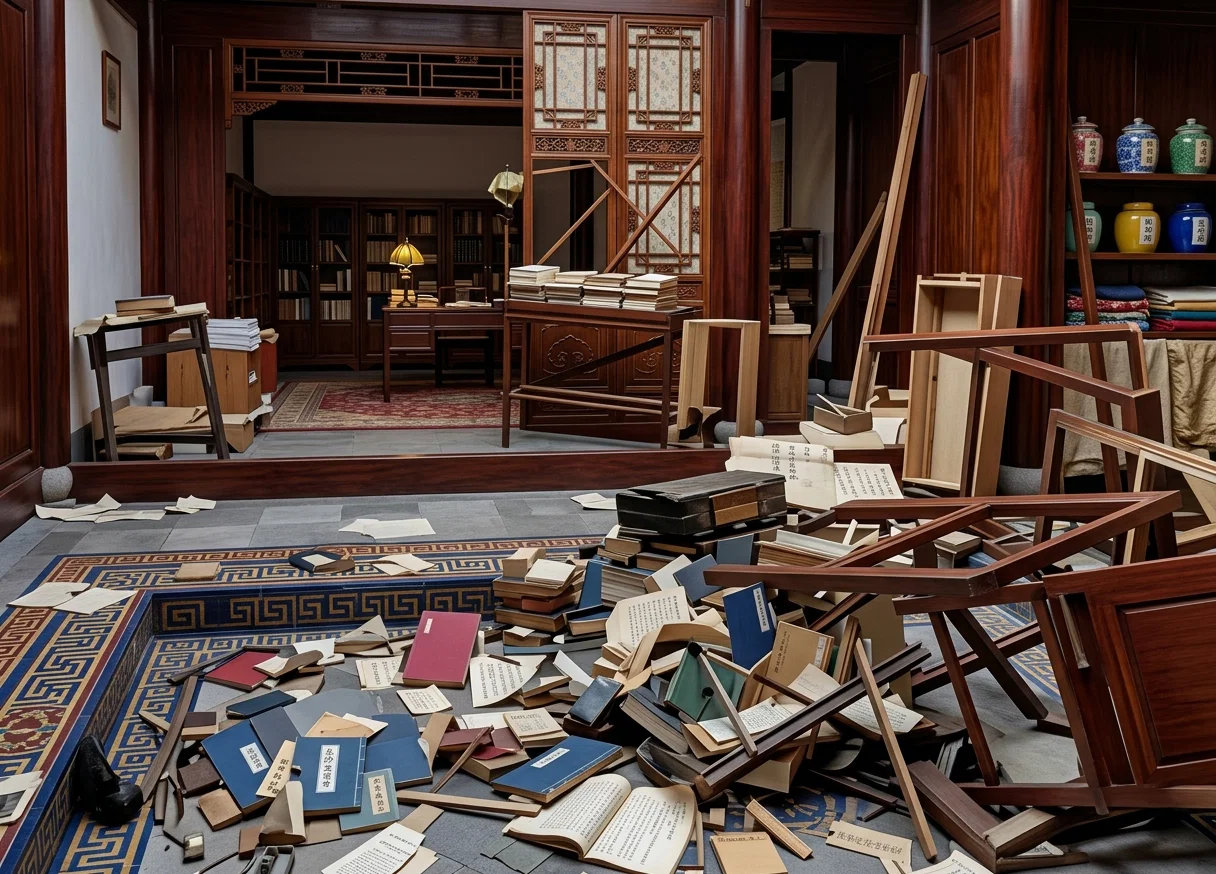
The brethren took us to the compound, where we found two soldiers, who were there to see that we were not molested. The accompanying illustration will give an idea of the appearance of most of the house as it looked the next morning. A great deal had been cleared up, so we could not tell just how it looked when the rioters left. The furniture was nearly all broken beyond repair. Several of the partitions between the rooms were broken out, and I think there was only one small window left whole in the house. Books, papers, eatables, broken glass, etc., were strewn all over the compound.
But we were more fortunate than many other missions. The large library was not seriously damaged. Though the books were strewn around, few were missing. Quite a quantity of drugs was usable. When we compare our losses with those of other missions, we thank God the Lord, and feel like pressing on more earnestly than ever before to give the message to these poor people.
Brother and Sister Laird lost the larger part of their clothes, dishes, etc., though the native brethren did noble service in saving the most valuable part of the goods. They even saved the mission property to the neglect and loss of their own. Of course the mission property was more valuable; but their action showed an excellent spirit.
On Sabbath we held a service with the church. Brother Huang, our native evangelist, preached. There seems to be an earnest spirit among the brethren. They are doing good work with our literature, even since Brother and Sister Laird went away. Brother Huang says there are still others who want to come and study the truth with him.
VIEW ACROSS THE COURT INTO BROTHER LAIRD'S STUDY. BETWEEN THE CROSSES A PARTITION WAS TORN OUT BY THE RIOTERS
Several of the other missions were both looted and burned, while others were only looted and smashed up. Only two small missions entirely escaped harm.
Besides all the loss in mission property, two or three fine Chinese government schools were also destroyed. The shore offices, godowns, and hulks of two large shipping companies were burned, cargoes and all. One shipping company was spared, the Japanese company, though I have since learned that the greater part of the capital in this company belonged to the Chinese. That is probably the reason it was spared. The indemnity asked will, no doubt, be very large; and when it is made known, it may cause more trouble.
We feel that the work in Hunan needs your prayers, especially at this time, that God may bless and sustain our native brethren, and that nothing may be lost on account of their being temporarily without foreign help. We pray that this crisis may even be to the furtherance of the work in Hunan, and thus help to hasten the Lord's appearing.
Hankow.
Our Work in Tokyo
By I. H. EVANS
I. H. EVANS
AFTER seventeen days on the sea, we reached the harbor of Yokohama, Japan, on the morning of June 24. We were cheered by the sight of Brethren F. W. Field, W. D. Burden, T. H. Okohira, and other Japanese who had come to give us welcome. The day was spent in landing and passing the customs, so it was Sabbath when we reached the homes of the brethren.
Sabbath morning it was my privilege to speak to the church in Tokyo, which holds its meetings in the spacious living-room of Brother Burden’s home. There were forty-six in attendance, among them many new believers, who were not with us two years ago when I met with this little company. Unity and love prevail, and there is no reason why the number of believers should not soon be greatly increased. During the years our work has been carried on in Japan, no special effort has ever been made to get the truth before the people of Tokyo. Some of our workers have lived in Japan nearly fourteen years; but as there are few foreigners in Tokyo, the work undertaken had to be done largely through an interpreter, when done by our foreign workers; and our Japanese workers have been so busily engaged in answering the calls elsewhere that they have never found it possible to make an extended effort in behalf of this great and needy city.
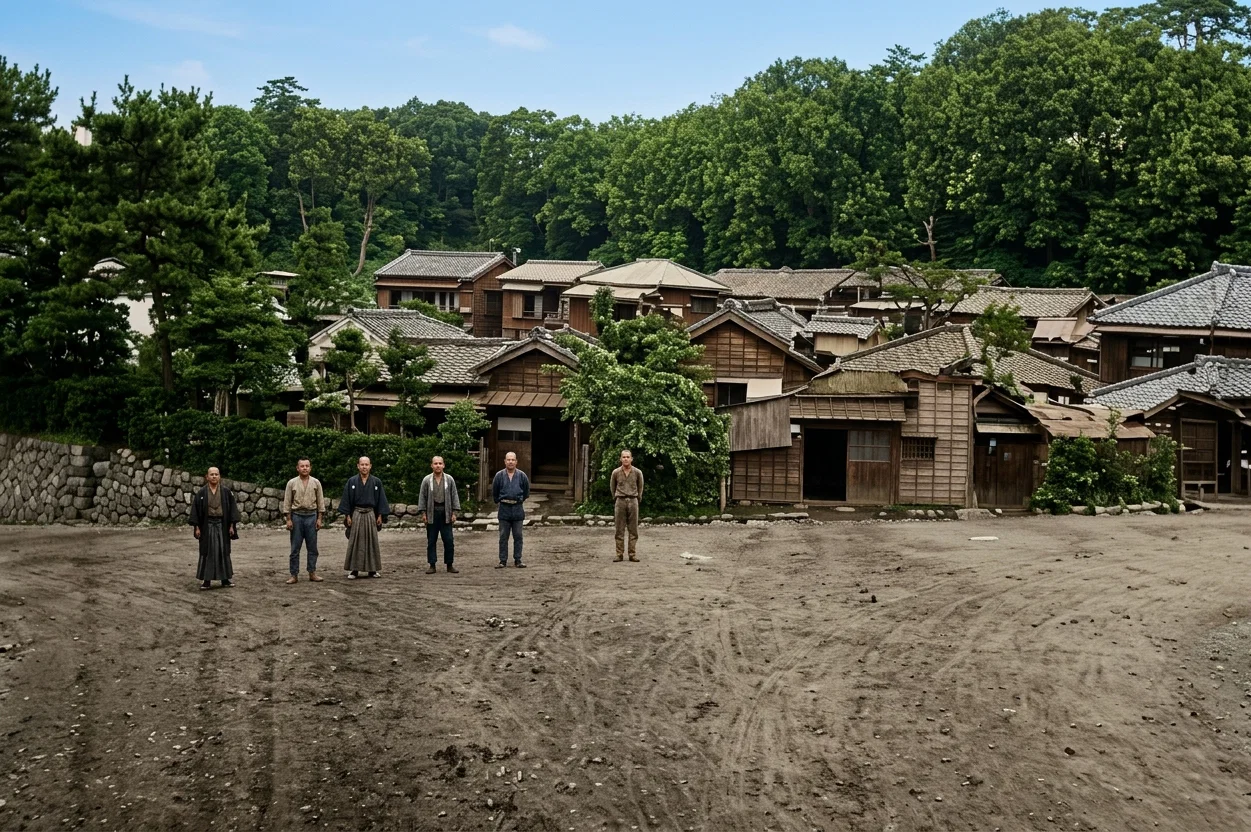
FRONT VIEW OF LOT IN TOKYO—MEN STANDING ON ROAD
ABOVE LOT
Tokyo is not only the capital and the metropolis of Japan, but it is the largest city of the far East, having a population of over two million five hundred thousand, and ranking among the great cities of the world. Improvements are constantly being made in widening the streets, extending the street-railway lines, and providing for the health and comfort of the rapidly increasing population. The city has one of the best filtration plants to be found anywhere, and supplies its people with pure water at a surprisingly low cost.
Most of the buildings in Japan seem low compared to those of the Western world. Few are more than two stories high, while the great majority of the dwelling-houses are only one story. The streets of the city are always clean, though after rains they are somewhat muddy, owing to the clay and gravel with which they are graded.
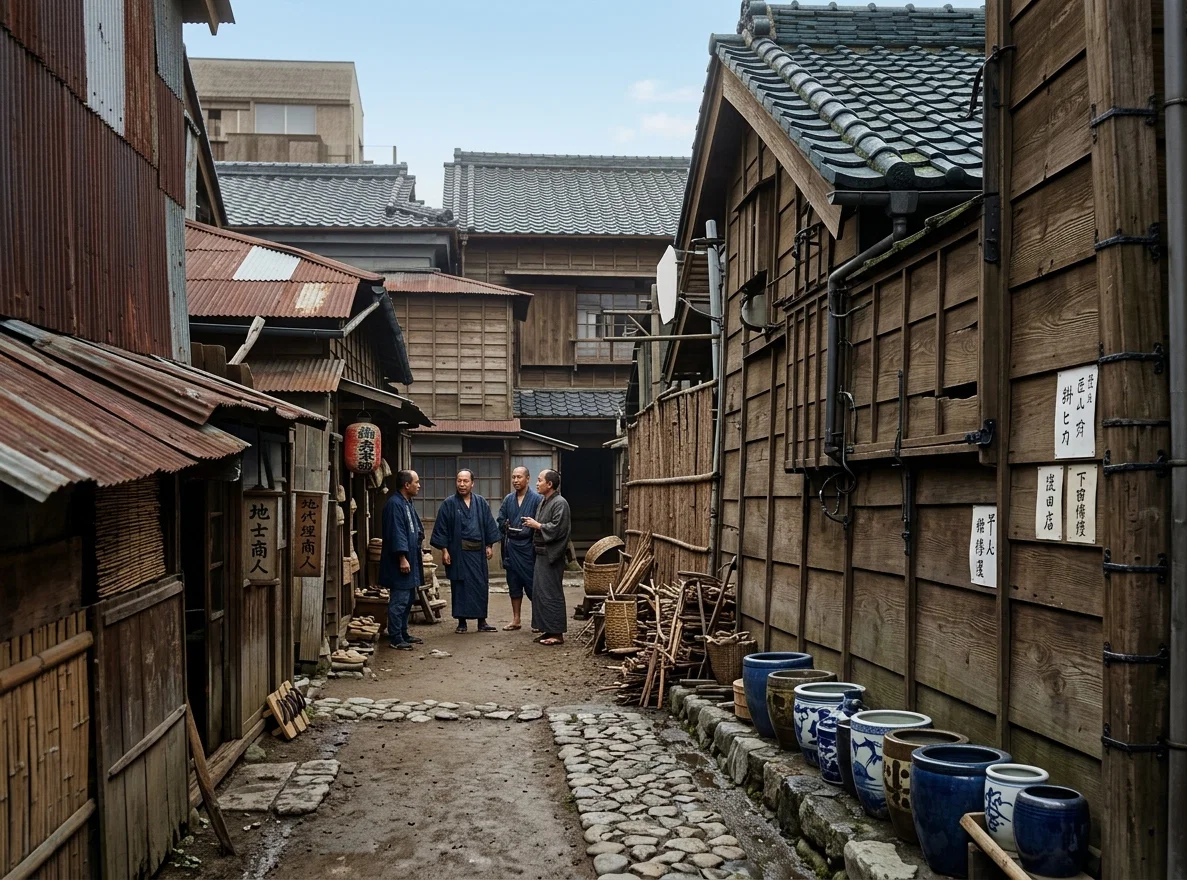
REAR VIEW OF LOT — BUILDINGS AT LEFT ON OUR LAND
Last spring our brethren in Japan purchased a small lot, about sixty by one hundred fifty feet. On it are three small, cheap, board houses, the material in which will about pay the expense of their removal. The brethren had in mind the erection of a printing-office, some treatment-rooms, and a church building for the accommodation of the Tokyo church. The accompanying illustrations give two views of the lot, and show part of the buildings on it.
We spent much time in looking for a suitable site for our institutions in Japan; and while we found several which are very favorable for location, we purchased none of them, as no funds were available. The need of suitable buildings for the carrying forward of the work in Japan is very great. At present our printing work, the school for training workers, and the meeting-house for the Tokyo church are all in Brother Burden’s house. The facilities for getting out the printed matter for Japan are most meager. A hand-press, which requires the full strength of a strong man to operate, located in the basement, where both light and ventilation are poor, a small job-press, a very poor paper-cutter, and a small quantity of type, constitute our printing outfit for Japan.
The sale of our denominational literature is already a demonstrated certainty, though the quality of work we have been able to do has been most unsatisfactory to ourselves and to the purchasers as well. Notwithstanding this, the Japanese periodical has a monthly sale of over three thousand copies, while the last special reached a sale of more than ten thousand copies. In order to get this message before fifty million intelligent, thrifty people, there must be facilities with which to print the truth in suitable form. The hearts of our brethren were greatly encouraged by the cheering news that soon a practical printer will join the working forces in Japan. This means much more to our work in this field than many can realize.
Brother and Sister F. H. DeVinney like their new field, and we have no doubt that they will be a blessing in this needy field, and a help to the people for whom they have come to labor.
The last Sabbath I was in Tokyo, the ordinances were celebrated. One dear old brother who is totally blind took part in this sacred service. Sometimes his countenance was almost radiant as, with closed eyes, he listened to the truth. Surely the Lord knows those who are his, and this dear old man will share in the promises made to the “heirs of faith.”
Shanghai, China.
The First General Meeting in Siberia
By Mrs. J. T. Boettcher
MRS. J. T. BOETTCHER
(Concluded)
To our surprise and delight we found our brethren had a nice tent all pitched and seated, ready for the meeting. We had expected that our meeting-house would be made from the branches and leaves of trees, but here was a tent capable of seating one hundred persons, and in front was a rostrum built of wood and covered with cloth, making a very neat appearance.
Here, then, miles away from any village, with not a house to be seen in the distance, on this beautiful spot in the edge of the woods, was held our first tent-meeting in Siberia. In the Sabbath-school there were present fifty adults and twenty-seven children, Germans and Russians. These are brethren and sisters who have emigrated from the southern part of European Russia to this part of Siberia. Some of them came three hundred miles or more with teams to attend this meeting. They were hungry to hear the word of God, and on Sabbath we had meetings from 9 A. M. until 7:30 in the evening, with only short11intermissions. It was a day rich in blessings and long to be remembered. Here, without the consent or presence of any police, we worshiped God with full liberty.
In the afternoon we had a good social meeting, in which all took part freely. The weather had become warmer, the sun shone, and all felt deeply grateful to God for such a beautiful and quiet place in which to worship. Many consecrated themselves anew to God for service.
There was present at this meeting an earnest Russian brother who has now been in the truth for about two years. He related to us some very interesting experiences. He had been acquainted with the truth some fifteen years before accepting it, bitterly opposing it all the time. First some of his children began to keep the Sabbath; then later his wife, bearing patiently for years all his opposition. He saw his children study the Bible, which ought to have pleased him, but strange to say, it did not. Sometimes he listened in another room while they were praying; and when he heard them praying for him, it affected him deeply. At last some of our ministers came to visit the family. He intended to have them make their visit very short; but instead of that the Lord worked upon his heart, and before they left, he, too, accepted the truth. He is, we believe, through the grace of God and the influence of his godly family, thoroughly a Seventh-day Adventist, and during the meeting he was solemnly ordained, by the laying on of hands, as elder of one of our Russian churches. In his family alone there are eleven Sabbath-keepers. We believe that this man, who was a veritable Saul, will become a Paul, and help to carry forward the work among the Russians in Siberia. On Sunday, some strangers not of our faith attended the meeting. They came with their teams from about eight miles away.
The needs of the cause, our great mission field, and the $300,000 Fund were presented to our people. All wanted to help, and soon over one hundred dollars was pledged or given in money, besides eggs and chickens which were set apart for this fund. These people have very little money; and although their houses are neat and clean, they have only straw roofs, and are furnished in the most simple manner. The truth always educates. We were pleased to see one window of each little house screened with netting and left open day and night, thus admitting plenty of fresh air.
The children of this settlement have no school privileges, so the parents decided at this meeting to build another house, consisting of three rooms and a kitchen. One room is to be used for their church meetings, one room for the school, and the remaining room and kitchen for the home of the school-teacher.
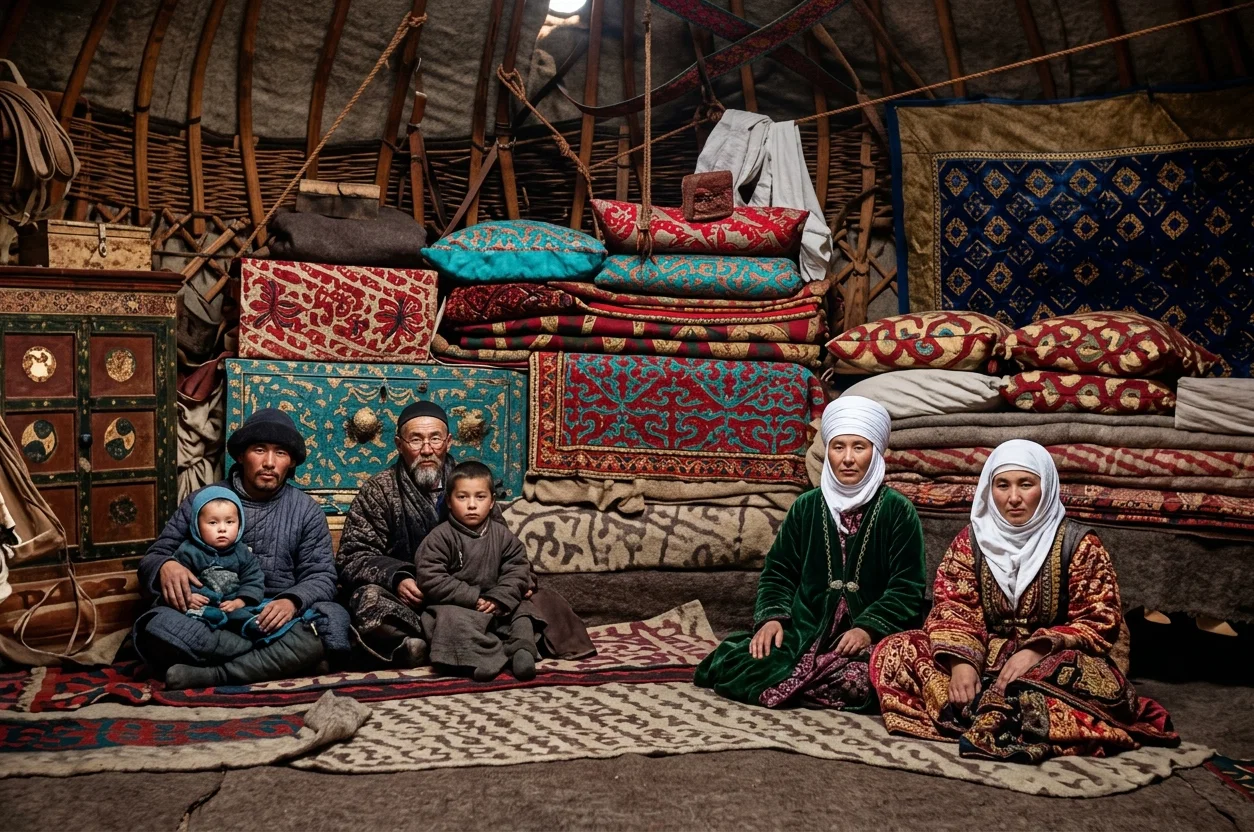
Near the lake, on the land of our brethren, stands a Kirghizen tent, just like those seen in Central Asia. It is the home of a Kirghizen family, who herd the cattle of the settlement. Last Friday, while looking about, we passed this tent, and went inside to visit the family. The tent is round, and contains an astonishing number of things. In the center was a fire from little sticks laid on the bare ground, the smoke escaping from an opening in the top of the tent. There were no chairs. On the ground before the fire sat an old grandmother cooking, and beside her the little granddaughter dressed in gay colors. The man, whose name was Abraham, rose at once upon our entrance to bid us welcome, and began to spread down rugs for us to sit upon. We sat down, and then they invited us to drink tea with them, our host even offering to get wine for us if we wished, although they themselves do not drink it. They seemed much pleased to learn that we, too, do not drink wine.
INSIDE A KIRGHIZEN TENT
Hearing groans behind us, we looked around and observed an old woman lying on a mat. They told us she was sick, and had kept her bed for four years. In a cradle lay a baby fast asleep. Soon the mother entered and seated herself upon a rug.
Our brethren tell us that these Mohammedan people are very trustworthy as herders. This afternoon, while we were singing our hymns by the side of the little lake where a young man had followed his Lord in baptism, two of the Kirghizen women came out of their tent to join us and listen to the singing. We shook hands with them to make them feel welcome, and later three of them attended one of our meetings.
After the meeting was closed, and the tent taken down, and we were packing our things to leave, the Spirit of the Lord still worked in a wonderful manner upon the people. The wife of one of our brethren said, with tears in her eyes, that she desired baptism. The brethren and sisters met together to pray, and to examine this young woman, who had resisted the Spirit of God for many years. When it was decided to have baptism at once, the son of Brother H. K. Loebsack, a promising youth of sixteen, and his sister, a bright little girl of fourteen, confessed that they had been under conviction during the meeting, and that they knew they ought to take this step. Men and women wept for joy as we left our packing, and proceeded once more to the lake, singing as we went. It was about nine o’clock in the evening, and the baptism was a most beautiful scene. All decided that the close of the meeting was the best part of all. Our hearts are filled with praise to God for his goodness.
_Beside All Waters_
THE following incident, which occurred at the Solusi Mission, South Africa, is related by W. C. Walston:—
“There is a native in this section, known as Pogo, who is nearly blind. He acquired his name because he always attended the beer-drinks at the kraals, and was usually the worse for beer when the vacation was over. Pogo is short for repogo, a grain of which the natives make beer; so they think the name Pogo a proper one for our friend.
“Pogo wanders from kraal to kraal, and stops wherever he can get something to eat and a place to sleep. For several years he has often come to the mission, stopping to bring some water from the spring for us, and we in return giving him something to eat. For the last year he has been here nearly every day; and besides giving him food, we have given him a blanket and some clothes. He always attends meetings on the Sabbath, but we never thought he was inclined to be religious. In our afternoon social meeting last Sabbath, we were surprised to see Pogo arise, and give in a good, earnest testimony. We never know where the seeds will grow, but are commanded to ‘sow beside all waters.’ And it is as true in Darkest Africa to-day as in any other part of the great harvest-field that ‘they that sow in tears shall reap in joy,’ and ‘he that goeth forth and weepeth, bearing precious seed, shall doubtless come again with rejoicing, bringing his sheaves with him.’”