The associated press reports of the proceedings of the Methodist Conference at Omaha, on May 9, say that—
Dr. J. M. King, of New York, a leading candidate for the episcopacy, offered a resolution for a proposed amendment to the Constitution of the United States. It relates to the protection of the public schools in the United States, against religious encroachments, and to define the attitude of the churches with relation to the schools. The resolution was adopted and applauded. Dr. King offered another resolution declaring that the appropriation of money by the national Government for ecclesiastical education was not in accord with the principles of the Constitution, and the churches should refuse to receive money from the Government for the education of the Indians. Dr. King spoke earnestly upon the subject, stating that all the churches had been getting assistance from the Government in their Indian work. He believed it was a wrong principle. The Catholic Church, he said, had received over $2,000,000. He wanted the whole contract system between the Government and the Church wiped out. The resolution was carried unanimously.
When Rev. Mr. King and Wm. Allen Butler championed this amendment and resolution before the House Committee on the judiciary some time ago, in reply to a question as to the breadth of application of this amendment, Mr. King said that it was “specialized upon the financial question,” therefore, of course, being of that restricted application, it could apply only to money transactions between the Government and individual churches or denominations. According to that interpretation this proposed amendment would be no bar to the use of money by the general Government for the advancement of the great religious trust from which is to be dispensed that dilute popular religion common and acceptable to the ruling majority, the attainment of which is one of the purposes of the religious Congress to be held at the World’s Fair.
If these gentlemen of the National League for the Preservation of American Institutions have given the slightest thought to the use and applicability of their measure, beyond the present purpose of locking the treasury doors against the Roman Catholic Church, this is just the view they have taken of it,—that the States and the general Government being debarred from showing financial favor to different or individual denominations, the way would be paved towards the furtherance and establishment of that modified form of religion which they fondly hope will be developed and rule in this country as the Christian religion. These men who are moving for the adoption of this constitutional amendment, and those who heard it with such acclamation, are all working and petitioning in almost a frenzy for the passage by Congress of any measure, however vicious the legislation may be, which shall close the gates of the Chicago Exposition on Sunday; Mr. King and Wm. Allen Butler, and the rest of the gentlemen of the National League, are stanch supporters of the enforced reading of the Bible in the public schools, that is, the King James or the Revised Version, though they would be ready to apply to Congress for a constitutional amendment, no doubt, if necessary, to shut out the Douay Version; many of the members of this League are members of, and sympathizers with, the National Reform Association and the American Sabbath Union.
The appeal to “principle” in the advocacy of this proposed constitutional amendment, is a specious plea. The application of the general principle is the very last thing to which they would submit. They would even prefer that the Roman Catholic Church should continue to receive the lion’s share of the public funds.
W. H. M.
The Sabbath Union at Omaha.
By L. A. HOOPES.
THE mass meeting of the American Sabbath Union held under the auspices of the Methodist Conference, at Omaha, May 15, was an assembly of mark. Any one would have been struck with the assumption of ecclesiastical and civic dignity which characterized the gathering. There were present on the platform three bishops, nine doctors of divinity, Judge Lawrence of Ohio, and Elliott F. Shepard. Bishop Newman presided, Chaplain McCabe and Rev. Manley Hand, of New York, led the singing. Nearly 4,000 people were present. The speakers were limited to ten minutes each, and those who spoke were, Bishop Newman, Rev. J. H. Knowles, Col. Shepard, Bishop Warren, Judge Lawrence, State Senator J. T. Edwards, of New York; Rev. Dr. Carman, of Canada; Rev. G. S. Chadbourne, Bishop Ninde, and Rev. J. W. Hamilton.
Dr. Knowles gave the history and statistics of the Sunday observance movement. He said the American Sabbath Union, had nineteen secretaries who devoted all their time to the work of the Union and fifty-two others who gave a portion of their time. When he told what had been done to secure the Sunday closing of the World's Fair he was warmly applauded.
Bishop Warren declared “the Sabbath an imperishable commandment,” quoting the miracle of the double portion of manna in the wilderness to prove it, and then argued for enforced Sunday observance upon those premises.
Judge Lawrence held that the law had no right to legalize shows and expositions that kept people out of reach of the churches. In neither his presentation of the law nor the gospel did it appear that another Daniel had come to judgment.
Dr. Carman gave some facts as to the progress of the Sunday movement in Canada.
Rev. G. S. Chadbourne attempted to show that wherever there were lax Sunday laws there was also freedom of divorce, and crimes against the home were more prevalent. The court records of some European countries would hardly bear him out in this, but he avoided that class of evidence.
Dr. Hamilton was of the opinion that the State should observe the “American Lord’s day.”
It certainly must be very apparent that the trend of the whole affair was directly and strongly toward a union of Church and State. The meeting was held as part of the Methodist Episcopal General Conference, and one would judge from the tumult of cheers and applause which came from the delegates to that body, that they were captivated by the speaking, and that they hailed with delight the day when their hopes will be realized, when the Church will have power to enter the precincts of the State and dictate laws, and enforce the dogmas of the Church. It is Rome with her bishops over again.
L. A. HOOPES.
Principles of American Government—Personal Rights.
By Publius
THE Declaration of Independence was signed in 1776, but the national Constitution was not adopted until the year 1787, and then it ran the gauntlet of all the States. But we may be thankful that there were men at that time who were wise enough to form that document and to adopt it. We will study both of these together. These are, truly, the grandest of all human documents; under these we have grown to be the grandest Nation on the earth—the admiration of the world. All honor to those noble men!
What makes this the best Government? We answer, Because the chief corner-stones of this Republic are civil and religious liberty. Equal rights to all. It is a recognized principle that religion is, of right, separate from the State. That “Governments derive their just powers from the consent of the governed,” is another principle as old as the Government. That bill of our rights says: “All men are created equal, and are endowed by their creator with certain unalienable rights, that among these are life, liberty, and the pursuit of happiness.” Men are not equal physically, mentally, or in social position; but these God-given rights belong to all alike. Governments are ordained to secure these rights, and whenever a government fails in this one particular, that moment it fails in its duty to the governed. These rights must be guarded, and the minority, however small, must be made secure in the enjoyment of these rights. These rights can not be transferred to another. Article IX., Amendments to the Constitution, reads:—
The enumeration in the Constitution of certain rights, shall not be construed to deny or disparage others retained by the people.
Thus we see there are other rights not mentioned or named in the bill. But who are the conservators of these rights? Is it the churches? Most certainly not. As these are God-given rights, they lie in the174breast of all alike—Christian, Jew, or infidel, believer or unbeliever; for Article X, of the Amendments says:—
The powers not delegated to the United States by the Constitution, nor prohibited by it to the States, are reserved to the States respectively, and to the people.
There is and can be but one limitation to the exercise of these rights, that is the infringement of the rights of another. So long as a man does not infringe upon the rights of another, he has the indisputable right to the employment of his rights. In this also must be included the right not to exercise these rights if a man shall so choose, else true liberty is gone. These rights are guaranteed by our national Constitution.—Publius, in Labor’s Tribune.
NATIONAL RELIGIOUS LIBERTY ASSOCIATION
FOUR men have been arrested for operating a merry-go-round, at the foot of West Forty-eighth St., on Sunday, May 22, and held for trial.
IN the various justice courts of New York City, twenty-eight persons were held, on Monday, May 23, for selling liquor and maintaining open billiard halls the previous day.
SOME of the prominent ladies of Cape May, N. J., went on a crusade against the saloons of that place on Sunday, May 22, and secured the arrest of a number of saloon-keepers for “breaking the Sabbath.”
THE New York Sabbath Committee, through its secretary, Rev. W. W. Atterbury, and employing the same detectives who purchased the exhibition of the city’s wickedness for Dr. Parkhurst, has undertaken a crusade against the dime museums and theatres which open on Sunday. Arrests have been made of the proprietors of Huber’s Dime Museum and the Globe Theater.
UPON the favorable report of the District Committee of the House, the Sunday ice bill for the District of Columbia (H. R. 8367), entitled “A bill prohibiting the delivery and sale of ice within the District of Columbia on the Sabbath day, commonly known as Sunday,” has been passed by the House of Representatives. The same bill has been favorably passed upon by the District Committee of the Senate, and it now remains only for the Senate to concur with the House in the passage of this bill, and Congress will have fully entered upon its course of religious legislation.
IMMEDIATELY following the passage of the Sunday ice bill by the House of Representatives, the Washington Post records the arrest of a restaurant keeper of Washington on the charge of “selling on Sunday.” A fine of thirty-five dollars was imposed. An appeal was taken. Thus almost instantly do those who desire the enforcement of religious laws take advantage of the slightest evidence that they will be upheld, to attempt to revive the colonial Church and State laws which remain on the statute books.
THE Sun, of May 25, has the following special dispatch from Norwich, Conn.:
Thirteen young men, most of whom belong in Norwich, went trout fishing in Voluntown on Sunday, May 1, twelve miles east of this city, in the wilds of eastern Connecticut, and a grand juror of that town, who takes care of the peace of the town, arrested the whole band, charging them with violating an old Blue Law of the State which forbids fishing on Sunday. He let them come home, but to-day they had to drive twelve miles to Voluntown to appear in court. They paid fines and costs amounting to thirteen dollars each.
Gradually the colonial laws in reference to religious observances are being revived. At the present rate of progress in this respect, it will be but a few years before we shall see a repetition of early colonial days in this regard.
CONGRESSMAN HOPKINS, of Illinois, has said to a reporter for the Washington Post that, “Nearly all the people who are sending in petitions to have the World’s Fair closed on Sunday, are doing so under a misapprehension. They all seem to think that those who want the Fair opened on Sunday, want the wheels of the whole Exposition to be going round. This is wrong. In the first place, it is not yet decided whether the Fair will be open or not. I am told that the subject has never been brought up by the Board of Directors. In the second place, those Directors who are in favor of keeping it open on Sunday are not in favor of allowing any machinery to be operated. They175merely want the fine art galleries, and similar exhibition halls, open, so that people can stroll through them, just as they do through all the art galleries in the cities. As for running the heavy machinery, that has never been contemplated by anybody.”
“Then again, some people claim that if the Exposition is not shut one day, all of the employees will have to work seven days a week. The fact is, that the World’s Fair is being built on the eight-hour plan, and six days constitutes a week’s work. An additional force of employees would be kept in reserve, so that nobody would have to work seven days. As far as I can learn, the laboring element of Chicago, and the surrounding towns, is unanimously in favor of keeping the gates open on Sunday. It is proposed to inaugurate a department of public worship, at Jackson Park, and hold religious services in the buildings if the gates are opened.
“During the summer months more than 50,000 working people visit Jackson Park every Sunday to enjoy the cool breezes and the pleasant lawns. They went there before the World’s Fair was thought of.”
IN the Congressional Record, of May 25, under the head of “Petitions,” is this suggestive paragraph:—
By MR. GREENLEAF: Three petitions, as follows: One from the Presbyterian Church of Brighton, N. Y.; one from the Presbyterian Church at Parma Center, N. Y.; and one from Westminster Presbyterian Church of Rochester, N. Y.; in favor of closing the World’s Fair on Sunday, in which occur these gently persuasive words, viz.: “Resolved, That we do hereby pledge ourselves and each other that we will from this time henceforth refuse to vote for or support for any office or position of trust any member of Congress, either Senator or Representative, who shall vote for any further aid of any kind to the World’s Fair except on conditions named in these resolutions.”
This same thing was said quietly in reference to the action of some of the members of the House of Representatives, in the last Congress, on Sunday bills then before them; in this Congress the open threat is made publicly, and to their very faces.
THE Washtenaw Times, of May 21, has the following paragraph, under the title, “It Is an Infringement”:—
“Many of the churches are sending petitions to the House of Representatives, praying Congress for legislation prohibiting the opening of the World’s Fair on Sunday.
“Why is the demand made? If these churches kept Saturday or Monday as a religious day, no such demand would ever have been made by them. It is evident, therefore, that this demand is made because they regard Sunday as a religious day. This proves that this is wholly a religious question, and Congress, therefore, has no right, according to our Constitution, to legislate upon it, even if this day is regarded by the majority as a holy day. If the State is to determine religious questions by the number of its adherents, and put its stamp upon the religion of the majority, then its ground is that on which all State religions have rested, and under the color of which religious proscription and persecution have been perpetrated and justified. According to the great American principle in respect to the civil government, religious faith is no part of citizenship, and no criterion of right. Sunday observers, Saturday observers, and no-day observers, are dealt with on precisely the same terms, the State knowing them only as citizens. We forfeit no right by being one, and gain no right by being the other. It is not in the province of the State to decide which is true or which is false.”
THE Chicago News says, “The World’s Fair is open on Sunday,” and publishes the following editorial item in regard to the matter:—
It would be just as well for those persons—and there are hundreds of thousand of them in the United States—who are trying to bring about the closing of the World’s Fair on Sunday, to bear in mind that the very thing against which they protest is now in full operation. The gates of the World’s Fair are open every Sunday and hundreds of sight-seers go to it. They are readily admitted upon the payment of the established fee. The World’s Fair Directors have thus decided the matter of the Sunday opening, while the whole country, represented by Congress, by great religious gatherings and many other influential bodies, is still debating the matter.
It may well be asked: Are the World’s Fair authorities justified in forestalling the judgment of the Nation in this matter? There is little real difference between the present arrangement at Jackson Park and that which will be in force if the fully erected enterprise shall be thrown open to visitors on Sundays a year hence.
Because of this action of the Directors the question now under debate by the whole Nation is not, “Shall the World’s Fair be open on Sunday?” but, “Shall the present condition of Sunday sight-seeing at Jackson Park be changed after the formal opening of the World’s Fair?”
The World’s Fair is open on Sunday. It is a condition, not a theory, that confronts us.
The Chicago News is an humble follower of the Mail and Express, and would no doubt advocate the closing of all the parks to Sunday visitors. Ordinarily, in pleasant summer weather, Jackson Park is filled on Sunday with thousands of sight-seers. Shall the fact that a World’s Fair is to be held in the Park preclude their going there on Sunday for a year and a half?
Sunday Ninety Years Ago.
THE following story comes from Milford, Conn., illustrative of the way in which Sunday laws were enforced in that State ninety years ago:—
Deacon Higby, as tithingman of Milford, was accustomed to sit between sunrise and sunset every Sunday in the front gallery of the old Plymouth Church, on the turnpike in that place. From the window he could command a view of the road for several miles east and west, and if any traveler passed on pleasure or business bent he was halted and compelled to stop over until the sun had set. Vice-President Burr arrived at Milford on Sunday morning. Deacon Higby saw the imposing equipage coming toward the church, and ran out to stop it. The postillions drew up at his word of command, and Mr. Burr asked, “What’s the matter?” Deacon Higby told him that he was breaking a law of the State by traveling on Sunday, and that he must put up his horses and wait until sunset. Burr was somewhat astonished at the command, and, after looking at the tall and imposing figure of the tithingman who stood at the horses’ heads, he remarked, as if expecting to settle the question: “But I am Aaron Burr, Vice-President of the United States.”
The deacon was no respecter of persons. With an obeisance, he replied: “It makes no difference if you are Vice-President of the United States. In the name of the God I serve and the country I honor, I forbid you to pass through this place until the sun has set.”
Burr obeyed the command and had his horses put out, and he and his retinue took dinner in Butler’s tavern, staying until after the sun went down.
It will be observed that at the time referred to Sunday was reckoned as beginning at sundown on Saturday, and ending at the same time the following evening. This was in accordance with the Bible count of time, now abandoned, however, by Sunday-keepers, possibly on account of the mischief which from the standpoint of Sunday sacredness it makes with the first day meeting, an account of which is given in the twentieth chapter of Acts. Counting from evening to evening, the Troas meeting was held on what we call Saturday night, and the light part of Sunday was spent by the apostle in walking from Troas to Assos, a distance of nineteen miles. That is just what he did; but counting from midnight to midnight as is now the custom gives color to the claim either thoughtlessly or dishonestly made, that the meeting at Troas was on what we call Sunday evening, and that the apostle resumed his journey Monday morning.
Cause for Alarm.
JAMES B. MASON, of Chapel Hill, N. C., who was educated at the State University and Trinity College, and was licensed in 1869 from the law school of the late Hon. W. H. Battle, Judge of the Supreme Court of North Carolina, gives utterance to the following significant words:—
“Where are the Roger Williamses, the Martin Luthers, and the John Wesleys, and their early coadjutors, the staffs of religious liberty, and where are the Thomas Jeffersons in the affairs of State? A sad recalling! We pause! We reflect much! Here with hope, there with forebodings! We cease here to speak of or imagine them!
“From these masterly days we have made rapid strides in civil and religious liberty, and free America—the United States—enjoys to-day the admiration of the entire civilized world. This I say, and this I believe. But, withal, have we not reached a point in human events demanding a pause and reflection? Is not the insignia of religious bigotry and intolerance wont to be erected? Are not legislators attempting to do the work of the Church? Is not the Church attempting to control the affairs properly belonging to both Church and State?”
They Are Proud of It.
THE Christian Statesman writing of the early part of this century, says:—
Only mail trains were allowed, Congress having authorized Sunday mails in 1810 as a war measure, which became the occasion of a Sabbath-observance revival in 1828-9, when petitions poured into Congress from nearly every State, asking that this official attack upon religion and rest should cease. The petitions failed, because the Post master General and Congress were partly too shallow and partly too wicked to see the fallacy of a Seventh-day-Baptist argument presented to them, which assumed that for Congress to cancel its order for Sunday mails would be a union of Church and State as if the order itself were not a case of State against Church, and also against the rights of Government employes in the matter of rest and conscience.
Seventh-day Baptists were undoubtedly responsible for the argument which decided the issue in 1828-9, and we are proud of the honor which our forefathers gained for themselves, and for the truth. The Statesman seems to lack the power to take God and the Sabbath into account in its consideration of Sunday. To read its pages one would think that the fundamental issue of the hour is the right of Government employes and poor workingmen to rest on Sunday. God, and his Sabbath, which the Statesman calls “Saturday,” and disregards as loftily as though Jehovah, maker of heaven and earth, had “no rights which the Statesman is bound to respect,” must not come into mind!
It is a serious pity that the “Post-master General and Congress were partly too shallow and partly too wicked to see the fallacy of a Seventh-day Baptist argument” in favor of rendering unto God the things that belong to him! How wonderfully deep, and how holy the Statesman is when compared with such a Congress, and such a Post-master General! It overwhelms one to think of it!—Sabbath Outlook.
Sunday Observances. -
WIFE—I'd like to know what you go to the club for on Sundays. Are the card rooms and billiard rooms open on Sunday?
Husband—Oh, no, my dear—no, indeed. We wouldn't think of such desecration. Everything is closed but the bar.—New York Weekly.
SACRED CHRONOLOGY.
By Sylvester Bliss
BY SYLVESTER BLISS.
This work treats of the Elements of Chronology, the different systems, and the various eras, and gives the chronology of the principal events recorded in sacred history from the creation, till the death of St. John. It also contains a vindication of the numbers of the Hebrew Scriptures. As an aid to investigation it is invaluable. The book has been thoroughly revised, and an entire chapter added, on the
PEOPLING OF THE EARTH.
This chapter is an exposition of the tenth chapter of Genesis, and gives an outline of the beginning of history and
THE ORIGIN OF NATIONS.
No student of history can well be without this book. 300 pages, cloth binding, with side stamp, $1.00.
Address,
PACIFIC PRESS PUB. CO.,
43 Bond St., New York City.
Or, Oakland, Cal.
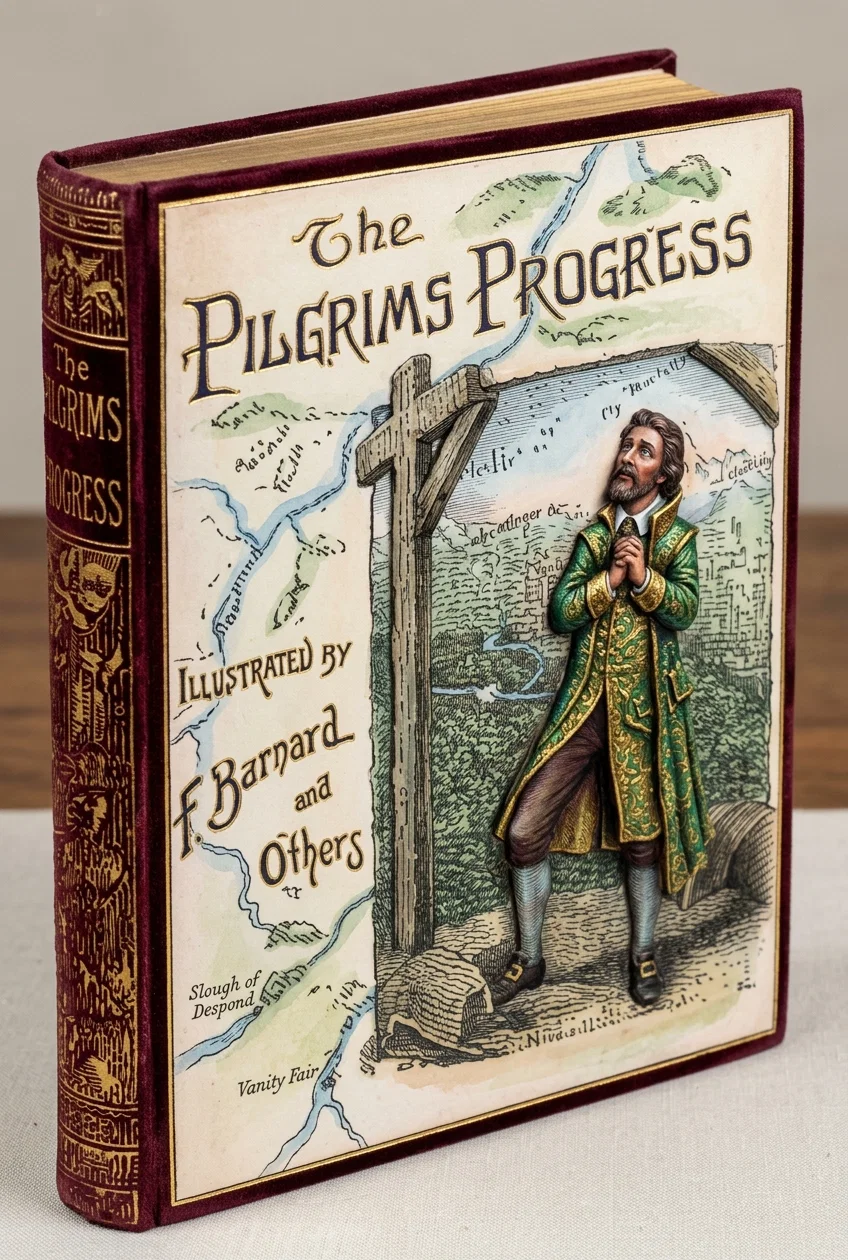
THE
PILGRIM'S
PROGRESS
By JOHN BUNYAN.
Royal Octavo Edition in large type, and contains over 100 illustrations, 50 of which are full page. Cloth, with side stamp in ink and gold, $1.00.