Pacific Press Publishing Company · New York · Apr 30, 1896
CIVIL GROUNDS OF RELIGIOUS INTOLERANCE.
In all ages and in every country religious intolerance has been defended on the ground of public policy.
Dissenters have ever been stigmatized as enemies of the State, subverters of social order, and disturbers of the public peace.
Ahab’s wicked accusation, contained in the question to Elijah: “Art thou he that troubleth Israel?” has been repeated in various forms in every country and in every age from that time until the present.
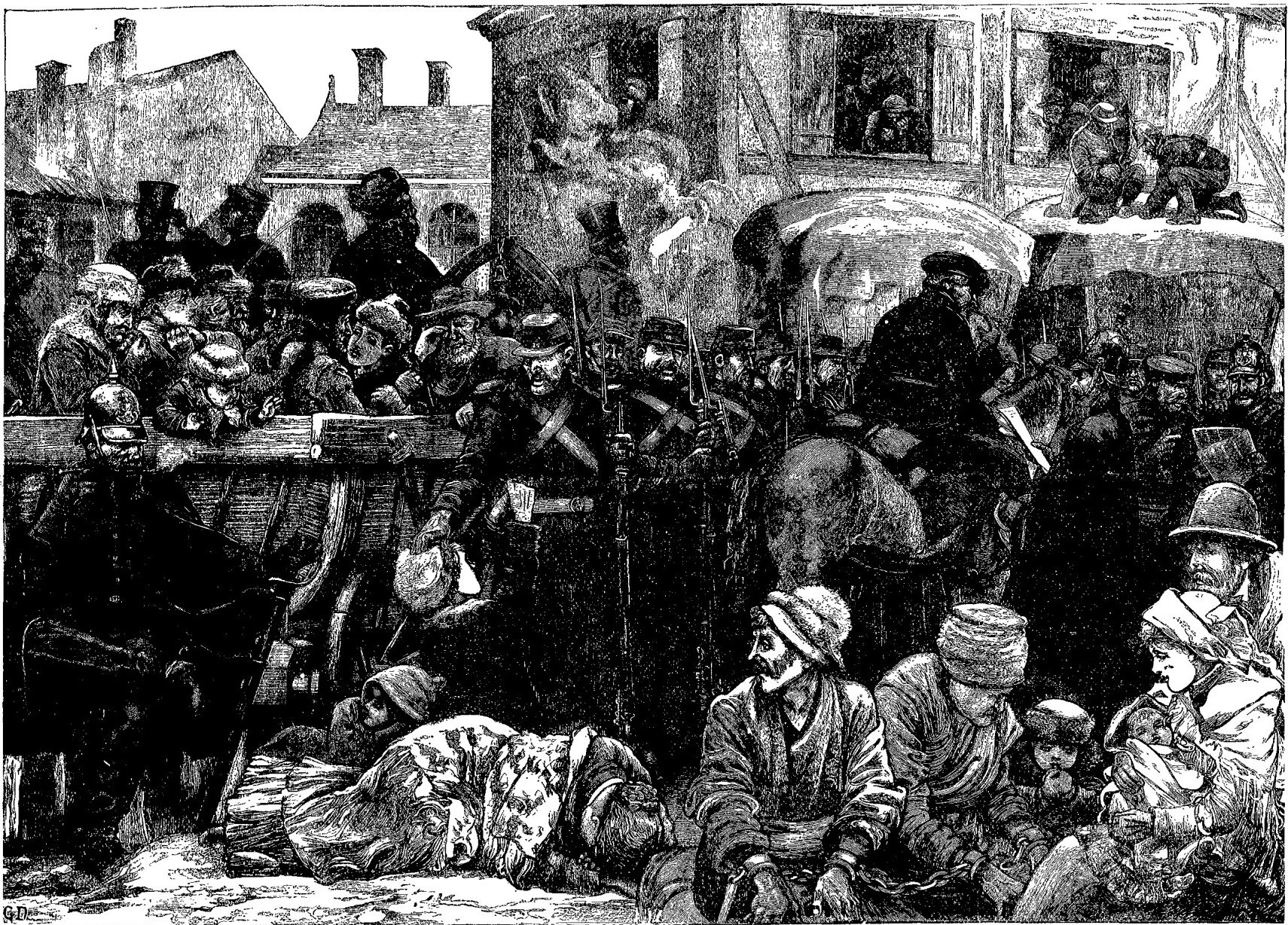
Exiled to Siberia for Their Faith.
When Daniel was accused to the king because he prayed three times a day contrary to the royal mandate, the accusation was in these words: “Daniel, which is of the children of the captivity of Judah, regardeth not thee, O king, nor the decree that thou hast signed.” His violation of the king’s decree was held to be subversive of social order, and his example to be pernicious in the extreme.
The Son of God was accused “as one that perverteth the people,” and the prevailing argument with Pilate for his condemnation was, “If thou let this man go, thou art not Cæsar’s friend: whosoever maketh himself a king speaketh against Cæsar.” Religious bigotry simply invoked against Christ the penalties of the civil law; he suffered ostensibly, not as a defamer of religion, but as an enemy of the State.
The apostles were also accused of being disturbers of the peace. At Thessalonica the cry was, “These that have turned the world upside down are come hither also; whom Jason hath received; and these all do contrary to the decrees of Cæsar, saying that there is another king, one Jesus.” And at Ephesus,138the silversmiths raised a tumult because their craft was endangered by the preaching of the apostles. Nor were their fears groundless. The danger which they saw threatening their business really existed; so close was the relation between the prevailing faith and the social and commercial customs of the people. Thus they plausibly argued that there existed a substantial civil basis for the legal prohibition of the preaching of the doctrine of Christ.
Human Nature Intolerant.
It is said that “times change and men change with them;” but there is really little truth in the supposed maxim. The grace of God is the only thing that really changes anybody. Men are naturally intolerant, and we still find them invoking the power of the State to enforce religious dogmas, and to bolster up religious creeds; and at the same time justifying their action on “civil” grounds.
In our own country the attempt has been made to justify various measures of religious legislation on the ground that the stability of our institutions and even of the Government itself depends upon the maintenance of our religion. This is especially true of Sunday laws. In a tract, “The American Sabbath,” published by the Presbyterian Board of Publication, Rev. Robert Patterson, D. D., says:—
It is the right of the State to protect by law such a fundamental support of government. This attack on the sabbath is treason against the very foundation of government. As such, let it be resisted by every American citizen. The American sabbath is essential to American liberty, to our Republic, and to God’s religion.
In his book, “The Sabbath for Man,” Mr. Crafts says:—
It is the conviction of the majority that the nation can not be preserved without religion, nor religion without the sabbath, nor the sabbath without laws; therefore sabbath laws are enacted by the right of self-preservation, not in violation of liberty, but for its protection.—Page 248.
The “argument” may seem plausible to many, but it is unsound. It would justify all the persecutions of the past, and revive the bloody scenes of the Dark Ages.
A Case in Point.
In harmony with this theory honest American citizens have within a year toiled in the chain-gang for no offense against their fellow-men, but only for refusing to honor a statute-intrenched religious institution; and to-day J. W. Lewis, a Seventh-day Adventist, swelters in a Tennessee jail like a common criminal for the same reason.
An exact parallel to it is found in Russia. There the faith of the Orthodox Church is the established religion; and the theory of the government is, as stated by Lady Herbert, in the Dublin Review, January, 1893, that “that which makes the body and strength of the Russian Government is its national religion.” It follows, according to Mr. Crafts’ and Dr. Patterson’s logic, that the Russian Government is perfectly justifiable in maintaining that religion at any cost.
The statement quoted from Lady Herbert was made upon the authority of Father Vanutelli, a Dominican monk, who was invited by the Russian Government to visit the principal religious establishments in that country. “He was everywhere cordially received,” remarked the Review of Reviews, “and had an interview with Pobiedonotzeff,” the famous procurator of the Holy Synod. Pobiedonotzeff, it appears, expressed his views very freely to his guest, saying, as Lady Herbert put it, “that society in the West was going to ruin, and that its decay was owing to the want of religion and the revolutionary and social principles which were being so widely enunciated.” “In Russia,” he said, “we have preserved the principle of authority and the deepest respect for the Christian religion. The people are attached to the government and thoroughly good at the bottom, and they enjoy a state of prosperity which in other countries does not exist. Here there are no political parties, no parliaments or rival authorities, and we wish to avoid any contact with what might disturb the tranquillity of the masses.”
Nowhere Does Christ Reign as in Russia.
Father Vanutelli himself said:—
I cannot understand how it is that so many persons who visit Russia write about it afterwards without alluding to the main characteristic of the people. Without an appreciation of their religious aspect any description of Russia must be incomplete. The Christian idea is predominant everywhere, and nowhere does Christ reign to such an extent as in Russia.
The following quotation from an article in the Century, for February, 1893, by Pierre Botkine, at that time secretary of the Russian Legation at Washington, will serve to throw some additional light upon this subject and show what Vanutelli meant by saying that “nowhere does Christ reign as in Russia.” Botkine said:—
The strength of Russia lies precisely in the unity of power, in the firm faith of the people in their church, and in their reliance upon and devotion to the high personality called to occupy the throne.
The Russian idea is that the Czar reigns by divine right. He is the acknowledged head of the church as well as of the civil government, and the fealty of the people to him is not simply that of subjects to a civil ruler, but to a spiritual lord as well, who has the power to close heaven against them or to admit them to all its enjoyments. Their patriotism and their religious veneration center in a single individual, namely, the Czar; hence his power over them, and the consequent strength of the government which is thus supported by the strongest sentiments of the human soul.
Religious Institutions and Political Stability.
In view of what has already been said it is scarcely necessary to say that the union of Church and State in Russia is perfect. Nor is it strange that the government regards any effort to weaken the established church, or to draw away converts from it, much as it would an attempt to undermine the empire itself, or to destroy in the breasts of the people, that feeling of patriotism that is the strength of every stable government. All religious restrictions in Russia are in the interests of political stability. Mr. Botkine said:—
The Orthodox Church is the State Church in Russia; and, as I have explained, the strength and might of the empire are considered by us to depend to a great degree upon the firm faith of the people in its doctrines and discipline. Our history abounds in proofs of this. It is therefore natural that our government cherishes and supports the orthodox religion, and tries to prevent the members of that church or their children from heedlessly going off into other communions.
This is but putting in other phrase the sentiment already quoted from Mr. Crafts and Dr. Patterson, in justification of Sunday laws. In Russia it is the conviction, if not of the majority, at least of the rulers, that the nation can not be preserved without religion, nor religion without the Orthodox Church, nor the Orthodox Church without laws; that to dissent from the established religion is treason against the empire; therefore such laws are enacted by the right of self-preservation.
The Motive of Religious Intolerance.
It is the purpose of the Russian Government to crush out all religious dissent throughout the length and breadth of the empire in the interests of the ideal of Czar Nicholas, “One empire, one tongue, one church;” or in other words, perfect unity, and consequently, matchless strength; and it matters not how many conscientious men and women travel the weary road to Siberia as a result of this theory. The motive is not avowedly religious, but political. The Czar seeks to control the religion of his subjects, we are told, only that he may the more firmly cement and bind together the various parts and elements in the empire. The logic is just as good in the one case as in the other. The principle is the same in America as in Europe.
Mr. Botkine even denied that there was any restriction of religious liberty in Russia except where certain obnoxious sects propagated doctrines which the authorities considered subversive of morals or of good order in society. Of the Jews he said: “We did not expel the Jews from the empire, as is often mistakenly charged, though we did restrict their rights as to certain localities of domicile and as to kinds of occupations—police regulations.” This being the case, Mr. Botkine regarded the remonstrances sent to the Czar from other countries as most impertinent. “The principle we contend for,” said he, “is home rule.”
The “Justification” the Same in All Ages.
It will be observed that the arguments urged in justification of restrictions of religious liberty are the same in every country and in every age. Elijah was persecuted because he “troubled” Israel; Daniel was persecuted because he regarded not the king’s command; Christ was put to death as an enemy of the State; the apostles were denounced and persecuted as disturbers of the peace; Jews and Protestants in Russia are banished to Siberia because they propagate doctrines which the authorities consider subversive of morals and of good order, and tending to weaken the government; and in this country it is urged that the same thing should be done for the very same reasons: indeed, the same principle does prevail to a greater or less extent, especially in our Sunday legislation. In Tennessee and some other States, as before remarked, “otherwise good citizens” are fined, imprisoned, and worked in the chain-gang for daring to dissent, practically, from the prevailing religion—and this on the plea that their example is prejudicial to good morals! and their acts against the peace and dignity of the State!! Surely we are not so very far ahead of our neighbors or even of the ancients after all! If times do change, men do not change with them to the extent of abandoning the supposed right of the majority or of the rulers to cram their religion, or at least, a portion of it, down the throats of the minority, or of their subjects. No considerable part of the race has yet developed sufficient moral power to yield complete obedience to the sum of all social law: “All things whatsoever ye would that men should do to you, do ye even so to them.”
Government Authority Limited to Conduct Between Men
“THE principles of our Government do not recognize in the majority any authority over the minority, except in matters which regard the conduct of man to his fellow man.”—House Committee on Post Offices and Post Roads, March 4, 1830.
POPULAR SOVEREIGNTY AND DIVINE SOVEREIGNTY.
At a recent “National Reform” convention held at Coulterville, Ill., the following resolution (among others) was passed:—
Resolved, That we condemn the assumption of absolute and popular sovereignty, and declare that the power of the people is limited by the law of God, and that the people are bound to set over them only such rulers as are willing to qualify by professed subjection to the law of Christ.
It is almost incredible that an assembly of intelligent people should declare itself in words so puerile and short-sighted. In pursuance of this thought let us notice a few facts.
1. The theory of popular government upon which our nation is established, makes no claim of sovereignty for the people in that sphere which is covered by the law of God. It claims no sovereignty for the people in the sphere of man’s relation to his Maker. Hence that popular sovereignty which pertains to republican government is not touched by the law of God at all.
The statement that the power of the people is limited by the law of God in the sphere covered by that law, would be equally beside the truth; for the people have no power at all in the direction of that which the law of God commands. This is a fundamental gospel truth. The power of God, and that alone, can perform that which the law commands.
2. “Professed subjection to the law of Christ” does not in itself amount to anything. Profession is not possession; and the former without the latter only makes an individual worse in the sight both of God and man. And it is as clear as noonday that if the people should undertake to put in political office only such persons as are willing to qualify in the manner described, the first announcement of such an intention would be the signal for unscrupulous self-seekers of every class to rush into the church. Then indeed would the prophetic utterance be fulfilled, “Babylon the great is fallen, is fallen, and is become the habitation of devils, and the hold of every foul spirit, and a cage of every unclean and hateful bird.” Rev. 18:2.
Any moral ruler over the individual other than God, is popery. God has no vicars or lieutenants on this earth; he has only ambassadors. And the adult individual who cannot rule himself, conformably to the principles of popular sovereignty, in that which pertains simply to his secular affairs, is fit only to be an inmate of some institution of charity.
GOVERNMENT DUTY ON “HOLY WATER.”
The collector of customs at Hartford, Conn., was recently, says the New York World, of April 15, called upon to decide a perplexing question, which was that of whether “holy water” imported from abroad was chargeable with government “duty.” “Several months ago,” says the World, “His Holiness Pope Leo XIII. blessed a quantity of water at the petition of a pious congregation in Hartford, Conn. One week ago a keg labeled ‘Holy Water’ arrived at the custom-house in this city and was sent to the collector of customs at Hartford, in bond.
“The keg arrived at Hartford. The official gauger of that port certified that it contained five gallons of a fluid that had the appearance and consistency of pure water. Then it fell upon the collector to determine whether the importation was or was not dutiable. The collector searched the records of the department in vain for a precedent. There was none.
“He found a number of department decisions admitting free of duty Appolinaris, Villacabras, and a dozen other waters for medicinal uses, when accompanied by an affidavit to the effect that they corresponded to the required medical formulae, and he found also that water from the Grotto at Lourdes had been admitted free because of the pious belief among Catholics that miracles had been performed by its use. Nowhere, however, could the collector at Hartford find anything bearing on holy water.”
Finally after long consultation with his assistant, the collector decided that “holy water” came under the head of “Unenumerated Articles” in the Wilson Bill, and as such was subject to a duty of 10 per cent. Special Deputy Naval Officer Gourley, an expert on customs enigmas, upon being visited by a World reporter, said that “holy water” should come under the same category as natural-spring water, which is considered a crude mineral and free from duty.
The situation might well have caused perplexity. Was the representative of the United States Government to affix a value to the papal blessing and on that basis charge a certain per cent. of duty? or was this “holy water” blessed by Leo himself to be regarded as “crude mineral” and admitted free? In either case there was a chance that the Roman pontiff might feel himself grievously insulted.
The incident may well serve as an occasion for pointing out the absurdity of the idea that holiness can be made a mere abstract quality of matter. Holiness cannot be separated from God. And therefore no man can impart holiness to anything, any more than he can impart God himself. It is the presence of God that makes holy; for God, and he alone, is holy in and of himself. And his holiness is imparted not at the volition of man, but only according to the divine will.
The papal blessing affected the water neither for better nor worse; and as ordinary water, it was of course not subject to duty upon entry into this country.
There is no danger that real holiness will ever have to be considered by the United States Government as a quality affecting the nature and value of any of its articles of import.
PERVADING LAWLESSNESS.
The Christian Leader (Cincinnati) of March 10, makes this comment and query:—
The spirit of lawlessness and insubordination pervades the entire country. Who can give the causes, proximate and remote, of these terrible crimes? In general terms it is called “the spirit of the age.” But what produced this spirit? In general terms we might explain that there is no fear of God before the eyes of the people. Atheism and agnosticism are rampant. What forces have produced this condition of things?
The mystery of the situation may be solved by discovering the cause which has removed from the people’s eyes the fear of God. Whatever has done this, has also removed from the minds of men the restraints of wholesome law, and clear conceptions of right and wrong. Without discussing the question at length, we will state three facts which have a fundamental bearing upon it.
1. It has long been taught by men, recognized as ministers of the gospel, that the law of God—the Decalogue—is abolished.
2. What amounts essentially to the same thing, the great majority of professed Christians have for centuries disregarded the fourth precept of the Decalogue—the very one which points out the true God—by observing another day than the one which it commands to be observed. And as the attention of the Christian world has within a few decades been called to this fact, those who still persist in their adherence to the false sabbath do so for the most part at the expense of their own convictions of duty as enjoined by God’s word. And the unconverted world at large have learned that professed Christians themselves place their own custom and tradition above the commandment of Jehovah.
3. These same “Christians” have for several years been clamoring and lobbying for legislation to exalt Sunday, and make criminal140acts performed on Sunday, which on all other days are held to be right and honorable. Nothing could contribute more powerfully to break down moral distinctions of right and wrong in the public mind than the course pursued by the Christian world regarding the Sabbath.
With these facts in mind, the present alarming moral condition of society is quite fully intelligible.
A VERY REMARKABLE ACTION.
We take the following from the Denver American, of the 18th inst., which is credited by our contemporary to the Catholic Citizen:—
A question of great importance in church circles has come up in Illinois. The issue is, whether a priest of the church should be held amenable to the laws of the United States for writing and sending through the mails a letter to one of his parishioners uttering a warning against a contemplated act that would be a violation of the laws and canons of the Catholic Church.
The issue is raised by the fact that Father Lawrence Erhardt, of the parish of Somonauk, in Illinois, has been held by the United States Commissioner in $5,000 bail to the grand jury, for sending to a woman communicant of his parish a letter based on the announced fact of her engagement to a divorced man, and in which he pointed out that the church could not recognize a marriage with a divorced person.
Action was taken against Father Erhardt, on the dictum of a post-office inspector, on the ground that the letter in question was an unmailable one within the meaning of the statute relating to such offenses. The case is the first of its kind that has arisen in the country, and the extraordinary nature of the proceeding has evoked some comment from leading clergymen. As the legal proceedings are in a Federal court, the outcome will establish a precedent applying to every part of the country.
We know nothing about the facts in this case further than what is here stated, but it seems incredible to us that anybody would hold that a priest, or anybody else, for that matter, was guilty of a crime for writing a letter of the character indicated, to one of his parishioners.
OUR COUNTRY ON THE DOWN GRADE.
“A SCORE of years ago,” says the Catholic Universe, of Feb. 28, 1896, “the sight of a Catholic priest sitting on a platform with the ministers of other denominations to discuss measures for civic, State, or national improvements, would have caused a wild frothing at the mouth. Now it is too common and too welcome to excite comment.” The statement points out the rapidity with which even the greatest changes in popular sentiment are taking place at the present time. We live in a fast age, fast especially in the downward rush of the tide of affairs in social and national life. A gathering of preachers “to discuss measures for civic, State, or national improvements,” can have no other meaning but that the churches represented by them will use their united power to shape and control affairs in city, State and national government. And that means a union of Church and State.
A PERSECUTING WORLD.
By F. D. Starr
BY F. D. STARR.
THE fact that the followers of Christ may expect inconvenience, opposition, and persecution, is made so prominent in the Scriptures, that we need simply to refer to this, without taking space to prove the truthfulness of the assertion. Such passages as John 15:18–20, Acts 14:22, 1 Thess. 3:4, 2 Tim. 3:12, with numerous other references that might be cited, clearly substantiate the fact that the Church must expect persecution in this world. However, there seems to be a strange condition of affairs at the present time, as there is so little persecution to be experienced ordinarily by those who make a profession of Christianity; and the question arises, Why is this so? If all who will live godly in Christ Jesus shall suffer persecution, why is so little persecution experienced now?
It is by no means a wonder that we hear occasionally of some one being thrown into jail or into prison for conscience’ sake. The strange thing is that these experiences are so rare. Not that it is a reasonable thing for Christians to be imprisoned; but the Scripture has so plainly and repeatedly told us that this would be the lot of believers, that it is remarkable that these experiences are not more common. They were matters of frequent occurrence in days past in the history of the Church. Many millions have forfeited their lives for adherence to their faith. But mark, the Scripture does not say that all who profess to be followers of Jesus Christ shall suffer persecution. No; the statement is, “All that will live godly in Christ Jesus shall suffer persecution.” May it not be then that the difficulty is that there are so few who are living godly in Christ Jesus? If they were living that life, they would without doubt experience more persecution.
The Saviour told his disciples, “If ye were of the world, the world would love his own.” Those, then, who conform to the world, have no reason to fear persecution on the part of the world whatever their profession may be. Their ways please the world, and they are pleased with the ways of the world. They are neither crucified to the world, nor is the world crucified to them. Our Saviour’s words stated in the reverse form would be as true as is his utterance in the form in which we find it. If the world love you, ye are of the world. So if our ways please the world, and the world is pleased with us, and we enjoy the love of the world, we may know we are of the world; but to be of the world is to be separated from God, for the love of the world and the love of the Father are separate, and cannot be united in the same individual. 1 John 2:15.
Why the world now offers so little opposition to the Christian is to many a difficult problem. For instance, the writer listened recently to a sermon from the text, “The last enemy that shall be destroyed is death.” 1 Cor. 15:26. The enemies of the Church were enumerated by the speaker, the last of these enemies being death itself. Among the enemies of the Church that were mentioned was the world. This is correct; the world is an enemy to the Church. But to demonstrate that at the present time the world is an enemy to the Church, evidently presented some difficulties to the mind of the speaker. So, after showing how that by offering temptations to sin, the world stood in the way of the Christian, he said, “The world may not now be a persecuting world, but is nevertheless a seductive world.” How comes this about? Has the world really ceased to be a persecuting world? It seemed so from the standpoint of the speaker. Doubtless as far as he and his pastorate were concerned, this was their experience. Mingling so freely with the world in socials and festivals and various gatherings for pleasure and amusement, how could the world be looked upon as a persecuting world?
But has persecution ceased? Does the world no longer oppose the religion of Jesus Christ and the work of his followers? It must be a remarkable change that has come over this world of ours and its society, if it is so in harmony with the gospel of Jesus Christ that it has no disposition to persecute his followers. And this, we may remark, at the same time that it is admitted to be “a seductive world,” just as intent upon alluring into sin as ever. This would indicate that its real character has not changed; if it is still engaged in seducing, why will it not persecute? Ah, verily, it does persecute. But why, from the attitude of the Church, does it not appear to be a persecuting world? It is with sadness that the facts in the case are stated. There are humble believers in Jesus Christ devoutly carrying out their conscientious convictions of duty, who are, in various parts of this and other lands, arrested, fined, and imprisoned for their faith. The world offers opposition to them. Cannot the entire Church, or the professed Church of Jesus Christ see this? If not, why not? Can answer be given?
We will not imagine an answer; we need not imagine one. Facts give the answer. And those facts are that in this work of persecution of the conscientious followers of Jesus Christ, the Church not only stands unconcerned and indifferent, as it were, but its members have been the very ones most aggressive in bringing about these persecutions. So that the case simply is that instead of the world to them being a persecuting world, they are joining in with the world, even leading it on in the matter of persecution. Verily, to them the world has ceased to be a persecuting world. No wonder the admission is sometimes made. This same Church, like the Church of former times, is to-day contending for the assistance of the civil power, so that her dogmas may be enforced upon dissenters, as in days of yore; and then, it is thought, when this scheme is carried out, this nation will be indeed and in truth a Christian nation, with the world and the Church combined, yet persecuting the humble minority, who cannot conscientiously agree with or conform to, the established religion.
But multitudes of honest Christians will not be drawn into this delusion. These very actions on the part of professed Christendom will open their eyes to see that that body of people who will demand religious legislation must certainly be in the wrong, for this method is not the method that Christ introduced for the promulgation of the gospel. The world has not changed. It is to-day a persecuting world. Let all the followers of Jesus Christ live godly lives in him, and they will realize the truthfulness of every one of the predictions of the Bible in regard to the opposition of the world.
SPIRITUALISM.
By G. Morse Green
What is It? Its Origin, Character, and the End of It.
BY G. MORSE GREEN.
“And the Lord God commanded the man, saying, Of every tree of the garden thou mayest freely eat: but of the tree of the knowledge of good and evil, thou shalt not eat of it: for in the day that thou eatest thereof thou shalt surely die.” Gen. 2:16, 17.
“And the serpent said unto the woman, Ye shall not surely die: for God doth know that in the day ye eat thereof, then your eyes shall be opened, and ye shall be as gods, knowing good and evil.” Gen. 3:4, 5.
Here was the first and greatest deception ever brought to bear upon the human race by the arch-enemy of God. If we study well the character of this first fatal delusion, it will give us the key to every other deception of Satan. It was a direct contradiction of the word of God and an emphatic assertion that man would not “surely die;” and that, therefore, he was himself a god. “And ye shall be as gods, knowing good and evil.” After Adam and Eve had yielded to Satan’s deceptive assurance and had partaken of the forbidden fruit, God told them plainly that the death sentence meant: Thou shalt “return unto the ground; for out of it wast thou taken; for dust thou art, and unto dust shalt thou return.” Gen. 3:19.
Although God’s word was fulfilled in the case of Adam and Eve, and their posterity from that day to this, Satan has continued to zealously promulgate the same falsehood ever since.
“There shall not be found among you any one that maketh his son or his daughter to pass through the fire, or that useth divination, or an observer of times, or an enchanter, or a witch, or a charmer, or a consulter with familiar spirits, or a wizard, or a necromancer. For all that do these things are an abomination unto the Lord.” Deut. 18:10–12.
The last-day workings of this deception are141seen in what is termed, “Spiritualism,” and are manifested through its mediums by means of “rapping,” “slate-writing,” “mind-reading,” “materializing,” “calling on the dead,” etc. Spiritualists everywhere claim that their communications are from those who have died, and whom they claim are not dead, but have really entered another state of existence. Hence, the conclusion of the whole deception is that man possesses inherent immortality, and therefore needs not even to know of God in order to possess eternal life.
That the spirits consulted by mediums are the spirits of devils impersonating people who have died, and are not the spirits of the persons themselves, is very clearly taught in the Bible. It explicitly states that “the dead know not anything,” and that their “thoughts perish,” in which condition it would be impossible to hold any communication with them whatever. “His sons come to honor, and he knoweth it not; and they are brought low, but he perceiveth it not of them.” Job 14:21. “His breath goeth forth, he returneth to his earth; in that very day his thoughts perish.” Ps. 146:4. “For the living know that they shall die; but the dead know not anything, neither have they any more a reward; for the memory of them is forgotten. Also their love, and their hatred, and their envy is now perished; neither have they any more a portion forever in anything that is done under the sun.” Eccl. 9:5, 6.
“Beloved, believe not every spirit, but try the spirits whether they are of God; because many false prophets are gone out into the world.” 1 John 4:1. “To the law and to the testimony; if they speak not according to this word, it is because there is no light in them.” Isa. 8:20. “For they are the spirits of devils, working miracles, which go forth unto the kings of the earth and of the whole world, to gather them to the battle of the great day of God Almighty.” Rev. 16:14. “There is a way that seemeth right unto a man; but the end thereof are the ways of death.” Prov. 14:12.
“The blessed and only Potentate, the King of kings, and Lord of lords; who only hath immortality” (1 Tim. 6:15, 16), is “the resurrection, and the life.”
THE OVERWEENING AMBITION OF THE PAPACY.
To again hold in her hands the destiny of nations, to depose kings and to set up kings, is the overweening ambition of the Papacy. The following, published in this city in the afternoon papers on the 17th inst., is significant:—
Pope to Mediate.
LONDON, April 17.—A despatch from Rome to the Pall Mall Gazette says that the Papal Nuncio, at Madrid, has been instructed to propose the mediation of the Pope in order to bring about a settlement of the troubles in Cuba, or to urge upon Spain the acceptance of President Cleveland's reported offer of mediation.
The Globe, discussing the affect of the election policy of the Spanish Premier, Senor Canovas del Castillo, says that either Cuba must be allowed to follow the example of the South American republics or the motherland must grant a generous measure of autonomy.
It is to be hoped that neither President nor Pope will interpose himself or his mediation between the Cubans and that political liberty and independence for which they are so gallantly doing battle.
OUR COUNTRY.
By May Wakeham
BY MAY WAKEHAM.
When speaking of the injustice of Sunday laws, seventh-day observers are often met with the response, “If you don't like our country and our laws you can go somewhere else”—just as if this country was created, and its Constitution and laws enacted for the sole benefit of first-day observers!
To such the writer would respectfully suggest that this is our country as well as theirs. We owe allegiance to the same God and Creator, whose will it is that all his creatures should enjoy the blessings of life, and who “maketh the sun to rise on the evil and on the good, and sendeth rain on the just and on the unjust.”
Our ancestors, as well as theirs, laid down their lives to free this country from the hand of oppression, that their children might enjoy “life, liberty, and the pursuit of happiness,” and the privilege of “worshipping God according to the dictates of their own consciences.” When rebellion reared its head in our midst, our fathers stood shoulder to shoulder to uphold the Government.
This is our native land, and we love it. We love the “Star Spangled Banner,” and have sung with fervent hearts
Long may it wave
O'er the land of the free and the home of the brave.
We love its broad plains, its sunlit mountains, and its mighty rivers, and with feelings of pride see it exalted to a leading position among the nations.
But it is with deep regret and sadness that we see the spirit of religious bigotry and persecution abroad in the land, and the liberties purchased by the life blood of some of earth's noblest sons fast being taken from us. Our fair country is on the down grade, and it is with dark forebodings of evil we look into her future.
Yes, we love our country and yield glad obedience to her just laws. But we love our God more, and when laws are enacted which come in conflict with his law, instead of fleeing for our lives like shame-faced criminals, we can but stand firmly for what our consciences and our Bibles tell us is the truth and suffer the penalty, trusting in him who has said: “Blessed are ye, when men shall revile you, and persecute you, and shall say all manner of evil against you falsely, for my sake. Rejoice, and be exceedingly glad: for great is your reward in heaven; for so persecuted they the prophets which were before you.” Matt. 5: 11, 12.