It will not be disputed by anyone who is acquainted with the Christian religion, who is acquainted with its fruits, who knows, by experience, what it is to have the law of love to God and man inwrought into the soul—it will not be disputed by any such that the more real true Christians there are in the nation—in politics and in office—the better it will be for the nation and the safer will be the rights and liberties of the people.
But there are two radically different views as to how religion will affect politics and the government.
One view is expressed in the following words from the Christian Statesman, of January 23:—
The duty of serving the Lord is binding equally everywhere. Can it be that God has bound men by moral law every place but one? Can it be that he left the great organization of the government, with its tremendous possibilities, both of good and evil, unaccountable, without moral and organic power for its control? This is true if the folly of modern State philosophy be true that religion has nothing to do with politics.
By a careful study we may resolve the above into the two following syllogisms:—
1. (1) Men are bound by moral law in all places.
(2) Governments are composed of men.
(3) Therefore governments are accountable to moral law.
2. (1) Governments are accountable to moral law.
(2) The “modern State philosophy” that religion has nothing to do with politics is contrary to government accountability to moral law.
(3) “Modern State philosophy” that religion has nothing to do with politics, is not true.
The fallacy of this may be seen by noticing that in the major premise of the first syllogism the term “men” is used indicating individual men; while in the minor premise and also in the conclusion the term “government” is used, indicating a collection or association of men; and this conclusion being made the major premise in the second syllogism, its conclusion must also be false.
This view of the personal accountability of government to moral law arraigns as false “modern State philosophy” which, as stated by Washington and Jefferson and Madison, was, that “the Government of the United States is not in any sense founded on the Christian religion,” and “religion is wholly exempt” from the cognizance of civil government. If it is indeed true that these principles, laid down by the founders of this Government are false, it is time the people were finding it out.
There are several difficulties in the way of the government’s setting up a standard of religion in politics.
It is forever impossible for the government to devise any means of reaching the thoughts and intents of the heart, and therefore in any standard that the State might see fit to set up it would have to be content with outward forms and creeds which the most corrupt and hypocritical office-seeker on earth would have no difficulty in subscribing to, while the man of honest conviction who should happen to disagree with the government standard and who had the strength of character to live up to his convictions, regardless of all worldly gain, would be shut out of office; thus the government would be turned into a manufactory of hypocrites, while at the same time closing the door of office to all dissenters however honest.
Again, if the government should set up a standard of religion in politics, it would not in so doing put into a single selfish office-seeking heart, that law of love to God and man which is able to transform the motives and desires of every one who yields to its claims; the ambitious office-seeker is as ambitious as ever, and these corrupt means that he would resort to before without any pretense of piety, he can now resort to under the garb of piety and the protection of the church.
These considerations are enough to show that any standard of religion in politics which the State should endeavor to set up would be a standard in name only and not in fact.
Does, then, “modern State philosophy” say that religion has nothing to do with politics? We answer, No; it is not the fact, but the how, that is in dispute.
The other view of this question is that religion has no other way of affecting politics than to transform the lives of individuals, by putting the law of love to God and man in their hearts.
What will be the effect of having this law written in the heart of the voter? He would not sell his vote for a glass of whiskey, for a few dollars, nor for the hope of preferment after election. But, holding the welfare of all his fellow-citizens equally as dear as his own, he would cast his ballot in accordance with what, after careful thought and study, he considered the best interests of his country, regardless of selfish interest. This law of love in the heart of the voter will lead him to protest against the infringement of the rights of a very small minority or of even a single individual, even though his own personal interests be in no way concerned, as quickly and as strenuously as if his own interests were directly concerned.
What will be the effect of having this law of love to God and man inwrought into the heart of the office-seekers? He will not lie to142the public for the sake of gaining votes, but will be honest and open-hearted. He will not sell himself to the whiskey ring nor any other ring for the sake of patronage. He will not sell his Christianity for office.
Lastly, what will be the effect upon the office-holder of having this law of love in his heart? It will make him honest; he will not receive bribes; he will hold the rights of others as sacred as he holds his own; he will hold the interests of his country too dear to betray them for selfish motives. That is, a man cannot be a Christian in private life and at the same time a corrupt office-holder. If he has the true spirit of Christianity, is a Christian, it will be manifest in every act of his life.
Since it is impossible for the State to set up a standard of religion that would put this law of love to God and man in the heart of a single individual, without which all profession is vain; and since it is impossible for the State to judge as to who has this law written in his heart, it must be apparent to all that the only way that religion can favorably affect politics is through the heart of the individual.
THEY ARE RIGHT—IF.
[Evangel and Sabbath Outlook.]
The earnestness and persistency with which the “Christian Amendment” to the National Constitution is supported by its friends is shown in the following from the Christian Statesman, the special organ of that movement:—
The hand of Providence is with us. The Christian amendment has been laid over until next year. This is not defeat. It means that the Christian people of this great land have many precious months in which to agitate, educate and petition. Shall we not now sink all differences of creed and denomination and with one mighty voice declare that God shall be the acknowledged Lord of America? Let us roll up petitions long enough to reach from the Penobscot to the Golden Gate and back again to Washington, and with each petition to Congress send one up to God’s throne asking him to speed this course and give victory to the right.
The connection between Sunday laws and the proposed “National Reform” is set forth by the following from the “Field Notes” of Secretary J. H. Leiper, in the Christian Statesman for March 28. It shows that we do not mistake in thinking that the “Civil Sabbath” argument cannot stop, logically, short of the full “God-in-the-Constitution” theocratic position. Leiper says:—
We meet with no opposition in our special work of sabbath defense, but the most convincing and always accepted argument in defense of the civil sabbath, as we present it, is precisely the central idea of National Reform—the moral personality of the State. No one ever takes any exception to it as applied to the duty of the State bearing on sabbath observance; all of which proves that opposition to the Christian amendment with every one except the infidel is prejudice or ignorance.
In one thing these amenders of the Constitution are right. If the doctrine of a “Civil Sabbath,” as it is usually applied to Sunday, is correct, there is no reason why their scheme for bringing the nation to the millennium by civil law should not be forwarded. We commend this to the consideration of the great mass of Christians who favor laws protecting and establishing the “Civil Sabbath,” but who do not favor the Constitutional Amendment. If the Sunday laws—outside the liquor laws—can be sustained logically or theologically, much more the whole God-in-the-Constitution scheme; sooner or later these issues will stand or fall together. They are part and parcel of the same general conception. That conception found full expression in the Sunday law of Constantine, 321 A. D., and despite such modifications as times and circumstances have wrought, the fundamental principle is unchanged. If we may make a “Civil Sabbath” by law, compelling men to idleness because of something which exists, or is supposed to exist, in Sunday, we can compel a “Civil Baptism,” a “Civil Good Friday,” and, in the end, a “Civil Church membership” in every detail. Certainly, Bro. Statesman, you are right—if the first fundamental error of the “Civil Sabbath” idea is accepted.
PERSUASION, OR COERCION; WHICH?
By A. Smith
BY A. SMITH.
“In the town of M——, New York, there lived an infidel who owned a saw-mill, situated by the side of the highway, over which many members of a Christian congregation passed, every Sunday, in going to and returning from their place of worship. The infidel was accustomed to manage his mill himself; and, having no regard for Sunday, he was as busy, and his mill as noisy, on that day as on any other. It was observed, however, that, at a certain time before service, the mill stopped, and remained silent, and appeared to be destitute of the presence of a human being for a few minutes, then resumed its noise and clatter till about the close of service when it again ceased for a little time. It was next noticed that Deacon B—— passed the mill toward the place of worship, during the silent interval. It appeared that the deacon being (as all other good deacons are) regular in his time, the infidel knew just when to stop his mill, so that it should be silent while Deacon B—— was passing, although he paid no regard to the passing of others. On being asked why he paid this marked respect to Deacon B——, the infidel replied, ‘The deacon professes just what the rest of you do, but he lives also such a life that it makes me feel bad here [putting his hand upon his heart] to run my mill while he is passing.’”
Had all other members of the church, like Deacon B——, lived up to their profession as he lived, would not the infidel have shown them like respect? and he might have shut down his mill altogether on Sunday out of regard to the religious element of the community, and, perhaps, himself have become a Christian.
An immense amount of responsibility for infidelity rests upon professed Christians themselves on account of their glaringly inconsistent conduct as representatives of Christ.
Suppose Deacon B—— had adopted National Reform ideas, and, instead of, Christ-like, winning by moral suasion as he did, had gone before a magistrate and sworn out a complaint against the infidel for running his mill “on the first day of the week, commonly called Sunday, or the Christian sabbath,” etc, what would have become of the infidel’s respect for him, or the Christianity he represented? It is not difficult to see what the result would have been.
National Reform religion is a religion of force, of coercion and its tendency is to engender hatred of Christ and his religion.
Says Paul “Knowing therefore the terror of the Lord, we persuade men.” 1 Cor. 5: 11.
Says the National Reformer, “Knowing therefore the terror of the Lord we coerce men.”
Which is the Christlike method? Which will best win its way to the hearts and consciences of men?
Grandville, Mich.
HOPE THOU IN CONGRESS.
[Evangel and Sabbath Outlook.]
The address of Rev. G. W. M. Rigor at a Sabbath Reform Convention held Dec. 23, 1895, in Lebanon, Pa., contains the following suggestive paragraph:—
While there are many noble exceptions to this rule, yet the fact remains that the great bulk of Sabbath-desecration in our land is perpetrated by those of foreign birth, a large proportion of whom are almost totally ignorant of the genius of our American institutions, and further, are loyal to a foreign ecclesiastical power that seeks to transform the American Christian sabbath into the Sunday of Continental Europe. Our hope is in the United States Congress, and unless it speedily brings relief by enacting laws which will restrict emigration to those only who are worthy and who are willing to become bona fide citizens of our great Republic and act in harmony with our institutions, the most serious consequences may result.
Slight analysis of the past is necessary to show that this influx of foreign Sabbathlessness is only transferring to America the fruits of the popular, yet false, theory that the Sabbath is abrogated and that Sunday is in its place as a day of the church and custom. What Mr. Rigor complains of is the result of the same popular errors which pervade America at the present time.
But the point we desire to fix in the mind of the reader is that this representative of “National Reform” along religious lines, this advocate of putting God’s name and Christ’s into the National Constitution in order to make this a “Christian Nation,” reveals the unutterable weakness of that movement when he says: “Our hope is in the United States Congress,” etc. His conclusion is logical,143but none the less self-condemnatory. When the leaders of a movement like the National Reform and kindred Sunday-supporting movements build their greatest hope on Congress, failure is not far away. But they cannot do otherwise consistently. Having cast the Sabbath of Jehovah and the example of Christ away, having staked all upon the “Civil Sabbath” issue, there is no other logical conclusion, even though it be the most broken of reeds to lean upon.
LEGAL HOLIDAYS.
[New York Mail and Express.]
THERE is a good deal of misconception regarding the question of legal holidays in this country. As a matter of fact, there is no such thing as a legal national holiday, not even the Fourth of July, Congress never having passed a law creating it such, but it is observed in all the States, as are Christmas and Thanksgiving days, those being the only three which have universal recognition, and in the States of Arkansas and Mississippi they are not upon the statute books.
In the case of New Year's day, there are five States which ignore its claims to being a legal holiday, Massachusetts, New Hampshire and Rhode Island joining with Arkansas and Mississippi in refusing it such recognition. Five States, Alabama, Louisiana, Maryland, Pennsylvania, and Tennessee, have made Good Friday a legal holiday, and Decoration day is down as such on the statute books of thirty-six States and Territories. Labor day is a holiday the date of which varies. This year, for instance, Pennsylvania will celebrate it on September 5, thirty-three other States on September 7, and three others on September 12, October 5 and November 25, the latter being the date fixed upon by Louisiana. In Connecticut, Lincoln's memory is honored by a State holiday on October 15, the date of the Emancipation Proclamation.
GRANT AND GARFIELD ON THE UNION OF CHURCH AND STATE.
By Wm. Penniman
BY WM. PENNIMAN.
In his message to Congress in 1875, General Grant said: “I would call your attention to the importance of correcting an evil that, if permitted to continue, will probably lead to great trouble in our land before the close of the nineteenth century. It is the acquisition of vast amounts of untaxed church property. In 1850, I believe, the church property of the United States, which paid no tax, municipal or State, amounted to $87,000,000. In 1860, the amount had doubled. In 1870, it was $354,483,587. By 1900, without a check, it is safe to say this property will reach a sum exceeding $3,000,000,000. So vast a sum, receiving all the protection and benefits of government without bearing its proportion of the burdens and expenses of the same, will not be looked upon acquiescently by those who have to pay the taxes. In a growing country, where real estate enhances so rapidly with time as in the United States, there is scarcely a limit to the wealth that may be acquired by corporations, religious or otherwise, if allowed to retain real estate without taxation. The contemplation of so vast a property as here alluded to, without taxation, may lead to sequestration without constitutional authority, and through blood. I would suggest the taxation of all property equally.”
James A. Garfield said in Congress: “The divorce between the Church and State ought to be absolute. It ought to be so absolute that no church property anywhere, in any State or in the nation, should be exempt from equal taxation; for if you exempt the property of any church organization, to that extent you impose a tax upon the whole community.”
In the preceding we have the thoughts of men who attained the highest honors the nation could bestow upon them, men of eminent ability and sagacity, men who were highly respected by both the religious and the political world. One of them has said, “Keep the Church and State forever separate.” The other uses equally as strong language in saying that “the divorce between Church and State ought to be absolute.” Yet, strange to tell, many would-be National Reformers, who formerly admired the teachings of these men, now in their blind zeal not only ignore what they said, but what the founders of our Constitution have said, and greatest of all what Christ has said; and would not only exempt church property from taxation, but would so amend our Constitution as to enforce a “civil” Sunday upon the people and thus compel not only the worship of the Papacy but also of his image.
THE NATIONAL SUNDAY LAW.
Arguments in behalf of the rights of American citizens, presented by A. T. Jones in opposition to the Blair Sunday Rest Bill. A thorough catechism upon the subject of Church and State. 192 pages. Price, 25 cents. Send for Spring Catalog of Publications.
PACIFIC PRESS PUBLISHING CO.
39 Bond Street, New York City.
Oakland, Cal. Kansas City, Mo.
A LITERARY WONDER.
THE NEW WEBSTER DICTIONARY AND Complete Vest-Pocket Library.
45,800 Words.
Absolutely Full Punctuation.
In quantity it is greater than any other abridged dictionary by several thousand words. More than this—the same covers contain Four Other Complete Books.—
A GAZETEER—PARLIAMENTARY MANUAL—
EXPERT CALCULATOR—LITERARY GUIDE.
Condensation without omission is a notable feature of this book. It abounds in novel time-saving and space-saving devices, but the greatest of all achievements in modern dictionary-making is the addition to the dictionary of 25,300 words by means of a single page, called the—
“COLUMBIAN WORD BUILDER.”
Bound in Morocco leather, with gold edge.
REGULAR PRICE, .50
WITH SENTINEL, one year, $1.25
In the Heart of the Sierras
By J. M. Hutchings
By Col. J. M. Hutchings.
The most authentic and intensely interesting description of the Yosemite Valley and Big Tree Groves of California ever written. It contains nearly 500 pages of text, with over 150 illustrations, 28 of which are beautiful full-page art-types. It portrays by aid of the artist’s genius and the author’s facile pen the lofty mountains and charming valleys, the placid lakes and thundering cataracts, of the world-renowned Yosemite. The mission of this work is to make the best possible representation of the marvelous scenery and sublime natural wonders of this unique region.
The original price of this book was — — — $3.25
We now offer it with the Sentinel, one year, for — 2.55
The Gospel Primer
A BOOK FOR THE CHILDREN.
Contains 160 pages of matter, which will interest the old as well as the young. There are thirty-three full-page illustrations, which, in themselves, teach many gospel truths.
The book has been re-written, and such additions have been made as it was thought would be of profit to its readers. Considerable prominence and much thought have been given the
WORD-METHOD DEPARTMENT.
It is not only desirable that the child should learn to read well in as few lessons as possible, but it is of greater importance that the mind should be developed spiritually while thus engaged. In the twenty-two pages devoted to this method, the child may learn to revere its Maker, and to love all for whom the Saviour gave his life. Such lessons, so early learned, are not easily forgotten.
With the words which have been taught in the word-method, a short story has been written on the Creation. A few new words are introduced in this account of God's work in the beginning, and a practical lesson is taught of the power, wisdom, and stability of God's word.
The same style and purpose is carried out in writing on other subjects. The aim is to keep the mind upon the things of God while teaching the child to read, and thus lead him to remember his Creator in the days of his youth.
The book has been enlarged by the addition of thirty-two pages of valuable matter. It is a most desirable book for teaching, as well as a pleasant and attractive feature of the home. It is beautifully illustrated, printed on fine paper, and bound in heavy board, with handsome design in colors.
Contains ninety-six pages, with twenty full-page illustrations. The work takes up Christ's great prophecy of his own second coming, and the signs of the times are clearly pointed out in relation to that greatest of all events.
The book contains 96 pages, with twenty full-page illustrations. The work takes up Christ's great prophecy of his own second coming, and the signs of the times are clearly pointed out in their relation to that greatest event.
JUST THE BOOK FOR THE TIMES.
Interesting, .·. Timely, .·. and .·. Instructive.
Price—Attractive Board Cover, — 25c.
The Law of God as Changed by the Papacy
Is the title of a large Chart just issued, which shows in a striking manner the blasphemous pretentions of the Papal power. The testimony of the Best Catholic Authorities is given, and shows, by quoting their own words, that Sunday is a child of the Catholic Church. These quotations, together with admissions from standard Catholic works, are arranged in parallel columns on either side of this Chart, while the center column contains the Ten Commandments as taught by the Catholic Church. The whole forms a collection of extracts of incalculable value for every Bible student.
The Charts are three by four feet in size, and are printed on heavy map cloth in bold type, easily read across the largest room.
Price, Post-paid, $1.00.
A fac-simile edition on thin paper, size 5½ x 7½ inches, suitable for missionary distribution, has been prepared, and will be sent post-paid at 50 cents per hundred, or $4.00 per thousand.
BIBLES
BIBLES
A LARGE AND VARIED STOCK.
Address all orders to
PACIFIC PRESS PUB. CO., 39 Bond St., New York
18 W. Fifth St., Kansas City, Mo.
12th & Castro Sts. Oakland, Cal.
Munn & Co. Patent Agency and Scientific American Notice
For information and free Handbook write to MUNN & CO., 361 BROADWAY, NEW YORK. Oldest bureau for securing patents in America. Every patent taken out by us is brought before the public by a notice given free of charge in the
Scientific American
Largest circulation of any scientific paper in the world. Splendidly illustrated. No intelligent man should be without it. Weekly, $3.00 a year; $1.50 six months. Address, MUNN & CO., PUBLISHERS, 361 Broadway, New York City.
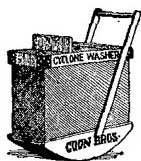
THE “CYCLONE” STILL WHIRLS
Sweeping Everything Clean Before It.
SEE WHAT THE PEOPLE SAY:
Knapp, Wis., March 4, 1896.
Messrs. Coon Bros., Battle Creek, Mich.
Gentlemen: Mrs. Petrie would not take one hundred dollars for her Cyclone Washer if she could not get another like it.
Yours truly, H. PETRIE.
Address, COON BROS., Battle Creek, Mich.
National Reform Party's Pittsburg Convention and Its Prospects
The Mail and Express, of April 22, prints this item of news in reference to the God-in-the-Constitution party:—
The National Reform party—whatever that may be—will nominate a Presidential ticket at Pittsburg next month, if it can corral sufficient delegates to make up the various committees without robbing the convention of its officers. The outlook at present is most encouraging, as the party’s New York State Convention, in Syracuse, was called to order yesterday with eight gentlemen present.
The Mail and Express seemed to be well acquainted with “National Reform” in the days of Elliott F. Shepard. The significance of this party’s activity is not to be estimated by the number present at their conventions, but by the wide-spread prevalence of doctrines of which “National Reform” is but the logical outgrowth; namely, such doctrines as that the State has a right to legislate on sabbath observance and other matters pertaining to public morality.
It is not quite clear how the National Reformers are going to conduct a political campaign while holding to their belief that it is wrong to vote or take any part in politics under this “godless” government.
Adventists Pardoned After Arkansas Sabbath Imprisonment
APRIL 20, Chester A. Gordon, and Rebecca Gordon, his wife, the Seventh-day Adventists sent to jail recently in Arkansas by an ignorant and bigoted justice of the peace, were “pardoned” by Governor Clarke.
The imprisonment of these people was without even color of law, as the statutes of Arkansas provide that “persons who are members of any religious society who observe as Sabbath any other day of the week than the Christian sabbath, or Sunday, shall not be subject to the penalties of this act, so that they observe one day in seven, agreeable to the faith and practice of their church or society.”
Though all the parties to this affair are colored, Governor Clarke was visibly affected when he heard the story of the injustice done to the Gordons, and he acted very promptly in the matter.
The most painful feature in this case is that the brutal contractors compelled both Gordon and his wife to work on the Sabbath. This is another illustration of how Sunday “laws” do not(?) interfere with the rights of conscience.
When asked why he ignored the statute in the case and ordered the Adventists to jail, the justice, who has only a trace of negro blood in his veins, said that “Gordon and his wife claimed to be seven day something,” but he never heard of it before, and he thought there were churches enough now for people to belong to and they were good enough for anybody. He further stated that he received his support from the church people, and they had complained to him, and he was obliged to have Gordon and his wife arrested.
A Forced Religious Observance Is an Abhorrent Sacrifice
A FORCED religious observance is a sacrifice which God abhors.
Civil Law Cannot Punish Sin Itself
ANY power which undertakes to deal by law with an act on the basis of its immorality, assumes the wisdom to measure and the power to adequately punish sin; and thus doing, it assumes to stand in the place of God. Earthly powers can by their laws deal with acts only on the basis of their character as violative or not violative of human rights.
Popular Sovereignty and the National Reform Party
WHATEVER is accomplished by the people is done through popular sovereignty; and yet we are gravely told by the “National Reform” party that the people ought to put God in the Constitution and elect pious men to political office on the ground that popular sovereignty does not afford the right kind of government!
Illustration Depicting Cruelty Done in Religion's Name
OUR illustration in this number is deserving of more than passing notice: it speaks volumes. The manacled men, the heartbroken women, and the wondering children, all tell far more eloquently than mere words could possibly do, of “man's inhumanity to man” that “makes countless thousands mourn.” And it is all the more sadly inexplicable when done in the name of the religion of the Lord Jesus Christ.
J. W. Lewis Imprisoned at Tiptonville for Dissent
J. W. LEWIS, the Seventh-day Adventist imprisoned at Tiptonville, Lake County, Tenn., for consistently dissenting from the religion of his neighbors, is no longer locked in the cage like a dangerous character, but is given the freedom of the jail and is permitted to occupy a room which, as he puts it, “seems like a palace,” in contrast to the iron cage. Right-minded people everywhere will rejoice that this persecuted man is finding favor with his keepers; but however easy his imprisonment may be made, the fact remains that he is deprived of his God-given liberty.
Sectarian Appropriations of Public Money Should Be Stopped
SECTARIAN appropriations of public money should be stopped not because some one sect is getting more than its share, thereby making the other sects jealous; but because it is not just to tax people to support that in which they do not believe, and in which they are prevented by conscience from having any representation.
Christianity Is Not a Part of Common Law
The doctrine that Christianity is in this country a part of the common law, is certainly very flattering to the common law, but not so flattering to Christianity. Great indeed must be the common law if Christianity is only a part of it. Christianity—the manifestation of supreme love to God and to our fellowmen—covers the whole individual life. It includes not only justice in dealing, but mercy as well; while the civil law can at most only aim at justice. Christianity is infinitely broader and higher than human law, and is administered by an infinitely higher power and authority. The doctrine that Christianity is a “part of the common law,” is one of the devil’s schemes to degrade Christianity.