A group of ladies once in great old Rome,
Showed each to each her wealth of jewels rare;
And one there was within whose humble home
No jewels were, but wealth of love was there.
So when they asked where her bright treasures were,
She pointed to her children at her side,
And gently said, “These are my treasures fair,”
And smiled upon them with a mother’s pride.
Home is the door whence our first blessings flow;
And they, who, like that good Roman dame of old,
Prize home’s wealth first, they best can feel and know
How to reach kindly hands into the cold
Of this great world, and call the wanderer back,
And bear God’s message far across the seas,
Where Arabs cower in the simoon’s track,
Or billows harden in the Arctic breeze.
True love begins at home. The children dear
Whom God has sent to cheer my earthly way,
Clasp tendril hands about my nature here,
And link me fast to others far away.
What easy lessons God gives first to learn!
Love father, mother, sister, brother, friend,
And wife and children; then may we discern
To love our neighbors to the great earth’s end.
True love begins at home, and reaching thence,
Twines sympathetic arms round all our race;
And fills our intervals of time and sense
With airs from heaven, its native dwelling place.
Love’s royal banner floats above our heads;
Beneath its folds majestic do we rest.
Home’s window-star its radiance outward sheds,—
Come in, lone heart, be thou a welcome guest.
Swing back, ye cloudy curtains, from the skies,
And let me see the architecture fine
Of those transparent palaces that rise
Where crystal streets in wondrous brilliance shine.
But little like them can I hope to build,
But yet in meek resemblance I would raise
A home with their transmitted luster filled,
Whose walls shall echo to Immanuel’s praise.
For home shall be a type of that above,
Like Israel’s desert temple long ago,
Built of the same grand masonry of love,
As that bright dwelling-place to which we go.
IMPRESSIONS OF A TEMPERANCE CITY.
THE following is part of what Dorcas Spencer says of Portland, Maine, after a recent visit to that city, as given in the W. C. T. U. Pacific Ensign:—
The mayor of Portland gave many interesting and suggestive figures. Portland has a population of 50,000, and is assessed for $50,000,000—without a millionaire in it. As I was driven about in a carriage all over and about the city, I could readily believe it had no paupers. I asked my host, “Where do the poor people live?” His reply was, “Well, I suppose there are some poor people, but I really could not tell where to find them.” There was certainly no squalor, and if there was dirt or filth at all, it was hidden as completely as the liquor traffic.
Portland is strikingly clean. Think of it—not a saloon in it; the twin vice of tobacco is rather shame-faced. Men smoke, without doubt, in that city; but the streets are not polluted with the smell of it, and it is refreshing to see so many men free from the habit.
And that is what temperance laws, faithfully enforced, would do for any city, the canteen and saloon defenders to the contrary notwithstanding.
“MAN OVERBOARD.”
By Editor
We certainly would not hesitate to rescue a man who had fallen overboard in the middle of the ocean, but there are a hundred thousand prisoners in this country who have either fallen overboard or else like Jonah they have been thrown overboard, and the same God that was interested in Jonah when he was cast into the sea is interested in these men. Are you seeking to help them or to save them? God looks down from heaven to “hear the groaning of the prisoner.” Ps. 102:20. We can be used as instruments in God’s hands to save these despairing, helpless men and women who have been cast overboard and for whom society has no pitying glance.
If we had been born of the same parents and brought up in the same environment as some of these prisoners, perhaps some of us would be behind prison bars to-day. If they had been given the same opportunities that we have had, perhaps they would have improved much better than we have.
In April we shall send a cheering Gospel message of hope in the form of a copy of the Life Boat, to be placed in the hands of practically every prisoner in the United States. Prison officials without exception are interested in this effort, and will assist us all they can. Will you interest your friends in this plan? The prisoner must have the Gospel as well as other sinners. He has more time to think than many who are on the outside of the prisons, as is shown by the following extracts from a few of hundreds of letters we have received since we issued our last Prison number of the Life Boat.
“If a man will study the paper called the SIGNS OF THE TIMES he will soon find that the eye of his spiritual understanding is opened to the very things which a short time before seemed impossible. I want to ask you about Dan. 8:14, ‘unto twenty-three hundred days and then shall the sanctuary be cleansed.’ What does that mean? I also want to know if the use of tea and coffee and meat is unhealthy—if so, why? I ask this because the less meat I eat the better I feel.”
“I am always ready to receive your welcome letters. They bring good cheer to me for they are the only thing I long for. Sometimes I dream that I am at home and happy with my father and mother and little children and my nephews and nieces. I love the little ones so much that I would give all the world for one day of freedom. If a man does not get his heart touched here in prison he will never get it touched any place.”
The following letter has just been received from the chaplain of the New Jersey State prison, and is a good sample of many others:—
“Five hundred copies of your very profitable Life Boat can be used here. Out on the sea of life, wrecked by bad habits, drifting toward the lee shore of everlasting destruction, a paper like yours will help to save many a one who would otherwise perish. Any number you can send will be very acceptable and will help me in my work as chaplain.”
This number of the Life Boat will be furnished at two cents each. Address, The Life Boat, 28 Thirty-third Place, Chicago.
Take a Tourist Car
—A Santa Fe tourist car—if you would enjoy your trip across the continent.
The cars are so comfortable, the route so interesting, the people so pleasant, the excursion manager so accommodating, the porters so obliging, and the meals so good, that you simply can't help being satisfied.
Personally conducted east and west three times a week—Mondays, Thursdays and Saturdays—by Chicago, Kansas City, Los Angeles and San Francisco.
Folder giving full information furnished on request by any Santa Fe Agent.
PERSEVERANCE IN PRAYER.
By Sarah E. Billyard
NEVER cease to pray for the salvation of those you love; never lose faith; the promises of the Lord are sure. He does not say, as we sometimes do, “I will do so and so, if I have time,” or “I will try to do this or that;” but He says plainly that the “fervent prayer of a righteous man availeth much.” “Ask and ye shall receive.” There is nothing uncertain about this. It may be years before you receive an answer; but keep on praying. The friend in the parable of the three loaves did not rise at once and lend the bread; but because of the petitioner’s importunity he arose and supplied his wants. So it is with prayer. We may not receive an answer at once, but keep on praying and believing. The Lord will do the rest. SARAH E. BILLYARD.
SENATOR HOAR'S TASTES.
By Francis E. Leupp
NO OTHER senator of Mr. Hoar's standing lives so simply as he. In Washington he does not keep house. Hence, of course, he does no entertaining, and takes small part in the social life of the capital. Indeed, his tastes lead him very little in the direction of companionship with his fellows. His leisure usually finds him in the diminutive study, for which he contrives to find space in his quiet lodgings, where he will read a good book far into the night, while other men generally are sleeping or making merry. His favorite subject is history, and he reads it not as so many do, for the sake of amassing a knowledge of unrelated facts, but in the spirit and with the zest of a philosopher tracing through the stories of the written page the motives of the men who have shaped events in all ages, the influence of these events on national character, and the logic of the effects which have flowed from divers causes. The records of the past he thus utilizes for purposes of prophecy and the guidance of his own generation. He is a firm believer in the theory that history moves in cycles, not by accident, but because the same conditions in all ages lead up to the same or corresponding consummations.
This will explain, for instance, his attitude on the question of imperialism from the moment its outcroppings were first discernible in the sequel of our war with Spain. It cost him sincere grief to part company with his party on this issue. It grieved him yet more, however, that the conduct of his party had been such as to force the separation upon him. To stand comparatively, or even quite alone, was not strange to him—it was, in a sense, an inheritance with his blood. A descendant of men who took in hand their little all and bade farewell to their country and its precious associations to come as pilgrims to a strange and forbidding shore, for the sake of maintaining their right to worship God in their own fashion; who hewed and ploughed and fought their way to independence against powerful odds; who, tho bred in the cold and calculating atmosphere of the north, stood shoulder to shoulder with their blood kindred of the South in one war, but shot them down in another, both for a principle of human liberty; how could he have faltered at the thought of isolation as a penalty for following his conscience? It was his party that went astray when it proposed the most startling and dangerous innovation ever conceived in republican statecraft—not he, who stood on the same ground with the authors of the constitution. —Francis E. Leupp, in the Pilgrim for March.
NOTICE TO GENERAL CONFERENCE DELEGATES AND VISITORS.
1. The next S. D. A. General Conference will be held in Oakland, Cal., March 27 to April 13, 1903.
2. The members of Oakland, San Francisco, Alameda, and Berkeley churches will put forth strenuous effort to entertain all the delegates, furnishing lodging and breakfast free, the delegates furnishing their own dinner, and supper if desired.
3. Rooms outside will be secured for visitors at from one to five dollars a week according to location, furnishings, etc.
4. A first-class, vegetarian restaurant will be opened for the accommodation of all, run on the European plan, where good meals may be obtained for from 15 to 25 cents.
5. In order to secure accommodations, it will be necessary for both delegates and visitors to send their names at once to the secretary of Committee on Arrangements, C. H. Jones, Pacific Press, Oakland, Cal. State just what accommodations are desired, single rooms, single beds or double, or beds in a large room with several others, on the dormitory plan. This latter will be cheaper.
6. It is suggested that all those who can—delegates and visitors—bring blankets.
7. Come clothed warmly, as there will be a chilliness experienced in the humid climate of the coast by those from the interior; and the nights are always cool.
Railway Rates and Directions.
1. Special colonist rate will be in effect from February 15 to April 15, namely $33.00 from Chicago to Oakland or San Francisco; $25.00 from Missouri River points. Tickets may be purchased over any line. Stop-over privileges good in California only. Tickets are good in tourist sleepers, chair-cars, and day coaches, but not in standard Pullman sleeper.
2. Double-berth in tourist sleeper costs from Chicago to Oakland $6.00; from Missouri points $5.00. Twenty or more coming together can secure control of a tourist car. There is no extra charge for seat in chair-car wherever run.
3. Regular clergy rate from Chicago to San Francisco is $36.25; Missouri River points $30.00. This is regular coming or going, and it is what all workers will have to pay returning by any route. Clergy tickets are good in either standard or tourist sleeper. Double-berth in standard sleeper Chicago to Oakland is $14.00.
4. Check baggage to and get off at Sixteenth Street Station, Oakland. Those coming over the Southern Pacific Coast Line, or the Santa Fé will land in San Francisco. Take the Broad Gauge Line ferry-boats to Oakland, taking the Berkeley local train on Oakland side of the Bay at the Mole, and get off at Sixteenth Street Station (about five minutes' ride).
5. Arriving at Sixteenth Street Station, either by this route or via Ogden and the S. P., take Twelfth Street electric car, get off at Twelfth and Brush streets right at church door.
6. Hold all baggage checks, and deliver them to the persons authorized to receive them at the church. When you are registered and located, baggage will be delivered at your room.
7. For information concerning making up of parties, address H. E. Osborne, Battle Creek, Mich. For further information concerning accommodations here, address C. H. Jones, Oakland, Cal.
For Rent
For Rent.—Near the St. Helena Sanitarium, two suites of furnished rooms, suitable for small families without children. Address, Mrs. W. C. White, Sanitarium, Cal.
Assistant for Honey Production
By W. A. H. Gilstrap
Wanted,—Sabbath-keeper for assistant in honey production and commercial-queen rearing till October. Please write soon, giving age, experience, wages desired, etc. W. A. H. Gilstrap, Modesto, Cal.
HEALTH FOODS.
We desire to correspond with young persons who have a desire to engage in the sale of health foods. Must be those who take a deep interest in and for the work. Address, Portland Sanitarium Food Co., Portland, Oregon.
WANTED
Fifteen young men and women to assist in Vegetarian Café that will be conducted for the convenience of the delegates and visitors of the General Conference.
There will be an opportunity for a number to work a short time each day for their board. Others can work more for board and wages. Write at once to E. G. Fulton, 755 Market St., San Francisco, Calif.
COLONIST RATES TO CALIFORNIA
VIA SOUTHERN PACIFIC
Every Day February 15 to June 15
NEW YORK
$50.00
PITTSBURGH
42.00
BUFFALO
42.50
CINCINNATI
39.00
LOUISVILLE
38.00
CHICAGO
33.00
PEORIA
31.00
ST. LOUIS
30.00
MEMPHIS
30.00
NEW ORLEANS
30.00
SIOUX CITY
25.00
OMAHA
25.00
KANSAS CITY
25.00
MINEOLA
25.00
HOUSTON
25.00
The cost of a ticket can be deposited at once with any Southern Pacific Agent in California, and the ticket will be furnished to the passenger in the East, while these low rates are in effect.
Illustrated California Literature Mailed Free to Any Address
E. O. McCORMICK T. H. GOODMAN
PASSENGER TRAFFIC MGR. GEN. PASSENGER AGENT
SAN FRANCISCO, CAL.
G. T. FORSYTH, DIV. FREIGHT AND PASSENGER AGENT
468 TENTH ST., OAKLAND, CAL.
A NATIVE MISSIONARY AMONG CANNIBALS.
The time had arrived to commence a mission on the great island of New Guinea. The London Missionary Society had begun its work at Takiti in the far east and worked westward; island after island and group after group had been evangelized. The Loyalty Group being at the western extremity of the mission, New Caledonia being closed to us by the French, and the Presbyterians and Episcopalians being at work in the New Hebrides, it was clearly the duty of the young churches of the Loyalty Group to regard New Guinea as their foreign mission field, for it was a kind of unwritten law in the South Sea mission that when an island had received the Gospel it was to hand it on to the next. The question had been discussed at the annual meeting of the missionaries of the Loyalty Islands mission, and the directors in London had sanctioned our proposal and appointed me to carry it out. So I called a great meeting of the churches of Lifu, laid the scheme before them, and asked for volunteers from the native pastors and students in our seminary, with the result that all volunteered, they requesting me to select from their number those I considered most suitable. I felt, of course, that the best men were needed for pioneer work in such a place as New Guinea, and this is how it came about that Gucheng was the first native evangelist appointed to the New Guinea mission. The sacrifices which Gucheng and his wife made in leaving their comfortable home and pretty village and devoted people for the risks and privations of pioneer work among the cannibals of New Guinea will bear comparison with those made by European missionaries. Their homes are as dear to them as ours are to us, yet they cheerfully give up all for the sake of Christ and His kingdom, and place themselves unreservedly at the disposal of the missionaries.
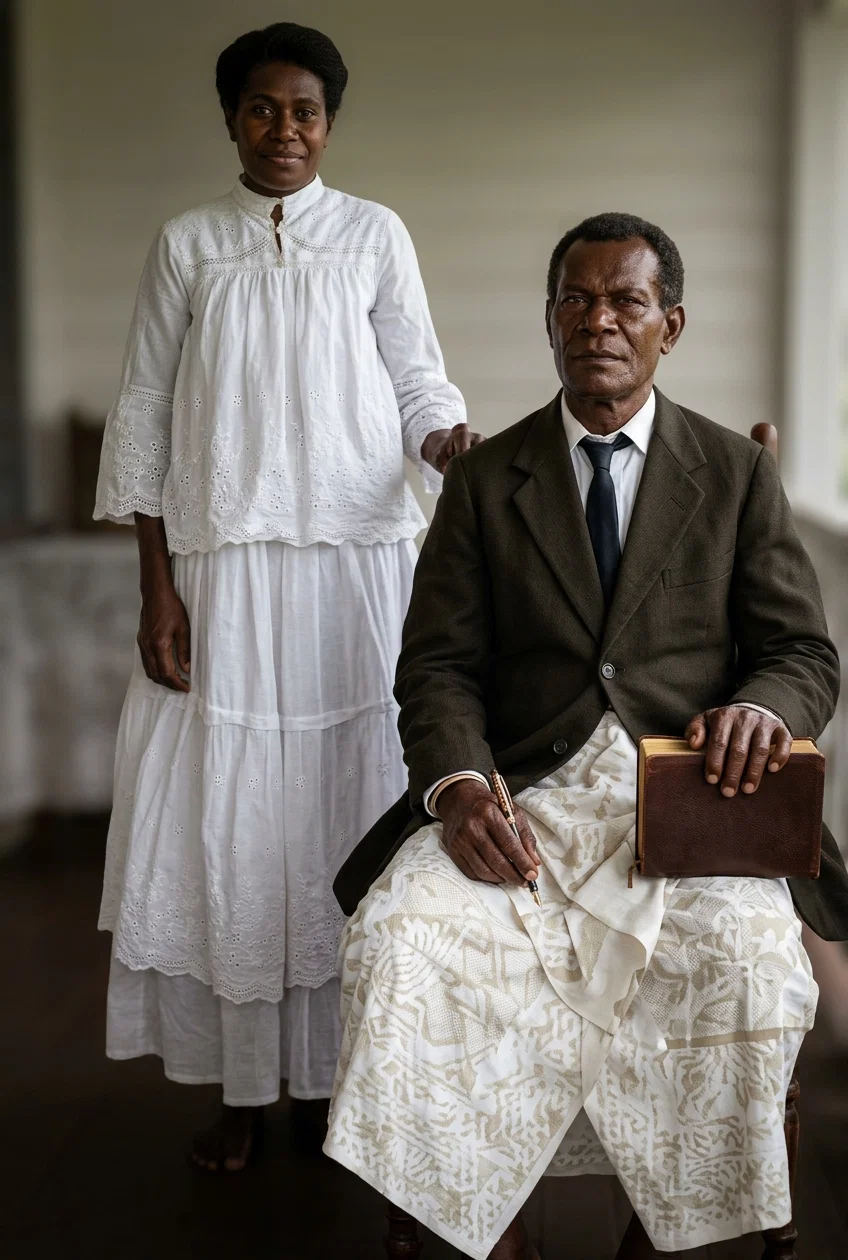
Native Island Evangelist and Wife, Rescued by the Gospel, now Rescuing Others Through Its Ministry.
The Cannibal at Home—Dragging the Victim to the Oven.
In beginning a great mission in a sickly climate, among a savage and cannibal people, it seemed imperative to form a central station at a place tolerably healthful and safe.
As Gucheng was the first native teacher selected for work in our New Guinea mission, so he was the first located; he and Mataika (another Lifu native) were appointed to begin the work on Darnley Island; consequently, they were specially interested as we drew near our first landing-place since we left Lifu for New Guinea. The “sailing instructions” informed us that the anchorage was in “Treachery Bay,” a name given to the place on account of a boat’s crew having been massacred there, and that the natives were very wild and treacherous, and warned all visitors to be on their guard; so that when we dropped anchor in the bay without seeing a native our suspicions were aroused. There was no one to introduce us to this people, and none of us knew anything of their language; but acts of kindness are a language that people can understand all the world over, and that was the only language we were able to use in our first touch with these cannibal tribes in different points of our mission. The first man upon whom we tried this language was the leading warrior of the place, who is now the senior deacon of the church there. Soon after we cast anchor on that memorable Saturday evening he made his appearance on a hill, evidently to reconnoitre. We beckoned to him, and then jumped into our boat and met him on the beach. That meeting, like many others of our first meetings with the cannibals in New Guinea, was very different from the pictures in books and magazines of the missionary’s first landing among savages. I have often been amused at the pictures of Moffat and Williams compared with my own experience. Instead of standing on the beach in a suit of broadcloth with Bible in hand, the pioneer missionary in New Guinea might be seen on the beach in very little and very light clothing, with an umbrella in one hand and a small bag in the other, containing not Bibles and tracts, but beads, jew’s-harps, small looking-glasses, and matches; not pointing to heaven, giving the impression that he is a rain-maker, but sitting on a stone with his shoes and stockings off, surrounded by an admiring crowd, who are examining his white feet, and rolling up his wet trousers (he having waded on shore from the boat), to see if he has a white leg, and then motioning for him to bare his breast, that they may see if that is also white. The opening and shutting of an umbrella, the striking of a match, the ticking and movement of a watch—these things cause great surprise and delight and loud exclamations.
What we did when we met this savage on the beach at Darnley was to induce him to enter our boat and accompany us to the vessel, which after a few friendly demonstrations we succeeded in doing, though he was evidently very much afraid. We talked to him on board in a manner most effectual. Not knowing the way to his heart through his ear, we took the familiar road through his stomach by giving him a good dinner, then made him a few small presents and sent him away rejoicing, giving him to understand by signs that he was to return next morning when the sun was up and bring his friends with him.
It would have been interesting to know what was said around the fires in the coconut grove that night. Our presents would be handed round for inspection and gazed upon with longing eyes. They would naturally feel that there were plenty more where they came from, and the question would be, how to get them. On these occasions some propose stealing, others suggest murder and plunder; the wise men, however, advise barter and begging. They have probably had intercourse with some foreign vessel, or have heard of natives who have, where the murder and plunder theory has been tried with results far from encouraging.
Long before sunrise we heard unmistakable evidence of a crowd having assembled on the beach, all anxious to get on board, hoping, no doubt, to be treated like our friend the night before. After our morning bath on deck, during which there were loud exclamations at our white skins, we sent in the boats to bring them off to the vessel. On such occasions in our first contact with savages, we take the precaution to fasten a rope across the after part of the vessel, beyond which we do not allow the natives to go. Two or three of the crew are stationed in the bows of the vessel, the mate and one of his men stand behind the rope in the after part, keeping a sharp lookout on the crowd. All movable articles which might tempt the natives are put below and the hatches fastened. The way to and from the cabin is in the reserved part of the vessel, which the natives are not allowed to approach till we are acquainted with them. Neglect or contempt of these precautions has often led to very serious and fatal consequences. As a rule, pioneers should not allow natives who are savages and cannibals to get behind them. The temptation to a savage who is walking behind, with a club or tomahawk on his shoulder, is often very great; he knows of no tribunal in heaven or on earth to punish him, and is often led to kill, not from revenge, but from sheer ambition, knowing that if he is successful he will gain both approval and popularity from his countrymen.
Imagine, then, this crowd of savages on board our vessel, naked, and ornamented with paint, feathers, and shells, all talking at once, examining everything, peering into every place, pressing against the rope which they are trying to remove or surmount in order to get to the cabin, standing in the rigging to get a better view, some of them falling or being pushed overboard, amid the laughter of their friends. What were we to do with such a congregation on that memorable Sunday morning? How I longed to be able to speak to them! All we could hope to accomplish was to make a favorable impression upon their minds, showing by our conduct that we were different from others who visited them. To this end I conducted our morning service in the Lifu language. The crew joined our eight teachers and13their wives, who all appeared in Sunday attire. Seven nationalities were represented, from the educated European to the debased savage. Every shade of color might be seen, both in skin and dress, from white to black. It was a strange and most interesting sight. Never before or since have I preached to such an audience. We sang, to the astonishment and delight of the natives, “Jesus shall reign,” etc., and the hills sent back the response, in solemn and glorious echo, “Jesus shall reign.” We prayed together that God would direct, protect, and bless His servants in the great work they were beginning, for never did men feel more than we did then their absolute dependence upon divine help. The savages looked on in silence and wonder. After the service we mingled with them freely, and took some of the leading men into the cabin; then made them a few presents, and sent them away feeling (as I afterward found) that whoever we were we differed from those who had hitherto visited them. In the afternoon we visited the village, where we were kindly received, return presents being made by the people. Thus our intercourse began, and in three or four days we had gained their confidence and established the mission, placing Gucheng in charge.
I must not omit to record a very touching incident that occurred in connection with the settlement of Gucheng on Darnley. It happened on the morning of the fifth day that I was standing near the door of the grass hut that we had purchased from the natives as a lodging for our teachers till they built a suitable house for themselves. Our friends inside did not know that I was near. Their boxes and bundles had been landed, and all was ready for us to start for the point on the New Guinea coast where we intended, if possible, to form our next station. As I approached I heard one of the women crying most piteously; it was Gucheng’s wife. I stood for a few minutes outside, unwilling to intrude, for such grief seemed to render the place sacred. “O, my country! my country! Why did we leave our happy home? Would that we were back at Lifu again! These people will kill us when the mission vessel leaves, or they will steal all we possess.” Then I heard her husband, in tremulous tones, saying, “We must remember what we have come here for—not to get pearl shell, or trepang, or any earthly riches, but to tell these people about the true God, and the loving Saviour, Jesus Christ. We must think of what He suffered for us. If they kill us, or steal our goods, whatever we may suffer, it will be very little compared with what He suffered for us.” I could stand it no longer, but walked away till I recovered myself; then I entered the hut, and talked and prayed with them, and I am not ashamed to add that we wept together. Our party soon joined us, and when we walked down to the boat I need scarcely say that we were all sad and sorrowful; and as we pulled off to the ship, and beheld the weeping little group on the beach, surrounded by naked, noisy savages, one could not help feeling how little the world knows of its forest heroes.
On our return to Darnley we were delighted with the change that had already taken place. Gucheng and his party had evidently been hard at work; with the help of the natives they had built a neat cottage, a great improvement upon the surrounding huts. It contained a living and a bedroom; in the middle of the former stood a table and a bench, the legs being not on, but in the floor, and on the table were yams, bananas, and young coconuts, while outside were a crowd of laughing natives, who all seemed anxious to show how pleased they were to have Gucheng and his wife live among them. We spent the Sunday there, and had a most interesting service in the coconut grove—the best of all places for public worship in such climates.—Missionary Review.
FOR JESUS’ SAKE.
MEN may misjudge thy aim,
May not praise thy name,
Think they have cause for blame,—
Say thou art wrong;
Hold on thy quiet way,
Heed not what men may say;
Christ is the judge, not they;
Fear not, be strong.
Be brave and dare to stand
Alone, with heart and hand,
Under thy Lord’s command,
Against the wrong.
From scenes of agony,
From cross and Calvary,
Christ whispers still to thee,
“Fear not, be strong.”
—Selected.
CHINESE WORSHIP.
In different parts of China altars are erected, or hewn out of some great rock, which are dedicated to the worship of heaven and earth. In the southern part of the city of Peking such an altar stands facing the Temple of Agriculture. It is the duty of the emperor to perform public worship yearly at this altar, tho he sometimes does it by proxy through some high official. The worship of heaven and earth is universal throughout China, and the officials all over the empire are obliged to conduct this worship. How much better the Gospel of Christ, behind which stand all the sure promises of God, than this false and compulsory worship, out of which nothing good has come or can come!
OUR WORK AND WORKERS.
A CANVASSERS’ SCHOOL for the northeastern part of Iowa will be held at Cedar Rapids, beginning on the 16th inst., and continuing till the 30th.
THE new church building at Spokane, Wash., is almost completed. It is fitted with church-school rooms, and is said to be a creditable structure.
THE NEW YORK INDICATOR says: “Cheering news comes concerning a good work being done at Minetto in holding a Sunday-school. About fifty are in attendance, and a good interest is manifested in the lessons. The Little Friend is used. Some are attending the regular prayer-meeting, and desire further to study the Bible.”
A SABBATH-SCHOOL of fifteen members was organized at Turkville, Kansas, February 17, by Brother T. Godfrey. Four persons had fully accepted the truth, and others were interested.
THE prosecution of two of our brethren for laboring on Sunday has aroused an interest in the subject of religious liberty at Statesville, N. C. The papers have opened their columns to the truth, and three lawyers have come out against the Sunday law.
At Fredericton, N. B., where Brother W. R. Andrews has been laboring, a church of eleven members has been organized, and a new house of worship is being erected. The church will be dedicated about the first of June, and the first annual meeting of the Canada Union Conference will be held in it.
THE following brethren and sisters arrived in San Francisco from Australia on the 5th inst.: G. A. Irwin and wife, A. T. Robinson and wife, E. H. Gates, and Miss Edith M. Graham. Brother Irwin is president of the Australasian Union Conference. Brother Gates is chairman of the missionary committee of that conference, and Sister Graham is the secretary and treasurer. They came to attend the General Conference. Brother Robinson preached in the Oakland church on the Sabbath following his arrival.
In the Central Advance we find this good report from Brother G. W. Berry: “A glorious victory has been achieved by the power of the Lord at this place. Brethren Cook and Beames have lately been doing colporter work in this part of the Big Horn Basin. They found an interest here, and held a ten days’ meeting in September. The meetings were resumed January 2. At this writing, January 20, twenty-four souls have given themselves to the Lord. Nearly all are starting for the first time to serve the Master.”
Of the medical missionary work at Kimberley, South Africa, Brother J. V. Wilson writes to the Review: “The great De Beers Diamond Mining Co., employing thousands of men, have voted to instruct their doctors to send their patients to our baths for treatment. Already this is greatly increasing our work. The government physician who prescribes for the post-office employees is sending the clerks here, and the Cape Police are coming also. This means a great deal for the work here. We are glad to have a part in this closing message, and wish to continue in it to the end.”
Some Life Boat workers recently visited the State prison at Lincoln, Neb., and distributed 300 papers. While talking with the prisoners one of the men said: “If I had ever had a kind word spoken to me before, I would not have been in this place.” The other man said, “Yes, that is the way with me. When I get out of here I am going to do all I can to help you people. The Life Boat work is a good work. We get copies every little while. I have a farm yet and some property. They are saving it until I get out, and then I am going to help you people all I can, and try to keep other fellows from getting in here.”
Brother J. E. Fulton says, in the Australasian Union Record, that “letters from Fiji give good reports of the work in that part. The work has now been started in several parts of the group. A number have accepted the truth through reading the Rarama, our little native paper. Years ago we were told by Europeans that if our work ever took hold there, white missionaries would be compelled to remain, by the work; that if we removed, the natives would apostatize. This may be so with some, but we are glad to state there are some good, stable souls among the natives; and more, there are some who have not seen us at all, and who have, through reading alone, commenced to obey the truth. Last report says that two of our native boys have been out preaching, and both have seen a number accept the truth under their labors. . . . The Avondale Press is now printing an edition of ‘Great Controversy’ in Fijian. Who will assist in paying the expenses of this work? Some have already helped us. We are thankful for this, but we need more help. This is a book that ought to be in the hands of the people. Catholicism is making great progress in Fiji. There is no literature for the people to give them an intelligent idea of the papal power. In the ‘Great Controversy’ the history of the past and the message of the present time are so linked together that we have therein the most valuable information that can be presented. No one will doubt this who knows the message for this time. A young native Fijian is now attending Avondale School, fitting himself to return as a missionary to his people.”